


Ezra 10:16
Bible text: King James Version (1769 Blayney text) · Public domain
Bible text: King James Version with Strong's numbers · Public domain
Bible text: Berean Standard Bible · Public domain
Bible text: American Standard Version (1901) · Public domain
Bible text: World English Bible, Messianic edition · Public domain
Bible text: Geneva Bible (1599) · Public domain
Bible text: Young's Literal Translation · Public domain
- וַיַּעֲשׂוּvai·ya·'a·suand they didH6213Conj-w ¦ V-Qal-ConsecImperf-3mpVerb Qal Consecutive Imperfect 3rd Plural Masculineוַandיַּעֲשׂוּthey did
- כֵןkhenthusH3651AdvAdverb
- בְּנֵיbe·Nei[the] children ofH1121N-mpcNoun Plural Masculine Construct
- הַגּוֹלָהha·go·Lahthe exileH1473Art ¦ N-fsNoun Singular Feminine Absoluteהַtheגּוֹלָהexile
- וַיִּבָּדְלוּvai·yi·ba·de·Luand they separated themselvesH914Conj-w ¦ V-Niphal-ConsecImperf-3mpVerb Niphal Consecutive Imperfect 3rd Plural Masculineוַandיִּבָּדְלוּthey separated themselves
- עֶזְרָא'ez·Ra'EzraH5830N-proper-mNoun Proper Masculine
- הַכֹּהֵןha·ko·Henthe priestH3548Art ¦ N-msNoun Singular Masculine Absoluteהַtheכֹּהֵןpriest
- אֲנָשִׁים'a·na·ShimmenH582N-mpNoun Plural Masculine Absolute
- רָאשֵׁיra·Shei[the] leaders ofH7218N-mpcNoun Plural Masculine Construct
- הָאָבוֹתha·'a·Votthe fathersH1Art ¦ N-fpNoun Plural Feminine Absoluteהָtheאָבוֹתfathers
- לְבֵיתle·Veitfor [the] house ofH1004Prep-l ¦ N-mscNoun Singular Masculine Constructלְforבֵית[the] house of
- אֲבֹתָם'a·vo·Tamtheir ancestorsH1N-fpc ¦ 3mpNoun Plural Feminine Constructאֲבֹתָancestorsםtheir
- וְכֻלָּםve·khu·Lamand all of themH3605Conj-w ¦ N-msc ¦ 3mpNoun Singular Masculine Constructוְandכֻלָּall ofםthem
- בְּשֵׁמוֹתbe·she·Motby namesH8034Prep-b ¦ N-fpNoun Plural Feminine Absoluteבְּbyשֵׁמוֹתnames
- וַיֵּשְׁבוּvai·ye·she·Vuand they sat downH3427Conj-w ¦ V-Qal-ConsecImperf-3mpVerb Qal Consecutive Imperfect 3rd Plural Masculineוַandיֵּשְׁבוּthey sat down
- בְּיוֹםbe·Yomon dayH3117Prep-b ¦ N-msNoun Singular Masculine Absoluteבְּonיוֹםday
- אֶחָד'e·ChadoneH259Adj-fsAdjective Numerical Singular Feminine Absolute
- לַחֹדֶשׁla·Cho·deshof the monthH2320Prep-l ¦ N-msNoun Singular Masculine Absoluteלַof theחֹדֶשׁmonth
- הָעֲשִׂירִיha·'a·si·Ri<the> tenthH6224Art ¦ Adj-msAdjective Numerical Position Singular Masculine Absoluteהָ<the>עֲשִׂירִיtenth
- לְדַרְיוֹשׁle·dar·Yo·oshto investigateH1875Prep-l ¦ V-Qal-InfVerb Qal Infinitive Constructלְtoדַרְיוֹשׁinvestigate
- הַדָּבָרha·da·Varthe matterH1697Art ¦ N-msNoun Singular Masculine Absoluteהַtheדָּבָרmatter
English is a literal word-by-word gloss of the Hebrew, not the KJV's wording. Why?
This is the original text the KJV's translators worked from — each Hebrew word with its own literal English meaning in this verse, prepared by scholars at Tyndale House, Cambridge. The KJV translates whole sentences, not word by word, so its wording differs: one Hebrew word can become several English words, and the KJV may choose “the LORD” where the gloss reads “Yahweh”. Both are faithful — they answer different questions. For the KJV's own rendering, switch to the KJV text.
Details
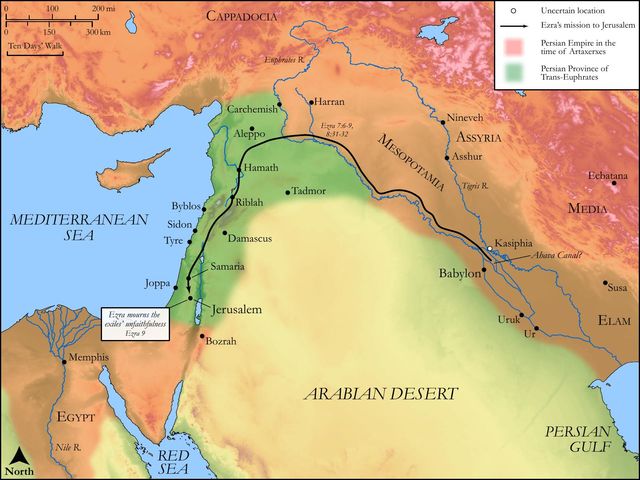
See on the biblical-era map
Study this verse
Public-domain commentary
Matthew Henry
From his Commentary on the Whole Bible. Henry comments on passages, not single verses — this entry covers Ezra 10:15–44.
The method of proceeding in this matter being concluded on, and the congregation dismissed, that each in his respective place might gain and give intelligence to facilitate the matter, we are here told, 1. Who were the persons that undertook to manage the matter and bring the causes regularly before the commissioners - Jonathan and Jahaziah, two active men, whether of the priests or of the people does not appear; probably they were the men that made that proposal (Ezr 10:13, Ezr 10:14) and were therefore the fittest to see it pursued; two honest Levites were joined with them, and helped them, Ezr 10:15. Dr. Lightfoot gives a contrary sense of this: only (or nevertheless) Jonathan and Jahaziah stood against this matter (which reading the original will very well bear), and these two Levites helped them in opposing it, either the thing itself or this method of proceeding. It was strange if a work of this kind was carried on and met with no opposition. 2. Who were the commissioners that sat upon this matter. Ezra was president, and with him certain chief men of the fathers who were qualified with wisdom and zeal above others for this service, Ezr 10:16. It was happy for them that they had such a man as Ezra to head them; they could not have done it well without his direction, yet he would not do it without their concurrence. 3. How long they were about it. They began the first day of the tenth month to examine the matter (Ezr 10:16), which was but ten days after this method was proposed (Ezr 10:9), and they finished in three months, Ezr 10:17. They sat closely and minded their business, otherwise they could not have despatched so many causes as they had before them in so little time; for we may suppose that all who were impeached were fairly asked what cause they could show why they should not be parted, and, if we may judge by other cases, provided the wife were proselyted to the Jewish religion she was not to be put away, the trial of which would require great care. 4. Who the persons were that were found guilty of this crime. Their names are here recorded to their perpetual reproach; many of the priests, nay, of the family of Jeshua, the high priest, were found guilty (Ezr 10:18), though the law had particularly provided, for the preserving of their honour in their marriages, that being holy themselves they should not marry such as were profane, Lev 21:7. Those that should have taught others the law broke it themselves and by their example emboldened others to do likewise. But, having lost their innocency in this matter, they did well to recant and give an example of repentance; for they promised under their hand to put away their strange wives (some think that they made oath to do so with their hands lifted up), and they took the appointed way of obtaining pardon, bringing the ram which was appointed by the law for a trespass offering (Lev 6:6), so owning their guilt and the desert of it, and humbly suing for forgiveness. About 113 in all are here named who had married strange wives, and some of them, it is said (Ezr 10:44), had children by them, which implies that not many of them had, God not crowning those marriages with the blessing of increase. Whether the children were turned off with the mothers, as Shechaniah proposed, does not appear; it should seem not: however it is probable that the wives which were put away were well provided for, according to their rank. One would think this grievance was now thoroughly redressed, yet we meet with it again (Neh 13:23 and Mal 2:11), for such corruptions are easily and insensibly brought in, but not without great difficulty purged out again. The best reformers can but do their endeavour, but, when the Redeemer himself shall come to Sion, he shall effectually turn away ungodliness from Jacob.
Historical interpretation
Historical reception
1 surviving comment on this verse from the historical church.
And they sat on the first day of the tenth month, etc. Note that the number three is very commonly used in mystical figures. It was previously said that in three days all the sons of the diaspora should come to Jerusalem; and now in three months, namely the tenth, eleventh, and twelfth, they are punished by foreign wives. For there are three virtues without which we cannot attain life: faith, hope, and charity. Coming into the world at the third time of the age, the Lord bestowed upon us the grace of the Gospel. For the first time was before the law with the patriarchs, the second with the prophets under the law, in the third He Himself came with grace; because redeeming us by His passion, He rose from the dead on the third day; through whose grace, both by being joined in fellowship with the holy Church and by being cleansed from the allurements of vices, aptly the sons of the diaspora, having to be corrected from their errors in three days, convened in Jerusalem, and in three months completed their task of correction. But also literally, the leaders of the families and the Levites worked opportunely and salutarily so that before the beginning of the first month all those who were stained by profane marriage were completed; that is, they were cleansed from such a crime, so that they could enter the first month, in which the Passover was to be held, pure, and could celebrate the Paschal feast pure, and could begin and continue the year pure. This is also suitable for us to imitate every year in Lent in preparation for Easter, so that as the solemnities of the Lord's Resurrection approach, we cleanse ourselves from all defilement of flesh and spirit, so that we may also be able to be partakers of the Resurrection.
Continue studying Ezra 10:16 across the web’s major study libraries — every link below opens this exact verse, chapter, or book on the destination site.
Read & Compare
 BibleGatewayThis verse in more than 200 translations and 70 languages.
 Bible.comThe YouVersion reader — hundreds of translations, reading plans, and highlights.
 ESV.orgCrossway's official English Standard Version reader.
 NET BibleThe NET translation with 60,000+ translators' notes on every rendering decision.
 STEP BibleTyndale House's free study tool — original text, vocabulary, and scholarly resources.
 BibliaLogos Bible Software's free web reader.
 USCCBThe New American Bible (Revised Edition) with the U.S. bishops' study notes.
Commentaries
 BibleHub CommentariesDozens of classic commentaries on this verse, gathered on one page.
 StudyLightMore than 100 commentary sets — the largest collection on the web.
 BibleRefPlain-English commentary on what this verse means, verse by verse.
 Enduring WordDavid Guzik's free commentary on this chapter, widely used by Bible teachers.
 Bible Study ToolsVerse commentary alongside Greek and Hebrew study aids.
Original Language & Research
- BibleHub InterlinearThe verse word by word — original language, transliteration, and English.
- BibleHub LexiconEvery word's original-language definition and Strong's entry.
 Blue Letter BibleDeep-study tools — Strong's numbers, concordance, and word studies.
 SefariaThe Hebrew text with Rashi and centuries of Jewish commentary.
Sermons, Hymns & Audio


TrulyRandomVerse is not affiliated with these sites and doesn’t control their content. They’re linked because they’re genuinely useful.
Summary
Ezra 10:16 marks the organized and decisive commencement of the post-exilic community's commitment to address the widespread sin of intermarriage with foreign women. Following a period of profound corporate confession and a solemn vow to reform, this verse details the practical, systematic steps taken by Ezra the priest, alongside a specially appointed council of chief fathers, to meticulously investigate each case and implement the necessary separation, thereby restoring the community's covenant fidelity and spiritual purity before God.
Context
ShowHideLiterary Context
Ezra 10:16 serves as a critical narrative pivot, transitioning the story from the emotional and spiritual outpouring of repentance to the concrete, administrative actions required for reform. The preceding chapter, Ezra 9, depicts Ezra's deep anguish and intercessory prayer over the nation's sin of intermarriage, which had compromised their distinct identity as God's covenant people. This powerful confession then leads to a corporate awakening in Ezra 10:1-15, where the people, moved by Ezra's grief and the gravity of their transgression, make a solemn vow to put away their foreign wives and children, as explicitly stated in Ezra 10:12. Verse 16, therefore, describes the crucial establishment of the judicial body and the setting of a timeline for the painstaking investigation necessary to fulfill this difficult but essential vow, laying the groundwork for the detailed list of those who complied, which follows in Ezra 10:18-44.
Historical & Cultural Context
This pivotal event unfolds around 458 BC, during the post-exilic period when a remnant of the Jewish people had returned from Babylonian captivity to Judea. Their primary mission was to re-establish themselves as God's covenant people, rebuild the Temple, and restore the Mosaic Law as the foundational blueprint for their society. Intermarriage with the surrounding pagan peoples was a persistent and grave issue throughout Israel's history, explicitly forbidden by God's Law (e.g., Deuteronomy 7:3-4) because it invariably led to syncretism, idolatry, and the erosion of their distinct identity as a holy nation. The "chief of the fathers" (also known as heads of ancestral houses or family clans) held significant social and religious authority, representing the various tribal divisions. Their involvement indicated a broad, representative, and authoritative approach to this sensitive issue, ensuring community-wide legitimacy. The specific mention of the "first day of the tenth month" underscores the urgency and the systematic, calendared nature of the proceedings, likely reflecting a desire to complete the purification before the new year.
Key Themes
ShowHideEzra 10:16 powerfully contributes to several overarching themes within the book of Ezra and the broader biblical narrative. It highlights the paramount importance of covenant faithfulness and spiritual purity, demonstrating the community's earnest desire to align themselves with God's commands after the devastating experience of exile, which was largely a consequence of their disobedience. The meticulous process described underscores the theme of corporate repentance and the cost of obedience, showing that genuine turning from sin often requires difficult and painful actions. Furthermore, it exemplifies godly leadership and accountability, with Ezra, the priest and scribe, meticulously organizing and overseeing the reform alongside the established family heads. This ensured that the process was orderly, just, and comprehensive, reflecting a deep understanding of God's demand for holiness and the gravity of their transgression, echoing the call for a people set apart, as seen in passages like Leviticus 19:2.
Exposition and Analysis
ShowHideKey Word Analysis
ShowHideDerived from H914, this verb means "to divide," "to distinguish," or "to set apart." In this context, it signifies that specific individuals—Ezra and the chief of the fathers—were formally designated and set aside for a particular, weighty judicial task. It implies a deliberate, intentional selection and consecration for a sacred responsibility, emphasizing their unique qualification and authority for the task at hand.
Derived from H1875, this primitive root means "to tread or frequent," but usually "to follow (for pursuit or search)," and by implication, "to seek or ask." Specifically, it denotes "to inquire," "to make inquisition," or "to search out." When used in a judicial context, as here, it conveys a sense of meticulous, painstaking investigation, not a hasty or superficial judgment.
Derived from H1697, this word signifies "a word," and by implication, "a matter (as spoken of) or thing." In the phrase "examine the matter," it refers to the specific issue at hand: the cases of intermarriage. Combined with dârash, it emphasizes that each individual case would be carefully reviewed, evidence considered, and decisions made according to the Law, ensuring fairness and thoroughness in the purification process.
Verse Breakdown
ShowHide"And the children of the captivity did so."
This opening clause serves as a powerful affirmation of the community's corporate obedience and commitment to the covenant they made in Ezra 10:12. It signifies their readiness to implement the difficult decision to put away their foreign wives and children, demonstrating a collective will to rectify their sin and return to covenant fidelity.
"And Ezra the priest, [with] certain chief of the fathers, after the house of their fathers, and all of them by [their] names, were separated,"
This phrase meticulously details the composition and selection of the judicial body. Ezra, as the spiritual and legal authority, is at the helm, but he is joined by "chief of the fathers"—heads of prominent families or clans. The phrase "after the house of their fathers" indicates that these were representatives chosen according to their ancestral lineage, ensuring broad and legitimate representation across the community. The emphasis on "all of them by their names" underscores the formal, deliberate, and accountable nature of their selection, highlighting that this was a carefully constituted, legitimate body, not a spontaneous mob.
"and sat down in the first day of the tenth month to examine the matter."
This final clause specifies the precise timing and purpose of their assembly. "Sat down" implies a formal, deliberative, and authoritative session, typical of judicial proceedings. The "first day of the tenth month" provides a clear starting point for this extensive process, indicating an organized and time-bound undertaking. Their sole purpose was "to examine the matter," referring to the thorough investigation of each case of intermarriage, ensuring that the reform was implemented with diligence and according to the Law.
Literary Devices
ShowHideEzra 10:16 employs several literary devices to convey its message effectively. The verse demonstrates Narrative Progression, marking a crucial turning point from the emotional and confessional phase of repentance in Ezra 9 and Ezra 10:1-15 to the concrete, systematic implementation of reform. This shift highlights the biblical principle that true repentance moves beyond sorrow to decisive action. There is a strong use of Emphasis through Detail, as the specific mention of "chief of the fathers," "by their names," and the "first day of the tenth month" underscores the meticulous, organized, and serious nature of the undertaking. This attention to procedural detail reinforces the gravity of the sin and the thoroughness required for its rectification. Furthermore, the phrase "children of the captivity" serves as a Synecdoche, where a part (those returned from exile) represents the whole (the entire community of Israel in Judea), emphasizing their shared experience and collective responsibility in this covenant renewal. The methodical approach described also subtly employs Foreshadowing, hinting at the detailed and extensive list of those who had intermarried that will follow in the subsequent verses, thereby emphasizing the comprehensive scope of the purification process.
Theological and Thematic Connections
ShowHideEzra 10:16 is a profound testament to the biblical themes of covenant renewal, corporate holiness, and the uncompromising nature of God's commands regarding purity. The painstaking process described reflects a deep understanding that the community's spiritual health and their unique identity as God's chosen people were inextricably linked to their obedience to His Law, particularly concerning separation from pagan influences. This commitment to "examine the matter" underscores that true repentance is not merely an emotional experience but involves concrete, often painful, steps to align one's life and community with God's revealed will. It highlights that sin, especially that which compromises God's covenant, must be confronted directly and systematically for genuine restoration to occur. The actions taken by Ezra and the "chief of the fathers" serve as a powerful reminder that leadership within God's people carries the weighty responsibility of upholding divine standards and guiding the community toward righteousness, even when it demands difficult sacrifices.
Reflection and Application
ShowHideEzra 10:16 offers enduring lessons for believers and communities today, challenging us to consider the seriousness with which we approach sin and our commitment to God's holiness. The meticulous, organized, and painful process undertaken by Ezra and the "chief of the fathers" demonstrates that genuine repentance often demands more than just confession; it requires concrete, deliberate, and sometimes costly actions to rectify wrongdoing and restore integrity. For individuals, this means diligently "examining the matter" of our own lives, identifying areas where we may have compromised our covenant with God through unholy alliances, worldly entanglements, or unconfessed sin. For the church, it underscores the importance of accountable leadership in upholding biblical standards, fostering an environment where sin is addressed with both grace and truth, and guiding the community toward corporate purity. This verse calls us to embrace the sometimes-painful process of spiritual purification, recognizing that true flourishing in faith comes through radical obedience and a steadfast commitment to being set apart for God's purposes, ensuring our lives reflect the holiness of the One who has called us.
Questions for Reflection
ShowHideFAQ
ShowHideWhy was intermarriage considered such a grave sin in Ezra's time?
ShowHideIntermarriage was not condemned on racial grounds, but because it represented a direct violation of God's covenant commands, explicitly laid out in the Mosaic Law (e.g., Deuteronomy 7:3-4). The primary concern was the spiritual purity and distinct identity of Israel as God's chosen people. Marrying outside the covenant community invariably led to the adoption of pagan religious practices, idolatry, and a dilution of their exclusive allegiance to Yahweh. This had historically been a major cause of Israel's spiritual decline and God's judgment, ultimately leading to the Babylonian exile. The post-exilic community, having just returned from captivity, understood that a return to this sin would jeopardize their renewed relationship with God and their very existence as a holy nation.
What was the role of the "chief of the fathers" in this process?
ShowHideThe "chief of the fathers" (also translated as "heads of families" or "heads of ancestral houses") were prominent leaders within the community, representing the various family clans and tribal divisions. Their involvement was crucial for several reasons: it ensured that the reform process had broad legitimacy and support across all segments of the population; it provided a structured, representative body for the meticulous "examination of the matter," ensuring accountability and fairness in the judicial proceedings; and it demonstrated that the commitment to purity was not just Ezra's initiative but a corporate decision embraced and implemented by the established leadership of the entire community. Their presence underscored the gravity and comprehensive nature of the reform, reflecting the principle of shared responsibility in upholding God's covenant.
Christ-Centered Fulfillment
ShowHideThe rigorous process of purification in Ezra 10:16, where the community meticulously "examined the matter" of intermarriage to restore their covenant purity, powerfully foreshadows the ultimate and perfect purification accomplished through Jesus Christ. The Law's demands for separation from defilement, like the prohibition against intermarriage, highlighted humanity's inherent inability to achieve perfect holiness on its own and pointed to the need for a deeper, spiritual cleansing. In Christ, the ultimate "examination" of sin and its consequences was borne on the cross, where the Lamb of God, who takes away the sin of the world, bore the full weight of human transgression. Believers are now called to a spiritual separation, not primarily from physical mixed marriages, but from the spiritual idolatry and defilement of the world, as we are united with Christ and become part of His holy bride, the Church (Ephesians 5:25-27). The painful "putting away" of foreign wives in Ezra prefigures the spiritual circumcision of the heart that accompanies conversion (Colossians 2:11), where we put off the old self and its sinful desires. The thoroughness of Ezra's reform reminds us that genuine repentance in the New Covenant also involves a radical turning from sin and a commitment to live a life set apart for God, empowered by the Holy Spirit, as we are called to be holy as He is holy (1 Peter 1:15-16). Thus, the legal and physical separation in Ezra finds its spiritual and eternal fulfillment in the transformative work of Christ, who enables us to truly be a people consecrated to God, living in genuine purity and fellowship with Him.