


Ezra 10:17
Bible text: King James Version (1769 Blayney text) · Public domain
Bible text: Berean Standard Bible · Public domain
Bible text: American Standard Version (1901) · Public domain
Bible text: World English Bible, Messianic edition · Public domain
Bible text: Geneva Bible (1599) · Public domain
Bible text: Young's Literal Translation · Public domain
- וַיְכַלּוּvay·kha·Luand they finishedH3615Conj-w ¦ V-Piel-ConsecImperf-3mpVerb Piel Consecutive Imperfect 3rd Plural Masculineוַandיְכַלּוּthey finished
- בַכֹּלva·Kolwith <the> everythingH3605Prep-b ¦ N-msNoun Singular Masculine Absoluteבַwith <the>כֹּלeverything
- אֲנָשִׁים'a·na·Shim[the] menH582N-mpNoun Plural Masculine Absolute
- הַהֹשִׁיבוּha·ho·Shi·vuwho they had marriedH3427Art ¦ V-Hiphil-Perf-3cpVerb Hiphil Perfect 3rd Plural common genderהַwhoהֹשִׁיבוּthey had married
- נָשִׁיםna·ShimwomenH802N-mpNoun Plural Masculine Absolute
- נָכְרִיּוֹתna·khe·ri·YotforeignH5237Adj-fpAdjective Plural Feminine Absolute
- עַד'aduntilH5704PrepPreposition
- יוֹםYomdayH3117N-msNoun Singular Masculine Absolute
- אֶחָד'e·ChadoneH259Adj-fsAdjective Numerical Singular Feminine Absolute
- לַחֹדֶשׁla·Cho·deshof the monthH2320Prep-l ¦ N-msNoun Singular Masculine Absoluteלַof theחֹדֶשׁmonth
- הָרִאשׁוֹןha·ri·Shon<the> firstH7223Art ¦ Adj-msAdjective Numerical Position Singular Masculine Absoluteהָ<the>רִאשׁוֹןfirst
English is a literal word-by-word gloss of the Hebrew, not the KJV's wording. Why?
This is the original text the KJV's translators worked from — each Hebrew word with its own literal English meaning in this verse, prepared by scholars at Tyndale House, Cambridge. The KJV translates whole sentences, not word by word, so its wording differs: one Hebrew word can become several English words, and the KJV may choose “the LORD” where the gloss reads “Yahweh”. Both are faithful — they answer different questions. For the KJV's own rendering, switch to the KJV text.
Details
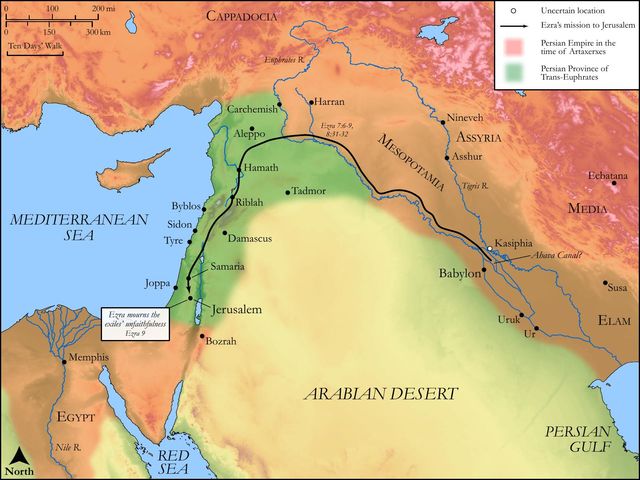
See on the biblical-era map
Study this verse
Public-domain commentary
Matthew Henry
From his Commentary on the Whole Bible. Henry comments on passages, not single verses — this entry covers Ezra 10:15–44.
The method of proceeding in this matter being concluded on, and the congregation dismissed, that each in his respective place might gain and give intelligence to facilitate the matter, we are here told, 1. Who were the persons that undertook to manage the matter and bring the causes regularly before the commissioners - Jonathan and Jahaziah, two active men, whether of the priests or of the people does not appear; probably they were the men that made that proposal (Ezr 10:13, Ezr 10:14) and were therefore the fittest to see it pursued; two honest Levites were joined with them, and helped them, Ezr 10:15. Dr. Lightfoot gives a contrary sense of this: only (or nevertheless) Jonathan and Jahaziah stood against this matter (which reading the original will very well bear), and these two Levites helped them in opposing it, either the thing itself or this method of proceeding. It was strange if a work of this kind was carried on and met with no opposition. 2. Who were the commissioners that sat upon this matter. Ezra was president, and with him certain chief men of the fathers who were qualified with wisdom and zeal above others for this service, Ezr 10:16. It was happy for them that they had such a man as Ezra to head them; they could not have done it well without his direction, yet he would not do it without their concurrence. 3. How long they were about it. They began the first day of the tenth month to examine the matter (Ezr 10:16), which was but ten days after this method was proposed (Ezr 10:9), and they finished in three months, Ezr 10:17. They sat closely and minded their business, otherwise they could not have despatched so many causes as they had before them in so little time; for we may suppose that all who were impeached were fairly asked what cause they could show why they should not be parted, and, if we may judge by other cases, provided the wife were proselyted to the Jewish religion she was not to be put away, the trial of which would require great care. 4. Who the persons were that were found guilty of this crime. Their names are here recorded to their perpetual reproach; many of the priests, nay, of the family of Jeshua, the high priest, were found guilty (Ezr 10:18), though the law had particularly provided, for the preserving of their honour in their marriages, that being holy themselves they should not marry such as were profane, Lev 21:7. Those that should have taught others the law broke it themselves and by their example emboldened others to do likewise. But, having lost their innocency in this matter, they did well to recant and give an example of repentance; for they promised under their hand to put away their strange wives (some think that they made oath to do so with their hands lifted up), and they took the appointed way of obtaining pardon, bringing the ram which was appointed by the law for a trespass offering (Lev 6:6), so owning their guilt and the desert of it, and humbly suing for forgiveness. About 113 in all are here named who had married strange wives, and some of them, it is said (Ezr 10:44), had children by them, which implies that not many of them had, God not crowning those marriages with the blessing of increase. Whether the children were turned off with the mothers, as Shechaniah proposed, does not appear; it should seem not: however it is probable that the wives which were put away were well provided for, according to their rank. One would think this grievance was now thoroughly redressed, yet we meet with it again (Neh 13:23 and Mal 2:11), for such corruptions are easily and insensibly brought in, but not without great difficulty purged out again. The best reformers can but do their endeavour, but, when the Redeemer himself shall come to Sion, he shall effectually turn away ungodliness from Jacob.
Continue studying Ezra 10:17 across the web’s major study libraries — every link below opens this exact verse, chapter, or book on the destination site.
Read & Compare
 BibleGatewayThis verse in more than 200 translations and 70 languages.
 Bible.comThe YouVersion reader — hundreds of translations, reading plans, and highlights.
 ESV.orgCrossway's official English Standard Version reader.
 NET BibleThe NET translation with 60,000+ translators' notes on every rendering decision.
 STEP BibleTyndale House's free study tool — original text, vocabulary, and scholarly resources.
 BibliaLogos Bible Software's free web reader.
 USCCBThe New American Bible (Revised Edition) with the U.S. bishops' study notes.
Commentaries
 BibleHub CommentariesDozens of classic commentaries on this verse, gathered on one page.
 StudyLightMore than 100 commentary sets — the largest collection on the web.
 BibleRefPlain-English commentary on what this verse means, verse by verse.
 Enduring WordDavid Guzik's free commentary on this chapter, widely used by Bible teachers.
 Bible Study ToolsVerse commentary alongside Greek and Hebrew study aids.
Original Language & Research
- BibleHub InterlinearThe verse word by word — original language, transliteration, and English.
- BibleHub LexiconEvery word's original-language definition and Strong's entry.
 Blue Letter BibleDeep-study tools — Strong's numbers, concordance, and word studies.
 SefariaThe Hebrew text with Rashi and centuries of Jewish commentary.
Sermons, Hymns & Audio


TrulyRandomVerse is not affiliated with these sites and doesn’t control their content. They’re linked because they’re genuinely useful.
Summary
Ezra 10:17 marks the definitive conclusion of the rigorous three-month investigation and resolution concerning the widespread issue of intermarriage among the returned exiles in Jerusalem. This verse signifies the successful completion of a painful but necessary national reformation, where the community, under Ezra's leadership, took drastic measures to purge itself of foreign wives and their children, thereby restoring its covenant fidelity and spiritual purity before God. The completion by the first day of the first month symbolically underscored a fresh start and renewed dedication to God's law for the new year.
Context
ShowHideLiterary Context
Ezra 10:17 provides the climactic resolution to the crisis of intermarriage detailed throughout Ezra 9 and Ezra 10. Following Ezra's profound prayer of confession and lament in Ezra 9:6-15, the people were moved to deep repentance, publicly committing to separate from their foreign wives and children (Ezra 10:1-5). A special commission was established to oversee this difficult process (Ezra 10:16), beginning its work on the first day of the tenth month. Thus, verse 17, stating the completion by the first day of the first month, highlights the thoroughness and determination with which this national cleansing was executed, bringing the narrative of this specific reform to a decisive close.
Historical & Cultural Context
The events of Ezra 10 occur during the post-exilic period, roughly 458 BC, as the Jewish community was attempting to re-establish itself in Jerusalem after decades of Babylonian captivity. The returnees, a remnant of Israel, were tasked with rebuilding not only the Temple and city but also their spiritual identity as God's covenant people. Intermarriage with the surrounding pagan nations was a recurring problem throughout Israel's history, explicitly forbidden by God in the Mosaic Law (e.g., Deuteronomy 7:1-4). This prohibition was not merely ethnic but theological, aimed at preventing idolatry and assimilation, which had historically led Israel astray from their covenant obligations. The community's vulnerability and the pervasive influence of foreign cultures made this a particularly pressing issue, threatening to undermine the very purpose of their return and the purity of their worship.
Key Themes
ShowHideThe central themes illuminated by Ezra 10:17 include radical obedience to God's commands, even when costly and painful, and the paramount importance of spiritual purity for the covenant community. The act of putting away foreign wives underscored Israel's distinct identity and their separation as a holy nation, preventing syncretism and idolatry, as warned in Exodus 34:15-16. This verse also powerfully demonstrates corporate repentance and reformation, showing a community's willingness to address pervasive sin and restore their relationship with God, echoing the initial commitment made in Ezra 10:3. Finally, the precise dating to the "first day of the first month" emphasizes covenant fidelity and the symbolic significance of a new beginning, a spiritual cleansing preceding the annual Passover celebration, marking a renewed dedication to God's law.
Exposition and Analysis
ShowHideKey Word Analysis
ShowHideMeaning "to end, whether intransitive (to cease, be finished, perish) or transitived (to complete, prepare, consume)". This term emphasizes the thoroughness and finality of the commission's work. It signifies that the arduous process of investigating and resolving the cases of intermarriage was brought to a definitive, comprehensive close, leaving no aspect unaddressed. The use of kâlâh here underscores the complete and decisive nature of the reformation.
Meaning "strange, in a variety of degrees and applications (foreign, non-relative, adulterous, different, wonderful)". In this context, "strange" refers specifically to women who were foreign, non-Israelite, and often associated with pagan practices. The term highlights their alien status not merely ethnically but, more critically, in terms of their religious and cultural incompatibility with Israel's covenant identity. Marrying such "strange" women posed a direct threat to the spiritual purity and distinctness of God's people.
Meaning "a day (as the warm hours), whether literal... or figurative (a space of time defined by an associated term)". While literally referring to a 24-hour period, the mention of "the first day" within the context of the "first month" carries significant symbolic weight. It marks a precise temporal milestone, signifying a new beginning and a cleansed slate for the community as they entered the new religious year, having completed the painful but necessary spiritual purification.
Verse Breakdown
ShowHide"And they made an end"
This phrase refers to the special commission established in Ezra 10:16, along with the elders and judges, who were tasked with investigating and resolving the cases of intermarriage. The active voice indicates their diligent and successful completion of the arduous task, implying a final and decisive action that brought the entire process to a definitive close.
"with all the men that had taken strange wives"
This emphasizes the comprehensive scope of the reform. "All" suggests that every case of intermarriage that came to light was addressed, indicating a thorough and unsparing application of the agreed-upon judgment. The focus is on the men, as they were the covenant heads of their households and responsible for leading their families in obedience to God's law, making their compliance critical for the community's spiritual integrity.
"by the first day of the first month"
This temporal marker provides a clear deadline and indicates the efficiency and commitment with which the commission operated. Starting on the first day of the tenth month (Ezra 10:16), the process took approximately three months. The completion by the start of the new religious year (Nisan) signifies a spiritual cleansing and readiness for the upcoming annual feasts, particularly Passover (Exodus 12:1-2), which commemorated Israel's deliverance and covenant renewal, marking a fresh start for the nation.
Literary Devices
ShowHideThe verse employs several literary devices to convey its powerful message. Narrative Progression is evident as this verse provides the definitive climax to the long and arduous process of addressing intermarriage, bringing a sense of resolution and finality to the narrative thread that began in Ezra 9. The precise dating to "the first day of the first month" functions as potent Symbolism, marking not just a chronological end but a spiritual new beginning, a cleansed slate for the community as they entered the new religious year and prepared for Passover. The phrase "all the men" suggests a degree of Hyperbole or emphasis on the thoroughness of the reform, underscoring the radical and comprehensive nature of their obedience. The stark, factual reporting of the completion also lends an air of Verisimilitude, grounding the difficult spiritual actions in a concrete historical timeline.
Theological and Thematic Connections
ShowHideEzra 10:17 is a stark reminder of the seriousness with which God views the purity of His covenant people and the radical measures sometimes required to restore spiritual health. The issue of intermarriage was not merely a social or ethnic concern but a direct threat to Israel's unique identity as a holy nation set apart for God's purposes. It underscores the principle that compromise with the world's values and practices inevitably leads to spiritual defilement and a breach of covenant. The community's willingness to undertake such a painful separation demonstrates a profound commitment to repentance and a recognition that true blessing comes through uncompromising obedience to God's revealed will. This event serves as a powerful Old Testament precedent for the New Testament call to holiness and separation from worldly entanglements for the sake of spiritual integrity.
Reflection and Application
ShowHideEzra 10:17, while describing a specific historical event with unique covenant implications for ancient Israel, offers profound principles for believers today. It challenges us to examine the areas in our lives where we might be compromising our spiritual purity or fidelity to God's Word. Just as the Israelites had to make a radical "end" to relationships that jeopardized their covenant standing, we are called to identify and sever ties with anything—be it relationships, habits, or pursuits—that draws us away from Christ and His holiness. True repentance often requires costly, decisive action, prioritizing God's will above personal comfort, social acceptance, or even deep emotional attachments. This verse reminds us that spiritual renewal, both individually and corporately, demands thoroughness and an unwavering commitment to live set apart for God's glory, ensuring that our lives reflect His standards rather than conforming to the patterns of the world.
Questions for Reflection
ShowHideFAQ
ShowHideWhy was intermarriage such a serious sin for the Israelites?
ShowHideThe prohibition against intermarriage was not primarily ethnic but theological. God had chosen Israel to be a holy nation, set apart to bear His name and witness to the world. Marrying "strange wives" (non-Israelite women from pagan nations) was forbidden because it inevitably led to the worship of foreign gods and the adoption of idolatrous practices, thereby corrupting Israel's spiritual purity and breaking their covenant with Yahweh. Deuteronomy 7:3-4 makes this clear, stating that such marriages would turn their children away from God to serve other gods. The concern was the preservation of monotheistic worship and the distinct identity of God's people.
Does Ezra 10:17 mean Christians should divorce their non-Christian spouses today?
ShowHideNo. The context of Ezra 10:17 is specific to ancient Israel's unique covenant and national identity, where intermarriage posed an existential threat to their spiritual survival as God's chosen people. The New Testament offers different guidance for believers in unequally yoked marriages. While 2 Corinthians 6:14 warns believers against entering into marriage with unbelievers, it does not command divorce for those already married to non-believers. Instead, 1 Corinthians 7:12-16 instructs the believing spouse to remain with their unbelieving partner, if the partner is willing, with the hope that the believing spouse might sanctify the unbelieving one and their children. The underlying principle for Christians is spiritual purity and avoiding compromise, but the application differs under the New Covenant.
Christ-Centered Fulfillment
ShowHideThe radical and painful purification described in Ezra 10:17, though necessary for Old Covenant Israel, ultimately points to the far greater and more complete spiritual cleansing accomplished by Jesus Christ. While Ezra's reform dealt with outward, physical separation to restore covenant purity, Christ's work provides an inward, spiritual transformation. He is the true Lamb of God who takes away the sin of the world, whose atoning sacrifice on the cross purifies us from all unrighteousness (1 John 1:7). Through His blood, He cleanses His church, making her holy and blameless, "without stain or wrinkle or any other blemish, but holy and blameless" (Ephesians 5:25-27). The Old Testament call for separation from pagan influences foreshadows the New Testament call for believers to be set apart from the world's sin and idolatry, not by physical divorce from unbelieving spouses, but by a radical commitment to Christ's Lordship and a transformed heart (Romans 12:1-2). He provides the power for true repentance and the means for genuine, lasting purity, making us a "holy priesthood" (1 Peter 2:9) fully reconciled to God.