


Ezekiel 42:10
Bible text: King James Version (1769 Blayney text) · Public domain
Bible text: Berean Standard Bible · Public domain
Bible text: American Standard Version (1901) · Public domain
Bible text: World English Bible, Messianic edition · Public domain
Bible text: Geneva Bible (1599) · Public domain
Bible text: Young's Literal Translation · Public domain
- בְּרֹחַבbe·Ro·chavin [the] breadth ofH7341Prep-b ¦ N-mscNoun Singular Masculine Constructבְּinרֹחַב[the] breadth of
- גֶּדֶרGe·der[the] wall ofH1444N-mscNoun Singular Masculine Construct
- הֶחָצֵרhe·cha·Tzerthe courtyardH2691Art ¦ N-csNoun Singular common gender Absoluteהֶtheחָצֵרcourtyard
- דֶּרֶךְDe·rekh[the] direction ofH1870N-cscNoun Singular common gender Construct
- הַקָּדִיםha·ka·Dimthe eastH6921Art ¦ N-msNoun Singular Masculine Absoluteהַtheקָּדִיםeast
- אֶל'el[were] toH413PrepPreposition
- פְּנֵיpe·Nei[the] face ofH6440N-mpcNoun Plural Masculine Construct
- הַגִּזְרָהha·giz·Rahthe separate placeH1508Art ¦ N-fsNoun Singular Feminine Absoluteהַtheגִּזְרָהseparate place
- וְאֶלve·'eland toH413Conj-w ¦ PrepPrepositionוְandאֶלto
- פְּנֵיpe·Nei[the] face ofH6440N-mpcNoun Plural Masculine Construct
- הַבִּנְיָןha·bin·Yanthe structureH1146Art ¦ N-msNoun Singular Masculine Absoluteהַtheבִּנְיָןstructure
- לְשָׁכוֹתle·sha·KhotroomsH3957N-fpNoun Plural Feminine Absolute
English is a literal word-by-word gloss of the Hebrew, not the KJV's wording. Why?
This is the original text the KJV's translators worked from — each Hebrew word with its own literal English meaning in this verse, prepared by scholars at Tyndale House, Cambridge. The KJV translates whole sentences, not word by word, so its wording differs: one Hebrew word can become several English words, and the KJV may choose “the LORD” where the gloss reads “Yahweh”. Both are faithful — they answer different questions. For the KJV's own rendering, switch to the KJV text.
Details
See on the biblical-era map
Study this verse
Public-domain commentary
Matthew Henry
From his Commentary on the Whole Bible. Henry comments on passages, not single verses — this entry covers Ezekiel 42:1–14. His two-level outline is real structure in the source text, so it is rendered as structure.
The prophet has taken a very exact view of the temple and the buildings belonging to it, and is now brought again into the outer court, to observe the chambers that were in that square.
I.Here is a description of these chambers, which (as that which went before) seems to us very perplexed and intricate, through our unacquaintedness with the Hebrew language and the rules of architecture at that time. We shall only observe, in general,
1.That about the temple, which was the place of public worship, there were private chambers, to teach us that our attendance upon God in solemn ordinances will not excuse us from the duties of the closet. We must not only worship in the courts of God's house, but must, both before and after our attendance there, enter into our chambers, enter into our closets, and read and meditate, and pray to our Father in secret; and a great deal of comfort the people of God have found in their communion with God in solitude.
2.That these chambers were many; there were three stories of them, and, though the higher stories were not so large as the lower, yet they served as well for retirement, Eze 42:5, Eze 42:6. There were many, that there might be conveniences for all such devout people as Anna the prophetess, who departed not from the temple night or day, Luk 2:37. In my Father's house are many mansions. In his house on earth there are so; multitudes by faith have taken lodgings in his sanctuary, and yet there is room.
3.That these chambers, though they were private, yet were near the temple, within view of it, within reach of it, to teach us to prefer public worship before private (the Lord loves the gates of Zion more than all the dwellings of Jacob, and so must we), and to refer our private worship to the public. Our religious performances in our chambers must be to prepare us for the exercises of devotion in public, and to further us in our improvement of them, as our opportunities are.
4.That before these chambers there were walks of five yards broad (Eze 42:4), in which those that had lodgings in these chambers might meet for conversation, might walk and talk together for their mutual edification, might communicate their knowledge and experiences. For we are not to spend all our time between the church and the chamber, though a great deal of time may be spent to very good purpose in both. But man is made for society, and Christians for the communion of saints; and the duties of that communion we must make conscience of, and the privileges and pleasures of that communion we must take the comfort of. It is promised to Joshua, who was high priest in the second temple, that God will give him places to walk in among those that stand by, Zac 3:7.
II.Here is the use of these chambers appointed, Eze 42:13, Eze 42:14.
1.They were for the priests that approach unto the Lord, that they may be always near their business and may not be non-residents. Therefore they are called holy chambers, because they were for use of those that ministered in holy things during their ministration. Those that have public work to do for God and the souls of men have need to be much in private, to fit themselves for it. Ministers should spend much time in their chambers, in reading, meditation, and prayer, that their profiting may appear; and they ought to be provided with conveniences for this purpose.
2.There the priests were to deposit the most holy things, those parts of the offerings which fell to their share; and there they were to eat them, they and their families, in a religious manner, for the place is holy; and thus they must make a difference between those feasts upon the sacrifice and other meals.
3.There (among other uses) they were to lay their vestments, which God had appointed them to wear when they ministered at the altar, their linen ephods, coats, girdles, and bonnets. We read of the providing of priests garments after their return out of captivity, Neh 7:70, Neh 7:72. When they had ended their service at the altar they must lay by those garments, to signify that the use of them should continue only during that dispensation; but they must put on other garments, such as other people wear, when they approached to those things which were for the people, that is, to do that part of their service which related to the people, to teach them the law and to answer their enquiries. Their holy garments must be laid up, that they may be kept clean and decent for the credit of their service.
Historical interpretation
Historical reception
1 surviving comment on this verse from the historical church.
Chapter XLII, verses 1 and following: 'And he brought me to the outer court by the way leading to the north, and he brought me to the treasury which was opposite the separated building and opposite the temple facing the north. On the face of the length of one hundred cubits of the north gate, and the breadth of fifty cubits, opposite the twenty cubits of the inner court, and opposite the pavement laid with stone of the outer court, where the porch was joined to the triple porch.' And before the treasury, there was a walkway ten cubits wide, looking inward, with the doors facing north, where the treasuries were lower on the upper levels because the porticoes that protruded from the lower and middle parts of the building supported them. These porticoes were narrow and did not have columns like the columns of the courtyards, so they protruded from the lower and middle parts of the building by fifty cubits. And there was an outer courtyard by the treasury, which was in the way of the outer court before the treasury: the length of it was fifty cubits. Because the length of the treasuries of the outer court was fifty cubits and the length before the face of the temple was one hundred cubits. And there was an entrance under these treasuries from the east for those who entered from the outer court: in the width of the courtyard of the eastern way before the separate building. And there were before the building treasuries, and a road in front of their face like the treasuries, which were on the northern side, according to their length, and thus their width. And every entrance of them, and their similarities, and their doors, according to the doors of the treasuries, which were on the road facing the South (Known), a door at the head of the road, which was in front of the separate vestibule through the Eastern road for those entering. LXX: And he brought me into the outer court towards the east, opposite the north gate; and he led me to the inner court, and behold, there were five chambers on the north side of the building, and a separate building adjoining the north side, one hundred cubits long and fifty cubits wide, with the same measurements as the gates of the inner court, and like the pillars of the outer court, according to the arrangement of the gateways of the three-sided portico, and opposite the chambers was a walkway ten cubits wide, one hundred cubits long, along the inner way of one cubit, with its entrance facing north. And the walkways of the upper rooms were similar, as the columns of the upper rooms stood out from the lower columns, and the space was similar. And there were triple porticoes, and they did not have columns like the columns on the outer side; therefore, they stood out from those that were lower, and in the middle of the ground fifty cubits, and the outer light was like the outer courtyard porticoes, which faced the porticoes of the north, with a length of fifty cubits. The length of the porticos facing the outer courtyard was fifty cubits. And these are opposite their own facade, all one hundred cubits, and the entrance of these porticos is towards the Eastern entrance, so one may enter through them into the outer courtyard, according to the light that was at the beginning of the walkway to the South, opposite the Southern side of the building, and separate. And the porticos and walkway are opposite their own facade, according to the measurements of the porticos and the way to the North, and their length, and their width, and all their exits, and entrances, and lights, and the entrance to the porticos towards the South, and the entrance from the beginning of the walkway to the light, the space of the reed pen: and so one may go towards the East through them. That which is translated into the East in the LXX is not found in the Hebrew, and it is clear that it is superfluous. For how is it brought out to the outer gate toward the East, when it follows against the gate of the North? That which we have also put above, and in this place: He brought me into the treasury, which will be opposite the separate building, and opposite the temple facing the North, for which it is held in the LXX: And he brought me: and behold, there are five chambers from the remaining building and next to the separate building toward the North: for separate, which Aquila and Symmachus translated, the second edition of Aquila, and Theodotion placed this word itself, Gazera (), expressing it similarly in all places: and many other things which are placed in the present passage between the Hebrew and the LXX not only differ in order, but also in number, and in the interpretation of words, so that if we wished to linger on each one, and seek and explain their reason for the diversity, we would depart greatly from the proposed subject. And I had wanted to pass over in silence my present testimony of final despair and greatness, but I thought it better to say anything than to say nothing at all, adopting that Socratic principle: I know that I do not know. For it is a part of knowledge to know that you do not know. Therefore, after the prophet had carefully observed the things that were inside, the man, whose rope and reed were in his hand, led him out to the outer courtyard, along the path leading to the North, which he had already seen from above before he entered the inner chambers. But we see things differently when it comes to perfect knowledge, compared to the beginning of discipline. And it is necessary for one who has looked into the inner workings, according to the same form and measures and hidden sacraments, to also see the external things. However, he was led into the treasury, or as the Septuagint translated it, the hall, or as Theodotion, the παστοφόριον, which is turned into a chamber: which was located opposite the separate building. But what the Seventy added for the treasury, five exedras, is not found in Hebrew. The treasury was a separate building, as we have already said. Gazera. And it was separate, receiving those who came from the North, and it was against the temple facing the North, that is, looking towards the parts of the North, but not located in the North, so that there would be an easier passage for those who were leaving the cold of the North, from which evils arise upon the earth (Jer. 1). We read in the book of Numbers that the tribes of Dan and Naphtali, and the sons of Bilhah and Zilpah, the maidservants of Rachel and Leah, held their camps in the northern regions. Moreover, the width of the entrance to the north was one hundred cubits, and the length was fifty cubits: a square number and perfect from ten decades, and from seven weeks, which is the number of remission, and at the beginning of unity, that is, the octave, it bursts forth, so that the spaces of the priestly duties in the temple of God may be shown. And that which is joined next to the Hebrew, opposite the twenty cubits of the inner court, which the Seventy have translated, was described like the gates of the inner court, has this meaning: that the number of a hundred and fifty in the outer court should have the same force as the number of twenty in the inner court. For if you reckon four times five times, in the number twenty, you will find both Testaments: so that both the Law may be held in the Gospel and the Gospel may be born from the root of the Law. For the number seventy, the likeness of the inner court, may have been interpreted, perhaps fearing the number twenty, in which offerings of Esau are made, to place in the inner court. It follows: And against the pavement, the floor of the outer court, where there was a porch, joined to the triple porch; for which seventy were transferred: And as the columns of the outer court were placed in order, opposite the face of the triple porches. However, it signifies that the pavement of the outer court was laid with living stone, so that the feet of the priests are not defiled by the dust of summer or the mud of winter. And so, the Lord, about to ascend to the Father, washes the feet of the Apostles (John 13), so that with purified and cleansed feet they may ascend to the kingdoms of heaven; and he commands the apostles that in whichever city they enter and are not received, they should shake off the dust from their feet (Matthew 10; and Mark 6): so that nothing of earthly possessions may remain with them. And not only was the pavement covered with stones, but there was also a portico joined to a triple portico. A portico protecting priests from rain and heat, and joined to the triple portico, showing the mystery of the Trinity, which, while being divided in names among the Father and the Son and the Holy Spirit, is yet joined in one divinity to itself. There was also before the treasury, or the halls, or the chambers, a walkway of ten cubits in width, looking towards the interior of the road of one cubit. And what was added by the Seventy: It is extra to have a length of one hundred cubits: for in the Hebrew it is not held, what they set forth, they took what is held in Hebrew, looking towards the interior of the road of one cubit, which we translated from the truth of Hebrew. But it signifies that before the doors of all the treasuries, or exedrae, and chambers, there was a walkway, having a width of ten cubits, which is a perfect number, either because of the Decalogue or because of the mystery of the Gospel. For if you come from one to four by twos and threes, the number ten is made, the number of the Gospels: in the width of which the priests walk, going before each treasury. But in such a way that they always look towards the interior of the path which leads to one cubit, that is, to the worship of one divinity, as the Son says to the Father: I have revealed thy name to men (John 17:6). For she is the way, looking inward, which is said in the Gospel: I am the way, and the truth, and the life (John XIV, 6): because no one comes to the knowledge of the Father, except through the Son. It follows: And their doors to the north, where the treasuries were in the lower and middle parts: because the porticoes which stood out from the lower and middle parts of the building supported them. For they were narrow, and did not have columns like the columns of the courts: therefore they stood out from the lower and middle parts by fifty cubits from the ground. What is joined: the doors of these, it is understood, (belong to) the exedrae or treasury rooms, about which there was discussion above. The treasuries were on the upper floors, that is, in the lower rooms. The upper rooms were ascended by Elijah and Elisha (1 Kings 17; 2 Kings 4); and the Lord, with the disciples, celebrated the Passover (Mark 14), and Tabitha, who was raised by the Apostle's faith and the merit of her virtues (Acts 9). These are the upper rooms, about which it is written in the psalm: He waters the mountains from his upper rooms (Psalm 104, 13). For unless a mountain is made, and rises to higher things, it will not be irrigated by the rains of the Lord, which for the diversity of merits are irrigated in the first, second, and third coenaculum. Even the storerooms themselves, that is, the treasuries of the Lord's treasures, are lower in the higher places. (Ephesians 3). However, the higher one is, the more one is humbled with the Apostle, saying: I am not worthy to be called an Apostle, because I persecuted the Church of God. (1 Corinthians 1:9). However, the treasure rooms themselves were located in the lower rooms, because they supported the porticoes that projected from the lower and middle parts of the building. And the reason why the treasure rooms were placed in the lower rooms and were lower was this: because the porticoes, which enjoyed the freedom of the air, supported and projected from the lower and middle parts of the building. In this way, the second floor of the building would be higher than the first floor, and the third floor would be higher than the second, so that as one ascended to higher levels, they would use a higher treasure room, which increased in humility, as the Lord says: 'If anyone wishes to be first, he shall be the last of all and the servant of all.' (Mark 9:35). For they were not carried by other columns, as we read in the columns of the atrium; but they protruded from the lower and middle parts of the ground by fifty cubits, as a sign of the remission of all debts. These, however, are the sad things of which it is commanded: Describe them in triple form, with counsel and knowledge, so that you may answer with words of truth those things that are proposed to you (Prov. 22:20-21). Therefore, the lower and outer parts need columns, but the higher and inner parts do not need the support of columns, that is, of external help. After this it is said: And the outer court was surrounded by a wall, with treasuries along the outside walls. The length of this outer court was fifty cubits, because the length of the treasuries of the outer court was fifty cubits, and the length before the front of the temple was one hundred cubits. The surrounding wall, called the peribolus, enclosed the treasuries along the outside walls of the outer court, and it was fifty cubits in length, as we have frequently mentioned. Moreover, the length in front of the face of the temple was not fifty cubits, as it was before the treasury, but one hundred cubits: so that after the remission of all sins, we may await perfect rewards in the number one hundred (Lev. XII). Regarding the barrier, or wall, which in Hebrew is called Gader (), the Seventy have interpreted it as light, which comes from outside and illuminates the eyes of our hearts: our natural light, which operates in the senses, is not sufficient to have the perfect brightness of knowledge, unless it enters from outside through the grace of God. What first illuminates the eyes of our heart, and the outer atrium, which extends to a width of fifty cubits, makes it shine. Then, when we come before the face of the temple, we shall receive perfect rewards in the number of one hundred. And below, there was an entrance to the treasury from the East for those entering from the outer atrium. For it is necessary for us to possess the riches of God, and to find the entrance below the treasury from the outer atrium, under the treasury of the East, and to come through the width of the vestibule, which faces the way of the East, to the building that is separated for the holy ones, before which are the treasuries, and in that very way, a likeness to the treasuries that were in the way of the North. For although we may reach the entrance to the East, the resemblance of the ancestors is found in the smaller things, and we cannot reach the light of the East except by way of the North, that is, by progressing from the smaller and lower things to the greater and higher things. In the very entrance itself, the length was similar to the width, that is, the same measurement throughout: every entrance and likeness, and doors had the same measurement and likeness as the treasure chambers that were on the road facing the South. For indeed, by the East the cold of the North is resisted, we reach the South, in which the bridegroom reclines at midday, and moves in full light. At the head, however, of the same road, that is, the Eastern one, which is open to those who enter, there is a door, which unless it is opened by Him who says: I am the door (John 10:9) and who has the key of David, to the vestibule separated by holy virtues, and which receives those coming from the North, we cannot reach. It is unnecessary to discuss each individual word of this passage in detail: both what has been said does not lack clarity, and what we keep silent about is almost similar to what we have said.
Continue studying Ezekiel 42:10 across the web’s major study libraries — every link below opens this exact verse, chapter, or book on the destination site.
Read & Compare
 BibleGatewayThis verse in more than 200 translations and 70 languages.
 Bible.comThe YouVersion reader — hundreds of translations, reading plans, and highlights.
 ESV.orgCrossway's official English Standard Version reader.
 NET BibleThe NET translation with 60,000+ translators' notes on every rendering decision.
 STEP BibleTyndale House's free study tool — original text, vocabulary, and scholarly resources.
 BibliaLogos Bible Software's free web reader.
 USCCBThe New American Bible (Revised Edition) with the U.S. bishops' study notes.
Commentaries
 BibleHub CommentariesDozens of classic commentaries on this verse, gathered on one page.
 StudyLightMore than 100 commentary sets — the largest collection on the web.
 BibleRefPlain-English commentary on what this verse means, verse by verse.
 Enduring WordDavid Guzik's free commentary on this chapter, widely used by Bible teachers.
 Bible Study ToolsVerse commentary alongside Greek and Hebrew study aids.
Original Language & Research
- BibleHub InterlinearThe verse word by word — original language, transliteration, and English.
- BibleHub LexiconEvery word's original-language definition and Strong's entry.
 Blue Letter BibleDeep-study tools — Strong's numbers, concordance, and word studies.
 SefariaThe Hebrew text with Rashi and centuries of Jewish commentary.
Sermons, Hymns & Audio


TrulyRandomVerse is not affiliated with these sites and doesn’t control their content. They’re linked because they’re genuinely useful.
Summary
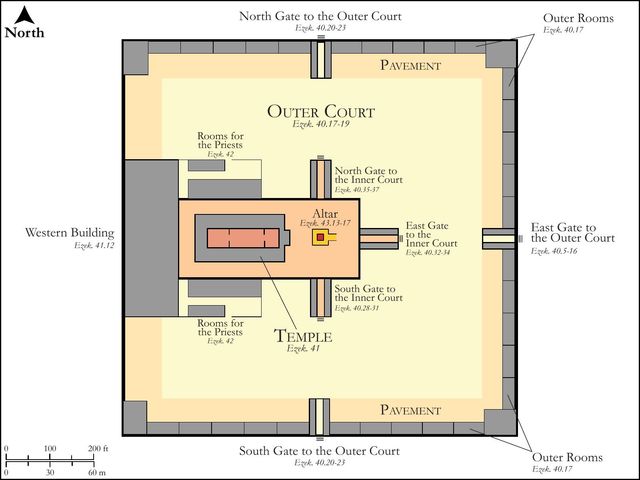
Ezekiel 42:10 provides a highly specific architectural detail within the prophet's sweeping vision of the eschatological temple. This verse precisely locates a series of chambers, specifying their integration into the substantial wall of the temple court on the eastern side, and their exact spatial relationship to both a designated "separate place" and another significant "building." It contributes to the overall impression of divine order, meticulous planning, and the sacred functionality of this visionary sanctuary, underscoring the precise arrangement of spaces dedicated to holy purposes.
Context
ShowHideLiterary Context
Ezekiel 42:10 is situated within the expansive and extraordinarily detailed temple vision found in Ezekiel 40 through Ezekiel 48. This segment marks a pivotal shift in the book, transitioning from prophecies of judgment and exile (chapters 1-39) to a profound and hopeful vision of restoration and future glory. The prophet is guided on a comprehensive tour of a new, divinely designed temple complex, receiving precise measurements and descriptions of its various components, including its courts, gates, and numerous chambers. Chapter 42 specifically elaborates on the chambers designated for the priests, detailing their location and function, particularly those on the north and south sides of the inner court, and their relationship to the "separate place" (or "temple area") and other structures. Verse 10, by pinpointing the eastern chambers, adds another layer of meticulous detail to this divine blueprint, reinforcing the comprehensive and purposeful nature of God's plan for His restored dwelling place among His people.
Historical & Cultural Context
The vision of the temple was revealed to Ezekiel during the Babylonian exile, a period of profound national despair and spiritual displacement for the Jewish people. Jerusalem and its revered temple had been utterly destroyed by Nebuchadnezzar in 586 BC, leaving the exiles without their central place of worship and a tangible symbol of God's covenant presence. In this context of desolation, Ezekiel's vision served as an extraordinarily powerful message of hope and divine faithfulness, promising a future restoration where God would once again dwell among His people in a glorious and perfect sanctuary. The meticulous architectural details, including the emphasis on the "thickness of the wall" and the precise placement of chambers, would have deeply resonated with the Israelite understanding of sacred space, where every element was designed with intentionality for holiness, order, and ritual purity, reflecting the very character of the divine. Such detailed blueprints were common for significant ancient structures, but here, the divine origin elevates its significance far beyond mere human construction, signifying a perfect, heavenly design.
Key Themes
ShowHideThe meticulous description in Ezekiel 42:10 contributes significantly to several overarching themes within the book of Ezekiel and the broader biblical narrative. Firstly, it powerfully underscores the theme of Divine Presence and Glory (Hebrew: kavod). The entire temple vision is a profound testament to God's unwavering desire to dwell among His people, and the precise design ensures a holy, fitting, and ordered dwelling for His glory, as vividly depicted in the return of the glory in Ezekiel 43:1-5. Secondly, it highlights the paramount importance of Holiness and Separation. The chambers, particularly those intended for priestly use, emphasize the absolute necessity of consecrated spaces and personnel for divine service, reinforcing the crucial distinction between the holy and the common, a foundational principle of Israelite worship and law, further elaborated in passages like Ezekiel 44:23. Thirdly, the sheer level of detail in the blueprint speaks to Divine Order and Perfection. God's comprehensive design leaves nothing to chance, demonstrating His sovereign control, His meticulous attention to detail, and His perfect plan for His people's worship and restoration. This divine meticulousness reflects the ultimate architect's comprehensive plan for a renewed covenant relationship.
Exposition and Analysis
ShowHideKey Word Analysis
ShowHideFrom an unused root of uncertain meaning, this word refers to a specific room or cell within a larger building, often serving purposes such as storage, eating, or lodging. In the context of Ezekiel's visionary temple, these "chambers" (plural in the KJV, though the Strong's reference is singular) are integral components of the complex, likely serving specialized functions related to priestly duties. As suggested by later verses in Ezekiel 42, these might include storing holy garments, preparing sacrificial offerings, or providing lodging for priests during their periods of service. Their inclusion highlights the highly functional, organized, and consecrated nature of the visionary temple.
This term, derived from a root meaning "to cut out" or "to separate," refers to an inclosure or a distinct, set-apart area. In Ezekiel's temple vision, the "separate place" (often rendered as "temple area" or "sanctuary") denotes a sacred, demarcated zone within the temple complex, emphasizing its unique holiness and perhaps its restricted accessibility to the common people. Its precise location relative to the chambers underscores the careful delineation and segregation of sacred space from the profane.
Derived from the verb "to build," this word simply denotes an "edifice" or a "structure." In this specific context, it most likely refers to a significant structure within the temple complex, potentially the main temple building itself or another prominent edifice that serves as a key landmark. Its mention alongside the "separate place" and the "chambers" helps to orient the reader within the intricate architectural layout, serving as a crucial spatial reference point in the divine blueprint.
Verse Breakdown
ShowHide"The chambers [were] in the thickness of the wall of the court toward the east"
This initial clause establishes the primary and precise location of the chambers. They are not freestanding structures but are intricately integrated into the substantial "thickness" or breadth of the wall that surrounds the temple "court." The orientation "toward the east" is profoundly significant in biblical temple architecture, as the east gate was traditionally associated with the entrance of God's glory and was a prominent feature. This suggests these chambers were strategically positioned within a robust, divinely ordained structure, facing a direction of immense symbolic importance.
"over against the separate place"
This phrase further specifies the chambers' exact position, indicating they were directly opposite or adjacent to the "separate place" (or sanctuary area). This close proximity underscores their intimate connection to the most holy parts of the temple, implying that their function was directly related to the sacred activities conducted within that consecrated zone. The Hebrew phrase pânîym, translated "over against," emphasizes a direct, face-to-face orientation or immediate proximity.
"and over against the building"
This final phrase provides yet another crucial point of reference, indicating that the chambers were also situated opposite or beside another significant "building" within the complex. This reiterates the meticulous precision of the vision, providing multiple spatial anchors to ensure the exact understanding of the layout. The repetition of "over against" reinforces the precise alignment and relational positioning of these various architectural components, leaving no ambiguity in the divine blueprint.
Literary Devices
ShowHideEzekiel 42:10, like much of the temple vision, primarily employs Architectural Description and Precision. The verse is a profound testament to the meticulous detail with which God reveals His plans, leaving no room for ambiguity regarding the exact placement and integration of these chambers within the temple complex. This serves to emphasize the divine Order and the sacred nature of the envisioned sanctuary. The phrase "over against" (Hebrew: pânîym) is repeated, demonstrating Repetition, which functions to reinforce the exact spatial relationships between the chambers, the separate place, and the building, underscoring the divine blueprint's absolute exactitude. Furthermore, the entire vision, of which this verse is an integral part, functions as profound Symbolism, representing not merely a literal future temple but also the restored and perfected relationship between God and His people, characterized by holiness, divine order, and the abiding presence of His glory.
Theological and Thematic Connections
ShowHideEzekiel 42:10, in its precise architectural detail, speaks volumes about the character of God and His relationship with His people. The meticulous planning of the temple, down to the exact placement of specific chambers, reveals a God of profound order, intentionality, and absolute holiness. Every element of the temple was designed with divine purpose to facilitate worship, maintain ritual purity, and provide a fitting dwelling for the divine presence. This divine blueprint underscores the principle that God's dwelling among His people is not haphazard but perfectly orchestrated, reflecting His glory and His desire for a consecrated community. The chambers, likely designated for priestly use, further emphasize the importance of set-apart spaces and individuals for sacred service, a theme central to the Old Covenant and foundational for understanding the New.
Reflection and Application
ShowHideEzekiel 42:10, though seemingly a dry architectural detail, offers profound spiritual lessons for the believer today. It serves as a powerful reminder that God is a God of meticulous detail, divine order, and purposeful design. Just as He possessed a precise blueprint for His dwelling place, He also has a perfect plan for our individual lives and for the collective life of His church. This verse challenges us to consider the "chambers" of our own existence – our time, talents, resources, relationships, and aspirations. Are they ordered according to God's divine design? Are they dedicated to His holy purposes, positioned "over against" His presence and His redemptive work in the world? We are called to live with intentionality, recognizing that every aspect of our being can be consecrated to Him, reflecting His glory and participating in His divine order. This encourages us to diligently seek God's blueprint for our spiritual walk, to embrace discipline and structure in our faith, and to appreciate the profound beauty and inherent purpose in His sovereign design for us as individuals and for the community of believers.
Questions for Reflection
ShowHideFAQ
ShowHideWhat is the significance of the "east" orientation mentioned in Ezekiel 42:10?
ShowHideThe "east" orientation holds profound significance in biblical temple architecture and prophecy. In both the Tabernacle and Solomon's Temple, the primary entrance faced east. In Ezekiel's vision, the glory of the Lord departs from the temple via the east gate in Ezekiel 10:19 and later dramatically returns through the very same east gate in Ezekiel 43:1-4. Thus, the eastern side was consistently associated with divine presence, access, and sometimes judgment. Placing these chambers on the eastern side of the court wall would have positioned them in a prominent and symbolically significant area, perhaps indicating their importance for those serving in the immediate presence of God's returning glory.
Were these chambers in Ezekiel's vision meant for human habitation or storage?
ShowHideWhile Ezekiel 42:10 itself doesn't explicitly state the precise function of these specific chambers, the broader context of Ezekiel 42 strongly indicates they were primarily for the exclusive use of the priests. Verses like Ezekiel 42:13-14 specify that similar chambers were where priests would eat the most holy offerings and where they would change their sacred garments before entering the holy place or approaching the people. Therefore, these chambers were undoubtedly designated for various priestly functions, including the consumption of sacred food, the storage of holy vestments, and quite possibly for the priests' lodging during their periods of service, emphasizing the profound holiness and separation required for their sacred duties.
Christ-Centered Fulfillment
ShowHideEzekiel's grand temple vision, with its meticulous architectural details like the chambers in Ezekiel 42:10, ultimately finds its profound and ultimate fulfillment in the person and work of Jesus Christ. While the physical temple served as a tangible shadow and type of God's dwelling among His people, Christ is the ultimate reality and the true, living temple of God (John 2:19-21). In Him, the divine presence no longer dwells in structures of stone and mortar but in a person, the incarnate Son of God. The precise design of the temple, including its dedicated chambers for holy service, foreshadows Christ's perfect and complete work as our great High Priest, who entered the true, heavenly sanctuary "not with the blood of goats and calves but with his own blood, thus obtaining eternal redemption" (Hebrews 9:11-12). Furthermore, the church, as the mystical body of Christ, becomes a spiritual temple built on the unshakable foundation of the apostles and prophets, with Christ Jesus himself as the chief cornerstone (Ephesians 2:19-22). Believers, as "living stones," are actively built into this spiritual house, forming a holy priesthood, offering spiritual sacrifices acceptable to God through Jesus Christ (1 Peter 2:5). Thus, the order, holiness, and divine presence meticulously detailed in Ezekiel's visionary temple are perfectly realized and infinitely expanded in Christ and His redeemed community, the church.