


Ezekiel 41:4
Bible text: King James Version (1769 Blayney text) · Public domain
Bible text: King James Version with Strong's numbers · Public domain
Bible text: Berean Standard Bible · Public domain
Bible text: American Standard Version (1901) · Public domain
Bible text: World English Bible, Messianic edition · Public domain
Bible text: Geneva Bible (1599) · Public domain
Bible text: Young's Literal Translation · Public domain
- וַיָּמָדvai·Ya·modand he measuredH4058Conj-w ¦ V-Qal-ConsecImperf-3msVerb Qal Consecutive Imperfect 3rd Singular Masculineוַandיָּמָדhe measured
- אֶת'et<obj.>H853DirObjMParticle Object Indicator
- אָרְכּוֹ'a·re·Koits lengthH753N-msc ¦ 3msNoun Singular Masculine Constructאָרְכּlengthוֹits
- עֶשְׂרִים'es·RimtwentyH6242Adj-mpAdjective Numerical Plural Masculine Absolute
- אַמָּה'a·Mahcubit[s]H520N-fsNoun Singular Feminine Absolute
- וְרֹחַבve·Ro·chavand [the] breadthH7341Conj-w ¦ N-msNoun Singular Masculine Absoluteוְandרֹחַב[the] breadth
- עֶשְׂרִים'es·Rim[was] twentyH6242Adj-mpAdjective Numerical Plural Masculine Absolute
- אַמָּה'a·Mahcubit[s]H520N-fsNoun Singular Feminine Absolute
- אֶל'eltoH413PrepPreposition
- פְּנֵיpe·Nei[the] face ofH6440N-mpcNoun Plural Masculine Construct
- הַהֵיכָלha·hei·Khalthe templeH1964Art ¦ N-msNoun Singular Masculine Absoluteהַtheהֵיכָלtemple
- וַיֹּאמֶרvai·Yo·merand he saidH559Conj-w ¦ V-Qal-ConsecImperf-3msVerb Qal Consecutive Imperfect 3rd Singular Masculineוַandיֹּאמֶרhe said
- אֵלַי'e·Laito meH413Prep ¦ 1csPrepositionאֵלַtoיme
- זֶהzehthisH2088PrtParticle Demonstrative
- קֹדֶשׁKo·desh[is] [the] holy place ofH6944N-mscNoun Title Singular Masculine Construct
- הַקֳּדָשִׁיםha·ko·da·Shimthe holy placesH6944Art ¦ N-mpNoun Title Plural Masculine Absoluteהַtheקֳּדָשִׁיםholy places
English is a literal word-by-word gloss of the Hebrew, not the KJV's wording. Why?
This is the original text the KJV's translators worked from — each Hebrew word with its own literal English meaning in this verse, prepared by scholars at Tyndale House, Cambridge. The KJV translates whole sentences, not word by word, so its wording differs: one Hebrew word can become several English words, and the KJV may choose “the LORD” where the gloss reads “Yahweh”. Both are faithful — they answer different questions. For the KJV's own rendering, switch to the KJV text.
Details
See on the biblical-era map
Study this verse
Public-domain commentary
Matthew Henry
From his Commentary on the Whole Bible. Henry comments on passages, not single verses — this entry covers Ezekiel 41:1–11.
We are still attending a prophet that is under the guidance of an angel, and therefore attend with reverence, though we are often at a loss to know both what this is and what it is to us. Observe here, 1. After the prophet had observed the courts he was at length brought to the temple, Eze 41:1. If we diligently attend to the instructions given us in the plainer parts of religion, and profit by them, we shall be led further into an acquaintance with the mysteries of the kingdom of heaven. Those that are willing to dwell in God's courts shall at length be brought into his temple. Ezekiel was himself a priest, but by the iniquity and calamity of the times was cut short of his birthright privilege of ministering in the temple; but God makes up the loss to him by introducing him into this prophetical, evangelical, celestial temple, and employing him to transmit a description of it to the church, in which he was dignified above all the rest of his order. 2. When our Lord Jesus spoke of the destroying of this temple, which his hearers understood of this second temple of Jerusalem, he spoke of the temple of his body (Joh 2:19, Joh 2:21); and with good reason might he speak so ambiguously when Ezekiel's vision had a joint respect to them both together, including also his mystical body the church, which is called the house of God (Ti1 3:15), and all the members of that body, which are living temples, in which the Spirit dwells. 3. The very posts of this temple, the door-posts, were as far one from the other, and consequently the door was as wide, as the whole breadth of the tabernacle of Moses (Eze 41:1), namely, twelve cubits, Exo 26:16, Exo 26:22, Exo 26:25. In comparison with what had been under the law we may say, Wide is the gate which leads into the church, the ceremonial law, that wall of partition which had so much straitened the gate, being taken down. 4. The most holy place was an exact square, twenty cubits each way, Eze 41:4. For the new Jerusalem is exactly square (Rev 21:16), denoting its stability; for we look for a city that cannot be moved. 5. The upper stories were larger than the lower, Eze 41:7. The walls of the temple were six cubits thick at the bottom, five in the middle story, and four in the highest, which gave room to enlarge the chambers the higher they went; but care was taken that the timber might have fast hold (though God builds high, he builds firmly), yet so as not to weaken one part for the strengthening of another; they had hold, but not in the wall of the house. By this spreading gradually, the side-chambers that were on the height of the house (in the uppermost story of all) were six cubits, whereas the lowest were but four; they gained a cubit every story. The higher we build up ourselves in our most holy faith the more should our hearts, those living temples, be enlarged.
Historical interpretation
Historical reception
1 surviving comment on this verse from the historical church.
(Vers. 3, 4.) "And he entered inside (or into the inner court) and measured the front (or threshold) of the gate to be two cubits, and the gate to be six (or ten) cubits, and the width of the gate to be seven cubits (or, the width of the gate from one shoulder to the other being seven cubits on each side). And he measured its (or the doors') length to be twenty cubits and its width to be twenty cubits in front of the temple. And he said to me: This is the Holy of Holies. « Let us make progress, for greater progress always opens up for us. After entering the temple, we once again enter inside, or as the Septuagint translated, the inner courtyard, in whose front, or Ael, for which Symmachus, around the gate, Theodotus Aelam, Hebrew Ul (), Aquila door, we interpret the front, there were two cubits. So, according to the higher meaning, we enter by the dual number to that place where the Holy of Holies is located. » And the gate itself was six cubits, through which we entered and obtained eternal rest, which is demonstrated in the number seven. For this reason, the Seventy translated it, and the width of the gate was seven cubits on this side and seven cubits on that side, in Hebrew and other editions only seven cubits were placed in the width of the gate. However, what follows: And its length was measured, or as the Seventy translated it, the doors were twenty cubits, for which in most codices forty are contained according to the Seventy, it also signifies a width of twenty cubits in front of the face of the temple, that which before the face of the temple and its entrance, the measure of past labor and struggle always comes to us. For just as the number two possesses a double relationship in individual numbers, so do the decades have the same relationship. And consider this: entering inward through the gateway of two cubits in width, and having six cubits in depth, and seven cubits in width on each side, and twenty cubits in length, and the same in the very doors of the temple, let it be taught by the prophet what that place is, or by what name it is called. For he said to me: This is the Holy of Holies. But if, as Scripture calls it, it is before the temple, or before the Holy of Holies, how great a blessedness must we think there is in the innermost parts of the temple! Concerning which the prophet speaks: This is labor in my sight, until I enter into the sanctuary of God, and understand their last things (Ps. 77:16-17). But this should also be noted, that in the description of the tabernacle it is said 'Holy of Holies' in the plural number; but here 'Holy of Holies' in the singular number, so that after the holy things we come to the holy: just as after many songs we come to the Song of Songs, which is the song of all songs, and in singing it, we are joined in the embrace of the Bridegroom.
Continue studying Ezekiel 41:4 across the web’s major study libraries — every link below opens this exact verse, chapter, or book on the destination site.
Read & Compare
 BibleGatewayThis verse in more than 200 translations and 70 languages.
 Bible.comThe YouVersion reader — hundreds of translations, reading plans, and highlights.
 ESV.orgCrossway's official English Standard Version reader.
 NET BibleThe NET translation with 60,000+ translators' notes on every rendering decision.
 STEP BibleTyndale House's free study tool — original text, vocabulary, and scholarly resources.
 BibliaLogos Bible Software's free web reader.
 USCCBThe New American Bible (Revised Edition) with the U.S. bishops' study notes.
Commentaries
 BibleHub CommentariesDozens of classic commentaries on this verse, gathered on one page.
 StudyLightMore than 100 commentary sets — the largest collection on the web.
 BibleRefPlain-English commentary on what this verse means, verse by verse.
 Enduring WordDavid Guzik's free commentary on this chapter, widely used by Bible teachers.
 Bible Study ToolsVerse commentary alongside Greek and Hebrew study aids.
Original Language & Research
- BibleHub InterlinearThe verse word by word — original language, transliteration, and English.
- BibleHub LexiconEvery word's original-language definition and Strong's entry.
 Blue Letter BibleDeep-study tools — Strong's numbers, concordance, and word studies.
 SefariaThe Hebrew text with Rashi and centuries of Jewish commentary.
Sermons, Hymns & Audio


TrulyRandomVerse is not affiliated with these sites and doesn’t control their content. They’re linked because they’re genuinely useful.
Summary
Ezekiel 41:4 precisely delineates the dimensions of the innermost sanctuary, the Holy of Holies, within the prophet Ezekiel's visionary temple. This verse specifies its square footprint as twenty cubits by twenty cubits, situated directly before the main temple structure, and emphatically declares it to be the "most holy place," thereby underscoring its unparalleled sanctity and its profound role as the sacred dwelling place of God's manifest presence.
Context
ShowHideLiterary Context
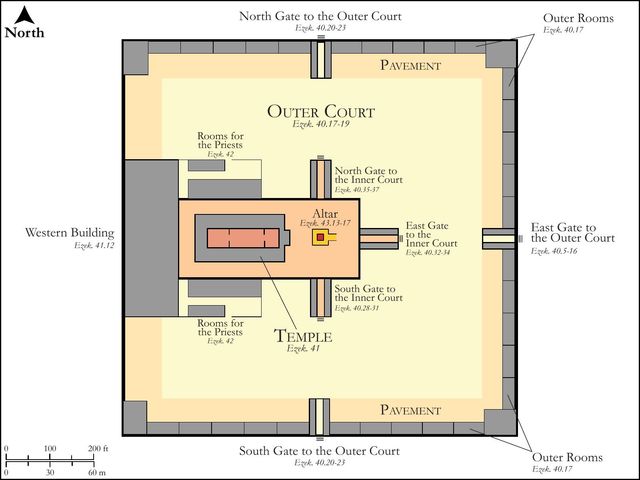
Ezekiel 41:4 is strategically positioned within a sprawling and meticulously detailed prophetic vision of a new temple, which spans from Ezekiel 40 through Ezekiel 48. Following an exhaustive survey of the outer court, described in Ezekiel 40:1-27, and the inner court, detailed in Ezekiel 40:28-47, the angelic guide leads Ezekiel into the very fabric of the temple building itself. Chapter 41 then proceeds to meticulously describe the temple's outer porch, the main hall (known as the Holy Place), and subsequently, in this particular verse, the innermost and most sacred chamber—the Holy of Holies. This deliberate progression of measurements, moving from the temple's peripheral elements to its deepest sanctum, powerfully emphasizes a spiritual journey towards the very heart of God's dwelling, highlighting the escalating sacredness and intensity of His presence as one draws nearer.
Historical & Cultural Context
The profound vision imparted to Ezekiel unfolded during the tumultuous period of the Babylonian exile, approximately fourteen years subsequent to the devastating destruction of Solomon's Temple in Jerusalem in 586 BC, as explicitly noted in Ezekiel 40:1. For the exiled Israelites, who had endured the traumatic desecration and utter ruin of their cherished sacred city and temple, this intricate and divinely revealed blueprint of a new temple offered an unparalleled source of profound hope and spiritual reassurance. It served as a powerful testament to God's unwavering faithfulness, His enduring covenant with His chosen people, and the glorious promise of future restoration and renewed, intimate fellowship. Culturally, the temple was not merely a building; it was the quintessential institution of Israelite worship, revered as the singular place where God's divine presence was believed to dwell tangibly among His people. The meticulous measurements and the unequivocal declaration of "most holy place" would have resonated deeply with their ingrained understanding of sacred space, divine order, and the inherent holiness of God, providing a stark and hopeful contrast to the chaos, defilement, and despair they had so recently experienced.
Key Themes
ShowHideThis pivotal verse, embedded within the grand narrative of the broader temple vision, profoundly contributes to several overarching theological themes. Firstly, it powerfully reinforces the theme of Divine Precision and Order. The exact, divinely ordained measurements of the temple, particularly its most sacred and inaccessible part, underscore God's meticulousness, His sovereign control, and His demand for absolute order in worship and in the manifestation of His presence. Secondly, the explicit and emphatic designation, "This is the most holy place," unequivocally highlights the Absolute Holiness of God's Presence. This innermost chamber, echoing the Holy of Holies found in both the Tabernacle and Solomon's Temple, was the exclusive dwelling place of God's manifest glory, signifying ultimate sanctity, profound separation, and unapproachable purity. Lastly, the entire visionary experience, including the precise details of this verse, functions as a potent symbol of Hope, Restoration, and Renewed Fellowship. For a people languishing in exile, whose God's glory had seemingly departed from their former, defiled temple as recounted in Ezekiel 10:18, the detailed and perfect vision of a divinely designed temple offered a tangible and glorious promise of God's triumphant return and His renewed, permanent dwelling among His people.
Exposition and Analysis
ShowHideKey Word Analysis
ShowHideThis primitive root signifies "to stretch" or, by implication, "to measure (as if by stretching a line)." In Ezekiel 41:4, its use emphasizes the meticulous and precise nature of the divine architect's work. The act of measuring underscores the exactness and intentionality behind every dimension of the visionary temple, indicating that nothing is left to human estimation or error, but is divinely ordained and perfectly executed.
This term refers to a large public building, specifically a "palace or temple." In this context, it denotes the main sanctuary building that houses the Holy Place and the Most Holy Place. The use of this term here distinguishes the innermost sanctuary from the broader temple complex, indicating its position "before" or in front of the main structure, implying its central and ultimate significance within the entire sacred edifice.
This is a superlative construction, literally "holiness of holinesses" or "holy of holies." It signifies the absolute highest degree of sacredness, separation, and consecration. This designation immediately identifies the measured space as the innermost sanctuary, the exclusive dwelling place of God's manifest glory, accessible only under strict divine protocols. Its repeated use emphasizes the unparalleled sanctity of this particular chamber above all other parts of the temple.
Verse Breakdown
ShowHide"So he measured the length thereof, twenty cubits; and the breadth, twenty cubits, before the temple:"
This clause provides the precise, divinely ordained dimensions of the innermost chamber. The measurement of "twenty cubits" (approximately 30 feet or 9 meters) for both length and breadth indicates a perfect square, a shape often associated with completeness and perfection in ancient architectural symbolism. The phrase "before the temple" specifies its exact location directly in front of the main sanctuary building, signifying its ultimate position at the very heart of the sacred complex. This exactitude highlights the divine precision inherent in the temple's design and its profound significance.
"and he said unto me, This [is] the most holy [place]."
This authoritative declaration by the angelic guide unequivocally identifies the measured space. The phrase "most holy place" (Hebrew: qodesh haqqodashim) is a superlative construction, emphasizing the absolute and unparalleled sanctity of this chamber. It is the Holy of Holies, the very presence chamber of God, set apart from all other areas due to the unique intensity and purity of God's dwelling there. This statement confirms the profound spiritual significance of the dimensions just revealed, marking it as the epicenter of divine encounter.
Literary Devices
ShowHideThe passage employs several significant literary devices to convey its profound theological message. The most prominent is Symbolism, where the meticulously measured temple, and particularly the "most holy place" within it, symbolizes God's inherent desire for perfect order, His absolute and unapproachable holiness, and His unwavering intention to dwell intimately among His people. The Precision and Detail of the measurements (specifically, twenty cubits by twenty cubits) serve to underscore divine intentionality and the immutable nature of God's sovereign plan. This extraordinary level of detail also lends an air of realism and tangibility to the vision, making it profoundly impactful and reassuring for the exiled audience. Furthermore, the Divine Speech ("and he said unto me, This is the most holy place") elevates the significance of the declaration, confirming the authoritative, sacred, and divinely revealed nature of the space directly from a celestial messenger.
Theological and Thematic Connections
ShowHideEzekiel 41:4, by identifying the Holy of Holies, connects profoundly to the overarching biblical theme of God's desire to dwell among His people, yet in a manner that simultaneously underscores His absolute holiness and transcendence. This innermost sanctuary, whether in the Tabernacle, Solomon's Temple, or Ezekiel's visionary blueprint, consistently represents the very epicenter of God's manifest presence. Its strict dimensions and severely restricted access in the Old Testament underscore the vast chasm between a holy, pure God and sinful humanity, a chasm that necessitated divine provision for atonement and mediated access. The vision's emphasis on a perfect, divinely measured sanctuary points forward to a time of ultimate restoration and unhindered communion, a theme that finds its ultimate and glorious fulfillment in the person and work of Jesus Christ.
Reflection and Application
ShowHideEzekiel 41:4, with its profound focus on the "most holy place," serves as a powerful and enduring reminder of God's absolute holiness and His profound desire for intimate fellowship with His creation. While believers no longer approach a physical Holy of Holies, the spiritual reality it represents remains vitally important for our faith and practice. Through Christ's perfect atoning work on the cross, the veil that once separated humanity from God's immediate presence has been dramatically torn from top to bottom, as recorded in Matthew 27:51, thereby granting us direct, unhindered access to God's presence. This extraordinary privilege calls us to live lives that are commensurate with such a glorious and sacred reality. We are now, by the indwelling of the Holy Spirit, the very temple of God (1 Corinthians 6:19), and as such, we are called to actively pursue holiness, recognizing that God's sacred presence dwells within us. Our daily lives, therefore, should reflect the profound sacredness of His indwelling, marked by reverence, moral purity, and a constant, conscious awareness of His holy presence in every thought, word, and deed.
Questions for Reflection
ShowHideFAQ
ShowHideWhat is the significance of the 20x20 cubit measurement for the Most Holy Place?
ShowHideThe 20x20 cubit measurement signifies a perfect square, which in biblical thought often represented perfection, completeness, and stability. This dimension is consistent with the Holy of Holies in Solomon's Temple, which was a perfect cube (20x20x20 cubits), as described in 1 Kings 6:20. This remarkable consistency across different temple designs underscores the divine blueprint and the unchanging nature of God's sacred space. It emphasizes the absolute perfection and sanctity required for God's dwelling place, highlighting that His presence is orderly, complete, and utterly holy, demanding a space set apart in every dimension.
How does Ezekiel's visionary temple relate to the historical temples of Israel?
ShowHideEzekiel's temple vision, while sharing significant architectural similarities with Solomon's Temple (e.g., the 20x20 cubit Holy of Holies), is generally understood to be a distinct, divinely revealed blueprint. Some scholars interpret it as a literal future temple to be built during a millennial age, while others see it as a symbolic representation of God's ideal dwelling with His people, a spiritual reality, or even an eschatological blueprint for the church. It certainly serves as a powerful prophetic promise of restoration and renewed covenant, contrasting the perfection of God's design with the defilement and destruction of the first temple, from which God's glory had tragically departed, as lamented in Ezekiel 10:18.
Is Ezekiel's temple a literal structure that will be built in the future?
ShowHideThe interpretation of Ezekiel's temple vision varies among biblical scholars and theological traditions. Some dispensationalists believe it describes a literal temple that will be built during a future millennial reign of Christ on earth, often referred to as the "Third Temple." Others interpret it symbolically, seeing it as a profound representation of the ideal spiritual dwelling of God among His people, a reality fulfilled in the church as the body of Christ, or ultimately in the New Heavens and New Earth. A third view sees it as an apocalyptic vision, primarily conveying profound theological truths about God's holiness, His enduring presence, and the promise of ultimate restoration, rather than a precise architectural blueprint for a future physical building. Regardless of the literal or symbolic interpretation, the vision powerfully conveys God's unwavering commitment to dwell with His people and the absolute, unblemished holiness of His presence.
Christ-Centered Fulfillment
ShowHideEzekiel 41:4, with its emphatic declaration of the "most holy place," finds its ultimate and glorious Christ-centered fulfillment in the person and redemptive work of Jesus Christ. The earthly Holy of Holies, whether in the Tabernacle or Solomon's Temple, was a veiled, inaccessible space, profoundly representing the profound separation between a holy God and sinful humanity. Only the High Priest could enter this sacred space, and then only once a year, carrying the blood of atonement. However, Jesus, by His perfect, sinless life and His sacrificial death on the cross, became the ultimate and eternal High Priest (Hebrews 4:14), entering not into a man-made sanctuary, but into heaven itself, through the efficacy of His own precious blood (Hebrews 9:11-12). He is the true "most holy place," the very embodiment of God's presence dwelling among us in human flesh (John 1:14). Through Him, the very veil that separated humanity from God was miraculously torn from top to bottom at His crucifixion (Matthew 27:51), signifying open and direct access to the Father for all who believe (Hebrews 10:19-22). Thus, the perfection, sanctity, and unblemished holiness symbolized by Ezekiel's visionary sanctuary are fully and eternally realized in Christ, who is our living temple, our direct access to God, and the one in whom the fullness of God's glory truly dwells.