


1 Kings 6:20
Bible text: King James Version (1769 Blayney text) · Public domain
Bible text: King James Version with Strong's numbers · Public domain
Bible text: Berean Standard Bible · Public domain
Bible text: American Standard Version (1901) · Public domain
Bible text: World English Bible, Messianic edition · Public domain
Bible text: Geneva Bible (1599) · Public domain
Bible text: Young's Literal Translation · Public domain
- וְלִפְנֵיve·lif·Neiand <to> beforeH6440Conj-w ¦ Prep-l ¦ N-mpcNoun Plural Masculine Constructוְandלִ<to>פְנֵיbefore
- הַדְּבִירha·de·Virthe innermost roomH1687Art ¦ N-msNoun Singular Masculine Absoluteהַtheדְּבִירinnermost room
- עֶשְׂרִים'es·Rim[was] twentyH6242N-mpNoun Plural Masculine Absolute
- אַמָּה'a·Mahcubit[s]H520N-fsNoun Singular Feminine Absolute
- אֹרֶךְ'O·rekhlengthH753N-msNoun Singular Masculine Absolute
- וְעֶשְׂרִיםve·'es·Rimand [was] twentyH6242Conj-w ¦ N-mpNoun Plural Masculine Absoluteוְandעֶשְׂרִים[was] twenty
- אַמָּה'a·Mahcubit[s]H520N-fsNoun Singular Feminine Absolute
- רֹחַבRo·chavbreadthH7341N-msNoun Singular Masculine Absolute
- וְעֶשְׂרִיםve·'es·Rimand [was] twentyH6242Conj-w ¦ N-mpNoun Plural Masculine Absoluteוְandעֶשְׂרִים[was] twenty
- אַמָּה'a·Mahcubit[s]H520N-fsNoun Singular Feminine Absolute
- קוֹמָתוֹko·ma·Toits heightH6967N-fsc ¦ 3msNoun Singular Feminine Constructקוֹמָתheightוֹits
- וַיְצַפֵּהוּvay·tza·Pe·huand he overlaid itH6823Conj-w ¦ V-Piel-ConsecImperf-3ms ¦ 3msVerb Piel Consecutive Imperfect 3rd Singular Masculineוַandיְצַפֵּhe overlaidהוּit
- זָהָבza·HavgoldH2091N-msNoun Singular Masculine Absolute
- סָגוּרsa·Gurgold plateH5462N-msNoun Singular Masculine Absolute
- וַיְצַףvay·Tzafand he overlaidH6823Conj-w ¦ V-Piel-ConsecImperf-3msVerb Piel Consecutive Imperfect 3rd Singular Masculineוַandיְצַףhe overlaid
- מִזְבֵּחַmiz·Be·achan altarH4196N-msNoun Singular Masculine Absolute
- אָרֶז'A·rezcedarH730N-msNoun Singular Masculine Absolute
English is a literal word-by-word gloss of the Hebrew, not the KJV's wording. Why?
This is the original text the KJV's translators worked from — each Hebrew word with its own literal English meaning in this verse, prepared by scholars at Tyndale House, Cambridge. The KJV translates whole sentences, not word by word, so its wording differs: one Hebrew word can become several English words, and the KJV may choose “the LORD” where the gloss reads “Yahweh”. Both are faithful — they answer different questions. For the KJV's own rendering, switch to the KJV text.
Details
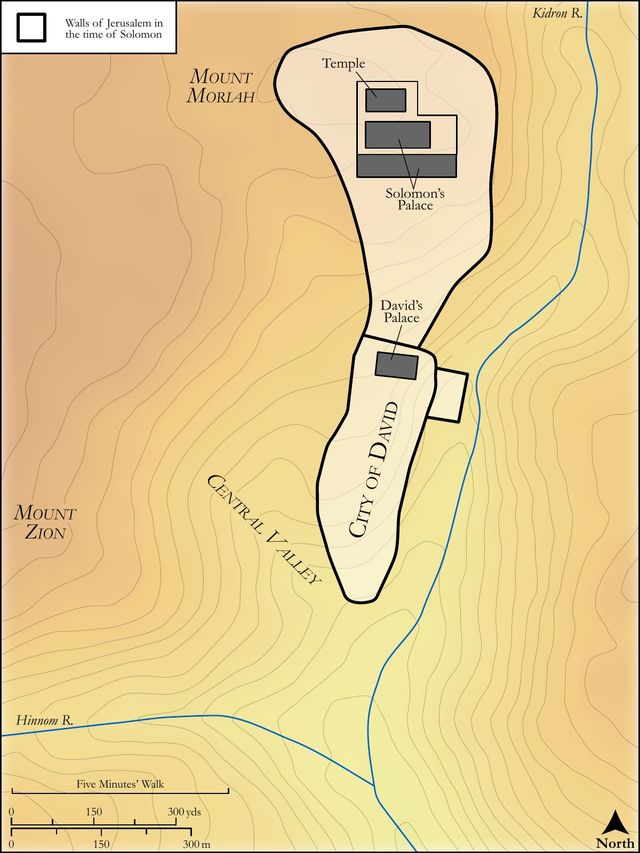
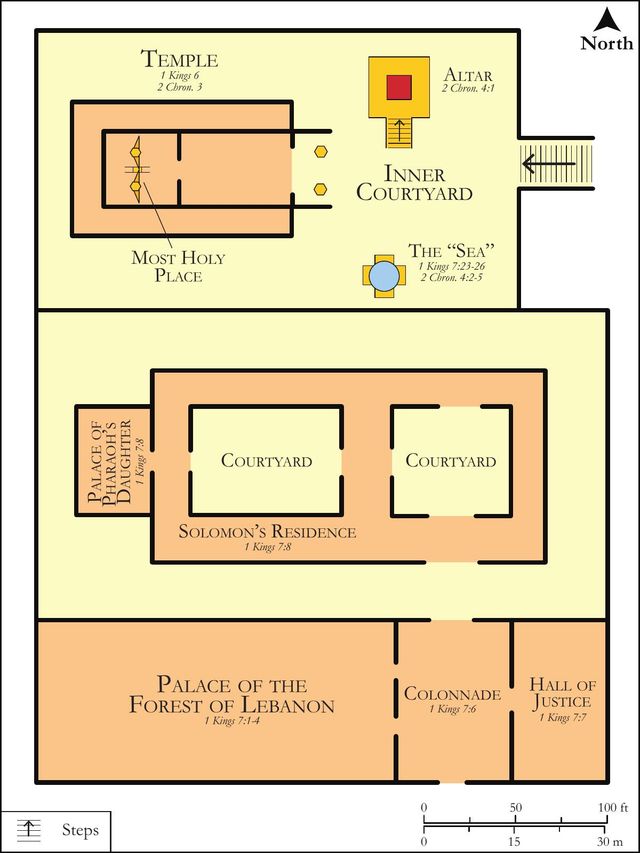
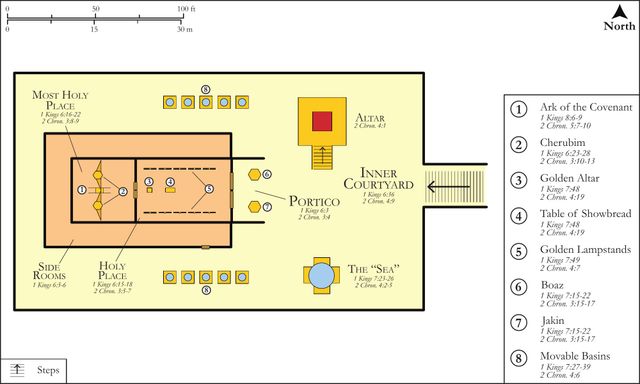
See on the biblical-era maps
Study this verse
Public-domain commentary
Matthew Henry
From his Commentary on the Whole Bible. Henry comments on passages, not single verses — this entry covers 1 Kings 6:15–38. His three-level outline is real structure in the source text, so it is rendered as structure.
Here, I. We have a particular account of the details of the building.
1.The wainscot of the temple. It was of cedar (Kg1 6:15), which was strong and durable, and of a very sweet smell. The wainscot was curiously carved with knops (like eggs or apples) and flowers, no doubt as the fashion then was, Kg1 6:18.
2.The gilding. It was not like ours, washed over, but the whole house, all the inside of the temple (Kg1 6:22), even the floor (Kg1 6:30), he overlaid with gold, and the most holy place with pure gold, Kg1 6:21. Solomon would spare no expense necessary to make it every way sumptuous. Gold was under foot there, as it should be in all the living temples: the abundance of it lessened its worth.
3.The oracle, or speaking-place (for so the word signifies), the holy of holies, so called because thence God spoke to Moses, and perhaps to the high priest, when he consulted with the breast-plate of judgment. In this place the ark of the covenant was to be set, Kg1 6:19. Solomon made every thing new, and more magnificent than it had been, except the ark, which was still the same that Moses made, with its mercy-seat and cherubim; that was the token of God's presence, which is always the same with his people whether they meet in tent or temple, and changes not with their condition.
4.The cherubim. Besides those at the ends of the mercy-seat, which covered the ark,
(1.)Solomon set up two more, very large ones, images of young men (as some think), with wings made of olive-wood, and all overlaid with gold, Kg1 6:23, etc. This most holy place was much larger than that in the tabernacle, and therefore the ark would have seemed lost in it, and the dead wall would have been unsightly, if it had not been thus adorned.
(2.)He carved cherubim upon all the walls of the house, Kg1 6:29. The heathen set up images of their gods and worshipped them; but these were designed to represent the servants and attendants of the God of Israel, the holy angels, not to be themselves worshipped (see thou do it not), but to show how great he is whom we are to worship.
5.The doors. The folding doors that led into the oracle were but a fifth part of the wall (Kg1 6:31), those into the temple were a fourth part (Kg1 6:33); but both were beautified with cherubim engraven on them, Kg1 6:32, Kg1 6:35.
6.The inner court, in which the brazen altar was at which the priests ministered. This was separated from the court where the people were by a low wall, three rows of hewn stone tipped with a cornice of cedar (Kg1 6:36), that over it the people might see what was done and hear what the priests said to them; for, even under that dispensation, they were not kept wholly either in the dark or at a distance.
7.The time spent in this building. It was but seven years and a half from the founding to the finishing of it, Kg1 6:38. Considering the vastness and elegance of the building, and the many appurtenances to it which were necessary to fit it for use, it was soon done. Solomon was in earnest in it, had money enough, had nothing to divert him from it, and many hands made quick work. He finished it (as the margin reads it) with all the appurtenances thereof, and with all the ordinances thereof, not only built the place, but set forward the work for which it was built.
II.Let us now see what was typified by this temple.
1.Christ is the true temple; he himself spoke of the temple of his body, Joh 2:21. God himself prepared him his body, Heb 10:5. In him dwelt the fulness of the Godhead, as the Shechinah in the temple. In him meet all God's spiritual Israel. Through him we have access with confidence to God. All the angels of God, those blessed cherubim, have a charge to worship him.
2.Every believer is a living temple, in whom the Spirit of God dwells, Co1 3:16. Even the body is such by virtue of its union with the soul, Co1 6:19. We are not only wonderfully made by the divine providence, but more wonderfully made anew by the divine grace. This living temple is built upon Christ as its foundation and will be perfected in due time.
3.The gospel church is the mystical temple; it grows to a holy temple in the Lord (Eph 2:21), enriched and beautified with the gifts and graces of the Spirit, as Solomon's temple with gold and precious stones. Only Jews built the tabernacle, but Gentiles joined with them in building the temple. Even strangers and foreigners are built up a habitation of God, Eph 2:19, Eph 2:22. The temple was divided into the holy place and the most holy, the courts of it into the outer and inner; so there are the visible and the invisible church. The door into the temple was wider than that into the oracle. Many enter into profession that come short of salvation. This temple is built firm, upon a rock, not to be taken down as the tabernacle of the Old Testament was. The temple was long in preparing, but was built at last. The top-stone of the gospel church will, at length, be brought forth with shoutings, and it is a pity that there should be the clashing of axes and hammers in the building of it. Angels are ministering spirits, attending the church on all sides and all the members of it.
4.Heaven is the everlasting temple. There the church will be fixed, and no longer movable. The streets of the new Jerusalem, in allusion to the flooring of the temple, are said to be of pure gold, Rev 21:21. The cherubim there always attend the throne of glory. The temple was uniform, and in heaven there is the perfection of beauty and harmony. In Solomon's temple there was no noise of axes and hammers. Every thing is quiet and serene in heaven; all that shall be stones in that building must in the present sate of probation and preparation be fitted and made ready for it, must be hewn and squared by divine grace, and so made meet for a place there.
Historical interpretation
Historical reception
1 surviving comment on this verse from the historical church.
“And the altar he also covered with cedar.” He means the altar of incense which was in front of the oracle [i.e., the inner sanctuary], about which a little further down are added the words “also the whole altar, which belonged to the oracle, he covered with gold.” From this we are given to understand that the same altar was indeed made of stone and overlaid with cedar and then covered with gold. It signifies typically the life of the perfectly righteous who are, as it were, placed near the oracle and giving up the basest pleasures concentrate all their attention merely on entering the kingdom of heaven. Hence quite appropriately it was not the flesh of victims that was burned on this altar but only incense, because such people no longer need to sacrifice in themselves carnal sins or seductive thoughts but only offer up the fragrance of spiritual prayers and heavenly desires through the fire of eternal love in the sight of their Creator. Now what the stone, cedar and gold represent in this kind of altar can be easily understood from what has been said above.
Continue studying 1 Kings 6:20 across the web’s major study libraries — every link below opens this exact verse, chapter, or book on the destination site.
Read & Compare
 BibleGatewayThis verse in more than 200 translations and 70 languages.
 Bible.comThe YouVersion reader — hundreds of translations, reading plans, and highlights.
 ESV.orgCrossway's official English Standard Version reader.
 NET BibleThe NET translation with 60,000+ translators' notes on every rendering decision.
 STEP BibleTyndale House's free study tool — original text, vocabulary, and scholarly resources.
 BibliaLogos Bible Software's free web reader.
 USCCBThe New American Bible (Revised Edition) with the U.S. bishops' study notes.
Commentaries
 BibleHub CommentariesDozens of classic commentaries on this verse, gathered on one page.
 StudyLightMore than 100 commentary sets — the largest collection on the web.
 BibleRefPlain-English commentary on what this verse means, verse by verse.
 Enduring WordDavid Guzik's free commentary on this chapter, widely used by Bible teachers.
 Bible Study ToolsVerse commentary alongside Greek and Hebrew study aids.
Original Language & Research
- BibleHub InterlinearThe verse word by word — original language, transliteration, and English.
- BibleHub LexiconEvery word's original-language definition and Strong's entry.
 Blue Letter BibleDeep-study tools — Strong's numbers, concordance, and word studies.
 SefariaThe Hebrew text with Rashi and centuries of Jewish commentary.
Sermons, Hymns & Audio


TrulyRandomVerse is not affiliated with these sites and doesn’t control their content. They’re linked because they’re genuinely useful.
Summary
1 Kings 6:20 offers a precise and profound description of the inner sanctuary of Solomon's Temple, known as the "oracle" or Holy of Holies. It meticulously details its perfect cubic dimensions—twenty cubits in length, breadth, and height—and highlights that this most sacred space, along with an associated cedar altar, was entirely overlaid with pure gold. This verse powerfully conveys the unparalleled holiness, divine perfection, and immense value attributed to the dwelling place of God's immediate presence among His people.
Context
ShowHideLiterary Context
This verse is intricately woven into the highly detailed architectural account of Solomon's construction of the Temple, a narrative that spans the entirety of 1 Kings 6. Following the general dimensions and initial construction details of the main sanctuary (the Holy Place) described in verses 1-19, verse 20 specifically narrows its focus to the innermost chamber, the dĕbîr, or Holy of Holies. This meticulous description of its precise dimensions and the lavish materials used emphasizes its unique sacredness and its central, indispensable role within the entire Temple complex. The subsequent verses, such as 1 Kings 6:21-28, continue to elaborate on the interior furnishings and exquisite adornments of this most sacred space, particularly the colossal cherubim and the altar, further reinforcing the divine glory and sanctity intended for this ultimate sanctuary.
Historical & Cultural Context
King Solomon's reign, spanning approximately 970-931 BC, was a golden age for Israel, characterized by unprecedented peace, immense prosperity, and significant international influence. The construction of the Temple in Jerusalem represented a monumental national undertaking, fulfilling a divine vision first entrusted to his father, King David, as recorded in 2 Samuel 7. This magnificent structure served as the permanent, centralized dwelling place for Yahweh, a significant transition from the movable Tabernacle that had accompanied Israel during their wilderness wanderings. The extensive use of precious materials, including cedar imported from Lebanon (likely through sophisticated trade agreements with Phoenicia) and vast quantities of pure gold, vividly reflects the immense wealth of Solomon's kingdom and recalls the tabernacle, adorned with the finest available resources that Israel brought to honor and magnify the LORD. The precise measurements and the perfect cubic design of the Holy of Holies also resonate with architectural principles found in other ancient sacred structures, universally signifying order, stability, and divine perfection.
Key Themes
ShowHideThe paramount theme highlighted in 1 Kings 6 and particularly underscored in verse 20 is the profound concept of Divine Presence and the Absolute Holiness of God. The Holy of Holies was consecrated as the symbolic dwelling place of Yahweh, the very spot where the Ark of the Covenant, representing God's direct presence, resided. The meticulous design, its perfect cubic dimensions, and the lavish, unblemished use of Pure Gold emphatically underscore the themes of Perfection, Completeness, and Unblemished Purity intrinsically associated with God Himself. This section also subtly highlights the Continuity and Development in God's redemptive plan, transitioning from the portable Tabernacle to a permanent, magnificent Temple, signifying God's enduring and unwavering commitment to dwell intimately with His people. Furthermore, the Temple's construction under Solomon's leadership reflects his Royal Priesthood and Kingship, as he orchestrates the building of God's own house, thereby fulfilling a crucial aspect of the covenant promise made to David.
Exposition and Analysis
ShowHideKey Word Analysis
ShowHideThis term specifically designates the innermost sanctuary of the Temple, known as the Most Holy Place or Holy of Holies. While its literal meaning may relate to being the "back part" or "inner room," its derivation from the Hebrew root dabar (meaning "to speak") suggests a deeper, profound significance: it was conceived as the "speaking place" or "place of divine utterance." This etymological connection emphasizes that the Holy of Holies was far more than a mere chamber; it was the very locus where God would communicate His divine will and manifest His presence to His chosen people, most notably through the High Priest on the annual Day of Atonement.
A cubit served as an ancient unit of linear measurement, conventionally based on the length of the forearm from the elbow to the tip of the middle finger, typically ranging from 18 to 21 inches (approximately 45-53 cm). The emphatic repetition of "twenty cubits" for the length, breadth, and height of the oracle signifies its precise formation as a perfect cube. This geometric perfection carries immense symbolic weight, representing completeness, wholeness, stability, and the absolute, unchangeable nature of God. Its cubic dimensions find a powerful echo in the description of the New Jerusalem in Revelation 21:16, thereby suggesting a divine order that transcends earthly structures and points to an ultimate, eternal reality.
The Hebrew phrase used here denotes gold that is refined, solid, or "shut off" from impurities, emphasizing its unadulterated and pristine quality. Gold, being inherently incorruptible, brilliantly lustrous, and immensely valuable across cultures, universally symbolizes purity, divine glory, royalty, and eternity. Its lavish and comprehensive application throughout the Holy of Holies signifies the unparalleled value, unblemished nature, and radiant glory of God's presence. This visual splendor powerfully communicated the unapproachable majesty and absolute purity of Yahweh to all who understood its symbolic language.
Verse Breakdown
ShowHide"And the oracle in the forepart [was] twenty cubits in length, and twenty cubits in breadth, and twenty cubits in the height thereof"
This clause precisely defines the exact dimensions of the dĕbîr, the Holy of Holies. Its designation as "in the forepart" refers to its strategic placement at the western, innermost end of the Temple structure. The perfect cubic shape—measuring 20x20x20 cubits—is a profound theological statement in itself, signifying the absolute perfection, inherent holiness, and divine completeness of God. Unlike the rectangular Holy Place, the cube speaks of ultimate divine order, a space entirely consecrated to the unblemished and sovereign presence of the Almighty.
"and he overlaid it with pure gold"
This phrase vividly describes the lavish material used to cover the entire interior of the Holy of Holies. The use of "pure gold" implies not merely a thin plating but a substantial, thick overlay, signifying the immense value, incorruptible purity, and transcendent glory associated with God's dwelling place. This act of overlaying transforms the physical space into a dazzling, radiant reflection of divine majesty, emphatically conveying that nothing less than the most precious and incorruptible material was fitting for the immediate and holy presence of God.
"and [so] covered the altar [which was of] cedar"
This final phrase indicates that an altar, most likely the Altar of Incense, situated either directly in front of or within the Holy of Holies, was also meticulously covered with gold. While the larger Altar of Burnt Offering was located in the outer court, the Altar of Incense (explicitly mentioned in 1 Kings 7:48) stood within the Holy Place, directly before the veil that separated it from the Holy of Holies. Its gold overlay, mirroring that of the Holy of Holies itself, underscored its sacred function in mediating worship, prayers, and offerings of incense directly before God's immediate presence. The mention of "cedar" for this altar highlights the use of this durable, fragrant, and highly prized wood, which was then further consecrated and glorified by the application of pure gold.
Literary Devices
ShowHideThe text in 1 Kings 6:20 masterfully employs several literary devices to convey its profound theological message beyond mere architectural specifications. Precision and Detailing are paramount, as the exact measurements and materials are enumerated with meticulous care. This serves not only as a functional architectural blueprint but also as a powerful testament to the divine instruction and the unparalleled human dedication involved in constructing a dwelling truly worthy of God. The Repetition of "twenty cubits" emphatically highlights the perfect cubic form of the Holy of Holies, drawing the reader's attention to its profound symbolic significance of completeness, divine perfection, and unchangeable order. Furthermore, Symbolism is richly interwoven throughout the verse: the cube itself symbolizes stability, ultimate perfection, and the inherent wholeness of God; gold represents purity, divine glory, incorruptibility, and immense value, directly reflecting the very nature of the divine presence; and cedar signifies durability, majesty, and enduring quality, further consecrated and elevated by the gold overlay. These devices collectively elevate the description from a simple architectural detail to a profound theological statement about the character of God and the sacred nature of His dwelling place among His people.
Theological and Thematic Connections
ShowHideThe description of the Holy of Holies in 1 Kings 6:20, with its perfect dimensions and pure gold overlay, profoundly shapes our understanding of God's transcendent nature and His intricate relationship with humanity. This innermost sanctuary was the earthly locus of God's dwelling, a place of supreme holiness and unapproachable glory, accessible only to the High Priest, and then, only once a year on the Day of Atonement. It communicated God's absolute transcendence, His unblemished purity, and His sovereign desire for a consecrated space among His covenant people. The meticulous detail in its construction and the use of the most precious materials underscore the profound reverence and awe due to the Almighty. This physical structure served as a tangible reminder of God's active presence, yet simultaneously highlighted the immense chasm between His infinite holiness and human sinfulness, a chasm that necessitated specific, divinely ordained rituals for even limited and mediated access.
Reflection and Application
ShowHideThe meticulous detail and unparalleled sacredness of the Holy of Holies, as so vividly described in 1 Kings 6:20, offer profound and enduring lessons for believers today. While we no longer worship in a physical temple with a literal Holy of Holies, the eternal principles it embodies remain profoundly relevant. It serves as a timeless reminder of God's absolute holiness, His unblemished purity, and His unwavering desire for a consecrated dwelling place. For those who are in Christ, the concept of God dwelling among us has profoundly transitioned from a physical structure to the spiritual indwelling of the Holy Spirit within individual believers and the corporate body of Christ, the Church. This glorious reality calls us to live lives of profound purity, deep reverence, and unwavering devotion, recognizing with awe that our very bodies are now temples of the living God. The preciousness of the pure gold and the perfection of the cube challenge us to offer God nothing less than our absolute best—our whole selves, consecrated and progressively purified by His Spirit, so that we may reflect His radiant glory in every aspect of our lives, individually and communally.
Questions for Reflection
ShowHideFAQ
ShowHideWhat is the "oracle" mentioned in this verse?
ShowHideThe "oracle" in 1 Kings 6:20 refers to the dĕbîr (דְּבִיר), which is the Hebrew term for the innermost sanctuary of Solomon's Temple, also known as the Most Holy Place or the Holy of Holies. This was the most sacred and exclusive chamber within the Temple, specifically designed to house the Ark of the Covenant, which powerfully symbolized God's direct and covenantal presence among His people. Its name, derived from a root meaning "to speak," also implies it was the hallowed place where God would communicate His divine will or "speak" to His High Priest on specific, divinely appointed occasions.
Why are the dimensions of the Holy of Holies a perfect cube (20x20x20 cubits)?
ShowHideThe perfect cubic dimensions of the Holy of Holies are deeply symbolic and theologically significant. The cube, equal in length, breadth and height, speaks of perfection, completeness, stability, and wholeness. Theologically, this geometric precision signifies the absolute holiness, unchangeable nature, and divine perfection of God Himself. It powerfully underscores that this sacred space was entirely consecrated to the unblemished and sovereign presence of the Almighty. This unique cubic form also finds a profound echo in the breathtaking description of the New Jerusalem in Revelation 21:16, suggesting a timeless continuity of divine order and the ultimate, eternal reality of God's dwelling with His people.
What is the significance of "pure gold" covering everything in the Holy of Holies?
ShowHideThe lavish and comprehensive use of "pure gold" throughout the Holy of Holies carries profound symbolic weight and theological meaning. Gold, being inherently incorruptible, brilliantly lustrous, and universally recognized as immensely valuable, symbolizes purity, divine glory, royalty, and eternity. Its pervasive presence signifies the unparalleled value, unblemished nature, and radiant glory of God's immediate presence. It visually communicated the unapproachable majesty, absolute purity, and transcendent worth of Yahweh, emphasizing that nothing less than the most precious, incorruptible, and glorious material was fitting for the direct dwelling place of the Holy God.
Christ-Centered Fulfillment
ShowHideThe Holy of Holies in Solomon's Temple, with its perfect cubic dimensions and pure gold overlay, stands as a powerful and profound foreshadowing of Christ and His ultimate redemptive work. This most sacred space, symbolizing God's dwelling and accessible only to the High Priest once a year, pointed to the inherent inaccessibility of a holy God to sinful humanity under the Old Covenant. However, in Christ, the ultimate reality of God's dwelling among humanity is fully and gloriously realized. Jesus is the true Temple, the very embodiment of God's presence, for in Him "all the fullness of the Deity lives in bodily form" (Colossians 2:9). His incarnation, where "the Word became flesh and made his dwelling among us" (John 1:14), is the supreme fulfillment of God's eternal desire to tabernacle with His people. Through His sacrificial death on the cross, the massive veil of the Temple, which had symbolically separated the Holy Place from the Holy of Holies, was miraculously torn from top to bottom (Matthew 27:51), signifying that the way to God's immediate presence was now opened and made accessible for all who believe. No longer confined to a physical structure, God's Spirit now intimately indwells believers, making each one a "temple of the Holy Spirit" (1 Corinthians 6:19). The cubic perfection of the Holy of Holies also finds its ultimate eschatological echo in the New Jerusalem, described as a perfect cube in Revelation 21:16, where there is no longer a need for a separate temple, "for the Lord God Almighty and the Lamb are its temple" (Revelation 21:22), indicating a complete, unhindered, and eternal dwelling of God with His redeemed people through Christ.