


Exodus 9:30
Bible text: King James Version (1769 Blayney text) · Public domain
Bible text: Berean Standard Bible · Public domain
Bible text: American Standard Version (1901) · Public domain
Bible text: World English Bible, Messianic edition · Public domain
Bible text: Geneva Bible (1599) · Public domain
Bible text: Young's Literal Translation · Public domain
- וְאַתָּהve·'a·Tahand youH859Conj-w ¦ Pro-2msPronoun Personal 2nd Singular Masculineוְandאַתָּהyou
- וַעֲבָדֶיךָva·'a·va·Dei·khaand your servantsH5650Conj-w ¦ N-mpc ¦ 2msNoun Plural Masculine Constructוַandעֲבָדֶיservantsךָyour
- יָדַעְתִּיya·Da'·tiI knowH3045V-Qal-Perf-1csVerb Qal Perfect 1st Singular common gender
- כִּיkithatH3588PrtParticle Conditional
- טֶרֶםTe·remnot yetH2962Adj-csAdjective Numerical Singular common gender Absolute
- תִּירְאוּןtir·'Unyou fear !H3372V-Qal-Imperf-2mp ¦ SfxVerb Qal Imperfect 2nd Plural Masculineתִּירְאוּyou fearן!
- מִפְּנֵיmi·pe·Nei<from> because ofH6440Prep-m ¦ N-mpcNoun Plural Masculine Constructמִ<from>פְּנֵיbecause of
- יְהוָהYah·wehYahwehH3068N-properNoun Proper Title
- אֱלֹהִים'E·lo·HimGodH430N-mpNoun Plural Masculine Absolute
English is a literal word-by-word gloss of the Hebrew, not the KJV's wording. Why?
This is the original text the KJV's translators worked from — each Hebrew word with its own literal English meaning in this verse, prepared by scholars at Tyndale House, Cambridge. The KJV translates whole sentences, not word by word, so its wording differs: one Hebrew word can become several English words, and the KJV may choose “the LORD” where the gloss reads “Yahweh”. Both are faithful — they answer different questions. For the KJV's own rendering, switch to the KJV text.
Details
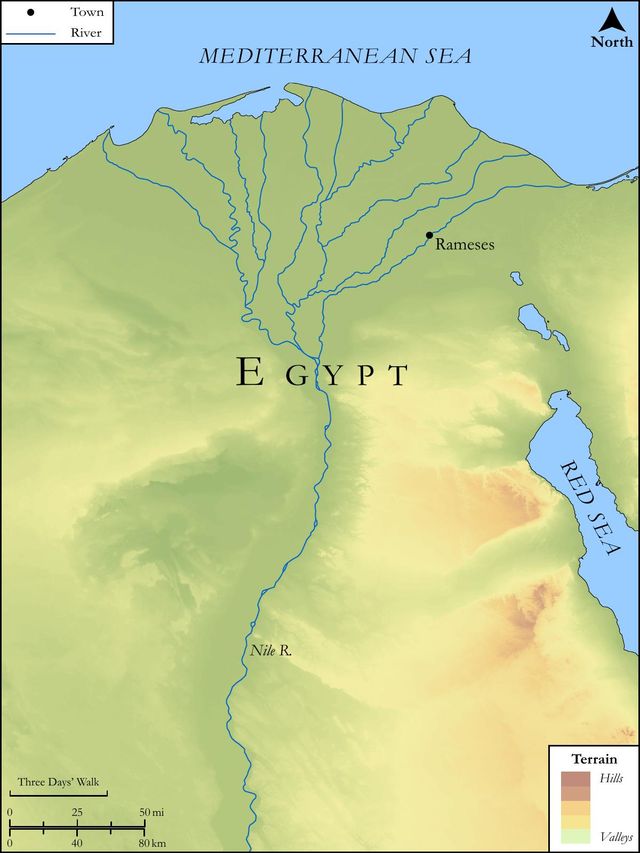
See on the biblical-era maps

Study this verse
Public-domain commentary
Matthew Henry
From his Commentary on the Whole Bible. Henry comments on passages, not single verses — this entry covers Exodus 9:22–35. His four-level outline is real structure in the source text, so it is rendered as structure.
The threatened plague of hail is here summoned by the powerful hand and rod of Moses (Exo 9:22, Exo 9:23), and it obeys the summons, or rather the divine command; for fire and hail fulfil God's word, Psa 148:8. And here we are told,
I.What desolations it made upon the earth.
The thunder, and fire from heaven (or lightning), made it both the more dreadful and the more destroying, Exo 9:23, Exo 9:24. Note, God makes the clouds, not only his store-houses whence he drops fatness on his people, but his magazines whence, when he pleases, he can draw out a most formidable train of artillery, with which to destroy his enemies. He himself speaks of the treasures of hail which he hath reserved against the day of battle and war, Job 38:22, Job 38:23. Woeful havoc this hail made in the land of Egypt. It killed both men and cattle, and battered down, not only the herbs, but the trees, Exo 9:25. The corn that was above ground was destroyed, and that only preserved which as yet had not come up, Exo 9:31, Exo 9:32. Note, God has many ways of taking away the corn in the season thereof (Hos 2:9), either by a secret blasting, or a noisy hail. In this plague the hot thunderbolts, as well as the hail, are said to destroy their flocks, Psa 78:47, Psa 78:48; and see Psa 105:32, Psa 105:33. Perhaps David alludes to this when, describing God's glorious appearances for the discomfiture of his enemies, he speaks of the hailstones and coals of fire he threw among them, Psa 18:12, Psa 18:13. And there is a plan reference to it on the pouring out of the seventh vial, Rev 16:21. Notice is here taken (Exo 9:26) of the land of Goshen's being preserved from receiving any damage by this plague. God has the directing of the pregnant clouds, and causes it to rain or hail on one city and not on another, either in mercy or in judgment.
II.What a consternation it put Pharaoh in. See what effect it had upon him,
1.He humbled himself to Moses in the language of a penitent, Exo 9:27, Exo 9:28. No man could have spoken better. He owns himself on the wrong side in his contest with the God of the Hebrews: "I have sinned in standing it out so long." He owns the equity of God's proceedings against him: The Lord is righteous, and must be justified when he speaks, though he speak in thunder and lightning. He condemns himself and his land: "I and my people are wicked, and deserve what is brought upon us." He begs the prayers of Moses: "Entreat the Lord for me, that this direful plague may be removed." And, lastly, he promises to yield up his prisoners: I will let you go. What could one desire more? And yet his heart was hardened all this while. Note, The terror of the rod often extorts penitent acknowledgments from those who have no penitent affections; under the surprise and smart of affliction, they start up, and say that which is pertinent enough, not because they are deeply affected, but because they know that they should be and that it is meet to be said.
2.Moses, hereupon, becomes an intercessor for him with God. Though he had all the reason in the world to think that he would immediately repent of his repentance, and told him so (Exo 9:30), yet he promises to be this friend in the court of heaven. Note, Even those whom we have little hopes of, yet we should continue to pray for, and to admonish, Sa1 12:23. Observe,
(1.)The place Moses chose for his intercession. He went out of the city (Exo 9:33), not only for privacy in his communion with God, but to show that he durst venture abroad into the field, notwithstanding the hail and lightning which kept Pharaoh and his servants within doors, knowing that every hail-stone had its direction from his God, who meant him no hurt. Note, Peace with God makes men thunderproof, for thunder is the voice of their Father.
(2.)The gesture: He spread abroad his hands unto the Lord - an outward expression of earnest desire and humble expectation. Those that come to God for mercy must stand ready to receive it.
(3.)The end Moses aimed at in interceding for him: That thou mayest know, and be convinced, that the earth is the Lord's (Exo 9:29), that is, that God has a sovereign dominion over all the creatures, that they all are ruled by him, and therefore that thou oughtest to be so. See what various methods God uses to bring men to their proper senses. Judgments are sent, judgments removed, and all for the same end, to make men know that he Lord reigns.
(4.)The success of it.
[1.]He prevailed with God, Exo 9:33. But,
[2.]He could not prevail with Pharaoh: He sinned yet more, and hardened his heart, Exo 9:34, Exo 9:35. The prayer of Moses opened and shut heaven, like Elias's (Jam 5:17, Jam 5:18), and such is the power of God's two witnesses (Rev 11:6); yet neither Moses nor Elias, nor those two witnesses, could subdue the hard hearts of men. Pharaoh was frightened into a compliance by the judgment, but, when it was over, his convictions vanished, and his fair promises were forgotten. Note, Little credit is to be given to confessions upon the rack. Note also, Those that are not bettered by judgments and mercies are commonly made worse.
Continue studying Exodus 9:30 across the web’s major study libraries — every link below opens this exact verse, chapter, or book on the destination site.
Read & Compare
 BibleGatewayThis verse in more than 200 translations and 70 languages.
 Bible.comThe YouVersion reader — hundreds of translations, reading plans, and highlights.
 ESV.orgCrossway's official English Standard Version reader.
 NET BibleThe NET translation with 60,000+ translators' notes on every rendering decision.
 STEP BibleTyndale House's free study tool — original text, vocabulary, and scholarly resources.
 BibliaLogos Bible Software's free web reader.
 USCCBThe New American Bible (Revised Edition) with the U.S. bishops' study notes.
Commentaries
 BibleHub CommentariesDozens of classic commentaries on this verse, gathered on one page.
 StudyLightMore than 100 commentary sets — the largest collection on the web.
 BibleRefPlain-English commentary on what this verse means, verse by verse.
 Enduring WordDavid Guzik's free commentary on this chapter, widely used by Bible teachers.
 Bible Study ToolsVerse commentary alongside Greek and Hebrew study aids.
Original Language & Research
- BibleHub InterlinearThe verse word by word — original language, transliteration, and English.
- BibleHub LexiconEvery word's original-language definition and Strong's entry.
 Blue Letter BibleDeep-study tools — Strong's numbers, concordance, and word studies.
 SefariaThe Hebrew text with Rashi and centuries of Jewish commentary.
Sermons, Hymns & Audio


TrulyRandomVerse is not affiliated with these sites and doesn’t control their content. They’re linked because they’re genuinely useful.
Summary
Exodus 9:30 serves as a profound declaration of God's perfect foreknowledge and Pharaoh's persistent spiritual rebellion, even amidst overwhelming divine judgment. Despite Pharaoh's temporary confession of sin during the devastating hail plague, the Lord reveals that Pharaoh and his servants have not yet developed a genuine, reverential fear of Him, indicating their hearts remain hardened and their repentance superficial. This verse underscores God's sovereignty over human will and sets the stage for further displays of His power against an unyielding adversary.
Context
ShowHideLiterary Context
This verse is a divine declaration delivered by Moses to Pharaoh, immediately following the seventh plague—a catastrophic hail storm that devastated Egypt's crops, livestock, and people (Exodus 9:23-26). Overwhelmed by the severity of this judgment, Pharaoh, for the first time, explicitly confesses his sin and acknowledges the Lord's righteousness, promising to release the Israelites (Exodus 9:27-28). Moses agrees to pray for the cessation of the hail but, in Exodus 9:29, also warns Pharaoh that the land belongs to the Lord. It is in this immediate exchange that God, through Moses, reveals His perfect understanding of Pharaoh's insincere heart in Exodus 9:30, anticipating his continued resistance even after the plague subsides. The subsequent verses (Exodus 9:31-32) describe the specific agricultural damage, while Exodus 9:33-35 confirm Pharaoh's renewed stubbornness once the immediate threat is removed.
Historical & Cultural Context
In ancient Egypt, Pharaoh was considered a divine king, a living god, and the embodiment of the order of the world (Ma'at). His authority was absolute, and his word was law. The plagues, therefore, were not merely natural disasters but direct assaults on Pharaoh's divine status and the gods of Egypt, demonstrating Yahweh's supreme power over all creation and all deities. Pharaoh's confession in Exodus 9:27 was a profound humiliation, a public admission that Yahweh, the God of the enslaved Hebrews, was superior. However, among the Egyptians the concept of "repentance" often involved a pragmatic response to avert disaster rather than a deep, internal transformation. Pharaoh's "fear" was initially terror-driven, a temporary concession to escape immediate suffering, rather than a genuine shift in allegiance or reverence for Yahweh. God's statement in Exodus 9:30 highlights this distinction, revealing that Pharaoh's cultural understanding of appeasing a powerful deity fell short of the biblical "fear of the LORD," which demands humble submission and obedience.
Key Themes
ShowHideThis verse contributes significantly to several overarching themes in Exodus. Foremost is the theme of Divine Sovereignty versus Human Stubbornness. Despite the overwhelming display of God's power through the plagues, Pharaoh's heart remains unyielding, demonstrating God's absolute control over the narrative even in the face of human defiance, as seen in the repeated declarations of God hardening Pharaoh's heart (e.g., Exodus 9:12). It also profoundly explores the Nature of True versus False Repentance. Pharaoh's confession in Exodus 9:27 appears genuine but is quickly revealed by God's insight in Exodus 9:30 to be superficial, driven by duress rather than a transformed will. Central to this is the Importance of the Fear of the Lord, which is presented not as mere terror but as reverential awe and obedient submission, a quality Pharaoh conspicuously lacks. Finally, the verse underscores God's perfect Foreknowledge, as He declares what Pharaoh's heart truly holds, setting the stage for the continued unfolding of His plan for Judgment and Deliverance through the remaining plagues.
Exposition and Analysis
ShowHideKey Word Analysis
ShowHideThis term (H5650) refers to those in a state of servitude or bond-service. In this context, it includes Pharaoh's officials and administrators who carry out his will and are complicit in the oppression of Israel. Their inclusion alongside Pharaoh highlights the collective nature of Egypt's rebellion and the widespread lack of genuine reverence for Yahweh among the ruling elite. It underscores that the divine judgment and the subsequent lack of true fear extend beyond Pharaoh himself to the very heart of the Egyptian system of power.
The verb "know" (H3045) here signifies God's perfect, comprehensive, and certain knowledge. It is not a mere intellectual awareness but an intimate, discerning understanding that penetrates beyond outward appearances and temporary confessions. God's "I know" means He perceives the true, unrepentant state of Pharaoh's heart and his future actions with absolute certainty, demonstrating His omniscience and His ability to see the true motives and intentions that lie beneath superficial displays of compliance.
This word (H3372) carries a dual meaning, encompassing both terror/dread and reverential awe/submission. While Pharaoh certainly experienced the former during the plagues, God's declaration indicates his failure to achieve the latter. The "fear of the LORD" in biblical theology is not merely being afraid of God's power, but a profound, humble respect for His holiness, sovereignty, and authority that leads to obedience, trust, and worship. Pharaoh's lack of this deeper, transformative fear is the root of his continued defiance and spiritual blindness.
Verse Breakdown
ShowHide"But as for thee and thy servants,"
This opening phrase serves as a direct address, pinpointing the specific recipients of God's declaration—Pharaoh and his entire administrative and ruling class. It emphasizes their collective responsibility and culpability in the ongoing defiance against God's command to release Israel. This highlights that the resistance is not merely an individual's stubbornness but a pervasive refusal by the Egyptian leadership.
"I know that ye will not yet fear the LORD God."
This is the core of the divine revelation, a powerful assertion of God's perfect foreknowledge and judgment.
"I know"
God's omniscience is unequivocally stated. He sees beyond Pharaoh's recent, seemingly repentant confession (Exodus 9:27) and discerns the true, unyielding condition of his heart. This is not a prediction based on observation but an absolute certainty derived from divine insight.
"ye will not yet"
The phrase "not yet" (Hebrew: ṭerem) is crucial. It does not imply a future possibility of genuine fear, but rather emphasizes that despite all the overwhelming evidence of God's power and righteousness, the necessary internal transformation for true, reverential fear has not occurred up to this point, nor will it. It underscores the depth of Pharaoh's spiritual blindness and obstinacy, confirming that his "repentance" was merely a temporary, pragmatic response to avert disaster, not a genuine change of heart.
"fear the LORD God"
As analyzed above, this refers to the profound, reverential awe and obedient submission that characterizes a right relationship with the sovereign Creator. Pharaoh's failure to possess this genuine fear is the fundamental reason for his continued defiance and the unfolding of further judgments.
Literary Devices
ShowHideThe verse employs dramatic irony, where the audience is privy to God's perfect knowledge of Pharaoh's insincerity, even as Pharaoh himself has just made a seemingly humble confession. This creates tension and foreshadows the continued conflict, highlighting the stark contrast between human pretense and divine insight. Furthermore, the verse functions as a prophecy, which is immediately fulfilled in the subsequent verses (Exodus 9:34-35) when Pharaoh hardens his heart again as soon as the immediate threat of the plague is removed. This immediate fulfillment reinforces God's absolute foreknowledge and sovereignty over the narrative.
THEOLOGICAL AND THEMATIC CONNECTIONS
ShowHideExodus 9:30 teaches several profound theological truths:
This theme of the fear of the Lord is foundational throughout the biblical narrative.
Reflection and Application
ShowHideExodus 9:30 offers timeless lessons for believers today, challenging us to examine the depth of our own faith and repentance. It reminds us that God sees beyond our outward confessions or temporary promises made under duress. True repentance is not merely expressing regret for consequences, but a fundamental change of heart that leads to a genuine, reverential fear of God and a commitment to obey Him. This verse calls us to live with integrity, knowing that God discerns our true motives and the hidden depths of our commitment. Our faith should be rooted in a deep awe of who God is, leading to willing submission to His will, rather than a transactional relationship based on avoiding discomfort.
Questions for Reflection
ShowHideFAQ
ShowHideDoes "not yet" imply Pharaoh could have eventually feared the Lord?
ShowHideThe phrase "not yet" (Hebrew: ṭerem) in this context does not suggest a future possibility of genuine fear. Instead, it highlights the current, persistent state of Pharaoh's heart despite overwhelming evidence. It means that up to this point, and by implication, moving forward, Pharaoh has not and will not develop the true, reverential fear of the Lord that leads to obedience. God's declaration here is a statement of His foreknowledge of Pharaoh's unyielding nature, not an open invitation for future change.
If God knew Pharaoh wouldn't fear Him, why did He continue with the plagues?
ShowHideThe plagues served multiple purposes beyond simply eliciting Pharaoh's "fear." They were:
Christ-Centered Fulfillment
ShowHideExodus 9:30, with its emphasis on God's perfect knowledge of the human heart and the vital importance of "fearing the LORD," finds profound fulfillment and amplification in the person and work of Jesus Christ. God's Knowledge of the Heart in Christ: Jesus, being God incarnate, perfectly embodies the divine omniscience seen in Exodus 9:30. He consistently knew the thoughts and intentions of people, seeing beyond outward appearances to the true state of their hearts (John 2:24-25; Luke 5:22). Just as God knew Pharaoh's insincerity, Jesus knew the true motives of those who approached him, whether with genuine faith or deceptive intent. The True "Fear of the Lord" Fulfilled in Christ: While Pharaoh failed to genuinely fear the Lord, Jesus perfectly lived out this concept. His entire life was one of perfect reverence, submission, and obedience to the Father's will, even to the point of death on the cross (Philippians 2:8). He did not merely dread consequences but lived in perfect awe and communion with God. Through His atoning work, Christ makes it possible for humanity, whose hearts are naturally rebellious like Pharaoh's (Romans 3:10-12), to receive a new heart and the Holy Spirit, enabling them to truly "fear the Lord" in a saving, obedient way (Jeremiah 32:40). Genuine Repentance through Christ: Pharaoh's superficial repentance contrasts sharply with the call to genuine repentance preached by Jesus and His apostles (Mark 1:15; Acts 2:38). True repentance, enabled by the Holy Spirit, involves a turning from sin and self-reliance to Christ, leading to a transformed life marked by the fear of God and obedience to His commands. The gospel offers not just relief from consequences, but a radical transformation of the heart, allowing us to truly know and fear the Lord.