


Exodus 39:8
Bible text: King James Version (1769 Blayney text) · Public domain
Bible text: King James Version with Strong's numbers · Public domain
Bible text: Berean Standard Bible · Public domain
Bible text: American Standard Version (1901) · Public domain
Bible text: World English Bible, Messianic edition · Public domain
Bible text: Geneva Bible (1599) · Public domain
Bible text: Young's Literal Translation · Public domain
- וַיַּעַשׂvai·Ya·'asand he madeH6213Conj-w ¦ V-Qal-ConsecImperf-3msVerb Qal Consecutive Imperfect 3rd Singular Masculineוַandיַּעַשׂhe made
- אֶת'et<obj.>H853DirObjMParticle Object Indicator
- הַחֹשֶׁןha·Cho·shenthe breastpieceH2833Art ¦ N-msNoun Singular Masculine Absoluteהַtheחֹשֶׁןbreastpiece
- מַעֲשֵׂהma·'a·Seh[the] work ofH4639N-mscNoun Singular Masculine Construct
- חֹשֵׁבcho·Sheva skillful workerH2803V-Qal-Prtcpl-msVerb Qal Participle Singular Masculine Absolute
- כְּמַעֲשֵׂהke·ma·'a·Sehlike [the] work ofH4639Prep-k ¦ N-mscNoun Singular Masculine Constructכְּlikeמַעֲשֵׂה[the] work of
- אֵפֹד'e·Fod[the] ephodH646N-msNoun Singular Masculine Absolute
- זָהָבza·HavgoldH2091N-msNoun Singular Masculine Absolute
- תְּכֵלֶתte·Khe·letviolet stuffH8504N-fsNoun Singular Feminine Absolute
- וְאַרְגָּמָןve·'ar·ga·Manand purpleH713Conj-w ¦ N-msNoun Singular Masculine Absoluteוְandאַרְגָּמָןpurple
- וְתוֹלַעַתve·to·La·'atand scarlet stuff ofH8438Conj-w ¦ N-fscNoun Singular Feminine Constructוְandתוֹלַעַתscarlet stuff of
- שָׁנִיsha·NiscarletH8144N-msNoun Singular Masculine Absolute
- וְשֵׁשׁve·Sheshand fine linenH8336Conj-w ¦ N-msNoun Singular Masculine Absoluteוְandשֵׁשׁfine linen
- מָשְׁזָרma·she·ZartwistedH7806V-Hophal-PassPrtcpl-msVerb Hophal Participle Passive Singular Masculine Absolute
English is a literal word-by-word gloss of the Hebrew, not the KJV's wording. Why?
This is the original text the KJV's translators worked from — each Hebrew word with its own literal English meaning in this verse, prepared by scholars at Tyndale House, Cambridge. The KJV translates whole sentences, not word by word, so its wording differs: one Hebrew word can become several English words, and the KJV may choose “the LORD” where the gloss reads “Yahweh”. Both are faithful — they answer different questions. For the KJV's own rendering, switch to the KJV text.
Details
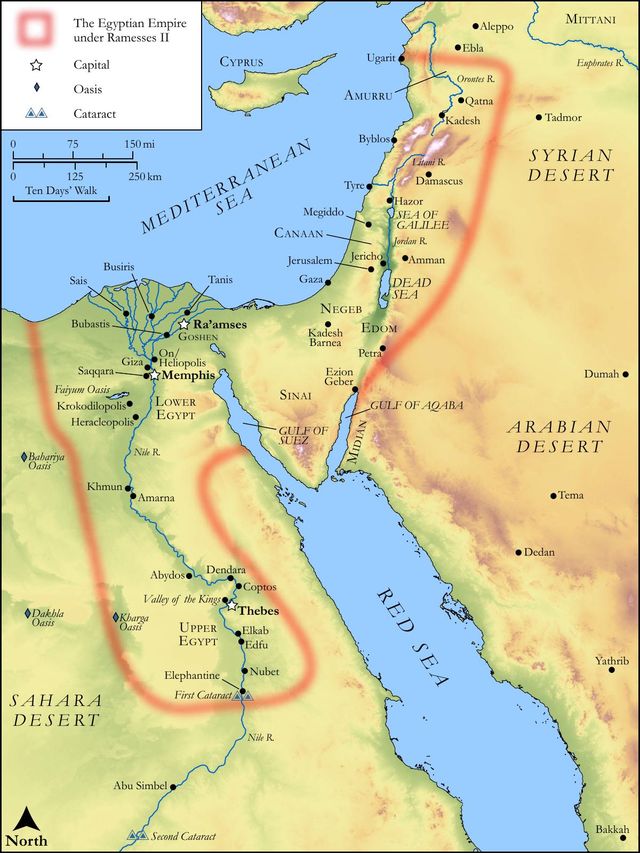
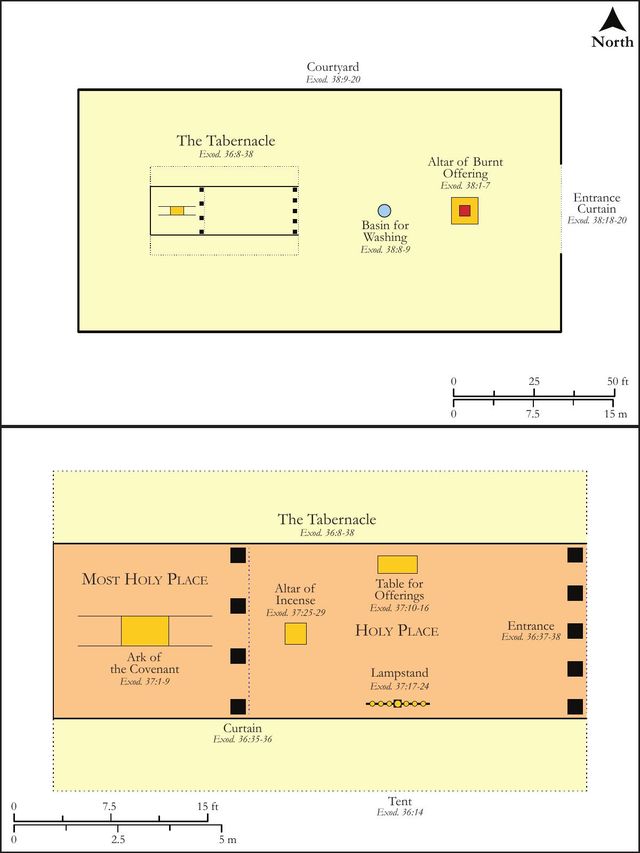
See on the biblical-era maps
Study this verse
Public-domain commentary
Matthew Henry
From his Commentary on the Whole Bible. Henry comments on passages, not single verses — this entry covers Exodus 39:1–31.
In this account of the making of the priests' garments, according to the instructions given (ch. 28), we may observe, 1. That the priests' garments are called here clothes of service, Exo 39:1. Note, Those that wear robes of honour must look upon them as clothes of service; for from those upon whom honour is put service is expected. It is said of those that are arrayed in white robes that they are before the throne of God, and serve him day and night in his temple, Rev 7:13, Rev 7:15. Holy garments were not made for men to sleep in, or to strut in, but to do service in; and then they are indeed for glory and beauty. The Son of man himself came not to be ministered unto, but to minister. 2. That all the six paragraphs here, which give a distinct account of the making of these holy garments, conclude with those words, as the Lord commanded Moses, Exo 39:5, Exo 39:7, Exo 39:21, Exo 39:26, Exo 39:29, Exo 39:31. The like is not in any of the foregoing accounts, as if in these, more than any other of the appurtenances of the tabernacle, they had a particular regard to the divine appointment, both for warrant and for direction. It is an intimation to all the Lord's ministers to make the word of God their rule in all their ministrations, and to act in observance of and obedience to the command of God. 3. That these garments, in conformity to the rest of the furniture of the tabernacle, were very rich and splendid; the church in its infancy was thus taught, thus pleased, with the rudiments of this world; but now under the gospel, which is the ministration of the Spirit, to affect and impose such pompous habits as the church of Rome does, under pretence of decency and instruction, is to betray the liberty wherewith Christ has made us free, and to entangle the church again in the bondage of those carnal ordinances which were imposed only till the time of reformation. 4. That they were all shadows of good things to come, but the substance is Christ, and the grace of the gospel; when therefore the substance has come, it is a jest to be fond of the shadow. (1.) Christ is our great high-priest; when he undertook the work of our redemption, he put on the clothes of service - he arrayed himself with the gifts and graces of the Spirit, which he received not by measure - girded himself with the curious girdle of resolution, to go through with his undertaking - charged himself with the curious girdle of resolution, to go through with his undertaking - charged himself with all God's spiritual Israel, bore them on his shoulders, carried them in his bosom, laid them near his heart, engraved them on the palms of his hands, and presented them in the breast-plate of judgment unto his Father. And (lastly) he crowned himself with holiness to the Lord, consecrating his whole undertaking to the honour of his Father's holiness: now consider how great this man is. (2.) True believers are spiritual priests. The clean linen with which all their clothes of service must be made is the righteousness of saints (Rev 19:8), and Holiness to the Lord must be so written upon their foreheads that all who converse with them may see, and say, that they bear the image of God's holiness, and are devoted to the praise of it.
Continue studying Exodus 39:8 across the web’s major study libraries — every link below opens this exact verse, chapter, or book on the destination site.
Read & Compare
 BibleGatewayThis verse in more than 200 translations and 70 languages.
 Bible.comThe YouVersion reader — hundreds of translations, reading plans, and highlights.
 ESV.orgCrossway's official English Standard Version reader.
 NET BibleThe NET translation with 60,000+ translators' notes on every rendering decision.
 STEP BibleTyndale House's free study tool — original text, vocabulary, and scholarly resources.
 BibliaLogos Bible Software's free web reader.
 USCCBThe New American Bible (Revised Edition) with the U.S. bishops' study notes.
Commentaries
 BibleHub CommentariesDozens of classic commentaries on this verse, gathered on one page.
 StudyLightMore than 100 commentary sets — the largest collection on the web.
 BibleRefPlain-English commentary on what this verse means, verse by verse.
 Enduring WordDavid Guzik's free commentary on this chapter, widely used by Bible teachers.
 Bible Study ToolsVerse commentary alongside Greek and Hebrew study aids.
Original Language & Research
- BibleHub InterlinearThe verse word by word — original language, transliteration, and English.
- BibleHub LexiconEvery word's original-language definition and Strong's entry.
 Blue Letter BibleDeep-study tools — Strong's numbers, concordance, and word studies.
 SefariaThe Hebrew text with Rashi and centuries of Jewish commentary.
Sermons, Hymns & Audio


TrulyRandomVerse is not affiliated with these sites and doesn’t control their content. They’re linked because they’re genuinely useful.
Summary
Exodus 39:8 meticulously details the construction of the high priest's breastplate, a pivotal component of his sacred vestments, crafted with extraordinary skill and specific, divinely appointed materials. This verse highlights the faithful and precise execution of God's intricate instructions for the Tabernacle and its furnishings, underscoring the profound artistry and deep symbolic significance inherent in each element designed for holy worship and the high priest's mediatorial office.
Context
ShowHideLiterary Context
Exodus 39 is situated within the latter portion of the book, which transitions from God's detailed commands for the Tabernacle's construction and priestly garments (beginning in Exodus 25) to the actual fulfillment of these instructions by the Israelite artisans. This chapter, specifically, recounts the fabrication of the sacred vestments for Aaron and his sons, emphasizing the meticulous adherence to the divine blueprint. The breastplate, first commanded in Exodus 28:15, is a central piece, and its creation here serves as a testament to the artisans' skill and their unwavering obedience to God's will. The recurring phrase "as the LORD commanded Moses" throughout Exodus 39 reinforces the theme of divine authority and human faithfulness in the execution of sacred tasks.
Historical & Cultural Context
In Israel, priestly attire was far more than mere clothing; it was a potent symbol of status, authority, and the sacred nature of the wearer's office, often reflecting the deity they served. The materials specified for the Tabernacle and its priestly garments—gold, precious stones, fine linens, and richly dyed wools—were exceedingly valuable and frequently associated with royalty and divinity in the broader cultural milieu, thereby reflecting the supreme majesty of Yahweh, the God of Israel. The term "cunning work" (Hebrew: maʻăseh choshev) denotes a highly specialized form of weaving or embroidery, indicating a level of craftsmanship that was not merely human ingenuity but divinely inspired and enabled, as evidenced by God's empowerment of artisans like Bezalel and Oholiab, whom He filled with wisdom, understanding, and knowledge for this very task (Exodus 31:3-6). This extraordinary attention to detail underscored the absolute holiness of God and the profound seriousness required in approaching His presence.
Key Themes
ShowHideThis verse contributes to several overarching themes within Exodus and the Pentateuch. Foremost is the theme of Divine Instruction and Human Obedience, as the meticulous creation of the breastplate demonstrates the Israelites' faithfulness in following God's precise commands. It also highlights the theme of Holiness and Separation, as the sacred garments set the high priest apart for his unique mediatorial role, emphasizing the purity required to approach a holy God. The use of precious and symbolic materials points to the Glory and Majesty of God, reflecting His inherent worth and the beauty He desires in worship. Furthermore, the breastplate's function of bearing the names of the tribes (as described in Exodus 28:29) foreshadows the theme of Representation and Intercession, a vital aspect of the high priest's office.
Exposition and Analysis
ShowHideKey Word Analysis
ShowHideThis term refers specifically to the ceremonial gorget worn by the high priest over the ephod. Its name, potentially deriving from a root meaning "to contain" or "to sparkle," aptly describes its function: holding the twelve precious stones representing the tribes of Israel and containing the Urim and Thummim. It was a central element of the high priest's attire, symbolizing his role in carrying the names and concerns of the people into God's presence.
The phrase combines maʻăseh (H4639), meaning "work" or "deed," with châshab (H2803), a root meaning "to plait or interpenetrate," "to weave," or "to contrive." This denotes a highly skilled, intricate, and artful design, specifically referring to the work of a master weaver or embroiderer who could integrate complex patterns directly into the fabric rather than merely applying them to the surface. It signifies a supreme degree of artistic and technical proficiency, indicating that the breastplate was not merely functional but a masterpiece of sacred art, reflecting divine inspiration and excellence.
Derived from an unused root meaning "to shimmer," zâhâb refers to the precious metal, gold. In the context of the Tabernacle and priestly garments, gold consistently symbolizes divinity, preciousness, purity, and the unblemished glory of God. Its inclusion signifies the sacredness and supreme value of the breastplate and the office it adorned.
Verse Breakdown
ShowHide"And he made the breastplate"
This initial clause directly states the action of the artisans, likely under the inspired leadership of Bezalel and Oholiab. It signifies the faithful execution of God's command to construct this vital piece of the high priest's attire, marking the transition from divine instruction to tangible, sacred artifact.
"[of] cunning work, like the work of the ephod;"
This specifies the exceptional quality and intricacy of the craftsmanship. The breastplate was to be fashioned with the same high standard of "cunning work" (skillful, interwoven design) as the ephod, indicating a consistent demand for excellence and precision in all the high priest's most significant garments. This highlights the divine standard of beauty and meticulousness required for sacred objects.
"[of] gold, blue, and purple, and scarlet, and fine twined linen."
This comprehensive list details the rich, symbolic materials used in the breastplate's construction. Each material carried profound theological meaning: gold for divinity and preciousness; blue for heaven and God's glory; purple for royalty and majesty; scarlet for life, blood, and atonement; and fine twined linen for purity and righteousness. Their combination created a garment that visually communicated the grandeur of God and the sacredness of the high priest's mediatorial office.
Literary Devices
ShowHideExodus 39:8 employs several literary devices to convey its profound meaning and significance. Symbolism is paramount, as each material—gold, blue, purple, scarlet, and fine twined linen—carries deep theological associations that point to God's character, the nature of sin, and the path to atonement. The phrase "like the work of the ephod" exemplifies Repetition, emphasizing the uniformity and exceptionally high standard of craftsmanship required for all the sacred garments, thereby reinforcing the idea that God's commands were to be followed with absolute precision and excellence. Furthermore, the detailed enumeration of the specific materials serves as a form of Merism, where listing components (colors and materials) represents the comprehensive and specific nature of God's divine design for the breastplate. This meticulous description collectively underscores the divine demand for excellence and holiness in all aspects of worship.
Theological and Thematic Connections
ShowHideExodus 39:8 powerfully illustrates God's demand for excellence, beauty, and precision in worship, reflecting His own perfect and glorious character. The meticulous craftsmanship and the rich symbolism of the materials used for the breastplate underscore the absolute holiness of God and the profound seriousness required in approaching His presence. The breastplate, which would bear the names of the tribes of Israel on the high priest's heart, also highlights his representative and mediatorial role, bearing the people's concerns before God. This divinely ordained function powerfully foreshadows the ultimate intercession on behalf of God's people by a greater High Priest.
Reflection and Application
ShowHideThe creation of the breastplate, with its "cunning work" and rich symbolic materials, serves as a profound and enduring reminder that God deserves our utmost excellence in every facet of our lives, particularly in our worship and service. Just as the Israelite artisans were divinely gifted and meticulously followed God's precise blueprint for the Tabernacle and its sacred furnishings, so too are believers today called to steward their unique gifts and talents with diligence and integrity. Our lives are meant to reflect the holiness and glory of God, whether in our spiritual disciplines, our relationships, our vocations, or our contributions to the community of faith. This passage challenges us to consider the intentionality and quality we bring to all our endeavors, recognizing that our lives, like the breastplate, are intended to be a beautiful, purposeful offering, bearing witness to God's character and representing His presence in a broken world.
Questions for Reflection
ShowHideFAQ
ShowHideWhat was the primary purpose of the high priest's breastplate?
ShowHideThe primary purpose of the high priest's breastplate was multifaceted. First, it completed his ceremonial attire, signifying his unique office and holiness before God. More significantly, it was designed to bear the names of the twelve tribes of Israel before the Lord, accomplished by twelve precious stones, each engraved with a tribal name, set into the breastplate (Exodus 28:21). This symbolized the high priest's role in representing and interceding for the entire nation in God's presence. It also contained the Urim and Thummim, mysterious objects used for discerning God's will and judgment (Exodus 28:30).
Why were specific colors and materials chosen for the breastplate?
ShowHideThe specific colors (blue, purple, scarlet) and materials (gold, fine twined linen) were chosen for their profound symbolic meanings, each pointing to a different aspect of God's character, the nature of sin, or the path to redemption. Gold symbolized divinity, preciousness, and purity. Blue represented heaven, the divine, and God's glory. Purple denoted royalty, majesty, and kingly authority. Scarlet often pointed to life, blood, and atonement, powerfully foreshadowing sacrifice. Fine twined linen signified purity, righteousness, and holiness. Together, these elements created a rich visual theological statement, emphasizing the grandeur of God's presence and the weighty responsibility of the high priest as mediator.
Christ-Centered Fulfillment
ShowHideThe meticulous creation of the high priest's breastplate, with its exquisite "cunning work" and rich symbolic materials, finds its ultimate and perfect fulfillment in the person and work of Jesus Christ. The Old Covenant high priest, bearing the names of Israel on his heart, served as a powerful type of the true and eternal High Priest. Unlike the Levitical priests who offered animal sacrifices and wore symbolic garments, Jesus entered the true heavenly sanctuary, not with the blood of goats and calves, but with His own precious blood, securing an eternal redemption for His people (Hebrews 9:11-12). The gold, symbolizing divinity and preciousness, points directly to Christ's divine nature as the Son of God. The blue, representing heaven, foreshadows His heavenly origin and His glorious ascension to the Father's right hand (Acts 1:9-11). The purple, denoting royalty, proclaims Jesus as the sovereign King of Kings and Lord of Lords, whose dominion is eternal (Revelation 19:16). The scarlet, signifying blood and atonement, powerfully prefigures His sacrificial death on the cross, through which He shed His blood for the forgiveness of sins, establishing a new covenant (Matthew 26:28). Finally, the fine twined linen, representing purity and righteousness, speaks of Christ's perfect, sinless life, which He offered as a spotless lamb, redeeming us not with perishable things but with His own precious blood (1 Peter 1:18-19). Thus, the breastplate, a masterpiece of human skill and divine design, beautifully anticipates the perfect person and work of Christ, who truly bears His people on His heart, intercedes for them eternally, and provides the ultimate and enduring access to God.