


Exodus 39:38
Bible text: King James Version (1769 Blayney text) · Public domain
Bible text: Berean Standard Bible · Public domain
Bible text: American Standard Version (1901) · Public domain
Bible text: World English Bible, Messianic edition · Public domain
Bible text: Geneva Bible (1599) · Public domain
Bible text: Young's Literal Translation · Public domain
- וְאֵתve·'Etand <obj.>H853Conj-w ¦ DirObjMParticle Object Indicatorוְandאֵת<obj.>
- מִזְבַּחmiz·Bach[the] altar ofH4196N-mscNoun Singular Masculine Construct
- הַזָּהָבha·za·Hav<the> goldH2091Art ¦ N-msNoun Singular Masculine Absoluteהַ<the>זָּהָבgold
- וְאֵתve·'Etand <obj.>H853Conj-w ¦ DirObjMParticle Object Indicatorוְandאֵת<obj.>
- שֶׁמֶןShe·men[the] oil ofH8081N-mscNoun Singular Masculine Construct
- הַמִּשְׁחָהha·mish·Chah<the> anointingH4888Art ¦ N-fsNoun Singular Feminine Absoluteהַ<the>מִּשְׁחָהanointing
- וְאֵתve·'Etand <obj.>H853Conj-w ¦ DirObjMParticle Object Indicatorוְandאֵת<obj.>
- קְטֹרֶתke·To·ret[the] incense ofH7004N-fscNoun Singular Feminine Construct
- הַסַּמִּיםha·sa·Mimthe perfume<s>H5561Art ¦ N-mpNoun Plural Masculine Absoluteהַtheסַּמִּיםperfume<s>
- וְאֵתve·'Etand <obj.>H853Conj-w ¦ DirObjMParticle Object Indicatorוְandאֵת<obj.>
- מָסַךְma·Sakh[the] screen ofH4539N-mscNoun Singular Masculine Construct
- פֶּתַחPe·tach[the] entrance ofH6607N-mscNoun Singular Masculine Construct
- הָאֹהֶלha·'O·helthe tentH168Art ¦ N-msNoun Singular Masculine Absoluteהָtheאֹהֶלtent
English is a literal word-by-word gloss of the Hebrew, not the KJV's wording. Why?
This is the original text the KJV's translators worked from — each Hebrew word with its own literal English meaning in this verse, prepared by scholars at Tyndale House, Cambridge. The KJV translates whole sentences, not word by word, so its wording differs: one Hebrew word can become several English words, and the KJV may choose “the LORD” where the gloss reads “Yahweh”. Both are faithful — they answer different questions. For the KJV's own rendering, switch to the KJV text.
Details
See on the biblical-era maps

Study this verse
Public-domain commentary
Matthew Henry
From his Commentary on the Whole Bible. Henry comments on passages, not single verses — this entry covers Exodus 39:32–43. His two-level outline is real structure in the source text, so it is rendered as structure.
Observe here, I. The builders of the tabernacle made very good despatch. It was not much more than five months from the beginning to the finishing of it. Though there was a great deal of fine work about it, such as is usually the work of time, embroidering and engraving, not only in gold, but in precious stones, yet they went through with it in a little time. Church-work is usually slow work, but they made quick work of this, and yet did it with the greatest exactness imaginable. For, 1. Many hands were employed, all unanimous, and not striving with each other. This expedited the business, and made it easy. 2. The workmen were taught of God, and so were kept from making blunders, which would have retarded them. 3. The people were hearty and zealous in the work, and impatient till it was finished. God had prepared their hearts, and then the thing was done suddenly, Ch2 29:36. Resolution and industry, and a cheerful application of mind, will, by the grace of God, bring a great deal of good work to pass in a little time, in less than one would expect.
II.They punctually observed their orders, and did not in the least vary from them.
They did it according to all that the Lord commanded Moses, Exo 39:32, Exo 39:42. Note, God's work must be done, in every thing, according to his own will. His institutions neither need nor admit men's inventions to make them either more beautiful or more likely to answer the intention of them. Add thou not unto his words. God is pleased with willing worship, but not with will-worship.
III.They brought all their work to Moses, and submitted it to his inspection and censure, Exo 39:33.
He knew what he had ordered them to make; and now the particulars were called over, and all produced, that Moses might see both that they had made all, omitting nothing, and that they had made all according to the instructions given them, and that, if they had made a mistake in any thing, it might be forthwith rectified. Thus they showed respect to Moses, who was set over them in the Lord; not objecting that Moses did not understand such work, and therefore that there was no reason for submitting it to his judgment. No, that God who gave them so much knowledge as to do the work gave them also so much humility as to be willing to have it examined and compared with the model. Moses was in authority, and they would pay a deference to his place. The spirit of the prophets is subject to the prophets. And besides, though they knew how to do the work better than Moses, Moses had a better and more exact idea of the model than they had, and therefore they could not be well pleased with their own work, unless they had his approbation. Thus in all the services of religion we should labour to be accepted of the Lord.
IV.Moses, upon search, found all done according to the rule, Exo 39:43.
Moses, both for their satisfaction and for his own, did look upon all the work, piece by piece, and behold they had done it according to the pattern shown him, for the same Being that showed him the pattern guided their hand in the work. All the copies of God's grace exactly agree with the original of his counsels: what God works in us, and by us, is the fulfilling of the good pleasure of his own goodness; and when the mystery of God shall be finished, and all his performances come to be compared with his purposes, it will appear that behold all is done according to the counsel of his own will, not one iota or tittle of which shall fall to the ground, or be varied from.
V.Moses blessed them.
1.He commended them, and signified his approbation of all they had done. He did not find fault where there was none, as some do, who think they disparage their own judgment if they do not find something amiss in the best and most accomplished performance. In all this work it is probable there might have been found here and there a stitch amiss, and a stroke awry, which would have served for an over-curious and censorious critic to animadvert upon; but Moses was too candid to notice small faults where there were no great ones. Note, All governors must be a praise to those that do well, as well as a terror to evil-doers. Why should any take a pride in being hard to be pleased?
2.He not only praised them, but prayed for them. He blessed them as one having authority, for the less is blessed of the better. We read not of any wages that Moses paid them for their work, but this blessing he gave them. For, though ordinarily the labourer be worthy of his hire, yet in this case, 1. They wrought for themselves. The honour and comfort of God's tabernacle among them would be recompence enough. If thou be wise, thou shalt be wise for thyself. 2. They had their meat from heaven on free-cost, for themselves and their families, and their raiment waxed not old upon them; so that they neither needed wages nor had reason to expect any. Freely you have received, freely give. The obligations we lie under, both in duty and interest, to serve God, should be sufficient to quicken us to our work, though we had not a reward in prospect. But, 3. This blessing, in the name of the Lord, was wages enough for all their work. Those whom God employs he will bless, and those whom he blesses are blessed indeed. The blessing he commands is life for evermore.
Continue studying Exodus 39:38 across the web’s major study libraries — every link below opens this exact verse, chapter, or book on the destination site.
Read & Compare
 BibleGatewayThis verse in more than 200 translations and 70 languages.
 Bible.comThe YouVersion reader — hundreds of translations, reading plans, and highlights.
 ESV.orgCrossway's official English Standard Version reader.
 NET BibleThe NET translation with 60,000+ translators' notes on every rendering decision.
 STEP BibleTyndale House's free study tool — original text, vocabulary, and scholarly resources.
 BibliaLogos Bible Software's free web reader.
 USCCBThe New American Bible (Revised Edition) with the U.S. bishops' study notes.
Commentaries
 BibleHub CommentariesDozens of classic commentaries on this verse, gathered on one page.
 StudyLightMore than 100 commentary sets — the largest collection on the web.
 BibleRefPlain-English commentary on what this verse means, verse by verse.
 Enduring WordDavid Guzik's free commentary on this chapter, widely used by Bible teachers.
 Bible Study ToolsVerse commentary alongside Greek and Hebrew study aids.
Original Language & Research
- BibleHub InterlinearThe verse word by word — original language, transliteration, and English.
- BibleHub LexiconEvery word's original-language definition and Strong's entry.
 Blue Letter BibleDeep-study tools — Strong's numbers, concordance, and word studies.
 SefariaThe Hebrew text with Rashi and centuries of Jewish commentary.
Sermons, Hymns & Audio


TrulyRandomVerse is not affiliated with these sites and doesn’t control their content. They’re linked because they’re genuinely useful.
Summary
Exodus 39:38 is a concise inventory verse, meticulously detailing the completion of several sacred components of the Tabernacle: the golden altar, the anointing oil, the sweet incense, and the hanging for the Tabernacle door. This verse is part of a larger record confirming that all elements of the sanctuary were prepared precisely according to God's divine commands given to Moses on Mount Sinai, signifying the Israelites' faithful obedience in establishing a holy dwelling place for the Lord among them.
Context
ShowHideLiterary Context
Exodus 39 marks the culmination of the detailed instructions for the Tabernacle's construction and the priestly garments, which were first outlined in Exodus 25-31. Having meticulously described the design and materials, the narrative now shifts to the execution of these plans by the skilled craftsmen, Bezalel and Aholiab, and their assistants. Verses 32-43 of this chapter serve as a comprehensive checklist, affirming that every single item, from the large structural components to the smallest furnishings, was brought to Moses for final inspection. The recurring refrain, "as the LORD commanded Moses" (e.g., Exodus 39:32, Exodus 39:42-43), underscores the paramount importance of precise obedience to divine revelation in the establishment of God's dwelling place and the system of worship. This verse, therefore, functions as a specific itemization within this larger report of completion and presentation.
Historical & Cultural Context
The construction of the Tabernacle occurred during Israel's nomadic journey through the wilderness, following their miraculous deliverance from Egyptian bondage. Among the nations round about, temples and sanctuaries were common, serving as dwelling places for their gods and centers of religious life. However, Israel's Tabernacle was unique in its portability, reflecting God's dynamic presence with His people as they journeyed, and in its specific divine blueprint, which distinguished it from pagan temples. The meticulous detail in its construction, including the items listed in Exodus 39:38, emphasized the absolute holiness of God and the sacredness required in approaching Him. The materials, craftsmanship, and ritual objects were not arbitrary but were divinely ordained to facilitate a holy encounter between a holy God and His redeemed, yet fallen, people. The very existence of the Tabernacle signified God's covenant faithfulness and His desire to dwell in the midst of Israel, setting them apart from all other nations.
Key Themes
ShowHideThis verse contributes significantly to several overarching themes within Exodus and the Pentateuch. Foremost is the theme of Obedience to Divine Command, highlighted by the repeated refrain "as the LORD commanded Moses" throughout Exodus 39. Every detail, down to the anointing oil and incense, was precisely executed according to God's blueprint, emphasizing that true worship and service must align with divine revelation. Secondly, the verse underscores the theme of God's Holiness and Presence. The sacred items listed, particularly the golden altar and the anointing oil, were integral to creating a holy space where a holy God could dwell among His people. The careful preparation of these elements reinforced the sacred boundary between the divine and the human, and the meticulousness required to approach God. Finally, the verse speaks to the theme of Worship and Atonement, as these items were essential for the sacrificial system and daily rituals that enabled Israel to maintain covenant relationship with God (e.g., Exodus 30:7-8).
Exposition and Analysis
ShowHideKey Word Analysis
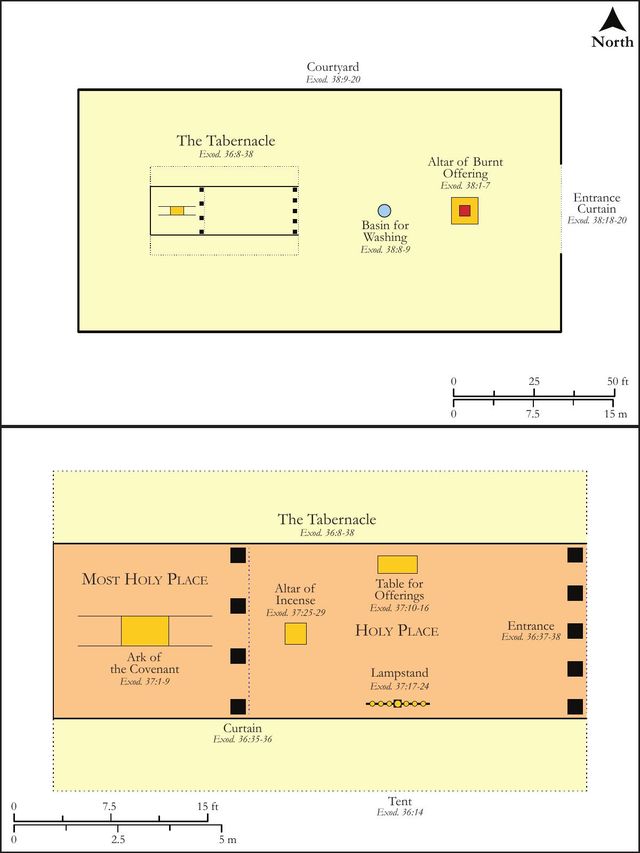
ShowHideFrom the root meaning "to sacrifice," this term refers to a raised structure for offerings. In this specific context, it denotes the "golden altar" (H2091, zâhâb), also known as the Altar of Incense. Unlike the bronze altar of burnt offering in the outer court, this altar was located in the Holy Place, made of acacia wood overlaid with pure gold, and was exclusively for the burning of sacred incense, symbolizing ascending prayers and worship rather than animal sacrifice.
Derived from the verb "to anoint," this word refers to the act of unction or the consecrated substance itself. Here, it specifically denotes the holy anointing oil (H8081, shemen), a specially compounded oil whose recipe was divinely given in Exodus 30:22-33. Its purpose was to consecrate and set apart the Tabernacle, its furnishings, and the priests for sacred service, signifying divine appointment and endowment for holy purpose.
This term refers to a fumigation or aromatic offering. In this verse, it is qualified as "sweet incense" (H5561, çam), signifying the specially prepared aromatic blend prescribed in Exodus 30:34-38. This sacred incense was burned daily on the golden altar, its rising smoke serving as a perpetual act of worship and a powerful symbol of the prayers of the saints ascending to God, pleasing to the Lord.
Verse Breakdown
ShowHide"And the golden altar"
This phrase identifies the Altar of Incense, a central piece of furniture in the Holy Place. Its construction from gold-overlaid acacia wood signifies its purity and value in the worship of God, distinct from the bronze altar of sacrifice.
"and the anointing oil"
This refers to the sacred oil used for the consecration and sanctification of the Tabernacle, its vessels, and the priests. Its inclusion here confirms its readiness for the solemn act of setting apart these elements for divine service.
"and the sweet incense"
This specifies the holy aromatic compound prepared for burning on the golden altar. Its presence indicates that the means for daily worship and the symbolic offering of prayer were fully prepared.
"and the hanging for the tabernacle door"
This denotes the colorful, embroidered curtain (H4539, mâçâk) that served as the entrance to the Holy Place, the main tent (H168, ʼôhel) of the Tabernacle. Its completion signifies the establishment of a defined and sacred entryway into God's dwelling, controlling access and visually marking the boundary between the profane and the holy.
Literary Devices
ShowHideExodus 39:38 primarily employs Inventory/List as a literary device. This verse, along with others in the chapter, functions as a detailed accounting of the completed Tabernacle components. This meticulous listing underscores the thoroughness with which the divine instructions were followed, leaving no room for omission or error. Furthermore, Symbolism is inherent in each item mentioned. The "golden altar" symbolizes prayer and worship; the "anointing oil" symbolizes consecration and the setting apart for holy service; the "sweet incense" symbolizes the ascending prayers of the saints; and the "hanging for the tabernacle door" symbolizes the necessary, divinely ordained access point into God's presence. The broader context of Exodus 39 also features Repetition, particularly the phrase "as the LORD commanded Moses," which serves to emphasize the unwavering obedience of the craftsmen and the divine authority behind every detail of the Tabernacle's construction.
Theological and Thematic Connections
ShowHideExodus 39:38, as part of the Tabernacle's completion, profoundly emphasizes God's holiness, His desire for intimate communion with His people, and the divinely appointed means by which sinful humanity could approach a holy God. Each item listed—the altar of incense, anointing oil, sacred incense, and the entrance curtain—was not merely functional but deeply symbolic, pointing to the necessity of prayer, consecration, and a divinely ordained pathway for worship. These elements underscored the meticulousness required in approaching God, reflecting His perfect nature and the serious nature of sin. They served as tangible reminders that access to God was not casual but predicated on His gracious provision and Israel's obedient adherence to His commands, foreshadowing the ultimate and perfect access provided through Christ.
Reflection and Application
ShowHideThe meticulous detail in Exodus 39:38 and the entire Tabernacle account serves as a profound reminder of God's character: He is a God of order, holiness, and intentionality. For believers today, this passage calls us to a similar intentionality and reverence in our spiritual lives. Just as the golden altar was dedicated to prayer, we are encouraged to cultivate a vibrant and consistent prayer life, recognizing it as our spiritual incense ascending to God. The anointing oil, symbolizing consecration, reminds us that as believers, we are set apart by the Holy Spirit for God's purposes, called to live lives of holiness and devotion. The "hanging for the tabernacle door" reminds us that access to God is not arbitrary but through the divinely appointed way. Our worship, our service, and our daily walk should reflect the same care and obedience that characterized the construction of the Tabernacle, honoring God in every detail of our lives.
Questions for Reflection
ShowHideFAQ
ShowHideWhat was the purpose of the golden altar mentioned in this verse?
ShowHideThe "golden altar" refers to the Altar of Incense, which stood in the Holy Place of the Tabernacle, directly before the veil to the Most Holy Place. Its primary purpose, as detailed in Exodus 30:1-10, was for the daily burning of the specially prepared "sweet incense." This act symbolized the prayers of God's people ascending to Him, as echoed in Revelation 8:3-4 where incense represents the prayers of the saints.
Why was the anointing oil so important for the Tabernacle and its elements?
ShowHideThe anointing oil was of immense importance because it served to consecrate and sanctify the Tabernacle, all its furnishings, and the priests themselves, setting them apart for holy service to God. Its composition was unique and divinely prescribed (see Exodus 30:22-33), emphasizing the absolute holiness and divine appointment of those things and individuals dedicated to the Lord. It marked them as sacred, distinct from anything common or profane.
What was the significance of the "hanging for the tabernacle door"?
ShowHideThe "hanging for the tabernacle door" was the colorful, embroidered curtain that served as the entrance to the Holy Place of the Tabernacle. Described in Exodus 26:36-37, it provided a clear visual boundary and controlled access to the sacred space. Its significance lay in signifying that while God desired to dwell among His people, there was a sacred order and distinction in approaching His holy presence. It was the divinely appointed threshold that one had to pass through to enter the area where the priests ministered.
Christ-Centered Fulfillment
ShowHideExodus 39:38, with its inventory of sacred Tabernacle items, finds its ultimate and profound fulfillment in Jesus Christ. The "golden altar" and "sweet incense," symbolizing the prayers of God's people, are fulfilled in Christ, our great High Priest, who ever lives to make intercession for us (Hebrews 7:25). Our prayers now ascend to God through Him, made acceptable by His perfect sacrifice. The "anointing oil," which consecrated and set apart for holy service, points directly to Christ as the Anointed One (Messiah), who was uniquely set apart by God and empowered by the Holy Spirit for His redemptive mission (Acts 10:38). Moreover, through Christ, believers receive the anointing of the Holy Spirit, setting us apart as God's holy people (1 John 2:20). Finally, the "hanging for the tabernacle door," which regulated access to God's presence, is superseded by Christ Himself. He declared, "I am the door; if anyone enters through Me, he will be saved" (John 10:9). His crucifixion, which symbolically tore the temple veil from top to bottom (Matthew 27:51), signifies that through His body, broken for us, we now have direct, unhindered access to the Father in the Most Holy Place (Hebrews 10:19-20). Thus, every item in Exodus 39:38 ultimately directs our gaze to Christ, the true Tabernacle, in whom God dwells among us (John 1:14), and through whom all the typological shadows find their glorious reality.