


Exodus 11:3
Bible text: King James Version (1769 Blayney text) · Public domain
Bible text: King James Version with Strong's numbers · Public domain
Bible text: Berean Standard Bible · Public domain
Bible text: American Standard Version (1901) · Public domain
Bible text: World English Bible, Messianic edition · Public domain
Bible text: Geneva Bible (1599) · Public domain
Bible text: Young's Literal Translation · Public domain
- וַיִּתֵּןvai·yi·Tenand he gaveH5414Conj-w ¦ V-Qal-ConsecImperf-3msVerb Qal Consecutive Imperfect 3rd Singular Masculineוַandיִּתֵּןhe gave
- יְהוָהYah·wehYahwehH3068N-properNoun Proper Title
- אֶת'et<obj.>H853DirObjMParticle Object Indicator
- חֵןchen[the] favor ofH2580N-mscNoun Singular Masculine Construct
- הָעָםha·'Amthe peopleH5971Art ¦ N-msNoun Singular Masculine Absoluteהָtheעָםpeople
- בְּעֵינֵיbe·'ei·Neiin [the] eyes ofH5869Prep-b ¦ N-fdcNoun Dual Feminine Constructבְּinעֵינֵי[the] eyes of
- מִצְרָיִםmitz·Ra·yimEgyptH4713N-properNoun Proper Location
- גַּםgamalsoH1571AdvAdverb
- הָאִישׁha·'Ishthe manH376Art ¦ N-msNoun Singular Masculine Absoluteהָtheאִישׁman
- מֹשֶׁהmo·ShehMosesH4872N-proper-mNoun Proper Masculine
- גָּדוֹלga·Dol[was] greatH1419Adj-msAdjective Singular Masculine Absolute
- מְאֹדme·'OdveryH3966Adj-msAdjective Numerical Singular Masculine Absolute
- בְּאֶרֶץbe·'E·retzin [the] land ofH776Prep-b ¦ N-fscNoun Singular Feminine Constructבְּinאֶרֶץ[the] land of
- מִצְרַיִםmitz·Ra·yimEgyptH4714N-properNoun Proper Location
- בְּעֵינֵיbe·'ei·Neiin [the] eyes ofH5869Prep-b ¦ N-fdcNoun Dual Feminine Constructבְּinעֵינֵי[the] eyes of
- עַבְדֵי'av·dei[the] servants ofH5650N-mpcNoun Plural Masculine Construct
- פַרְעֹהfar·'OhPharaohH6547N-msNoun Title Singular Masculine Absolute
- וּבְעֵינֵיu·ve·'ei·Neiand in [the] eyes ofH5869Conj-w ¦ Prep-b ¦ N-fdcNoun Dual Feminine Constructוּandבְinעֵינֵי[the] eyes of
- הָעָםha·'Amthe peopleH5971Art ¦ N-msNoun Singular Masculine Absoluteהָtheעָםpeople
English is a literal word-by-word gloss of the Hebrew, not the KJV's wording. Why?
This is the original text the KJV's translators worked from — each Hebrew word with its own literal English meaning in this verse, prepared by scholars at Tyndale House, Cambridge. The KJV translates whole sentences, not word by word, so its wording differs: one Hebrew word can become several English words, and the KJV may choose “the LORD” where the gloss reads “Yahweh”. Both are faithful — they answer different questions. For the KJV's own rendering, switch to the KJV text.
Details
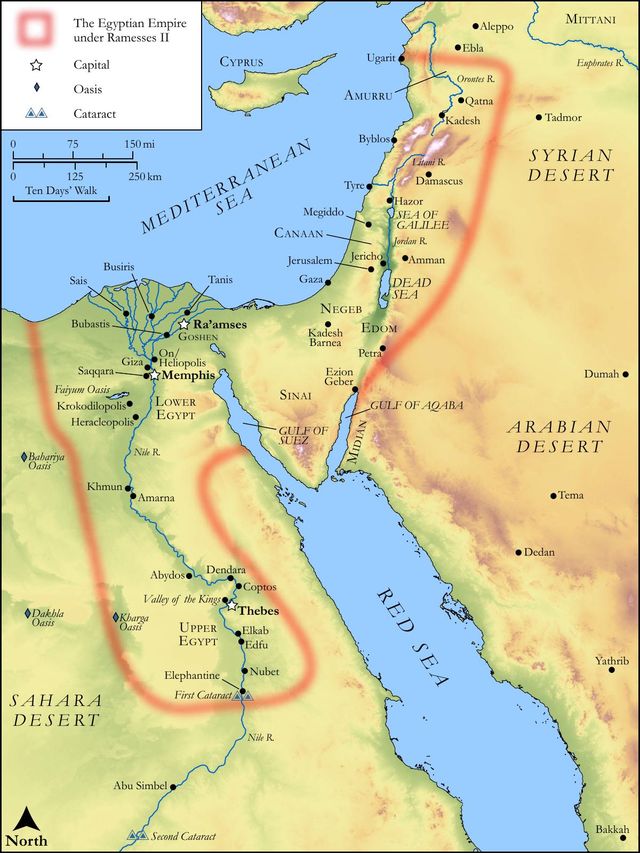
See on the biblical-era map
Study this verse
Public-domain commentary
Matthew Henry
From his Commentary on the Whole Bible. Henry comments on passages, not single verses — this entry covers Exodus 11:1–3. His two-level outline is real structure in the source text, so it is rendered as structure.
Here is, I. The high favour Moses and Israel were in with God. 1. Moses was a favourite of Heaven, for God will not hide from him the thing he will do. God not only makes him his messenger to deliver his errands, but communicates to him his purpose (as the man of his counsel) that he would bring one plague more, and but one, upon Pharaoh, by which he would complete the deliverance of Israel, Exo 11:1. Moses longed to see an end of this dreadful work, to see Egypt no more plagued and Israel no more oppressed: "Well," says God, "now it is near an end; the warfare shall shortly be accomplished, the point gained; Pharaoh shall be forced to own himself conquered, and to give up the cause." After all the rest of the plagues, God says, I will bring one more. Thus, after all the judgments executed upon sinners in this world, still there is one more reserved to be brought on them in the other world, which will completely humble those whom nothing else would humble. 2. The Israelites were favourites of Heaven; for God himself espouses their injured cause, and takes care to see them paid for all their pains in serving the Egyptians. This was the last day of their servitude; they were about to go away, and their masters, who had abused them in their work, would not have defrauded them of their wages, and have sent them away empty; while the poor Israelites were so fond of liberty that they would be satisfied with that, without pay, and would rejoice to get that upon any terms: but he that executeth righteousness and judgment for the oppressed provided that the labourers should not lose their hire, and ordered them to demand it now at their departure (Exo 11:2), in jewels of silver and jewels of gold, to prepare for which God, by the plagues, had now made the Egyptians as willing to part with them upon any terms as, before, the Egyptians, by their severities, had made them willing to go upon any terms. Though the patient Israelites were content to lose their wages, yet God would not let them go without them. Note, One way or other, God will give redress to the injured, who in a humble silence commit their cause to him; and he will see to it that none be losers at last by their patient suffering any more than by their services.
II.The high favour Moses and Israel were in with the Egyptians, Exo 11:3.
1.Even the people that has been hated and despised now came to be respected; the wonders wrought on their behalf put an honour upon them and made them considerable. How great do they become for whom God thus fights! Thus the Lord gave them favour in the sight of the Egyptians, by making it appear how much he favoured them: he also changed the spirit of the Egyptians towards them, and made them to be pitied of their oppressors, Psa 106:46.
2.The man Moses was very great. How could it be otherwise when they saw what power he was clothed with, and what wonders were wrought by his hand? Thus the apostles, though otherwise despicable men, came to be magnified, Act 5:13. Those that honour God he will honour; and with respect to those that approve themselves faithful to him, how meanly soever they may pass through this world, there is a day coming when they will look great, very great, in the eyes of all the world, even theirs who now look upon them with the utmost contempt. Observe, Though Pharaoh hated Moses, there were those of Pharaoh's servants that respected him. Thus in Caesar's household, even Nero's, there were some that had an esteem for blessed Paul, Phi 1:13.
Historical interpretation
Historical reception
2 surviving comments on this verse. Each one is dated, so this reads as a timeline rather than a list.
When Moses had come to the place which God shows him, he is not permitted to ascend, but first God says to him, “Loose the tie of the shoes from your feet.” None of these things are said to Abraham and Isaac, but they ascend and do not put aside their shoes. The reason for this is perhaps that although Moses was “great,” he was nevertheless coming from Egypt, and some fetters of mortality were bound to his feet. Abraham and Isaac, however, have none of these, but “they come to the place.”
About Isaac it is said that “he grew strong until he became great, exceedingly great.” Moses was called “great,” and John the Baptist was called “great,” and now Jesus is called “great,” and after this no one is any longer called “great.” For before he who is truly “great” had come, in comparison with the rest of men, the saints whom we mentioned earlier were called “great.”
Continue studying Exodus 11:3 across the web’s major study libraries — every link below opens this exact verse, chapter, or book on the destination site.
Read & Compare
 BibleGatewayThis verse in more than 200 translations and 70 languages.
 Bible.comThe YouVersion reader — hundreds of translations, reading plans, and highlights.
 ESV.orgCrossway's official English Standard Version reader.
 NET BibleThe NET translation with 60,000+ translators' notes on every rendering decision.
 STEP BibleTyndale House's free study tool — original text, vocabulary, and scholarly resources.
 BibliaLogos Bible Software's free web reader.
 USCCBThe New American Bible (Revised Edition) with the U.S. bishops' study notes.
Commentaries
 BibleHub CommentariesDozens of classic commentaries on this verse, gathered on one page.
 StudyLightMore than 100 commentary sets — the largest collection on the web.
 BibleRefPlain-English commentary on what this verse means, verse by verse.
 Enduring WordDavid Guzik's free commentary on this chapter, widely used by Bible teachers.
 Bible Study ToolsVerse commentary alongside Greek and Hebrew study aids.
Original Language & Research
- BibleHub InterlinearThe verse word by word — original language, transliteration, and English.
- BibleHub LexiconEvery word's original-language definition and Strong's entry.
 Blue Letter BibleDeep-study tools — Strong's numbers, concordance, and word studies.
 SefariaThe Hebrew text with Rashi and centuries of Jewish commentary.
Sermons, Hymns & Audio


TrulyRandomVerse is not affiliated with these sites and doesn’t control their content. They’re linked because they’re genuinely useful.
Summary
Exodus 11:3 serves as a pivotal statement of divine preparation, strategically preceding the final, devastating plague and the Israelites' imminent departure. It reveals God's sovereign orchestration in two critical ways: first, by supernaturally inclining the Egyptians to grant the Israelites immense favor, ensuring their provision and dignified exit; and second, by elevating Moses to a position of profound authority and respect, recognized even by Pharaoh's own court and the general populace, thereby underscoring the undeniable divine power backing his mission.
Context
ShowHideLiterary Context
This verse is strategically positioned at a critical juncture in the Exodus narrative, immediately following God's instruction to the Israelites to "ask" (or "demand") articles of silver and gold from their Egyptian neighbors in Exodus 11:2. It functions as a divine explanation, providing the theological and practical basis for how such an improbable request would be fulfilled and why Moses, the instrument of escalating judgment, continued to command respect. It bridges the intense, plague-ridden confrontations of the preceding chapters, particularly the hardening of Pharaoh's heart and the nine plagues, with the dramatic and decisive events of the Passover and the Exodus detailed in Exodus 12. The verse thus highlights divine agency in preparing both the people and the circumstances for the climactic liberation.
Historical & Cultural Context
In Hebrew thought, the concept of "favor" (חֵן, chen) was deeply intertwined with social standing, divine blessing, and often, the standing of one people before another. For a subjugated, enslaved people like the Israelites to receive favor—manifested as a willingness to part with valuable possessions—from their oppressors was an extraordinary and counter-cultural phenomenon. This was not merely an act of goodwill but a divinely orchestrated form of recompense for centuries of brutal forced labor, serving as an act of divine justice. Moses' "greatness" (גָּדוֹל, gadol) in the eyes of the Egyptians, despite being the direct cause of their national suffering, speaks volumes about the overwhelming power of the God he represented. In a polytheistic culture where Pharaoh was considered a divine figure, Moses' consistent ability to humble him and inflict such devastation would have elevated him to an almost supernatural status, demonstrating that the God of Israel was undeniably superior to all Egyptian deities and their ruler. This perception of Moses' power would have contributed significantly to the Egyptians' willingness to grant the Israelites' requests.
Key Themes
ShowHideExodus 11:3 contributes significantly to several overarching themes within the book of Exodus and the broader Pentateuch. Firstly, it underscores the theme of Divine Sovereignty and Control, demonstrating God's absolute power not only over natural phenomena (plagues) but also over human hearts and perceptions, even those of His enemies. Secondly, it highlights God's Faithfulness to His Covenant Promises, specifically the promise to Abraham that his descendants would leave Egypt with great possessions (Genesis 15:14). Thirdly, the verse emphasizes Divine Justice and Retribution, as the "plundering" of Egypt through the granting of favor serves as compensation for centuries of oppression and a judgment against Pharaoh's defiance. Finally, it reinforces the theme of God's Vindication and Empowerment of His Chosen Leader, showing how God elevates and validates Moses' authority even in the face of immense opposition, transforming him from a reluctant shepherd (Exodus 4:13) into a figure of unparalleled influence.
Exposition and Analysis
ShowHideKey Word Analysis
ShowHideThis is the covenant name of God, Yahweh (H3068), signifying "the self-Existent or Eternal." Its use here emphasizes that it is the personal, covenant-keeping God of Israel who is actively intervening and orchestrating these events. It highlights His unique identity and sovereign authority over all creation and human affairs, distinguishing Him from the gods of Egypt.
This term denotes "graciousness," "kindness," or "goodwill," which can be subjective (a feeling) or objective (a manifestation like beauty or, in this context, tangible gifts). Here, it signifies a divinely-induced, benevolent disposition in the Egyptians, leading them to willingly give valuable items to the Israelites. It underscores God's ability to influence the hearts of even those hostile to His people, ensuring His promises of provision and justice are fulfilled.
This word means "great (in any sense)," "mighty," or "significant." Applied to Moses, it speaks to his immense influence, reputation, and authority. This "greatness" was not self-achieved but a direct result of God empowering him to perform powerful signs and deliver divine messages that continually humbled Pharaoh and his people. It signifies a status of awe and respect, even from those he was afflicting, demonstrating the overwhelming power of the God he served.
Verse Breakdown
ShowHide"And the LORD gave the people favour in the sight of the Egyptians."
This opening clause immediately establishes divine agency as the primary cause of the Egyptians' benevolent disposition. It was not Israel's charm or negotiation skills, but Yahweh Himself who supernaturally softened the hearts of the Egyptians. This favor was crucial for the Israelites to receive valuable items (silver, gold, clothing) as they departed, effectively "plundering" their former masters as a form of divine compensation for generations of brutal slavery (Exodus 12:35-36). This act demonstrates God's commitment to justice and His power to turn the hearts of kings and commoners alike.
"Moreover the man Moses [was] very great in the land of Egypt, in the sight of Pharaoh's servants, and in the sight of the people."
This second clause highlights Moses' elevated status and widespread recognition. Despite his initial reluctance and feelings of inadequacy, God's consistent demonstration of power through him had transformed Moses from a fugitive shepherd into a figure of immense authority. His "greatness" was recognized by all segments of Egyptian society—from the highest officials in Pharaoh's court to the common people—signifying the undeniable power of the God he served. This recognition of Moses' authority would have contributed significantly to the Egyptians' willingness to grant favor to the Israelites. The adverb "very" (H3966, mᵉʼôd) intensifies the description of Moses' greatness, emphasizing its profound and pervasive nature.
Literary Devices
ShowHideThe verse employs parallelism by linking the favor shown to the people with the greatness of Moses, both attributed to divine action and both crucial for the impending exodus. This structural device highlights the dual nature of God's preparation: His direct intervention on behalf of His people and His empowerment of His chosen leader. The repeated phrase "in the sight of" ("in the sight of the Egyptians," "in the sight of Pharaoh's servants," and "in the sight of the people") functions as repetition (anaphora), emphasizing the widespread, undeniable, and publicly acknowledged nature of both the favor bestowed upon Israel and the immense authority of Moses. This repetition underscores the divine orchestration of public perception, leaving no doubt that these outcomes were not accidental but divinely willed.
Theological and Thematic Connections
ShowHideExodus 11:3 powerfully illustrates God's absolute sovereignty, His meticulous preparation for His redemptive plan, and His vindication of His chosen people and servants. It teaches that God is not only capable of judging nations but also of shaping their hearts and perceptions to achieve His purposes. This divine favor and Moses' elevated status are not accidental but integral to God's grand design for Israel's liberation and establishment as a nation, demonstrating His complete control over all circumstances, even the minds of His enemies.
This theme of God granting favor to His people in the eyes of their oppressors or those in authority is a recurring motif throughout biblical history, demonstrating His faithfulness, protective care, and ability to work through unexpected means.
Reflection and Application
ShowHideExodus 11:3 offers profound encouragement for believers today, reminding us that God is sovereign over all circumstances, even the hearts of those who oppose His will. This verse calls us to trust in God's meticulous preparation for His purposes in our lives and in the world. We can find assurance that God goes before us, orchestrating events and even softening hostile hearts to fulfill His plans, even when circumstances seem impossible or overwhelming. Furthermore, it reminds us that when God calls and empowers His servants for His work, He also establishes their authority and reputation, not for their own glory, but for the advancement of His kingdom. Our influence, therefore, comes not from our own strength or cunning but from the God we represent. This passage encourages us to rely on His perfect timing and abundant provision, knowing that He will equip us for every task and ensure our needs are met as we walk in obedience to His call, even in the face of opposition.
Questions for Reflection
ShowHideFAQ
ShowHideWas it right for the Israelites to "plunder" the Egyptians?
ShowHideThe biblical text states that "the LORD gave the people favour in the sight of the Egyptians," implying the Egyptians willingly gave them articles of silver, gold, and clothing. This was not an act of theft or unjust plunder in the modern sense, but rather a divinely orchestrated compensation for centuries of forced labor and severe oppression. From God's perspective, it was an act of justice, ensuring His people left Egypt with dignity and resources, not as defeated slaves. It also served as a judgment against Egypt for their cruelty and their persistent defiance of God's commands. This act fulfilled God's earlier promise to Abraham in Genesis 15:14 that his descendants would come out of their bondage with "great possessions."
How could Moses be "very great" in Egypt after bringing so much destruction?
ShowHideMoses' "greatness" was a direct reflection of the overwhelming power and undeniable authority of the God he represented. While the plagues brought immense devastation and suffering upon Egypt, they also demonstrated Yahweh's undeniable supremacy over all Egyptian gods, Pharaoh himself, and the forces of nature. The Egyptians, including Pharaoh's servants, would have recognized that Moses was not acting on his own but as the powerful and accurate agent of a superior deity. This awe-inspiring power, coupled with the precision and fulfillment of Moses' predictions regarding each plague, would have commanded profound respect, fear, and even a grudging admiration, leading to his "greatness" in their eyes, even amidst their suffering. His consistent ability to humble Pharaoh, the supposed divine ruler, elevated Moses to a status beyond that of a mere human.
Christ-Centered Fulfillment
ShowHideExodus 11:3, with its themes of divine favor, a divinely appointed leader, and a people being equipped for their exodus, finds profound and ultimate fulfillment in Jesus Christ. Just as God granted favor to Israel for their physical liberation from Egyptian bondage, so too does God grant grace (unmerited favor) to humanity through Christ for spiritual liberation. Jesus is the ultimate "great" one, not merely in the eyes of men, but as the eternally begotten Son of God, the King of kings and Lord of lords (Revelation 19:16). He came not to bring plagues of judgment upon humanity, but to bear the ultimate plague of sin on the cross, leading humanity out of the bondage of sin and death into new life (Romans 6:23). He is the greater Moses, leading a greater exodus, not from Egypt to an earthly promised land, but from the kingdom of darkness to the glorious kingdom of light (Colossians 1:13-14). Through Christ's atoning work, believers are not merely compensated for past wrongs but are richly endowed with every spiritual blessing in the heavenly places and an inheritance far greater than any earthly plunder (Ephesians 1:3-14). The favor shown to Israel in Egypt foreshadows the unmerited favor (grace) that God pours out on all who believe in His Son, making them heirs with Christ and equipping them for their journey to the heavenly promised land, where they will dwell with God forever.