


Amos 5:13
Bible text: King James Version (1769 Blayney text) · Public domain
Bible text: Berean Standard Bible · Public domain
Bible text: American Standard Version (1901) · Public domain
Bible text: World English Bible, Messianic edition · Public domain
Bible text: Geneva Bible (1599) · Public domain
Bible text: Young's Literal Translation · Public domain
- לָכֵןla·Khen<to> thereforeH3651Prep-l ¦ AdvAdverbלָ<to>כֵןtherefore
- הַמַּשְׂכִּילha·mas·Kilthe prudent [person]H7919Art ¦ V-Hiphil-Prtcpl-msVerb Hiphil Participle Singular Masculine Absoluteהַtheמַּשְׂכִּילprudent [person]
- בָּעֵתba·'Etat the timeH6256Prep-b ¦ N-csNoun Singular common gender Absoluteבָּat theעֵתtime
- הַהִיאha·Hi'<the> thatH1931Art ¦ Pro-3fsPronoun Personal 3rd Singular Feminineהַ<the>הִיאthat
- יִדֹּםyi·Domhe will be silentH1826V-Qal-Imperf-3msVerb Qal Imperfect 3rd Singular Masculine
- כִּיkiforH3588PrtParticle Conditional
- עֵת'et[is] a timeH6256N-csNoun Singular common gender Absolute
- רָעָהra·'AhevilH7451Adj-fsAdjective Singular Feminine Absolute
- הִיאHi'itH1931Pro-3fsPronoun Personal 3rd Singular Feminine
English is a literal word-by-word gloss of the Hebrew, not the KJV's wording. Why?
This is the original text the KJV's translators worked from — each Hebrew word with its own literal English meaning in this verse, prepared by scholars at Tyndale House, Cambridge. The KJV translates whole sentences, not word by word, so its wording differs: one Hebrew word can become several English words, and the KJV may choose “the LORD” where the gloss reads “Yahweh”. Both are faithful — they answer different questions. For the KJV's own rendering, switch to the KJV text.
Details
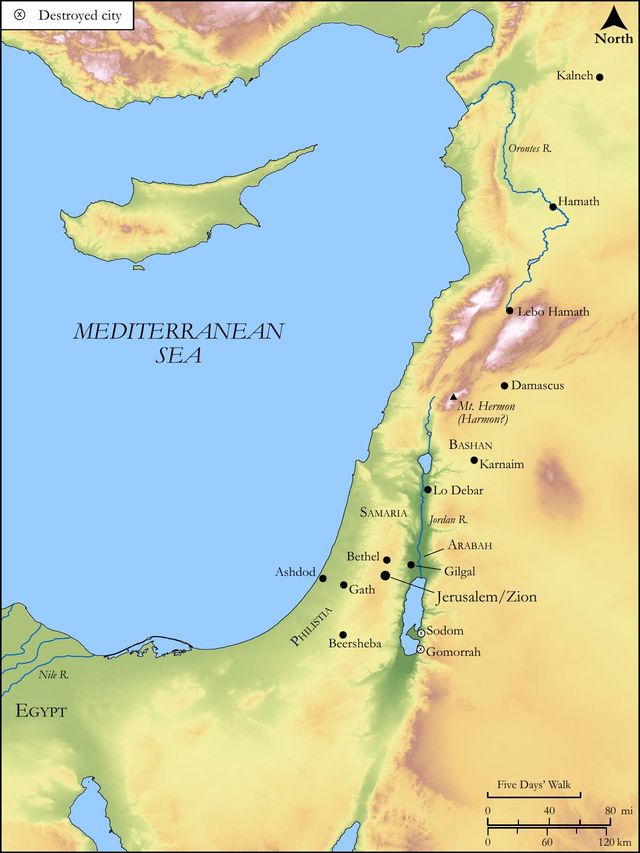
See on the biblical-era map
Study this verse
Public-domain commentary
Matthew Henry
From his Commentary on the Whole Bible. Henry comments on passages, not single verses — this entry covers Amos 5:4–15. His four-level outline is real structure in the source text, so it is rendered as structure.
This is a message from God to the house of Israel, in which,
I.They are told of their faults, that they might see what occasion there was for them to repent and reform, and that, when they were called to return, they might not need to ask, Wherein shall we return?
1.God tells them, in general (Amo 5:12), "I know your manifold transgressions, and your mighty sins; and you shall be made to know them too." In our penitent reflections upon our sins we must consider, as God does in his judicial remarks upon them, and will do in the great day,
(1.)That they are very numerous; they are our manifold transgressions, sins of various kinds and often repeated. Oh what a multitude of vain and vile thoughts lodge within us! What a multitude of idle, foolish, wicked words have been spoken by us! In what a multitude of instances have we gratified and indulged our corrupt appetites and passions! And how many our own omissions of duty and in duty! Who can understand his errors? Who can tell how often he offends? God knows how many, just how many, our transgressions are; none of them pass him unobserved; we know that they are to us innumerable; more than the hairs of our head; and we have reason to see what danger we have brought ourselves into, and what abundance of work we have made for repentance, by our manifold transgressions, by the numberless number of our sins of daily incursion.
(2.)That some of them are very heinous; they are our mighty sins; sins that are more exceedingly sinful in their own nature and by being committed presumptuously and with a high hand, sins against the light of nature, flagrant crimes, that are mighty to overpower your convictions and to pull down judgments upon you.
2.He specifies some of these mighty sins.
(1.)They corrupted the worship of God, and turned to idols; this is implied Amo 5:5. They had sought to Bethel, where one of the golden calves was; they had frequented Gilgal, a place which they chose to set up idols in, because it had been made famous in the days of Joshua by God's wonderful appearances to and for his people. Beer-sheba likewise, a place that had been famous in the days of the patriarchs, was now another rendezvous of idols; as we find also, Jos 8:14. And thither they passed, though it lay at a distance, in the land of Judah. Now, having thus shamefully gone a whoring from God, no doubt they should have felt themselves concerned to return to him.
(2.)They perverted justice among themselves (Amo 5:7): "You turn judgment to wormwood, that is, you make your administrations of justice bitter and nauseous, and highly displeasing both to God and man." That fruit has become a weed, a weed in the garden; as nothing is more venerable, nothing more valuable, than justice duly administered, so nothing is more hurtful, nothing more abominable, than designedly doing wrong under colour and pretence of doing right. Corruptio optimi est pessima - The best, when corrupted, becomes the worst. "You leave off righteousness in the earth, as if those that do wrong were accountable to the God of heaven only, and not to the princes and judges of the earth." Thus it was as before the flood, when the earth was filled with violence.
(3.)They were very oppressive to the poor, and made them poorer; they trod upon the poor (Amo 5:11), trampled upon them, hectored over them, made them their footstool, and were most imperious and barbarous to those that were most obsequious and submissive; they care not what shame and slavery they put those to who were poor and such as they could get nothing by. The judges aimed at nothing but to enrich themselves; and therefore they took from the poor burdens of wheat, took it by extortion, either by way of bribe or by usury. The poor had no other way to save themselves from being trodden upon, and trodden to dirt, by them, than by presenting to them horse-loads of that corn which they and their families should have had to subsist upon, and they forced them to do it. They took from the poor debts of wheat, so some read it. It was legally due either for rent or for corn lent, but they exacted it with rigour from those who were disabled by the providence of God to pay it, as Neh 5:2, Neh 5:5. In demanding and recovering even a just debt we must take heed left we act either unjustly or uncharitably. This sin of oppression by are again charged with (Amo 5:12): They afflict the just, by turning the edge of the law and of the sword of justice against those that are the innocent and quiet in the land; they hated men because they were more righteous than themselves, and he that departed from evil thereby made himself a prey to them. They take a bribe from the rich to patronize and protect them in oppressing the poor, so that he who has money in his hand is sure to have the judgment on his side, be his cause ever so bad. Thus they turn aside the poor in the gate, in the courts of justice, from their right. If the poor sue for their right, who cannot bribe them, or are so honest that they will not, though they have it ever so clear in view and ever so near, yet they are turned away from it by their unrighteous sentence and cannot come at it. And therefore the prudent will keep silence, Amo 5:13. Men will reckon it their prudence, when they are wronged and injured, to be silent, and make no complaints to the magistrates, for it will be to no purpose; they shall not have justice done them.
(4.)They were malicious persecutors of God's faithful ministers and people, Amo 5:10. Their hearts were so fully set in them to do evil that they could not bear to be reproved,
[1.]By the ministry of the word, by the reading and expounding of the law, and the messages which prophets delivered to them in the name of the Lord. They hate him that rebukes in the gate, in the gate of the Lord's house, or in their courts of justice, or in the places of concourse, where Wisdom is lifting up her voice, Pro 1:21. Reprovers in the gate are reprovers by office; these they hated, counting them their enemies because they told them the truth, as Ahab hated Micaiah. They not only despised them, but had an enmity to them, and sought to do them mischief. Those that hate reproof love ruin.
[2.]By the conversation of their honest neighbours. Though things were generally very bad, yet there were some among them that spoke uprightly that made conscience of what they said, and, as it was their praise, so it was the shame of those that spoke deceitfully, and condemned them, as Noah's faith condemned the unbelief of the old world, and for that reason they abhorred them; they were such inveterate enemies to the thing called honesty that they could not endure the sight of an honest man. All that have any sense of the common interest of mankind will love and value such as speak uprightly, for veracity is the bond of human society; to what a pitch of folly and madness then have those arrived who, having banished all notions of justice out of their own hearts, would have them banished out of the world too, and so put mankind into a state of war, for the abhor him that speaks uprightly! And for this reason the prudent shall keep silence in that time, Amo 5:13. Prophets cannot, dare not, keep silence; the impulse they are under will not allow them to act on prudential considerations; they must cry aloud, and not spare. But as for other wise and good men they shall keep silence, and shall reckon it is their prudence to do so, because it is an evil time. First, They shall think it dangerous to complain, and therefore shall keep silence; this was one way in which they afflicted the just, that by false suggestions and strained innuendos they made men offenders for a word (Isa 19:21); and therefore the prudent, who were wise as serpents, because they knew not how what they said might be misinterpreted and misrepresented, were so cautious as to say nothing, lest they should run themselves into a premunire, because it was an evil time. Note, Through the iniquity of the times, as good men are hidden, so good men are silent, and it is their wisdom to be so; little said soon amended. But it is their comfort that they may speak freely to God when they know not to whom else they can speak freely. Secondly, They shall think if fruitless to reprove. They see what wickedness is committed, and their spirits are stirred up, as Paul's at Athens; but they shall think it prudent not to bear an open testimony against it, because it is to no purpose. They are joined to their idols; let them alone. Let no man strive or rebuke another; for it is but casting pearls before swine. The cautious men will say to a bold reprover, as Erasmus to Luther, "Abi in cellam, et dic, Miserere mei, Domine - Away to they cell, and cry, Have mercy on me, O Lord!" Let grave lessons and counsels be kept for better men and better times. And there is a time to keep silence as well as a time to speak, Ecc 3:7. Evil times will not bear plain dealing, that is evil men will not; and the men the prophet here speaks of had reason to think themselves evil men indeed, when wise and good them thought it in vain to speak to them and were afraid of having any thing to do with them.
II.They are told of their danger and what judgments they lay exposed to for their sins.
1.The places of their idolatry are in danger of being ruined in the first place, Amo 5:5. Gilgal, the head-quarters of idolatry, shall go into captivity, not only its inhabitants, but its images, and Bethel, with its golden calf shall come to nought. The victorious enemy shall make nothing of it, so easily shall it be spoiled, and shall bring it to nothing, so effectually shall it be spoiled. Idols were always vanity, and things of nought, and so they shall prove when God appears to abolish them.
2.The body of the kingdom is in danger of being ruined with them, Amo 5:6. There is danger lest, if you seek him not in time, he break out like a fire in the house of Joseph and devour it; for our God is a righteous Judge, is a consuming fire, and the men of Israel, as criminals, are stubble before him; woe to those that make themselves fuel to the fire of God's wrath. It follows, And there shall be none to quench it in Bethel. There their idols were, and their idolatrous priests; thither they brought their sacrifices, and there they offered up their prayers. But God tells them that when the fire of his judgments should kindle upon them all the gods they served at Bethel should not be able to quench it, should not turn away the judgment, nor be any relief to them under it. Thus those that make an idol of the world will find it insufficient to protect them when God comes to reckon with them for their spiritual idolatry.
3.What they have got by oppression and extortion shall be taken from them (Amo 5:11): "You have built houses of hewn stone, which you thought would be lasting; but you shall not dwell in them, for your enemies shall burn them down, or possess them for themselves, or take you into captivity. You have planted pleasant vineyards, have contrived how to make them every way agreeable, and have promised yourselves many a pleasant walk in them; but you shall be forced to walk off, and shall never drink wine of them." The law had tenderly provided that if a man had built a house, or planted a vineyard, he should be at his liberty to return from the wars, Deu 20:5, Deu 20:6. But now the necessity would be so urgent that it would not be allowed; all must go to the battle, and many of those who had lately been building and planting should fall in battle, and never enjoy what they had been labouring for. What is not honestly got is not likely to be long enjoyed.
III.They are told their duty, and have great encouragement to set about it in good earnest, and good reason.
The duties here prescribed to them are godliness and honesty, seriousness in their applications to God and justice in their dealings with men; and each of these is here pressed upon them with proper arguments to enforce the exhortation.
1.They are here exhorted to be sincere and devout in their addresses to God, Amo 5:4. God says to the house of Israel, Seek you me, and with good reason, for should not a people seek unto their God? Isa 8:19. Whither else should they go but to their protector? Israel was a prince with God; let his descendants seek the Lord, as he did, and they shall be so too. Now, in order to their doing this, they must abandon their idolatries. God is not sought truly if he be not sought exclusively, for he will endure no rivals: "Seek you the Lord, and seek not Bethel (Amo 5:5), consult not your idol-oracles, nor ask at the mouth of the priests of Bethel; seek not to the golden calf there for protection, nor bring your prayers and sacrifices any longer thither, or to Gilgal, for you forsake your own mercies if you observe those lying vanities. But seek the Lord (Amo 5:6, Amo 5:8); enquire after him; enquire of him; seek to know his mind as your rule, to secure his favour as your felicity." To press this exhortation we are told to consider, (1.) What we shall get by seeking God; it will be our life; we shall find him, and shall be happy in him. So he tells them himself (Amo 5:4): Seek you me, and you shall live. Those that seek perishing gods shall perish with them (Amo 5:5), but those that seek the living God shall live with him: "You shall be delivered from the killing judgments which you are threatened with; your nation shall live, shall recover from its present languishings; your souls shall live; you shall be sanctified and comforted, and made for ever blessed. You shall live." (2.) What a God he is whom we are to seek, Amo 5:8, Amo 5:9. [1.] He is a God of almighty power himself. The idols were impotent things, could do neither good nor evil, and therefore it was folly either to fear or trust them; but the God of Israel does every thing, and can do any thing, and therefore we ought to seek him; he challenges our homage who has all power in his hand, and it is our interest to have him on our side. Divers proofs and instances are here given of God's power, as Creator, in the kingdom of nature, as both founding and governing that kingdom. Compare Amo 4:13. First, The stars are the work of his hands; those stars which the heathens worshipped (Amo 5:26), the stars of your god, those stars are God's creatures and servants. He makes the seven stars and Orion, two very remarkable constellations, which Amos, a herdsman, while he kept his cattle by night, had particularly observed the motions of. He made them at the first, he still makes them to be what they are to this earth and either binds or looses the sweet influences of Peliades and Orion, the two constellations here mentioned. See Job 38:31; Job 9:9, to which passages Amos seems here to refer, putting them in mind of those ancient discoveries of the glory of God before he was called the God of Israel. Secondly, The constant succession of day and night is under his direction, and is kept up by his power and providence. It is he that turns the night (which is dark as the shadow of death) into the morning by the rising of the sun, and by the setting of the sun makes the day dark with night; and the same power can, for humble penitents, easily turn affliction and sorrow into prosperity and joy, but can as easily turn the prosperity of presumptuous sinners into darkness, into utter darkness. Thirdly, The rain rises and falls as he appoints. He calls for the waters of the sea; out of them vapours are drawn up by the heat of the sun, which gather into clouds, and are poured out upon the face of the earth, to water it and make it fruitful. This was the mercy that had been withholden from them of late (Amo 4:7); and therefore to whom should they apply but to him who had power to give it? For all the vanities of the heathen could not give rain, nor could the heavens themselves give showers Jer 14:22. It is God that has made these things; Jehovah is his name, the name by which the God of nature, the God of the whole earth, has made himself known to his people Israel and covenanted with them. [2.] As he is God of almighty power himself, so he gives strength and power unto his people that seek him, and renews strength to those that had lost it, if they wait upon him for it; for (Amo 5:9) he strengthens the spoiled against the strong to such a degree that the spoiled come against the fortress and make bold and brave attacks upon those that had spoiled them. This is an encouragement to the people to seek the Lord, that, if they do so, they shall find him above to retrieve their affairs, when they are brought to the lowest ebb; though they are the spoiled, and their enemies are the strong, if they can but engage God for them, they shall soon recruit so as the next time to be not only the aggressors, but the conquerors; they come against the fortress, to make reprisals and become masters of it.
2.They are here exhorted to be honest and just in their dealings with men, Amo 5:14, Amo 5:15, where observe,
(1.)The duty required: Seek good, and not evil. Hate the evil, and love the good, and establish judgment in the gate; re-establish it there, whence it has been banished, Amo 5:7. Note, Things are not so bad but that they may be amended if the right course be taken; we must not despair but that grievances may be redressed and abuses rectified; justice may yet triumph where injustice tyrannizes. In order to this, good must be loved and sought, evil must be hated and no longer sought. We must love good principles and adhere to them, love to do good and abound in doing it, love good people, and good converse, and good duties; and, whatever good we do, we must do it from a principle of love, do it of choice and with delight. Those who thus love good will seek it, will contrive to do all the good they can, enquire for opportunities of doing it, and endeavor to do it to the utmost of their power. They will also hate evil, will abhor the thought of doing an unjust thing, and abstain from all appearance of it. In vain do we pretend to seek God in our devotions if we do not seek good in our whole conversations.
(2.)The reasons annexed. [1.] This is the sure way to be happy ourselves and to have the continual presence of God with us: "Seek good, and not evil, that you may live, may escape the punishment of the evil you have sought and loved (righteousness delivereth from death), that you may have the favour of God, which is your life, which is better than life itself, that you may have comfort in yourselves and may live to some good purpose. You shall live, for so the Lord God of hosts shall be with you and be your life." Note, Those that keep in the way of duty have the presence of God with them, as the God of hosts, a God of almighty power. "He will be with you as you have spoken, that is, as you have gloried; you shall have that really which, while you went on in unrighteous ways, you only seemed to have and boasted of as if you had." Those that truly repent and reform enter into the enjoyment of that comfort which before they had only flattered themselves with the imagination of. Or, "As you have prayed when you sought the Lord. Live up to your prayers, and you shall have what you pray for." [2.] This is the likeliest way to make the nation happy: "If you seek and love that which is good, you may contribute to the saving of the land from ruin." It may be, the Lord God of hosts will be gracious to the remnant of Joseph; though there is but a remnant left, yet, if God be gracious to that remnant, it will rise to a great nation again; and if some among them turn from sin, especially if judgment be established in the gate, though we cannot be certain, yet there is a great probability that public affairs will take a new and happy turn, and every thing will mend if men mend their lives. Temporary promises are made with an It may be; and our prayers must be made accordingly.
Historical interpretation
Historical reception
1 surviving comment on this verse from the historical church.
(Verse 11 and following) Therefore, because you plundered the poor and took the choice spoil from them, you will build houses of cut stone but not live in them. You will plant pleasant vineyards but not drink their wine, for I know your many crimes and powerful sins, you who oppress the righteous and take bribes, and push aside the needy in the gate. Therefore, the wise will be silent in that time, for it is an evil time. LXX: Therefore, because you struck the poor with fists, and took from them choice gifts, you built houses with hewn stones, but will not live in them. You planted desirable vineyards, but will not drink their wine; for I know your many wicked acts and your mighty sins: trampling the righteous, accepting bribes, and turning away the poor at the gates. Therefore, those who have understanding will keep silent at that time, for it is an evil time. Lest perhaps Israel might think that they were delivered to punishment by the enemies only for idolatry, he joins other things which he committed, having lost the religion of truth. 'You were ravaging,' he says, 'the poor so that you could take from him who scarcely had necessary food, and whatever precious and beautiful things you saw, you handed them over to your own uses. And from the price of those things which you were seizing and taking from the poor, you built houses with squared stone, so that by despoiling men, you could clothe walls with marble, which, because you built them from plunder, and not only a dwelling and a roof, which human weakness requires, but also beauty and delights, you prepared them suddenly for captivity or death, you will not dwell in them.' You have also planted very loving vineyards for future drinks, and you do not drink wine from them, because I know all your sins and crimes, and strong sins that provoke my wrath. You are enemies of justice, all of you who accept gifts and oppress the poor in judgment. Therefore, the poor and wise person, when he sees the judge who redeems him, will be silent in that time, because it is an evil time. Certainly, it should be understood in this way: what profit is there now in enumerating your sins, since there is already no remedy, and the enemy army surrounds the walls of your cities? We can also say this about heretics, who plunder the poor or strike his head with a raised hand, for this is what κατεκονδύλιζον means in Greek, according to what we read above, striking the head of the poor. For heretics do not strike anyone except the poor, who cannot withstand the threat: not in other members, but in the main part, the heart, and in the truth of faith. I consider them poor who, relying on simple faith alone, are unable to respond to the malice of heretics. And whatever good works they have prepared for the gifts of God, they will lose in the time of battle and struggle unless they resist their adversaries. Those adversaries, on the other hand, build homes for themselves through the composition and structure of words, in order to remain safe and secure. But they will not dwell in them, for they will be destroyed and overthrown by men of the Church. And they not only build houses, but also plant most loving and desirable vineyards, so that they may imitate the mysteries of Christ; but they do not drink wine from them, except what is the unstoppable fury of dragons. For the Lord expected these vineyards to bear fruit, and they brought forth not grapes, but thorns and briars: not judgment, but outcry, with which they blaspheme against their God with insane mouths. Therefore, they will not dwell in their houses, and they will not drink the wine of the vineyards they have planted, because the Lord has known many of their wickednesses. Here, knowledge is to be understood not according to what we read elsewhere: The Lord knows those who are his (2 Tim. 2:19), but according to the fact that nothing is hidden from God, and he knows all the secrets of sinners. 'I have known', he says, 'many impious acts: which are not only many, but also strong and oppressive, trampling on justice itself, or on the one who is just. And you receive, he says, a payment: for which all likewise transferred propitiation: we have said gift; but according to the language of the Scriptures, price is called 'ἄλλαγμα', which we also read in the Gospel: But what shall a man give in exchange for his soul? (Matt. 16:26)? Even the poor have turned aside at the gates: or as Symmachus interpreted, they have oppressed, so that they could sell judgments contrary to the truth of the law by means of bribes, falling into that which is written: Gifts blind even the eyes of the wise (Deut. XVI, 19). This is what heretics accept, so that they can turn the severity of the Scriptures, which threaten torment to sinners, into blessings; and while they promise prosperity to the rich, they are only harsh and severe with the poor. Therefore, when a knowledgeable and wise ecclesiastical man recognizes many impieties in what is called the house of God, and not only many, but also strong ones that can suppress justice, and the madness of scholars has gone so far that they accept bribes in court and do everything for gifts, and they also avoid the poor at the gates and disdain to hear them, let him be silent at that time, lest he give the holy to dogs, and cast pearls before swine (Matt. 7), who, when converted, will trample them and imitate Jeremiah saying: I was alone, for I am filled with bitterness (Jer. 15:17). And that in the Psalms: I am alone until I pass by (Is. 140:10).
Continue studying Amos 5:13 across the web’s major study libraries — every link below opens this exact verse, chapter, or book on the destination site.
Read & Compare
 BibleGatewayThis verse in more than 200 translations and 70 languages.
 Bible.comThe YouVersion reader — hundreds of translations, reading plans, and highlights.
 ESV.orgCrossway's official English Standard Version reader.
 NET BibleThe NET translation with 60,000+ translators' notes on every rendering decision.
 STEP BibleTyndale House's free study tool — original text, vocabulary, and scholarly resources.
 BibliaLogos Bible Software's free web reader.
 USCCBThe New American Bible (Revised Edition) with the U.S. bishops' study notes.
Commentaries
 BibleHub CommentariesDozens of classic commentaries on this verse, gathered on one page.
 StudyLightMore than 100 commentary sets — the largest collection on the web.
 BibleRefPlain-English commentary on what this verse means, verse by verse.
 Enduring WordDavid Guzik's free commentary on this chapter, widely used by Bible teachers.
 Bible Study ToolsVerse commentary alongside Greek and Hebrew study aids.
Original Language & Research
- BibleHub InterlinearThe verse word by word — original language, transliteration, and English.
- BibleHub LexiconEvery word's original-language definition and Strong's entry.
 Blue Letter BibleDeep-study tools — Strong's numbers, concordance, and word studies.
 SefariaThe Hebrew text with Rashi and centuries of Jewish commentary.
Sermons, Hymns & Audio


TrulyRandomVerse is not affiliated with these sites and doesn’t control their content. They’re linked because they’re genuinely useful.
Summary
Amos 5:13 offers a poignant observation on the moral and spiritual climate of ancient Israel, asserting that in a period characterized by pervasive injustice and moral decay, the truly discerning individual will choose silence. This verse highlights the futility and potential danger of speaking truth in an environment so hostile to righteousness that wisdom dictates restraint, signaling a profound societal brokenness that inevitably invites divine judgment.
Context
ShowHideLiterary Context
Amos 5:13 is situated within a series of prophetic pronouncements and laments concerning the Northern Kingdom of Israel. Preceding this verse, Amos has delivered scathing indictments against Israel's injustices, including their oppression of the poor, perversion of justice in the courts, and their abhorrence for those who speak truth (Amos 5:10-12). The prophet decries their turning justice into wormwood and righteousness into bitterness, illustrating a society where moral foundations have crumbled. Following this verse, Amos continues with a desperate plea for Israel to "seek good, and not evil, that ye may live" (Amos 5:14), emphasizing that their only hope lies in a genuine return to the Lord and a restoration of justice. The immediate context thus paints a picture of a nation ripe for judgment due to its pervasive corruption and rejection of God's righteous standards.
Historical & Cultural Context
Amos prophesied to the Northern Kingdom of Israel during the prosperous reign of Jeroboam II (c. 793-753 BC). This era was marked by significant economic growth and military success, leading to a widening gap between the rich and the poor. While outwardly religious, with bustling sanctuaries and numerous sacrifices, Israel's internal life was riddled with moral decay, oppression, and spiritual apostasy. The wealthy exploited the vulnerable, court systems were corrupted by bribes, and true worship was replaced by superficial rituals. The "evil time" described by Amos reflects a society where the powerful oppressed the weak, and honesty was met with hostility. In such a climate, speaking out against injustice was not only unpopular but could be dangerous, leading to persecution or even death for those who dared to challenge the corrupt establishment.
Key Themes
ShowHideAmos 5:13 contributes significantly to several overarching themes in the book of Amos. Firstly, it underscores the pervasive Oppression that characterized Israel, where righteousness was so despised that even the wise refrained from public admonition. This theme is central to Amos's message, as he consistently condemns the exploitation of the poor and the perversion of justice (Amos 2:6-7 and Amos 8:4-6). Secondly, the verse highlights the Futility of False Piety; despite their religious observances, Israel's lack of justice rendered their worship meaningless in God's eyes (Amos 5:21-24). The "evil time" points to the inevitability of Divine Judgment, a dominant theme throughout the book of Amos, as God's patience with Israel's persistent sin was reaching its limit. Finally, the verse introduces the theme of Prudence and Discernment, suggesting that true wisdom involves recognizing the spiritual climate and acting accordingly, even if that means a strategic silence in the face of overwhelming evil.
Exposition and Analysis
ShowHideKey Word Analysis
ShowHideThis word signifies being circumspect and intelligent. It implies a practical wisdom that allows one to consider, instruct, prosper, and deal prudently. In Amos 5:13, the "prudent" person is not merely intellectually smart but possesses a discerning wisdom that understands the severe moral climate and acts wisely in response. Their prudence is a form of spiritual intelligence, recognizing the futility or danger of speaking truth in a hostile environment.
This primitive root means to be dumb, astonished, or to stop. It can also imply to perish, cease, or be cut off. In this context, it denotes a deliberate act of holding one's peace or remaining quiet. The silence of the prudent is not born of cowardice or complicity, but of a sober assessment that vocal protest would be ineffective, misunderstood, or even lead to harm in such an "evil time." It is a strategic withdrawal from public discourse, a recognition that the conditions are not conducive to hearing truth.
This word describes something bad or evil, encompassing natural or moral evil, adversity, affliction, calamity, mischief, or wickedness. When applied to "time," as in "evil time," it denotes a period characterized by profound moral depravity, distress, and societal corruption. It's a time when wickedness is rampant, justice is perverted, and the general state of affairs is dire, often leading to divine displeasure and impending disaster.
Verse Breakdown
ShowHide"Therefore the prudent shall keep silence in that time;"
This clause presents the consequence of the prevailing conditions described in the preceding verses. The "prudent" (those who are wise and discerning) recognize the depth of the nation's moral decay and the hostility towards truth. Their response is to "keep silence," a deliberate act of restraint. This silence is not an endorsement of the evil but a pragmatic acknowledgment that their words would be futile or dangerous in such a climate. It suggests a strategic withdrawal from public confrontation, preserving their integrity and perhaps awaiting a more opportune moment or divine intervention.
"for it [is] an evil time."
This second clause provides the justification for the prudent's silence. The phrase "evil time" describes a period of profound moral and spiritual decline, where injustice is rampant, corruption is pervasive, and society has become fundamentally hostile to righteousness. It is a time when speaking truth is not only unwelcome but may invite persecution, making it an unproductive or perilous endeavor for those who would otherwise seek justice. This declaration underscores the severity of Israel's spiritual condition, indicating that the nation has reached a critical point of no return, where wickedness reigns supreme.
Literary Devices
ShowHideAmos 5:13 employs several literary devices to convey its stark message. The most prominent is Irony, as wisdom is paradoxically found in silence rather than speech. In a healthy society, the prudent would speak out against injustice; here, their wisdom dictates restraint, highlighting the extreme perversion of the social order. There is also an element of Understatement in "evil time," which, while direct, subtly implies a depth of depravity so profound that it stifles even the wise. The verse functions as a form of Foreshadowing, as the inability of the prudent to speak out against the prevailing wickedness signals that the nation's moral cup is full, portending inevitable divine judgment. Finally, the verse presents a stark Contrast between the "prudent" individual and the corrupt society, emphasizing the isolation of righteousness in a world steeped in sin.
Theological and Thematic Connections
ShowHideAmos 5:13 profoundly speaks to the nature of divine justice and the human response to pervasive evil. It reveals that when a society reaches a point where truth-telling becomes dangerous or futile, it signifies a deep spiritual brokenness that is ripe for God's intervention. This "evil time" is not merely a period of hardship but a moral catastrophe, where the very fabric of righteousness has unraveled. The silence of the prudent underscores God's ultimate sovereignty; when human efforts to correct are stifled, it often precedes God's direct action to bring justice and judgment. This verse reminds us that while believers are called to be salt and light, there are moments when discerning wisdom dictates a strategic quietness, trusting God to work in His own timing and through His own means.
Reflection and Application
ShowHideAmos 5:13 offers a challenging yet crucial principle for believers navigating complex moral landscapes today. While the Christian call is generally to speak truth in love and contend for righteousness, this verse reminds us that wisdom involves discerning the times. There are indeed "evil times" when the prevailing culture is so hostile to biblical truth that direct confrontation may be unproductive, leading only to further hardening of hearts or unnecessary persecution. This does not mean complicity or abandoning one's convictions, but rather a strategic understanding of when to speak and when to prayerfully wait, to maintain personal integrity, and to focus on a quieter witness through righteous living. It prompts us to consider if our efforts to speak are truly heard or if they are merely casting "pearls before swine," as Jesus warned. In such times, the prudent may choose to cultivate inner spiritual strength, focus on building up the church, and pray for God's transformative power, trusting that He will ultimately bring justice and light to darkness.
Questions for Reflection
ShowHideFAQ
ShowHideDoes "prudent shall keep silence" mean Christians should never speak out against injustice?
ShowHideNo, not at all. Amos 5:13 describes a very specific and extreme scenario where society has become so utterly corrupt and hostile to truth that speaking out is not only ineffective but potentially self-destructive for the speaker. Throughout Scripture, prophets, apostles, and Jesus Himself consistently spoke out against injustice, hypocrisy, and sin (e.g., Isaiah 1:17, Matthew 23). This verse highlights a rare and dire circumstance where the "evil time" has reached such a peak that wisdom dictates a strategic silence, perhaps to preserve one's ability to minister in other ways, or to await God's direct intervention. It's about discerning the timing and efficacy of one's witness, not about abandoning the call to righteousness.
What are the characteristics of an "evil time" as described in Amos 5:13?
ShowHideAn "evil time" in the context of Amos 5:13 is a period marked by profound moral and spiritual decay, where injustice is rampant, corruption is pervasive, and society has become fundamentally hostile to righteousness. Key characteristics include the perversion of justice in courts, oppression of the poor, rejection of those who speak truth, and a general societal embrace of wickedness despite outward religious observances. It's a time when the societal conditions are so dire that truth is suppressed, and efforts to correct or admonish are met with scorn, opposition, or even persecution, making vocal protest ineffective or self-destructive. It signifies a society that has reached a critical point of no return, where the measure of iniquity is full.
Christ-Centered Fulfillment
ShowHideAmos 5:13, with its stark portrayal of an "evil time" where the prudent must keep silence, finds profound Christ-centered fulfillment in several ways. Jesus, the ultimate embodiment of wisdom and prudence, entered a world steeped in sin, an "evil time" where truth was often rejected and justice perverted. While He boldly proclaimed the Kingdom of God and denounced the hypocrisy of the religious leaders (Matthew 23:13-36), there were also moments when He chose strategic silence. Before His accusers, when confronted with false testimonies, Jesus remained silent, fulfilling prophecy and demonstrating a divine prudence that transcended human understanding (Isaiah 53:7; Matthew 27:12-14). His silence was not weakness but a powerful act of submission to the Father's will and a demonstration that His Kingdom was not of this world, not to be defended by human arguments or political maneuvering (John 18:36). Ultimately, Jesus's death on the cross, in the face of the world's ultimate "evil time" of sin and injustice, became the means by which true justice and righteousness would be established for all who believe, ushering in a new era where the Spirit empowers believers to speak truth with wisdom and courage, knowing that the ultimate victory over evil has been secured through the Lamb of God (John 1:29; Revelation 12:10-11).