


2 Samuel 9:5
Bible text: King James Version (1769 Blayney text) · Public domain
Bible text: Berean Standard Bible · Public domain
Bible text: American Standard Version (1901) · Public domain
Bible text: World English Bible, Messianic edition · Public domain
Bible text: Geneva Bible (1599) · Public domain
Bible text: Young's Literal Translation · Public domain
- וַיִּשְׁלַחvai·yish·Lachand he sentH7971Conj-w ¦ V-Qal-ConsecImperf-3msVerb Qal Consecutive Imperfect 3rd Singular Masculineוַandיִּשְׁלַחhe sent
- הַמֶּלֶךְha·Me·lekhthe kingH4428Art ¦ N-msNoun Singular Masculine Absoluteהַtheמֶּלֶךְking
- דָּוִדda·VidDavidH1732N-proper-mNoun Proper Masculine
- וַיִּקָּחֵהוּvai·yi·ka·Che·huand he took himH3947Conj-w ¦ V-Qal-ConsecImperf-3ms ¦ 3msVerb Qal Consecutive Imperfect 3rd Singular Masculineוַandיִּקָּחֵhe tookהוּhim
- מִבֵּיתmi·Beitfrom [the] house ofH1004Prep-m ¦ N-mscNoun Singular Masculine Constructמִfromבֵּית[the] house of
- מָכִירma·KhirMakirH4353N-proper-mNoun Proper Masculine
- בֶּןben[the] son ofH1121N-mscNoun Singular Masculine Construct
- עַמִּיאֵל'a·mi·'ElAmmielH5988N-proper-mNoun Proper Masculine
- מִלּוֹmi·Lofrom LoH3810Prep-m ¦ N-properNoun Proper LocationמִfromלּוֹLo
- דְבָרde·VarDebarH3810N-properNoun Proper Location
English is a literal word-by-word gloss of the Hebrew, not the KJV's wording. Why?
This is the original text the KJV's translators worked from — each Hebrew word with its own literal English meaning in this verse, prepared by scholars at Tyndale House, Cambridge. The KJV translates whole sentences, not word by word, so its wording differs: one Hebrew word can become several English words, and the KJV may choose “the LORD” where the gloss reads “Yahweh”. Both are faithful — they answer different questions. For the KJV's own rendering, switch to the KJV text.
Details
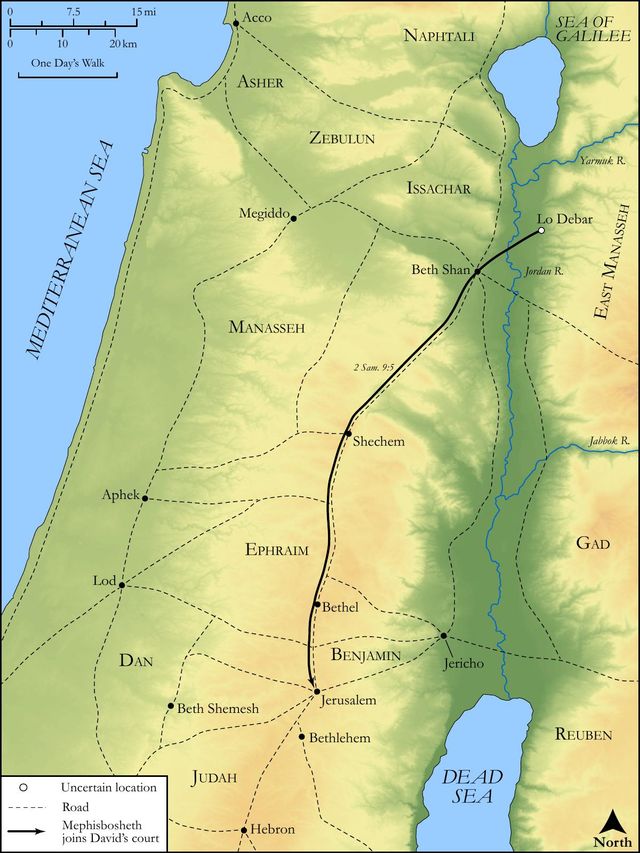
See on the biblical-era maps

Study this verse
Public-domain commentary
Matthew Henry
From his Commentary on the Whole Bible. Henry comments on passages, not single verses — this entry covers 2 Samuel 9:1–8. His three-level outline is real structure in the source text, so it is rendered as structure.
Here is, I. David's enquiry after the remains of the ruined house of Saul, Sa2 9:1. This was a great while after his accession to the throne, for it should seem that Mephibosheth, who was but five years old when Saul died, had now a son born, Sa2 9:12. David had too long forgotten his obligations to Jonathan, but now, at length, they are brought to his mind. It is good sometimes to bethink ourselves whether there be any promises or engagements that we have neglected to make good; better do it late than never. The compendium which Paul gives us of the life of David is this (Act 13:36), that he served his generation according to the will of God, that is, he was a man that made it his business to do good; witness this instance, where we may observe,
1.That he sought an opportunity to do good. He might perhaps have satisfied his conscience with the performance of his promise to Jonathan if he had been only ready, upon request or application made to him by any of his seed, to help and succour them. But he does more, he enquires of those about him first (Sa2 9:1), and, when he met with a person that was likely to inform him, asked him particularly, Is there any yet left of the house of Saul, that I may show him kindness? Sa2 9:3. "Is there any, not only to whom I may do justice (Num 5:8), but to whom I may show kindness?" Note, Good men should seek opportunities of doing good. The liberal deviseth liberal things, Isa 32:8. For, the most proper objects of our kindness and charity are such as will not be frequently met with without enquiry. The most necessitous are the least clamorous.
2.Those he enquired after were the remains of the house of Saul, to whom he would show kindness for Jonathan's sake: Is there any left of the house of Saul? Saul had a very numerous family (Ch1 8:33), enough to replenish a country, and was yet so emptied that none of it appeared; but it was a matter of enquiry, Is there any left? See how the providence of God can empty full families; see how the sin of man will do it. Saul's was a bloody house, no marvel it was thus reduced, Sa2 21:1. But, though God visited the iniquity of the father upon the children, David would not. "Is there any left that I can show kindness to, not for Saul's own sake, but for Jonathan's?" (1.) Saul was David's sworn enemy, and yet he would show kindness to his house with all his heart and was forward to do it. He does not say, "Is there any left of the house of Saul, that I may find some way to take them off, and prevent their giving disturbance to me or my successor?" It was against Abimelech's mind that any one was left of the house of Gideon (Jdg 9:5), and against Athaliah's mind that any one was left of the seed royal, Ch2 22:10, Ch2 22:11. Those were usurped governments. David's needed no such vile supports. He was desirous to show kindness to the house of Saul, not only because he trusted in God and feared not what they could do unto him, but because he was of a charitable disposition and forgave what they had done to him. Note, We must evince the sincerity of our forgiving those that have been any way unjust or injurious to us by being ready, as we have opportunity, to show kindness both to them and theirs. We must not only not avenge ourselves upon them, but we must love them, and do them good (Mat 5:44), and not be backward to do any office of love and good-will to those that have done us many an injury. Pe1 3:9, - but, contrari-wise, blessing. This is the way to overcome evil, and to find mercy for ourselves and ours, when we or they need it. (2.) Jonathan was David's sworn friend, and therefore he would show kindness to his house. This teaches us, [1.] To be mindful of our covenant. The kindness we have promised we must conscientiously perform, though it should not be claimed. God is faithful to us; let us not be unfaithful to one another. [2.] To be mindful of our friendships, our old friendships. Note, Kindness to our friends, even to them and theirs, is one of the laws of our holy religion. He that has friends must show himself friendly, Pro 18:24. If Providence has raised us, and our friends and their families are brought low, yet we must not forget former acquaintance, but rather look upon that as giving us so much the fairer opportunity of being kind to them: then our friends have most need of us and we are in the best capacity to help them. Though there be not a solemn league of friendship tying us to this constancy of love, yet there is a sacred law of friendship no less obliging, that to him that is in misery pity should be shown by his friend, Job 6:14. A brother is born for adversity. Friendship obliges us to take cognizance of the families and surviving relations of those we have loved, who, when they left us, left behind them their bodies, their names, and their posterity, to be kind to.
3.The kindness he promised to show them he calls the kindness of God; not only great kindness, but,
(1.)Kindness in pursuance of the covenant that was between him and Jonathan, to which God was a witness. See Sa1 20:42.
(2.)Kindness after God's example; for we must be merciful as he is. He spares those whom he has advantage against, and so must we. Jonathan's request to David was (Sa1 20:14, Sa1 20:15), "Show me the kindness of the Lord, that I die not, and the same to my seed." The kindness of God is some greater instance of kindness than one can ordinarily expect from men.
(3.)It is kindness done after a godly sort, and with an eye to God, and his honour and favour.
II.Information given him concerning Mephibosheth, the son of Jonathan.
Ziba was an old retainer to Saul's family, and knew the state of it. He was sent for and examined, and informed the king that Jonathan's son was living, but lame (how he came to be so we read before, Sa2 4:4), and that he lived in obscurity, probably among his mother's relations in Lo-debar in Gilead, on the other side Jordan, where he was forgotten, as a dead man out of mind, but bore this obscurity the more easily because he could remember little of the honour he fell from.
III.The bringing of him to court.
The king sent (Ziba, it is likely) to bring him up to Jerusalem with all convenient speed, Sa2 9:5. Thus he eased Machir of his trouble, and perhaps recompensed him for what he had laid out on Mephibosheth's account. This Machir appears to have been a very generous free-hearted man, and to have entertained Mephibosheth, not out of any disaffection to David or his government, but in compassion to the reduced son of a prince, for afterwards we find him kind to David himself when he fled from Absalom. He is named (Sa2 17:27) among those that furnished the king with what he wanted at Mahanaim, though David, when he sent for Mephibosheth from him, little thought that the time would come when he himself would gladly be beholden to him: and perhaps Machir was then the more ready to help David in recompence for his kindness to Mephibosheth. Therefore we should be forward to give, because we know not but we ourselves may some time be in want, Ecc 11:2. And he that watereth shall be watered also himself, Pro 11:25. Now,
1.Mephibosheth presented himself to David with all the respect that was due to his character. Lame as he was, he fell on his face, and did homage, Sa2 9:6. David had thus made his honours to Mephibosheth's father, Jonathan, when he was next to the throne (Sa1 20:41, he bowed himself to him three times), and now Mephibosheth, in like manner, addresses him, when affairs are so completely reversed. Those who, when they are in inferior relations, show respect, shall, when they come to be advanced, have respect shown to them.
2.David received him with all the kindness that could be.
(1.)He spoke to him as one surprised, but pleased to see him. "Mephibosheth! Why, is there such a man living?" He remembered his name, for it is probable that he was born about the time of the intimacy between him and Jonathan.
(2.)He bade him not be afraid: Fear not, Sa2 9:7. It is probable that the sight of David put him into some confusion, to free him from which he assures him that he sent for him, not out of any jealousy he had of him, nor with any bad design upon him, but to show him kindness. Great men should not take a pleasure in the timorous approaches of their inferiors (for the great God does not), but should encourage them.
(3.)He gives him, by grant from the crown, all the land of Saul his father, that is, his paternal estate, which was forfeited by Ishbosheth's rebellion and added to his own revenue. This was a real favour, and more than giving him a kind word. True friendship will be generous.
(4.)Though he had thus given him a good estate, sufficient to maintain him, yet for Jonathan's sake (whom perhaps he saw some resemblance of in Mephibosheth's face), he will take him to be a constant guest at his own table, where he will not only be comfortably fed, but have company and attendance suitable to his birth and quality. Though Mephibosheth was lame and unsightly, and does not appear to have had any great fitness for business, yet, for his good father's sake, David took him to be one of his family.
3.Mephibosheth accepts this kindness with great humility and self-abasement. He was not one of those that take every favour as a debt, and think every thing too little that their friends do for them; but, on the contrary, speaks as one amazed at the grants David made him (Sa2 9:8): What is thy servant, that thou shouldst look upon such a dead dog as I am? How does he vilify himself! Though the son of a prince, and the grandson of a king, yet his family being under guilt and wrath, and himself poor and lame, he calls himself a dead dog before David. Note, It is good to have the heart humble under humbling providences. If, when divine Providence brings our condition down, divine grace brings our spirits down with it, we shall be easy. And those who thus humble themselves shall be exalted. How does he magnify David's kindness! It would have been easy to lessen it if he had been so disposed. Had David restored him his father's estate? It was but giving him his own. Did he take him to his table? This was policy, that he might have an eye upon him. But Mephibosheth considered all that David said and did as very kind, and himself as less than the least of all his favours. See Sa1 18:18.
Continue studying 2 Samuel 9:5 across the web’s major study libraries — every link below opens this exact verse, chapter, or book on the destination site.
Read & Compare
 BibleGatewayThis verse in more than 200 translations and 70 languages.
 Bible.comThe YouVersion reader — hundreds of translations, reading plans, and highlights.
 ESV.orgCrossway's official English Standard Version reader.
 NET BibleThe NET translation with 60,000+ translators' notes on every rendering decision.
 STEP BibleTyndale House's free study tool — original text, vocabulary, and scholarly resources.
 BibliaLogos Bible Software's free web reader.
 USCCBThe New American Bible (Revised Edition) with the U.S. bishops' study notes.
Commentaries
 BibleHub CommentariesDozens of classic commentaries on this verse, gathered on one page.
 StudyLightMore than 100 commentary sets — the largest collection on the web.
 BibleRefPlain-English commentary on what this verse means, verse by verse.
 Enduring WordDavid Guzik's free commentary on this chapter, widely used by Bible teachers.
 Bible Study ToolsVerse commentary alongside Greek and Hebrew study aids.
Original Language & Research
- BibleHub InterlinearThe verse word by word — original language, transliteration, and English.
- BibleHub LexiconEvery word's original-language definition and Strong's entry.
 Blue Letter BibleDeep-study tools — Strong's numbers, concordance, and word studies.
 SefariaThe Hebrew text with Rashi and centuries of Jewish commentary.
Sermons, Hymns & Audio


TrulyRandomVerse is not affiliated with these sites and doesn’t control their content. They’re linked because they’re genuinely useful.
Summary
Second Samuel 9:5 meticulously chronicles King David's decisive action to retrieve Mephibosheth, the son of his beloved covenant friend Jonathan and grandson of King Saul, from his obscure and desolate dwelling in Lodebar. This verse marks the physical culmination of David's earlier inquiry to extend kindness to the remnants of Saul's house, initiating Mephibosheth's profound journey from a state of forgotten desolation and vulnerability to a position of honor, security, and lavish provision within the very heart of the royal court.
Context
ShowHideLiterary Context
This verse stands as a pivotal moment in the narrative of David's extraordinary kindness to Mephibosheth, a story that commences with David's heartfelt inquiry in 2 Samuel 9:1. Following David's earnest desire to honor his covenant with Jonathan, Ziba, Saul's former servant, reveals Mephibosheth's existence and his current residence in the remote locale of Lodebar, as detailed in 2 Samuel 9:2-4. Verse 5 then describes the immediate and authoritative execution of David's benevolent intent: the dispatching of royal messengers to bring Mephibosheth to Jerusalem. This act is the precursor to Mephibosheth's subsequent reception at the king's table, a scene vividly portrayed in 2 Samuel 9:6-8, thereby fulfilling the solemn oath David had made to Jonathan years prior.
Historical & Cultural Context
Among the kings of that day, it was a deeply entrenched and brutal custom for a new king to systematically eliminate all potential rivals from the previous dynasty. This practice, often involving the execution of all male heirs, was designed to secure the new monarch's throne and prevent future rebellions. David's actions, therefore, stand in stark and radical contrast to this prevailing custom. Instead of eradication, he extends unprecedented grace and restoration, driven by the profound covenant he had sworn with Jonathan. Mephibosheth's lameness, a permanent disability likely sustained during his hurried flight as a child (2 Samuel 4:4), further overlooked him in a society that frequently viewed physical infirmity as a sign of divine disfavor or inherent weakness. His hiding in Lodebar, a remote, obscure, and seemingly desolate place, underscores his extreme vulnerability and the perceived danger he faced as a surviving member of the former royal family, making David's initiative all the more remarkable.
Key Themes
ShowHideDavid's actions in this chapter, culminating in the "sending and fetching" of Mephibosheth, powerfully illustrate several profound theological and narrative themes. Firstly, Covenant Faithfulness is paramount, as David meticulously honors the solemn oath he made to Jonathan to show enduring kindness to his descendants (1 Samuel 20:14-17). This demonstrates the enduring nature of loyalty and commitment, even across generations and changes in political power. Secondly, Grace and Restoration are vividly portrayed. Mephibosheth, a forgotten, lame, and impoverished individual, is dramatically brought from deep obscurity to a place of unparalleled honor at the king's table, receiving undeserved favor that transforms his status entirely from a potential threat to a permanent, cherished guest. Thirdly, the narrative subtly but profoundly points to Divine Providence and God's Initiative. Just as David actively seeks out Mephibosheth, this story serves as an earthly echo of God's sovereign initiative in seeking out and restoring those who are lost, broken, or overlooked, inviting them into His kingdom and presence, a theme beautifully echoed in the New Testament's emphasis on God's redemptive plan for humanity, as seen in Ephesians 2:4-5.
Exposition and Analysis
ShowHideKey Word Analysis
ShowHideThis verb (H7971) signifies dispatching, sending forth, or extending. Its use here emphasizes David's deliberate and active initiative. He does not passively wait for Mephibosheth to approach him; rather, he proactively sends his representatives, demonstrating his earnest desire and unwavering commitment to fulfill his promise to Jonathan. This is not a mere invitation but an authoritative, compassionate summons.
Meaning to take, seize, or bring (H3947), this word powerfully reinforces the active and decisive nature of David's command. It suggests a determined act of retrieval, pulling Mephibosheth out of his current circumstances. Combined with "sent," it highlights the king's sovereign power and unwavering determination to effect this profound change in Mephibosheth's life, bringing him from a state of hidden neglect to one of royal recognition.
This place name (H3810) is deeply symbolic. It literally means "no pasture," "no word," or "no thing," implying a desolate, barren, forgotten, or even non-existent place. Mephibosheth's residence in such a location underscores his impoverished, neglected, and isolated condition, a stark and poignant contrast to the vibrancy, provision, and honor of the royal court. It powerfully emphasizes the depth of his need and the extraordinary extent of David's kindness in reaching into such a place of profound obscurity.
Verse Breakdown
ShowHide"Then king David sent, and fetched him"
This opening clause immediately establishes David's active, initiating role in Mephibosheth's life. The coupled verbs "sent" and "fetched" underscore the king's determination and the deliberate, purposeful nature of his action. It highlights that Mephibosheth's dramatic change of circumstances was not accidental or self-initiated but a direct, sovereign act born of David's compassionate intent and covenant faithfulness.
"out of the house of Machir, the son of Ammiel"
This phrase precisely identifies Mephibosheth's immediate dwelling place. Machir, a wealthy and influential man from Gilead, provided refuge for Mephibosheth, indicating a measure of care and protection. However, it also highlights Mephibosheth's dependence and the fact that he was living under someone else's roof, not in a place of his own authority or prominence. His location with Machir, a loyal Israelite, suggests a safe but still hidden and non-royal existence.
"from Lodebar"
This concluding phrase provides the broader geographical and profound symbolic context of Mephibosheth's obscurity. Lodebar, with its evocative meaning of "no pasture" or "no word," powerfully conveys a place of emptiness, desolation, and forgetfulness. It encapsulates Mephibosheth's overlooked, vulnerable, and forgotten status, far removed from the centers of power and influence, thereby emphasizing the profound and life-altering transformation that David's royal summons would bring.
Literary Devices
ShowHideThe verse employs several significant literary devices to enhance its meaning and impact. Symbolism is profoundly evident in the name "Lodebar" itself. It functions not merely as a geographical location but as a powerful symbol of spiritual barrenness, social isolation, and forgottenness, representing Mephibosheth's entire condition of destitution and despair. The narrative also utilizes Contrast with striking effectiveness, setting the desolate, "no-pasture" existence of Lodebar against the abundant, honorable, and secure environment of David's royal court, into which Mephibosheth is about to be brought. This stark juxtaposition magnifies the immense magnitude of David's grace and the dramatic transformation of Mephibosheth's circumstances. Furthermore, the entire episode, particularly David's proactive seeking and bringing forth of an overlooked individual, serves as a powerful Foreshadowing of a greater divine initiative. David's extraordinary grace toward a disabled, forgotten individual from a rival house foreshadows God's own sovereign act of seeking out and redeeming humanity in its spiritual "Lodebar" to bring them into His glorious kingdom and intimate fellowship.
Theological and Thematic Connections
ShowHide2 Samuel 9:5 serves as a profound and moving illustration of God's character and His redemptive work in human history. David's proactive search for Mephibosheth, his unwavering covenant faithfulness, and his extension of undeserved kindness powerfully mirror the very essence of divine grace. Just as Mephibosheth was lame, forgotten, and without inherent hope in the desolate confines of Lodebar, humanity, in its fallen state, is spiritually crippled by sin, alienated from God, and utterly without inherent means of restoration. Yet, God, in His sovereign love, boundless mercy, and unwavering faithfulness to His covenant promises, initiates the search, reaching into our places of spiritual desolation to bring us into His glorious presence and adopt us into His eternal family. This transformative act of grace fundamentally alters our status, changing us from enemies or strangers to beloved sons and daughters, privileged to be seated at the King's table.
Reflection and Application
ShowHideThe scene depicted in 2 Samuel 9:5 is a powerful and challenging call for believers to embody the very grace and faithfulness that King David so remarkably demonstrated. It compels us to actively seek out and extend profound kindness to those who are overlooked, forgotten, or living in desperate circumstances, not for personal recognition or gain, but out of a genuine heart of compassion and covenant loyalty. Just as David meticulously remembered and honored his oath to Jonathan, we are called to remember our commitments, particularly our divine mandate to love our neighbor as ourselves and to reflect God's restorative love into a broken and hurting world. This verse profoundly encourages us to look beyond outward appearances, perceived weaknesses, or past associations, and instead to see every individual through the transformative lens of God's boundless grace, offering them dignity, belonging, and enduring hope. Moreover, it serves as a deeply personal and profound reminder of our own spiritual journey: we, too, were once in a "Lodebar" of sin, spiritual lameness, and separation from God, and it was God's divine initiative, His sovereign "sending and fetching," that miraculously brought us into His marvelous light and graciously placed us at His eternal table.
Questions for Reflection
ShowHideFAQ
ShowHideWho was Machir, and why was Mephibosheth with him in Lodebar?
ShowHideMachir, the son of Ammiel, was a wealthy and influential man from Lodebar in Gilead, a region located east of the Jordan River. He is later noted for providing crucial provisions for David and his army during Absalom's rebellion, demonstrating his loyalty and generosity (2 Samuel 17:27-29). Mephibosheth was likely with Machir because, after Saul's death and the subsequent political instability, it was far safer for a surviving member of the former royal family to live in a remote, protected location away from the political center of Jerusalem. Machir provided a secure refuge for Mephibosheth, indicating either a measure of loyalty to the former royal house or simply a compassionate heart, keeping him safe but also hidden from David's potential retribution, which was customary for new kings establishing their reign.
What is the symbolic significance of Mephibosheth's lameness in this narrative?
ShowHideMephibosheth's lameness (2 Samuel 4:4) is profoundly symbolic within the narrative. Physically, it rendered him unable to flee quickly or to pose any military threat, thereby reinforcing his vulnerability and complete dependence. Theologically, it often serves as a powerful symbol of humanity's spiritual inability or brokenness due to sin. Just as Mephibosheth could not come to David on his own, we are spiritually "lame" and utterly unable to approach a holy God or earn His favor through our own efforts. David's act of "fetching" him, despite his physical infirmity and lack of merit, powerfully illustrates God's sovereign grace that actively seeks out and restores the broken, helpless, and undeserving, bringing them into a relationship they could never initiate or deserve on their own.
Christ-Centered Fulfillment
ShowHideThe poignant account of King David sending for Mephibosheth in 2 Samuel 9:5 serves as a beautiful and profound foreshadowing of the greater, ultimate grace demonstrated by Jesus Christ, the true and eternal King. Just as Mephibosheth was a forgotten, lame descendant of a former king, dwelling in a desolate "Lodebar" of obscurity and helplessness, humanity, in its fallen state, is spiritually crippled by sin, alienated from God, and dwelling in a "land of no pasture" or spiritual death (Ephesians 2:1-3). We are not merely invited to come to God in our brokenness; rather, we are actively sought out by the true King. Christ, the Son of David, did not wait for us to initiate reconciliation; instead, He, in His infinite love and unwavering faithfulness to the new covenant, initiated the divine "sending and fetching." He descended from the glories of heaven to earth, reaching into the very depths of our spiritual Lodebar, to rescue us from the dominion of sin and death (Colossians 1:13). Through His sacrificial death and glorious resurrection, Jesus brings us from a state of enmity and alienation to a position of unparalleled honor and intimate fellowship, seating us with Him in the heavenly realms, not as servants but as co-heirs in His eternal kingdom (Ephesians 2:6). This divine act of grace transforms our identity, granting us full access to the King's presence and abundant provision, fulfilling the promise of eternal life and unending fellowship with God (Revelation 3:20).