


2 Samuel 2:20
Bible text: King James Version (1769 Blayney text) · Public domain
Bible text: Berean Standard Bible · Public domain
Bible text: American Standard Version (1901) · Public domain
Bible text: World English Bible, Messianic edition · Public domain
Bible text: Geneva Bible (1599) · Public domain
Bible text: Young's Literal Translation · Public domain
- וַיִּפֶןvai·Yi·fenand he turnedH6437Conj-w ¦ V-Qal-ConsecImperf-3msVerb Qal Consecutive Imperfect 3rd Singular Masculineוַandיִּפֶןhe turned
- אַבְנֵר'av·NerAbnerH74N-proper-mNoun Proper Masculine
- אַחֲרָיו'a·cha·Ravbehind himH310Adj-mpc ¦ 3msAdjective Numerical Plural Masculine Constructאַחֲרָיbehindוhim
- וַיֹּאמֶרvai·Yo·merand he saidH559Conj-w ¦ V-Qal-ConsecImperf-3msVerb Qal Consecutive Imperfect 3rd Singular Masculineוַandיֹּאמֶרhe said
- הַאַתָּהha·'a·Tah¿ youH859Interrog ¦ Pro-2msPronoun Personal 2nd Singular Masculineהַ¿אַתָּהyou
- זֶהzeh[is] thisH2088PrtParticle Demonstrative
- עֲשָׂהאֵל'a·sa·h·'ElO AsahelH6214N-proper-mNoun Proper Masculine
- וַיֹּאמֶרvai·Yo·merand he saidH559Conj-w ¦ V-Qal-ConsecImperf-3msVerb Qal Consecutive Imperfect 3rd Singular Masculineוַandיֹּאמֶרhe said
- אָנֹכִי'a·No·khiIH595Pro-1csPronoun Personal 1st Singular common gender
English is a literal word-by-word gloss of the Hebrew, not the KJV's wording. Why?
This is the original text the KJV's translators worked from — each Hebrew word with its own literal English meaning in this verse, prepared by scholars at Tyndale House, Cambridge. The KJV translates whole sentences, not word by word, so its wording differs: one Hebrew word can become several English words, and the KJV may choose “the LORD” where the gloss reads “Yahweh”. Both are faithful — they answer different questions. For the KJV's own rendering, switch to the KJV text.
Details
See on the biblical-era maps
Study this verse
Public-domain commentary
Matthew Henry
From his Commentary on the Whole Bible. Henry comments on passages, not single verses — this entry covers 2 Samuel 2:18–24. His two-level outline is real structure in the source text, so it is rendered as structure.
We have here the contest between Abner and Asahel. Asahel, the brother of Joab and cousin-german to David, was one of the principal commanders of David's forces, and was famous for swiftness in running: he was as light of foot as a wild roe (Sa2 2:18); this he got the name of by swift pursuing, not swift flying. Yet, we may suppose, he was not comparable to Abner as a skilful experienced soldier; we must therefore observe,
I.How rash he was in aiming to make Abner his prisoner.
He pursued after him, and no other, Sa2 2:19. Proud of his relation to David and Joab, his own swiftness, and the success of his party, no less a trophy of victory would now serve the young warrior than Abner himself, either slain or bound, which he thought would put an end to the war and effectually open David's way to the throne. This made him very eager in the pursuit, and careless of the opportunities he had of seizing others in his way, on his right hand and on his left; his eye was on Abner only. The design was brave, had he been par negotio - equal to its accomplishment: but let not the swift man glory in his swiftness, any more than the strong man in his strength; magnis excidit ausis - he perished in an attempt too vast for him.
II.How generous Abner was in giving him notice of the danger he exposed himself to, and advising him not to meddle to his own hurt, Ch2 25:19.
1.He bade him content himself with a less prey (Sa2 2:21): "Lay hold of one of the young men, plunder him and make him thy prisoner, meddle with thy match, but pretend not to one who is so much superior to thee." It is wisdom in all contests to compare our own strength with that of our adversaries, and to take heed of being partial to ourselves in making the comparison, lest we prove in the issue enemies to ourselves, Luk 14:31.
2.He begged of him not to put him upon the necessity of slaying him in his own defence, which he was very loth to do, but must do rather than be slain by him, Sa2 2:22. Abner, it seems, either loved Joab or feared him; for he was very loth to incur his displeasure, which he would certainly do if he slew Asahel. It is commendable for enemies to be thus respectful one to another. Abner's care how he should lift up his face to Joab gives cause to suspect that he really believed David would have the kingdom at last, according to the divine designation, and then, in opposing him, he acted against his conscience.
III.How fatal Asahel's rashness was to him.
He refused to turn aside, thinking that Abner spoke so courteously because he feared him; but what came of it? Abner, as soon as he came up to him, gave him his death's wound with a back stroke (Sa2 2:23): He smote him with the hinder end of his spear, from which he feared no danger. This was a pass which Asahel was not acquainted with, nor had learned to stand upon his guard against; but Abner, perhaps, had formerly used it, and done execution with it; and here it did effectual execution. Asahel died immediately of the wound. See here,
1.How death often comes upon us by ways that we least suspect. Who would fear the hand of a flying enemy or the butt-end of a spear? yet from these Asahel receives his death's wound.
2.How we are often betrayed by the accomplishments we are proud of. Asahel's swiftness, which he presumed so much upon, did him no kindness, but forwarded his fate, and with it he ran upon his death, instead of running from it. Asahel's fall was not only Abner's security from him, but put a full stop to the conqueror's pursuit and gave Abner time to rally again; for all that came to the place stood still, only Joab and Abishai, instead of being disheartened, were exasperated by it, pursued Abner with so much the more fury (Sa2 2:24), and overtook him at last about sunset, when the approaching night would oblige them to retire.
Continue studying 2 Samuel 2:20 across the web’s major study libraries — every link below opens this exact verse, chapter, or book on the destination site.
Read & Compare
 BibleGatewayThis verse in more than 200 translations and 70 languages.
 Bible.comThe YouVersion reader — hundreds of translations, reading plans, and highlights.
 ESV.orgCrossway's official English Standard Version reader.
 NET BibleThe NET translation with 60,000+ translators' notes on every rendering decision.
 STEP BibleTyndale House's free study tool — original text, vocabulary, and scholarly resources.
 BibliaLogos Bible Software's free web reader.
 USCCBThe New American Bible (Revised Edition) with the U.S. bishops' study notes.
Commentaries
 BibleHub CommentariesDozens of classic commentaries on this verse, gathered on one page.
 StudyLightMore than 100 commentary sets — the largest collection on the web.
 BibleRefPlain-English commentary on what this verse means, verse by verse.
 Enduring WordDavid Guzik's free commentary on this chapter, widely used by Bible teachers.
 Bible Study ToolsVerse commentary alongside Greek and Hebrew study aids.
Original Language & Research
- BibleHub InterlinearThe verse word by word — original language, transliteration, and English.
- BibleHub LexiconEvery word's original-language definition and Strong's entry.
 Blue Letter BibleDeep-study tools — Strong's numbers, concordance, and word studies.
 SefariaThe Hebrew text with Rashi and centuries of Jewish commentary.
Sermons, Hymns & Audio


TrulyRandomVerse is not affiliated with these sites and doesn’t control their content. They’re linked because they’re genuinely useful.
Summary
2 Samuel 2:20 captures a critical and deeply personal exchange during the bitter civil war between the house of Saul, led by the seasoned general Abner, and the emerging kingdom of David. In this tense moment of relentless pursuit, Abner directly confronts Asahel, David's swift warrior and Joab's brother, making a final, desperate attempt to avert a tragic kinsman confrontation. The verse powerfully highlights Abner's profound reluctance to engage in a fatal duel and Asahel's unwavering, albeit ultimately self-destructive, determination.
Context
ShowHideLiterary Context
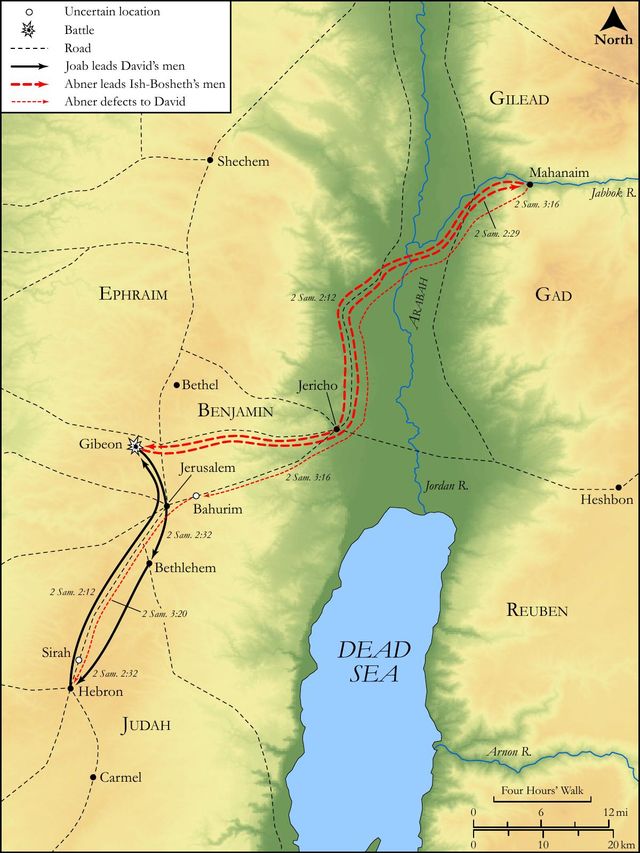
This verse is strategically placed immediately following a decisive and bloody battle at the Pool of Gibeon, where Abner's forces suffered a significant defeat at the hands of David's men. The initial skirmish, a challenge of twelve men from each side, quickly escalated into a full-scale rout, with Abner's army in full retreat. Asahel, famed for his extraordinary speed, described in 2 Samuel 2:18, relentlessly pursued Abner alone. Prior to this verse, Abner had made multiple attempts to deter Asahel, first by urging him to turn aside and pursue a less significant warrior, and then by issuing a direct warning of the fatal consequences if he persisted (2 Samuel 2:21-22). This specific exchange in verse 20 represents Abner's final, direct plea to Asahel, underscoring the high stakes and the personal nature of the impending clash before Abner is forced to defend himself.
Historical & Cultural Context
The backdrop for this encounter is the tumultuous period immediately following King Saul's death, a time when Israel was tragically divided. One faction remained loyal to Saul's son, Ish-bosheth (championed by Abner), while the other recognized David's anointing as the rightful king. This was a devastating civil war, pitting Israelite against Israelite, a scenario deeply antithetical to a culture that highly valued tribal and familial unity. Within this context, blood feuds were a grave matter, and killing a kinsman, especially one as prominent as Joab's brother, would inevitably lead to severe repercussions and likely escalate the conflict. Abner, as Saul's cousin and chief commander, was acutely aware of the political and personal ramifications of such an act, which undoubtedly fueled his profound reluctance to kill Asahel.
Key Themes
ShowHideThis verse powerfully contributes to several overarching themes within 2 Samuel 2 and the broader narrative of David's rise. It starkly underscores the tragic nature of civil war, where personal relationships and loyalties are tragically pitted against each other, leading to unnecessary bloodshed. It highlights the danger of unchecked zeal and single-minded determination, as Asahel's unwavering pursuit, despite clear warnings from a seasoned warrior, leads directly to his demise, a fate clearly foreshadowed in this very exchange and fulfilled in 2 Samuel 2:23. Furthermore, the interaction reveals the complexities of leadership and loyalty in a fractured nation, as Abner, though an adversary, attempts to avoid unnecessary bloodshed, while Asahel's loyalty to David's cause drives him to a fatal confrontation. The entire chapter, 2 Samuel 2, sets the stage for the protracted conflict between the houses of Saul and David, a conflict deeply impacted by this personal tragedy.
Exposition and Analysis
ShowHideKey Word Analysis
ShowHideFrom the root meaning "to turn," this word translated as "looked" signifies Abner's action of turning around to face his pursuer. It indicates a deliberate shift from evasion to direct confrontation, representing a pivotal moment where Abner ceases fleeing and resolves to address the relentless pursuit head-on. This turning is not merely physical but also a turning point in the narrative, leading directly to the tragic climax.
This primitive root, translated as "said" and "answered," carries a wide semantic range from speaking to declaring. In this verse, its dual use highlights the direct verbal exchange between Abner and Asahel. Abner's "said" is a direct, personal inquiry, while Asahel's "answered" is a terse, resolute declaration. The repetition emphasizes the dialogue as the central action of the verse, conveying the high stakes and the unyielding wills of both men.
Asahel's name, meaning "God has made" or "God has acted," stands in poignant contrast to his impending fate. Abner's direct use of the name "Asahel" underscores his recognition of Joab's brother, highlighting the personal and familial connection that Abner was attempting to honor by avoiding a fatal confrontation. The naming makes the interaction intensely personal, emphasizing the tragedy of Israelite fighting Israelite.
Verse Breakdown
ShowHide"Then Abner looked behind him, and said,"
This opening clause establishes the immediate context of the encounter. Abner, having been relentlessly pursued, makes a conscious decision to stop his flight and directly engage his pursuer. The act of "looking behind him" signifies his awareness of Asahel's unwavering pursuit and his decision that the moment for direct confrontation has arrived, implying a final, desperate attempt to resolve the situation without violence.
"[Art] thou Asahel?"
This is Abner's direct, personal, and profoundly significant question. It serves multiple purposes: it confirms the identity of his relentless pursuer, expresses his recognition of Joab's influential brother, and implicitly conveys a warning or a plea. Abner's earlier attempts to deter Asahel (2 Samuel 2:21-22) strongly suggest a deep reluctance to kill him, making this question a final, desperate appeal to Asahel's reason, self-preservation, or respect for the potential blood feud.
"And he answered, I [am]."
Asahel's brief and emphatic response is a stark declaration of his identity and, more significantly, an unwavering affirmation of his intent. There is no hesitation, no negotiation, only a terse, unequivocal confirmation that he is indeed the one relentlessly pursuing Abner. This bluntness underscores his single-minded, perhaps reckless, determination, leaving no room for turning back and sealing the tragic confrontation that immediately follows.
Literary Devices
ShowHideThe exchange in 2 Samuel 2:20 is rich with literary devices that amplify its dramatic tension and thematic significance. The primary device is Dialogue, which provides a direct, unmediated insight into the characters' intentions and personalities. Abner's question and Asahel's terse reply create immediate Foreshadowing of Asahel's impending death, as Abner's reluctance and Asahel's obstinacy clearly set the stage for a fatal confrontation just verses later (2 Samuel 2:23). There is also a strong element of Irony: the seasoned warrior, Abner, is actively trying to avoid killing his young, less experienced pursuer, while Asahel's youthful zeal and single-mindedness force Abner's hand. This interaction serves as powerful Characterization, revealing Abner's pragmatic and somewhat humane side (despite his role in the civil war) and Asahel's unwavering, perhaps reckless, determination. The entire scene is imbued with Dramatic Tension, built through the relentless pursuit and culminating in this direct, high-stakes verbal exchange that precedes the tragic climax.
Theological and Thematic Connections
ShowHideThe tense exchange in 2 Samuel 2:20 serves as a poignant reminder of the tragic consequences of human conflict, particularly when personal ambition or unchecked zeal overrides wisdom and the desire for peace. It illustrates how individual decisions, even those driven by loyalty or courage, can have far-reaching and devastating ripple effects, escalating cycles of violence and revenge within a community or nation. The passage implicitly raises questions about the nature of divine sovereignty amidst human choices, as the civil war unfolds according to God's ultimate plan for David's kingdom, yet through the messy, often tragic, actions of individuals. It underscores the importance of discernment and humility, warning against the dangers of a single-minded pursuit that ignores wise counsel and the potential for greater harm.
Reflection and Application
ShowHideThe tragic encounter between Abner and Asahel offers a profound cautionary tale for believers today, highlighting the critical importance of tempering zeal with wisdom and discernment. Asahel's unwavering determination, while admirable in its courage and loyalty, became a fatal flaw because it lacked the prudence to heed Abner's clear warnings. In our own lives, whether in personal pursuits, ministry endeavors, or even in defending truth, we must earnestly ask ourselves if our zeal is truly guided by God's wisdom and Spirit, or by our own unchecked ambition, stubbornness, or desire for personal glory. Are we willing to listen to counsel, even from those we perceive as adversaries, if it might avert unnecessary conflict, prevent our own downfall, or lead to a more righteous outcome? This passage challenges us to consider the long-term consequences of our actions, especially in moments of conflict or intense pursuit, and to prioritize peace, reconciliation, and the greater good where possible, understanding that our choices can set in motion chains of events that impact not only ourselves but also our communities and future generations.
Questions for Reflection
ShowHideFAQ
ShowHideWhy was Abner so reluctant to kill Asahel?
ShowHideAbner's profound reluctance stemmed primarily from two significant factors: the severe cultural implications of a blood feud and his pragmatic understanding of the ongoing civil war. Asahel was the brother of Joab, David's chief commander and a powerful, influential figure. Killing Asahel would inevitably provoke Joab's immediate and fierce vengeance, directly escalating the already bloody conflict between the house of Saul (which Abner represented) and the house of David. Abner, as a seasoned general and astute politician, sought to avoid such a personal and politically damaging vendetta. He had already warned Asahel multiple times to turn aside and pursue someone of lesser stature, even offering him an honorable escape by taking spoils from another soldier, as detailed in 2 Samuel 2:21-22. His final question in 2 Samuel 2:20 was a last-ditch effort to avoid a confrontation that he knew would have dire, long-lasting consequences for the nation.
What does Asahel's "I am" signify in this context?
ShowHideAsahel's terse "I am" is a powerful and unyielding declaration of his identity and, more profoundly, his unwavering determination and single-minded focus. It signifies his absolute refusal to be deterred, despite Abner's clear warnings and the implied mortal danger. This brief response conveys a sense of youthful, perhaps reckless, zeal and a tragic lack of strategic wisdom. Asahel was renowned for his extraordinary speed (2 Samuel 2:18), and his relentless pursuit of Abner seemed driven by a desire for personal glory or a decisive blow against the enemy general. His "I am" not only confirms his identity but, more importantly, seals his unwavering commitment to the chase, ultimately leading directly to his demise just moments later in 2 Samuel 2:23.
Christ-Centered Fulfillment
ShowHideThe tragic confrontation between Abner and Asahel, born of human conflict, unchecked zeal, and the devastating reality of civil war, finds its profound contrast and ultimate resolution in the person and redemptive work of Jesus Christ. Unlike Asahel's fatal pursuit, driven by human ambition and leading to death, Christ's pursuit of humanity is one of boundless, self-sacrificial love, aiming for reconciliation and eternal life. Where Abner issued a warning that went unheeded, leading to destruction, Christ, the ultimate "I AM" (John 8:58), offers warnings that lead to salvation for those who listen and obey (Matthew 7:13-14). The civil war in 2 Samuel highlights the devastating consequences of division and personal vendettas, but Jesus came as the true Prince of Peace, who breaks down walls of hostility and reconciles humanity not only to God but also to one another through His ultimate sacrifice on the cross (Ephesians 2:14-16). Asahel's zeal, though courageous, was ultimately unwise and self-destructive; Christ's zeal, however, was perfectly aligned with the Father's will, leading Him to the cross not for personal glory but for the redemption of the world (John 4:34). He is the true Lamb of God, who takes away the sin of the world, resolving the ultimate conflict between humanity and God, a peace that far transcends any temporary truce in a civil war.