


2 Samuel 2:16
Bible text: King James Version (1769 Blayney text) · Public domain
Bible text: King James Version with Strong's numbers · Public domain
Bible text: Berean Standard Bible · Public domain
Bible text: American Standard Version (1901) · Public domain
Bible text: World English Bible, Messianic edition · Public domain
Bible text: Geneva Bible (1599) · Public domain
Bible text: Young's Literal Translation · Public domain
- וַיַּחֲזִקוּvai·ya·cha·Zi·kuand they took holdH2388Conj-w ¦ V-Hiphil-ConsecImperf-3mpVerb Hiphil Consecutive Imperfect 3rd Plural Masculineוַandיַּחֲזִקוּthey took hold
- אִישׁ'isheachH376N-msNoun Singular Masculine Absolute
- בְּרֹאשׁbe·Roshon [the] head ofH7218Prep-b ¦ N-mscNoun Singular Masculine Constructבְּonרֹאשׁ[the] head of
- רֵעֵהוּre·'E·huhis neighborH7453N-msc ¦ 3msNoun Singular Masculine Constructרֵעֵneighborהוּhis
- וְחַרְבּוֹve·char·Boand his swordH2719Conj-w ¦ N-fsc ¦ 3msNoun Singular Feminine Constructוְandחַרְבּswordוֹhis
- בְּצַדbe·Tzad[was] in [the] side ofH6654Prep-b ¦ N-mscNoun Singular Masculine Constructבְּ[was] inצַד[the] side of
- רֵעֵהוּre·'E·huhis neighborH7453N-msc ¦ 3msNoun Singular Masculine Constructרֵעֵneighborהוּhis
- וַיִּפְּלוּvai·yi·pe·Luand they fellH5307Conj-w ¦ V-Qal-ConsecImperf-3mpVerb Qal Consecutive Imperfect 3rd Plural Masculineוַandיִּפְּלוּthey fell
- יַחְדָּוyach·DavtogetherH3162AdvAdverb
- וַיִּקְרָאvai·yik·Ra'and someone calledH7121Conj-w ¦ V-Qal-ConsecImperf-3msVerb Qal Consecutive Imperfect 3rd Singular Masculineוַandיִּקְרָאsomeone called
- לַמָּקוֹםla·ma·Kom<to> the placeH4725Prep-l ¦ N-msNoun Singular Masculine Absoluteלַ<to> theמָּקוֹםplace
- הַהוּאha·Hu'<the> thatH1931Art ¦ Pro-3msPronoun Personal 3rd Singular Masculineהַ<the>הוּאthat
- חֶלְקַתchel·KatHelkathH2521N-properNoun Proper Location
- הַצֻּרִיםha·tzu·RimHazzurimH2521N-properNoun Proper Location
- אֲשֶׁר'a·SherwhichH834RelParticle Relative
- בְּגִבְעוֹןbe·giv·'on[is] in GibeonH1391Prep-b ¦ N-properNoun Proper Locationבְּ[is] inגִבְעוֹןGibeon
English is a literal word-by-word gloss of the Hebrew, not the KJV's wording. Why?
This is the original text the KJV's translators worked from — each Hebrew word with its own literal English meaning in this verse, prepared by scholars at Tyndale House, Cambridge. The KJV translates whole sentences, not word by word, so its wording differs: one Hebrew word can become several English words, and the KJV may choose “the LORD” where the gloss reads “Yahweh”. Both are faithful — they answer different questions. For the KJV's own rendering, switch to the KJV text.
Details
See on the biblical-era maps

Study this verse
Public-domain commentary
Matthew Henry
From his Commentary on the Whole Bible. Henry comments on passages, not single verses — this entry covers 2 Samuel 2:8–17. His three-level outline is real structure in the source text, so it is rendered as structure.
Here is, I. A rivalship between two kings - David, whom God made king, and Ishbosheth, whom Abner made king. One would have thought, when Saul was slain, and all his sons that had sense and spirit enough to take the field with him, David would come to the throne without any opposition, since all Israel knew, not only how he had signalized himself, but how manifestly God had designated him to it; but such a spirit of contradiction is there, in the devices of men, to the counsels of God, that such a weak and silly thing as Ishbosheth, who was not thought fit to go with his father to the battle, shall yet be thought fit to succeed him in the government, rather than David shall come peaceably to it. Herein David's kingdom was typical of the Messiah's, against which the heathens rage and the rulers take counsel, Psa 2:1, Psa 2:2. 1. Abner was the person who set up Ishbosheth in competition with David, perhaps in his zeal for the lineal succession (since they must have a king like the nations, in this they must be like them, that the crown must descend from father to son), or rather in his affection to his own family and relations (for he was Saul's uncle), and because he had no other way to secure to himself the post of honour he was in, as captain of the host. See how much mischief the pride and ambition of one man may be the occasion of. Ishbosheth would never have set up himself if Abner had not set him up, and made a tool of him to serve his own purposes. 2. Mahanaim, the place where he first made his claim, was on the other side Jordan, where it was thought David had the least interest, and being at a distance from his forces they might have time to strengthen themselves. But having set up his standard there, the unthinking people of all the tribes of Israel (that is, the generality of them) submitted to him (Sa2 2:9), and Judah only was entirely for David. This was a further trial of the faith of David in the promise of God, and of his patience, whether he could wait God's time for the performance of that promise. 3. Some difficulty there is about the time of the continuance of this competition. David reigned about seven years over Judah only (Sa2 2:11), and yet (Sa2 2:10) Ishbosheth reigned over Israel but two years: before those two years, or after, or both, it was in general for the house of Saul (Sa2 3:6), and not any particular person of that house, that Abner declared. Or these two years he reigned before the war broke out (Sa2 2:12), which continued long, even the remaining five years, Sa2 3:1.
II.An encounter between their two armies.
1.It does not appear that either side brought their whole force into the field, for the slaughter was but small, Sa2 2:30, Sa2 2:31. We may wonder,
(1.)That the men of Judah did not appear and act more vigorously for David, to reduce all the nation into obedience to him; but, it is likely, David would not suffer them to act offensively, choosing rather to wait till the thing would do itself or rather till God would do it for him, without the effusion of Israelitish blood; for to him, as a type of Christ, that was very precious, Psa 72:14. Even those that were his adversaries he looked upon as his subjects, and would treat them accordingly.
(2.)That the men of Israel could in a manner stand neuter, and sit down tamely under Ishbosheth, for so many years, especially considering what characters many of the tribes displayed at this time (as we find, Ch1 12:23, etc.): Wise men, mighty men, men of valour, expert in war, and not of double heart, and yet for seven years together, for aught that appears, most of them seemed indifferent in whose hand the public administration was. Divine Providence serves its own purposes by the stupidity of men at some times and the activity of the same persons at other times; they are unlike themselves, and yet the motions of Providence are uniform.
2.In this battle Abner was the aggressor. David sat still to see how the matter would fall, but the house of Saul, and Abner at the head of it, gave the challenge, and they went by the worst. Therefore go not forth hastily to strive, nor be forward to begin quarrels, lest thou know not what to do in the end thereof, Pro 25:8. A fool's lips and hands enter into contention.
3.The seat of the war was Gibeon. Abner chose it because it was in the lot of Benjamin, where Saul had the most friends; yet, since he offered battle, Joab, David's general, would not decline it, but there joined issue with him, and met him by the pool of Gibeon, Sa2 2:13. David's cause, being built upon God's promise, feared not the disadvantages of the ground. The pool between them gave both sides time to deliberate.
4.The engagement was at first proposed by Abner, and accepted by Joab, to be between twelve and twelve of a side.
(1.)It should seem this trial of skill began in sport. Abner made the motion (Sa2 2:14): Let the young men arise and play before us, as gladiators. Perhaps Saul had used his men to these barbarous pastimes, like a tyrant indeed, and Abner had learnt of him to make a jest of wounds and death and divert himself with the scenes of blood and horror. He meant, "Let them fight before us," when he said, "Let them play before us." Fools thus make a mock at sin. but he is unworthy the name of a man that can be thus prodigal of human blood, that can thus throw about firebrands, arrows, and death, and say, Am not I in sport? Pro 26:18, Pro 26:19. Joab, having been bred up under David, had so much wisdom as not to make such a proposal, yet had not resolution enough to resist and gainsay it when another made it; for he stood upon a point of honour, and thought it a blemish to his reputation to refuse a challenge, and therefore said, Let them arise; not that he was fond of the sport, or expected that the duels would be decisive, but he would not be hectored by his antagonist. How many precious lives have thus been sacrificed to the caprices of proud men! Twelve of each side were accordingly called out as champions to enter the lists, a double jury of life and death, not of others', but their own; and the champions on Abner's side seem to have been most forward, for they took the field first (Sa2 2:15), having perhaps been bred up in a foolish ambition thus to serve the humour of their commander-in-chief. But,
(2.)However it began, it ended in blood (Sa2 2:16): They thrust every man his sword into his fellow's side (spurred on by honour, not by enmity); so they fell down together, that is, all the twenty-four were slain, such an equal match were they for one another, and so resolute, that neither side would either beg or give quarter; they did as it were by agreement (says Josephus) dispatch one another with mutual wounds. Those that strike at other men's lives often throw away their own and death only conquers and rides in triumph. The wonderful obstinacy of both sides was remembered in the name given to the place: Heldath-hazzurim - the field of rocky men, men that were not only strong in body, but of firm and unshaken constancy, that stirred not at the sight of death. Yet the stout-hearted were spoiled, and slept their sleep, Psa 76:5. Poor honour for men to purchase at so vast an expense! Those that lose their lives for Christ shall find them.
5.The whole army at length engaged, and Abner's forces were routed, Sa2 2:17. The former was a drawn battle, in which all were killed on both sides, and therefore they must put it upon another trial, in which (as it often happens) those that gave the challenge went away with loss. David had God on his side; his side therefore was victorious.
Continue studying 2 Samuel 2:16 across the web’s major study libraries — every link below opens this exact verse, chapter, or book on the destination site.
Read & Compare
 BibleGatewayThis verse in more than 200 translations and 70 languages.
 Bible.comThe YouVersion reader — hundreds of translations, reading plans, and highlights.
 ESV.orgCrossway's official English Standard Version reader.
 NET BibleThe NET translation with 60,000+ translators' notes on every rendering decision.
 STEP BibleTyndale House's free study tool — original text, vocabulary, and scholarly resources.
 BibliaLogos Bible Software's free web reader.
 USCCBThe New American Bible (Revised Edition) with the U.S. bishops' study notes.
Commentaries
 BibleHub CommentariesDozens of classic commentaries on this verse, gathered on one page.
 StudyLightMore than 100 commentary sets — the largest collection on the web.
 BibleRefPlain-English commentary on what this verse means, verse by verse.
 Enduring WordDavid Guzik's free commentary on this chapter, widely used by Bible teachers.
 Bible Study ToolsVerse commentary alongside Greek and Hebrew study aids.
Original Language & Research
- BibleHub InterlinearThe verse word by word — original language, transliteration, and English.
- BibleHub LexiconEvery word's original-language definition and Strong's entry.
 Blue Letter BibleDeep-study tools — Strong's numbers, concordance, and word studies.
 SefariaThe Hebrew text with Rashi and centuries of Jewish commentary.
Sermons, Hymns & Audio


TrulyRandomVerse is not affiliated with these sites and doesn’t control their content. They’re linked because they’re genuinely useful.
Summary
2 Samuel 2:16 recounts a grim and pivotal moment in the nascent civil war between the house of Saul, led by Abner, and the house of David, under Joab. At the Pool of Gibeon, what began as a proposed "game" between twelve champions from each side tragically escalated into a synchronized, fatal duel where every man simultaneously seized his opponent by the head and thrust his sword into his side. This horrific mutual destruction resulted in all twenty-four men falling dead together, permanently marking the location and earning it the poignant name Helkathhazzurim, "Smoothness of the Rocks," a place forever associated with this field of fatal combat.
Context
ShowHideLiterary Context
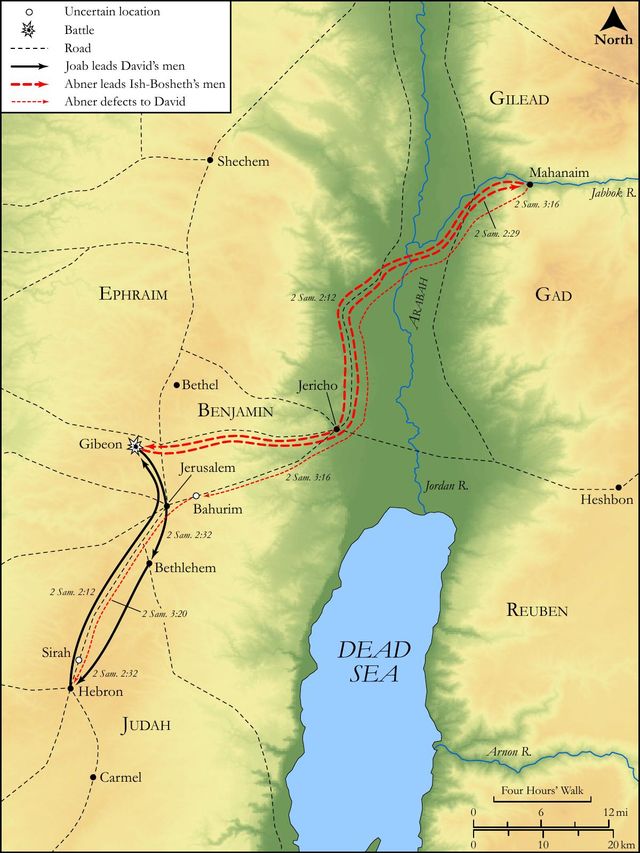
This verse is strategically positioned at the immediate outset of direct military engagement between the two rival factions vying for control of Israel following King Saul's death. After David's anointing as king over Judah in Hebron, Abner, Saul's general, had established Saul's son, Ish-bosheth, as king over the rest of Israel, setting the stage for conflict. The two armies meet at the Pool of Gibeon, where Abner, perhaps seeking to avoid a full-scale battle or to display the prowess of his men, proposes a "game" or challenge to Joab, David's general, as recorded in 2 Samuel 2:14. Joab accepts, leading directly to the macabre scene described in 2 Samuel 2:16, which immediately precipitates the intense, general battle that follows, detailed in 2 Samuel 2:17. The verse thus serves as a grim prelude, setting the tone for the ensuing bloodshed and highlighting the immediate, devastating consequences of the conflict.
Historical & Cultural Context
The period described is a critical juncture in Israelite history, marking the transition from Saul's fragmented kingdom to David's unified monarchy. Following Saul's death on Mount Gilboa, a power vacuum emerged, leading to a protracted civil war. Abner's attempt to consolidate power under Ish-bosheth directly challenged David's divinely ordained kingship. The practice of champions engaging in single combat or small-group duels as a prelude to larger battles was not uncommon in the wars of that day, often intended to break the enemy's morale or secure a quick victory without a full engagement. However, the outcome at Gibeon—a simultaneous, mutual slaughter—was highly unusual and underscored the unique brutality and senselessness of this particular conflict, rooted in internal division rather than external threat. Gibeon itself was a significant city, known for its large pool and strategic location, making it a natural point of confrontation.
Key Themes
ShowHideThis verse powerfully encapsulates several overarching themes present in the books of Samuel. It starkly illustrates the brutality and senselessness of civil war, demonstrating how internal conflict can lead to mutual destruction, consuming all parties involved without clear victors. The "game" proposed by Abner, a reckless act of human folly and pride, tragically results in immediate, shared fatalities, emphasizing the devastating consequences of unbridled aggression and poor judgment. This event serves as a microcosm of the larger conflict, where the pursuit of power and factionalism lead to widespread suffering. Furthermore, the naming of the place, Helkathhazzurim, highlights the significance of place names as memorials to pivotal historical events, ensuring that the tragic outcome of this encounter would be remembered and serve as a somber reminder of the cost of division. The narrative also underscores the sovereignty of God working through human actions, even in their depravity, to bring about His ultimate plan for David's kingship, as seen in the broader narrative of 2 Samuel.
Exposition and Analysis
ShowHideKey Word Analysis
ShowHideThis verb (H2388) means "to fasten upon," "to seize," or "to take hold (fast)." In the context of 2 Samuel 2:16, it describes the deliberate and firm grip each man took on his opponent's head. This action signifies a committed and inescapable engagement, emphasizing the direct, personal, and intentional nature of the duel. It indicates that the combatants were locked in a mutual struggle, ensuring that neither could escape the ensuing fatal blow.
This noun (H2719) refers to a "cutting instrument" or "sharp implement," primarily a sword, but also an axe or dagger. Its etymological root suggests "drought" or "desolation," highlighting its destructive effect. In this verse, the "sword" is the instrument of mutual destruction, symbolizing the lethal intent and the immediate, fatal consequence of the "game." It underscores the brutality of the encounter and the swiftness with which life was extinguished.
This proper name (H2521) is derived from "Helkath" (meaning "field" or "portion") and "hazzurim," which the Strong's data defines as "smoothness of the rocks." While the literal meaning is "Smoothness of the Rocks," the context of the deadly duel has led to traditional interpretations such as "Field of Swords" or "Field of Sharpened Edges," connecting "tsurim" (rocks) to flint or sharp blades, or even to "strong men" (adversaries). The name serves as a grim and enduring memorial to the place where twenty-four men fell in mutual combat, forever linking the landscape to this tragic event.
Verse Breakdown
ShowHide"And they caught every one his fellow by the head,"
This opening clause establishes the intimate and deliberate nature of the duel. Each of the twelve champions from both sides simultaneously seized his opponent by the head. This firm grip was likely intended to control the adversary, immobilizing them and ensuring the precision of the subsequent fatal strike. It highlights the direct, face-to-face confrontation and the mutual commitment to this deadly contest.
"and [thrust] his sword in his fellow's side;"
This is the pivotal action of the verse, detailing the synchronized, fatal blow. With their opponents held securely, each man plunged his sword into the side of his "fellow." The use of "fellow" emphasizes the chilling symmetry and reciprocity of the act – it was not a one-sided attack, but a mutual, self-destructive engagement. The "side" refers to the vulnerable flank or torso, indicating a deliberate aim for a fatal wound.
"so they fell down together:"
This clause describes the immediate and inevitable consequence of the synchronized thrusts. Because each man delivered a fatal blow to his opponent at the exact same moment, all twenty-four participants—twelve from Abner's side and twelve from Joab's side—collapsed and died simultaneously. This outcome powerfully illustrates the concept of mutual destruction, where no one emerges victorious, only dead, serving as a stark visual representation of the futility and devastating cost of their "game."
"wherefore that place was called Helkathhazzurim, which [is] in Gibeon."
This final clause provides the etymology of the place name, cementing the tragic event in the geographical and historical memory of Israel. The naming of the site as "Helkathhazzurim" ("Smoothness of the Rocks," commonly understood as "Field of Swords" or "Field of Sharpened Edges") transforms it into a permanent memorial to the senseless loss of life. The addition "which is in Gibeon" provides geographical specificity, ensuring future generations would know the exact location of this grim encounter.
Literary Devices
ShowHideThe narrative in 2 Samuel 2:16 employs several potent literary devices to convey its message. Irony is prominent, as what begins as a proposed "game" (Hebrew: שַׂחַק, śaḥaq, "to play" or "to sport" in 2 Samuel 2:14) quickly devolves into a deadly, mutual slaughter, highlighting the grim reality of civil conflict where there are no true winners. The simultaneous deaths serve as powerful symbolism for the self-destructive nature of internal division; when a nation or people are divided against themselves, they ultimately destroy each other. The verse also functions as an etiology, explaining the origin and meaning of the place name Helkathhazzurim, thus embedding the historical event within the landscape and ensuring its remembrance. Furthermore, this specific, brutal encounter serves as foreshadowing, signaling the intense and bloody nature of the protracted civil war that will follow between the house of David and the house of Saul, underscoring that the initial "game" was merely a prelude to far greater devastation.
Theological and Thematic Connections
ShowHideThe grim scene at Helkathhazzurim offers profound theological and thematic insights into the nature of human conflict and its devastating consequences. It stands as a stark testament to human depravity and the destructive power of pride, ambition, and unbridled aggression. The mutual destruction of the twenty-four young men underscores the futility of division and the self-inflicted wounds that result from internal strife. Theologically, it reminds us that while God works out His purposes, human sin and folly always bear painful fruit. This passage serves as a cautionary tale, urging believers to pursue peace and reconciliation rather than escalating conflicts, recognizing that the cost of division is often borne by all parties involved. It highlights the urgent need for divine wisdom and intervention in human affairs, contrasting sharply with the destructive "wisdom" of the world.
Reflection and Application
ShowHide2 Samuel 2:16, though a distant historical account, holds timeless lessons for contemporary life. It forces us to confront the inherent dangers of pride, bravado, and the escalation of conflict, whether in personal relationships, communities, or nations. The "game" at Gibeon illustrates how seemingly small provocations or competitions, fueled by ego and a lack of wisdom, can rapidly spiral into devastating, mutual destruction. It challenges us to consider the true cost of "winning" at all costs, especially when it involves the dehumanization or destruction of others. The passage compels us to prioritize reconciliation, seek peaceful resolutions, and actively work to de-escalate tensions rather than contributing to cycles of retaliation. It calls us to cultivate humility, empathy, and a spirit of peacemaking, recognizing that true strength lies not in dominating others, but in fostering unity and healing, reflecting the character of God who is himself a God of peace.
Questions for Reflection
ShowHideFAQ
ShowHideWhat was the "game" Abner proposed that led to this tragic event?
ShowHideThe "game" was a challenge proposed by Abner to Joab, suggesting that young men from both sides "play before us" (2 Samuel 2:14). This was likely intended as a form of ritual combat or a limited duel between champions to determine initial superiority or to avoid a full-scale battle. However, it tragically escalated into a synchronized, fatal encounter where twelve men from each side simultaneously killed their opponents, leading to mutual destruction rather than a clear victory for either side.
What does the name "Helkathhazzurim" mean, and why was the place given this name?
ShowHide"Helkathhazzurim" (Hebrew: חֶלְקַת הַצֻּרִים) literally means "Smoothness of the Rocks." However, due to the context of the horrific event, it is commonly interpreted as "Field of Swords" or "Field of Sharpened Edges," drawing on the potential secondary meanings of the Hebrew root. The place was given this name to commemorate the tragic event described in 2 Samuel 2:16, where twenty-four young men—twelve from Abner's side and twelve from Joab's side—engaged in a simultaneous duel and all fell dead together. The name serves as a permanent, grim memorial to the senseless loss of life and the mutual destruction that occurred there at the outset of the civil war.
Why did these men fight in such a way that led to all of them dying simultaneously?
ShowHideThe text indicates that "they caught every one his fellow by the head, and [thrust] his sword in his fellow's side; so they fell down together." This suggests a pre-arranged, perhaps ritualistic, form of combat where each man was committed to delivering a fatal blow to his opponent at the same moment. It was likely a combination of extreme bravado, a desire for a decisive outcome, and a profound miscalculation of the ultimate consequence. The result was a chilling demonstration of symmetrical violence, where the intent to kill was perfectly matched by the opponent, leading to no survivors among the participants of this particular "game." It underscores the futility and devastating cost of human pride and aggression.
Christ-Centered Fulfillment
ShowHideThe gruesome scene at Helkathhazzurim, a "Field of Swords" where mutual destruction reigns, stands in stark contrast to the ultimate "Field" of reconciliation and life found in Jesus Christ. The civil war between the house of Saul and the house of David epitomizes humanity's fallen state—marked by division, pride, and self-destructive conflict. In this Old Testament account, human attempts to establish power through violence lead only to death and further bloodshed. However, the New Testament reveals a different kind of "battle" and a different kind of "victory." Jesus Christ, the true King, does not engage in mutual destruction but offers self-sacrificial love. He is the ultimate Peacemaker, who, through His own death on the cross, did not inflict mutual wounds but absorbed the full wrath of God against sin, thereby reconciling humanity to God and breaking down the dividing walls of hostility between people, as powerfully declared in Ephesians 2:14-16. Unlike the Gibeon duel where death brought only more death, Christ's death brings life, peace, and unity to all who believe, fulfilling God's purpose of reconciling all things to Himself through Christ's blood on the cross (Colossians 1:19-20). His kingdom is not divided against itself, as He Himself taught in Matthew 12:25, and He offers His peace, not as the world gives, but as a lasting inheritance to His followers (John 14:27). The "Field of Swords" is redeemed by the "Prince of Peace" (Isaiah 9:6), who calls His followers to be peacemakers (Matthew 5:9), transforming fields of conflict into fields of grace and new life.