


2 Chronicles 3:9
Bible text: King James Version (1769 Blayney text) · Public domain
Bible text: Berean Standard Bible · Public domain
Bible text: American Standard Version (1901) · Public domain
Bible text: World English Bible, Messianic edition · Public domain
Bible text: Geneva Bible (1599) · Public domain
Bible text: Young's Literal Translation · Public domain
- וּמִשְׁקָלu·mish·Kaland [the] weightH4948Conj-w ¦ N-msNoun Singular Masculine Absoluteוּandמִשְׁקָל[the] weight
- לְמִסְמְרוֹתle·mis·me·Rotof nailsH4548Prep-l ¦ N-fpNoun Plural Feminine Absoluteלְofמִסְמְרוֹתnails
- לִשְׁקָלִיםlish·ka·Limto shekelsH8255Prep-l ¦ N-mpNoun Plural Masculine Absoluteלִtoשְׁקָלִיםshekels
- חֲמִשִּׁיםcha·mi·ShimfiftyH2572N-mpNoun Plural Masculine Absolute
- זָהָבza·HavgoldH2091N-msNoun Singular Masculine Absolute
- וְהָעֲלִיּוֹתve·ha·'a·li·Yotand the upper roomsH5944Conj-w ¦ Art ¦ N-fpNoun Plural Feminine Absoluteוְandהָtheעֲלִיּוֹתupper rooms
- חִפָּהchi·Pahhe overlaidH2645V-Piel-Perf-3msVerb Piel Perfect 3rd Singular Masculine
- זָהָבza·HavgoldH2091N-msNoun Singular Masculine Absolute
English is a literal word-by-word gloss of the Hebrew, not the KJV's wording. Why?
This is the original text the KJV's translators worked from — each Hebrew word with its own literal English meaning in this verse, prepared by scholars at Tyndale House, Cambridge. The KJV translates whole sentences, not word by word, so its wording differs: one Hebrew word can become several English words, and the KJV may choose “the LORD” where the gloss reads “Yahweh”. Both are faithful — they answer different questions. For the KJV's own rendering, switch to the KJV text.
Details
See on the biblical-era maps
Study this verse
Public-domain commentary
Matthew Henry
From his Commentary on the Whole Bible. Henry comments on passages, not single verses — this entry covers 2 Chronicles 3:1–9.
Here is, I. The place where the temple was built. Solomon was neither at liberty to choose nor at a loss to fix the place. It was before determined (Ch1 22:1), which was an ease to his mind. 1. It must be at Jerusalem; for that was the place where God had chosen to put his name there. The royal city must be the holy city. There must be the testimony of Israel; for there are set the thrones of judgment, Psa 122:4, Psa 122:5. 2. It must be on Mount Moriah, which, some think, was that very place in the land of Moriah where Abraham offered Isaac, Gen 22:2. So the Targum says expressly, adding, But he was delivered by the word of the Lord, and a ram provided in his place. That was typical of Christ's sacrifice of himself; therefore fitly was the temple, which was likewise a type of him, built there. 3. It must be where the Lord appeared to David, and answered him by fire, Ch1 21:18, Ch1 21:26. There atonement was made once; and therefore, in remembrance of that, there atonement was made once; and therefore, in remembrance of that, there atonement must still be made. Where God has met with me it is to be hoped that he will still manifest himself. 4. It must be in the place which David has prepared, not only which he had purchased with his money, but which he had purchased with his money, but which he had pitched upon divine direction. It was Solomon's wisdom not to enquire out a more convenient place, but to acquiesce in the appointment of God, whatever might be objected against it. 5. It must be in the threshold floor of Ornan, which, if (as a Jebusite) it gives encouragement to the Gentiles, obliges us to look upon temple-work as that which requires the labour of the mind, no less than threshing-work dos that of the body.
II.The time when it was begun; not till the fourth year of Solomon's reign, Ch2 3:2.
Not that the first three years were trifled away, or spent in deliberating whether they should build the temple or no; but they were employed in the necessary preparations for it, wherein three years would be soon gone, considering how many hands were to be got together and set to work. Some conjecture that this was a sabbatical year, or year of release and rest to the land, when the people, being discharged from their husbandry, might more easily lend a hand to the beginning of this work; and then the year in which it was finished would fall out to be another sabbatical year, when they would likewise have leisure to attend the solemnity of the dedication of it.
III.The dimensions of it, in which Solomon was instructed (Ch2 3:3), as he was in other things, by his father.
This was the foundation (so it may be read) which Solomon laid for the building of the house. This was the rule he went by, so many cubits the length and breadth, after the first measure, that is, according to the measure first fixed, which there was no reason to make any alteration of when the work came to be done; for the dimensions were given by divine wisdom, and what God does shall be for ever; nothing can be put to it, or taken from it, Ecc 3:14. His first measure will be the last.
IV.The ornaments of the temple.
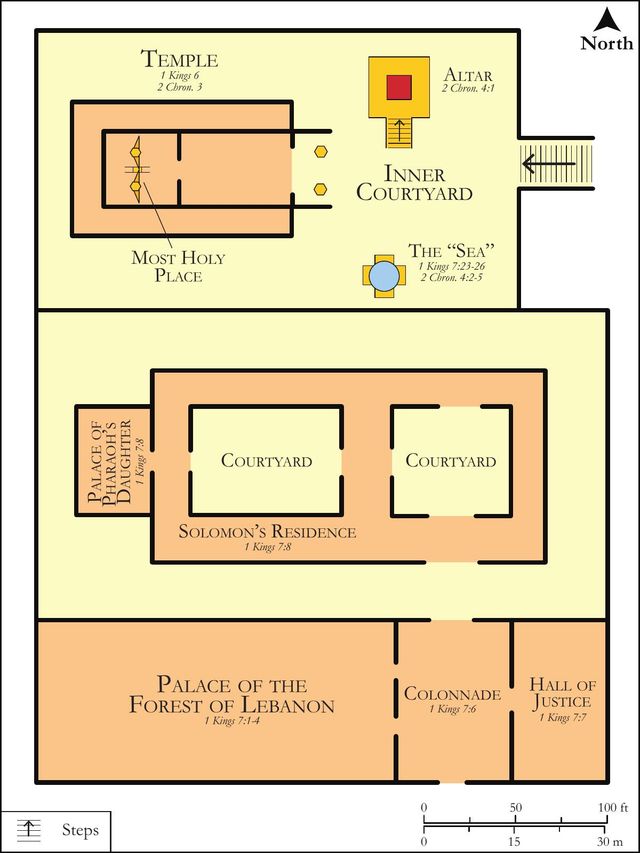
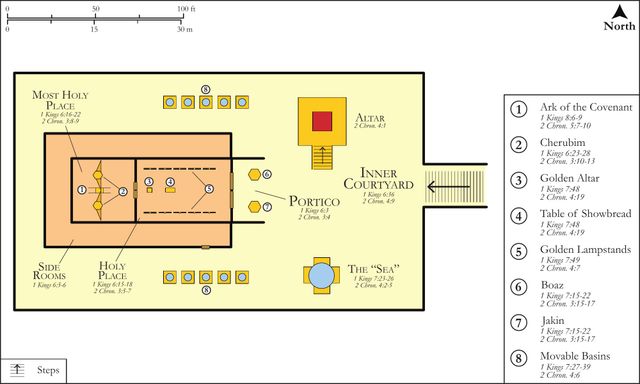
The timber-work was very fine, and yet, within, it was overlaid with pure gold (Ch2 3:4), with fine gold (Ch2 3:5). and that embossed with palm-trees and chains. It was gold of Parvaim (Ch2 3:6), the best gold. The beams and posts, the walls and doors, were overlaid with gold, Ch2 3:7. The most holy place, which was ten yards square, was all overlaid with fine gold (Ch2 3:8), even the upper chambers, or rather the upper floor or roof - top, bottom, and sides, were all overlaid with gold. Every nail, or screw, or pin, with which the golden plates were fastened to the walls that were overlaid with them, weighed fifty shekels, or was worth so much, workmanship and all. A great many precious stones were dedicated to God (Ch1 29:2, Ch1 29:8), and these were set here and there, where they would show to the best advantage. The finest houses now pretend to no better garnishing than good paint on the roof and walls; but the ornaments of the temple were most substantially rich. It was set with precious stones, because it was a type of the new Jerusalem, which has no temple in it because it is all temple, and the walls, gates, and foundations of which are said to be of precious stones and pearls, Rev 21:18, Rev 21:19, Rev 21:21.
Continue studying 2 Chronicles 3:9 across the web’s major study libraries — every link below opens this exact verse, chapter, or book on the destination site.
Read & Compare
 BibleGatewayThis verse in more than 200 translations and 70 languages.
 Bible.comThe YouVersion reader — hundreds of translations, reading plans, and highlights.
 ESV.orgCrossway's official English Standard Version reader.
 NET BibleThe NET translation with 60,000+ translators' notes on every rendering decision.
 STEP BibleTyndale House's free study tool — original text, vocabulary, and scholarly resources.
 BibliaLogos Bible Software's free web reader.
 USCCBThe New American Bible (Revised Edition) with the U.S. bishops' study notes.
Commentaries
 BibleHub CommentariesDozens of classic commentaries on this verse, gathered on one page.
 StudyLightMore than 100 commentary sets — the largest collection on the web.
 BibleRefPlain-English commentary on what this verse means, verse by verse.
 Enduring WordDavid Guzik's free commentary on this chapter, widely used by Bible teachers.
 Bible Study ToolsVerse commentary alongside Greek and Hebrew study aids.
Original Language & Research
- BibleHub InterlinearThe verse word by word — original language, transliteration, and English.
- BibleHub LexiconEvery word's original-language definition and Strong's entry.
 Blue Letter BibleDeep-study tools — Strong's numbers, concordance, and word studies.
 SefariaThe Hebrew text with Rashi and centuries of Jewish commentary.
Sermons, Hymns & Audio


TrulyRandomVerse is not affiliated with these sites and doesn’t control their content. They’re linked because they’re genuinely useful.
Summary
2 Chronicles 3:9 offers a meticulous detail of Solomon's Temple construction, revealing the extraordinary lavishness applied even to seemingly minor components like the nails, which weighed fifty shekels of gold, and the comprehensive gold overlay of the upper chambers. This verse profoundly underscores the unparalleled dedication, immense wealth, and meticulous craftsmanship invested in creating a dwelling place for God, emphasizing the Temple's sacredness, purity, and the divine glory it was intended to reflect.
Context
ShowHideLiterary Context
This verse is deeply embedded within the detailed architectural account of Solomon's construction of the Temple, commencing in 2 Chronicles 3:1. The preceding verses meticulously describe the Temple's foundational dimensions, the precious materials utilized for its structure, and the initial gold overlay of the inner sanctuary, including the cherubim. Specifically, 2 Chronicles 3:7 mentions the general overlaying of the entire house—its beams, posts, walls, and doors—with gold, alongside the intricate carving of cherubim. Verse 9 then provides an astonishing, almost hyper-specific detail, focusing on the substantial weight of gold used for the nails and the gold covering of the "upper chambers." This highlights that no part of the sacred edifice, however small or seemingly utilitarian, was considered unworthy of the most precious material. This pervasive emphasis on detail and extravagance continues into the subsequent verses, which describe the veil and the two pillars, further underscoring the Temple's unparalleled magnificence.
Historical & Cultural Context
The construction of the Temple by King Solomon, around 960 BCE, marked the pinnacle of Israelite national and religious identity. This monumental undertaking fulfilled the divine promise made to his father, David, that his son would build a house for God's name, as recorded in 2 Samuel 7:13. Among the nations round about, temples were typically grand structures, signifying the unique and profound relationship between Yahweh and Israel. Gold, universally recognized as the most precious metal, was highly valued for its incorruptibility, malleability, and radiant beauty. It was frequently associated with divinity, royalty, and purity among the nations. Its extensive use in the Temple, even for elements as seemingly insignificant as nails, underscored the structure's sacred function as the dwelling place of God's tangible presence, where the glory of the Lord would reside among His people, as vividly described in 1 Kings 8:11.
Key Themes
ShowHide2 Chronicles 3:9 powerfully illustrates several pivotal themes that permeate the Temple narrative and the broader chronicler's theological agenda. Firstly, it exemplifies Unparalleled Devotion and Sacrifice, showcasing Solomon's and Israel's profound commitment to dedicating their absolute best to the Lord. The sheer quantity of gold, even for the nails, symbolizes a "no-expense-spared" approach to honoring God, reflecting a heart of worship that prioritizes divine glory above all earthly wealth. Secondly, the pervasive use of gold underscores the Divine Glory and Sacredness of the Temple. Gold, as an enduring symbol of purity, incorruptibility, and divine majesty, transformed the physical structure into a tangible representation of God's holy presence. The Temple was not merely a building but a consecrated space where the transcendent God condescended to dwell among His people, inspiring profound awe and reverence. This emphasis on the Temple's splendor serves to magnify the God who inhabits it, reinforcing the overarching themes of divine sovereignty and the paramount importance of proper, unreserved worship in the chronicler's theology.
Exposition and Analysis
ShowHideKey Word Analysis
ShowHideThis term refers to a peg, spike, or nail, typically made of metal, used for fastening. In the context of the Temple, these "nails" were likely large, decorative pegs or spikes used to secure the extensive gold sheets or panels to the underlying wooden framework. The fact that they were made of solid gold, rather than merely gold-plated, and weighed a significant fifty shekels (approximately 1.25 pounds or 0.57 kg) speaks volumes about the extraordinary value and meticulous attention to detail invested in every single component of the Temple, even those that might be considered structural or less visible. This detail underscores a profound commitment to perfection and lavishness in God's house.
A primitive root meaning "to cover," by implication, "to veil, to encase, protect." This verb signifies the act of completely covering a surface with another material. In this verse, it describes the comprehensive application of gold to the "upper chambers." The choice of this verb emphasizes the thoroughness of the gold application, indicating that these areas were not merely adorned with gold accents but were entirely encased or covered, reflecting a holistic dedication to making the entire structure radiate divine glory.
This feminine noun refers to something lofty, such as a stairway, or more commonly, a second-story room, a room on the roof, or an upper chamber. In the context of the Temple, these were likely ancillary rooms built around or above the main sanctuary. They could have served various purposes, such as storage for sacred vessels, priestly vestments, or offerings, or possibly as living quarters for priests. The fact that these functional, peripheral spaces, not just the central sanctuary, were also completely overlaid with gold demonstrates the comprehensive nature of the Temple's embellishment. It signifies that the entire complex, from its most sacred inner core to its surrounding functional spaces, was consecrated and adorned to reflect God's glory without reservation.
Verse Breakdown
ShowHide"And the weight of the nails [was] fifty shekels of gold"
This clause provides a stunning, specific detail about the materials used in the Temple's construction. It specifies that even the nails, likely large pegs or decorative spikes used to fasten the gold panels, were made of solid gold, weighing a remarkable fifty shekels. This detail powerfully emphasizes the unparalleled lavishness and the "no expense spared" attitude towards building God's house. It highlights the meticulous craftsmanship and the immense value placed on every single component, no matter how small or seemingly utilitarian, underscoring the sacredness and preciousness of the entire structure in the eyes of its builders.
"And he overlaid the upper chambers with gold"
This second clause indicates that the gold overlay was not confined to the main sanctuary or the most prominent areas but extended comprehensively to the "upper chambers." These ancillary rooms, possibly for storage, priestly use, or administrative functions, were also completely covered in gold. This demonstrates the holistic nature of the Temple's adornment, signifying that the entire complex, from its most sacred core to its surrounding functional spaces, was dedicated and consecrated to God's glory. It speaks to a grand vision of making the dwelling place of the Lord utterly magnificent in every aspect.
Literary Devices
ShowHideThe verse primarily employs Symbolism and Emphasis. The pervasive and extensive use of gold throughout the Temple, particularly for elements as seemingly minor as nails and as expansive as the upper chambers, is profoundly symbolic. Gold universally represents purity, divinity, royalty, and enduring value. Its application here symbolizes the absolute holiness, unblemished nature, and radiant glory of God, for whom the Temple was meticulously built. It also signifies the preciousness of worship offered to Him and the incorruptible nature of divine presence. The chronicler uses this vivid detail to emphasize the unprecedented wealth, meticulous craftsmanship, and profound dedication involved in the Temple's construction. This emphasis serves to underscore the Temple's unique status as God's chosen dwelling place on earth, inspiring awe, reverence, and a deep appreciation for the magnitude of the undertaking and the God it honored.
Theological and Thematic Connections
ShowHideThe extraordinary detail of gold nails and overlaid upper chambers in 2 Chronicles 3:9 serves as a profound theological statement about the nature of God and the appropriate response of His people. It teaches that God is worthy of the absolute best, not merely in grand gestures but in every minute, often unseen, detail. This meticulous dedication reflects a deep understanding of God's holiness, majesty, and unapproachable glory, where even the seemingly insignificant parts of His dwelling place are treated with ultimate reverence. The Temple, in its unparalleled splendor, was a tangible representation of God's glory and a constant reminder of His covenant presence among Israel, demanding a worship that spared no expense and held nothing back. This principle of offering our "first and best" extends beyond material possessions to our time, talents, and entire lives, reflecting a heart fully devoted to the Lord.
Reflection and Application
ShowHide2 Chronicles 3:9, with its vivid depiction of gold nails and overlaid chambers, challenges us to consider the depth of our own devotion and the quality of our offering to God. While we no longer construct physical temples of gold, the underlying principle remains profoundly relevant: God is worthy of our absolute best in every area of our lives. This verse encourages us to move beyond superficial acts of worship and to examine the "nails" and "upper chambers" of our spiritual lives—those seemingly small, hidden, or less glamorous aspects of our faith and service. Are we as meticulous and generous with our integrity, our private prayers, our hidden acts of kindness, and our stewardship of resources as we are with our public displays of faith? True devotion is comprehensive, impacting every facet of our being. It calls us to offer our time, talents, and treasures with a heart that recognizes God's supreme worth, ensuring that even the most minute details of our lives are consecrated to His glory, reflecting a genuine love that holds nothing back and seeks to honor Him in all things.
Questions for Reflection
ShowHideFAQ
ShowHideWhy were the nails made of gold, and what is their significance?
ShowHideThe mention of nails weighing fifty shekels of gold in 2 Chronicles 3:9 is striking because nails are typically functional, not inherently valuable or decorative. Their composition of solid gold, rather than mere gold plating, underscores the extraordinary commitment to lavishness and perfection in every detail of the Temple's construction. These "nails" were likely large, decorative pegs or spikes used to secure the extensive gold paneling to the wooden structure of the Temple. Their significance lies in demonstrating that absolutely no expense was spared, and no component, however seemingly minor or utilitarian, was considered too insignificant to be made of the most precious material. This symbolized the absolute holiness and supreme worthiness of God, for whom the Temple was built, and highlighted the unparalleled devotion of Solomon and the Israelite people. It conveyed that God deserves the very best in every aspect of worship and service, down to the smallest detail.
Christ-Centered Fulfillment
ShowHideThe Temple, in its magnificent splendor and gold-laden details, including the nails and upper chambers, served as a profound prefigurement of Christ. Just as the Temple was the dwelling place of God's manifest presence among His people, Jesus is the ultimate tabernacle, the very embodiment of God dwelling among us, full of grace and truth, as beautifully declared in John 1:14. The Temple's gold, symbolizing purity, divinity, and glory, finds its perfect fulfillment in the sinless, divine nature of Jesus Christ, who is precisely the radiance of God's glory and the exact imprint of His nature (Hebrews 1:3). Furthermore, the meticulous attention to every detail, even the nails, in the Temple's construction, foreshadows the perfect, comprehensive sacrifice of Christ, where every aspect of His life, death, and resurrection was precisely ordained and perfectly executed for our redemption. He is the true Temple, not made with human hands, through whom we now have direct access to God (Hebrews 9:11-12). Moreover, through Christ, believers themselves become living stones, spiritually built into a holy temple, a spiritual house, and a royal priesthood, offering spiritual sacrifices acceptable to God (1 Peter 2:5). This signifies that the ultimate "gold overlay" is the indwelling Holy Spirit in the hearts of those who believe, making them temples of God's presence.