


1 Samuel 14:9
Bible text: King James Version (1769 Blayney text) · Public domain
Bible text: Berean Standard Bible · Public domain
Bible text: American Standard Version (1901) · Public domain
Bible text: World English Bible, Messianic edition · Public domain
Bible text: Geneva Bible (1599) · Public domain
Bible text: Young's Literal Translation · Public domain
- אִם'imifH518PrtParticle Conditional
- כֹּהkohthusH3541AdvAdverb
- יֹאמְרוּyo·me·Ruthey will sayH559V-Qal-Imperf-3mpVerb Qal Imperfect 3rd Plural Masculine
- אֵלֵינוּ'e·Lei·nuto usH413Prep ¦ 1cpPreposition Definiteאֵלֵיtoנוּus
- דֹּמּוּDo·mube stillH1826V-Qal-Imp-2mpVerb Qal Imperative 2nd Plural Masculine
- עַד'aduntilH5704PrepPreposition
- הַגִּיעֵנוּha·gi·'E·nuwe reachH5060V-Hiphil-Inf ¦ 1cpVerb Hiphil Infinitive Constructהַגִּיעֵreachנוּwe
- אֲלֵיכֶם'a·lei·Khem<to> youH413Prep ¦ 2mpPreposition Definiteאֲלֵי<to>כֶםyou
- וְעָמַדְנוּve·'a·Mad·nuand we will remainH5975Conj-w ¦ V-Qal-ConsecPerf-1cpVerb Qal Consecutive Perfect 1st Plural common genderוְandעָמַדְנוּwe will remain
- תַחְתֵּינוּtach·Tei·nuour in placeH8478N-mpc ¦ 1cpNoun Plural Masculine Constructתַחְתֵּיin placeנוּour
- וְלֹאve·Lo'and notH3808Conj-w ¦ NegParticle Negativeוְandלֹאnot
- נַעֲלֶהna·'a·Lehwe will go upH5927V-Qal-Imperf-1cpVerb Qal Imperfect 1st Plural common gender
- אֲלֵיהֶם'a·lei·Hemto themH413Prep ¦ 3mpPreposition Definiteאֲלֵיtoהֶםthem
English is a literal word-by-word gloss of the Hebrew, not the KJV's wording. Why?
This is the original text the KJV's translators worked from — each Hebrew word with its own literal English meaning in this verse, prepared by scholars at Tyndale House, Cambridge. The KJV translates whole sentences, not word by word, so its wording differs: one Hebrew word can become several English words, and the KJV may choose “the LORD” where the gloss reads “Yahweh”. Both are faithful — they answer different questions. For the KJV's own rendering, switch to the KJV text.
Details
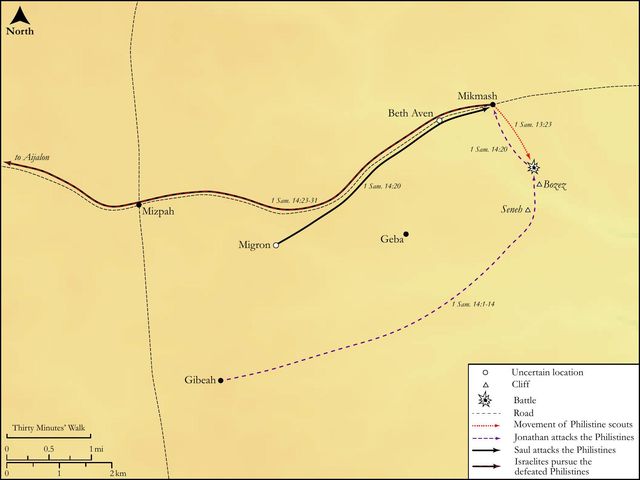
See on the biblical-era map
Study this verse
Public-domain commentary
Matthew Henry
From his Commentary on the Whole Bible. Henry comments on passages, not single verses — this entry covers 1 Samuel 14:1–15. His three-level outline is real structure in the source text, so it is rendered as structure.
We must here take notice,
I.Of the goodness of God in restraining the Philistines, who had a vast army of valiant men in the field, from falling upon that little handful of timorous trembling people that Saul had with him, whom they would easily have swallowed up at once. It is an invisible power that sets bounds to the malice of the church's enemies, and suffers them not to do that which we should think there is nothing to hinder them from.
II.Of the weakness of Saul, who seems here to have been quite at a loss, and unable to help himself.
1.He pitched his tent under a tree, and had but 600 men with him, Sa1 14:2. Where were now the 3000 men he had chosen, and put such a confidence in? Sa1 13:2. Those whom he trusted too much to failed him when he most needed them. He durst not stay in Gibeah, but got into some obscure place, in the uttermost part of the city, under a pomegranate-tree, under Rimmon (so the word is), Ha-Rimmon, that Rimmon near Gibeah, in the caves of which those 600 Benjamites that escaped his themselves, Jdg 20:47. Some think that there Saul took shelter, so mean and abject was his spirit, now that he had fallen under God's displeasure, every hour expecting the Philistines upon him, and thereby the accomplishment of Samuel's threatening, Sa1 13:14. Those can never think themselves safe that see themselves cast out of God's protection.
2.Now he sent for a priest, and the ark, a priest from Shiloh, and the ark from Kirjath-jearim, Sa1 14:3, Sa1 14:18. Saul had once offended by offering sacrifice himself, Sa1 13:9. Now he resolves never to fall into that error again, and therefore sends for a priest, and hopes to compromise the matter with God Almighty by a particular reformation, as many do whose hearts are unhumbled and unchanged. Samuel, the Lord's prophet, had forsaken him, but he thinks he can make up that loss by commanding Ahiah, the Lord's priest, to attend him, and he will not make him stay for him nor reprove him, as Samuel had done, but will do just as he bids him, Sa1 14:18, Sa1 14:19. Many love to have such ministers as will be what they would have them to be, and prophesy smooth things to them; and their caressing them because they are priests, they hope, will atone for their enmity to those ministers that deal faithfully and plainly with them. He will also have the ark brought, perhaps to upbraid Samuel, who in the days of his government, for aught that appears, had not made any public use of it; or in hopes that this would make up the deficiency of his forces; one would have supposed that they would never bring the ark into the camp again, since, the last time, it not only did not save them, but did itself fall into the Philistines' hands. But it is common for those that have lost the substance of religion to be most fond of the shadows of it, as here is a deserted prince courting a deserted priest.
III.Of the bravery and piety of Jonathan, the son of Saul, who was much fitter than the father to wear the crown. "A sweet imp (says bishop Hall) out of a crab-stock."
1.He resolved to go incognito - unknown to any one, into the camp of the Philistines; he did not acquaint his father with his design, for he knew he would forbid him; nor the people, for he knew they would all discourage him, and, because he resolved not to heed their objections, he resolved not to hear them, nor ask their advice, Sa1 14:1, Sa1 14:3. Nor had he so great an opinion of the priest as to consult him, but, being conscious of a divine impulse putting him upon it, he threw himself into the mouth of danger, in hope of doing service to his country. The way of access to the enemies' camp is described (Sa1 14:4, Sa1 14:5) as being peculiarly difficult, and their natural entrenchments impregnable, yet this does not discourage him; the strength and sharpness of the rocks do but harden and whet his resolutions. Great and generous souls are animated by opposition and take a pleasure in breaking through it.
2.He encouraged his armour-bearer, a young man that attended him, to go along with him in the daring enterprise, (Sa1 14:6): "Come, and let us put our lives in our hands, and go over to the enemies' garrison, and try what we can do to put them into confusion." See whence he draws his encouragements. (1.) "They are uncircumcised, and have not the seal of the covenant in their flesh, as we have. Fear not, we shall do well enough with them, for they are not under the protection of God's covenant as we are, cannot call him theirs as we can, by the sign of circumcision." If such as are enemies to us are also strangers to God, we need not fear them. (2.) "God is able to make us two victorious over their unnumbered regiments. There is no restraint in the Lord, no limitation to the holy One of Israel, but it is all one to him to save by many or by few." This is a true easily granted in general, that it is all alike to Omnipotence what the instruments are by which it works; and yet it is not so easy to apply it to a particular case; when we are but few and feeble then to believe that God can not only save us, but save by us, this is an instance of faith, which, wherever it is, shall obtain a good report. Let this strengthen the weak and encourage the timid: let it be pleaded with God for the enforcing of our petitions and with ourselves for the silencing of our fears: It is nothing with God to help, whether with many or with those that have no power, Ch2 14:11. (3.) "Who knows but he that can use us for his glory will do it? It may be the Lord will work for us, work with us, work a sign or miracle for us." So the Chaldee. We may encourage ourselves with hope that God will appear for us, though we have not ground on which to build an assurance. An active faith will venture far in God's cause upon an it may be. Jonathan's armour-bearer, or esquire, as if he had learned to carry, not his arms only, but his heart, promised to stand by him and to follow him withersoever he went, Sa1 14:7. We have reason to think that Jonathan felt a divine impulse and impression putting him upon this bold adventure, in which he was encouraged by his servant's concurrence, otherwise the danger was so great which he ran upon that he would have tempted God rather than trusted him. And perhaps he had an actual regard to that word of Joshua (Jos 23:10), One man of you shall chase a thousand, borrowed from Moses, Deu 32:30.
3.How bold soever his resolution was, he resolved to follow Providence in the execution of it, which, he believed, would guide him with its eye (Psa 32:8), and which therefore he would carefully attend and take hints of direction from. See how he put himself upon Providence, and resolved to be determined by it. "Come" (says he to his confidant), "we will discover ourselves to the enemy, as those that are not afraid to look them in the face (Sa1 14:8), and then, if they be so cautious as to bid us stand, we will advance no further, taking it for an intimation of Providence that God would have us act defensively, and we will prepare as well as we can to give them a warm reception (Sa1 14:9); but if they be so presumptuous as to challenge us, and the first sentinel we meet with bid us march on, we will push forward, and make as brisk an onset, assuredly gathering thence that it is the will of God we should act offensively, and then not doubting but he will stand by us," Sa1 14:10. And upon this issue he puts it, firmly believing, as we all should,
(1.)That God has the governing of the hearts and tongues of all men, even of those that know him not, nor have any regard to him, and serves his own purposes by them, though they mean not so, neither do their hearts think so. Jonathan knew God could discover his mind to him if he pleased, and would do it, since he depended upon him, as surely by the mouth of a Philistine as by the mouth of a priest.
(2.)That God will, some way or other, direct the steps of those that acknowledge him in all their ways, and seek unto him for direction, with full purpose of heart to follow it. Sometimes we find most comfort in that which is least our own doing, and into which we have been led by the unexpected, but well observed, turns of Providence.
4.Providence gave him the sign he expected, and he answered the signal. He and his armour-bearer did not surprise the Philistines when they were asleep, but discovered themselves to them by day-light, Sa1 14:11. The guards of the Philistines,
(1.)Disdained them, upbraided them with the cowardice of many of their people, and looked upon them to be of the regiment of sneakers: Behold, the Hebrews come forth out of their holes. If some of Christ's soldiers play the coward, others that play the man may perhaps be upbraided with it.
(2.)They defied them (Sa1 14:12): Come, and we will show you a thing, as if they came like children to gaze about them; but meaning, as Goliath (Sa1 17:44), that they would give them as meat to the fowls of the air. They bantered them, not doubting but to make a prey of them. This greatly emboldened Jonathan. With it he encouraged his servant; he had spoken with uncertainty (Sa1 14:6): It may be the Lord will work for us; but now he speaks with assurance (Sa1 14:12): The Lord has delivered them, not into our hands (he sought not his own glory), but into the hand of Israel, for he aimed at nothing but the advantage of the public. His faith being thus strengthened, no difficulty can stand before him; he climbs up the rock upon all four (Sa1 14:13), though he has nothing to cover him, nor any but his own servant to second him, nor any human probability of any thing but death before him.
5.The wonderful success of this daring enterprise. The Philistines, instead of falling upon Jonathan, to slay him, or take him prisoner, fell before him (Sa1 14:13) unaccountably, upon the first blows he gave. They fell, that is,
(1.)They were many of them slain by him and his armour-bearer, Sa1 14:14. Twenty Philistines fell presently. It was not so much the name of Jonathan that made them yield so tamely (though some think that this had become terrible to them, since he smote one of their garrisons, Sa1 13:3), but it was God's right hand and his arm that got him this victory.
(2.)The rest were put to flight, and fell foul upon one another (Sa1 14:15): There was trembling in the host. There was no visible cause for fear; they were so numerous, bold, and advantageously posted; the Israelites had fled before them; not an enemy made head against them, but one gentleman and his man; and yet they shook like an aspen-leaf. The consternation was general: they all trembled; even the spoilers, those that had been most bold and forward, shared in the common fright, the joints of their loins were loosed, and their knees smote one against another, and yet none of them could tell why or wherefore. It is called a trembling of God (so the original phrase is), signifying not only, as we render it, a very great trembling, which they could not resist nor reason themselves clear of, but that it was supernatural, and came immediately from the hand of God. He that made the heart knows how to make it tremble. To complete the confusion, even the earth quaked, and made them ready to fear that it would sink under them. Those that will not fear the eternal God, he can make afraid of a shadow. See Pro 21:1; Isa 33:14.
Historical interpretation
Historical reception
1 surviving comment on this verse from the historical church.
The one perfectly divine thing, the one glimpse of God's paradise given on earth, is to fight a losing battle - and not lose it.
Continue studying 1 Samuel 14:9 across the web’s major study libraries — every link below opens this exact verse, chapter, or book on the destination site.
Read & Compare
 BibleGatewayThis verse in more than 200 translations and 70 languages.
 Bible.comThe YouVersion reader — hundreds of translations, reading plans, and highlights.
 ESV.orgCrossway's official English Standard Version reader.
 NET BibleThe NET translation with 60,000+ translators' notes on every rendering decision.
 STEP BibleTyndale House's free study tool — original text, vocabulary, and scholarly resources.
 BibliaLogos Bible Software's free web reader.
 USCCBThe New American Bible (Revised Edition) with the U.S. bishops' study notes.
Commentaries
 BibleHub CommentariesDozens of classic commentaries on this verse, gathered on one page.
 StudyLightMore than 100 commentary sets — the largest collection on the web.
 BibleRefPlain-English commentary on what this verse means, verse by verse.
 Enduring WordDavid Guzik's free commentary on this chapter, widely used by Bible teachers.
 Bible Study ToolsVerse commentary alongside Greek and Hebrew study aids.
Original Language & Research
- BibleHub InterlinearThe verse word by word — original language, transliteration, and English.
- BibleHub LexiconEvery word's original-language definition and Strong's entry.
 Blue Letter BibleDeep-study tools — Strong's numbers, concordance, and word studies.
 SefariaThe Hebrew text with Rashi and centuries of Jewish commentary.
Sermons, Hymns & Audio


TrulyRandomVerse is not affiliated with these sites and doesn’t control their content. They’re linked because they’re genuinely useful.
Summary
1 Samuel 14:9 presents the initial condition of a two-part test devised by Jonathan, King Saul's son, and his armor-bearer. Facing overwhelming Philistine military dominance, Jonathan seeks a clear, divinely ordained sign to determine whether they should engage a nearby Philistine garrison. This verse outlines the specific scenario for not advancing: if the Philistines arrogantly command them to "Tarry until we come to you," it would signal that God was not leading them to attack at that moment, prompting them to remain in their current position. This demonstrates Jonathan's blend of audacious faith and prudent discernment in seeking God's explicit guidance for a high-stakes military operation.
Context
ShowHideLiterary Context
This verse is situated within a critical period for Israel under King Saul's reign, marked by severe Philistine oppression and military disadvantage. Jonathan's audacious plan is introduced in 1 Samuel 14:1-5, where he secretly departs with only his armor-bearer. His profound declaration of faith, "there is no restraint to the LORD to save by many or by few," is found in 1 Samuel 14:6. The immediate preceding verses detail their approach to the Philistine garrison, setting the stage for the proposed signs. This verse (1 Samuel 14:9) presents the first, negative, condition, which is then contrasted with the positive condition in 1 Samuel 14:10, leading directly into the miraculous victory that follows. The narrative emphasizes Jonathan's initiative and faith in contrast to Saul's indecision and reliance on traditional religious rituals without true spiritual discernment.
Historical & Cultural Context
The period of the Judges and early Monarchy was characterized by ongoing conflict with surrounding peoples, particularly the Philistines, who were technologically superior, possessing iron weaponry while the Israelites were largely disarmed (see 1 Samuel 13:19-22). King Saul's army was demoralized and scattered, with many hiding in caves or crossing the Jordan. In this desperate situation, Jonathan's action reflects a profound trust in God's ability to save despite overwhelming odds. The practice of seeking a "sign" or "token" from God for confirmation of divine will was a recognized, though not universally commanded, method in ancient Israel, often employed by individuals like Gideon (as seen in Judges 6:36-40). Jonathan's specific test, involving the Philistines' verbal response, was a practical way to discern God's leading in a high-stakes military maneuver, relying on divine providence to orchestrate the enemy's words.
Key Themes
ShowHideJonathan's proposed test highlights several crucial themes within 1 Samuel. First, it underscores the theme of seeking divine guidance and dependence on God's will in all endeavors, especially those of great consequence. Jonathan does not presume upon God's will but actively seeks a clear indication, demonstrating that true faith is not reckless but discerning. Second, it powerfully illustrates the theme of faith in action against overwhelming odds, a motif prevalent throughout the book as God often works through the weak and few to demonstrate His power (e.g., David and Goliath in 1 Samuel 17). Jonathan's conviction, articulated in 1 Samuel 14:6, that "there is no restraint to the LORD to save by many or by few," is the bedrock of his plan. Finally, the verse subtly introduces the theme of prudence and caution alongside boldness. Jonathan's willingness to "stand still" if the sign is negative shows a mature understanding that courage also involves knowing when not to act, recognizing that God's leading might sometimes mean restraint rather than immediate advance.
Exposition and Analysis
ShowHideKey Word Analysis
ShowHideThis verb (H1826) means "to be dumb; by implication, to be astonished, to stop; also to perish; cease, be cut down (off), forbear, hold peace, quiet self, rest, be silent, keep (put to) silence, be (stand) still, tarry, wait." In this context, it carries a dismissive and challenging tone from the Philistines, implying "Stay put, don't move, we will come to you and deal with you on our terms." It signifies a command for Jonathan and his armor-bearer to halt their approach and await the Philistines' initiative, which would be a sign of their confidence and contempt.
This verb (H5975) means "to stand, in various relations (literal and figurative, intransitive and transitive); abide (behind), appoint, arise, cease, confirm, continue, dwell, be employed, endure, establish, leave, make, ordain, be (over), place, (be) present (self), raise up, remain, repair, [phrase] serve, set (forth, over, -tle, up), (make to, make to be at a, with-) stand (by, fast, firm, still, up), (be at a) stay (up), tarry." Here, it denotes Jonathan's disciplined response to the negative sign, indicating a resolve to hold their ground and not initiate the assault.
This verb (H5927) means "to ascend, intransitively (be high) or actively (mount); used in a great variety of senses, primary and secondary, literal and figurative; arise (up), (cause to) ascend up, at once, break (the day) (up), bring (up), (cause to) burn, carry up, cast up, [phrase] shew, climb (up), (cause to, make to) come (up), cut off, dawn, depart, exalt, excel, fall, fetch up, get up, (make to) go (away, up); grow (over) increase, lay, leap, levy, lift (self) up, light, (make) up, [idiom] mention, mount up, offer, make to pay, [phrase] perfect, prefer, put (on), raise, recover, restore, (make to) rise (up), scale, set (up), shoot forth (up), (begin to) spring (up), stir up, take away (up), work." It specifically refers to the act of climbing the steep, rocky ascent to the Philistine garrison. Jonathan's statement "will not go up unto them" indicates that if the first sign is given, they will not initiate the attack by ascending to the enemy's position, thus obeying the negative divine signal.
Verse Breakdown
ShowHide"If they say thus unto us, Tarry until we come to you;"
This clause sets the first, negative, condition for Jonathan's test. The Philistines' envisioned response is a contemptuous challenge, born of their superior position and numbers. Their command to "Tarry" (wait) implies they view Jonathan and his armor-bearer as insignificant and easily conquerable, intending to descend and engage them at their leisure. For Jonathan, this specific verbal response would serve as a clear, divinely orchestrated sign that God was not sanctioning their immediate offensive.
"then we will stand still in our place, and will not go up unto them."
This clause outlines Jonathan's intended response if the first condition is met. "Stand still in our place" signifies holding their ground without advancing, accepting the Philistines' challenge to wait, but crucially, not initiating the attack. The phrase "will not go up unto them" explicitly states their obedience to the negative sign, indicating a willingness to abandon the assault if God's signal is to restrain. This demonstrates Jonathan's commitment to follow God's direction, even if it means holding back from an action he had intended.
Literary Devices
ShowHideThe verse primarily employs a Conditional Clause structure ("If... then...") to articulate Jonathan's proposed test. This structure clearly defines the cause-and-effect relationship between the Philistines' response and Jonathan's subsequent action, emphasizing the precise nature of the divine sign he seeks. There is also an element of Antithesis or Contrast at play, as this negative condition (not advancing) is implicitly set against the positive condition presented in the very next verse 1 Samuel 14:10, where a different Philistine response would signal divine approval for attack. This creates a sense of Suspense for the reader, as the outcome of Jonathan's daring plan hinges entirely on the Philistines' unprompted words. The Philistines' words themselves are imbued with Irony, as their arrogant challenge, intended to assert their dominance, is unwittingly used by God as a means of communication to His servant, turning their contempt into a divine oracle.
Theological and Thematic Connections
ShowHideJonathan's method of seeking a specific "sign" from God, while not a prescriptive model for all believers in every age, powerfully illustrates the timeless principle of discerning and submitting to divine will. His willingness to act only upon clear divine indication, even when it meant potentially holding back from a bold plan, underscores the importance of humility and dependence on God rather than presumptuous action. This approach contrasts sharply with the often impulsive and self-reliant actions of King Saul later in the narrative. Jonathan's test highlights that true courage is not recklessness but a Spirit-led obedience that waits for God's timing and direction. It reminds us that God can use even the words and actions of our adversaries to communicate His will, demonstrating His sovereign control over all circumstances.
Reflection and Application
ShowHideJonathan's willingness to seek a clear sign from God before acting, even in a moment of great urgency and personal conviction, offers a profound lesson for believers today. While we do not typically seek physical "signs" in the same way, the underlying principle of discerning God's will and exercising spiritual prudence remains vital. In our own lives, when faced with significant decisions or daunting challenges, are we quick to rush forward based on our own strength and wisdom, or do we patiently wait for God's clear leading? Jonathan's example teaches us that true faith is not blind presumption but a discerning trust that listens for God's voice, whether it calls us to advance boldly or to "stand still" in patient obedience. It reminds us that God's power is not limited by our numbers or resources, but our success is ultimately contingent on His divine approval and timing. This verse calls us to cultivate a posture of humble dependence, regularly seeking God's direction through prayer, diligent study of Scripture, and wise counsel, trusting that He will make our path clear.
Questions for Reflection
ShowHideFAQ
ShowHideWhy did Jonathan seek a "sign" instead of just praying for guidance?
ShowHideIn the Old Testament, particularly during the period of the Judges and early monarchy, seeking specific, often physical or circumstantial, "signs" was a recognized method by which individuals sought immediate and unambiguous divine guidance for specific actions, especially in military or leadership contexts. While prayer was undoubtedly part of their spiritual life, a "sign" provided a concrete, observable confirmation of God's will. Figures like Gideon also used such methods (see Judges 6:36-40). God, in His sovereignty, often accommodated these methods to communicate with His people, even orchestrating the responses of others, as seen here with the Philistines. It was a means of confirming divine leading when direct prophetic revelation might not have been immediately available or clear for a particular tactical decision.
Does this mean we should look for physical signs today to discern God's will?
ShowHideWhile God is sovereign and can use any means to communicate, the primary and normative means of discerning God's will for believers today are through the Holy Spirit, who indwells us and illuminates Scripture, prayer, wise counsel from godly individuals, and observing divine providence (God's active working in circumstances). The completed revelation of God in Jesus Christ and the inspired Word of God (the Bible) provides sufficient guidance for all matters of faith and life. Seeking specific, external "signs" as a primary method can be prone to misinterpretation or even lead to superstition. Jonathan's context was unique, and his method was an accommodation of God's communication in that era, not a universal command for all believers in all times.
What does "stand still in our place" imply about Jonathan's obedience?
ShowHide"Stand still in our place" implies a disciplined and obedient restraint. If the Philistines gave the first sign ("Tarry until we come to you"), Jonathan and his armor-bearer would not advance. This demonstrates that Jonathan was not recklessly charging into battle but was genuinely seeking God's will and was prepared to obey, even if it meant holding back from his audacious plan. It shows a mature faith that is willing to wait, to be patient, and to trust that God's timing and method are always best, even if it means abandoning a humanly conceived strategy. It underscores that true courage is not just about moving forward, but also about knowing when to remain still in obedience to God's leading.
Christ-Centered Fulfillment
ShowHideJonathan's bold faith and his meticulous seeking of divine guidance in 1 Samuel 14:9, even to the point of being willing to "stand still" if God did not approve the advance, powerfully foreshadow the perfect obedience and discerning submission of Jesus Christ. Jonathan, a deliverer for Israel, sought to act only in accordance with God's will for a specific battle. Christ, the ultimate Deliverer, lived His entire life in perfect submission to the Father's will, always doing what pleased Him (see John 8:29). Unlike Jonathan, who needed external signs, Jesus perfectly embodied the Father's will, stating, "I can do nothing on my own. As I hear, I judge... for I seek not my own will but the will of Him who sent me" (John 5:30). His ultimate victory over sin and death was achieved not by human strength or a conditional test, but through His perfect obedience, even to the point of death on a cross (Philippians 2:8). Jonathan's reliance on God for victory by few or many is fully realized in Christ, who, by His single, perfect sacrifice, accomplished salvation for countless multitudes, fulfilling God's will completely (see Hebrews 10:7-10). Thus, Jonathan's discerning faith points forward to the One who perfectly discerned and flawlessly executed the Father's redemptive plan.