


1 Samuel 14:7
Bible text: King James Version (1769 Blayney text) · Public domain
Bible text: Berean Standard Bible · Public domain
Bible text: American Standard Version (1901) · Public domain
Bible text: World English Bible, Messianic edition · Public domain
Bible text: Geneva Bible (1599) · Public domain
Bible text: Young's Literal Translation · Public domain
- וַיֹּאמֶרvai·Yo·merand he saidH559Conj-w ¦ V-Qal-ConsecImperf-3msVerb Qal Consecutive Imperfect 3rd Singular Masculineוַandיֹּאמֶרhe said
- לוֹloto <the> himPrep-l ¦ 3msSuffix Personal 3rd Singular Masculineלto <the>וֹhim
- נֹשֵׂאno·Se'[the] bearer ofH5375V-Qal-Prtcpl-msVerb Qal Participle Singular Masculine Construct
- כֵלָיוkhe·Lavhis armor<s>H3627N-mpc ¦ 3msNoun Plural Masculine Constructכֵלָיarmor<s>וhis
- עֲשֵׂה'a·SehdoH6213V-Qal-Imp-2msVerb Qal Imperative 2nd Singular Masculine
- כָּלkolallH3605N-msNoun Singular Masculine Absolute
- אֲשֶׁר'a·SherthatH834RelParticle Relative
- בִּלְבָבֶךָbil·va·Ve·kha[is] in your heartH3824Prep-b ¦ N-msc ¦ 2msNoun Singular Masculine Constructבִּ[is] inלְבָבֶheartךָyour
- נְטֵהne·Tehturn asideH5186V-Qal-Imp-2msVerb Qal Imperative 2nd Singular Masculine
- לָךְLakhfor <the> yourselfPrep-l ¦ 2msSuffix Personal 2nd Singular Masculineלָfor <the>ךְyourself
- הִנְנִיhi·Nihere IH2005Prt ¦ 1csParticle InterjectionהִנְhereנִיI
- עִמְּךָ'i·me·Kha[am] with youH5973Prep ¦ 2msPreposition Definiteעִמְּ[am] withךָyou
- כִּלְבָבֶךָkil·va·Ve·khaaccording to your heartH3824Prep-k ¦ N-msc ¦ 2msNoun Singular Masculine Constructכִּaccording toלְבָבֶheartךָyour
English is a literal word-by-word gloss of the Hebrew, not the KJV's wording. Why?
This is the original text the KJV's translators worked from — each Hebrew word with its own literal English meaning in this verse, prepared by scholars at Tyndale House, Cambridge. The KJV translates whole sentences, not word by word, so its wording differs: one Hebrew word can become several English words, and the KJV may choose “the LORD” where the gloss reads “Yahweh”. Both are faithful — they answer different questions. For the KJV's own rendering, switch to the KJV text.
Details
See on the biblical-era map
Study this verse
Public-domain commentary
Matthew Henry
From his Commentary on the Whole Bible. Henry comments on passages, not single verses — this entry covers 1 Samuel 14:1–15. His three-level outline is real structure in the source text, so it is rendered as structure.
We must here take notice,
I.Of the goodness of God in restraining the Philistines, who had a vast army of valiant men in the field, from falling upon that little handful of timorous trembling people that Saul had with him, whom they would easily have swallowed up at once. It is an invisible power that sets bounds to the malice of the church's enemies, and suffers them not to do that which we should think there is nothing to hinder them from.
II.Of the weakness of Saul, who seems here to have been quite at a loss, and unable to help himself.
1.He pitched his tent under a tree, and had but 600 men with him, Sa1 14:2. Where were now the 3000 men he had chosen, and put such a confidence in? Sa1 13:2. Those whom he trusted too much to failed him when he most needed them. He durst not stay in Gibeah, but got into some obscure place, in the uttermost part of the city, under a pomegranate-tree, under Rimmon (so the word is), Ha-Rimmon, that Rimmon near Gibeah, in the caves of which those 600 Benjamites that escaped his themselves, Jdg 20:47. Some think that there Saul took shelter, so mean and abject was his spirit, now that he had fallen under God's displeasure, every hour expecting the Philistines upon him, and thereby the accomplishment of Samuel's threatening, Sa1 13:14. Those can never think themselves safe that see themselves cast out of God's protection.
2.Now he sent for a priest, and the ark, a priest from Shiloh, and the ark from Kirjath-jearim, Sa1 14:3, Sa1 14:18. Saul had once offended by offering sacrifice himself, Sa1 13:9. Now he resolves never to fall into that error again, and therefore sends for a priest, and hopes to compromise the matter with God Almighty by a particular reformation, as many do whose hearts are unhumbled and unchanged. Samuel, the Lord's prophet, had forsaken him, but he thinks he can make up that loss by commanding Ahiah, the Lord's priest, to attend him, and he will not make him stay for him nor reprove him, as Samuel had done, but will do just as he bids him, Sa1 14:18, Sa1 14:19. Many love to have such ministers as will be what they would have them to be, and prophesy smooth things to them; and their caressing them because they are priests, they hope, will atone for their enmity to those ministers that deal faithfully and plainly with them. He will also have the ark brought, perhaps to upbraid Samuel, who in the days of his government, for aught that appears, had not made any public use of it; or in hopes that this would make up the deficiency of his forces; one would have supposed that they would never bring the ark into the camp again, since, the last time, it not only did not save them, but did itself fall into the Philistines' hands. But it is common for those that have lost the substance of religion to be most fond of the shadows of it, as here is a deserted prince courting a deserted priest.
III.Of the bravery and piety of Jonathan, the son of Saul, who was much fitter than the father to wear the crown. "A sweet imp (says bishop Hall) out of a crab-stock."
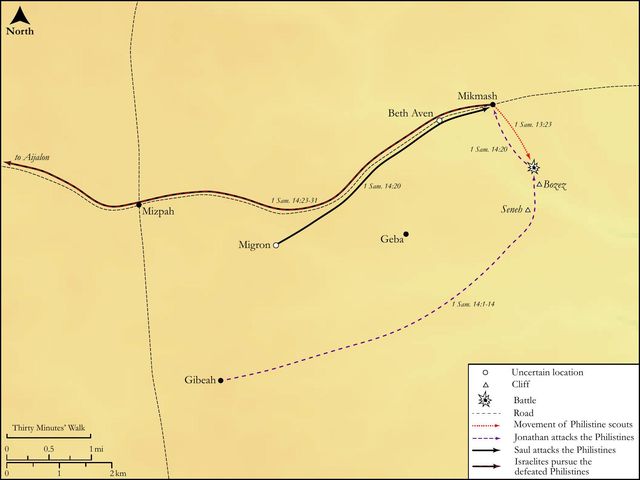
1.He resolved to go incognito - unknown to any one, into the camp of the Philistines; he did not acquaint his father with his design, for he knew he would forbid him; nor the people, for he knew they would all discourage him, and, because he resolved not to heed their objections, he resolved not to hear them, nor ask their advice, Sa1 14:1, Sa1 14:3. Nor had he so great an opinion of the priest as to consult him, but, being conscious of a divine impulse putting him upon it, he threw himself into the mouth of danger, in hope of doing service to his country. The way of access to the enemies' camp is described (Sa1 14:4, Sa1 14:5) as being peculiarly difficult, and their natural entrenchments impregnable, yet this does not discourage him; the strength and sharpness of the rocks do but harden and whet his resolutions. Great and generous souls are animated by opposition and take a pleasure in breaking through it.
2.He encouraged his armour-bearer, a young man that attended him, to go along with him in the daring enterprise, (Sa1 14:6): "Come, and let us put our lives in our hands, and go over to the enemies' garrison, and try what we can do to put them into confusion." See whence he draws his encouragements. (1.) "They are uncircumcised, and have not the seal of the covenant in their flesh, as we have. Fear not, we shall do well enough with them, for they are not under the protection of God's covenant as we are, cannot call him theirs as we can, by the sign of circumcision." If such as are enemies to us are also strangers to God, we need not fear them. (2.) "God is able to make us two victorious over their unnumbered regiments. There is no restraint in the Lord, no limitation to the holy One of Israel, but it is all one to him to save by many or by few." This is a true easily granted in general, that it is all alike to Omnipotence what the instruments are by which it works; and yet it is not so easy to apply it to a particular case; when we are but few and feeble then to believe that God can not only save us, but save by us, this is an instance of faith, which, wherever it is, shall obtain a good report. Let this strengthen the weak and encourage the timid: let it be pleaded with God for the enforcing of our petitions and with ourselves for the silencing of our fears: It is nothing with God to help, whether with many or with those that have no power, Ch2 14:11. (3.) "Who knows but he that can use us for his glory will do it? It may be the Lord will work for us, work with us, work a sign or miracle for us." So the Chaldee. We may encourage ourselves with hope that God will appear for us, though we have not ground on which to build an assurance. An active faith will venture far in God's cause upon an it may be. Jonathan's armour-bearer, or esquire, as if he had learned to carry, not his arms only, but his heart, promised to stand by him and to follow him withersoever he went, Sa1 14:7. We have reason to think that Jonathan felt a divine impulse and impression putting him upon this bold adventure, in which he was encouraged by his servant's concurrence, otherwise the danger was so great which he ran upon that he would have tempted God rather than trusted him. And perhaps he had an actual regard to that word of Joshua (Jos 23:10), One man of you shall chase a thousand, borrowed from Moses, Deu 32:30.
3.How bold soever his resolution was, he resolved to follow Providence in the execution of it, which, he believed, would guide him with its eye (Psa 32:8), and which therefore he would carefully attend and take hints of direction from. See how he put himself upon Providence, and resolved to be determined by it. "Come" (says he to his confidant), "we will discover ourselves to the enemy, as those that are not afraid to look them in the face (Sa1 14:8), and then, if they be so cautious as to bid us stand, we will advance no further, taking it for an intimation of Providence that God would have us act defensively, and we will prepare as well as we can to give them a warm reception (Sa1 14:9); but if they be so presumptuous as to challenge us, and the first sentinel we meet with bid us march on, we will push forward, and make as brisk an onset, assuredly gathering thence that it is the will of God we should act offensively, and then not doubting but he will stand by us," Sa1 14:10. And upon this issue he puts it, firmly believing, as we all should,
(1.)That God has the governing of the hearts and tongues of all men, even of those that know him not, nor have any regard to him, and serves his own purposes by them, though they mean not so, neither do their hearts think so. Jonathan knew God could discover his mind to him if he pleased, and would do it, since he depended upon him, as surely by the mouth of a Philistine as by the mouth of a priest.
(2.)That God will, some way or other, direct the steps of those that acknowledge him in all their ways, and seek unto him for direction, with full purpose of heart to follow it. Sometimes we find most comfort in that which is least our own doing, and into which we have been led by the unexpected, but well observed, turns of Providence.
4.Providence gave him the sign he expected, and he answered the signal. He and his armour-bearer did not surprise the Philistines when they were asleep, but discovered themselves to them by day-light, Sa1 14:11. The guards of the Philistines,
(1.)Disdained them, upbraided them with the cowardice of many of their people, and looked upon them to be of the regiment of sneakers: Behold, the Hebrews come forth out of their holes. If some of Christ's soldiers play the coward, others that play the man may perhaps be upbraided with it.
(2.)They defied them (Sa1 14:12): Come, and we will show you a thing, as if they came like children to gaze about them; but meaning, as Goliath (Sa1 17:44), that they would give them as meat to the fowls of the air. They bantered them, not doubting but to make a prey of them. This greatly emboldened Jonathan. With it he encouraged his servant; he had spoken with uncertainty (Sa1 14:6): It may be the Lord will work for us; but now he speaks with assurance (Sa1 14:12): The Lord has delivered them, not into our hands (he sought not his own glory), but into the hand of Israel, for he aimed at nothing but the advantage of the public. His faith being thus strengthened, no difficulty can stand before him; he climbs up the rock upon all four (Sa1 14:13), though he has nothing to cover him, nor any but his own servant to second him, nor any human probability of any thing but death before him.
5.The wonderful success of this daring enterprise. The Philistines, instead of falling upon Jonathan, to slay him, or take him prisoner, fell before him (Sa1 14:13) unaccountably, upon the first blows he gave. They fell, that is,
(1.)They were many of them slain by him and his armour-bearer, Sa1 14:14. Twenty Philistines fell presently. It was not so much the name of Jonathan that made them yield so tamely (though some think that this had become terrible to them, since he smote one of their garrisons, Sa1 13:3), but it was God's right hand and his arm that got him this victory.
(2.)The rest were put to flight, and fell foul upon one another (Sa1 14:15): There was trembling in the host. There was no visible cause for fear; they were so numerous, bold, and advantageously posted; the Israelites had fled before them; not an enemy made head against them, but one gentleman and his man; and yet they shook like an aspen-leaf. The consternation was general: they all trembled; even the spoilers, those that had been most bold and forward, shared in the common fright, the joints of their loins were loosed, and their knees smote one against another, and yet none of them could tell why or wherefore. It is called a trembling of God (so the original phrase is), signifying not only, as we render it, a very great trembling, which they could not resist nor reason themselves clear of, but that it was supernatural, and came immediately from the hand of God. He that made the heart knows how to make it tremble. To complete the confusion, even the earth quaked, and made them ready to fear that it would sink under them. Those that will not fear the eternal God, he can make afraid of a shadow. See Pro 21:1; Isa 33:14.
Historical interpretation
Historical reception
1 surviving comment on this verse from the historical church.
The one perfectly divine thing, the one glimpse of God's paradise given on earth, is to fight a losing battle - and not lose it.
Continue studying 1 Samuel 14:7 across the web’s major study libraries — every link below opens this exact verse, chapter, or book on the destination site.
Read & Compare
 BibleGatewayThis verse in more than 200 translations and 70 languages.
 Bible.comThe YouVersion reader — hundreds of translations, reading plans, and highlights.
 ESV.orgCrossway's official English Standard Version reader.
 NET BibleThe NET translation with 60,000+ translators' notes on every rendering decision.
 STEP BibleTyndale House's free study tool — original text, vocabulary, and scholarly resources.
 BibliaLogos Bible Software's free web reader.
 USCCBThe New American Bible (Revised Edition) with the U.S. bishops' study notes.
Commentaries
 BibleHub CommentariesDozens of classic commentaries on this verse, gathered on one page.
 StudyLightMore than 100 commentary sets — the largest collection on the web.
 BibleRefPlain-English commentary on what this verse means, verse by verse.
 Enduring WordDavid Guzik's free commentary on this chapter, widely used by Bible teachers.
 Bible Study ToolsVerse commentary alongside Greek and Hebrew study aids.
Original Language & Research
- BibleHub InterlinearThe verse word by word — original language, transliteration, and English.
- BibleHub LexiconEvery word's original-language definition and Strong's entry.
 Blue Letter BibleDeep-study tools — Strong's numbers, concordance, and word studies.
 SefariaThe Hebrew text with Rashi and centuries of Jewish commentary.
Sermons, Hymns & Audio


TrulyRandomVerse is not affiliated with these sites and doesn’t control their content. They’re linked because they’re genuinely useful.
Summary
1 Samuel 14:7 captures a pivotal moment of profound loyalty and courageous solidarity between Jonathan and his armourbearer. In response to Jonathan's audacious proposal to attack a Philistine garrison, the armourbearer pledges his absolute and unconditional support, echoing Jonathan's deepest convictions and demonstrating a rare depth of commitment. This resolute affirmation sets the stage for a divinely empowered victory against overwhelming odds, highlighting the power of united faith and partnership in the face of adversity.
Context
ShowHideLiterary Context
This verse immediately follows Jonathan's faith-filled declaration in 1 Samuel 14:6, where he proposes to his armourbearer that they attack the Philistine outpost, stating, "It may be that the Lord will work for us: for there is no restraint to the Lord to save by many or by few." The armourbearer's response in verse 7 is a direct and enthusiastic affirmation of this audacious proposition, forming a crucial dialogue that initiates the miraculous events of the chapter. The narrative then proceeds to describe their reconnaissance, the Philistines' reaction to their approach, and the subsequent divine intervention that leads to a great rout. This incident significantly impacts the broader conflict between Israel and the Philistines, detailed across 1 Samuel 13 and 1 Samuel 14, showcasing God's power to deliver His people.
Historical & Cultural Context
The setting is a period of severe Philistine oppression over Israel during the early reign of King Saul. The Philistines had strategically disarmed the Israelites, preventing them from forging weapons and maintaining garrisons throughout the land, effectively subjugating them (as detailed in 1 Samuel 13:19-22). The Israelite army under Saul was small, poorly equipped, and demoralized, with many soldiers deserting. Jonathan's initiative, therefore, was not merely a military maneuver but an act of profound faith and desperation in a time when Israel's very existence was threatened. The role of an armourbearer was one of immense trust and proximity, typically a personal attendant, protector, and confidant of a warrior, making his loyalty and willingness to share in such a perilous venture all the more significant and exemplary.
Key Themes
ShowHideThis verse powerfully contributes to several key themes within 1 Samuel. Faith and Divine Sovereignty are paramount, as Jonathan's plan is rooted in the conviction that God can save regardless of human numbers or strength, a belief the armourbearer implicitly embraces. This contrasts sharply with the wavering faith often displayed by King Saul. Courage and Initiative are vividly displayed by both men, standing in stark opposition to the general fear and inaction prevalent among the Israelite forces. The theme of Loyalty and Partnership is central to the armourbearer's response, highlighting the critical role of faithful companionship and mutual trust in fulfilling a God-given vision. This act of shared resolve foreshadows the Lord's intervention, demonstrating that God often works through the bold actions of a faithful few, as seen in other biblical accounts like Gideon's victory in Judges 7.
Exposition and Analysis
ShowHideKey Word Analysis
ShowHideIn Hebrew thought, the "heart" (לֵבָב, lêbâb) is far more than merely the seat of emotions; it is the center of one's entire being—encompassing intellect, will, moral character, and inner disposition. When the armourbearer says, "Do all that is in thine heart" and "I am with thee according to thy heart," he is expressing a complete alignment with Jonathan's deepest convictions, intentions, and strategic resolve. This signifies not just emotional support, but intellectual and volitional agreement with Jonathan's audacious, faith-driven plan. It goes beyond mere obedience; it is a profound affirmation of shared purpose and inner disposition, indicating a unity of spirit and will.
The verb "do" (עָשָׂה, ʻâsâh) is a primitive root meaning "to do or make, in the broadest sense and widest application." In this context, it signifies the armourbearer's full permission and encouragement for Jonathan to execute his plan. It implies not just passive consent but an active endorsement of Jonathan's proposed action. The armourbearer is not merely saying "yes," but empowering Jonathan to proceed with his deepest convictions, promising his active participation in whatever Jonathan decides to "do." This highlights the proactive and decisive nature of the armourbearer's commitment.
Verse Breakdown
ShowHide"And his armourbearer said unto him,"
This clause introduces the armourbearer's direct and personal response to Jonathan's proposal. It emphasizes the individual agency and the profound, intimate nature of the commitment being made between these two men, setting the stage for a pivotal moment in the narrative.
"Do all that [is] in thine heart:"
This is an emphatic affirmation, granting Jonathan full authority and permission to act upon his innermost convictions and strategic thinking. It removes any hesitation or doubt from the armourbearer's side, signaling complete trust in Jonathan's judgment and faith-inspired plan. It is an invitation for Jonathan to lead with his whole being.
"turn thee;"
This phrase functions as a direct command or an urgent encouragement to proceed, to "turn" or "go" towards the objective. It is an active endorsement, urging Jonathan to put his audacious plan into motion without delay, demonstrating the armourbearer's eagerness to participate.
"behold, I [am] with thee according to thy heart."
This climactic declaration reiterates and strengthens the initial pledge. "Behold" (הִנֵּה, hinnēh) draws attention to the certainty and immediacy of his presence and commitment. The repetition of "according to thy heart" powerfully underscores the armourbearer's total alignment with Jonathan's will and purpose, signifying not just physical accompaniment but a spiritual and volitional unity in the dangerous endeavor.
Literary Devices
ShowHideThe verse primarily employs Dialogue to convey the profound bond and shared resolve between Jonathan and his armourbearer. The armourbearer's words are a direct, unhesitating response to Jonathan's audacious proposal, immediately establishing the dynamic of their partnership and mutual trust. The use of Repetition, specifically the phrase "according to thy heart," serves to emphasize the depth of the armourbearer's commitment and his complete alignment with Jonathan's inner conviction and purpose. This repetition powerfully underscores the theme of unwavering loyalty and shared vision. Furthermore, the armourbearer's declaration functions as a strong Affirmation and Encouragement, bolstering Jonathan's resolve and setting the stage for the miraculous events that follow, thereby highlighting the transformative power of supportive companionship in moments of bold faith.
Theological and Thematic Connections
ShowHideThis verse powerfully illustrates the theological principle that God often works through faithful individuals who step out in courageous obedience, even when human odds are stacked against them. The armourbearer's unconditional loyalty to Jonathan, rooted in a shared understanding of God's limitless power, serves as a model of faithful partnership in God's redemptive plan. Their united front against the Philistine oppression highlights the divine enablement that accompanies those who trust in the Lord's ability to save, whether by many or by few. This act of faith-filled solidarity underscores that God delights in using the weak things of the world to shame the strong, demonstrating His glory and sovereignty through unexpected means and through the unity of His people.
Reflection and Application
ShowHide1 Samuel 14:7 offers a powerful blueprint for Christian living, emphasizing the transformative power of loyal partnership and courageous faith. In a world often characterized by self-interest, wavering commitment, and a reluctance to take risks for God's kingdom, the armourbearer's unconditional pledge to Jonathan stands as a beacon of true solidarity. This verse challenges us to consider what it means to truly be "with" someone—to align our hearts, wills, and actions with a shared, God-given vision, especially when that vision seems daunting or impossible from a human perspective. It calls us to cultivate relationships marked by deep trust and mutual encouragement, where we are willing to "do all that is in" another's God-inspired heart, and to stand with them "according to their heart." This is not blind allegiance, but a discerning, faith-filled commitment to a righteous cause, trusting that God will work through such unity and courage to accomplish His purposes. It reminds us that sometimes, the greatest acts of faith are not solitary heroic deeds, but courageous partnerships forged in shared conviction and divine reliance, reflecting the very nature of the body of Christ.
Questions for Reflection
ShowHideFAQ
ShowHideWhat does "according to thy heart" truly mean in this context?
ShowHideThe phrase "according to thy heart" (Hebrew: k'libbecha) signifies a profound and complete alignment of will, purpose, and inner conviction. It's far more than just agreement; it's an unconditional endorsement of Jonathan's deepest intentions and strategic resolve. The armourbearer is not merely saying he will follow orders, but that he fully embraces Jonathan's audacious, faith-driven plan as if it were his own. This implies a shared understanding of Jonathan's faith that "the Lord will work for us" (as stated in 1 Samuel 14:6), and a willingness to participate fully in that vision, no matter the risk. It highlights a rare depth of trust and solidarity, where one's inner being is fully committed to another's God-inspired purpose, reflecting a unity of spirit essential for divine endeavors.
How does the armourbearer's loyalty relate to the overall narrative of 1 Samuel?
ShowHideThe armourbearer's loyalty in 1 Samuel 14:7 serves as a stark contrast to the wavering faith and eventual disobedience of King Saul, Jonathan's father, which is a major theme throughout 1 Samuel. While Saul struggles with obedience and trust in God's timing (e.g., his impatience leading to an unlawful sacrifice in 1 Samuel 13:8-14), Jonathan and his armourbearer demonstrate unwavering faith and courageous initiative, embodying the very qualities Saul lacked. This highlights the principle that God often works through the faithful few, even when the appointed leader falters. Their partnership sets the stage for a miraculous victory that underscores God's sovereignty and His ability to deliver His people through unexpected means, reinforcing the narrative's focus on faithful leadership versus human inadequacy and the importance of relying on God's power.
Christ-Centered Fulfillment
ShowHideThe unwavering loyalty and shared purpose exhibited in 1 Samuel 14:7 find their ultimate fulfillment and deepest meaning in the person and work of Jesus Christ. Just as the armourbearer pledged his life "according to thy heart" to Jonathan's audacious, faith-driven mission, so too does Christ call His disciples to a radical, wholehearted commitment to His kingdom mission. Jesus's invitation to "follow me" (e.g., Matthew 4:19) is a call to align our entire being—our will, intellect, and emotions—with His divine purpose, even when it leads to difficult paths of self-denial and sacrifice (Luke 9:23). The armourbearer's willingness to face overwhelming odds with Jonathan foreshadows the ultimate sacrifice of Christ, who, as the true Lamb of God, willingly went to the cross, fully aligned with the Father's heart, to secure victory over sin and death (John 10:18). Moreover, Christ Himself is the ultimate "armourbearer" for His people, not needing support but providing it, promising His constant presence and empowering His followers to participate in His ongoing mission, assuring them, "I am with you always, even to the end of the age" (Matthew 28:20). Thus, the loyalty and partnership in 1 Samuel 14:7 point to the perfect, self-giving loyalty of Christ and the call for His followers to live in complete devotion to Him, sharing in His redemptive work by His power.