


1 Kings 7:18
Bible text: King James Version (1769 Blayney text) · Public domain
Bible text: King James Version with Strong's numbers · Public domain
Bible text: Berean Standard Bible · Public domain
Bible text: American Standard Version (1901) · Public domain
Bible text: World English Bible, Messianic edition · Public domain
Bible text: Geneva Bible (1599) · Public domain
Bible text: Young's Literal Translation · Public domain
- וַיַּעַשׂvai·Ya·'asand he madeH6213Conj-w ¦ V-Qal-ConsecImperf-3msVerb Qal Consecutive Imperfect 3rd Singular Masculineוַandיַּעַשׂhe made
- אֶת'et<obj.>H853DirObjMParticle Object Indicator
- הָעַמּוּדִיםha·'a·mu·Dimthe pillarsH5982Art ¦ N-mpNoun Plural Masculine Absoluteהָtheעַמּוּדִיםpillars
- וּשְׁנֵיu·she·Neiand twoH8147Conj-w ¦ N-cdcNoun Dual common gender Constructוּandשְׁנֵיtwo
- טוּרִיםtu·RimrowsH2905N-mpNoun Plural Masculine Absolute
- סָבִיבsa·Viv[were] all aroundH5439N-csNoun Singular common gender Absolute
- עַל'alonH5921PrepPreposition
- הַשְּׂבָכָהha·se·va·Khahthe networkH7639Art ¦ N-fsNoun Singular Feminine Absoluteהַtheשְּׂבָכָהnetwork
- הָאֶחָתha·'e·Chat<the> oneH259Art ¦ N-fsNoun Singular Feminine Absoluteהָ<the>אֶחָתone
- לְכַסּוֹתle·kha·Sotto coverH3680Prep-l ¦ V-Piel-InfVerb Piel Infinitive Constructלְtoכַסּוֹתcover
- אֶת'et<obj.>H853DirObjMParticle Object Indicator
- הַכֹּתָרֹתha·ko·ta·Rotthe capitalsH3805Art ¦ N-fpNoun Plural Feminine Absoluteהַtheכֹּתָרֹתcapitals
- אֲשֶׁר'a·SherwhichH834RelParticle Relative
- עַל'al[were] onH5921PrepPreposition
- רֹאשׁrosh[the] top ofH7218N-mscNoun Singular Masculine Construct
- הָרִמֹּנִיםha·ri·mo·Nimthe pomegranatesH7416Art ¦ N-mpNoun Plural Masculine Absoluteהָtheרִמֹּנִיםpomegranates
- וְכֵןve·Khenand thusH3651Conj-w ¦ AdvAdverbוְandכֵןthus
- עָשָׂה'a·Sahhe didH6213V-Qal-Perf-3msVerb Qal Perfect 3rd Singular Masculine
- לַכֹּתֶרֶתla·ko·Te·retfor the capitalH3805Prep-l ¦ N-fsNoun Singular Feminine Absoluteלַfor theכֹּתֶרֶתcapital
- הַשֵּׁנִיתha·she·Nit<the> secondH8145Art ¦ Adj-fsAdjective Numerical Position Singular Feminine Absoluteהַ<the>שֵּׁנִיתsecond
English is a literal word-by-word gloss of the Hebrew, not the KJV's wording. Why?
This is the original text the KJV's translators worked from — each Hebrew word with its own literal English meaning in this verse, prepared by scholars at Tyndale House, Cambridge. The KJV translates whole sentences, not word by word, so its wording differs: one Hebrew word can become several English words, and the KJV may choose “the LORD” where the gloss reads “Yahweh”. Both are faithful — they answer different questions. For the KJV's own rendering, switch to the KJV text.
Details
See on the biblical-era maps
Study this verse
Public-domain commentary
Matthew Henry
From his Commentary on the Whole Bible. Henry comments on passages, not single verses — this entry covers 1 Kings 7:13–47. His four-level outline is real structure in the source text, so it is rendered as structure.
We have here an account of the brass-work about the temple. There was no iron about the temple, though we find David preparing for the temple iron for things of iron, Ch1 29:2. What those things were we are not told, but some of the things of brass are here described and the rest mentioned.
I.The brasier whom Solomon employed to preside in this part of the work was Hiram, or Huram (Ch2 4:11), who was by his mother's side an Israelite, of the tribe of Naphtali, by his father's side a man of Tyre, Kg1 7:14. If he had the ingenuity of a Tyrian, and the affection of an Israelite to the house of God (the head of a Tyrian and the heart of an Israelite), it was happy that the blood of the two nations mixed in him, for thereby he was qualified for the work to which he was designed. As the tabernacle was built with the wealth of Egypt, so the temple with the wit of Tyre. God will serve himself by the common gifts of the children of men.
II.The brass he made use of was the best he could get.
All the brazen vessels were of bright brass (Kg1 7:45), good brass, so the Chaldee, that which was strongest and looked finest. God, who is the best, must be served and honoured with the best.
III.The place where all the brazen vessels were cast was the plain of Jordan, because the ground there was stiff and clayey, fit to make moulds of for the casting of the brass (Kg1 7:46), and Solomon would not have this dirty smoky work done in or near Jerusalem.
IV.The quantity was not accounted for.
The vessels were unnumbered (so it may be read, Kg1 7:47, as well as unweighed), because they were exceedingly numerous, and it would have been an endless thing to keep the account of them; neither was the weight of the brass, when it was delivered to the workmen, searched or enquired into; so honest were the workmen, and such great plenty of brass they had, that there was no danger of wanting. We must ascribe it to Solomon's care that he provided so much, not to his carelessness that he kept no account of it.
V.Some particulars of the brass-work are described.
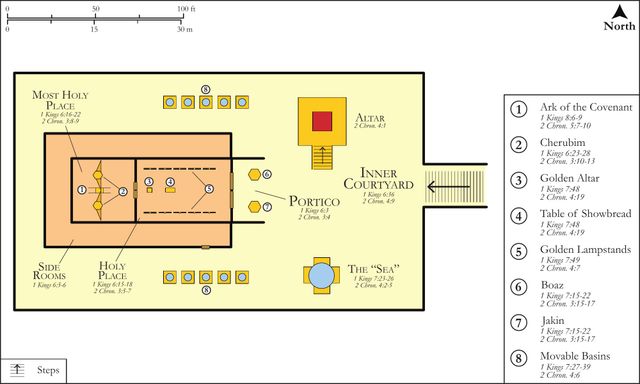
1.Two brazen pillars, which were set up in the porch of the temple (Kg1 7:21), whether under the cover of the porch or in the open air is not certain; it was between the temple and the court of the priests. These pillars were neither to hang gates upon nor to rest any building upon, but purely for ornament and significancy.
(1.)What an ornament they were we may gather from the account here given of the curious work that was about them, chequer-work, chain-work, net-work, lily-work, and pomegranates in rows, and all of bright brass, and framed no doubt according to the best rules of proportion, to please the eye.
(2.)Their significancy is intimated in the names given them (Kg1 7:21): Jachin - he will establish; and Boaz - in him is strength. Some think they were intended for memorials of the pillar of cloud and fire which led Israel through the wilderness: I rather think them designed for memorandums to the priests and others that came to worship at God's door,
[1.]To depend upon God only, and not upon any sufficiency of their own, for strength and establishment in all their religious exercises. When we come to wait upon God, and find our hearts wandering and unfixed, then by faith let us fetch in help from heaven: Jachin - God will fix this roving mind. It is a good thing that the heart be established with grace. We find ourselves weak and unable for holy duties, but this is our encouragement: Boaz - in him is our strength, who works in us both to will and to do. I will go in the strength of the Lord God. Spiritual strength and stability are to be had at the door of God's temple, where we must wait for the gifts of grace in the use of the means of grace.
[2.]It was a memorandum to them of the strength and establishment of the temple of God among them. Let them keep close to God and duty, and they should never lose their dignities and privileges, but the grant should be confirmed and perpetuated to them. The gospel church is what God will establish, what he will strengthen, and what the gates of hell can never prevail against. But, with respect to this temple, when it was destroyed particular notice was taken of the destroying of these pillars (Kg2 25:13, Kg2 25:17), which had been the tokens of its establishment, and would have been so if they had not forsaken God.
2.A brazen sea, a very large vessel, above five yards in diameter, and which contained above 500 barrels of water for the priests' use, in washing themselves and the sacrifices, and keeping the courts of the temple clean, Kg1 7:23, etc. It stood raised upon the figures of twelve oxen in brass, so high that either they must have stairs to climb up to it or cocks at the bottom to draw water from it. The Gibeonites, or Nethinim, who were to draw water for the house of God, had the care of filling it. Some think Solomon made the images of oxen to support this great cistern in contempt of the golden calf which Israel had worshipped, that (as bishop Patrick expresses it) the people might see there was nothing worthy of adoration in those figures; they were fitter to make posts of than to make gods of. Yet this prevailed not to prevent Jerusalem's setting up the calves for deities. In the court of the tabernacle there was only a laver of brass provided to wash in, but in the court of the temple a sea of brass, intimating that by the gospel of Christ much fuller preparation is made for our cleansing than was by the law of Moses. That had a laver, this has a sea, a fountain opened, Zac 13:1.
3.Ten bases, or stands, or settles, of brass, on which were put ten lavers, to be filled with water for the service of the temple, because there would not be room at the molten sea for all that had occasion to wash there. The bases on which the lavers were fixed are very largely described here, Kg1 7:27, etc. They were curiously adorned and set upon wheels, that the lavers might be removed as there was occasion; but ordinarily they stood in two rows, five on one side of the court and five on the other, Kg1 7:39. Each laver contained forty baths, that is, about ten barrels, Kg1 7:38. Those must be very clean that bear the vessels of the Lord. Spiritual priests and spiritual sacrifices must be washed in the laver of Christ's blood and of regeneration. We must wash often, for we daily contract pollution, must cleanse our hands and purify our hearts. Plentiful provision is made for our cleansing; so that if we have our lot for ever among the unclean it will be our own fault.
4.Besides these, there was a vast number of brass pots made to boil the flesh of the peace-offerings in, which the priests and offerers were to feast upon before the Lord (see Sa1 2:14); also shovels, wherewith they took out the ashes of the altar. Some think the word signifies flesh-hooks, with which they took meat out of the pot. The basins also were made of brass, to receive the blood of the sacrifices. These are put for all the utensils of the brazen altar, Exo 38:3. While they were about it they made abundance of them, that they might have a good stock by them when those that were first in use wore out and went to decay. Thus Solomon, having wherewithal to do so, provided for posterity.
Historical interpretation
Historical reception
1 surviving comment on this verse from the historical church.
True, there were two rows of networks right around the capital, but both rows were repeated seven times over until the capital was encircled and the row rejoined itself after going full circle. Nor is the figure of the mystery obscured by the fact that there are two rows of network since it is well known that the virtue of love consists of two distinct aspects, namely, when we are bidden to love God with our whole heart, our whole mind and our whole strength and our neighbor as ourselves. But both of those rows have seven rows of nets because without the grace of the Holy Spirit neither God nor the neighbor can be loved. For the statement “because the love of God has been poured into our hearts through the Holy Spirit who has been given to us” remains true. But where the love of God is, there, assuredly, the love of the neighbor also is poured into the hearts of the faithful because, of course, the one cannot be had without the other. Furthermore, these networks were made to cover the capitals, that is, to encircle them completely, because, rightly understood, every page of holy Scripture echoes throughout with the sound of the grace of love and peace. For the capitals are indeed the volumes of the divine Word, the networks are the bonds of mutual love, and the capitals are covered with networks when the sacred words, if I may say so, are shown on all sides to be clothed with the gift of love. For even in the things that we do not understand in the Scriptures, love is abundantly in evidence.
Continue studying 1 Kings 7:18 across the web’s major study libraries — every link below opens this exact verse, chapter, or book on the destination site.
Read & Compare
 BibleGatewayThis verse in more than 200 translations and 70 languages.
 Bible.comThe YouVersion reader — hundreds of translations, reading plans, and highlights.
 ESV.orgCrossway's official English Standard Version reader.
 NET BibleThe NET translation with 60,000+ translators' notes on every rendering decision.
 STEP BibleTyndale House's free study tool — original text, vocabulary, and scholarly resources.
 BibliaLogos Bible Software's free web reader.
 USCCBThe New American Bible (Revised Edition) with the U.S. bishops' study notes.
Commentaries
 BibleHub CommentariesDozens of classic commentaries on this verse, gathered on one page.
 StudyLightMore than 100 commentary sets — the largest collection on the web.
 BibleRefPlain-English commentary on what this verse means, verse by verse.
 Enduring WordDavid Guzik's free commentary on this chapter, widely used by Bible teachers.
 Bible Study ToolsVerse commentary alongside Greek and Hebrew study aids.
Original Language & Research
- BibleHub InterlinearThe verse word by word — original language, transliteration, and English.
- BibleHub LexiconEvery word's original-language definition and Strong's entry.
 Blue Letter BibleDeep-study tools — Strong's numbers, concordance, and word studies.
 SefariaThe Hebrew text with Rashi and centuries of Jewish commentary.
Sermons, Hymns & Audio


TrulyRandomVerse is not affiliated with these sites and doesn’t control their content. They’re linked because they’re genuinely useful.
Summary
Provides a meticulous description of the intricate decorative elements adorning the capitals of the two colossal bronze pillars, Jachin and Boaz, which stood prominently at the entrance of Solomon's magnificent Temple. This verse specifically details the "network" (lattice-work) and the "two rows round about" of pomegranates that embellished these "chapiters" (capitals), highlighting the extraordinary craftsmanship and symbolic richness invested in God's dwelling place. It underscores the profound attention to detail and the symbolic significance of every component within the sacred architecture, reflecting the divine expectation for excellence and beauty in worship and the abundance associated with God's presence.
Context
ShowHideLiterary Context
This verse is situated within a comprehensive and highly detailed account of the construction of Solomon's Temple and his royal palace, a narrative that spans 1 Kings 6 through 1 Kings 7. More precisely, 1 Kings 7:13-22 focuses on the pivotal role of Hiram of Tyre, a master craftsman renowned for his bronze work, in creating the elaborate bronze components for the Temple. The preceding verses, 1 Kings 7:15-17, describe the casting, dimensions, and initial decorative elements (like chains) of the two massive pillars themselves. Verse 1 Kings 7:18 then elaborates on the intricate ornamentation of their capitals, providing specific details about the "network" and "pomegranates." The narrative subsequently continues to describe other bronze furnishings and vessels, emphasizing the comprehensive nature of the Temple's construction and its elaborate design, culminating in the placement and naming of the pillars, Jachin and Boaz, in 1 Kings 7:21. This meticulous description underscores the divine importance placed on every detail of the sacred edifice, reflecting God's demand for perfection in His dwelling.
Historical & Cultural Context
Solomon's reign, roughly from 970 to 931 BC, marked a golden age for ancient Israel, characterized by unprecedented peace, immense prosperity, and significant architectural ambition. The construction of the Temple in Jerusalem was the crowning achievement of his reign, serving as the central place of worship for the nation and a tangible symbol of God's covenant presence among His people. The engagement of Hiram of Tyre, a highly skilled Phoenician craftsman, highlights the international collaboration and advanced metallurgical techniques prevalent in the region during this era. Phoenicia was widely recognized for its superior bronze work, and its artisans were highly sought after for major construction projects. The Temple was not merely a functional structure but an elaborate expression of royal devotion and of the LORD's presence among His people, built after the pattern of the tabernacle. The inclusion of highly symbolic decorative elements, such as the pomegranates mentioned in 1 Kings 7:18, was a common practice in sacred architecture, conveying messages of fertility, abundance, blessing, and divine favor, which resonated deeply with the agricultural and spiritual life of ancient Israel.
Key Themes
ShowHideThe detailed description in 1 Kings 7:18 contributes significantly to several overarching themes within the book of Kings and the broader biblical narrative. Firstly, it powerfully illustrates Divine Grandeur and Meticulous Craftsmanship, emphasizing that God deserves the absolute finest in terms of artistry, materials, and execution. The extraordinary precision and beauty of the Temple's construction, down to the smallest decorative elements, reflect God's own character of order, beauty, and excellence. Secondly, the prominent use of pomegranates underscores the Symbolism of Abundance and Life. Pomegranates, with their numerous seeds, were widely recognized symbols of fertility, prosperity, and blessing in Israel, appearing elsewhere in sacred contexts such as the high priest's garments in Exodus 28:33 with golden bells between them. Their presence on the Temple pillars signifies the fruitfulness and blessings associated with God's covenant presence and the life He bestows. Finally, the verse contributes to the theme of Architectural Significance, demonstrating that the pillars Jachin and Boaz were not merely structural but deeply symbolic, marking the entrance to the holy place and embodying strength and establishment, further enhanced by their elaborate and meaningful ornamentation, as seen in their placement and naming in 1 Kings 7:21.
Exposition and Analysis
ShowHideKey Word Analysis
ShowHideThis term (H3805) refers to the capital or crown of a column, the uppermost part that rests on the shaft. In the context of the Temple pillars, these chapiters were not merely structural elements but highly ornamental features, designed to be visually striking and to bear significant symbolic decoration. They served as the elaborate termination point of the colossal bronze pillars, drawing the eye upward and signifying the completion and beauty of the structure.
This word (H7639) describes an intricate lattice-work, chain-work, or filigree. It refers to a decorative pattern of interwoven chains or a net-like design that adorned the chapiters. This elaborate design element would have created a visually rich texture, adding a layer of complexity and grandeur to the pillars' capitals, possibly evoking images of a net or interwoven chains, symbolizing divine order, interconnectedness, or even a protective enclosure.
The fruit of the pomegranate tree (H7416), highly valued in Israel for its beauty, taste, and numerous seeds. As a decorative motif, pomegranates were used in sacred contexts in Israelite worship, as on the hem of the high priest's robe. Symbolically, they represented fertility, abundance, prosperity, and blessing. Their presence on the Temple pillars reinforced the themes of divine blessing, fruitfulness, and the life-giving presence associated with God's dwelling among His people.
Verse Breakdown
ShowHide"And he made the pillars, and two rows round about upon the one network"
This clause attributes the craftsmanship to Hiram of Tyre, detailing his work on the decorative elements for the capitals of the bronze pillars. The phrase "two rows round about" specifies the precise arrangement of the pomegranates, indicating a deliberate, symmetrical, and visually appealing design that encircled the capitals. The "one network" served as the foundational decorative layer or background upon which these rows of pomegranates were meticulously placed, creating a complex and rich visual texture.
"to cover the chapiters that [were] upon the top, with pomegranates"
This clarifies the explicit purpose and placement of the elaborate ornamentation. The network and pomegranates were designed to embellish and "cover" (more accurately, to adorn or crown) the chapiters (capitals) of the pillars, which rested "upon the top" of the pillar shafts. The pomegranates were the primary visual motif, arranged to create a striking and symbolically rich effect on the pillar crowns, drawing attention to their significance.
"and so did he for the other chapiter"
This final phrase confirms the uniformity and symmetry of the design. The intricate and detailed ornamentation described for the capital of the first pillar was replicated identically for the capital of the second pillar. This ensured balance and consistent grandeur at the Temple's entrance, reinforcing the idea of a perfectly designed and executed sacred space.
Literary Devices
ShowHideThe description in 1 Kings 7:18 employs several literary devices to convey the magnificence and symbolic depth of the Temple's architectural elements. Symbolism is paramount, with the pomegranates serving as powerful symbols of fertility, abundance, and divine blessing. Their inclusion is not merely aesthetic but communicates profound theological truths about God's desire to bless His people and the fruitfulness of His presence. The "network" itself could be seen as symbolic of divine order, intricate divine design, or even the interwoven nature of God's covenant with His people. The meticulous enumeration of details, such as "two rows round about," exemplifies descriptive imagery, allowing the reader to vividly visualize the elaborate craftsmanship and the precise arrangement of the ornaments. Furthermore, the focus on such minute, beautiful details within the context of colossal structures highlights a form of synecdoche or merism, where the part represents the whole, emphasizing that every aspect of the Temple, from its grand scale to its smallest ornament, was perfected for God's glory and reflected His character.
Theological and Thematic Connections
ShowHideThe meticulous detail of the Temple's ornamentation, as described in 1 Kings 7:18, speaks volumes about God's character and His expectations for worship. It underscores that God is a God of order, beauty, and excellence, deserving of the highest quality in all that is dedicated to Him. The Temple, as the physical manifestation of God's presence among His people, was to reflect His glory in every dimension, from its grand architecture to its intricate decorative elements. The pomegranates, with their rich symbolism of abundance and life, further emphasize God's desire to bless His people and to establish a fruitful covenant relationship with them. This attention to detail teaches us that true worship involves offering our very best, not only in grand gestures but also in the seemingly small or hidden aspects of our service and devotion, knowing that God delights in perfection and beauty.
Reflection and Application
ShowHideWhile we no longer construct physical temples in the same manner as Solomon, the principles embedded in 1 Kings 7:18 remain profoundly relevant for believers today. This verse challenges us to consider the quality and intentionality of our "offerings" to God. If God commanded such meticulous detail and beauty for a physical structure designed to house His presence, how much more should we strive for excellence in our lives, which are now, by His indwelling Spirit, the very "temple" where He dwells? This means pursuing excellence in our work, cultivating integrity in our relationships, and dedicating ourselves wholeheartedly to spiritual disciplines and acts of service. The symbolism of the pomegranates encourages us to live lives that are fruitful and abundant, not for our own glory, but as a reflection of God's blessings and the indwelling Spirit. Our lives should be adorned with the "fruit of the Spirit," demonstrating the beauty and abundance that come from God's presence within us, serving as a fragrant testament to His glory in every detail.
Questions for Reflection
ShowHideFAQ
ShowHideWhat was the significance of the "network" on the chapiters?
ShowHideThe "network" (Hebrew sᵉbâkâh) refers to an intricate lattice-work or chain-work that adorned the capitals of the pillars. While its precise symbolic meaning is not explicitly stated in the text, it served primarily as a highly detailed decorative element, adding a layer of visual complexity and richness to the pillars. It likely provided the base or framework upon which the pomegranates and chains (as mentioned in 1 Kings 7:17) were arranged. It contributed significantly to the overall grandeur and meticulous detail of the Temple, symbolizing the divine order and the extraordinary craftsmanship dedicated to God's sanctuary, reflecting the beauty and perfection inherent in God's design.
Why were pomegranates chosen as a decorative motif for the Temple?
ShowHidePomegranates were highly symbolic in Israelite culture, consistently representing fertility, abundance, prosperity, and divine blessing due to their numerous seeds and vibrant color. Their inclusion on the Temple pillars, and also on the high priest's garments (Exodus 28:33), underscored the themes of fruitfulness and blessing that God intended for His people through His presence in the Temple. They served as a visual reminder of God's covenant promises of life, prosperity, and the abundant provision available through His dwelling among them, symbolizing the spiritual fruitfulness that flows from His presence.
Christ-Centered Fulfillment
ShowHideThe elaborate beauty and symbolic richness of Solomon's Temple, particularly the intricate details like the pomegranates and networks on the pillars described in 1 Kings 7:18, ultimately point beyond themselves to the person and work of Jesus Christ. The earthly Temple, magnificent as it was, served as a shadow and type of a greater reality—the true dwelling place of God among humanity. Jesus Himself is the ultimate Temple, the very embodiment of God's presence, as profoundly declared in John 1:14, where "the Word became flesh and tabernacled among us." The pomegranates, symbolizing abundance and life, find their supreme fulfillment in Christ, who came that we "may have life and have it abundantly" (John 10:10). The pillars, named Jachin ("He establishes") and Boaz ("In Him is strength"), foreshadow Christ as the one who establishes God's kingdom and provides divine strength to His people. He is the cornerstone upon whom God's spiritual house is built (Ephesians 2:20), far surpassing any structure made with human hands. The unparalleled beauty and glory of the Temple, with its meticulous designs, ultimately prefigure the incomparable glory of God revealed in the face of Jesus Christ (2 Corinthians 4:6). Through His sacrifice and resurrection, Christ has not only established God's presence among His people forever but has also made believers themselves living temples of the Holy Spirit (1 Corinthians 3:16), adorned with the fruit of His Spirit (Galatians 5:22-23), fulfilling the ancient symbols in a new and living way.