


1 Chronicles 16:38
Bible text: King James Version (1769 Blayney text) · Public domain
Bible text: Berean Standard Bible · Public domain
Bible text: American Standard Version (1901) · Public domain
Bible text: World English Bible, Messianic edition · Public domain
Bible text: Geneva Bible (1599) · Public domain
Bible text: Young's Literal Translation · Public domain
- וְעֹבֵדve·'o·Vedand Obed-H5654Conj-w ¦ N-proper-mNoun Proper MasculineוְandעֹבֵדObed-
- אֱדֹם'e·DomEdomH5654N-proper-mNoun Proper Masculine
- וַאֲחֵיהֶםva·'a·chei·Hemand their relativesH251Conj-w ¦ N-mpc ¦ 3mpNoun Plural Masculine Constructוַandאֲחֵיrelativesהֶםtheir
- שִׁשִּׁיםshi·ShimsixtyH8346N-mpNoun Plural Masculine Absolute
- וּשְׁמוֹנָהu·she·mo·Nahand eightH8083Conj-w ¦ N-csNoun Singular common gender Absoluteוּandשְׁמוֹנָהeight
- וְעֹבֵדve·'o·Vedand Obed-H5654Conj-w ¦ N-proper-mNoun Proper MasculineוְandעֹבֵדObed-
- אֱדֹם'e·DomEdomH5654N-proper-mNoun Proper Masculine
- בֶּןben[the] son ofH1121N-mscNoun Singular Masculine Construct
- יְדִיתוּןye·di·TunJedithunH3038N-proper-mNoun Proper Masculine
- וְחֹסָהve·cho·Sahand HosahH2621Conj-w ¦ N-proper-mNoun Proper MasculineוְandחֹסָהHosah
- לְשֹׁעֲרִיםle·sho·'a·Rimto gatekeepersH7778Prep-l ¦ N-mpNoun Plural Masculine Absoluteלְtoשֹׁעֲרִיםgatekeepers
English is a literal word-by-word gloss of the Hebrew, not the KJV's wording. Why?
This is the original text the KJV's translators worked from — each Hebrew word with its own literal English meaning in this verse, prepared by scholars at Tyndale House, Cambridge. The KJV translates whole sentences, not word by word, so its wording differs: one Hebrew word can become several English words, and the KJV may choose “the LORD” where the gloss reads “Yahweh”. Both are faithful — they answer different questions. For the KJV's own rendering, switch to the KJV text.
Details
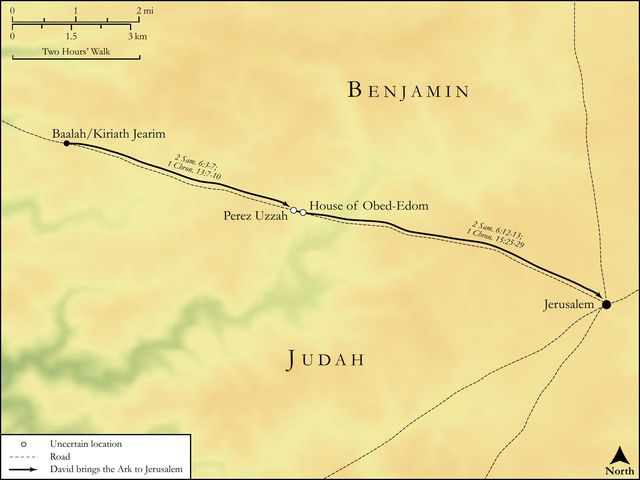
See on the biblical-era map
Study this verse
Public-domain commentary
Matthew Henry
From his Commentary on the Whole Bible. Henry comments on passages, not single verses — this entry covers 1 Chronicles 16:37–43.
The worship of God is not only to be the work of a solemn day now and then, brought in to grace a triumph; but it ought to be the work of every day. David therefore settles it here for a constancy, puts it into a method, which he obliged those that officiated to observe in their respective posts. In the tabernacle of Moses, and afterwards in the temple of Solomon, the ark and the altar were together; but, ever since Eli's time, they had been separated, and still continued so till the temple was built. I cannot conceive what reason there was why David, who knew the law and was zealous for it, did not either bring the ark to Gibeon, where the tabernacle and the altar were, or bring them to Mount Zion, where the ark was. Perhaps the curtains and hangings of Moses's tabernacle were so worn with time and weather that they were not fit to be removed, nor fit to be a shelter for the ark; and yet he would not make all new, but only a tent for the ark, because the time was at hand when the temple should be built. Whatever was the reason, all David's time they were asunder, but he took care that neither of them should be neglected. 1. At Jerusalem, where the ark was, Asaph and his brethren were appointed to attend, to minister before the ark continually, with songs of praise, as every day's work required, Ch1 16:37. No sacrifices were offered there, nor incense burnt, because the altars were not there: but David's prayers were directed as incense, and the lifting up of his hands as the evening sacrifice (Psa 141:2), so early did spiritual worship take place of ceremonial. 2. Yet the ceremonial worship, being of divine institution, must by no means be omitted; and therefore at Gibeon were the altars where the priests attended, for their work was to sacrifice and burn incense, which they did continually, morning and evening, according to the law of Moses, Ch1 16:39, Ch1 16:40. These must be kept up because, however in their own nature they were inferior to the moral services of prayer and praise, yet, as they were types of the mediation of Christ, they had a great deal of honour put upon them, and the observance of them was of great consequence. Here Zadok attended, to preside in the service of the altar; as (it is probable) Abiathar settled at Jerusalem, to attend the ark, because he had the breast-plate of judgment, which must be consulted before the ark: this is the reason why we read in David's time both Zadok and Abiathar were the priests (Sa2 8:17; Sa2 20:25), one where the altar was and the other where the ark was. At Gibeon, where the altars were, David also appointed singers to give thanks to the Lord, and the burden of all their songs must be, For his mercy endureth for ever, Ch1 16:41. They did it with musical instruments of God, such instruments as were appointed and appropriated to this service, not such as they used on other occasions. Between common mirth and holy joy there is a vast difference, and the limits and distances between them must be carefully observed and kept up. Matters being thus settled, and the affairs of religion put into a happy channel, (1.) The people were satisfied, and went home pleased. (2.) David returned to bless his house, resolving to keep up family worship still, which public worship must not supersede.
Continue studying 1 Chronicles 16:38 across the web’s major study libraries — every link below opens this exact verse, chapter, or book on the destination site.
Read & Compare
 BibleGatewayThis verse in more than 200 translations and 70 languages.
 Bible.comThe YouVersion reader — hundreds of translations, reading plans, and highlights.
 ESV.orgCrossway's official English Standard Version reader.
 NET BibleThe NET translation with 60,000+ translators' notes on every rendering decision.
 STEP BibleTyndale House's free study tool — original text, vocabulary, and scholarly resources.
 BibliaLogos Bible Software's free web reader.
 USCCBThe New American Bible (Revised Edition) with the U.S. bishops' study notes.
Commentaries
 BibleHub CommentariesDozens of classic commentaries on this verse, gathered on one page.
 StudyLightMore than 100 commentary sets — the largest collection on the web.
 BibleRefPlain-English commentary on what this verse means, verse by verse.
 Enduring WordDavid Guzik's free commentary on this chapter, widely used by Bible teachers.
 Bible Study ToolsVerse commentary alongside Greek and Hebrew study aids.
Original Language & Research
- BibleHub InterlinearThe verse word by word — original language, transliteration, and English.
- BibleHub LexiconEvery word's original-language definition and Strong's entry.
 Blue Letter BibleDeep-study tools — Strong's numbers, concordance, and word studies.
 SefariaThe Hebrew text with Rashi and centuries of Jewish commentary.
Sermons, Hymns & Audio


TrulyRandomVerse is not affiliated with these sites and doesn’t control their content. They’re linked because they’re genuinely useful.
Summary
1 Chronicles 16:38 meticulously details King David's organized assignment of Levitical duties for the daily service of the tabernacle, specifically appointing Obed-Edom, along with sixty-eight of his brethren, and another Obed-Edom (son of Jeduthun) and Hosah, to serve as porters. This verse highlights the precise and comprehensive nature of David's establishment of worship in Jerusalem, underscoring the importance of every role, even those seemingly behind-the-scenes, in maintaining the sanctity and order of God's dwelling place and ensuring continuous, reverent worship before the Ark of the Covenant.
Context
ShowHideLiterary Context
This verse is situated within a pivotal section of 1 Chronicles 16, which marks the culmination of David's efforts to bring the Ark of the Covenant to Jerusalem and establish a centralized place of worship. Following the grand procession, sacrifices, and David's magnificent psalm of thanksgiving (verses 7-36), the narrative transitions to the practical, enduring organization of tabernacle service. Verses 37-42 provide a detailed roster of individuals and groups appointed for various roles, including priests, musicians, and gatekeepers, emphasizing the meticulous planning involved. Verse 38 specifically focuses on the appointment of porters, highlighting the comprehensive administrative and spiritual oversight David exercised to ensure continuous and orderly worship. The prominent mention of Obed-Edom here also serves as a literary callback to his earlier, blessed role in housing the Ark, as recounted in 1 Chronicles 13:14.
Historical & Cultural Context
The period of King David represents a significant turning point in Israel's history, transitioning from a decentralized tribal system to a unified monarchy with Jerusalem as its spiritual and political heart. The meticulous organization of the Levites for tabernacle service, even before the construction of the permanent Temple, laid the essential groundwork for the elaborate and highly structured worship system that would fully flourish under Solomon. In Israel, "porters" or gatekeepers were not merely passive doorkeepers; they held positions of considerable trust, authority, and responsibility. Their duties extended to controlling access to sacred spaces, maintaining security, managing offerings and tithes, and ensuring overall order within the temple precincts. Their role was absolutely vital for preserving the sanctity of the tabernacle, protecting its sacred contents, and regulating the flow of people, reflecting the high value placed on order, purity, and proper procedure in the worship of the LORD.
Key Themes
ShowHideA central and pervasive theme throughout 1 Chronicles is the paramount importance of proper worship and the meticulous organization of the Levitical service. David's actions in this chapter, including the detailed appointments, underscore that worship is not to be chaotic or spontaneous but requires intentional structure, dedicated personnel, and reverent adherence to divine mandates. The verse also powerfully illustrates the theme of faithfulness in service and divine blessing, exemplified by Obed-Edom, whose prior faithfulness in housing the Ark (as seen in 2 Samuel 6:11) clearly contributed to his continued and prominent role in the tabernacle service. Furthermore, this verse subtly yet profoundly conveys the idea that all roles in God's service are valuable and indispensable, regardless of their visibility or perceived status. Whether leading public worship or guarding the gates, each function contributes integrally to the overall sanctity, effectiveness, and divine approval of the service, reflecting God's desire for order, excellence, and holistic devotion in all things pertaining to Him.
Exposition and Analysis
ShowHideKey Word Analysis
ShowHideThis name, meaning "worker of Edom" or "servant of Edom," refers to two distinct individuals in this verse. The first "Obededom" is likely the Gittite, famously blessed for housing the Ark of the Covenant for three months (2 Samuel 6:11-12). His inclusion here with a large contingent of 68 brethren signifies his continued prominence and the recognition of God's favor upon him, leading to a significant role in the newly established worship system. The second "Obededom also the son of Jeduthun" indicates a different Levite from the family of Jeduthun, one of David's chief musicians, highlighting the extensive and diverse involvement of various Levitical families in the tabernacle service.
This term denotes a literal male offspring, but in a broader sense, it can refer to a descendant, a member of a group, or one who belongs to a particular family or lineage. In this verse, "Obededom also the son of Jeduthun" precisely identifies the second Obed-Edom as a direct descendant or a member of the family line associated with Jeduthun, a prominent Levitical leader and musician. This genealogical detail is crucial for distinguishing between the two Obed-Edoms and underscores the importance of family lineage and inherited roles within the Levitical structure.
Derived from the root meaning "gate," this term refers to gatekeepers or guardians. In the context of the tabernacle and later the Temple, porters were far more than mere doorkeepers. They held a crucial and trusted position, responsible for security, controlling access to sacred areas, maintaining order, and sometimes even managing the treasury or offerings at the gates. Their role ensured the sanctity of the worship space and protected both personnel and property. Their appointment reflects the meticulous organization required for the proper functioning of divine service and the high regard for maintaining the sanctity of God's dwelling.
Verse Breakdown
ShowHide"And Obededom with their brethren, threescore and eight;"
This initial clause identifies the primary group of porters. "Obededom" here refers to the Gittite, whose household was famously blessed by the presence of the Ark. The phrase "with their brethren, threescore and eight" (meaning 68) indicates a substantial number of individuals associated with him, likely his family members or those under his leadership, all appointed to the significant role of porters. This highlights the communal and organized nature of the service, emphasizing that the work was shared among many.
"Obededom also the son of Jeduthun and Hosah"
This clause introduces additional key individuals appointed as porters, carefully distinguishing them from the first group. The repetition of "Obededom" is immediately clarified by the designation "the son of Jeduthun," identifying a different individual from the family of Jeduthun, one of David's chief musicians and Levitical leaders (1 Chronicles 16:41-42). "Hosah" is another prominent Levite mentioned elsewhere as a gatekeeper (1 Chronicles 26:10-11). This meticulous naming underscores the specific and intentional assignment of duties to various Levitical families, ensuring comprehensive coverage for the tabernacle's needs.
"[to be] porters:"
This final phrase explicitly states the specific role assigned to these individuals and their brethren. It emphasizes that their function was to serve as gatekeepers, a vital role in maintaining the security, order, and sanctity of the tabernacle. The inclusion of this specific duty underscores David's commitment to a well-ordered and reverent system of worship, where every necessary function was clearly defined and assigned.
Literary Devices
ShowHideThe verse employs several literary devices to convey its message of meticulous organization and the importance of every role. Enumeration is evident in the precise number "threescore and eight" (68), which highlights the detailed and comprehensive nature of David's appointments, ensuring no aspect of tabernacle service was left unaddressed. This numerical precision underscores the administrative rigor applied to the divine service. The Repetition of the name "Obededom," immediately followed by the distinguishing phrase "son of Jeduthun," serves as a crucial clarification, preventing confusion between two individuals sharing the same name. This also creates a subtle sense of Emphasis on the widespread involvement of various Levitical families and the importance of these specific individuals within the larger structure of worship. Furthermore, the verse contributes to the overall Thematic Development of order, faithfulness, and the value of every contribution to God's service, which is a recurring motif throughout the book of Chronicles, portraying David as a king deeply committed to establishing proper and reverent worship.
Theological and Thematic Connections
ShowHide1 Chronicles 16:38, while seemingly a mere administrative detail, carries profound theological weight, underscoring God's desire for order, intentionality, and faithfulness in worship and service. It demonstrates that in God's economy, every role, from the most visible priest to the gatekeeper, is deemed essential and valuable. The meticulous organization of the Levites reflects the divine order that God established for His people to approach Him and minister in His presence. The continued appointment of Obed-Edom, who was previously blessed for his faithful care of the Ark, serves as a powerful testament to God's recognition and reward for faithfulness, even in tasks that might appear mundane or behind-the-scenes. This principle extends to all believers, reminding us that our service, no matter how small or hidden, contributes to the larger work of God's kingdom and is seen, valued, and often blessed by Him.
Reflection and Application
ShowHideThis verse offers a powerful and enduring reminder that in God's economy, there are no insignificant roles or "small" tasks. Just as the porters were crucial for the security, sanctity, and smooth functioning of the tabernacle, every member of the body of Christ has a vital and indispensable part to play in the functioning of the church and the advancement of God's kingdom. Whether our service is visible and public, leading from the front, or hidden and behind-the-scenes, supporting from the periphery, it is equally valued by God when performed with faithfulness, diligence, and a heart of devotion. The inspiring example of Obed-Edom, whose prior faithfulness in housing the Ark led to tangible blessing and continued, prominent appointment, encourages us to serve diligently and with excellence in whatever capacity God has placed us, trusting that our obedience brings about His favor and contributes meaningfully to His grand design. Our commitment to excellence in our assigned duties, no matter how humble, truly honors God and builds up His people, reflecting the divine order and care He desires for His house.
Questions for Reflection
ShowHideFAQ
ShowHideWho was Obed-Edom, and why is he mentioned twice in this verse?
ShowHideObed-Edom was a Levite (specifically a Gittite, likely from Gath-Rimmon, a Levitical city) who famously housed the Ark of the Covenant for three months when King David initially attempted to bring it to Jerusalem. During this time, God greatly blessed Obed-Edom and his entire household (2 Samuel 6:11-12). In 1 Chronicles 16:38, the first mention of "Obededom with their brethren, threescore and eight" refers to this same blessed individual and a large group associated with him, appointed as porters. The second mention, "Obededom also the son of Jeduthun," refers to a different individual bearing the same name, who was a descendant of Jeduthun, one of David's chief musicians and Levitical leaders responsible for temple music (1 Chronicles 25:1). The dual mention highlights the widespread and meticulous organization of the Levitical service, involving various families and individuals, and underscores the continued recognition of the Obed-Edom who was so blessed by God.
What was the significance of "porters" in the tabernacle service? Were they just doorkeepers?
ShowHideThe "porters" (Hebrew: shôwʻêrîm) were far more than simple doorkeepers; they held a crucial and highly trusted position within the tabernacle and later the Temple. Their responsibilities were extensive and vital for the proper functioning and sanctity of the holy space. These included maintaining security, strictly controlling access to the sacred areas to ensure only authorized personnel entered, preserving the sanctity of the worship space, and ensuring orderly conduct among those who approached. They might also have been involved in managing offerings, guarding the treasury at the gates, or even assisting in certain ceremonial duties. Their role was indispensable for the proper functioning of the worship system and the protection of the holy space, reflecting the paramount importance of order, reverence, and purity in approaching God. This position demanded integrity, strength, and unwavering faithfulness, as they were the first line of defense and order for the house of God.
Christ-Centered Fulfillment
ShowHideThe meticulous organization of the tabernacle service, including the appointment of porters like Obed-Edom, beautifully foreshadows the perfect order and unparalleled access established through Jesus Christ. In the Old Testament, porters guarded the physical gates to a sacred space, controlling who could enter and ensuring the sanctity of the earthly dwelling of God. However, in Christ, we are granted direct, unhindered access to the very presence of God. Jesus declares, "I am the gate; whoever enters through me will be saved" (John 10:9). He is the ultimate "porter" who opens the way to the Father, having torn the veil of separation through His perfect sacrifice on the cross (Matthew 27:51). Furthermore, the New Testament teaches that believers are now living stones, built into a spiritual house, a "holy priesthood" (1 Peter 2:5), where every member has a vital role in serving God. Just as Obed-Edom's faithfulness was blessed and recognized, our service in the New Covenant is a response to Christ's finished work, empowering us to serve in the spiritual temple, the Church, where Christ is the head and cornerstone (Ephesians 2:19-22). All our service, whether visible or hidden, finds its ultimate purpose, value, and effectiveness in Him, contributing to the building of His eternal Kingdom and bringing glory to God.