


Zechariah 10:11
- וְעָבַרve·'a·Varand he will passH5674Conj-w ¦ V-Qal-ConsecPerf-3msVerb Qal Consecutive Perfect 3rd Singular Masculineוְandעָבַרhe will pass
- בַּיָּםbai·Yamin the seaH3220Prep-b ¦ N-msNoun Singular Masculine Absoluteבַּin theיָּםsea
- צָרָהtza·RahtroubleH6869N-fsNoun Singular Feminine Absolute
- וְהִכָּהve·hi·Kahand he will strikeH5221Conj-w ¦ V-Hiphil-ConsecPerf-3msVerb Hiphil Consecutive Perfect 3rd Singular Masculineוְandהִכָּהhe will strike
- בַיָּםvai·Yamin the seaH3220Prep-b ¦ N-msNoun Singular Masculine Absoluteבַin theיָּםsea
- גַּלִּיםga·LimwavesH1530N-mpNoun Plural Masculine Absolute
- וְהֹבִישׁוּve·ho·Vi·shuand they will dry upH3001Conj-w ¦ V-Hiphil-ConsecPerf-3cpVerb Hiphil Consecutive Perfect 3rd Plural common genderוְandהֹבִישׁוּthey will dry up
- כֹּלkolallH3605N-mscNoun Singular Masculine Construct
- מְצוּלוֹתme·tzu·Lot[the] depths ofH4688N-fpcNoun Plural Feminine Construct
- יְאֹרye·'Or[the] RiverH2975N-properNoun Proper Location
- וְהוּרַדve·hu·Radand it will be brought downH3381Conj-w ¦ V-Hophal-ConsecPerf-3msVerb Hophal Consecutive Perfect 3rd Singular Masculineוְandהוּרַדit will be brought down
- גְּאוֹןge·'on[the] pride ofH1347N-mscNoun Singular Masculine Construct
- אַשּׁוּר'a·ShurAssyriaH804N-properNoun Proper Location
- וְשֵׁבֶטve·She·vetand [the] scepter ofH7626Conj-w ¦ N-mscNoun Singular Masculine Constructוְandשֵׁבֶט[the] scepter of
- מִצְרַיִםmitz·Ra·yimEgyptH4714N-properNoun Proper Location
- יָסוּרya·Surit will departH5493V-Qal-Imperf-3msVerb Qal Imperfect 3rd Singular Masculine
English is a literal word-by-word gloss of the Hebrew, not the KJV's wording. Why?
This is the original text the KJV's translators worked from — each Hebrew word with its own literal English meaning in this verse, prepared by scholars at Tyndale House, Cambridge. The KJV translates whole sentences, not word by word, so its wording differs: one Hebrew word can become several English words, and the KJV may choose “the LORD” where the gloss reads “Yahweh”. Both are faithful — they answer different questions. For the KJV's own rendering, switch to the KJV text.
Details
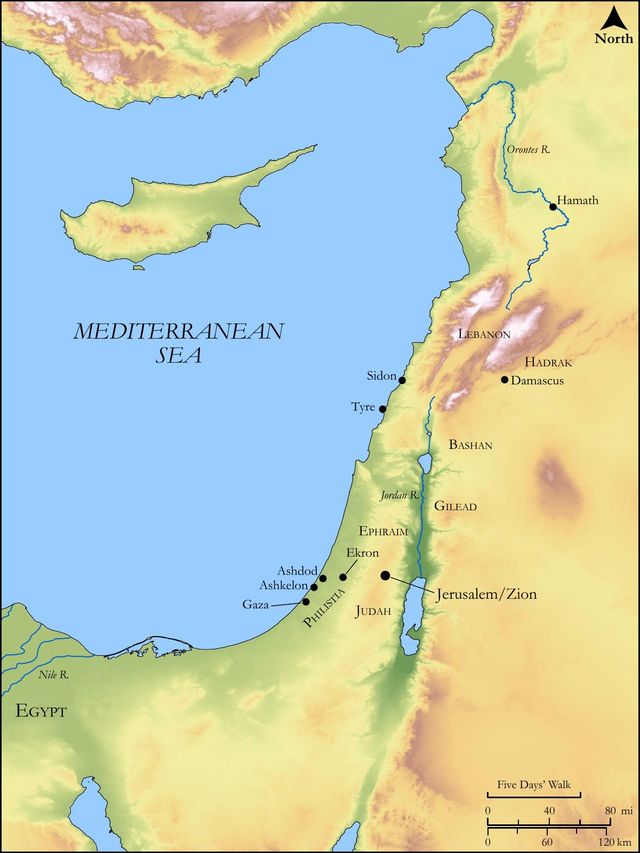
See on the biblical-era map
Study this verse
Public-domain commentary
Matthew Henry
From his Commentary on the Whole Bible. Henry comments on passages, not single verses — this entry covers Zechariah 10:5–12. His three-level outline is real structure in the source text, so it is rendered as structure.
Here are divers precious promises made to the people of God, which look further than to the state of the Jews in the latter days of their church, and have certain reference to the spiritual Israel of God, the gospel-church, and all true believers.
I.They shall have God's favour and presence, and shall be owned and accepted of him.
This is the foundation of all the rest: The Lord is with them, Zac 10:5. He espouses their cause, takes their part, is on their side; and, if he be for them, who can be against them? Again (Zac 10:6), I have mercy upon them. All their dignity and joy are owing purely to God's mercy; and mercy, as it supposes misery, so it excludes merit. They had been cast off, the effect of which could not but be misery; they had been justly cast off, and therefore could pretend to merit nothing at God's hand but wrath and the curse; yet it is promised, They shall be as though I had not cast them off. The transgressions of their fathers, for which they had been rejected, shall not only not be visited upon them, but shall not be so much as remembered against them. God will be as perfectly reconciled to them as if he had never contended with them, and the falling out of these lovers shall rather be the renewing than the weakening of love. They shall have such a full assurance of God's being reconciled to them, and upon that shall be so well reconciled to themselves, that they shall be as easy as if they had never been cast off; and their condition, after their restoration to the divine favour, shall be so very happy that there shall not remain the least scar from the wounds which were given them by their being cast off. Such favour does God show to returning repenting sinners, who were by nature at a distance, and children of wrath; such fellowship are they admitted into, and such freedom does he use with them, that they are as though they had never been cast off.
1.The covenant they are admitted into is the same that ever it was: I am the Lord their God, according to the original contract, the covenant made with their fathers.
2.The communion they are admitted into is the same that ever it was: I will hear them. They shall be as welcome as ever to speak to him, and as sure as ever to receive from him an answer of peace; for, as he never did, so he never will, say to Jacob's seed, Seek you me in vain.
II.They shall be victorious over their enemies, that would draw them from either their duty to God or their comfort in God (Zac 10:5):
They shall be as mighty men, that are both strong in body and bold in spirit, men of vigour, men of valour, effective men. Those of Ephraim, as well as those of Judah, shall be like a mighty man (Zac 10:7), that dares to go about a difficult enterprise and is able to go through with it. They shall, as mighty men, tread down their enemies in the battle, as the dirt that is thrown out of the houses is trodden with other dirt in the mire of the streets. And they shall therefore fight, because the Lord is with them. Some would argue that they may therefore sit still, and do nothing, because the Lord is with them, who can and will do all. No; God's gracious presence with us to help us must not supersede, but quicken and animate, our endeavours to help ourselves; and we must therefore work out our salvation with fear and trembling, because it is God that works in us both to will and to do. They shall fight with readiness and resolution because, if God be with them, they are sure to be conquerors, more than conquerors. For then the riders on horses shall be confounded. The cavalry of the enemies shall be routed, and put into disorder, by the infantry of the Jews. The preachers of the gospel of Christ went forth to war a good warfare; they charged bravely, because God was with them; and the riders on horses that opposed them were confounded, for God chose the weak and foolish things of the world to confound the wise and mighty. But whence have they all this might? How come they to be so able, so active? It is in the Lord, and in the power of his might, that they are so (Zac 10:6): I will strengthen the house of Judah, and so I will save the house of Joseph. Note, God saves us by strengthening us, and works out our happiness by working in us to do our duty. And thus we are engaged to the utmost diligence in using the strength God gives us; and yet, when all is done, God must have the glory of all. God is our strength, and so becomes both our song and our salvation.
III.Those of them that are dispersed shall be gathered together into one body (Zac 10:6):
I will bring them again to place them, bring them from other lands to place them in their own land. This was a token of their being perfectly restored to all their other ancient privileges - they shall be restored to the possession of their own land. This was fulfilled when the children of God that were scattered abroad were by faith in Christ incorporated in the gospel-chruch, and Jews and Gentiles became one fold, Joh 10:16. In order to this (Zac 10:8) I will hiss for them, or, rather, whistle for them, as the shepherd with his pipe calls his sheep together, that know his voice; and so I will gather them. The preaching of the gospel was, as it were, God's hissing for souls to come to Jesus Christ, his calling in his scattered sheep to the green pastures. I will gather them, for I have redeemed them. Note, Those whom Christ has redeemed by his blood God will gather by his grace, as a hen gathers her brood under her wings. This promise is enlarged upon Zac 10:10, I will bring them again also out of the land of Egypt. Some think this was literally fulfilled when Ptolemaeus Philadelphus king of Egypt sent 120,000 Jews out of his country into their own land, as was the promise of gathering them out of Assyria by Alexander the son of Antiochus Epiphanes. But it has its spiritual accomplishment in the gathering in of precious souls out of a bondage worse than that in Egypt or Assyria, and the bringing of them into the glorious liberties of the children of God and their enjoyments, which are as the beautiful fruitful pastures in the land of Gilead and Lebanon. All the land of promise is theirs, even Gilead, the utmost border of it eastward, and Lebanon, the utmost border northward. But how shall this be? How shall a people so dispersed be got together? How shall those that are set at such a distance from their own country be brought to it again? It is true the difficulties seem insuperable, but they shall be got over as easily, as effectually as those that lay in the way of their deliverance out of Egypt and their entrance into Canaan: He shall pass through the sea with affliction, as of old through the Red Sea, to the sore affliction of Pharaoh and his hosts, or to the sore affliction of the sea, the waves whereof he shall smite, so that it shall be driven back, as when the sea saw and fled, Psa 114:3. And all the deeps of the river (all the rivers, though ever so deep) shall dry up, as Jordan did, to make way for Israel's passage into that good land which God had given them. Does the pride of Assyria stand in the way of their deliverance? He shall give check to it who sets bounds to the proud waves of the sea, and it shall be brought down. Does the sceptre of Egypt oppose it? That shall depart away, so that it shall not be able to obstruct the gathering in of God's Israel when his time shall come for the doing of it. When the gospel-chruch was to be gathered out of all nations by the preaching of the gospel great opposition was given to it by the enraged combined powers of earth and hell. Insuperable difficulties seemed to be in the way of it. But, by a divine power going along with the doctrine of Christ, it became mighty to the pulling down of strong holds, and the conversion and salvation of thousands. Then the sea fled, and Jordan was driven back at the presence of the Lord.
IV.They shall greatly multiply, and the church, that new world, shall be replenished (Zac 10:8):
They shall increase as they have increased formerly in Egypt, and great additions shall be made to their numbers, as in the days of David and Solomon. When God gathers his redeemed ones to himself they shall help to gather in others with them, and their motion homeward shall be like that of a snow-ball. Crescit eundo - The further it goes the larger it grows by accretion. I will gather them, and they shall increase. Note, The church of Christ is a growing body, as long as it is in the present state of minority, till it comes to the measure of the stature of the fulness of Christ. There are added to it daily such as shall be saved.
1.It shall spread to distant places. It shall fill Canaan, even to the lands of Gilead and Lebanon, so that no more place, no more room, shall be found for it there, Zac 10:10. In Judah only God had been known, and his name was great in Israel only; here only he revealed his statutes and judgments. But in gospel-times that place shall be much too strait; the church's tent must be enlarged, and its cords lengthened: Then I will sow them among the people, Zac 10:9. Their scattering shall be like the scattering of seed in the ground, not to bury it, but to increase it, that it may bring forth much fruit. The Jews are said to be dispersed into every nation under heaven (Act 2:5); and, as it was their troubles that dispersed some of them, so perhaps others transplanted themselves into colonies because the land of Israel was too strait for them; and many were natives of other nations, but proselyted to the Jewish religion. Now these were sown among the people, Hos 2:23. And this contributed very much to the spreading of the gospel. The Jews that came from all parts to worship at Jerusalem fetched thence the gospel light and fire to their own countries, as those Acts 2, and the eunuch, Acts 8. And their own synagogues in the several cities of the Gentiles were the first receptacles of the apostles and their preaching, wherever they came. Thus when God sowed them among the people, that they might not get hurt by the Gentiles, but do good to them, he took care that they should remember him, and make mention of his name in far countries; and, by keeping up the knowledge of God among them as he had revealed himself in the Old Testament, they would be the more ready to admit the knowledge of Christ as he has revealed himself in the New Testament.
2.It shall last to future ages. The church shall not be res unius aetatis - a temporary thing, but a seed in it shall serve the Lord, Zac 10:7. Yea, their children shall see it and be glad; and they shall live with their children, and turn again, Zac 10:9. Converts to Christ shall have their children about them, whom they shall teach the knowledge of the Lord, and bring with them when they turn again to the holy land and the way of holiness. It was said to those to whom the gospel was first preached, The promise is to you and to your children, Act 2:39. They shall be so sown among the people as never to be extirpated. Christ's family upon earth shall never be extinct, nor his purchased possession lost for want of heirs.
V.God himself will be both their strength and their song.
1.In him they shall be comforted, and shall have abundant satisfaction (Zac 10:7): Their heart shall rejoice as through wine; for Christ's love, which is their joy, is better than wine. They shall be like a mighty man, and their heart shall rejoice. When we resolutely resist, and so overcome, our spiritual enemies, then our hearts shall rejoice. But we ruin our own joy if our resistance be feeble and we yield to the temptations of Satan. Their heart shall rejoice, and then they shall be as a mighty man; for the joy of the Lord will be our strength. And with their graces their joys shall be propagated: Their children shall see it and be glad, and their hearts also shall rejoice in the Lord. It is good to acquaint children betimes with the delights of religion, and to make the services of it as pleasant as may be to them, that, learning betimes to rejoice in the Lord, they may with purpose of heart cleave to him.
2.By him they shall be carried on with vigour, and enlargement of heart, in his service (Zac 10:12): I will strengthen them in the Lord, strengthen them for their walk and work, as well as for their warfare. It is the God of Israel that gives strength and power unto his people, that strengthens all their powers and faculties for spiritual performances, above what they are by nature and against what they are by the corruption of nature. Now observe,
(1.)How they are thus enabled and invigorated for their duty: I the Lord will strengthen them in the Lord, in the Messiah, who is Jehovah our strength, as well as Jehovah our righteousness. Strength is treasured up for us in Christ, and from him it is communicated to us. It is through Christ strengthening us that we can do all things, and without him we can do nothing. His strength is commanded him for this purpose, Psa 68:28.
(2.)What good use they shall make of this strength given unto them: They shall walk up and down in his name. If God strengthen us, we must bestir ourselves, must walk up and down in all the duties of the Christian life, must be active and busy in the work of God, must walk up and down as industrious men do, losing no time, and letting slip no opportunity. But still we must walk up and down in the name of Christ, must do all by warrant from him and in dependence on him, with an eye to his word as our rule and his glory as our end. To us to live must be Christ; and, whatever we do in word or deed, we must do all in the name of the Lord Jesus, that we receive not the strengthening grace of God in vain. See Psa 80:17, Psa 80:18.
Historical interpretation
Historical reception
1 surviving comment on this verse from the historical church.
(Verse 11, 12) And it shall pass through the sea strait, and strike the waves in the sea; and all the deep waters of the river shall be confounded, and the pride of Assyria shall be humbled, and the scepter of Egypt shall depart. I will strengthen them in the Lord; and they shall walk in His name, says the Lord. LXX: And they shall pass through the narrow sea, and strike the waves in the sea, and the deep waters of the rivers shall be dried up; and all the injury of the Assyrians shall be taken away, and the scepter of Egypt shall be lifted up. And I will strengthen them in the Lord their God, and they shall glory in His name, says the Lord. The Hebrews narrate that the captive people of the Jews, not only to the Medes and Persians, but also to the Bosporus and the northern region, were transported by the Assyrians and Chaldeans, and afterwards partially restored by the mercy of God, when He turned them towards Himself; and this is what is now said: They shall pass over the narrow sea. The straits of Propontis, which divide Chalcedon and once Byzantium by a narrow channel. And the Lord, going before his people, will strike the waves of the sea, and all the deeps of rivers will be confounded, as it was done in the drying up of the Jordan (Joshua 3), and the people passed over the Red Sea in the desert (Exod. 24). And when he has been freed from the depths of captivity and the bitterness of evil, Assyria will be humbled, and the empire of Egypt will withdraw from them. And they will be strengthened in the Lord, and they will walk in the land of Israel in his name, says the Lord. These things, as they were handed down to us by the Hebrews, we have expressed to the people of our language, faithfully representing the words spoken to them by those from whom they were spoken. However, we who are called by the name of Christ, leave behind the letter that kills, and follow the life-giving spirit, rather comparing spiritual things with spiritual things, not the Bosporus and the dryness of the sea and the dry flow of the Jordan, which are like fables, but we seek the worthy mercy of God towards His servants, with Him leading the way and opening the path for us, we cross the sea channel, or rather the narrow sea, which is widest for sinners: For wide is the gate and broad is the way that leads to destruction: and narrow is the gate and narrow is the way that leads to life (Matthew 7:13). About this sea we read in the Psalms: Those who go down to the sea in ships, doing business in many waters, have seen the works of the Lord, and his wonders in the deep (Psalm 107:23-24). In this sea of the world, in which the number of the saints is restricted, and they are in a state of tribulation, the apostles descended, and the Lord himself, in order to free us from the bitter waves (Mark 4). In this sea, the net of the Gospel is cast (Matthew 13), which is woven with the testimonies of the Scriptures, so that it may draw out many fish that are submerged in the depths of this world, into the free air, so that they may sing praises to God. There are those who go down to the sea and work many deeds in the ships of the Churches, and they behold the wonders of God in the deep of the riches of His wisdom and knowledge (1 Corinthians 2); and in the Holy Spirit who searches even the heights of God, to whom the Lord speaks: Come after me, and I will make you fishers of men (Matthew 4:19). Concerning these fishermen who go down to the sea and are in ships, Isaiah also prophesies: They will fly in the ships of foreigners, and they will equally plunder the sea (Isaiah 11:14). For in the churches, the apostles flew throughout the whole world in order to plunder the sea and take the spoils of the dragon who ruled in the sea, of whom it is written: 'This great and wide sea, in which are creatures without number, both small and great creatures, and ships pass through it.' This dragon, which You made to play with (Psalm 103:25-26), is the vast and wide sea with small and great creatures, which interact with the dragon and are without number. But those who are on the sea and fly over the sea in ships, hear with the Savior: You rule the power of the sea: you calm the movement of its waves (Ps. LXXXVIII, 10). And when they have passed through the strait of the sea and have trampled its waves with their feet, all the deep waters, of which it is written: Who turns the sea into dry land, they shall pass through the river on foot (Psalm LXV, 6), so that the injury or arrogance of Assyria and Egypt may be humbled and depart from the holy and believing people, and those who are freed may be strengthened in the Lord and say: My strength and my praise is the Lord (Ps. CXVII, 14). And again: I will love you, O Lord, my strength (Psalm 17:1). And with Jeremiah: You are my strength, my help, and my refuge, O Lord my God (Jeremiah 16:19). Therefore, the Apostle, in whom Christ spoke, said: I can do all things through him who strengthens me (Philippians 4:13). And they will not only be strengthened in the Lord, but they will also glory in him and say: But far be it from me to boast except in the cross of our Lord Jesus Christ, by whom the world has been crucified to me, and I to the world (Galatians 6:14). And: Whoever boasts, let him boast in the Lord (1 Corinthians 1:31). And in another place: Let not the wise man boast in his wisdom, and let not the strong man boast in his strength, and let not the rich man boast in his riches; but let him who boasts boast in this: to understand and know the Lord, and to practice mercy and justice in the midst of the earth (Jeremiah 9:23-24). But because it is written in Hebrew: And they shall walk in His name, it is thus understood: that Christians should walk in the name of Christ, and let the new name be written on their hearts, and let them walk with the Lord in the dignity of such a great name, as Enoch walked and pleased God, and was translated (Genesis 5).
Continue studying Zechariah 10:11 across the web’s major study libraries — every link below opens this exact verse, chapter, or book on the destination site.
Read & Compare
 BibleGatewayThis verse in more than 200 translations and 70 languages.
 Bible.comThe YouVersion reader — hundreds of translations, reading plans, and highlights.
 ESV.orgCrossway's official English Standard Version reader.
 NET BibleThe NET translation with 60,000+ translators' notes on every rendering decision.
 STEP BibleTyndale House's free study tool — original text, vocabulary, and scholarly resources.
 BibliaLogos Bible Software's free web reader.
 USCCBThe New American Bible (Revised Edition) with the U.S. bishops' study notes.
Commentaries
 BibleHub CommentariesDozens of classic commentaries on this verse, gathered on one page.
 StudyLightMore than 100 commentary sets — the largest collection on the web.
 BibleRefPlain-English commentary on what this verse means, verse by verse.
 Enduring WordDavid Guzik's free commentary on this chapter, widely used by Bible teachers.
 Bible Study ToolsVerse commentary alongside Greek and Hebrew study aids.
Original Language & Research
- BibleHub InterlinearThe verse word by word — original language, transliteration, and English.
- BibleHub LexiconEvery word's original-language definition and Strong's entry.
 Blue Letter BibleDeep-study tools — Strong's numbers, concordance, and word studies.
 SefariaThe Hebrew text with Rashi and centuries of Jewish commentary.
Sermons, Hymns & Audio


TrulyRandomVerse is not affiliated with these sites and doesn’t control their content. They’re linked because they’re genuinely useful.
Summary
Zechariah 10:11 is a powerful prophetic declaration of God's future, dramatic intervention on behalf of His people, echoing the foundational Exodus narrative. It foretells a "new exodus" where God will supernaturally remove all geographical and political obstacles, demonstrating His absolute power over creation and His enemies, specifically the historical oppressors of Assyria and Egypt. This divine act of deliverance and judgment will facilitate the complete restoration and gathering of His scattered people, bringing them securely back to their land.
Context
ShowHideLiterary Context
Zechariah 10 stands within the second major section of the book (chapters 7-14), which transitions from specific visions to broader prophetic oracles concerning Israel's future. Following chapter 9's prophecy of the coming King and the defeat of enemies, chapter 10 shifts focus to the restoration and gathering of Judah and Israel. The chapter begins with a call to seek rain from the Lord, contrasting Him with false idols and shepherds who have led the people astray. Verses 6-12 paint a vivid picture of God's active role in strengthening, redeeming, and bringing His people back from exile. Verse 11 specifically highlights the dramatic means by which this return will be accomplished, serving as a climactic statement of divine power in the process of restoration described throughout the chapter.
Historical & Cultural Context
Zechariah prophesied to the Jewish community that had returned to Jerusalem from Babylonian exile (c. 520-518 BC). This post-exilic period was marked by the daunting task of rebuilding the Temple and the city, coupled with internal struggles and external opposition. The memory of the Babylonian exile was fresh, and the earlier Assyrian conquest of the Northern Kingdom (Israel) centuries prior still loomed large in the collective memory. Egypt, though not a direct oppressor at this immediate time, represented a historical power that had enslaved Israel for centuries. The imagery of passing through the sea and drying up rivers directly invokes the Exodus narrative, a foundational story of God's miraculous deliverance and a deeply ingrained cultural memory for the Israelites. This prophecy would have offered immense encouragement and hope to a people facing hardship and uncertainty, reminding them of God's covenant faithfulness and His ability to overcome any obstacle.
Key Themes
ShowHideThis verse powerfully contributes to several key themes within Zechariah and the broader prophetic tradition. The most prominent is Divine Deliverance and Power, portrayed through the miraculous control over natural elements, reminiscent of the Red Sea crossing and the crossing of the Jordan. This signifies a "new exodus," a future gathering of God's people from all lands where they were scattered, as mentioned in Zechariah 10:8-10. Another crucial theme is the Judgment of Oppressors. The downfall of "the pride of Assyria" and the departure of "the sceptre of Egypt" symbolize the complete removal of all oppressive powers that had historically afflicted Israel. Assyria had devastated the Northern Kingdom in 2 Kings 17, and Egypt had enslaved God's people for centuries, as recounted in Exodus 1. Their humiliation signifies God's justice and the end of any power that stands against His divine will. Finally, underlying these acts of deliverance and judgment is the overarching theme of Restoration and Gathering, where God ensures the safe return and secure establishment of His people, fulfilling His covenant promises.
Exposition and Analysis
ShowHideKey Word Analysis
ShowHideThis word signifies "arrogance or majesty; by implication, (concretely) ornament." It encompasses concepts like excellency, pomp, and swelling. In this context, "the pride of Assyria" refers not just to their haughtiness but also to their power, military might, and imperial glory—all that constituted their perceived invincibility and dominance. Its "bringing down" signifies a complete humbling and dismantling of their formidable strength.
A primitive root meaning "to strike (lightly or severely, literally or figuratively)." It can also mean to beat, kill, or slay. The use of "smite" in relation to the waves evokes a powerful, decisive, and authoritative act of God, mirroring Moses's actions at the Red Sea. It implies a direct, forceful, and destructive blow against the natural elements, rendering them powerless and subservient to divine will.
This term refers to "a deep place (of water or mud); bottom, depth." When used in conjunction with "the river" (often referring to the Nile, H2975), "the deeps of the river" points to the formidable, uncrossable depths of a major waterway. The drying up of these deeps underscores the completeness of God's control over nature, removing even the most profound natural barriers to His people's passage.
Verse Breakdown
ShowHide"And he shall pass through the sea with affliction"
This clause introduces the divine agent ("he," referring to the Lord or His appointed leader empowered by Him) who will miraculously navigate a "sea of distress" or "sea of trouble." The "sea" here symbolizes an immense, seemingly insurmountable obstacle, and the "affliction" highlights the difficulty or danger associated with it, making God's intervention all the more profound. This is a direct allusion to the Exodus, where Israel passed through the Red Sea.
"and shall smite the waves in the sea, and all the deeps of the river shall dry up"
This part elaborates on the nature of God's intervention. "Smite the waves" emphasizes a forceful, direct, and authoritative act of divine power over the chaotic and dangerous elements of the sea, rendering them harmless. The subsequent drying up of "all the deeps of the river" (likely the Nile, given the Egyptian context) further underscores God's absolute control over natural barriers, removing any watery impediment to His people's return, just as the Jordan was dried for Joshua's entry into Canaan.
"and the pride of Assyria shall be brought down, and the sceptre of Egypt shall depart away"
This final clause shifts focus from natural obstacles to political and military ones. "The pride of Assyria" represents the formidable power, arrogance, and imperial dominion of a nation that had historically devastated Israel. Its "bringing down" signifies a complete humbling and destruction of its might. Similarly, "the sceptre of Egypt" symbolizes the authority, rule, and oppressive power of Egypt, which will "depart away," indicating the complete removal of its influence and ability to oppress God's people. This signifies God's ultimate judgment against all who oppose His redemptive purposes.
Literary Devices
ShowHideZechariah 10:11 is rich with literary devices that amplify its prophetic message. Allusion is central, as the entire verse powerfully alludes to the Exodus narrative and the crossing of the Jordan. The imagery of passing through a sea, smiting waves, and drying up a river directly recalls these foundational acts of divine deliverance in Israel's history, signaling a "new exodus" of even greater magnitude. Symbolism is also prominent: the "sea" and "river" symbolize insurmountable obstacles and the chaotic forces of opposition, while "Assyria" and "Egypt" symbolize all oppressive worldly powers that stand against God's people. The "pride" and "sceptre" are symbolic of the very essence of their power and authority. Furthermore, Parallelism is evident in the structure of the latter half of the verse, where the downfall of Assyria is paralleled with the departure of Egypt's sceptre, reinforcing the comprehensive nature of God's judgment on all enemies. The language is also highly Figurative, painting vivid mental pictures of God's overwhelming power and decisive action.
Theological and Thematic Connections
ShowHideZechariah 10:11 profoundly illustrates God's sovereign power, His unwavering faithfulness to His covenant promises, and His ultimate justice. It reveals a God who is not distant but actively intervenes in history to deliver His people and dismantle oppressive practices. The "new exodus" imagery underscores that God's redemptive work is continuous and comprehensive, not limited to past historical events but extending into the future. It teaches that no obstacle, whether natural or political, can thwart God's purposes for His elect. This divine intervention is a testament to His love for His people and His commitment to their full restoration, demonstrating that He is both their mighty deliverer and their righteous judge. The verse also highlights the theme of divine reversal: what was once a source of pride and power for the nations becomes the instrument of their humiliation and downfall at God's command.
Reflection and Application
ShowHideZechariah 10:11 offers profound encouragement and a robust foundation for faith in the face of daunting challenges. For believers today, this prophecy assures us that our God is not limited by any "sea of affliction" or "deep river" that may stand in our way. Whether these obstacles are personal struggles, societal injustices, or spiritual battles, the same God who cleared the Red Sea and brought down empires is capable of making a way for us. This verse calls us to place our trust not in human strength or political systems, but in the omnipotent God who judges oppression and faithfully gathers His own. It reminds us that even when the "pride" of worldly powers seems overwhelming, their ultimate downfall is assured by God's decree. Therefore, we are called to persevere with hope, knowing that God is actively working to bring about His purposes of deliverance and restoration, leading His people to a place of ultimate peace and security.
Questions for Reflection
ShowHideFAQ
ShowHideIs Zechariah 10:11 a literal prophecy of a future physical event, or is it symbolic?
ShowHideWhile the language uses vivid physical imagery (sea, waves, river drying up), it is primarily symbolic and prophetic. The "sea" and "river" represent formidable, seemingly insurmountable obstacles, both geographical and political, that God will supernaturally remove to facilitate the return and restoration of His people. Similarly, "Assyria" and "Egypt" symbolize not just those specific historical nations but all oppressive world powers that stand against God's plan for His people. The prophecy speaks to God's ultimate power to clear any path and defeat any enemy for the sake of His redemptive purposes, echoing the historical Exodus but pointing to a future, comprehensive spiritual and physical gathering.
Who is the "he" who passes through the sea and smites the waves?
ShowHideThe "he" refers to the Lord Himself, or a divinely empowered agent acting on His behalf. In the context of Zechariah 10, which speaks of God strengthening and gathering His people, it is most naturally understood as God's direct, sovereign intervention. Just as He acted through Moses to part the Red Sea in Exodus 14, so too will He act decisively to remove all barriers to the final restoration of His people. This emphasizes God's active and personal involvement in the deliverance of His chosen ones.
How does this prophecy relate to the New Testament and the Christian faith?
ShowHideZechariah 10:11, with its "new exodus" theme, finds its ultimate fulfillment in the person and work of Jesus Christ. The spiritual obstacles of sin and death, far greater than any physical sea or oppressive empire, were overcome by Christ's sacrificial death and resurrection. He is the ultimate Deliverer who leads His people out of bondage to sin and into the promised land of eternal life. The judgment on Assyria and Egypt foreshadows Christ's victory over all spiritual powers of darkness and the ultimate downfall of all earthly systems that oppose God's kingdom, as seen in Colossians 2:15.
Christ-Centered Fulfillment
ShowHideZechariah 10:11, with its powerful imagery of a "new exodus" and the vanquishing of oppressive powers, finds its ultimate and most profound fulfillment in Jesus Christ. He is the divine "He" who passes through the ultimate "sea of affliction"—the sea of sin, death, and spiritual bondage—not by avoiding it, but by entering into it and conquering it. Just as God "smote the waves" and dried up the river for Israel's physical deliverance, Christ, through His crucifixion and resurrection, "smote" the power of sin and death, rendering them powerless over those who believe in Him, as celebrated in 1 Corinthians 15:55-57. The "pride of Assyria" and the "sceptre of Egypt" symbolize all the forces of evil and human systems that oppress God's people; these are ultimately brought down by Christ's victory on the cross, where He disarmed the spiritual rulers and authorities, making a public spectacle of them (Colossians 2:15). Through His atoning work, Jesus gathers His scattered people from every nation, tribe, and tongue, fulfilling the promise of restoration and bringing them into His eternal kingdom, a spiritual reality that transcends any earthly return to a physical land, as described in Revelation 7:9-10. He is the true Shepherd who leads His flock through all trials, ensuring their ultimate and secure dwelling with God.