


Ruth 3:14
Bible text: King James Version (1769 Blayney text) · Public domain
Bible text: King James Version with Strong's numbers · Public domain
Bible text: Berean Standard Bible · Public domain
Bible text: American Standard Version (1901) · Public domain
Bible text: World English Bible, Messianic edition · Public domain
Bible text: Geneva Bible (1599) · Public domain
Bible text: Young's Literal Translation · Public domain
- וַתִּשְׁכַּבva·tish·Kavand she lay downH7901Conj-w ¦ V-Qal-ConsecImperf-3fsVerb Qal Consecutive Imperfect 3rd Singular Feminineוַandתִּשְׁכַּבshe lay down
- מַרְגְּלוֹתָיוmar·ge·la·tavhis feetH4772N-fpc ¦ 3msNoun Plural Feminine Constructמַרְגְּלוֹתָיfeetוhis
- עַד'aduntilH5704PrepPreposition
- הַבֹּקֶרha·Bo·kerthe morningH1242Art ¦ N-msNoun Singular Masculine Absoluteהַtheבֹּקֶרmorning
- וַתָּקָםva·Ta·komand she aroseH6965Conj-w ¦ V-Qal-ConsecImperf-3fsVerb Qal Consecutive Imperfect 3rd Singular Feminineוַandתָּקָםshe arose
- בְּטֶרֶםbit·rom<in> beforeH2962Prep-b ¦ Adj-csAdjective Numerical Singular common gender Absoluteבְּ<in>טֶרֶםbefore
- יַכִּירya·Kirhe recognizedH5234V-Hiphil-Imperf-3msVerb Hiphil Imperfect 3rd Singular Masculine
- אִישׁ'ishanyoneH376N-msNoun Singular Masculine Absolute
- אֶת'et<obj.>H853DirObjMParticle Object Indicator
- רֵעֵהוּre·'E·huhis neighborH7453N-msc ¦ 3msNoun Singular Masculine Constructרֵעֵneighborהוּhis
- וַיֹּאמֶרvai·Yo·merand he saidH559Conj-w ¦ V-Qal-ConsecImperf-3msVerb Qal Consecutive Imperfect 3rd Singular Masculineוַandיֹּאמֶרhe said
- אַל'almay notH408NegParticle Negative
- יִוָּדַעyi·va·Da'it be knownH3045V-Niphal-Imperf-3msVerb Niphal Imperfect 3rd Singular Masculine
- כִּיkithatH3588PrtParticle Conditional
- בָאָהVa·'ahshe cameH935V-Qal-Perf-3fsVerb Qal Perfect 3rd Singular Feminine
- הָאִשָּׁהha·'i·Shahthe womanH802Art ¦ N-fsNoun Singular Feminine Absoluteהָtheאִשָּׁהwoman
- הַגֹּרֶןha·Go·renthe threshing floorH1637Art ¦ N-fsNoun Singular Feminine Absoluteהַtheגֹּרֶןthreshing floor
English is a literal word-by-word gloss of the Hebrew, not the KJV's wording. Why?
This is the original text the KJV's translators worked from — each Hebrew word with its own literal English meaning in this verse, prepared by scholars at Tyndale House, Cambridge. The KJV translates whole sentences, not word by word, so its wording differs: one Hebrew word can become several English words, and the KJV may choose “the LORD” where the gloss reads “Yahweh”. Both are faithful — they answer different questions. For the KJV's own rendering, switch to the KJV text.
Details
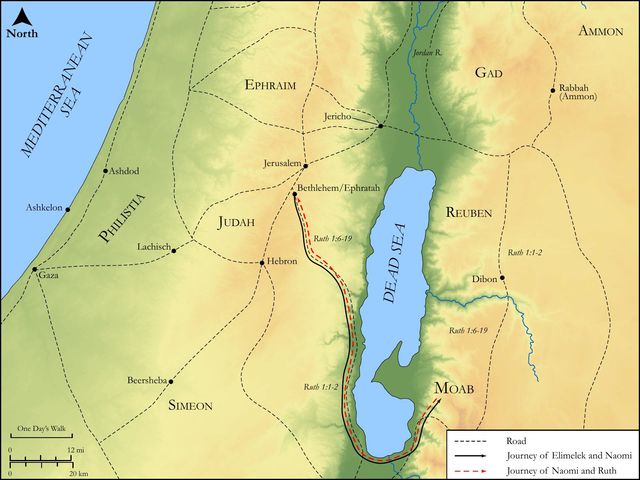
See on the biblical-era map
Study this verse
Public-domain commentary
Matthew Henry
From his Commentary on the Whole Bible. Henry comments on passages, not single verses — this entry covers Ruth 3:14–18.
We are here told, I. How Ruth was dismissed by Boaz. It would not have been safe for her to go home in the dead of the night; therefore she lay at his feet (not by his side) until morning. But as soon as ever the day broke, that she had light to go home by, she got away, before one could know another, that, if she were seen, yet she might not be known to be abroad so unseasonably. She was not shy of being known to be a gleaner in the field, nor ashamed of that mark of her poverty. But she would not willingly be known to be a night-walker, for her virtue was her greatest honour, and that which she most valued. Boaz dismissed her, 1. With a charge to keep counsel (Rut 3:14): Let it not be known that a woman came into the floor, and lay all night so near to Boaz; for, though they needed not to care much what people said of them while they were both conscious to themselves of an unspotted purity, yet, because few could have come so near the fire as they did and not have been scorched, had it been known it would have occasioned suspicions in some and reflections from others. Good people would have been troubled, and bad people would have triumphed, and therefore let it not be known. Note, We must always take care, not only to keep a good conscience, but to keep a good name: either we must not do that which, though innocent, is liable to be misinterpreted, or, if we do, we must not let it be known. We must avoid not only sin, but scandal. There was likewise a particular reason for concealment here. If this matter should take wind, it might prejudice the freedom of the other kinsman's choice, and he would make this his reason for refusing Ruth, that Boaz and she had been together. 2. He dismissed her with a good present of corn, which would be very acceptable to her poor mother at home, and an evidence for her that he had not sent her away in dislike, which Naomi might have suspected if he had sent her away empty. He gave it to her in her veil, or apron, or mantle, gave it to her by measure. Like a prudent corn-master, he kept an account of all he delivered out. It was six measures, that is six omers as is supposed, ten of which made an ephah; whatever the measure was, it is probable he gave her as much as she could well carry, Rut 3:15. And the Chaldee says, Strength was given her from the Lord to carry it; and adds that now it was told her by the spirit of prophecy that from her should descend six of the most righteous men of their age, namely, David, Daniel, his three companions, and the king Messiah.
II.How she was welcomed by her mother-in-law.
She asked her, "Who art thou, my daughter? Art thou a bride or no? Must I give thee joy?" So Ruth told her how the matter stood (Rut 3:17), whereupon her mother, 1. Advised her to be satisfied in what was done: Sit still, my daughter, till thou know how the matter will fall (Rut 3:18) - how it is decreed in heaven, so the Chaldee reads it, for marriages are made there. She had done all that was fit for her to do, and now she must patiently wait the issue and not be perplexed about it. Let us learn hence to cast our care upon providence, to follow that and attend the motions of it, composing ourselves into an expectation of the event, with a resolution to acquiesce in it, whatever it be. Sometimes that proves best done for us that is least our own doing. "Sit still, therefore, and see how the matter will fall, and say, Let it fall how it will, I am ready for it." 2. She assured her that Boaz, having undertaken this matter, would approve himself a faithful careful friend: He will not be at rest till he have finished the matter. Though it was a busy time with him in his fields and his floor, yet, having undertaken to serve his friend, he would not neglect the business. Naomi believes that Ruth has won his heart, and that therefore he will not be easy till he knows whether she be his or no. This she gives as a reason why Ruth should sit still and not perplex herself about it, that Boaz had undertaken it, and he would be sure to manage it well. Much more reason have good Christians to be careful for nothing, but cast their care on God, because he has promised to care for them: and what need have we to care if he do? Sit still, and see how the matter will fall, for the Lord will perfect that which concerns thee, and will make it to work for good to thee, Psa 37:4, Psa 37:5; Psa 138:8. Your strength is to sit still, Isa 30:7.
Continue studying Ruth 3:14 across the web’s major study libraries — every link below opens this exact verse, chapter, or book on the destination site.
Read & Compare
 BibleGatewayThis verse in more than 200 translations and 70 languages.
 Bible.comThe YouVersion reader — hundreds of translations, reading plans, and highlights.
 ESV.orgCrossway's official English Standard Version reader.
 NET BibleThe NET translation with 60,000+ translators' notes on every rendering decision.
 STEP BibleTyndale House's free study tool — original text, vocabulary, and scholarly resources.
 BibliaLogos Bible Software's free web reader.
 USCCBThe New American Bible (Revised Edition) with the U.S. bishops' study notes.
Commentaries
 BibleHub CommentariesDozens of classic commentaries on this verse, gathered on one page.
 StudyLightMore than 100 commentary sets — the largest collection on the web.
 BibleRefPlain-English commentary on what this verse means, verse by verse.
 Enduring WordDavid Guzik's free commentary on this chapter, widely used by Bible teachers.
 Bible Study ToolsVerse commentary alongside Greek and Hebrew study aids.
Original Language & Research
- BibleHub InterlinearThe verse word by word — original language, transliteration, and English.
- BibleHub LexiconEvery word's original-language definition and Strong's entry.
 Blue Letter BibleDeep-study tools — Strong's numbers, concordance, and word studies.
 SefariaThe Hebrew text with Rashi and centuries of Jewish commentary.
Sermons, Hymns & Audio


TrulyRandomVerse is not affiliated with these sites and doesn’t control their content. They’re linked because they’re genuinely useful.
Summary
Ruth 3:14 marks a pivotal moment in the narrative, depicting Ruth's discreet departure from the threshing floor under Boaz's protective instruction. Following her bold, yet humble, plea for redemption, Ruth remained in a position of trust and waiting until the pre-dawn hours. Boaz's insistence that her presence remain unknown underscores his profound concern for both her reputation and his own integrity, meticulously setting the stage for the honorable and public fulfillment of his role as kinsman-redeemer. This verse powerfully highlights themes of discretion, honor, and Boaz's righteous character, all providentially working towards Ruth's secure future and the continuation of Naomi's family line.
Context
ShowHideLiterary Context
This verse immediately follows Ruth's audacious, yet culturally astute, request to Boaz to "spread your cloak over your servant, for you are a kinsman-redeemer" Ruth 3:9. Boaz, recognizing her exceptional virtue and loyalty, had already promised to fulfill this duty if the nearer kinsman declined Ruth 3:13. Verse 14 serves as the crucial bridge between this private, nocturnal agreement and the public legal proceedings that will unfold in Ruth chapter 4. It meticulously emphasizes the careful, strategic actions taken by Boaz to ensure the honorable execution of the redemption, preventing any potential scandal that could jeopardize the entire process. The secrecy surrounding Ruth's departure is paramount for maintaining the integrity of all parties involved and ensuring a smooth, unimpeachable transition to the public sphere.
Historical & Cultural Context
The threshing floor (goren) was a vital agricultural site where grain was separated from chaff, often located outside the village and commonly used for sleeping by men guarding the valuable harvest. For an unmarried woman like Ruth to be found there overnight with a man, even a relative, would have been highly scandalous in ancient Israelite society, which operated on a strict honor-shame code. A woman's reputation was paramount, directly impacting her marriageability and social standing. Boaz's immediate and decisive concern for Ruth's reputation and his own demonstrates his deep adherence to societal norms and his profound personal integrity. His actions reflect the cultural imperative to avoid even the appearance of impropriety, especially when dealing with vulnerable individuals and matters of family honor and legal redemption.
Key Themes
ShowHideRuth 3:14 powerfully contributes to several overarching themes within the book. The most prominent is the Protection of Reputation and Honor, as Boaz's instruction directly safeguards Ruth's good name, a concept highly valued in Israelite society (Proverbs 22:1). This intertwines with the theme of Discretion and Wisdom, as both Ruth's timely departure and Boaz's command illustrate prudent action in a sensitive situation, avoiding scandal and ensuring the honorable progression of events. Furthermore, the verse highlights Boaz's Integrity and Righteousness, showcasing him not as one who would exploit a vulnerable woman, but as a man of principle committed to justice and compassionate care. Finally, while not explicitly stated, the careful orchestration of events undergirds the theme of Divine Providence, demonstrating God's hidden hand guiding human actions towards the restoration of Naomi's family line and the ultimate lineage of David and Christ. This meticulous care reflects the broader narrative of God's faithful oversight of His people, even in the mundane details of daily life, as seen throughout the Book of Ruth.
Exposition and Analysis
ShowHideKey Word Analysis
ShowHideThis word refers to the dawn or the break of day. In this context, it signifies the earliest possible time for Ruth to depart, emphasizing the need for absolute discretion before the full light of day would allow people to clearly discern one another. It marks the transition from the private, nocturnal encounter to the public sphere.
This term denotes a threshing-floor, an open area used for processing grain. Its significance here lies in its public, agricultural nature, making Ruth's overnight presence highly unusual and potentially compromising. Boaz's concern about a "woman came into the floor" highlights the social impropriety that must be avoided, underscoring the delicate nature of the situation and his commitment to honor.
This primitive root is used broadly to mean "to know," "to ascertain by seeing," "to recognize," or "to make known." In the phrase "before one could know another," it refers to the inability to clearly identify individuals in the dim light. In Boaz's command, "Let it not be known," it speaks to preventing any public awareness or recognition of Ruth's presence, emphasizing the crucial need for secrecy to protect reputations and ensure the integrity of the impending redemption process.
Verse Breakdown
ShowHide"¶ And she lay at his feet until the morning:"
This clause depicts Ruth's humble, trusting, and obedient posture. Having made her bold request and received Boaz's promise, she remains in a position of waiting and submission, demonstrating her faith in his word and her reliance on his protection. Her presence until morning also signifies the completion of the night's events and the transition to a new day, which will bring about the public resolution of her situation. This period of waiting underscores the quiet trust and the sacred, yet discreet, nature of the encounter.
"and she rose up before one could know another."
This phrase emphasizes the extreme discretion employed. Ruth departs under the cover of darkness, at the earliest possible moment before the sun fully rises and people can clearly see and recognize one another. This action is critical for protecting her reputation and preventing any gossip or scandal that could arise from her being seen leaving the threshing floor at dawn, thereby safeguarding the integrity of all involved.
"And he said, Let it not be known that a woman came into the floor."
This is Boaz's direct command, revealing his immediate and primary concern: the preservation of Ruth's honor and, by extension, his own and the integrity of the redemption process. His instruction is not born of shame but of profound wisdom and strategic foresight, ensuring that the necessary legal steps can proceed without the taint of impropriety. It highlights his honorable character and his unwavering commitment to protecting the vulnerable, demonstrating a righteousness that extends beyond mere legalism to genuine care.
Literary Devices
ShowHideRuth 3:14 employs several literary devices that enrich its meaning and underscore its significance. Foreshadowing is prominent, as the private, discreet actions on the threshing floor anticipate and meticulously lay the groundwork for the public, honorable redemption that will unfold in Ruth chapter 4. The secrecy of this encounter ensures the integrity of the subsequent legal process, setting the stage for a blameless transaction. Symbolism is also at play: the threshing floor, typically a place of labor and harvest, here becomes a liminal space where a private, intimate, yet entirely honorable, transaction of promise occurs, bridging Ruth's vulnerability with the promise of security. Ruth's position at Boaz's "feet" can symbolize humility, submission, and a plea for protection, while also subtly alluding to the cultural practice of lying at the feet of one's lord or master. Furthermore, there is an element of irony; what could have been a scene of potential scandal (a woman spending the night at a man's feet on a threshing floor) is transformed by Boaz's integrity and Ruth's virtue into a pivotal moment of honorable promise and discreet protection. The contrast between the darkness of night, where secrecy is maintained, and the approaching dawn, which signals the time for public action, also underscores the careful transition from private understanding to public declaration, highlighting the meticulous planning behind God's providential care.
Theological and Thematic Connections
ShowHideRuth 3:14 profoundly illustrates the biblical emphasis on integrity, discretion, and the diligent protection of one's own reputation and the honor of others. Boaz's actions are not merely about adhering to social customs but reflect a deeper commitment to righteousness and a godly concern for the vulnerable. His wisdom in navigating a potentially compromising situation with such meticulous care demonstrates a character aligned with divine principles. This passage teaches that true godliness involves not only doing what is right but also doing it in a way that avoids even the appearance of evil, safeguarding the testimony of faith and ensuring that good deeds are not undermined by misunderstanding or scandal. It speaks powerfully to the responsibility of those in positions of power or influence to act with honor and to be vigilant guardians of the dignity of those under their care, especially the lowly and those who are most vulnerable.
Reflection and Application
ShowHideRuth 3:14 offers timeless wisdom for navigating our own lives with integrity and discretion in a complex world. In an age often driven by sensationalism, immediate disclosure, and quick judgment, Boaz's profound concern for Ruth's reputation reminds us of the paramount importance of protecting the honor of others, especially those who are vulnerable, easily misunderstood, or subject to public scrutiny. It challenges us to consider not only the inherent rightness of our actions but also how they might be perceived by others, encouraging us to act with wisdom and foresight to avoid unnecessary scandal or misinterpretation that could harm our witness or the reputation of others. For those in positions of leadership, influence, or pastoral care, this passage serves as a powerful call to safeguard the dignity and well-being of those under their care, ensuring that their conduct is consistently above reproach. Ultimately, it invites us to live lives marked by such unwavering integrity and thoughtful discretion that our actions, even in private moments, reflect the impeccable character of God, building trust, fostering healthy relationships, and paving the way for honorable and redemptive outcomes in all circumstances.
Questions for Reflection
ShowHideFAQ
ShowHideWhy was it so important for Ruth's presence on the threshing floor to be kept secret?
ShowHideIt was absolutely crucial to protect Ruth's reputation and avoid scandal. In ancient Israelite society, an unmarried woman spending the night with a man, even a relative, in a public agricultural space like a threshing floor, could easily lead to accusations of impropriety or sexual misconduct. Such a stain on her reputation would have severely jeopardized her marriage prospects, her social standing, and the entire process of her legal redemption. Boaz, as a righteous and honorable man, understood this profound cultural imperative and acted decisively to safeguard her honor, ensuring that the legal process of redemption could proceed without any moral cloud or public suspicion. His own integrity was also on the line, as he was responsible for her well-being and the honorable execution of his kinsman-redeemer duties, as discussed in Ruth 3:13.
What does "she lay at his feet" signify in this context?
ShowHideRuth's action of lying at Boaz's feet signifies several important things. Primarily, it conveys a posture of humility, submission, and profound trust. She was meticulously following Naomi's instructions Ruth 3:4 and placing herself under Boaz's authority and protection, appealing to him as her kinsman-redeemer. It was a vulnerable position, yet one that expressed her complete reliance on him to act honorably and fulfill his duty. In this narrative, "feet" primarily denotes a position of respectful waiting and a plea for favor, distinct from any sexual impropriety, which Boaz's subsequent actions unequivocally confirm. It highlights her trust in his character and his role as a protector.
How does this verse contribute to the overall plot of the Book of Ruth?
ShowHideRuth 3:14 is a pivotal verse that meticulously bridges the private, nocturnal understanding and promise between Ruth and Boaz and the public, legal resolution of her situation. It solidifies Boaz's unwavering commitment to Ruth and Naomi's redemption while simultaneously demonstrating his profound wisdom and integrity in handling such a delicate matter. By ensuring Ruth's discreet departure, Boaz protects their reputations, which is absolutely essential for the honorable and successful completion of the kinsman-redeemer process in Ruth chapter 4. This verse sets the stage for the public transaction at the city gate, moving the narrative forward towards the restoration of Naomi's lineage and the eventual birth of Obed, the grandfather of King David, thereby advancing the divine plan for Israel's monarchy and the lineage of the Messiah.
Christ-Centered Fulfillment
ShowHideRuth 3:14, with its profound emphasis on Boaz's integrity, protective care, and discreet yet firm commitment, beautifully foreshadows the character and redemptive work of Jesus Christ, our ultimate Kinsman-Redeemer. Just as Boaz, a man of impeccable honor, acted decisively to secure Ruth's future and protect her reputation from scandal, so Christ, in His perfect righteousness and boundless love, came to redeem humanity from the shame and bondage of sin. Boaz's careful and compassionate handling of Ruth's vulnerability on the threshing floor mirrors Christ's tender and unwavering care for His church, His beloved bride, whom He loves and protects, ensuring her honor and purity before God Ephesians 5:25-27. The secrecy of Ruth's departure before dawn, preventing misjudgment and preserving integrity, can be seen as a subtle parallel to Christ's divine wisdom in accomplishing salvation, often hidden from the world's understanding, yet perfectly executed according to God's sovereign plan. Boaz's promise made in the darkness of night, leading to a new day of hope and public redemption, powerfully points to Christ's sacrificial work on the cross, which, though seemingly a defeat to human eyes, brought about the glorious dawn of a new covenant and eternal life for all who trust in Him 2 Corinthians 5:17. He is the one who, in His great love, took on our flesh to redeem us, not ashamed to call us brothers and sisters Hebrews 2:14-17, perfectly righteous and without blemish 1 Peter 2:22, securing our honor and eternal future in Him.