

 TRV
TRV
- English
- King James KJV
- Complete Jewish CJB
- World English WEBM
- Berean Standard BSB
- American Standard ASV
- Geneva GNV
- Young's Literal YLT
- Douay-Rheims DRC
- International
- Shqip ALB
- العربية SVD
- বাংলা BN-IRV
- မြန်မာ Judson
- 简体文 CUV-S
- 繁體中文 CUV-T
- Čeština BKR
- Nederlands STVE
- Français LSG
- Deutsch SCH
- Ελληνικά Vamvas
- ગુજરાતી GU-IRV
- Hausa HCB
- עברית Hebrew
- हिन्दी HCV
- Magyar KAROLI
- Bahasa Indonesia INDO-TB
- Italiano Diodati
- 日本語 Kougo
- 한국어 Korean
- മലയാളം MAL
- मराठी MRCV
- Norsk DNB
- فارسی OPV
- Polski BG
- Português Almeida
- Română Cornilescu
- Русский Synodal
- Español RVG
- Kiswahili Neno
- Svenska SV1917
- Tagalog TAG-ADB
- தமிழ் TCV
- తెలుగు TSA
- ภาษาไทย THAI-KJV
- Українська Ohienko
- Tiếng Việt CADMAN
- Yorùbá YCB
Dealing with Division and Heresy
Dealing with Division and Heresy
In this passage
- Who
- Where
- When
- About
See also
Where else Scripture says this.
Romans 16:17
Now I beseech you, brethren, mark them that are causing the divisions and occasions of stumbling, contrary to the doctrine which ye learned: and turn away from them.from verse 102 Timothy 2:14
Of these things put them in remembrance, charging them in the sight of the Lord, that they strive not about words, to no profit, to the subverting of them that hear.from verse 92 John 1:10
If any one cometh unto you, and bringeth not this teaching, receive him not into your house, and give him no greeting:from verse 10Matthew 18:15
And if thy brother sin against thee, go, show him his fault between thee and him alone: if he hear thee, thou hast gained thy brother.from verse 10Matthew 18:17
And if he refuse to hear them, tell it unto the church: and if he refuse to hear the church also, let him be unto thee as the Gentile and the publican.from verse 102 Timothy 2:23
But foolish and ignorant questionings refuse, knowing that they gender strifes.from verse 91 Timothy 4:7
but refuse profane and old wives’ fables. And exercise thyself unto godliness:from verse 92 Timothy 2:16
But shun profane babblings: for they will proceed further in ungodliness,from verse 9Titus 1:14
not giving heed to Jewish fables, and commandments of men who turn away from the truth.from verse 92 Thessalonians 3:14
And if any man obeyeth not our word by this epistle, note that man, that ye have no company with him, to the end that he may be ashamed.from verse 102 Timothy 3:5
holding a form of godliness, but having denied the power thereof: from these also turn away.from verse 101 Timothy 1:3
As I exhorted thee to tarry at Ephesus, when I was going into Macedonia, that thou mightest charge certain men not to teach a different doctrine,from verse 9
Where this happens

Study this passage
Commentary written on this passage, not on a single verse.
Public-domain commentary
Matthew Henry
From his Commentary on the Whole Bible. Henry comments on passages, not single verses — this entry covers Titus 3:9–15. His two-level outline is real structure in the source text, so it is rendered as structure.
Here is the fifth and last thing in the matter of the epistle: what Titus should avoid in teaching; how he should deal with a heretic; with some other directions. Observe,
I.That the apostle's meaning might be more clear and full, and especially fitted to the time and state of things in Crete, and the many judaizers among them, he tells Titus what, in teaching, he should shun, Tit 3:9. There are needful questions to be discussed and cleared, such as make for improvement in useful knowledge; but idle and foolish enquiries, tending neither to God's glory nor the edification of men, must be shunned. Some may have a show of wisdom, but are vain, as many among the Jewish doctors, as well as of later schoolmen, who abound with questions of no moment or use to faith or practice; avoid these. - And genealogies (of the gods, say some, that the heathen poets made such noise about; or rather those that the Jews were so curious in): some lawful and useful enquiries might be made into these things, to see the fulfilling of the scriptures in some cases, and especially in the descent of Christ the Messiah; but all that served to pomp only, and to feed vanity, in boasting of a long pedigree, and much more such as the Jewish teachers were ready to busy themselves in and trouble their hearers with, even since Christ had come, and that distinction of families and tribes had been taken away, as if they would build again that policy which now is abolished, these Titus must withstand as foolish and vain. - And contentious, and strivings about the law. There were those who were for the Mosaic rites and ceremonies, and would have them continued in the church, though by the gospel and the coming of Christ they were superseded and done away. Titus must give no countenance to these, but avoid and oppose them; for they are unprofitable and vain: this is to be referred to all those foolish questions and genealogies, as well as those strivings about the law. They are so far from instructing and building up in godliness, that they are hindrances of it rather: the Christian religion, and good works, which are to be maintained, will hereby be weakened and prejudiced, the peace of the church disturbed, and the progress of the gospel hindered. Observe, Ministers must not only teach things good and useful, but shun and oppose the contrary, what would corrupt the faith, and hinder godliness and good works; nor should people have itching ears, but love and embrace sound doctrine, which tends most to the use of edifying.
II.But because, after all, there will be heresies and heretics in the church, the apostle next directs Titus what to do in such a case, and how to deal with such, Tit 3:10. He who forsakes the truth as it is in Christ Jesus, who broaches false doctrines and propagates them to the corrupting of the faith in weighty and momentous points, and breaks the peace of the church about them, after due means used to reclaim him, must be rejected. "Admonish him once and again, that, if possible, he may be brought back, and thou mayest gain thy brother; but, if this will not reduce him, that others be not hurt, cast him out of the communion, and warn all Christians to avoid him." - Knowing that he that is such is subverted (turned off from the foundation) and sinneth grievously, being self-condemned. Those who will not be reclaimed by admonitions, but are obstinate in their sins and errors, are subverted and self-condemned; they inflict that punishment upon themselves which the governors of the church should inflict upon them: they throw themselves out of the church, and throw off its communion, and so are self-condemned. Observe, 1. How great an evil real heresy is, not lightly therefore to be charged upon any, though greatly to be taken heed of by all. Such a one is subverted or perverted - a metaphor from a building so ruined as to render it difficult if not impossible to repair and raise it up again. Real heretics have seldom been recovered to the true faith: not so much defect of judgment, as perverseness of the will, being in the case, through pride, or ambition, or self-willedness, or covetousness, or such like corruption, which therefore must be taken heed of: "Be humble, love the truth and practise it, and damning heresy will be escaped." 2. Pains and patience must be used about those that err most grievously. They are not easily and soon to be given up and cast off, but competent time and means must be tried for their recovery. 3. The church's means even with heretics are persuasive and rational. They must be admonished, instructed, and warned; so much nouthesia imports. 4. Upon continued obstinacy and irreclaimableness, the church has power, and is obliged, to preserve its own purity, by severing such a corrupt member which discipline may by God's blessing become effectual to reform the offender, or if not it will leave him the more inexcusable in his condemnation.
III.The apostle subjoins some further directions, Tit 3:12, Tit 3:13. Here are two personal things enjoined: -
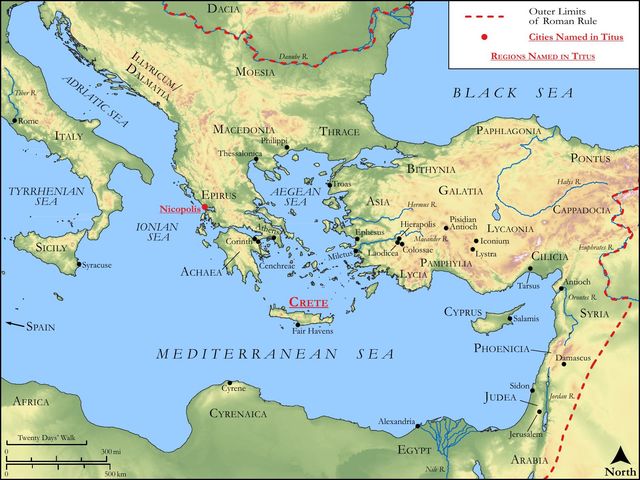
1.That Titus should hold himself ready to come to Paul at Nicopolis (a city of Thrace, as is reckoned, on the borders of Macedonia), as soon as Artemas or Tychicus should be sent to Crete, to supply his place, and take care of the churches there when he should leave them. The apostle would not have them in their young and weak state be without one or other of chief sufficiency, to guide and help them. Titus, it seems, was not their ordinary fixed bishop or pastor, but an evangelist, otherwise Paul would not have called him so much from his charge. Of Artemas we read little, but Tychicus is mentioned on many occasions with respect. Paul calls him a beloved brother, and faithful minister, and fellow-servant in the Lord: one fit therefore for the service intimated. When Paul says to Titus, Be diligent to come to me to Nicopolis, for I have determined there to winter, it is plain that the epistle was not written from Nicopolis, as the postcript would have it, for then he would have said, I determined here, not there, to winter.
2.The other personal charge to Titus is that he would bring two of his friends on their journey diligently, and see them furnished, so that nothing should be wanting to them. This was to be done, not as a piece of common civility only, but of Christian piety, out of respect both to them and the work they were sent about, which probably was to preach the gospel, or to be in some way serviceable to the churches. Zenas is styled the lawyer, whether in reference to the Roman or the Mosaic law, as having some time been his profession, is doubtful. Apollos was an eminent and faithful minister. Accompanying such persons part of their way, and accommodating them for their work and journeys, was a pious and needful service; and to further this, and lay in for it, what the apostle had before exhorted Titus to teach (Tit 3:8) he repeats here: Let ours also learn to maintain good works for necessary uses, that they be not unfruitful, Tit 3:14. Let Christians, those who have believed in God, learn to maintain good works, especially such as these, supporting ministers in their work of preaching and spreading the gospel, hereby becoming fellow-helpers to the truth, Jo3 1:5-8. That they be not unfruitful. Christianity is not a fruitless profession; the professors of it must be filled with the fruits of righteousness, which are by Jesus Christ, to the glory and praise of God. It is not enough that they be harmless, but they must be profitable, doing good, as well as eschewing evil. - "Let ours set up and maintain some honest labour and employment, to provide for themselves and their families, that they be not unprofitable burdens on the earth;" so some understand it. Let them not think that Christianity gives them a writ of ease; no, it lays an obligation upon them to seek some honest work and calling, and therein to abide with God. This is of good report, will credit religion and be good to mankind; they will not be unprofitable members of the body, not burdensome and chargeable to others, but enabled to be helpful to those in want. To maintain good works for necessary uses; not living like drones on the labours of others, but themselves fruitful to the common benefit.
IV.The apostle concludes with salutations and benedictions, Tit 3:5.
Though perhaps not personally known (some of them at least), yet all by Paul testify their love and good wishes to Titus, owning him thereby in his work, and stimulating him to go on therein. Great comfort and encouragement it is to have the heart and prayers of other Christians with and for us. Greet those that love us in the faith, or for the faith, who are our loving fellow-christians. Holiness, or the image of God in any, is the great endearing thing that gives strength to all other bonds, and is itself the best. Grace be with you all. Amen. This is the closing benediction, not to Titus alone, but to all the faithful with him, which shows that though the epistle bears the single name of Titus in the inscription, yet it was for the use of the churches there, and they were in the eye, and upon the heart, of the apostle, in the writing of it. "Grace be with you all, the love and favour of God, with the fruits and effects thereof, according to need, spiritual ones especially, and the increase and feeling of them more and more in your souls." This is the apostle's wish and prayer, showing his affection to them, his desire of their good, and a means of obtaining for them, and bringing down upon them, the thing requested. Observe, Grace is the chief thing to be wished and begged for, with respect to ourselves or others; it is, summarily, all good. Amen shuts up the prayer, expressing desire and hope, that so it may, and so it shall be.
Historical interpretation
Eight Centuries of Reception
19 surviving comments on this passage. Each one is dated, so this reads as a timeline rather than a list.
Select a marker to jump to its quote. Markers stagger vertically where authors wrote within a few decades of each other.
But as many as separate from the Church, and give heed to such old wives' fables as these, are truly self-condemned; and these men Paul commands us, "after a first and second admonition, to avoid.".
"Such was the horror which the apostles and their disciples had against holding even verbal communication with any corrupters of the truth; as Paul also says, "A man that is an heretic, after the first and second admonition, reject; knowing that he that is such is subverted, and sinneth, being condemned of himself."
Unhappy Aristotle! who invented for these men dialectics, the art of building up and pulling down; an art so evasive in its propositions, so far-fetched in its conjectures, so harsh, in its arguments, so productive of contentions-embarrassing even to itself, retracting everything, and really treating of nothing! Whence spring those "fables and endless genealogies," and "unprofitable questions," and "words which spread like a cancer? " From all these, when the apostle would restrain us, he expressly names philosophy as that which he would have us be on our guard against.
It is the same Paul who, in his epistle to the Galatians, counts “heresies” among “the sins of the flesh,” who also intimates to Titus that “a man who is a heretic” must be “rejected after the first admonition.” This is on the ground that “he that is perverted and commits sin as a self-condemned man.” Indeed, in almost every epistle, when enjoining on us [the duty] of avoiding false doctrines, he sharply condemns heresies. Of these the practical effects are false doctrines, called in Greek heresis, a word used in the sense of that choice which a man makes when he either teaches them [to others] or takes up with them [for himself]. For this reason it is that he calls the heretic self-condemned, because he has himself chosen that in which he is condemned.
On this point, however, we dwell no longer, since it is the same Paul who, in his Epistle to the Galatians, counts "heresies" among "the sins of the flesh," who also intimates to Titus, that "a man who is a heretic" must be "rejected after the first admonition," on the ground that "he that is such is perverted, and committeth sin, as a self-condemned man." Indeed, in almost every epistle, when enjoining on us (the duty) of avoiding false doctrines, he sharply condemns heresies.
For the faith of the sacred Scripture sets forth that the Church is not without, nor can be separated nor divided against itself, but maintains the unity of an inseparable and undivided house; since it is written of the sacrament of the passover, and of the lamb, which Lamb designated Christ: "In one house shall it be eaten: ye shall not carry forth the flesh abroad out of the house." Which also we see expressed concerning Rahab, who herself also bore a type of the Church, who received the command which said, "Thou shalt bring thy father, and thy mother, and thy brethren, and all thy father's household unto thee into thine house; and whosoever shall go out of the doors of thine house into the street, his blood shall be upon him." In which mystery is declared, that they who will live, and escape from the destruction of the world, must be gathered together into one house alone, that is, into the Church; but whosoever of those thus collected together shall go out abroad, that is, if any one, although he may have obtained grace in the Church, shall depart and go out of the Church, that his blood shall be upon him; that is, that he himself must charge it upon himself that he perishes; which the Apostle Paul explains, teaching and enjoining that a heretic must be avoided, as perverse, and a sinner, and as condemned of himself. For that man will be guilty of his own ruin, who, not being cast out by the bishop, but of his own accord deserting from the Church is by heretical presumption condemned of himself.
That we must not speak with heretics. To Titus: "A man that is an heretic, after one rebuke avoid; knowing that one of such sort is perverted, and sinneth, and is by his own self condemned." Of this same thing in the Epistle of John: "They went out from among us, but they were not of us; for if they had been of us, they would doubtless have remained with us." Also in the second to Timothy: "Their word doth creep as a canker."