

 TRV
TRV
- English
- King James KJV
- Complete Jewish CJB
- World English WEBM
- Berean Standard BSB
- American Standard ASV
- Geneva GNV
- Young's Literal YLT
- Douay-Rheims DRC
- International
- Shqip ALB
- العربية SVD
- বাংলা BN-IRV
- မြန်မာ Judson
- 简体文 CUV-S
- 繁體中文 CUV-T
- Čeština BKR
- Nederlands STVE
- Français LSG
- Deutsch SCH
- Ελληνικά Vamvas
- ગુજરાતી GU-IRV
- Hausa HCB
- עברית Hebrew
- हिन्दी HCV
- Magyar KAROLI
- Bahasa Indonesia INDO-TB
- Italiano Diodati
- 日本語 Kougo
- 한국어 Korean
- മലയാളം MAL
- मराठी MRCV
- Norsk DNB
- فارسی OPV
- Polski BG
- Português Almeida
- Română Cornilescu
- Русский Synodal
- Español RVG
- Kiswahili Neno
- Svenska SV1917
- Tagalog TAG-ADB
- தமிழ் TCV
- తెలుగు TSA
- ภาษาไทย THAI-KJV
- Українська Ohienko
- Tiếng Việt CADMAN
- Yorùbá YCB
Daniel Studies Jeremiah's Prophecy
Daniel Studies Jeremiah's Prophecy
In this passage
- Who
- Where
- When
- About
See also
Where else Scripture says this.
Jeremiah 29:10
For thus saith Jehovah, After seventy years are accomplished for Babylon, I will visit you, and perform my good word toward you, in causing you to return to this place.from verse 2Jeremiah 25:11
And this whole land shall be a desolation, and an astonishment; and these nations shall serve the king of Babylon seventy years.from verse 2Jeremiah 25:12
And it shall come to pass, when seventy years are accomplished, that I will punish the king of Babylon, and that nation, saith Jehovah, for their iniquity, and the land of the Chaldeans; and I will make it desolate for ever.from verse 22 Chronicles 36:21
to fulfil the word of Jehovah by the mouth of Jeremiah, until the land had enjoyed its sabbaths: for as long as it lay desolate it kept sabbath, to fulfil threescore and ten years.from verse 2Revelation 1:3
Blessed is he that readeth, and they that hear the words of the prophecy, and keep the things that are written therein: for the time is at hand.from verse 2Zechariah 7:5
Speak unto all the people of the land, and to the priests, saying, When ye fasted and mourned in the fifth and in the seventh month, even these seventy years, did ye at all fast unto me, even to me?from verse 22 Peter 1:19
And we have the word of prophecy made more sure; whereunto ye do well that ye take heed, as unto a lamp shining in a dark place, until the day dawn, and the day-star arise in your hearts:from verse 22 Peter 1:21
For no prophecy ever came by the will of man: but men spake from God, being moved by the Holy Spirit.from verse 2Ezra 1:1
Now in the first year of Cyrus king of Persia, that the word of Jehovah by the mouth of Jeremiah might be accomplished, Jehovah stirred up the spirit of Cyrus king of Persia, so that he made a proclamation throughout all his kingdom, andput italso in writing, saying,from verse 22 Timothy 3:15
and that from a babe thou hast known the sacred writings which are able to make thee wise unto salvation through faith which is in Christ Jesus.from verse 22 Timothy 3:17
that the man of God may be complete, furnished completely unto every good work.from verse 2Micah 3:12
Therefore shall Zion for your sake be plowed as a field, and Jerusalem shall become heaps, and the mountain of the house as the high places of a forest.from verse 2
Where this happens
Study this passage
Commentary written on this passage, not on a single verse.
Public-domain commentary
Matthew Henry
From his Commentary on the Whole Bible. Henry comments on passages, not single verses — this entry covers Daniel 9:1–3.
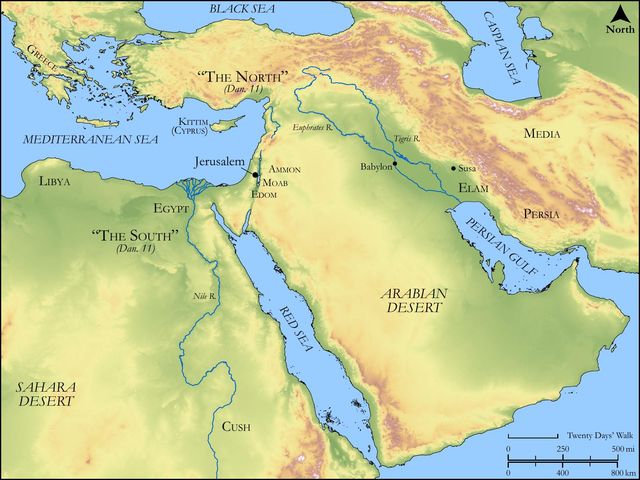
We left Daniel, in the close of the foregoing chapter, employed in the king's business; but here we have him employed in better business than any king had for him, speaking to God and hearing from him, not for himself only, but for the church, whose mouth he was to God, and for whose use the oracles of God were committed to him, relating to the days of the Messiah. Observe, 1. When it was that Daniel had this communion with God (Dan 9:1), in the first year of Darius the Mede, who was newly made king of the Chaldeans, Babylon being conquered by him and his nephew, or grandson, Cyrus. In this year the seventy years of the Jews' captivity ended, but the decree for their release was not yet issued out; so that this address of Daniel's to God seems to have been ready in that year, and, probably, before he was cast into the lions' den. And one powerful inducement, perhaps, it was to him then to keep so close to the duty of prayer, though it cost him his life, that he had so lately experienced the benefit and comfort of it. 2. What occasioned his address to God by prayer (Dan 9:2): He understood by books that seventy years was the time fixed for the continuance of the desolations of Jerusalem. Dan 9:2. The book by which he understood this was the book of the prophecies of Jeremiah, in which he found it expressly foretold (Jer 29:10), After seventy years be accomplished in Babylon (and therefore they must be reckoned from the first captivity, in the third year of Jehoiakim, which Daniel had reason to remember by a good token, for it was in that captivity that he was carried away himself, Dan 1:1), I will visit you, and perform my good word towards you. It was likewise said (Jer 25:11), This whole land shall be seventy years a desolation (chorbath), the same word that Daniel here uses for the desolations of Jerusalem, which shows that he had that prophecy before him when he wrote this. Though Daniel was himself a great prophet, and one that was well acquainted with the visions of God, yet he was a diligent student in the scripture, and thought it no disparagement to him to consult Jeremiah's prophecies. He was a great politician, and prime-minister of state to one of the greatest monarchs upon earth, and yet could find both heart and time to converse with the word of God. The greatest and best men in the world must not think themselves above their Bibles. 3. How serious and solemn his address to God was when he understood that the seventy years were just upon expiring (for it appears, by Ezekiel's dating of his prophecies, that they exactly computed the years of their captivity), then he set his face to seek God by prayer. Note, God's promises are intended, not to supersede, but to excite and encourage, our prayers; and, when we see the day of the performance of them approaching, we should the more earnestly plead them with God and put them in suit. So Daniel did here; he prayed three times a day, and, no doubt, in every prayer made mention of the desolations of Jerusalem; yet he did not think that enough, but even in the midst of his business set time apart for an extraordinary application to Heaven on Jerusalem's behalf. God had said to Ezekiel that though Daniel, among others, stood before him, his intercession should not prevail to prevent the judgment (Eze 14:14), yet he hopes, now that the warfare is accomplished (Isa 40:2), his prayer may be heard for the removing of the judgment. When the day of deliverance dawns it is time for God's praying people to bestir themselves; something extraordinary is then expected and required from them, besides their daily sacrifice. Now Daniel sought by prayer and supplications, for fear lest the sins of the people should provoke him to defer their deliverance longer than was intended, or rather that the people might be prepared by the grace of God for the deliverance now that the providence of God was about to work it out for them. Now observe, (1.) The intenseness of his mind in this prayer; I set my face unto the Lord God to seek him, which denotes the fixedness of his thoughts, the firmness of his faith, and the fervour of his devout affections, in the duty. We must, in prayer, set God before us, an set ourselves as in his presence; to him we must direct our prayer and must look up. Probably, in token of his setting his face towards God, he did, as usual, set his face towards Jerusalem, to affect his own heart the more with the desolations of it. (2.) The mortification of his body in this prayer. In token of his deep humiliation before God for his own sins, and the sins of his people, and the sense he had of his unworthiness, when he prayed he fasted, put on sackcloth, and lay in ashes, the more to affect himself with the desolations of Jerusalem, which he was praying for the repair of, and to make himself sensible that he was now about an extraordinary work.
Historical interpretation
Four Centuries of Reception
5 surviving comments on this passage. Each one is dated, so this reads as a timeline rather than a list.
Select a marker to jump to its quote. Markers stagger vertically where authors wrote within a few decades of each other.
Verse 1. "In the first year of the Darius who was the son of Ahasuerus of the race of the Medes and who reigned over the kingdom of the Chaldeans, in the first year of his reign..." This is the Darius who in cooperation with Cyrus conquered the Chaldeans and Babylonians. We are not to think of that other Darius in the second year of whose reign the Temple was built (as Porphyry supposes in making out a late date for Daniel); nor are we to think of the Darius who was vanquished by Alexander, the king of the Macedonians. He therefore adds the name of his father and also refers to his victory, inasmuch as he was the first of the race of the Medes to overthrow the kingdom of the Chaldeans. He does this to avoid any mistake in the reading which might arise from the similarity of the name.
Verse 2. "I, Daniel, understood by the books the number of the years concerning which the word of the Lord had come to the prophet Jeremiah, that seventy years would be accomplished for the desolation of Jerusalem." Jeremiah had predicted seventy years for the desolation of the Temple (Jeremiah 29:1-10), at the end of which the people would again return to Judaea and build the Temple and the city of Jerusalem. But this fact did not render Daniel careless, but rather encouraged him to pray that God might through his supplications fulfil that which He had graciously promised. Thus he avoided the danger that carelessness might result in pride, and pride cause offense to the Lord. Accordingly we read in Genesis that prior to the Deluge one hundred and twenty years were appointed for men to come to repentance (Genesis 6:3); and inasmuch as they refused to repent even within so long an interval of time as a hundred years, God did not wait for the remaining twenty years to be fulfilled, but brought on the punishment earlier which He had threatened for a later time. So also Jeremiah is told, on account of the hardness of the heart of the Jewish people: "Pray not for this people, for I will not hearken unto thee" (Jeremiah 7:16). Samuel also was told: "How long wilt thou mourn over Saul? I also have rejected him" (1 Samuel 16:1). And so it was with sackcloth and ashes that Daniel besought the Lord to fulfil what He had promised, not that Daniel lacked faith concerning the future, but rather he would avoid the danger that a feeling of security might produce carelessness, and carelessness produce an offense to God.
We must distinguish between the reign of Darius son of Ahasuerus and that of Darius the Persian. In this way, the things that are now being read will harmonize with the things that were spoken earlier. He did not simply introduce Darius as Darius the Mede but rather as one “from the race of the Medes.” Now, as it is clear, he was not a Mede on both sides of his family, that is, on his father’s and mother’s side. At the same time he ruled over the kingdom of the Chaldeans, when Belshazzar was killed in the middle of the night by a divine intervention after his godless act. According to my research, this Darius seems to have reigned for a very brief time.
Darius, the son of Astyages, who destroyed the Babylonian Empire with the help of his kinsmen Cyrus, was sixty-two years old when he attacked Babylon. He is called by another name by the Greeks. He took the prophet Daniel and led him into the middle of his court and feted him with every honor. Daniel himself made mention of this Darius: “In the first year of Darius.…” In his chronology, Eusebius counts thirty years from the destruction of Jerusalem to the beginning of the reign of Cyrus, king of the Persians. Julius Africanus, however, counts seventy years. Moreover, Jerome has this to say in his exposition of the prophet Daniel: “The Hebrews pass on a story of this sort up until the seventieth year, when Jeremiah had said that the captivity of the Jews would come to an end. Zechariah also speaks about this at the beginning of his book.”
When the time fixed for the captivity is completed, Daniel begins to pray for the return; indeed, he had not dared to pray [to that purpose] before that moment, in order not to press God needlessly and in order not to hear the word that had been addressed to Jeremiah: “Do not pray for this people, and do not intercede with me, for I will not hear you.” But after seeing that the sentence had been executed, he prays with fasting and sackcloth and ashes. At the same time he thought that the Jews might stay a longer time in captivity because of their sins, according to the fact that God had added thirty years to the Jews in Egypt and had reduced [the time for repentance conceded] to the generation of Noah of twenty years and of fifty in the case of the house of Ephrem. Moreover, it is not at the beginning of their fault that the sinners ask questions of the judge but after the punishment.