


Numbers 4:13
Bible text: King James Version (1769 Blayney text) · Public domain
Bible text: Berean Standard Bible · Public domain
Bible text: American Standard Version (1901) · Public domain
Bible text: World English Bible, Messianic edition · Public domain
Bible text: Geneva Bible (1599) · Public domain
Bible text: Young's Literal Translation · Public domain
- וְדִשְּׁנוּve·di·she·Nuand they will take away [the] ashes fromH1878Conj-w ¦ V-Piel-ConsecPerf-3cpVerb Piel Consecutive Perfect 3rd Plural common genderוְandדִשְּׁנוּthey will take away [the] ashes from
- אֶת'et<obj.>H853DirObjMParticle Object Indicator
- הַמִּזְבֵּחַha·miz·Be·achthe altarH4196Art ¦ N-msNoun Singular Masculine Absoluteהַtheמִּזְבֵּחַaltar
- וּפָרְשׂוּu·fa·re·Suand they will spread outH6566Conj-w ¦ V-Qal-ConsecPerf-3cpVerb Qal Consecutive Perfect 3rd Plural common genderוּandפָרְשׂוּthey will spread out
- עָלָיו'a·Lavover itH5921Prep ¦ 3msPreposition Definiteעָלָיoverוit
- בֶּגֶדBe·geda covering ofH899N-mscNoun Singular Masculine Construct
- אַרְגָּמָן'ar·ga·Manpurple clothH713N-msNoun Singular Masculine Absolute
English is a literal word-by-word gloss of the Hebrew, not the KJV's wording. Why?
This is the original text the KJV's translators worked from — each Hebrew word with its own literal English meaning in this verse, prepared by scholars at Tyndale House, Cambridge. The KJV translates whole sentences, not word by word, so its wording differs: one Hebrew word can become several English words, and the KJV may choose “the LORD” where the gloss reads “Yahweh”. Both are faithful — they answer different questions. For the KJV's own rendering, switch to the KJV text.
Details
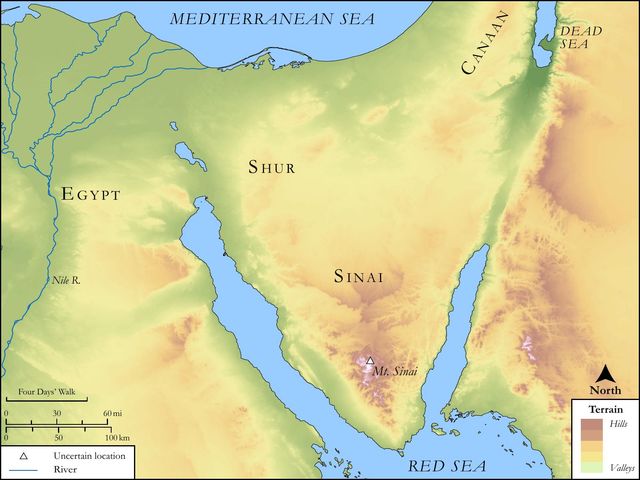
See on the biblical-era map
Study this verse
Public-domain commentary
Matthew Henry
From his Commentary on the Whole Bible. Henry comments on passages, not single verses — this entry covers Numbers 4:1–20. His four-level outline is real structure in the source text, so it is rendered as structure.
We have here a second muster of the tribe of Levi. As that tribe was taken out of all Israel to be God's peculiar, so the middle-aged men of that tribe were taken from among the rest to be actually employed in the service of the tabernacle. Now observe,
I.Who were to be taken into this number.
All the males from thirty years old to fifty. Of the other tribes, those that were numbered to go forth to war were from twenty years old and upward, but of the Levites only from thirty to fifty; for the service of God requires the best of our strength, and the prime of our time, which cannot be better spent than to the honour of him who is the first and best. And a man may make a good soldier much sooner than a good minister. Now,
1.They were not to be employed till they were thirty years old, because till then they were in danger of retaining something childish and youthful and had not gravity enough to do the service, and wear the honour, of a Levite. They were entered as probationers at twenty-five years old, (Num 8:24), and in David's time, when there was more work to be done, at twenty (Ch1 23:24, and so Ezr 3:8); but they must be five years learning and waiting, and so fitting themselves for service; nay, in David's time they were ten years in preparation, from twenty to thirty. John Baptist began his public ministry, and Christ his, at thirty years old. This is not in the letter of it obligatory on gospel ministers now, as if they must either not begin their work till thirty years old or must leave off at fifty; but it gives us two good rules: - (1.) That ministers must not be novices, Ti1 3:6. It is a work that requires ripeness of judgment and great steadiness, and therefore those are very unfit for it who are but babes in knowledge and have not put away childish things. (2.) That they must learn before they teach, serve before they rule, and must first be proved, Ti1 3:10.
2.They were discharged at fifty years old from the toilsome part of the service, particularly that of carrying the tabernacle; for that is the special service to which they are here ordained, and which there was most occasion for while they were in the wilderness. When they began to enter upon old age, they were dismissed,
(1.)In favour to them, that they might no be over-toiled when their strength began to decay. Twenty years' good service was thought pretty well for one man.
(2.)In honour to the work, that it might not be done by those who, through the infirmities of age, were slow and heavy. The service of God should be done when we are in the most lively active frame. Those do not consider this who put off their repentance to old age, and so leave the best work to be done in the worst time.
II.How their work is described.
They are said to enter into the host, or warfare, to do the work in the tabernacle. The ministry is a good work (Ti1 3:1): ministers are not ordained to the honour only, but to the labour, not only to have the wages, but to do the work. It is also a good warfare, Ti1 1:18. Those that enter into the ministry must look upon themselves as entered into the host, and approve themselves good soldiers, Ti2 2:3. Now, as to the sons of Kohath in particular, here is,
1.Their service appointed them, in the removes of the tabernacle. Afterwards, when the tabernacle was fixed, they had other work assigned them; but this was the work of the day, which was to be done in its day. Observe, Wherever the camp of Israel went, the tabernacle of the Lord went with them, and care must be taken for the carriage of it. Note, Wherever we go, we must see to it that we take our religion along with us, and not forget that or any part of it. Now the Koliathites were to carry all the holy things of the tabernacle. They were charged with those things before (Num 3:31), but here they have more particular instructions given them.
(1.)Aaron, and his sons the priests, must pack up the things which the Kohathites were to carry, as here directed, Num 4:5, etc. God had before appointed that none should come into the most holy place, but only Aaron once a year with a cloud of incense (Lev 16:2); and yet, the necessity of their unsettled state requiring it, that law is here dispensed with; for every time they removed Aaron and his sons went in to take down the ark, and make it up for carriage; for (as the learned bishop Patrick suggests) the shechinah, or display of the divine majesty, which was over the mercy-seat, removed for the present in the pillar of cloud, which was taken up, and then the ark was not dangerous to be approached.
(2.)All the holy things must be covered, the ark and table with three coverings, all the rest with two. Even the ashes of the altar, in which the holy fire was carefully preserved and raked up, must have a purple cloth spread over them, Num 4:13. Even the brazen altar, though in the court of the sanctuary it stood open to the view of all, yet was covered in the carriage of it. All these coverings were designed,
[1.]For safety, that these holy things might not be ruffled with the wind, sullied with the rain, nor tarnished with the sun, but that they might be preserved in their beauty; for on all the glory shall be a defence. The coverings of badgers' skins, being thick and strong, would keep out wet; and, while we are in our passage through the wilderness of this world, it concerns us to be fenced for all weathers, Isa 4:5, Isa 4:6.
[2.]For decency and ornament. Most of these things had a cloth of blue, or purple, or scarlet, spread outmost; and the ark was covered with a cloth wholly of blue (Num 4:6), an emblem (say some) of the azure skies, which are spread like a curtain between us and the Majesty on high, Job 26:9. Those that are faithful to God should endeavour likewise to appear beautiful before men, that they may adorn the doctrine of God our Saviour.
[3.]For concealment. It signified the darkness of that dispensation. That which is now brought to light by the gospel, and revealed to babes, was then hidden from the wise and prudent. They saw only the coverings, not the holy things themselves (Heb 10:1); but now Christ has destroyed the face of the covering, Isa 25:7.
(3.)When all the holy things were covered, then the Kohathites were to carry them on their shoulders. These things that had staves were carried by their staves (Num 4:6, Num 4:8, Num 4:11, Num 4:14); those that had not were carried upon a bar, or bier, or bearing barrow, Num 4:10, Num 4:12. See how the tokens of God's presence in this world are movable things; but we look for a kingdom that cannot be moved.
2.Eleazar, now the eldest son of Aaron, is appointed overseer of the Kohathites in this service (Num 4:16); he must take care that nothing was forgotten, left behind, or displaced. As a priest he had more honour than the Levites, but then he had more care; and that care was a heavier burden, no doubt, upon his heart, than all the burdens that were laid upon their shoulders. It is much easier to do the work of the tabernacle than to discharge the trusts of it, to obey than to rule.
3.Great care must be taken to preserve the lives of these Levites, by preventing their unseasonable irreverent approach to the most holy things: Cut you not off the Kohathites, Num 4:18. Note, Those who do not what they can to keep others from sin do what they can to cut them off. [1.] The Kohathites must not see the holy things till the priests had covered them, Num 4:20. Even those that bore the vessels of the Lord saw not what they bore, so much were even those in the dark concerning the gospel whose office it was to expound the law. And, [2.] When the holy things were covered, they might not touch them, at least not the ark, called here the holy thing, upon pain of death, Num 4:15. Uzza was struck dead for the breach of this law. Thus were the Lord's ministers themselves then kept in fear, and that was a dispensation of terror, as well as darkness; but now, through Christ, the case is altered; we have seen with our eyes, and our hands have handles, the word of life (Jo1 1:1), and we are encouraged to come boldly to the throne of grace.
Continue studying Numbers 4:13 across the web’s major study libraries — every link below opens this exact verse, chapter, or book on the destination site.
Read & Compare
 BibleGatewayThis verse in more than 200 translations and 70 languages.
 Bible.comThe YouVersion reader — hundreds of translations, reading plans, and highlights.
 ESV.orgCrossway's official English Standard Version reader.
 NET BibleThe NET translation with 60,000+ translators' notes on every rendering decision.
 STEP BibleTyndale House's free study tool — original text, vocabulary, and scholarly resources.
 BibliaLogos Bible Software's free web reader.
 USCCBThe New American Bible (Revised Edition) with the U.S. bishops' study notes.
Commentaries
 BibleHub CommentariesDozens of classic commentaries on this verse, gathered on one page.
 StudyLightMore than 100 commentary sets — the largest collection on the web.
 BibleRefPlain-English commentary on what this verse means, verse by verse.
 Enduring WordDavid Guzik's free commentary on this chapter, widely used by Bible teachers.
 Bible Study ToolsVerse commentary alongside Greek and Hebrew study aids.
Original Language & Research
- BibleHub InterlinearThe verse word by word — original language, transliteration, and English.
- BibleHub LexiconEvery word's original-language definition and Strong's entry.
 Blue Letter BibleDeep-study tools — Strong's numbers, concordance, and word studies.
 SefariaThe Hebrew text with Rashi and centuries of Jewish commentary.
Sermons, Hymns & Audio


TrulyRandomVerse is not affiliated with these sites and doesn’t control their content. They’re linked because they’re genuinely useful.
Summary
Numbers 4:13 presents a precise divine instruction to the Kohathite Levites regarding the preparation of the bronze altar of burnt offering for transport during Israel's wilderness journeys. It mandates the careful removal of ashes from the altar, followed by its covering with a royal purple cloth. This directive is a critical component of the meticulous protocol for dismantling and moving the Tabernacle, underscoring the profound holiness of the altar and the exacting reverence required in the service of God, even when the sacred objects are not actively in use.
Context
ShowHideLiterary Context
Numbers 4:13 is situated within a detailed section (Numbers 4:1-33) that meticulously outlines the specific duties of the three Levitical clans—the Kohathites, Gershonites, and Merarites—concerning the dismantling, transportation, and reassembly of the Tabernacle and its sacred furnishings. While earlier chapters (Numbers 1-3) established the tribal census and general Levitical roles, chapter 4 provides the granular, practical instructions for their service. The Kohathites, to whom this verse is addressed, were uniquely entrusted with the most sacred objects, including the Ark of the Covenant, the lampstand, the table of showbread, and the altars. Crucially, before the Kohathites could handle these holy objects, they first had to be prepared and covered by the priests (Aaron and his sons), as detailed in the preceding verses (Numbers 4:5-12). This specific instruction for the altar of burnt offering follows this pattern of priestly preparation, ensuring its ritual purity and protection before the Kohathites could carry it, emphasizing the strict hierarchy and order within the Tabernacle service.
Historical & Cultural Context
The instructions in Numbers 4:13 were given to the Israelites during their wilderness wanderings, a period defined by constant movement and the central presence of the Tabernacle as the tangible dwelling place of God among His people. The meticulous regulations for handling the Tabernacle components were not merely logistical but were crucial for maintaining ritual purity and avoiding divine wrath, as any unauthorized or improper contact could result in death (Numbers 4:15). Among the nations, sacred objects and places were generally treated with extreme reverence, but the Israelite system, revealed by Yahweh, was unique in its pervasive and detailed emphasis on holiness, purity, and order. The removal of ashes from the altar was a daily priestly duty (Leviticus 6:10-11), but its specific mention here highlights the need to prepare the altar not just for ongoing sacrifice but for safe and holy transit. The use of a purple cloth was highly significant, as purple dye (often derived from murex snails) was exceedingly rare and expensive, reserved for royalty, nobility, and sacred religious items, signifying immense value, dignity, and divine authority (e.g., Exodus 26:31 for the Tabernacle's veil and Exodus 28:6 for the high priest's ephod).
Key Themes
ShowHideNumbers 4:13 contributes significantly to several major theological and narrative themes within the book of Numbers and the Pentateuch. Foremost among these is the theme of Divine Holiness, emphasizing that God's presence is utterly sacred and demands meticulous reverence in all interactions, even with the physical objects associated with His worship. The detailed instructions underscore the theme of Order and Structure, illustrating God's demand for precise protocols in His service, where every action has a prescribed method and purpose. This verse also highlights the Mediatorial Role of the Priesthood, as only Aaron and his sons were permitted to prepare the altar, acting as indispensable intermediaries between God and the people. Furthermore, the instructions for the altar, the central place of Atonement and Sacrifice, reinforce its profound significance. Finally, the use of the costly purple cloth introduces the theme of Divine Majesty and Royalty, signifying that the God of Israel is the supreme King, and His dwelling place and instruments of worship reflect His regal splendor, even during transit through the wilderness (Numbers 9:15-23).
Exposition and Analysis
ShowHideKey Word Analysis
ShowHideFrom a primitive root meaning "to be fat" or "to fatten," this term specifically refers to the fatty ash remains from the burnt offerings on the altar. In this context, it signifies the residue of consumed sacrifices. The instruction to "take away the ashes" (from the root's broader meaning "to remove fat ashes") emphasizes the need for cleanliness and order even concerning the remnants of sacred acts, preparing the altar for its journey in a ritually pure state.
This primitive root means "to break apart, disperse, etc.," but in the context of a cloth, it specifically means "to spread (abroad, forth, selves, out), stretch (forth, out)." It implies a deliberate, expansive action of covering. Here, it signifies the careful and complete covering of the altar, ensuring its protection and concealment from common view during transport, reflecting the reverence due to holy objects.
This word, of foreign origin, denotes a specific deep red-purple dye or the dyed material itself. It was one of the most valuable and prestigious colors of that age, derived from murex shellfish, and was universally associated with royalty, wealth, and divine majesty. Its use for the altar's covering elevates the altar's status, marking it as belonging to the King of kings and underscoring its supreme holiness and importance even when not actively in use for sacrifice.
Verse Breakdown
ShowHide"And they shall take away the ashes from the altar"
This initial command specifies the first step in preparing the bronze altar for movement. The "ashes" (Hebrew: dâshên) are the residue of the burnt offerings, which would have accumulated on the altar. The act of "taking away" (a nuance derived from the broader meaning of the root dâshên to remove fat ashes, implying careful handling) signifies the priests' duty to meticulously cleanse the altar. This action ensures ritual purity and prepares the altar for its sacred journey, emphasizing that even the remnants of worship must be handled with reverence and order.
"and spread a purple cloth thereon"
Following the removal of the ashes, the altar is to be covered with a "purple cloth" (Hebrew: beged ʼargâmân). This specific color is highly symbolic, representing royalty, dignity, and holiness due to its rarity and costliness. The act of "spreading" (Hebrew: pâras) implies a deliberate and complete covering, shielding the holy altar from common view and protecting it during transit. This covering serves both a practical purpose (protection from damage and defilement) and a profound symbolic one (designating its supreme sacredness and connection to God's royal presence).
Literary Devices
ShowHideNumbers 4:13, though a concise instruction, employs significant Symbolism and Metonymy. The "ashes" themselves are symbolic, representing the consumed sacrifice and the completion of atonement, yet they still require careful handling, indicating that even the remnants of holy things are sacred and demand respect. The most prominent device is the Symbolism of the "purple cloth." Purple, as discussed, is a powerful symbol of royalty, wealth, and divine majesty. Its use here elevates the status of the altar, marking it not merely as a functional piece of furniture but as an object belonging to the divine King. This covering acts as a visual Metonymy, where the color stands in for the attributes of God Himself—His kingship, holiness, and supreme worth. The meticulous detail in this instruction also serves as a form of Didacticism, teaching the Israelites about the absolute necessity of reverence, order, and holiness in their approach to God and His worship, a lesson reinforced by the severe consequences for disobedience.
Theological and Thematic Connections
ShowHideNumbers 4:13 powerfully underscores the themes of divine holiness, meticulous order, and the sacredness of God's presence. The extreme care mandated for the altar, even in its preparation for transport, reveals that God's holiness permeates every aspect of His worship and the instruments associated with it. This instruction teaches that nothing related to God is trivial or to be treated lightly; even the ashes and the covering cloth are part of a divinely ordained protocol. This principle extends beyond the physical Tabernacle, reminding believers that our approach to God, His Word, and His work must be marked by reverence, intentionality, and a deep respect for His majesty, recognizing that He is a holy and awesome God.
Reflection and Application
ShowHideNumbers 4:13, while seemingly a mundane logistical instruction, carries profound spiritual weight for believers today. It calls us to consider the reverence and intentionality with which we approach God and all that pertains to Him. Just as the altar, the place of sacrifice and atonement, was treated with the utmost care—even its ashes and its covering—so too should we approach our spiritual lives, our worship, and our engagement with God's Word. This verse reminds us that holiness is not confined to grand moments but extends to the details, the "ashes" and "coverings" of our daily walk. It challenges us to reflect on whether our lives reflect the same meticulous care for God's honor and presence that was demanded of the Levites. Are we treating our spiritual disciplines, our church community, and our personal walk with God with the reverence and order that His holiness demands? This passage serves as a powerful reminder that true worship involves not just grand gestures but also faithful stewardship of the seemingly small, daily acts of obedience and reverence.
Questions for Reflection
ShowHideFAQ
ShowHideWhy was it necessary to remove the ashes before covering the altar?
ShowHideRemoving the ashes (Hebrew: dâshên) was a crucial step for both practical and symbolic reasons. Practically, it ensured the altar was clean and ready for transport, preventing the spread of messy residue and maintaining the sanctity of the Tabernacle's components. Symbolically, it was part of the daily priestly ritual of purification and preparation, as detailed in Leviticus 6:10-11. Even though the altar was not actively being used for sacrifice during transport, its sacredness required it to be in a state of ritual cleanliness. This act underscored the meticulous order and purity God demanded in all aspects of His service, ensuring that even the remnants of sacrifice were handled with reverence before the altar was covered and moved.
What is the significance of the purple cloth used to cover the altar?
ShowHideThe purple cloth (Hebrew: ʼargâmân) was highly significant due to its rarity, cost, and profound symbolic associations. Purple dye was extremely expensive and labor-intensive to produce, making it a color reserved for royalty, nobility, and objects of immense value and high status. Its use here signifies the altar's supreme importance, sacredness, and its direct connection to the divine King. The purple covering not only protected the altar physically during transit but also visually marked it as belonging to God, shielding its holiness from common view and reinforcing its dignity and majesty. This color was consistently used for the most sacred elements of the Tabernacle and the high priest's garments, such as the veil separating the Holy Place from the Most Holy Place (Exodus 26:31) and the high priest's ephod (Exodus 28:6), further emphasizing its regal and holy connotations.
Christ-Centered Fulfillment
ShowHideNumbers 4:13, with its detailed instructions for preparing the altar of burnt offering, finds its ultimate and profound fulfillment in Jesus Christ. The altar, the central place where sacrifices were offered for the atonement of sin, powerfully foreshadowed the ultimate, once-for-all sacrifice of Christ on the cross. The removal of the ashes and the covering of the altar with a royal purple cloth speak volumes about the nature and efficacy of Christ's redemptive work. The "ashes" represent the completed sacrifice, signifying that Christ's offering on Calvary was perfect and complete, leaving no need for further animal sacrifices (Hebrews 10:10-14). Just as the altar was cleansed of its remnants, Christ's sacrifice fully cleanses us from sin, taking away our transgressions completely and permanently (1 John 1:7). The purple cloth, symbolizing royalty and majesty, points directly to Jesus as the King of kings and Lord of lords, whose sacrifice was not merely a ritual act but the ultimate, sovereign act of a divine God-man. He is the Lamb of God who takes away the sin of the world (John 1:29), and through His royal, atoning blood, we are made holy and granted access into God's very presence (Hebrews 10:19-22). The portability of the altar, now covered and prepared for movement, also subtly prefigures the universal and accessible nature of Christ's atonement—no longer confined to a physical structure or a specific location, but available to all who believe, wherever they may be, as His disciples are commissioned to go and make disciples of all nations (Matthew 28:19-20).