


Numbers 10:24
Bible text: King James Version (1769 Blayney text) · Public domain
Bible text: Berean Standard Bible · Public domain
Bible text: American Standard Version (1901) · Public domain
Bible text: World English Bible, Messianic edition · Public domain
Bible text: Geneva Bible (1599) · Public domain
Bible text: Young's Literal Translation · Public domain
- וְעַלve·'Aland [was] overH5921Conj-w ¦ PrepPrepositionוְandעַל[was] over
- צְבָאtze·Va'[the] military group ofH6635N-mscNoun Singular Masculine Construct
- מַטֵּהma·Teh[the] tribe ofH4294N-mscNoun Singular Masculine Construct
- בְּנֵיbe·Nei[the] descendants ofH1121N-mpcNoun Plural Masculine Construct
- בִנְיָמִןvin·ya·MinBenjaminH1144N-proper-mNoun Proper Masculine
- אֲבִידָן'a·vi·DanAbidanH27N-proper-mNoun Proper Masculine
- בֶּןben[the] son ofH1121N-mscNoun Singular Masculine Construct
- גִּדְעוֹנִיgid·'o·NiGideoniH1441N-proper-mNoun Proper Masculine
English is a literal word-by-word gloss of the Hebrew, not the KJV's wording. Why?
This is the original text the KJV's translators worked from — each Hebrew word with its own literal English meaning in this verse, prepared by scholars at Tyndale House, Cambridge. The KJV translates whole sentences, not word by word, so its wording differs: one Hebrew word can become several English words, and the KJV may choose “the LORD” where the gloss reads “Yahweh”. Both are faithful — they answer different questions. For the KJV's own rendering, switch to the KJV text.
Details
See on the biblical-era map
Study this verse
Public-domain commentary
Matthew Henry
From his Commentary on the Whole Bible. Henry comments on passages, not single verses — this entry covers Numbers 10:11–28. His two-level outline is real structure in the source text, so it is rendered as structure.
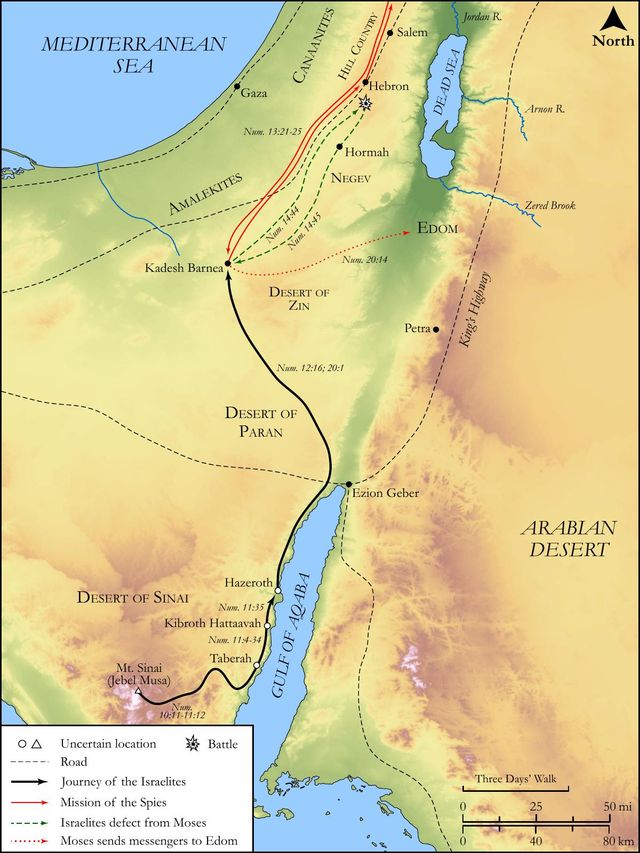
Here is, I. A general account of the removal of the camp of Israel from mount Sinai, before which mountain it had lain now about a year, in which time and place a great deal of memorable business was done. Of this removal, it should seem, God gave them notice some time before (Deu 1:6, Deu 1:7): You have dwelt long enough in this mountain, turn you and take your journey towards the land of promise. The apostle tells us that mount Sinai genders to bondage (Gal 4:24), and signifies the law there given, which is of use indeed as a schoolmaster to bring us to Christ, yet we must not rest in it, but advance towards the joys and liberties of the children of God, for our happiness is conferred not by the law, but by promise. Observe, 1. The signal given (Num 10:11): The cloud was taken up, and we may suppose it stood for some time, till they were ready to march; and a great deal of work it was to take down all those tents, and pack up all those goods that they had there; but every family being employed about its own, and all at the same time, many hands made quick work of it. 2. The march began: They took their journey according to the commandment of the Lord, and just as the cloud led them, Num 10:13. Some think that mention is thus frequently made in this and the foregoing chapter of the commandment of the Lord, guiding and governing them in all their travels, to obviate the calumny and reproach which were afterwards thrown upon Israel, that they tarried so long in the wilderness, because they had lost themselves there, and could not find the way out. No, the matter was not so; in every stage, in every step, they were under divine direction; and, if they knew not where they were, yet he that led them knew. Note, Those that have given up themselves to the direction of God's word and Spirit steer a steady course, even when they seem to be bewildered. While they are sure they cannot lose their God and guide, they need not fear losing their way. 3. The place they rested in, after three days' march: They went out of the wilderness of Sinai, and rested in the wilderness of Paran. Note, All our removals in this world are but from one wilderness to another. The changes which we think will be for the better do not always prove so; while we carry about with us, wherever we go, the common infirmities of human nature, we must expect, wherever we go, to meet with its common calamities; we shall never be at rest, never at home, till we come to heaven, and all will be well there.
II.A particular draught of the order of their march, according to the late model.
1.Judah's squadron marched first, Num 10:14-16. The leading standard, now lodged with that tribe, was an earnest of the sceptre which in David's time should be committed to it, and looked further to the captain of our salvation, of whom it was likewise foretold that unto him should the gathering of the people be.
2.Then came those two families of the Levites which were entrusted to carry the tabernacle. As soon as ever the cloud was taken up, the tabernacle was taken down, and packed up for removing, Num 10:17. And here the six wagons came laden with the more bulky part of the tabernacle. This frequent removing of the tabernacle in all their journeys signified the movableness of that ceremonial dispensation. That which was so often shifted would at length vanish away, Heb 8:13.
3.Reuben's squadron marched forward next, taking place after Judah, according to the commandment of the Lord, Num 10:18-20.
4.Then the Kohathites followed with their charge, the sacred furniture of the tabernacle, in the midst of the camp, the safest and most honourable place, Num 10:21. And they (that is, says the margin, the Gershonites and Merarites) did set up the tabernacle against they came; and perhaps it is expressed thus generally because, if there was occasion, not those Levites only, but the other Israelites that were in the first squadron, lent a hand to the tabernacle to hasten the rearing of it up, even before they set up their own tents.
5.Ephraim's squadron followed next after the ark (Num 10:22-24), to which some think the psalmist alludes when he prays (Psa 80:2), Before Ephraim, Benjamin, and Manasseh, the three tribes that composed this squadron, stir up thy strength (and the ark is called his strength, Psa 78:61), and come and save us.
6.Dan's squadron followed last, Num 10:25-27. It is called the rearward, or gathering host, of all the camps, because it gathered up all that were left behind; not the women and children (these we may suppose were taken care of by the heads of their families in their respective tribes), but all the unclean, the mixed multitude, and all that were weak and feeble, and cast behind in their march. Note, He that leadeth Joseph like a flock has a tender regard to the hindmost (Eze 34:16), that cannot keep pace with the rest, and of all that are given him he will lose none, Joh 17:11.
Continue studying Numbers 10:24 across the web’s major study libraries — every link below opens this exact verse, chapter, or book on the destination site.
Read & Compare
 BibleGatewayThis verse in more than 200 translations and 70 languages.
 Bible.comThe YouVersion reader — hundreds of translations, reading plans, and highlights.
 ESV.orgCrossway's official English Standard Version reader.
 NET BibleThe NET translation with 60,000+ translators' notes on every rendering decision.
 STEP BibleTyndale House's free study tool — original text, vocabulary, and scholarly resources.
 BibliaLogos Bible Software's free web reader.
 USCCBThe New American Bible (Revised Edition) with the U.S. bishops' study notes.
Commentaries
 BibleHub CommentariesDozens of classic commentaries on this verse, gathered on one page.
 StudyLightMore than 100 commentary sets — the largest collection on the web.
 BibleRefPlain-English commentary on what this verse means, verse by verse.
 Enduring WordDavid Guzik's free commentary on this chapter, widely used by Bible teachers.
 Bible Study ToolsVerse commentary alongside Greek and Hebrew study aids.
Original Language & Research
- BibleHub InterlinearThe verse word by word — original language, transliteration, and English.
- BibleHub LexiconEvery word's original-language definition and Strong's entry.
 Blue Letter BibleDeep-study tools — Strong's numbers, concordance, and word studies.
 SefariaThe Hebrew text with Rashi and centuries of Jewish commentary.
Sermons, Hymns & Audio


TrulyRandomVerse is not affiliated with these sites and doesn’t control their content. They’re linked because they’re genuinely useful.
Summary
Numbers 10:24 precisely identifies Abidan the son of Gideoni as the divinely appointed leader over the host of the tribe of Benjamin. This seemingly minor detail is profoundly significant, underscoring God's meticulous attention to order, structure, and individual responsibility within the Israelite community as they prepared to depart Mount Sinai. It highlights the divine blueprint for leadership and organization necessary for the vast nation to function cohesively on their journey toward the Promised Land, demonstrating that every tribe and every leader had a specific, divinely ordained place within God's grand design for His people.
Context
ShowHideLiterary Context
Numbers 10 marks a pivotal transition in Israel's journey, signaling their departure from Mount Sinai after a year of encampment, receiving the Law, and constructing the Tabernacle. The chapter meticulously details the precise, divinely ordained order of march for the Israelite tribes. Following the instructions for the silver trumpets (Numbers 10:1-10) and the initial movements of the first two divisions—Judah's camp and Reuben's camp (Numbers 10:14-20)—Numbers 10:24 introduces Abidan, the leader of Benjamin, a tribe belonging to the third division, the camp of Ephraim (Numbers 10:22-24). This structured enumeration of leaders and tribal positions echoes the initial census and encampment arrangements established in Numbers 1 and Numbers 2, emphasizing continuity and consistency in God's ordered plan for His people from their initial organization to their onward journey.
Historical & Cultural Context
The setting is the vast and often hostile wilderness, a challenging environment that necessitated exceptional organization for the survival and efficient movement of an estimated two million people. The Israelite society was fundamentally tribal, with each tribe maintaining a distinct identity and internal governance, yet functioning as an integral part of a unified nation under God. Leaders like Abidan were not mere figureheads; they held immense responsibility for the welfare, discipline, and logistical movement of their respective "hosts" or military-like divisions. This meticulous, almost military, organization was crucial for protection against potential enemies, for internal efficiency, and for strict adherence to divine commands in a demanding environment. The detailed record reflects the order proper to an army on the march, but here, it is uniquely divinely mandated, setting Israel apart as a people under God's direct and sovereign governance.
Key Themes
ShowHideThis verse, along with its surrounding context, powerfully illustrates several core themes foundational to the book of Numbers and the Pentateuch. First, Divine Order and Structure is paramount; God is not a God of chaos but of meticulous design, evident in the precise arrangement of the tribes and the appointment of specific leaders for every segment of the nation. This divine blueprint for organization is foundational, beginning with the detailed census and tribal arrangements described in Numbers 1. Second, Leadership and Responsibility is highlighted through Abidan's role. As a tribal head, he bore the weighty responsibility for the well-being, discipline, and movement of a significant portion of Israel, a theme reiterated throughout the Pentateuch regarding those in authority, such as Moses and the elders (e.g., Deuteronomy 1:15). Third, Tribal Identity and Unity is subtly reinforced. While each tribe, like Benjamin, maintained its distinct identity and leader, they all functioned as integral parts of a larger, unified nation under God's ultimate leadership, demonstrating how individual components contribute to the strength and purpose of the whole. Abidan is also recognized as the leader of Benjamin in earlier organizational lists, such as Numbers 1:11.
Exposition and Analysis
ShowHideKey Word Analysis
ShowHideThis name, derived from the Hebrew words for "father" (אָב) and "judgment" (דִּין), means "my father is judge" or "father of judgment." This etymology is highly significant for a tribal leader, suggesting a person endowed with wisdom, authority, and the capacity for righteous discernment and leadership. It implies a lineage or character marked by justice and the ability to arbitrate disputes, fitting for one entrusted with the welfare of an entire tribe in a society governed by divine law.
The name of Abidan's father, Gideoni, is derived from a root (גָּדַע) meaning "to cut off" or "to hew," and is related to the name Gideon (גִּדְעוֹן) which implies "hewer" or "warlike." This etymology suggests a strong, decisive, or even warrior-like lineage, adding to the perceived strength, authority, and perhaps military aptitude of Abidan as a leader within a nation on the move through potentially hostile territory.
While often translated as "host" or "army," this term (H6635) encompasses a broader meaning of "a mass of persons (or figuratively, things), especially regularly organized for war." It can also denote "service" or "campaign." In this context, it emphasizes the organized, disciplined, and military-like nature of the Israelite camp and its divisions. It underscores that the movement was not a chaotic migration but a structured, purposeful march, reflecting divine order and readiness for any challenge, including conflict.
Verse Breakdown
ShowHide"And over the host of the tribe of the children of Benjamin"
This clause precisely identifies the specific group being discussed—the entire multitude or military division belonging to the tribe of Benjamin. It highlights the fundamental tribal structure that characterized Israelite society and emphasizes the collective identity and organized nature of this specific segment of the nation. The use of "host" (ṣāḇāʼ) suggests a body capable of organized movement and defense, underscoring the practical necessity of strong, recognized leadership for such a large and mobile community.
"[was] Abidan the son of Gideoni"
This part of the verse names the individual divinely appointed to lead the aforementioned "host." The "[was]" is supplied in the KJV, as the Hebrew simply states the leader's name directly after the tribe, implying his designated position and authority. The inclusion of his father's name, Gideoni, establishes his lineage and identity within the tribal structure, reinforcing the patriarchal and familial nature of Israelite leadership and society. It confirms his specific authority and designated role in the grand divine plan for Israel's journey, emphasizing that leadership was not arbitrary but rooted in established order.
Literary Devices
ShowHideThe primary literary device at play in Numbers 10:24 and its surrounding context is Enumeration or Cataloging. The detailed listing of tribal leaders and their specific positions within the marching order (Numbers 10:14-27) serves to emphasize the meticulous divine organization of the Israelite camp. This systematic cataloging reinforces the theme of God's orderliness and His direct involvement in the practical arrangements of His people, illustrating that no detail is too small for His sovereign oversight. Furthermore, the Repetition of Abidan's name (e.g., in Numbers 1:11 and Numbers 7:60) solidifies his identity and consistent role, ensuring that his leadership is recognized as stable, enduring, and divinely sanctioned throughout the narrative of the wilderness journey. The phrase "host of the tribe" can also be seen as a form of Synecdoche, where a part (the military-like "host" or organized multitude) represents the whole tribe, emphasizing their collective, disciplined capacity for movement and defense rather than just a collection of individuals.
Theological and Thematic Connections
ShowHideNumbers 10:24, though a specific detail, contributes significantly to the overarching theological narrative of God's character and His relationship with His people. It reveals a God who is not distant or chaotic, but intimately involved in the practicalities of human existence, desiring order, structure, and clear leadership for the well-being and effective functioning of His covenant community. This divine meticulousness in organizing ancient Israel foreshadows God's ongoing commitment to order in His church and in the world. It reminds us that God's plans are purposeful and that every individual and group has a designated place and function within His larger design, contributing to the collective journey of faith. The appointment of leaders like Abidan underscores the principle that God works through human instruments, entrusting them with significant responsibilities for the guidance and care of His flock, reflecting His providential care for His people.
Reflection and Application
ShowHideNumbers 10:24, while seemingly a dry genealogical or organizational detail, carries profound implications for our lives and communities today. It serves as a powerful reminder that God is a God of order, not chaos. Just as He meticulously arranged the tribes of Israel and appointed specific leaders for their journey, so too does He value structure, clear guidance, and individual responsibility within our contemporary lives, our families, our workplaces, and especially within the church. This verse encourages us to embrace order in our own affairs, recognizing that discipline, intentionality, and respect for established structures are often prerequisites for effective progress and harmony. It also calls us to appreciate and respect those whom God has placed in positions of leadership, understanding the weighty responsibility they carry and offering them our support and prayer. Furthermore, it reminds us that every person, like every tribe, has a unique and vital place within God's larger plan, contributing to the overall well-being and mission of the collective body. Our seemingly small roles are significant when performed faithfully within God's divine order, contributing to the flourishing of the whole.
Questions for Reflection
ShowHideFAQ
ShowHideWhy is such a specific detail as a tribal leader's name included in the Bible?
ShowHideThe inclusion of specific names and detailed organizational structures, like Abidan's leadership in Numbers 10:24, serves multiple crucial purposes. Firstly, it underscores the historical accuracy and reliability of the biblical narrative, providing concrete details that ground the account in reality and demonstrate its meticulous nature. Secondly, it highlights God's meticulousness and attention to detail in His dealings with His people. Every aspect of Israel's journey, from the Tabernacle's construction to the marching order, was divinely ordained, demonstrating God's sovereign control and providential care. This is evident throughout the book of Numbers, particularly in the detailed census records found in Numbers 1 and the precise encampment instructions in Numbers 2. Thirdly, it emphasizes the importance of leadership and individual responsibility within God's plan. Abidan was not an anonymous figure but a divinely appointed leader, accountable for his tribe's well-being and movement. Finally, it reinforces the tribal identity and inheritance within Israel, ensuring that each family and lineage understood its specific place and role within the larger covenant community, preserving their heritage and responsibilities.
What was the significance of the tribe of Benjamin in Israel's history?
ShowHideThe tribe of Benjamin, though one of the smallest tribes of Israel (as noted in their census count in Numbers 1:37), played a remarkably significant role throughout Israelite history. Known for their fierce warriors and skilled slingers (Judges 20:16), they were often at the forefront of battles. The first king of Israel, Saul, hailed from the tribe of Benjamin (1 Samuel 9:1). After the division of the kingdom following Solomon's reign, Benjamin remained loyal to the house of David, forming part of the southern kingdom of Judah alongside Judah itself. Perhaps most notably for Christians, the Apostle Paul, a pivotal figure in early Christianity and author of much of the New Testament, proudly identified himself as "of the tribe of Benjamin" (Romans 11:1 and Philippians 3:5). Their position in the marching order, as part of the third division following the Levites and the Tabernacle, reflects their strategic importance and their consistent presence within the core of Israel's national identity and spiritual life.
Christ-Centered Fulfillment
ShowHideThe meticulous order and divinely appointed leadership seen in Numbers 10:24 and the broader organization of Israel's camp find their ultimate fulfillment and deepest meaning in Jesus Christ and His church. Just as Abidan was the head of the tribe of Benjamin, Christ is the supreme and ultimate Head of His church, the new covenant people of God (Ephesians 1:22 and Colossians 1:18). The detailed structure and leadership within ancient Israel foreshadow the divinely ordained order within the body of Christ, where every member has a specific function and gifts are given by the Holy Spirit for the building up of the whole (1 Corinthians 12:12). The "host" of Israel, moving under divine guidance towards the Promised Land, prefigures the church, a spiritual host journeying through this world towards its eternal inheritance in Christ. The perfect order and purpose of God's plan for Israel's earthly pilgrimage point to the even greater precision and intentionality of His redemptive plan, culminating in Christ, who perfectly leads His people through the wilderness of this world to the heavenly Canaan, as the "captain of their salvation" (Hebrews 2:10). In Christ, all the fragmented leadership and imperfect order of the Old Covenant find their perfect unity, divine authority, and ultimate purpose.