


Nehemiah 6:7
Bible text: King James Version (1769 Blayney text) · Public domain
Bible text: King James Version with Strong's numbers · Public domain
Bible text: Berean Standard Bible · Public domain
Bible text: American Standard Version (1901) · Public domain
Bible text: World English Bible, Messianic edition · Public domain
Bible text: Geneva Bible (1599) · Public domain
Bible text: Young's Literal Translation · Public domain
- וְגַםve·gamand alsoH1571Conj-w ¦ AdvAdverbוְandגַםalso
- נְבִיאִיםne·vi·'ImprophetsH5030N-mpNoun Plural Masculine Absolute
- הֶעֱמַדְתָּhe·'e·Mad·tayou have appointedH5975V-Hiphil-Perf-2msVerb Hiphil Perfect 2nd Singular Masculine
- לִקְרֹאlik·Ro'to proclaimH7121Prep-l ¦ V-Qal-InfVerb Qal Infinitive Constructלִtoקְרֹאproclaim
- עָלֶיךָ'a·Lei·khaon youH5921Prep ¦ 2msPrepositionעָלֶיonךָyou
- בִירוּשָׁלִַםvi·ru·sha·Limin JerusalemH3389Prep-b ¦ N-properNoun Proper LocationבִinירוּשָׁלִַםJerusalem
- לֵאמֹרle·Mor<to> sayingH559Prep-l ¦ V-Qal-InfVerb Qal Infinitive Constructלֵ<to>אמֹרsaying
- מֶלֶךְMe·lekha kingH4428N-msNoun Singular Masculine Absolute
- בִּיהוּדָהbi·hu·Dah[is] in JudahH3063Prep-b ¦ N-properNoun Proper Locationבִּ[is] inיהוּדָהJudah
- וְעַתָּהve·'a·Tahand nowH6258Conj-w ¦ AdvAdverbוְandעַתָּהnow
- יִשָּׁמַעyi·sha·Ma'it will be heardH8085V-Niphal-Imperf-3msVerb Niphal Imperfect 3rd Singular Masculine
- לַמֶּלֶךְla·Me·lekhby the kingH4428Prep-l ¦ N-msNoun Singular Masculine Absoluteלַby theמֶּלֶךְking
- כַּדְּבָרִיםka·de·va·Rimaccording to the wordsH1697Prep-k ¦ N-mpNoun Plural Masculine Absoluteכַּaccording to theדְּבָרִיםwords
- הָאֵלֶּהha·'E·leh<the> theseH428Art ¦ PrtParticle Demonstrativeהָ<the>אֵלֶּהthese
- וְעַתָּהve·'a·Tahand thereforeH6258Conj-w ¦ AdvAdverbוְandעַתָּהtherefore
- לְכָהle·Khahcome !H1980V-Qal-Imp-2ms ¦ SfxVerb Qal Imperative 2nd Singular Masculineלְכָcomeה!
- וְנִוָּעֲצָהve·ni·va·'a·Tzahso let us take counselH3289Conj-w ¦ V-Niphal-Imperf-1cpVerb Niphal Imperfect 1st Plural common genderוְsoנִוָּעֲצָהlet us take counsel
- יַחְדָּוyach·DavtogetherH3162AdvAdverb
English is a literal word-by-word gloss of the Hebrew, not the KJV's wording. Why?
This is the original text the KJV's translators worked from — each Hebrew word with its own literal English meaning in this verse, prepared by scholars at Tyndale House, Cambridge. The KJV translates whole sentences, not word by word, so its wording differs: one Hebrew word can become several English words, and the KJV may choose “the LORD” where the gloss reads “Yahweh”. Both are faithful — they answer different questions. For the KJV's own rendering, switch to the KJV text.
Details
See on the biblical-era map
Study this verse
Public-domain commentary
Matthew Henry
From his Commentary on the Whole Bible. Henry comments on passages, not single verses — this entry covers Nehemiah 6:1–9. His two-level outline is real structure in the source text, so it is rendered as structure.
Two plots upon Nehemiah we have here an account of, how cunningly they were laid by his enemies and how happily frustrated by God's good providence and his prudence.
I.A plot to trepan him into a snare.
The enemies had an account of the good forwardness the work was in, that all the breaches of the wall were made up, so that they considered it as good as done, though at that time the doors of the gates were off the hinges (Neh 6:1); they must therefore now or never, by one bold stroke, take off Nehemiah. They heard how well guarded he was, so that there was no attacking him upon the spot; they will therefore try by all the arts of wheedling to get him among them. Observe,
1.With what hellish subtlety they courted him to meet them, not in any city, lest that should excite a suspicion that they intended to secure him, but in a village in the lot of Benjamin: "Come, let us meet together to consult about the common interests of our provinces." Or they would have him think that they coveted his friendship, and would be glad to be better acquainted with him, in order to a good understanding between them and the settling of a good correspondence. But they thought to do him a mischief. It is probable that he had some secret intelligence given him that they designed to imprison or murder him; or he knew them so well that, without breach of charity, he concluded they aimed at his life, and therefore, when they spoke fair, he believed them not.
2.See with what heavenly wisdom he declined the motion. His God did instruct him to give them that prudent answer by messengers of his own: "I am doing a great work, am very busy, and am loth to let the work stand still while I leave it to come down to you," Neh 6:3. His care was that the work might not cease; he knew it would if he left it ever so little; and why should it cease while I come down to you? He says nothing of his jealousies, nor reproaches them for their treacherous design, but gives them a good reason and one of the true reasons why he would not come. Compliment must always give way to business. Let those that are tempted to idle merry meetings by their vain companions thus answer the temptation, "We have work to do, and must not neglect it." Four times they attacked him with the same solicitation, and he as often returned the same answer, which, we may suppose, was very vexatious to them; for really it was the ceasing of the work that they aimed at, and it would make them despair of breaking the undertaking to see the undertaker so intent upon it. I answered them (says he) after the same manner, Neh 6:4. Note, We must never suffer ourselves to be overcome by the greatest importunity to do any thing sinful or imprudent; but, when we are attacked with the same temptation, must still resist it with the same reason and resolution.
II.A plot to terrify him from his work.
Could they but drive him off, the work would cease of course. This therefore Sanballat attempts, but in vain. 1. he endeavours to possess Nehemiah with an apprehension that his undertaking to build the walls of Jerusalem was generally represented as factious and seditious, and would be resented accordingly at court, Neh 6:5-7. The best men, even in their most innocent and excellent performances, have lain under this imputation. This is written to him in an open letter, as a thing generally known and talked of, that it was reported among the nations, and Gashmu will aver it for truth, that Nehemiah was aiming to make himself king and to shake off the Persian yoke. Note, It is common for that which is the sense only of the malicious to be falsely represented by them as the sense of the many. Now Sanballat pretends to inform Nehemiah of this as a friend, that he might hasten to court to clear himself, or stay his proceedings, for fear they should be thus misconstrued; at least, upon this surmise, he urges him to give him the meeting - "Let us take counsel together how to quell the report," hoping by this means either to take him off, or at least to take him off from his business. Thus were his words softer than oil, and yet war was in his heart, and he hoped, like Judas, to kiss and kill. But surely in vain is the net spread in the sight of any bird. Nehemiah was soon aware what they aimed at, to weaken their hands from the work (Neh 6:9), and therefore not only denied that such things were true, but that they were reported; he was better known than to be thus suspected. 2. Thus he escaped the snare and kept his ground, nor would he be frightened by winds and clouds from sowing and reaping. Suppose it was thus reported, we must never omit known duty merely for fear it should be misconstrued; but, while we keep a good conscience, let us trust God with our good name. But indeed it was not thus reported. God's people, though sufficiently loaded with reproach, yet are not really so low in reputation as some would have them thought to be.
In the midst of his complaint of their malice, in endeavouring to frighten him, and so weaken his hands, he lifts up his heart to Heaven in this short prayer: Now therefore, O God! strengthen my hands. It is the great support and relief of good people that in all their straits and difficulties they have a good God to go to, from whom, by faith and prayer, they may fetch in grace to silence their fears and strengthen their hands when their enemies are endeavouring to fill them with fears and weaken their hands. When, in our Christian work and warfare, we are entering upon any particular services or conflicts, this is a good prayer for us to put up: "I have such a duty to do, such a temptation to grapple with; now therefore, O God! strengthen my hands." Some read it, not as a prayer, but as a holy resolution (for O God is supplied in our translation): Now therefore I will strengthen my hands. Note, Christian fortitude will be sharpened by opposition. Every temptation to draw us from duty should quicken us so much the more to duty.
Continue studying Nehemiah 6:7 across the web’s major study libraries — every link below opens this exact verse, chapter, or book on the destination site.
Read & Compare
 BibleGatewayThis verse in more than 200 translations and 70 languages.
 Bible.comThe YouVersion reader — hundreds of translations, reading plans, and highlights.
 ESV.orgCrossway's official English Standard Version reader.
 NET BibleThe NET translation with 60,000+ translators' notes on every rendering decision.
 STEP BibleTyndale House's free study tool — original text, vocabulary, and scholarly resources.
 BibliaLogos Bible Software's free web reader.
 USCCBThe New American Bible (Revised Edition) with the U.S. bishops' study notes.
Commentaries
 BibleHub CommentariesDozens of classic commentaries on this verse, gathered on one page.
 StudyLightMore than 100 commentary sets — the largest collection on the web.
 BibleRefPlain-English commentary on what this verse means, verse by verse.
 Enduring WordDavid Guzik's free commentary on this chapter, widely used by Bible teachers.
 Bible Study ToolsVerse commentary alongside Greek and Hebrew study aids.
Original Language & Research
- BibleHub InterlinearThe verse word by word — original language, transliteration, and English.
- BibleHub LexiconEvery word's original-language definition and Strong's entry.
 Blue Letter BibleDeep-study tools — Strong's numbers, concordance, and word studies.
 SefariaThe Hebrew text with Rashi and centuries of Jewish commentary.
Sermons, Hymns & Audio


TrulyRandomVerse is not affiliated with these sites and doesn’t control their content. They’re linked because they’re genuinely useful.
Summary
Nehemiah 6:7 captures a critical escalation in the opposition Nehemiah faced during the rebuilding of Jerusalem's walls. This verse reveals a grave and fabricated accusation from Sanballat, Tobiah, and Geshem: that Nehemiah had appointed "prophets" to publicly declare him king in Judah, an act of sedition against the Persian emperor. This dangerous slander was coupled with an explicit threat to report the alleged treason to Artaxerxes, all calculated to coerce Nehemiah into a meeting outside Jerusalem where his enemies intended to harm him and decisively halt God's sacred work.
Context
ShowHideLiterary Context
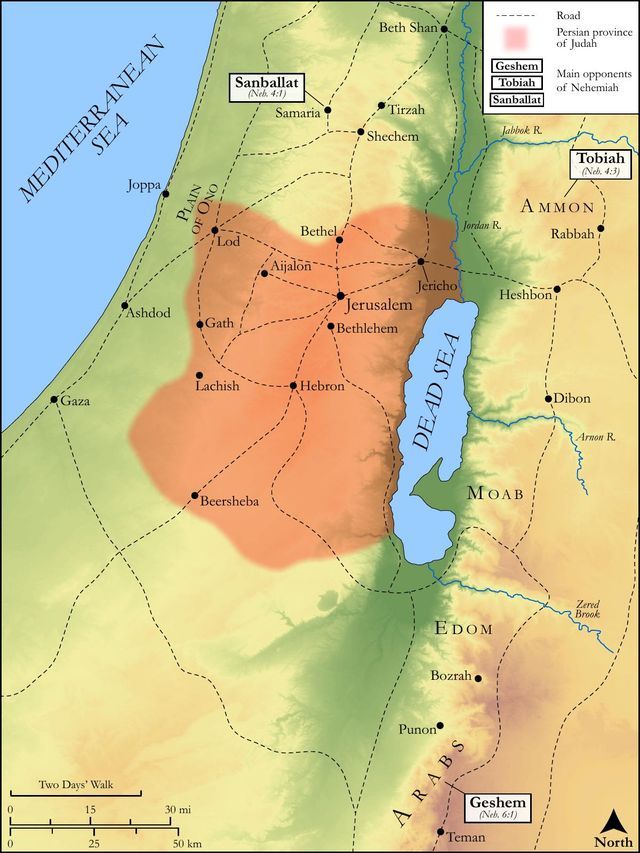
Nehemiah 6:7 is situated within a continuous narrative of escalating opposition to Nehemiah's divinely appointed task of rebuilding Jerusalem's walls. Preceding this verse, Nehemiah's adversaries—Sanballat, Tobiah, and Geshem—had employed various tactics, including ridicule and scorn (Nehemiah 4:1-3), armed threats and plots to attack (Nehemiah 4:7-8), and repeated, deceptive invitations to meet in the plain of Ono, which Nehemiah steadfastly refused, recognizing them as traps (Nehemiah 6:1-4). This particular verse introduces the fifth in a series of letters sent by Sanballat, distinguished by its open, public nature and the extreme severity of its false accusation. It marks a strategic shift from physical intimidation to political slander, aiming to discredit Nehemiah and force him into a compromising position, thereby bringing an end to the "great work" (Nehemiah 6:3).
Historical & Cultural Context
During the time of Nehemiah, Judah existed as a province within the vast and powerful Persian Empire. Any declaration of a local "king" or an attempt to establish an independent monarchy was unequivocally considered an act of treason against the reigning Persian emperor, Artaxerxes. Such an accusation, if proven or even credibly alleged, would carry the severe penalty of death for the accused and potentially devastating repercussions for the entire Jewish community. The specific mention of "prophets" in the accusation is highly significant; under Persian rule, figures perceived as prophets could be seen as political agitators or legitimizers of rulers. Sanballat's charge thus implies Nehemiah was orchestrating a seditious movement, leveraging religious figures to spread propaganda. This tactic was a common method for undermining rivals within the Persian administrative system, where local governors like Nehemiah served at the pleasure of the king and could be easily removed or executed for perceived disloyalty. The explicit threat to "report to the king" was therefore a credible and terrifying instrument of coercion, designed to exploit Nehemiah's vulnerability as a royal appointee.
Key Themes
ShowHideThis verse powerfully illustrates several core themes prevalent throughout the book of Nehemiah and the broader biblical narrative. Firstly, False Accusation and Slander is central, as Nehemiah's enemies resort to baseless lies to undermine his character and mission, a recurring tactic against those pursuing God's purposes (Psalm 35:11). Secondly, Political Intimidation is vividly displayed in the explicit threat to report Nehemiah to the Persian king, leveraging the severe consequences of treason to instill fear and compel his compliance. Thirdly, the verse highlights Deception and Cunning, as the adversaries mask their malicious intent with an urgent invitation to "take counsel together," a calculated ploy to lure Nehemiah into a trap (Proverbs 26:24-26). Finally, it implicitly foreshadows Nehemiah's unwavering Perseverance in God's Work, as his subsequent response, detailed in Nehemiah 6:8-9, demonstrates his refusal to be diverted or intimidated, emphasizing his steadfast commitment to the divine mandate despite intense pressure.
Exposition and Analysis
ShowHideKey Word Analysis
ShowHideMeaning "a prophet or (generally) inspired man." In this context, Nehemiah's enemies use "prophets" pejoratively, implying false or seditious figures appointed by Nehemiah to declare him king. While a true prophet speaks God's word, these alleged "prophets" would be spreading politically motivated propaganda, lending a deceptive religious veneer to Nehemiah's supposed treasonous ambitions. This highlights the enemies' attempt to frame Nehemiah's actions as a religiously sanctioned rebellion.
Meaning "a king; royal." This word carries immense political weight within a Persian province. To declare "a king in Judah" was not merely a local political maneuver but a direct challenge to the sovereignty of the Persian emperor. It implied an attempt to establish an independent kingdom, which was a capital offense and a grave act of rebellion against imperial power. The accusation was meticulously designed to be as politically incendiary as possible, aiming for the most severe repercussions.
Meaning "to advise; reflexively, to deliberate or resolve." The invitation to "take counsel together" is presented by the enemies as a reasonable and necessary step to address the fabricated crisis. However, given the preceding context of repeated attempts to lure Nehemiah away, this term is deeply ironic and deceptive. It suggests a collaborative problem-solving session, but its true intent was to isolate and harm Nehemiah, transforming a supposed consultation into a capture.
Verse Breakdown
ShowHide"And thou hast also appointed prophets to preach of thee at Jerusalem, saying, [There is] a king in Judah:"
This clause articulates the core of the false accusation. Sanballat alleges that Nehemiah has not only positioned himself as a potential monarch but has also orchestrated a public relations campaign through "prophets" in Jerusalem to announce his kingship. This charge is meticulously crafted to be treasonous: it implies a deliberate, organized, and religiously sanctioned rebellion against the Persian crown, making Nehemiah a direct threat to imperial authority. The specific mention of "prophets" adds a layer of religious subversion to the political charge, making it appear more legitimate to an external observer.
"and now shall it be reported to the king according to these words."
This clause contains the explicit threat that elevates the accusation from mere slander to a direct act of political intimidation. Sanballat states his clear intention to formalize the accusation by reporting it to King Artaxerxes. This was far from an idle threat; a formal complaint of sedition to the Persian court would trigger an immediate investigation, potentially leading to Nehemiah's arrest, trial, and execution, and almost certainly the cessation of the rebuilding project. The enemies are leveraging the full weight of imperial power to force Nehemiah's hand and compel him to abandon his work.
"Come now therefore, and let us take counsel together."
This final clause serves as the deceptive bait. Following the severe accusation and explicit threat, the enemies extend an urgent invitation for a meeting under the guise of resolving the fabricated crisis. The phrase "Come now therefore" conveys a sense of immediacy and necessity, designed to pressure Nehemiah into a hasty decision. However, given their previous attempts to trap Nehemiah (as detailed in Nehemiah 6:2), this invitation is clearly a ruse to lure him away from the safety of the city walls and into a vulnerable position where they could either harm him or force him to abandon his work.
Literary Devices
ShowHideNehemiah 6:7 masterfully employs several literary devices to convey the adversaries' cunning and the gravity of the situation. Slander and Calumny are central, as the verse presents a fabricated, malicious accusation designed to damage Nehemiah's reputation and standing with the king. The accusation itself is a form of False Witness, directly violating the Ninth Commandment. Intimidation is clearly present through the explicit threat of reporting the alleged treason to the Persian king, leveraging the fear of imperial punishment. There is also profound Irony in the enemies' invitation to "take counsel together"; what they propose as a collaborative discussion is, in reality, a deceptive trap. The urgency conveyed by "Come now therefore" is a form of Manipulation, designed to pressure Nehemiah into a hasty and ill-advised decision. The entire interaction highlights a strategic Psychological Warfare aimed at breaking Nehemiah's resolve and diverting him from his God-given mission.
Theological and Thematic Connections
ShowHideNehemiah 6:7 resonates deeply with the enduring biblical theme of opposition to God's work and His chosen servants. Just as Nehemiah faced cunning and malicious slander designed to thwart the rebuilding of Jerusalem, so too does God's kingdom work often encounter resistance from spiritual and human adversaries. This verse underscores that such opposition frequently takes the form of false accusations, character assassination, and political maneuvering rather than direct confrontation, aiming to discredit leaders and demoralize followers. Yet, it also implicitly points to God's faithfulness in protecting His people and enabling them to persevere through such trials, as Nehemiah's steadfastness in the face of this grave threat demonstrates. The integrity of God's servant is tested, but ultimately, God vindicates those who remain faithful to His calling.
Reflection and Application
ShowHideNehemiah 6:7 offers profound and timeless lessons for believers navigating challenges in their own lives and ministries. When we are engaged in significant work for God, whether it involves building up a community, serving in a difficult calling, or simply striving to live faithfully, we should anticipate opposition. This opposition often manifests not as overt attacks, but as subtle deceptions, false accusations, and insidious attempts to distract or discredit us. Like Nehemiah, we are called to cultivate keen spiritual discernment to recognize the true motives behind seemingly benign invitations or serious allegations. Our primary response should be to remain singularly focused on the "great work" God has entrusted to us, refusing to be drawn into unnecessary conflicts or diverted by manipulative tactics. This requires a deep and abiding reliance on God's wisdom, unwavering prayer, and a steadfast commitment to integrity, trusting that He will ultimately vindicate His faithful servants and ensure the completion of His divine purposes, even when facing the gravest of threats.
Questions for Reflection
ShowHideFAQ
ShowHideWhy was the accusation of Nehemiah being "a king in Judah" so dangerous?
ShowHideThe accusation was incredibly dangerous because Judah was a province under the direct rule of the vast Persian Empire. Any attempt to declare a local "king" or establish an independent monarchy was considered an act of high treason against the Persian emperor, Artaxerxes. Such an offense was punishable by death, not only for the accused but often for their family and associates, and could lead to severe repercussions for the entire Jewish community, including the immediate cessation of the rebuilding project. Sanballat's aim was to leverage the immense power of the Persian Empire to eliminate Nehemiah and definitively halt the work.
Who were these "prophets" Nehemiah was accused of appointing?
ShowHideThe "prophets" mentioned in the accusation were not necessarily legitimate prophets of God. Sanballat used the term to imply that Nehemiah had appointed individuals to act as his propagandists, spreading the seditious message that he was establishing himself as king in Judah. These would have been false prophets or agitators, perhaps even people paid by Nehemiah's enemies to spread rumors, to lend a veneer of religious legitimacy to the fabricated political rebellion. The accusation was designed to make Nehemiah's alleged treason appear more organized and religiously sanctioned in the eyes of the Persian authorities.
What was the true motive behind Sanballat's invitation to "take counsel"?
ShowHideThe true motive behind Sanballat's invitation to "take counsel together" was not to genuinely resolve a crisis or engage in legitimate discussion. It was a deceptive ploy to lure Nehemiah away from the safety of Jerusalem's walls and into a vulnerable position. As Nehemiah himself states in Nehemiah 6:2, their intent was to "do me harm." They likely planned to capture, assassinate, or otherwise incapacitate him, thereby stopping the rebuilding of the walls and demoralizing the Jewish people. The invitation was a trap, masked by urgency and a false pretense of cooperation.
Christ-Centered Fulfillment
ShowHideNehemiah's experience in Nehemiah 6:7, facing false accusations of seeking kingship and being threatened with imperial judgment, powerfully foreshadows the life and ministry of Jesus Christ. Like Nehemiah, Jesus was relentlessly opposed by those who sought to thwart God's redemptive work. He was constantly subjected to slander (Matthew 12:24), false accusations (Matthew 26:59-60), and deceptive traps designed to ensnare Him in political sedition against Rome (Luke 20:20-26). Indeed, the ultimate charge leveled against Him before Pilate was that He claimed to be "King of the Jews," a direct challenge to Caesar's authority (John 19:12). Yet, Jesus, like Nehemiah, steadfastly refused to be diverted from His "great work" of redemption, setting His face toward Jerusalem and the cross (Luke 9:51). His unwavering commitment to His Father's will, even unto death, demonstrated perfect integrity and obedience. Ultimately, while Nehemiah was vindicated by God's protection and the completion of the walls, Jesus' vindication came through His resurrection and ascension, establishing His eternal spiritual kingdom and proving Him to be the true King, not just of Judah, but of all creation, seated at the right hand of God (Acts 2:36). Believers, as followers of Christ, are called to endure similar opposition and slander, knowing that their ultimate vindication and the triumph of God's kingdom are secured in Him (John 15:20).