


Nehemiah 3:22
Bible text: King James Version (1769 Blayney text) · Public domain
Bible text: Berean Standard Bible · Public domain
Bible text: American Standard Version (1901) · Public domain
Bible text: World English Bible, Messianic edition · Public domain
Bible text: Geneva Bible (1599) · Public domain
Bible text: Young's Literal Translation · Public domain
- וְאַחֲרָיוve·'a·cha·Ravand after himH310Conj-w ¦ Adj-mpc ¦ 3msAdjective Numerical Plural Masculine Constructוְandאַחֲרָיafterוhim
- הֶחֱזִיקוּhe·che·Zi·kuthey repairedH2388V-Hiphil-Perf-3cpVerb Hiphil Perfect 3rd Plural common gender
- הַכֹּהֲנִיםha·ko·ha·Nimthe priestsH3548Art ¦ N-mpNoun Plural Masculine Absoluteהַtheכֹּהֲנִיםpriests
- אַנְשֵׁי'an·Shei[the] men ofH582N-mpcNoun Plural Masculine Construct
- הַכִּכָּרha·ki·Karthe surrounding regionH3603Art ¦ N-fsNoun Singular Feminine Absoluteהַtheכִּכָּרsurrounding region
English is a literal word-by-word gloss of the Hebrew, not the KJV's wording. Why?
This is the original text the KJV's translators worked from — each Hebrew word with its own literal English meaning in this verse, prepared by scholars at Tyndale House, Cambridge. The KJV translates whole sentences, not word by word, so its wording differs: one Hebrew word can become several English words, and the KJV may choose “the LORD” where the gloss reads “Yahweh”. Both are faithful — they answer different questions. For the KJV's own rendering, switch to the KJV text.
Details
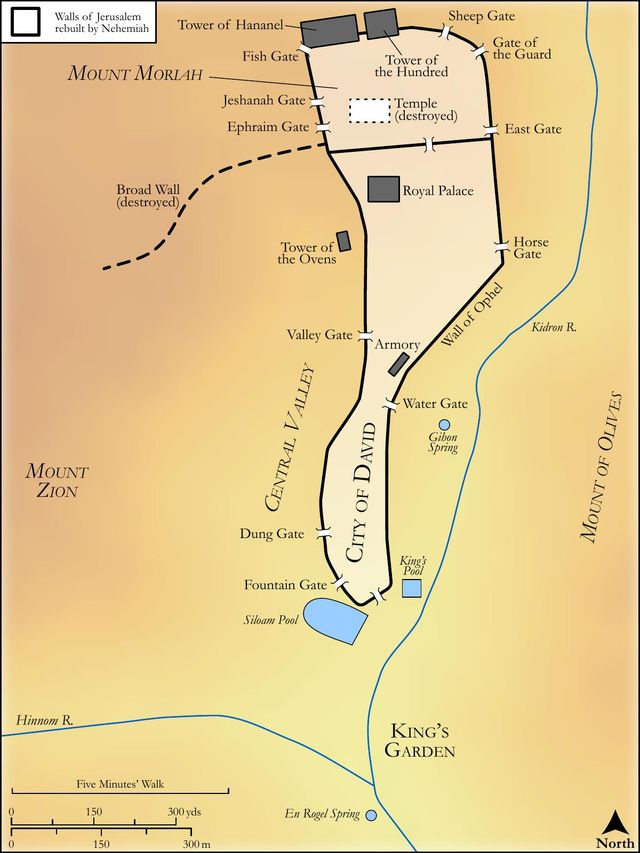
See on the biblical-era map
Study this verse
Public-domain commentary
Matthew Henry
From his Commentary on the Whole Bible. Henry comments on passages, not single verses — this entry covers Nehemiah 3:1–32. His two-level outline is real structure in the source text, so it is rendered as structure.
The best way to know how to divide this chapter is to observe how the work was divided among the undertakers, that every one might know what he had to do, and mind it accordingly with a holy emulation, and desire to excel, yet without any contention, animosity, or separate interest. No strife appears among them but which should do most for the public good. Several things are observable in the account here given of the building of the wall about Jerusalem: -
I.That Eliashib the high priest, with his brethren the priests, led the van in this troop of builders, Neh 3:1.
Ministers should be foremost in every good work; for their office obliges them to teach and quicken by their example, as well as by their doctrine. If there be labour in it, who so fit as they to work? if danger, who so fit as they to venture? The dignity of the high priest was very great, and obliged him to signalize himself in this service. The priests repaired the sheep-gate, so called because through it were brought the sheep that were to be sacrificed in the temple; and therefore the priests undertook the repair of it because the offerings of the Lord made by fire were their inheritance. And of this gate only it is said that they sanctified it with the word and prayer, and perhaps with sacrifices perhaps,
1.Because it led to the temple; or,
2.Because with this the building of the wall began, and it is probable (though they were at work in all parts of the wall at the same time) that this was first finished, and therefore at this gate they solemnly committed their city and the walls of it to the divine protection; or,
3.Because the priests were the builders of it; and it becomes ministers above others, being themselves in a peculiar manner sanctified to God, to sanctify to him all their performances, and to do even their common actions after a godly sort.
II.That the undertakers were very many, who each took his share, some more and some less, in this work, according as their ability was.
Note, What is to be done for the public good every one should assist in, and further, to the utmost of his place and power. United force will conquer that which no individual dares venture on. Many hands will make light work.
III.That many were active in this work who were not themselves inhabitants of Jerusalem, and therefore consulted purely the public welfare and not any private interest or advantage of their own. Here are the men of Jericho with the first (Neh 3:2), the men of Gibeon and Mizpah (Neh 3:7), and Zanoah, Neh 3:13. Every Israelite should lend a hand towards the building up of Jerusalem.
IV.That several rulers, both of Jerusalem and of other cities, were active in this work, thinking themselves bound in honour to do the utmost that their wealth and power enabled them to do for the furtherance of this good work. But it is observable that they are called rulers of part, or the half part, of their respective cities. One was ruler of the half part of Jerusalem (Neh 3:12), another of part of Beth-haccerem (Neh 3:14), another of part of Mizpah (Neh 3:15), another of the half part of Beth-zur (Neh 3:16), one was ruler of one half part, and another of the other half part, of Keilah, Neh 3:17, Neh 3:18. Perhaps the Persian government would not entrust any one with a strong city, but appointed two to be a watch upon each other. Rome had two consuls.
V.Here is a just reproach fastened upon the nobles of Tekoa, that they put not their necks to the work of their Lord (Neh 3:5), that is, they would not come under the yoke of an obligation to this service; as if the dignity and liberty of their peerage were their discharge from serving God and doing good, which are indeed the highest honour and the truest freedom. Let not nobles think any thing below them by which they may advance the interests of their country; for what else is their nobility good for but that it puts them in a higher and larger sphere of usefulness than that in which inferior persons move?
VI.Two persons joined in repairing the old gate (Neh 3:6), and so were co-founders, and shared the honour of it between them.
The good work which we cannot compass ourselves we must be thankful to those that will go partners with us in. Some think that this is called the old gate because it belonged to the ancient Salem, which was said to be first built by Melchizedek.
VII.Several good honest tradesmen, as well as priests and rulers, were active in this work - goldsmiths, apothecaries, merchants, Neh 3:8, Neh 3:32. They did not think their callings excused them, nor plead that they could not leave their shops to attend the public business, knowing that what they lost would certainly be made up to them by the blessing of God upon their callings.
VIII.Some ladies are spoken of as helping forward this work - Shallum and his daughters (Neh 3:12), who, though not capable of personal service, yet having their portions in their own hands, or being rich widows, contributed money for buying materials and paying workmen. St. Paul speaks of some good women that laboured with him in the gospel, Phi 4:3.
IX.Of some it is said that they repaired over against their houses (Neh 3:10, Neh 3:23, Neh 3:28, Neh 3:29), and of one (who, it is likely, was only a lodger) that he repaired over against his chamber, Neh 3:30. When a general good work is to be done each should apply himself to that part of it that falls nearest to him and is within his reach. If every one will sweep before his own door, the street will be clean; if every one will mend one, we shall be all mended. If he that has but a chamber will repair before that, he does his part.
X.Of one it is said that he earnestly repaired that which fell to his share (Neh 3:20) - he did it with an inflamed zeal; not that others were cold or indifferent, but he was the most vigorous of any of them and consequently made himself remarkable. It is good to be thus zealously affected in a good thin; and it is probable that this good man's zeal provoked very many to take the more pains and make the more haste.
XI.Of one of these builders it is observed that he was the sixth son of his father, Neh 3:30.
His five elder brethren, it seems, laid not their hand to this work, but he did. In doing that which is good we need not stay to see our elders go before us; if they decline it, it does not therefore follow that we must. Thus the younger brother, if he be the better man, and does God and his generation better service, is indeed the better gentleman; those are most honourable that are most useful.
XII.Some of those that had first done helped their fellows, and undertook another share where they saw there was most need.
Meremoth repaired, Neh 3:4. and again, Neh 3:21. And the Tekoites, besides the piece they repaired (Neh 3:5), undertook another piece (Neh 3:27), which is the more remarkable because their nobles set them a bad example by withdrawing from the service, which, instead of serving them for an excuse to sit still, perhaps made them the more forward to do double work, that by their zeal they might either shame or atone for the covetousness and carelessness of their nobles.
Lastly, Here is no mention of any particular share that Nehemiah himself had in this work. A name-sake of his is mentioned, Neh 3:16. But did he do nothing? Yes, though he undertook not any particular piece of the wall, yet he did more than any of them, for he had the oversight of them all; half of his servants worked where there was most need, and the other half stood sentinel, as we find afterwards (Neh 4:16), while he himself in his own person walked the rounds, directed and encouraged the builders, set his hand to the work where he saw occasion, and kept a watchful eye upon the motions of the enemy, as we shall find in the next chapter. The pilot needs not haul at a rope: it is enough for him to steer.
Continue studying Nehemiah 3:22 across the web’s major study libraries — every link below opens this exact verse, chapter, or book on the destination site.
Read & Compare
 BibleGatewayThis verse in more than 200 translations and 70 languages.
 Bible.comThe YouVersion reader — hundreds of translations, reading plans, and highlights.
 ESV.orgCrossway's official English Standard Version reader.
 NET BibleThe NET translation with 60,000+ translators' notes on every rendering decision.
 STEP BibleTyndale House's free study tool — original text, vocabulary, and scholarly resources.
 BibliaLogos Bible Software's free web reader.
 USCCBThe New American Bible (Revised Edition) with the U.S. bishops' study notes.
Commentaries
 BibleHub CommentariesDozens of classic commentaries on this verse, gathered on one page.
 StudyLightMore than 100 commentary sets — the largest collection on the web.
 BibleRefPlain-English commentary on what this verse means, verse by verse.
 Enduring WordDavid Guzik's free commentary on this chapter, widely used by Bible teachers.
 Bible Study ToolsVerse commentary alongside Greek and Hebrew study aids.
Original Language & Research
- BibleHub InterlinearThe verse word by word — original language, transliteration, and English.
- BibleHub LexiconEvery word's original-language definition and Strong's entry.
 Blue Letter BibleDeep-study tools — Strong's numbers, concordance, and word studies.
 SefariaThe Hebrew text with Rashi and centuries of Jewish commentary.
Sermons, Hymns & Audio


TrulyRandomVerse is not affiliated with these sites and doesn’t control their content. They’re linked because they’re genuinely useful.
Summary
Nehemiah 3:22, a concise yet profoundly significant verse within the meticulous inventory of builders in Nehemiah 3, underscores the continuous and sequential nature of Jerusalem's wall reconstruction. It specifically highlights the active participation of "the priests" and "the men of the plain," thereby emphasizing the broad, community-wide involvement that transcended traditional roles and geographical boundaries in this monumental post-exilic restoration project, signifying a unified commitment to God's work.
Context
ShowHideLiterary Context
Nehemiah 3 functions as a remarkable and detailed testament to organized, collaborative labor, meticulously cataloging the individuals, families, guilds, and communities responsible for specific sections of the wall. The phrase "And after him" in verse 22 serves as a crucial connective tissue, linking the work of the priests and men of the plain to the preceding group, likely Meremoth the son of Uriah, the son of Hakkoz, who repaired a second section in Nehemiah 3:21. This continuous enumeration throughout the chapter, commencing with the high priest Eliashib and his brethren repairing the Sheep Gate in Nehemiah 3:1, underscores the contiguous nature of the repair work around the city and the comprehensive, section-by-section approach to the reconstruction. The chapter's structure itself powerfully reflects the unity, shared purpose, and collective dedication of the returned exiles, each contributing an essential part to the restoration of their city's vital defenses and dignity.
Historical & Cultural Context
The rebuilding of Jerusalem's walls unfolded in the mid-5th century BC, during the critical post-exilic period under Persian imperial rule. The Jewish community, having returned from Babylonian captivity, faced formidable challenges, including internal disorganization, persistent external opposition from figures like Sanballat and Tobiah, and a profound sense of vulnerability. A fortified wall was far more than a mere physical defense; it was an indispensable symbol of national identity, security, and renewed covenant faithfulness with God. In this context, the involvement of "the priests" is particularly noteworthy. Their primary duties were traditionally centered on spiritual and sacrificial service within the Temple, as meticulously outlined in the Mosaic Law. Their active participation in the arduous manual labor for the city's physical defense demonstrates an extraordinary commitment to the community's holistic well-being and a willingness to serve beyond their customary, sacred roles. "The men of the plain" refers to residents from the Kikkar (Jordan Valley) or Shephelah (the lowlands west of Judah), indicating that the effort extended beyond those living immediately within Jerusalem, drawing resources and manpower from surrounding territories, thus signifying a broad, national commitment to the restoration project.
Key Themes
ShowHideNehemiah 3:22, intricately woven into its broader chapter, powerfully illustrates several key themes pertinent to community, leadership, and divine purpose. Foremost among these is Community-Wide Participation, underscoring that the rebuilding of Jerusalem was not the exclusive work of a select few but a massive undertaking involving nearly every segment of society. Everyone, from the most prominent leaders to ordinary citizens, had a vital role, embodying the principle of each person contributing with a mind to work. Another significant theme is Sacrificial Service and Leadership by Example, particularly highlighted by the inclusion of "the priests." Their willingness to engage in arduous physical labor, stepping outside their traditional spiritual duties, set a powerful precedent for civic and spiritual leadership, demonstrating that true service often requires humility and hands-on involvement. Finally, the mention of "the men of the plain" points to Geographical Universal reach and Unity, demonstrating that the restoration effort transcended immediate geographical boundaries, drawing together people from various regions under a common, God-ordained purpose, fostering a sense of national solidarity and shared destiny in the face of adversity, as seen in the broader call to return to the Lord.
Exposition and Analysis
ShowHideKey Word Analysis
ShowHideThis primitive root (H2388) carries a robust semantic range, encompassing "to fasten upon," "to seize," "to be strong," "to strengthen," "to cure," "to help," "to repair," and "to fortify." In the context of the wall, it implies far more than mere construction; it signifies the arduous process of mending, rebuilding, and fortifying existing ruins, bringing them back to a state of strength and integrity. It speaks to a dedicated, painstaking work of restoration, emphasizing the resolve and perseverance required to overcome the brokenness of the past.
This active participle (H3548) refers to "one officiating," specifically a "priest," a descendant of Aaron consecrated by God for sacred service in the Tabernacle and later the Temple. Their duties primarily involved offering sacrifices, teaching the Law, and mediating between God and the people. Their appearance in a list of manual laborers is profoundly significant, indicating a commitment to the community's holistic welfare that transcended their usual liturgical functions. It demonstrates a comprehensive understanding of their calling, where spiritual leadership extended to tangible, communal service for the security and identity of the people.
This term (H3603), derived from a root meaning "to circle," denotes "a circumjacent tract or region," often referring to a fertile, well-watered plain, most notably the Jordan Valley (e.g., Genesis 13:10). In Nehemiah's context, "the men of the plain" refers to inhabitants of the lowlands or fertile regions surrounding Jerusalem, perhaps the Jordan Valley or other agricultural districts like the Shephelah. Their participation signifies that the rebuilding effort was not confined to Jerusalem's immediate residents but was a broader, national undertaking, drawing people and resources from various parts of Judah, symbolizing widespread unity.
Verse Breakdown
ShowHide"And after him"
This phrase serves as a crucial transitional marker in Nehemiah 3's meticulous catalog of builders. It indicates a sequential and contiguous assignment of labor, linking the section of the wall repaired by the priests and men of the plain to the immediately preceding section mentioned in verse 21. This emphasis on sequence underscores the organized, systematic, and collaborative nature of the entire rebuilding project, demonstrating how each group's efforts seamlessly connected to the next.
"repaired the priests"
This clause highlights the active and direct involvement of the priestly class in the physical, often arduous, labor of wall reconstruction. This detail is striking given their primary spiritual and liturgical duties. Their participation powerfully underscores the idea that the rebuilding was a comprehensive community effort, where even those with sacred vocations contributed physically, setting a profound example of unity, dedication, and service beyond their traditional roles. It demonstrates a holistic commitment to the well-being of the entire community.
"the men of the plain"
This final clause identifies a specific geographical group participating in the work. "The plain" refers to a distinct region outside Jerusalem, likely the fertile lowlands or Jordan Valley. Their inclusion demonstrates that the rebuilding effort was not confined to the inhabitants of Jerusalem itself but was a widespread, national endeavor, drawing manpower and commitment from surrounding territories and diverse communities across Judah, reinforcing the theme of broad communal solidarity.
Literary Devices
ShowHideNehemiah 3:22, like the entire chapter, is characterized by the literary device of Catalog or List, a precise and repetitive enumeration of individuals and groups, along with their specific contributions to the wall's reconstruction. This detailed listing serves to underscore the comprehensive nature of the communal effort and the meticulous organization behind it. The repeated "after him" (or similar sequential phrases throughout the chapter) functions as a form of Anaphora or Repetition, creating a rhythmic flow that emphasizes the continuous, contiguous, and collaborative nature of the work, reinforcing the idea of a unified, step-by-step progression. Furthermore, the phrase "the men of the plain" employs Synecdoche (or perhaps Metonymy), where "the plain" (a geographical region) stands for the people residing in that region, effectively representing the broader population beyond Jerusalem's immediate vicinity. The implicit Juxtaposition of the priests' sacred duties with their engagement in manual labor also serves to highlight the extraordinary nature of their commitment and leadership by example, emphasizing their willingness to humble themselves for the common good.
Theological and Thematic Connections
ShowHideNehemiah 3:22 powerfully illustrates the biblical principle of shared responsibility and corporate action in the service of God's kingdom. The participation of the priests, traditionally set apart for sacred duties, alongside the "men of the plain," representing broader geographical inclusion, underscores that God's work requires the diverse gifts and dedicated efforts of all His people. The rebuilding of the physical wall was not merely an act of civic engineering but a profound spiritual undertaking, symbolizing the restoration of God's people, their identity, and their covenant relationship with Him. This collective commitment to a common, God-ordained purpose serves as a timeless model for the church and any community striving to fulfill a divine mandate, emphasizing that every individual's contribution, regardless of their background or usual role, is vital and valued in the grand tapestry of God's redemptive plan. It speaks to the unity of purpose that should characterize God's people as they engage in His mission.
Reflection and Application
ShowHideNehemiah 3:22, nestled within the grand narrative of Jerusalem's wall reconstruction, offers profound and actionable lessons for contemporary believers and communities. It calls us to consider our own roles in the "rebuilding" work God has set before us, whether it's strengthening our families, fortifying our churches, or contributing to the well-being and spiritual health of our broader communities. The striking example of the priests, stepping beyond their traditional liturgical roles to engage in arduous physical labor, challenges us to serve where the need is greatest, even if it requires us to move beyond our comfort zones, perceived areas of expertise, or established routines. Similarly, the "men of the plain" remind us that God's work is expansive and inclusive, requiring the willing participation of diverse individuals from various backgrounds, geographical locations, and walks of life. True and lasting impact is often achieved not by a select few, but by a unified body, each member contributing their unique gifts, resources, and time with a shared vision and a "mind to work." This verse profoundly encourages us to embrace shared responsibility, to lead by humble example (especially for those in spiritual leadership), and to value every contribution, recognizing that the strength and flourishing of the whole depend on the faithful, collective effort of each part.
Questions for Reflection
ShowHideFAQ
ShowHideWhy is it important that "the priests" are mentioned specifically here?
ShowHideThe specific mention of "the priests" is highly significant because their primary duties were spiritual and sacrificial within the Temple, as outlined in the Mosaic Law. Their active participation in the manual labor of rebuilding the city walls demonstrates a profound and holistic commitment to the well-being of the entire community, transcending their traditional liturgical roles. It highlights that the rebuilding effort was a total community endeavor, with leaders setting an example of service and unity, emphasizing that no task for the common good was beneath anyone, regardless of their status or usual function. It underscored the spiritual nature of the physical work.
What does "the men of the plain" signify about the scope of the rebuilding effort?
ShowHide"The men of the plain" refers to residents from the fertile lowlands or valleys surrounding Jerusalem, often specifically the Kikkar (Jordan Valley) or the Shephelah. Their involvement signifies that the rebuilding project was not limited to the immediate inhabitants of Jerusalem but drew participation and resources from surrounding territories. This indicates a broad, national commitment to the restoration of the capital and its defenses, demonstrating a widespread unity and shared purpose among the returned exiles across different geographical areas of Judah. It underscores the universal reach and extensive reach of the communal effort, embodying a truly national endeavor.
How does this verse fit into the overall narrative of Nehemiah 3?
ShowHideNehemiah 3 is a meticulously detailed and systematic record of the various groups and individuals who repaired specific sections of Jerusalem's wall. Verse 22 continues this precise enumeration, linking the work of the priests and men of the plain to the preceding section, emphasizing the contiguous and organized nature of the reconstruction. It serves as another powerful example of the diverse segments of society, from high priests to residents of outlying regions, each contributing their part to the monumental task. This reinforces the chapter's overarching theme of unity, shared labor, and collective dedication to a common, God-ordained goal, demonstrating how the entire community rallied together for the restoration of their city.
Christ-Centered Fulfillment
ShowHideThe physical rebuilding of Jerusalem's walls in Nehemiah, exemplified by the collective effort in Nehemiah 3:22, serves as a powerful Old Testament foreshadowing of the spiritual rebuilding and restoration accomplished through Jesus Christ. Just as the priests and men of the plain united to secure their physical city, Christ, our ultimate High Priest, came not merely to perform rituals but to actively build His spiritual temple, the Church (Ephesians 2:19-22). He is the foundational cornerstone, the one who gathers diverse people—from every "plain" and background—into one unified body, breaking down all dividing walls (Ephesians 2:14). The sacrificial labor of the priests in Nehemiah points to Christ's ultimate sacrifice, where He, our great High Priest, laid down His life to secure our eternal salvation and spiritual dwelling place with God (Hebrews 4:14-16 and Hebrews 9:11-14). The unified effort to build the wall for protection and identity reflects the Church's ongoing mission to build up the body of Christ and extend His kingdom, with each member contributing their unique gifts under His headship (Romans 12:4-5 and Ephesians 4:15-16). Ultimately, the temporary security provided by the rebuilt wall pales in comparison to the eternal security and spiritual dwelling place Christ provides for all who believe in Him, a city with foundations, whose architect and builder is God (John 10:28 and Hebrews 11:10).