


Nehemiah 12:25
Bible text: King James Version (1769 Blayney text) · Public domain
Bible text: Berean Standard Bible · Public domain
Bible text: American Standard Version (1901) · Public domain
Bible text: World English Bible, Messianic edition · Public domain
Bible text: Geneva Bible (1599) · Public domain
Bible text: Young's Literal Translation · Public domain
- מַתַּנְיָהma·tan·YahMattaniahH4983N-proper-mNoun Proper Masculine
- וּבַקְבֻּקְיָהu·vak·buk·Yahand BakbukiahH1229Conj-w ¦ N-proper-mNoun Proper MasculineוּandבַקְבֻּקְיָהBakbukiah
- עֹבַדְיָה'oad·YahObadiahH5662N-proper-mNoun Proper Masculine
- מְשֻׁלָּםme·shu·LamMeshullamH4918N-proper-mNoun Proper Masculine
- טַלְמוֹןtal·MonTalmonH2929N-proper-mNoun Proper Masculine
- עַקּוּב'a·KuvAkkubH6126N-proper-mNoun Proper Masculine
- שֹׁמְרִיםsho·me·RimkeepingH8104V-Qal-Prtcpl-mpVerb Qal Participle Plural Masculine Absolute
- שׁוֹעֲרִיםsho·'a·Rim[were] gatekeepersH7778N-mpNoun Plural Masculine Absolute
- מִשְׁמָרmish·MarguardH4929N-msNoun Singular Masculine Absolute
- בַּאֲסֻפֵּיba·'a·su·Peiat [the] storerooms ofH624Prep-b ¦ N-mpcNoun Plural Masculine Constructבַּatאֲסֻפֵּי[the] storerooms of
- הַשְּׁעָרִיםha·she·'a·Rimthe gatesH8179Art ¦ N-mpNoun Plural Masculine Absoluteהַtheשְּׁעָרִיםgates
English is a literal word-by-word gloss of the Hebrew, not the KJV's wording. Why?
This is the original text the KJV's translators worked from — each Hebrew word with its own literal English meaning in this verse, prepared by scholars at Tyndale House, Cambridge. The KJV translates whole sentences, not word by word, so its wording differs: one Hebrew word can become several English words, and the KJV may choose “the LORD” where the gloss reads “Yahweh”. Both are faithful — they answer different questions. For the KJV's own rendering, switch to the KJV text.
Details
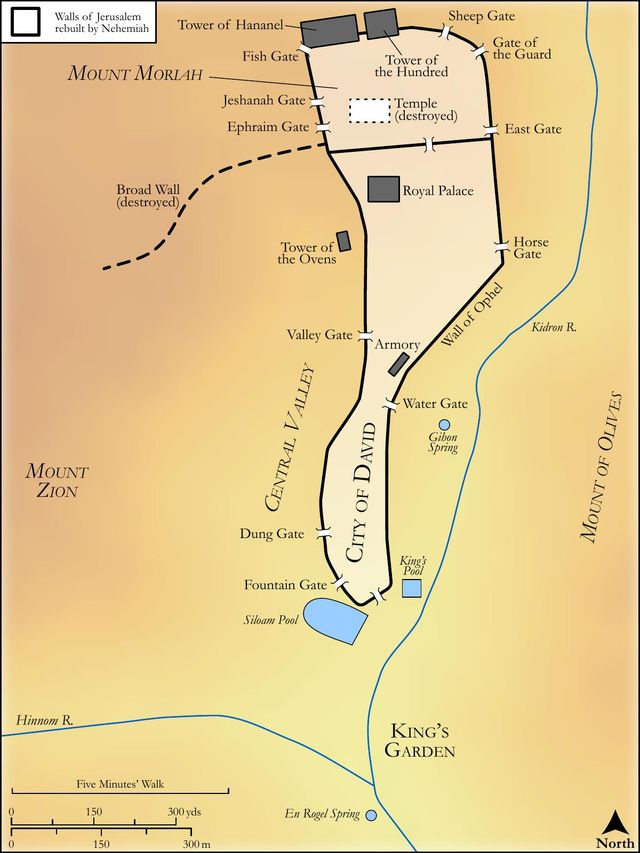
See on the biblical-era map
Study this verse
Public-domain commentary
Matthew Henry
From his Commentary on the Whole Bible. Henry comments on passages, not single verses — this entry covers Nehemiah 12:1–26.
We have here the names, and little more than the names, of a great many priests and Levites, that were eminent in their day among the returned Jews. Why this register should be here inserted by Nehemiah does not appear, perhaps to keep in remembrance those good men, that posterity might know to whom they were beholden, under God, for the happy revival and re-establishment of their religion among them. Thus must we contribute towards the performance of that promise, Psa 112:6, The righteous shall be in everlasting remembrance. Let the memory of the just be blessed, be perpetuated. It is a debt we still owe to faithful ministers to remember our guides, who have spoken to us the word of God, Heb 13:7. Perhaps it is intended to stir up their posterity, who succeeded them in the priest's office and inherited their dignities and preferments, to imitate their courage and fidelity. It is good to know what our godly ancestors and predecessors were, that we may learn thereby what we should be. We have here, 1. The names of the priests and Levites that came up with the first out of Babylon, when Jeshua was high priest. Jeremiah and Ezra are mentioned with the first (Neh 12:1), but, it is supposed, not Jeremiah the prophet nor Ezra the scribe; the fame of the one was long before and that of the other some time after, though both of them were priests. Of one of the Levites it is said (Neh 12:8) that he was over the thanksgiving, that is, he was entrusted to see that the psalms, the thanksgiving psalms, were constantly sung in the temple in due time and manner. The Levites kept their turns in their watches, reliving one another as becomes brethren, fellow-labourers, and fellow-soldiers. 2. The succession of high priests during the Persian monarchy, from Jeshua (or Jesus), who was high priest at the time of the restoration, to Jaddua (or Jaddus), who was high priest when Alexander the Great, after the conquest of Tyre, came to Jerusalem, and paid great respect to this Jaddus, who met him in his pontifical habit, and showed him the prophecy of Daniel, which foretold his conquests. 3. The next generation of priests, who were chief men, and active in the days of Joiakim, sons of the first set. Note, We have reason to acknowledge God's favour to his church, and care of it, in that, as one generation of ministers passes away, another comes. All those who are mentioned Neh 12:1, etc., as eminent in their generation, are again mentioned, though with some variation in several of the names, Neh 12:12, etc., except two, as having sons that were likewise eminent in their generation - a rare instance, that twenty good fathers should leave behind them twenty good sons (for so many here are) that filled up their places. 4. The next generation of Levites, or rather a latter generation; for those priests who are mentioned flourished in the days of Joiakim the high priest, these Levites in the days of Eliashib, Neh 12:22. Perhaps then the forementioned families of the priests began to degenerate, and the third generation of them came short of the first two; but the work of God shall never fail for want of instruments. Then a generation of Levites was raised up, who were recorded chief of the fathers (Neh 12:22), and were eminently serviceable to the interests of the church, and their service not the less acceptable either to God or to his people for their being Levites only, of the lower rank of ministers. Eliashib the high priest being allied to Tobiah (Neh 13:4), the other priests grew remiss; but then the Levites appeared the more zealous, as appears by this, that those who were now employed in expounding (Neh 8:7) and in praying (Neh 9:4, Neh 9:5) were all Levites, not priests, regard being had to their personal qualifications more than to their order. These Levites were some of them singers (Neh 12:24), to praise and give thanks, others of them porters (Neh 12:25), keeping the ward at the thresholds of the gates, and both according to the command of David.
Continue studying Nehemiah 12:25 across the web’s major study libraries — every link below opens this exact verse, chapter, or book on the destination site.
Read & Compare
 BibleGatewayThis verse in more than 200 translations and 70 languages.
 Bible.comThe YouVersion reader — hundreds of translations, reading plans, and highlights.
 ESV.orgCrossway's official English Standard Version reader.
 NET BibleThe NET translation with 60,000+ translators' notes on every rendering decision.
 STEP BibleTyndale House's free study tool — original text, vocabulary, and scholarly resources.
 BibliaLogos Bible Software's free web reader.
 USCCBThe New American Bible (Revised Edition) with the U.S. bishops' study notes.
Commentaries
 BibleHub CommentariesDozens of classic commentaries on this verse, gathered on one page.
 StudyLightMore than 100 commentary sets — the largest collection on the web.
 BibleRefPlain-English commentary on what this verse means, verse by verse.
 Enduring WordDavid Guzik's free commentary on this chapter, widely used by Bible teachers.
 Bible Study ToolsVerse commentary alongside Greek and Hebrew study aids.
Original Language & Research
- BibleHub InterlinearThe verse word by word — original language, transliteration, and English.
- BibleHub LexiconEvery word's original-language definition and Strong's entry.
 Blue Letter BibleDeep-study tools — Strong's numbers, concordance, and word studies.
 SefariaThe Hebrew text with Rashi and centuries of Jewish commentary.
Sermons, Hymns & Audio


TrulyRandomVerse is not affiliated with these sites and doesn’t control their content. They’re linked because they’re genuinely useful.
Summary
Nehemiah 12:25 meticulously enumerates specific individuals—Mattaniah, Bakbukiah, Obadiah, Meshullam, Talmon, and Akkub—who diligently served as porters, or gatekeepers, within the post-exilic Jerusalem temple. This verse, situated within a broader chapter detailing the joyous dedication of the rebuilt city walls and the re-establishment of temple services, profoundly underscores the essential nature of every assigned role, regardless of its perceived prominence, for ensuring the security, sanctity, and operational integrity of the sacred space and the community's vibrant worship life. It powerfully conveys the divine emphasis on order, faithful diligence, and the collective participation required for the flourishing of God's redemptive work among His people.
Context
ShowHideLiterary Context
Nehemiah 12 marks a pivotal transition in the book, moving from the physical rebuilding of Jerusalem's walls (chapters 3-6) and the subsequent social and spiritual reforms (chapters 8-10) to the re-establishment of orderly worship and communal life. The chapter begins with a detailed genealogy of priests and Levites who returned with Zerubbabel (Nehemiah 12:1-9) and a lineage of high priests (Nehemiah 12:10-11), setting the stage for the formal dedication. The core of the chapter describes the grand dedication ceremony of the rebuilt walls, featuring two large thanksgiving choirs parading on the walls (Nehemiah 12:27-43). Sandwiched between these significant narrative sections are administrative lists, including those of temple officials such as singers, treasurers, and, as highlighted in Nehemiah 12:25, the porters. This meticulous cataloging serves to affirm the thorough and structured restoration of Israel's covenant life, emphasizing that every function, from the highest priestly office to the most practical gatekeeping duty, was integral to the re-established divine order and the proper functioning of the temple.
Historical & Cultural Context
The historical backdrop for Nehemiah 12:25 is post-exilic Jerusalem, specifically around 444 BC, following the return of Jewish exiles from Babylonian captivity under the leadership of Nehemiah and Ezra. The community was engaged in a profound effort to rebuild not only their city but also their national and spiritual identity. The Second Temple, though rebuilt decades earlier under Zerubbabel (Ezra 3-6), now needed its full complement of personnel and a robust system of operation. In the cities of Israel and especially in sacred precincts, gates were critical points of control, security, commerce, and public interaction. Gatekeepers were therefore far more than simple custodians; they were trusted officials responsible for regulating access, ensuring security against both human threats and ritual impurity, and often managing storerooms or treasuries associated with the gates. The detailed organization of temple personnel, including the porters, reflects a conscious and diligent effort to restore the Levitical system of service as prescribed in the Mosaic Law, ensuring the purity, order, and protection of the sacred precincts. This meticulous attention to detail was crucial for the survival and spiritual flourishing of the nascent Jewish community in a challenging geopolitical environment.
Key Themes
ShowHideNehemiah 12:25, though a seemingly administrative detail, contributes significantly to several overarching themes within the book of Nehemiah and the broader biblical narrative. Firstly, it underscores the theme of order and organization in divine service. Nehemiah's leadership is characterized by meticulous planning and delegation, ensuring that every aspect of the community's life, particularly its worship, is conducted with precision and purpose, echoing the New Testament principle that "all things should be done decently and in order" 1 Corinthians 14:40. Secondly, the verse highlights the value of every role within the community of faith. The porters, while not priests or prophets, were indispensable for the temple's security and sanctity, demonstrating that all functions, when performed faithfully, are vital to God's work. This aligns with the biblical teaching on the body of Christ, where even seemingly "less honorable" members are essential and indispensable 1 Corinthians 12:22-24. Thirdly, it exemplifies the theme of faithfulness and diligence in stewardship. The porters were "keeping the ward," implying constant vigilance and dedication to their assigned duty, a quality consistently praised throughout Scripture as a mark of a trustworthy servant Luke 16:10. Finally, the verse contributes to the broader theme of restoration and covenant renewal, illustrating how the physical rebuilding of Jerusalem was inextricably linked with a spiritual reordering and a renewed commitment to God's established ways.
Exposition and Analysis
ShowHideKey Word Analysis
ShowHideThis term (H7778, שׁוֹעֵר) refers to a "janitor" or "doorkeeper." In the context of the temple, these were not mere custodians but highly trusted and often Levitical officials. Their duties extended beyond simply opening and closing doors; they were responsible for the security of the temple precincts, controlling access for worshippers and priests, preventing unauthorized entry, and often managing the temple treasuries and storerooms located at the gates. Their role was crucial for maintaining the sanctity, purity, and operational integrity of the sacred space.
This phrase combines the verb shâmar (H8104, שָׁמַר), meaning "to guard, protect, attend to, watch," with the noun mishmâr (H4929, מִשְׁמָר), which denotes "a guard, a post, a charge, an observance." Together, they powerfully convey the idea of maintaining a vigilant watch or diligently executing a specific, assigned duty. It emphasizes continuous, active, and dedicated performance of their security role, highlighting the seriousness and importance with which their responsibility was viewed by both human authorities and God.
The term "thresholds" (H624, אָסֻף) refers to the very entrance points or sills of the gates. This precise location underscores the strategic importance of the porters' duties. Their station at the "thresholds of the gates" (H8179, שַׁעַר) signifies their direct and primary responsibility for regulating all entry and exit. They served as the first line of defense, ensuring that only authorized and ritually clean individuals entered the sacred temple precincts, thereby protecting its sanctity and order.
Verse Breakdown
ShowHide"Mattaniah, and Bakbukiah, Obadiah, Meshullam, Talmon, Akkub"
This clause provides a specific and meticulous enumeration of six individuals. The inclusion of their personal names, rather than a generic title, emphasizes the personal accountability of each man and the significant value placed on their individual contributions to the collective work of the temple. This detailed listing reflects the careful administrative practices characteristic of Nehemiah's leadership and the divine recognition of individual service within the community.
"[were] porters"
This phrase clearly identifies the specific office or function held by the named individuals. It defines their primary role within the intricate temple organization, distinguishing them from priests, Levites, or singers, yet affirming their integral and indispensable place within the overall structure. Their designation as "porters" immediately conveys their core duty as gatekeepers and guardians of the sacred space.
"keeping the ward"
This phrase describes the essential nature of their duty—one of constant vigilance, guardianship, and faithful execution of their assigned charge. It implies a continuous, active, and responsible commitment to their post, ensuring the security, purity, and proper functioning of the temple precincts. This was not a passive role but demanded unwavering attention and diligent performance.
"at the thresholds of the gates"
This specifies the precise and strategic location of their service. The "thresholds" represent the critical entry points, signifying their direct responsibility for controlling and regulating access to the sacred precincts. This detail highlights the paramount importance of their position as the initial line of defense and the primary point of contact for anyone approaching or departing the temple area, emphasizing their role in maintaining order and sanctity.
Literary Devices
ShowHideNehemiah 12:25 predominantly employs Cataloging or Listing, a pervasive literary device found in the historical and administrative sections of the Old Testament. This detailed enumeration of names and roles serves to document the meticulous organization of the post-exilic community and the re-establishment of the temple service. The act of listing itself emphasizes the divine preference for Order and Structure in worship and communal life, reflecting Nehemiah's diligent efforts to restore systematic and intentional service to God. The specific naming of individuals also functions as a form of Commemoration, honoring those who faithfully contributed to the restoration of Jerusalem and its spiritual infrastructure, ensuring their dedication is recorded for posterity. Furthermore, the precise description of their role—"porters keeping the ward at the thresholds of the gates"—utilizes Specificity to underscore the vital, practical nature of their duties, highlighting that every function, no matter how seemingly mundane, was crucial for the sanctity and security of the temple.
Theological and Thematic Connections
ShowHideNehemiah 12:25, while an administrative detail, carries profound theological significance, underscoring God's valuing of order, responsibility, and the indispensable contribution of every individual within His covenant community. It illustrates that faithfulness in seemingly humble or behind-the-scenes roles is just as vital to God's overarching work as more prominent ministries. The porters' diligent guardianship of the temple gates reflects a broader biblical principle of stewardship—protecting what is sacred, maintaining boundaries, and ensuring purity within God's house. This meticulous organization of temple service prefigures the New Testament understanding of the church as a unified body where diverse gifts and functions are essential for its health and mission, with each part contributing uniquely to the whole. The commitment to "keeping the ward" also speaks to the spiritual vigilance required of all believers in their respective callings, safeguarding the integrity of faith, doctrine, and community life.
Reflection and Application
ShowHideNehemiah 12:25 serves as a powerful and enduring reminder that every role within the body of Christ, regardless of its visibility or perceived prominence, is essential, valued, and purposed by God. The porters were not the high priests offering sacrifices or the Levites leading grand worship processions, yet their diligent "keeping the ward" at the "thresholds of the gates" was absolutely indispensable for the security, sanctity, and proper functioning of the temple. This truth profoundly challenges us to embrace our own unique callings and responsibilities within our families, churches, workplaces, and broader communities with the same faithfulness, diligence, and sense of divine purpose. It encourages us to find dignity and meaning in every task, recognizing that when performed "as unto the Lord," even the most mundane duties contribute significantly to His larger redemptive purposes. Our faithfulness in "little things" often proves our trustworthiness and prepares us for greater responsibilities. Ultimately, this verse calls us to a posture of spiritual vigilance and faithful stewardship, diligently guarding the integrity of our personal faith and the communities to which we belong.
Questions for Reflection
ShowHideFAQ
ShowHideWhy are specific names listed for the porters in Nehemiah 12:25, rather than just a general description of their role?
ShowHideThe meticulous listing of specific names like Mattaniah, Bakbukiah, Obadiah, Meshullam, Talmon, and Akkub in Nehemiah 12:25 serves several crucial purposes within the biblical narrative and the historical context. Firstly, it reflects the careful administrative and organizational efforts undertaken by Nehemiah and the post-exilic community to re-establish order, accountability, and a proper functioning system for their spiritual and civic life. Such detailed records were common in Israel and are frequently found in biblical genealogies and administrative lists (e.g., the census in Numbers 1). Secondly, it powerfully underscores the personal responsibility and unwavering commitment of each individual to the collective work of God. It highlights that these were not anonymous laborers but specific individuals entrusted with vital duties, emphasizing the divine value placed on individual service. Thirdly, it acts as a form of commemoration, honoring those who faithfully contributed to the monumental restoration of Jerusalem and its temple, ensuring their dedicated service was recorded for posterity. This aligns with the biblical principle that God sees and values every individual's contribution to His kingdom, no matter how humble or behind-the-scenes the task may seem (compare Matthew 10:42).
Christ-Centered Fulfillment
ShowHideWhile Nehemiah 12:25 details the vital role of Old Testament porters who guarded the physical temple, its deeper and ultimate fulfillment is profoundly found in Jesus Christ and His New Covenant church. Jesus Himself is the ultimate "Gate" or "Door" through whom all must enter to find salvation, abundant life, and spiritual pasture John 10:7 and John 10:9. He is the one who perfectly "keeps the ward" over His people, diligently guarding them from spiritual harm, ensuring their eternal security, and preserving them in His Father's hand John 10:28-29 and John 17:12. In the New Covenant, the physical temple is superseded by the spiritual temple, which is the church—the collective body of believers, indwelt by the Holy Spirit 1 Corinthians 3:16. Every believer, therefore, is called to a vital and unique role within this spiritual house, contributing to its health, purity, and mission. Just as the porters ensured proper access and security for the temple, so believers are called to be vigilant in upholding truth, guarding against false teachings, and faithfully serving in their unique spiritual gifts to protect, build up, and expand the body of Christ Ephesians 4:11-16. Ultimately, the faithfulness of these Old Testament porters points to the perfect and unwavering faithfulness of Christ, who perfectly guards His church and is the secure, living entrance to eternal life and communion with God.