


Nehemiah 11:27
Bible text: King James Version (1769 Blayney text) · Public domain
Bible text: King James Version with Strong's numbers · Public domain
Bible text: Berean Standard Bible · Public domain
Bible text: American Standard Version (1901) · Public domain
Bible text: World English Bible, Messianic edition · Public domain
Bible text: Geneva Bible (1599) · Public domain
Bible text: Young's Literal Translation · Public domain
- וּבַחֲצַרu·va·cha·Tzarand in HazarH2705Conj-w ¦ Prep-b ¦ N-properNoun Proper LocationוּandבַinחֲצַרHazar
- שׁוּעָלshu·'AlShualH2705N-properNoun Proper Location
- וּבִבְאֵרu·viv·'Erand in BeerH884Conj-w ¦ Prep-b ¦ N-properNoun Proper LocationוּandבִinבְאֵרBeer
- שֶׁבַעShe·va'ShebaH884N-properNoun Proper Location
- וּבְנֹתֶיהָu·ve·no·Tei·haand its daughtersH1323Conj-w ¦ N-fpc ¦ 3fsNoun Plural Feminine Constructוּandבְנֹתֶיdaughtersהָits
English is a literal word-by-word gloss of the Hebrew, not the KJV's wording. Why?
This is the original text the KJV's translators worked from — each Hebrew word with its own literal English meaning in this verse, prepared by scholars at Tyndale House, Cambridge. The KJV translates whole sentences, not word by word, so its wording differs: one Hebrew word can become several English words, and the KJV may choose “the LORD” where the gloss reads “Yahweh”. Both are faithful — they answer different questions. For the KJV's own rendering, switch to the KJV text.
Details
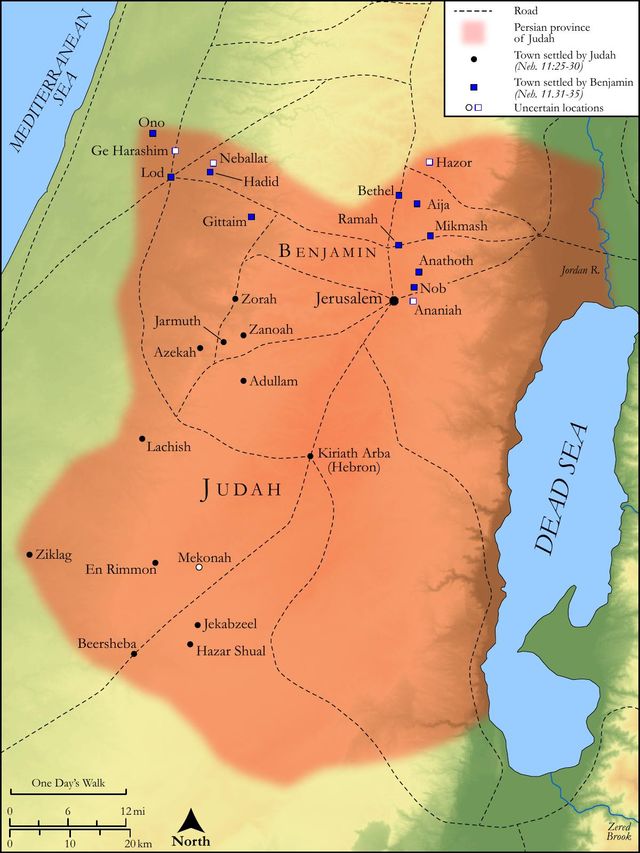
See on the biblical-era map
Study this verse
Public-domain commentary
Matthew Henry
From his Commentary on the Whole Bible. Henry comments on passages, not single verses — this entry covers Nehemiah 11:20–36.
Having given an account of the principal persons that dwelt in Jerusalem (a larger account of whom he had before, Ch1 9:2, etc.), Nehemiah, in these verses, gives us some account of the other cities, in which dwelt the residue of Israel, Neh 11:20. It was requisite that Jerusalem should be replenished, yet not so as to drain the country. The king himself is served of the field, which will do little service if there be not hands to manage it. Let there therefore be no strife, no envy, no contempt, no ill will, between the inhabitants of the cities and those of the villages; both are needful, both useful, and neither can be spared. 1. The Nethinims, the posterity of the Gibeonites, dwelt in Ophel, which was upon the wall of Jerusalem (Neh 3:26), because they were to do the servile work of the temple, which therefore they must be posted near to, that they might be ready to attend, Neh 11:21. 2. Though the Levites were dispersed through the cities of Judah, yet they had an overseer who resided in Jerusalem, superior of their order and their provincial, to whom they applied for direction, who took care of their affairs and took cognizance of their conduct, whether they did their duty, Neh 11:22. 3. Some of the singers were appointed to look after the necessary repairs of the temple, being ingenious men, and having leisure between their hours of service; they were over the business of the house of God, Neh 11:22. And, it seems, the king of Persia had such a kindness for their office that he allotted a particular maintenance for them, besides what belonged to them as Levites, Neh 11:23. 4. Here is one that was the king's commissioner at Jerusalem. He was of the posterity of Zerah (Neh 11:24); for of that family of Judah there were some new settled in Jerusalem, and not all of Pharez, as appears by that other catalogue, Ch1 9:6. He is said to be at the king's hand, or on the king's part, in all matters concerning the people, to determine controversies that arose between the king's officers and his subjects, to see that what was due to the king from the people was duly paid in and what was allowed by the king for the temple service was duly paid out, and happy it was for the Jews that one of themselves was in this post. 5. Here is an account of the villages, or country towns, which were inhabited by the residue of Israel - the towns in which the children of Judah dwelt (Neh 11:25-30), those that were inhabited by the children of Benjamin (Neh 11:31-35), and divisions for the Levites among both, Neh 11:36. We will now suppose them safe and easy, though few and poor, but by the blessing of God they were likely to increase in wealth and power, and they would have been more likely if there had not been that general profaneness among them, and lukewarmness in religion, with which they were charged in God's name by the prophet Malachi, who, it is supposed, prophesied about this time, and in whom prophecy ceased for some ages, till it revived in the great prophet and his forerunner.
Continue studying Nehemiah 11:27 across the web’s major study libraries — every link below opens this exact verse, chapter, or book on the destination site.
Read & Compare
 BibleGatewayThis verse in more than 200 translations and 70 languages.
 Bible.comThe YouVersion reader — hundreds of translations, reading plans, and highlights.
 ESV.orgCrossway's official English Standard Version reader.
 NET BibleThe NET translation with 60,000+ translators' notes on every rendering decision.
 STEP BibleTyndale House's free study tool — original text, vocabulary, and scholarly resources.
 BibliaLogos Bible Software's free web reader.
 USCCBThe New American Bible (Revised Edition) with the U.S. bishops' study notes.
Commentaries
 BibleHub CommentariesDozens of classic commentaries on this verse, gathered on one page.
 StudyLightMore than 100 commentary sets — the largest collection on the web.
 BibleRefPlain-English commentary on what this verse means, verse by verse.
 Enduring WordDavid Guzik's free commentary on this chapter, widely used by Bible teachers.
 Bible Study ToolsVerse commentary alongside Greek and Hebrew study aids.
Original Language & Research
- BibleHub InterlinearThe verse word by word — original language, transliteration, and English.
- BibleHub LexiconEvery word's original-language definition and Strong's entry.
 Blue Letter BibleDeep-study tools — Strong's numbers, concordance, and word studies.
 SefariaThe Hebrew text with Rashi and centuries of Jewish commentary.
Sermons, Hymns & Audio


TrulyRandomVerse is not affiliated with these sites and doesn’t control their content. They’re linked because they’re genuinely useful.
Summary
Nehemiah 11:27 is a concise geographical listing that meticulously records the repopulation of Hazarshual, Beersheba, and their surrounding villages by the returned Jewish exiles. This verse is an integral part of a broader chapter detailing the resettlement efforts in the territories of Judah and Benjamin following the successful rebuilding of Jerusalem's walls. It powerfully underscores the practical and tangible fulfillment of God's enduring promises to restore His people to their ancestral land, transforming a desolate territory into a vibrant, re-established community.
Context
ShowHideLiterary Context
Nehemiah 11 serves as a crucial administrative and historical record, meticulously documenting the repopulation of Judah and Benjamin after the completion of Jerusalem's walls and the solemn covenant renewal ceremony detailed in Nehemiah 9-10. With the capital city secured, the narrative shifts focus from the rebuilding of physical structures to the re-establishment of a functioning society. This chapter outlines the process of selecting inhabitants for Jerusalem, where one-tenth of the population was chosen to reside (Nehemiah 11:1-2), and then provides a comprehensive census of those who settled in the various towns and villages outside the capital. Verse 27 is specifically part of a list (Nehemiah 11:25-30) enumerating towns in the southern region of Judah, demonstrating the extensive reach of the resettlement beyond the immediate vicinity of Jerusalem and highlighting the thoroughness of the post-exilic restoration.
Historical & Cultural Context
The events described in Nehemiah unfold in the mid-5th century BCE, during the period of Persian imperial rule. Following the Babylonian exile, which had left the land of Judah largely desolate for decades, a remnant of the Jewish people returned in successive waves, first under Zerubbabel, then Ezra, and finally Nehemiah. The act of repopulating the land was not merely a logistical challenge but a profound theological imperative, signifying the re-establishment of Israel's presence in the Promised Land and the fulfillment of ancient prophecies. Beersheba, explicitly mentioned in this verse, held immense historical and symbolic weight as the traditional southernmost boundary of Israel ("from Dan to Beersheba"). Its repopulation was thus a vital step in reclaiming ancestral territory, securing the southern frontier of the small Persian province of Yehud (Judah), and reasserting the Jewish people's claim to their divinely promised inheritance.
Key Themes
ShowHideNehemiah 11:27, situated within its broader chapter, contributes significantly to several overarching themes. The most prominent is Resettlement and Repopulation, which showcases the practical, tangible efforts to re-establish life and community in the land after the devastating exile, thereby fulfilling numerous prophetic promises of return and restoration (e.g., Jeremiah 29:10-14). This verse also powerfully illustrates God's Faithfulness and Providence, as the detailed return and settlement in specific, often historically significant, locations underscore His unwavering commitment to His covenant people and His meticulous oversight of their restoration. The careful listing of places emphasizes the Importance of Place and Inheritance, demonstrating that the physical land was intrinsically linked to Israel's national, religious, and covenantal identity. Finally, the collective act of settling together, as meticulously detailed throughout this chapter, is foundational to Community Building and National Rebirth, laying the essential groundwork for the social, economic, and religious reconstruction of the post-exilic Jewish community.
Exposition and Analysis
ShowHideKey Word Analysis
ShowHideThis place name literally translates to "village of (the) fox" or "court of the fox." Its inclusion in this list, alongside the more prominent Beersheba, signifies the comprehensive nature of the resettlement effort. It indicates that the returnees were not merely re-inhabiting major urban centers but were extending their presence to smaller, perhaps less strategically important, and even remote settlements in the southern part of Judah. The repopulation of such a place demonstrates the thoroughness of the reclamation of ancestral territory.
Meaning "well of an oath" or "well of seven," Beersheba carries profound historical and symbolic weight within the biblical narrative. It is deeply associated with the patriarchs Abraham and Isaac, who made covenants and dug wells there (e.g., Genesis 21:31 and Genesis 26:33). As the traditional southernmost major city of Judah, its repopulation was critically important for re-establishing the historical boundaries of Israel and reclaiming a deeply rooted ancestral heritage, symbolizing continuity and divine faithfulness.
The Hebrew word bath (H1323), while often translated as "daughter," is used idiomatically in the geography of Scripture to refer to dependent towns or satellite communities surrounding a larger, more prominent city. In this context, "the villages thereof" (literally "its daughters") refers to the smaller settlements that were economically, politically, or socially tied to Beersheba. Their inclusion emphasizes that the resettlement was not confined to major urban centers but extended to the entire rural landscape, ensuring a thorough and pervasive re-establishment of the population across the land, fostering interconnected communities and a re-established social fabric.
Verse Breakdown
ShowHide"And at Hazarshual"
This initial phrase introduces the first of the two primary geographical locations mentioned in the verse. Hazarshual, a smaller settlement, represents the diligent efforts of the returnees to reclaim and inhabit the entire ancestral land, not just the most significant or well-known centers. Its inclusion highlights the comprehensive scope of the repopulation.
"and at Beersheba"
This clause signifies the repopulation of one of Judah's most historically and geographically significant cities. Beersheba, marking the traditional southern boundary, symbolizes the full extent of the restored territory and the reclaiming of a deep patriarchal heritage. Its re-establishment was a powerful statement of continuity, divine faithfulness, and the reassertion of Israel's presence in the Promised Land.
"and [in] the villages thereof"
This concluding phrase expands the scope of the resettlement beyond the named cities to encompass their dependent satellite communities. The "villages thereof" (an idiom for "its daughters") indicates a thorough and pervasive repopulation, demonstrating that the land was being settled not merely in isolated pockets but comprehensively, fostering interconnected communities and a re-established social and economic fabric throughout the region.
Literary Devices
ShowHideThe primary literary device employed in Nehemiah 11, and specifically evident in this verse, is Cataloging or Listing. The entire chapter functions as a detailed register of names and places, meticulously recording the individuals and locations involved in the post-exilic resettlement. This seemingly dry enumeration serves several crucial purposes: it provides an authoritative historical record, validates the legitimacy of the returnees' claims to the land, and emphasizes the thoroughness and divine order behind the repopulation effort. The inclusion of both historically prominent (Beersheba) and less prominent (Hazarshual) locations within this list creates a sense of Completeness or Totality, implicitly suggesting that the entire breadth of the ancestral land, from its established centers to its outlying dependencies, was being reclaimed. This meticulous detail also subtly conveys the Providence of God, showing His hand in the precise, practical steps of national restoration.
Theological and Thematic Connections
ShowHideNehemiah 11:27, despite its nature as a simple geographical listing, carries profound theological weight. It stands as a powerful testament to God's unwavering faithfulness in fulfilling His covenant promises to bring His people back from exile and re-establish them securely in the land He swore to their ancestors. The repopulation of these specific towns, particularly Beersheba with its deep patriarchal connections, is a tangible demonstration of God's restorative power and His meticulous commitment to His people's physical and spiritual well-being. It highlights that divine restoration is not merely an abstract spiritual concept but often involves concrete, practical acts of rebuilding communities, establishing homes, and reclaiming physical territory. This act of resettlement is a testament to the enduring nature of God's covenant with Israel, proving that even after severe judgment and desolation, His redemptive purposes prevail and His promises are ultimately fulfilled.
Reflection and Application
ShowHideThis seemingly mundane list of places in Nehemiah 11:27 offers profound implications for our understanding of God's work and our role within it. It serves as a powerful reminder that God's grand redemptive plan often unfolds through very practical, detailed, and sometimes even tedious acts of obedience and diligence. The rebuilding of a nation wasn't solely about spiritual revival or grand pronouncements; it was fundamentally about people physically settling into homes, cultivating land, and establishing vibrant communities. This teaches us that faithfulness isn't exclusively about dramatic spiritual gestures but also about the diligent, often unseen, work of building, maintaining, and contributing to the specific places and communities God has called us to. Just as the exiles meticulously reclaimed their physical inheritance, we are called to steward our spiritual inheritance and actively build up the Body of Christ in the specific "villages" and "cities" where God has placed us. Every place, from the historically significant to the seemingly obscure, has a vital role in God's providential plan, and our faithful presence within them contributes directly to His ongoing work of restoration and flourishing.
Questions for Reflection
ShowHideFAQ
ShowHideWhy is it important for the Bible to list these specific places like Hazarshual and Beersheba?
ShowHideThe detailed listing of specific places in Nehemiah 11, including Hazarshual and Beersheba, serves several crucial purposes. Firstly, it provides a meticulous historical and administrative record, authenticating the tangible return and resettlement of the Jewish people in their ancestral land after the Babylonian exile. This meticulous detail underscores the concrete reality of God's faithfulness in fulfilling His promises of restoration (Jeremiah 29:10). Secondly, it demonstrates the comprehensive nature of the repopulation effort; it wasn't just Jerusalem that was rebuilt, but the entire surrounding territory, from major historical centers like Beersheba to smaller, perhaps less significant, "villages." This shows a thorough re-establishment of the community and a reclaiming of the full inheritance. Finally, for the original audience, these lists affirmed their identity and connection to the land, reminding them of God's providential hand in bringing them back to their divinely appointed home and re-establishing their national presence.
Christ-Centered Fulfillment
ShowHideThe physical repopulation of the land in Nehemiah 11:27, including the return to ancestral sites like Beersheba, powerfully foreshadows the spiritual restoration and gathering of God's people in Christ. Just as the scattered exiles were brought back to a specific geographical location to re-establish a physical community, so too are all believers, once scattered and alienated by sin, gathered into the one spiritual body of Christ, the true Israel of God (Galatians 3:28-29). The "well of the oath" at Beersheba, a place of covenant for the patriarchs, finds its ultimate and eternal fulfillment in the new covenant established through the sacrificial blood of Jesus, who is the ultimate "well of living water" that satisfies spiritual thirst (John 4:10-14). The re-establishment of a physical presence in the land points to the spiritual reality that in Christ, we are given an eternal inheritance, not bound by geographical borders, but encompassing all who believe and are united with Him (Ephesians 1:11). The meticulous care God showed in resettling His people in their physical land reflects His even greater, more profound care in building His spiritual temple, the Church, where every believer is a living stone, perfectly united in Christ as His dwelling place (1 Peter 2:4-5).