


Mark 8:20
Bible text: King James Version (1769 Blayney text) · Public domain
Bible text: Berean Standard Bible · Public domain
Bible text: American Standard Version (1901) · Public domain
Bible text: World English Bible, Messianic edition · Public domain
Bible text: Geneva Bible (1599) · Public domain
Bible text: Young's Literal Translation · Public domain
- ὅτεhoteWhenG3753CONJConjunction
- δὲdenowG1161CONJConjunction
- τοὺςtoustheG3588T-APMDefinite article Accusative Plural Masculine
- ἑπτὰheptasevenG2033A-NUIAdjective
- εἰςeistoG1519PREPPreposition
- τοὺςtoustheG3588T-APMDefinite article Accusative Plural Masculine
- τετρακισχιλίουςtetrakischiliousfour thousandG5070A-APMAdjective Accusative Plural Masculine
- πόσωνposōnof how manyG4214Q-GPFCorrelative or Interrogative pronoun Genitive Plural Feminine
- σπυρίδωνspuridōnbasketsG4711N-GPFNoun Genitive Plural Feminine
- πληρώματαplērōmata[the] fillingsG4138N-APNNoun Accusative Plural Neuter
- κλασμάτωνklasmatōnof fragmentsG2801N-GPNNoun Genitive Plural Neuter
- ἤρατε;ēratetook you up?G142V-AAI-2PVerb Aorist Active Indicative 2nd Plural
- οἱhoi<the>G3588T-NPMDefinite article Nominative Plural Masculine
- καὶkaiAndG2532CONJConjunction
- λέγουσινlegousinthey speakG3004V-PAI-3PVerb Present Active Indicative 3rd Plural
- ἑπτάheptaSevenG2033A-NUIAdjective
English is a literal word-by-word gloss of the Greek, not the KJV's wording. Why?
This is the original text the KJV's translators worked from — each Greek word with its own literal English meaning in this verse, prepared by scholars at Tyndale House, Cambridge. The KJV translates whole sentences, not word by word, so its wording differs: one Greek word can become several English words, and the KJV may choose “charity” where the gloss reads “love”. Both are faithful — they answer different questions. For the KJV's own rendering, switch to the KJV text.
Details
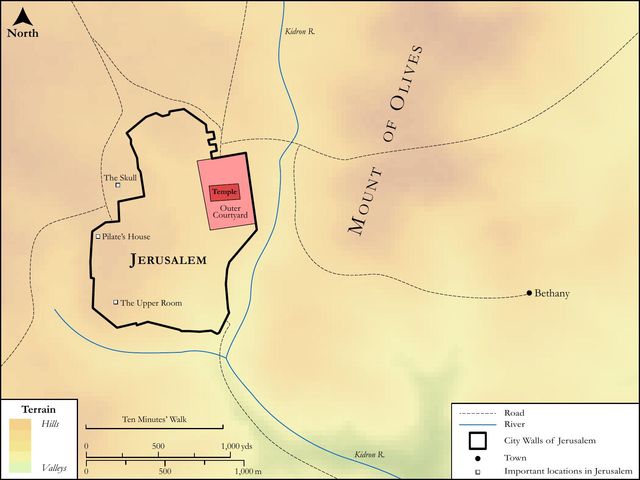
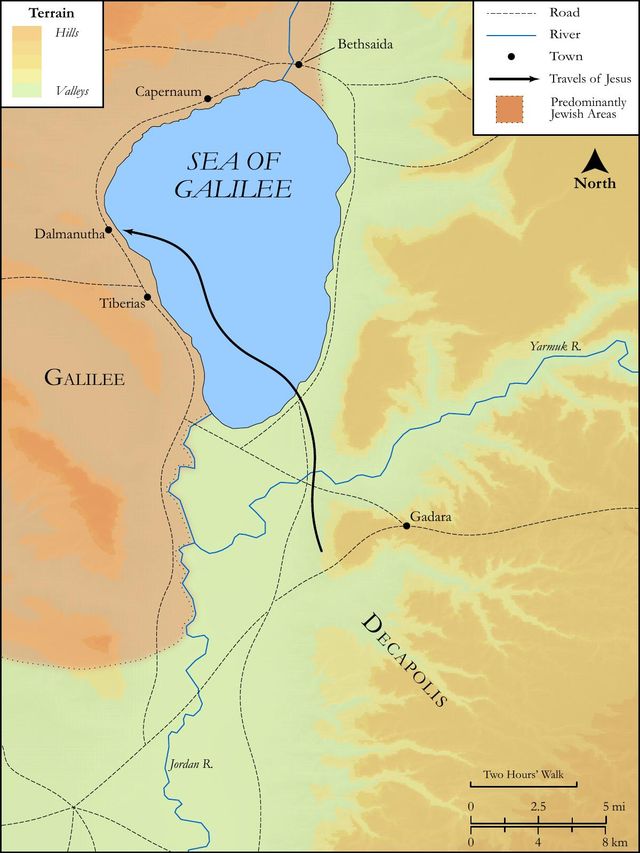
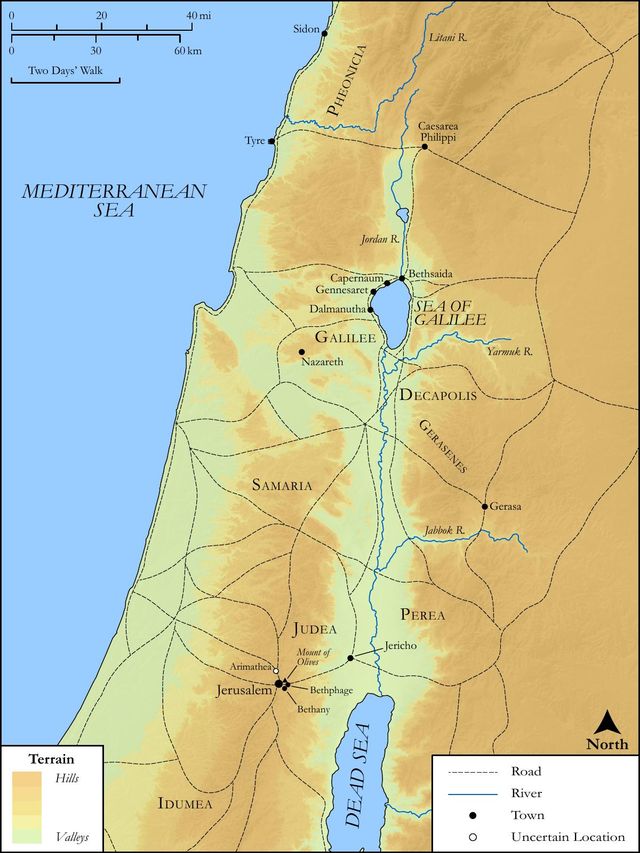
See on the biblical-era maps
Study this verse
Public-domain commentary
Matthew Henry
From his Commentary on the Whole Bible. Henry comments on passages, not single verses — this entry covers Mark 8:10–21. His three-level outline is real structure in the source text, so it is rendered as structure.
Still Christ is upon motion; now he visits the parts of Dalmanutha, that no corner of the land of Israel might say that they had not had his presence with them. He came thither by ship (Mar 8:10); but, meeting with occasions of dispute there, and not with opportunities of doing good, he entered into the ship again (Mar 8:13), and came back. In these verses, we are told,
I.How he refused to gratify the Pharisees, who challenged him to give them a sign from heaven.
They came forth on purpose to question with him; not to propose questions to him, that they might learn of him, but to cross question with him, that they might ensnare him.
1.They demanded of him a sign from heaven, as if the signs he gave them on earth, which were more familiar to them, and were more capable of being examined and enquired into, were not sufficient. There was a sign from heaven at his baptism, in the descent of the dove, and the voice (Mat 3:16, Mat 3:17); it was public enough; and if they had attended John's baptism as they ought to have done, they might themselves have seen it. Afterward, when he was nailed to the cross, they prescribed a new sign; Let him come down from the cross, and we will believe him; thus obstinate infidelity will still have something to say, though ever so unreasonable. They demanded this sign, tempting him; not in hopes that he would give it them, that they might be satisfied, but in hopes that he would not, that they might imagine themselves to have a pretence for their infidelity.
2.He denied them their demand; He sighed deeply in his spirit, Mar 8:12. He groaned (so some), being grieved for the hardness of their hearts, and the little influence that his preaching and miracles had had upon them. The infidelity of those that have long enjoyed the means of conviction, is a great grief to the Lord Jesus; it troubles him, that sinners should thus stand in their own light, and put a bar in their own door. (1.) He expostulates with them upon this demand; "Why doth this generation seek after a sign; this generation, that is so unworthy to have the gospel brought to it, and to have any sign accompanying it; this generation, that so greedily swallows the traditions of the elders, without the confirmation of any sign at all; this generation, into which, by the calculating of the times prefixed in the Old Testament, they might easily perceive that the coming of the Messiah must fall; this generation, that has had such plenty of sensible and merciful signs given them in the cure of their sick? What an absurdity is it for them to desire a sign!" (2.) He refuses to answer their demand; Verily, I say unto you, there shall no sign, no such sign, be given to this generation. When God spoke to particular persons in a particular case, out of the road of his common dispensation, they were encouraged to ask a sign, as Gideon and Ahaz; but when he speaks in general to all, as in the law and the gospel, sending each with their own evidence, it is presumption to prescribe other signs than what he has given. Shall any teach God knowledge? He denied them, and then left them, as men not fit to be talked with; if they will not be convinced, they shall not; leave them to their strong delusions.
II.How he warned his disciples against the leaven of the Pharisees and of Herod. Observe here,
1.What the caution was (Mar 8:15); "Take heed, beware, lest ye partake of the leaven of the Pharisees, lest ye embrace the tradition of the elders, which they are so wedded to, lest ye be proud, and hypocritical, and ceremonious, like them." Matthew adds, and of the Sadducees; Mark adds, and of Herod: whence some gather, that Herod, and his courtiers were generally Sadducees, that is, deists, men of no religion. Others give this sense, The Pharisees demanded a sign from heaven; and Herod was long desirous to see some miracle wrought by Christ (Luk 23:8); such as he should prescribe, so that the leaven of both was the same; they were unsatisfied with the signs they had, and would have others of their own devising; "Take heed of this leaven" (saith Christ), "be convinced by the miracles ye have seen, and covet not to see more."
2.How they misunderstood this caution. It seems, at their putting to sea this time, they had forgotten to take bread, and had not in their ship more than one loaf, Mar 8:14. When therefore Christ bid them beware of the leaven of the Pharisees, they understood it as an intimation to them, not to apply themselves to any of the Pharisees for relief, when they came to the other side, for they had lately been offended at them for eating with unwashen hands. They reasoned among themselves, what should be the meaning of this caution, and concluded, "It is because we have no bread; he saith this, to reproach us for being so careless as to go to sea, and go among strangers, with but one loaf of bread; he doth, in effect, tell us, we must be brought to short allowance, and must eat our bread by weight." They reasoned it - dielogizonto, they disputed about it; one said, "It was owing to you;" and the other said, "It was owing to you, that we are so ill provided for this voyage." Thus distrust of God makes Christ's disciples quarrel among themselves.
3.The reproof Christ gave them for their uneasiness in this matter, as it argued a disbelief of his power to supply them, notwithstanding the abundant experience they had had of it. The reproof is given with some warmth, for he knew their hearts, and knew they needed to be thus soundly chidden; "Perceive ye not yet, neither understand, that which you have had so many demonstrations of? Have ye your hearts yet hardened, so as that nothing will make any impression upon them, or bring them to compliance with your Master's designs? Having eyes, see ye not that which is plain before your eyes? Having ears, hear ye not that which you have been so often told? How strangely stupid and senseless are ye! Do ye not remember that which was done but the other day, when I broke the five loaves among the five thousand, and soon after, the seven loaves among the four thousand? Do ye not remember how many baskets full ye took up of the fragments?" Yes, they did remember, and could tell that they took up twelve baskets full one time, and seven another; "Why then," said he, "how is it that ye do not understand? As if he that multiplied five loaves, and seven, could not multiply one." They seemed to suspect that the one was not matter enough to work upon, if he should have a mind to entertain his hearers a third time: and if that was their thought, it was indeed a very senseless one, as if it were not all alike to the Lord, to save by many or few, and as easy to make one loaf to feed five thousand as five. It was therefore proper to remind them, not only of the sufficiency, but of the overplus, of the former meals; and justly were they chidden for not understanding what Christ therein designed, and what they from thence might have learned. Note,
(1.)The experiences we have had of God's goodness to us in the way of duty, greatly aggravate our distrust of him, which is therefore very provoking to the Lord Jesus.
(2.)Our not understanding of the true intent and meaning of God's favours to us, is equivalent to our not remembering of them.
(3.)We are therefore overwhelmed with present cares and distrusts, because we do not understand, and remember, what we have known and seen of the power and goodness of our Lord Jesus. It would be a great support to us, to consider the days of old, and we are wanting both to God and ourselves if we do not.
(4.)When we thus forgot the works of God, and distrust him, we should chide ourselves severely for it, as Christ doth his disciples here; "Am I thus without understanding? How is it that my heart is thus hardened?"
Historical interpretation
Six Centuries of Reception
3 surviving comments on this verse. Each one is dated, so this reads as a timeline rather than a list.
Select a marker to jump to its quote. Markers stagger vertically where authors wrote within a few decades of each other.
(Vict. Ant. e Cat. in Marc.) Matthew says, of the leaven of the Pharisees and of the Sadducees; Luke, however, of the Pharisees only. All three, therefore, name the Pharisees, as being the most important of them, but Matthew and Mark have each mentioned one of the secondary sects; and fitly has Mark added of Herod, as a supplement to Matthew's narrative, in which they were left out. But in saying this, He by degrees brings the disciples to understanding and faith.
(in Marc. 2, 33) The Pharisees, then, seek a sign from heaven, that He, Who had for the second time fed many thousands of men with a few loaves of bread, should now, after the example of Moses, refresh the whole nation in the last time with manna sent down from heaven, and dispersed amongst them all.
(ubi sup.) When, as related above, He was about to refresh the believing multitude, He gave thanks, so now, on account of the foolish petition of the Pharisees, He groans; because, bearing about with Him the feelings of human nature, as He rejoices over the salvation of men, so He grieves over their errors. Wherefore it goes on, And he groaned in spirit, and saith, Why doth this generation seek after a sign? Verily I say unto you, If a sign shall be given to this generation. That is, no sign shall be given; as it is written in the Psalms, (Ps. 89:36) I have sworn once by my holiness, if I shall fail David, that is, I will not fail David.
(ubi sup.) For a sign from heaven was not to be given to a generation of men, who tempted the Lord; but to a generation of men seeking the Lord, He shows a sign from heaven, when in the sight of the Apostles He ascended into heaven. It goes on, And he left them, and entering into a ship again, he departed to the other side.
(ubi sup.) Some may ask, how they had no bread, when they had filled seven baskets just before they embarked in the ship. But Scripture relates that they had forgotten to take them with them, which is a proof how little care they had for the flesh in other things, since in their eagerness to follow the Lord, even the necessity of refreshing their bodies had escaped from their mind.
(ubi sup.) Or, the leaven of the Pharisees is making the decrees of the divine law inferior to the traditions of men, preaching the law in word, attacking it in deed, tempting the Lord, and disbelieving His doctrine and His works; but the leaven of Herod is adultery, murder, rash swearing, a pretence of religion, hatred to Christ and His forerunner.
(ubi sup.) Taking occasion then from the precept, which He had commanded, saying, Beware of the leaven of the Pharisees and of the leaven of Herod, our Saviour teaches them what was the meaning of the five and the seven loaves, concerning which He adds, And do ye not remember, when I brake the five loaves amongst five thousand, and how many baskets full of fragments ye took up? For if the leaven mentioned above means perverse traditions, of course the food, with which the people of God was nourished, means the true doctrine.
After that our Lord had worked the miracle of the loaves, He immediately retires into another spot, lest on account of the miracle, the multitudes should take Him to make Him a king; wherefore it is said, And straightway he entered into a ship with his disciples, and came into the parts of Dalmanutha.
Or they seek for a sign from heaven, that is, they wish Him to make the sun and moon stand still, to bring down hail, and change the atmosphere; for they thought that He could not perform miracles from heaven, but could only in Beelzebub perform a sign on earth.
Now the reason why the Lord did not listen to them was, that the time of signs from heaven had not arrived, that is, the time of the second Advent, when the powers of the heaven shall be shaken, and the moon shall not give her light. But in the time of the first Advent, all things are full of mercy, and such things do not take place.
The Lord indeed quits the Pharisees, as men uncorrected; for where there is a hope of correction, there it is right to remain; but where the evil is incorrigible, we should go away. There follows: Now they had forgotten to take bread, neither had they in the ship with them more than one loaf.
By a special providence1 also the disciples forgot to take bread, that they might be blamed by Christ, and thus become better, and arrive at a knowledge of Christ's power. For it goes on, And he charged them, saying, Take heed, and beware of the leaven of the Pharisees and of the leaven of Herod.
He means by leaven their hurtful and corrupt doctrine, full of the old malice, for the Herodians were the teachers, who said that Herod was the Christ.
But the disciples themselves thought that the Lord spoke of the leaven of bread. Wherefore it goes on, And they reasoned amongst themselves, saying, it is because we have no bread; and this they said, as not understanding the power of Christ, who could make bread out of nothing; wherefore the Lord reproves them; for there follows, And when Jesus knew it, he said unto them, Why reason ye because ye have no bread?
Continue studying Mark 8:20 across the web’s major study libraries — every link below opens this exact verse, chapter, or book on the destination site.
Read & Compare
 BibleGatewayThis verse in more than 200 translations and 70 languages.
 Bible.comThe YouVersion reader — hundreds of translations, reading plans, and highlights.
 ESV.orgCrossway's official English Standard Version reader.
 NET BibleThe NET translation with 60,000+ translators' notes on every rendering decision.
 STEP BibleTyndale House's free study tool — original text, vocabulary, and scholarly resources.
 BibliaLogos Bible Software's free web reader.
 USCCBThe New American Bible (Revised Edition) with the U.S. bishops' study notes.
Commentaries
 BibleHub CommentariesDozens of classic commentaries on this verse, gathered on one page.
 StudyLightMore than 100 commentary sets — the largest collection on the web.
 BibleRefPlain-English commentary on what this verse means, verse by verse.
 Enduring WordDavid Guzik's free commentary on this chapter, widely used by Bible teachers.
 Bible Study ToolsVerse commentary alongside Greek and Hebrew study aids.
Original Language & Research
- BibleHub InterlinearThe verse word by word — original language, transliteration, and English.
- BibleHub LexiconEvery word's original-language definition and Strong's entry.
 Blue Letter BibleDeep-study tools — Strong's numbers, concordance, and word studies.
 CNTR CollationThe earliest Greek manuscripts of this verse, collated letter by letter.
Sermons, Hymns & Audio


TrulyRandomVerse is not affiliated with these sites and doesn’t control their content. They’re linked because they’re genuinely useful.
Summary
Mark 8:20 captures a pivotal moment in Jesus's ministry where He challenges His disciples to recall the details of the miraculous feeding of the four thousand. This question, posed immediately after the event, serves not merely as a memory test but as a profound spiritual probe, exposing their lingering spiritual dullness and lack of comprehension despite witnessing undeniable demonstrations of divine power and abundant provision. Their simple, factual answer—"Seven"—underscores their struggle to connect the physical miracle with its deeper theological implications concerning Jesus's identity and His boundless capacity to meet every need.
Context
ShowHideLiterary Context
Mark 8:20 is embedded within a critical section of Mark's Gospel (Mark 8:14-21) that immediately follows the second miraculous feeding of the four thousand in Mark 8:1-9. This dialogue is strategically placed before Peter's pivotal confession of Jesus as the Christ in Mark 8:29 and the subsequent first prediction of Jesus's suffering and resurrection. Jesus's questioning here, which also references the earlier feeding of the five thousand in Mark 6:30-44, highlights the disciples' persistent struggle to grasp His identity and power. Despite witnessing two distinct, large-scale miracles of provision, they remain spiritually obtuse, failing to connect these acts to who Jesus truly is. The passage is a stark portrayal of the disciples' spiritual blindness, a recurring theme in Mark's narrative leading up to their eventual, though still incomplete, understanding.
Historical & Cultural Context
The setting for this dialogue is likely in the region of Dalmanutha or the district of Magadan, on the western shore of the Sea of Galilee, a predominantly Gentile area. Large crowds following a rabbi or prophet were common, but the logistical challenge of feeding thousands in a remote, unpopulated area would have been immense, making the miraculous provision all the more astounding. Bread was a staple of the ancient diet, and shared meals often carried significant social and religious meaning, symbolizing fellowship, covenant, and divine blessing. The act of collecting "fragments" or leftovers was a common practice, emphasizing the value of every morsel and the abundance of the provision. The disciples, being Jewish, would have understood the cultural significance of these elements, yet they struggled to apply that understanding to the radical new reality presented by Jesus. Their background as ordinary people, mostly fishermen, meant they were accustomed to practical realities, but perhaps less adept at discerning spiritual truths from extraordinary events.
Key Themes
ShowHideThis verse powerfully contributes to several key themes woven throughout Mark's Gospel. Firstly, it underscores the theme of Divine Provision and Abundance, demonstrating Jesus's boundless power to provide for His people, not just adequately but superabundantly, as evidenced by the leftover fragments. This theme contrasts sharply with human limitations and anxieties. Secondly, it highlights the Disciples' Spiritual Dullness and Lack of Understanding. Despite repeated miracles and direct teaching, the disciples consistently fail to grasp the full implications of Jesus's identity and mission, as explicitly stated in Mark 8:17. Their factual memory of the events does not translate into spiritual insight, revealing a profound disconnect between observation and comprehension. Lastly, the passage showcases Jesus's Pedagogical Patience and Method. Jesus does not immediately rebuke or dismiss His disciples but patiently questions them, guiding them through their own experiences to prompt deeper reflection and a more profound understanding of His identity as the Christ, the one who truly satisfies all hunger, both physical and spiritual. This patient teaching method is crucial for their eventual, albeit imperfect, spiritual growth.
Exposition and Analysis
ShowHideKey Word Analysis
ShowHideThis numerical term, G2033, refers specifically to the quantity of baskets of fragments collected after the feeding of the four thousand. In biblical numerology, "seven" often symbolizes completeness, perfection, or divine fullness. Its recurrence here, distinct from the "twelve" baskets in the first feeding miracle, emphasizes the distinct yet equally complete and abundant nature of God's provision in different contexts.
The Greek word G4711, spyrís, denotes a large hamper or lunch-receptacle, distinct from the smaller kophinos (G2894) used in the feeding of the five thousand. This distinction in the type of basket, consistently maintained in the Gospel accounts, serves as a subtle mnemonic for the disciples, reinforcing that these were two separate, equally miraculous events, each with its own unique details of abundant leftovers. The large size of the spyrís further underscores the sheer volume of the fragments.
Derived from the verb "to break," G2801, klásma refers to the broken pieces or bits of bread left over. The presence of substantial "fragments" after thousands have eaten highlights the miraculous abundance of Jesus's provision, demonstrating that His power not only meets needs but overflows them. It signifies that God's supply is inexhaustible and generous beyond measure.
This verb, G142, aírō, means "to lift up" or "to take up or away." In this context, it refers to the act of gathering the leftover fragments. Jesus's use of this verb compels the disciples to recall their active participation in collecting the surplus, making the miracle a tangible, undeniable experience for them. It emphasizes the physical reality of the abundance they personally handled.
Verse Breakdown
ShowHide"And when the seven among four thousand"
Jesus initiates the question by directing their memory to the recent miracle, specifically recalling the number of baskets (seven) and the approximate size of the crowd (four thousand). This precise reference forces the disciples to confront a recent, undeniable event, setting the stage for the probing nature of His inquiry. It serves as a factual anchor for their recollection.
"how many baskets full of fragments took ye up?"
This is the core of Jesus's question, directly asking about the quantity of leftover bread collected. The phrasing emphasizes the "fragments" (broken pieces), highlighting the abundance even after a massive crowd had eaten. The question is designed to prompt not just a numerical answer, but a deeper reflection on the source and nature of such overwhelming provision.
"And they said, Seven."
The disciples' immediate and accurate response confirms their factual memory of the event. However, the brevity and simplicity of their answer, without further elaboration or expression of wonder, subtly reveals their continued spiritual dullness. They can recall the number, but they seemingly fail to grasp the profound theological implications of what that "seven" truly represents regarding Jesus's identity and power.
Literary Devices
ShowHideMark 8:20 employs several literary devices to convey its profound message. The most prominent is Interrogatio, or a rhetorical question. Jesus asks a question not because He lacks the information, but to prompt His disciples to reflect, recall, and ultimately gain deeper understanding. His question serves as a pedagogical tool, forcing them to engage with their own experiences and draw conclusions about His identity and power. There is also a subtle element of Irony present; the disciples, having just witnessed an astounding miracle, can accurately recall the numerical details of the leftovers, yet they remain spiritually blind to the profound implications of Jesus's power and identity, a theme explicitly stated in Mark 8:17-18. The "seven" baskets of fragments also carry Symbolism, representing completeness and superabundant provision, a divine fullness that transcends human limitations. This numerical detail, along with the "four thousand" fed, serves as a tangible symbol of God's limitless capacity to provide.
Theological and Thematic Connections
ShowHideMark 8:20 stands as a poignant reminder of God's unfailing and abundant provision, a truth consistently demonstrated through Jesus's ministry. The miraculous feedings underscore Jesus's identity as the divine provider, capable of sustaining His people beyond all human expectation. Yet, the disciples' struggle to grasp this reality, despite direct experience, highlights a persistent human tendency towards spiritual amnesia and an inability to connect God's past faithfulness with present challenges. This passage challenges believers to move beyond mere factual recall of God's works to a deeper, transformative understanding of His character and power. It emphasizes that true faith involves not just remembering what God has done, but trusting in who He is, recognizing that His provision extends far beyond the physical to encompass every spiritual need. The leftover "fragments" powerfully symbolize that God's generosity is not merely sufficient but overflows, leaving an undeniable testimony to His boundless grace and power.
Reflection and Application
ShowHideMark 8:20 serves as a powerful mirror for contemporary believers, inviting us to examine the depth of our own faith and understanding. Like the disciples, we often witness God's miraculous provision and faithfulness in our lives, yet when new challenges arise, we can quickly forget His past deeds and fall into anxiety or doubt. This verse challenges us to move beyond a mere intellectual acknowledgment of God's power to a heart-level trust that truly believes He is the ultimate provider, capable of meeting every need, physical and spiritual. It calls us to cultivate a spiritual memory that actively recalls God's past interventions, allowing those memories to build our faith for future trials. Are we truly learning from our experiences of God's grace, or are we, like the disciples, prone to spiritual amnesia, failing to connect His consistent faithfulness with our present circumstances? This passage urges us to seek a deeper, transformative understanding of Jesus's identity, allowing His boundless power to shape our worldview and alleviate our fears, trusting that His provision, like the overflowing baskets, is always more than enough.
Questions for Reflection
ShowHideFAQ
ShowHideWhy does Jesus ask His disciples a question He already knows the answer to?
ShowHideJesus's question in Mark 8:20 is not for His own information but is a pedagogical tool designed to prompt His disciples' reflection and spiritual growth. He is guiding them to connect the dots between the miraculous events they witnessed and His true identity and power. By making them recall the specific numbers of baskets of leftovers from both the feeding of the five thousand (Mark 6:43) and the four thousand (Mark 8:8), Jesus aims to expose their spiritual dullness and challenge them to understand that if He can provide so abundantly for thousands with so little, He can surely provide for their every need and is indeed the Son of God with divine authority. It's a call to move from factual memory to spiritual insight.
What is the significance of the numbers "seven" and "four thousand" in this context?
ShowHideThe numbers in Mark 8:20 are highly significant. The "four thousand" people fed in the second miracle, often understood to be predominantly Gentiles (as opposed to the "five thousand" who were likely mostly Jews), suggests Jesus's universal mission to provide for all nations. The "seven" baskets of fragments collected afterward is also symbolic. In biblical numerology, "seven" often represents completeness, perfection, or divine fullness, reinforcing the idea that God's provision is not just sufficient but superabundant. The distinct numbers (five thousand fed with twelve baskets in the first miracle vs. four thousand fed with seven baskets in the second) serve as a clear distinction between the two separate miracles, emphasizing that Jesus's power is not a one-time event but a consistent, overflowing reality, available to both Jew and Gentile.
Christ-Centered Fulfillment
ShowHideMark 8:20, with its focus on Jesus's abundant provision and the disciples' spiritual dullness, powerfully foreshadows the ultimate Christ-centered fulfillment found in the New Testament. The physical bread, miraculously multiplied and overflowing in "seven" baskets, points to Jesus Himself as the true "Bread of Life" (John 6:35), who fully satisfies the deepest spiritual hunger of humanity. The disciples' inability to grasp the profound implications of these miracles highlights humanity's inherent spiritual blindness, which can only be overcome through the revelation of Christ. Just as Jesus provided physical sustenance, He ultimately offers Himself as the spiritual sustenance through His atoning sacrifice on the cross (John 6:51). The "fragments" of bread, symbolizing overflowing abundance, become a powerful metaphor for the inexhaustible grace and mercy poured out through Christ's death and resurrection, sufficient for the sins of the entire world (1 John 2:2). Furthermore, the disciples' eventual understanding of Jesus's identity, though slow, is ultimately a work of the Holy Spirit, who illuminates the truth of Christ to believers (John 16:13-14). Thus, Mark 8:20 serves as a vital stepping stone, revealing Jesus as the divine provider whose ultimate provision is Himself, freely given to satisfy every spiritual need and transform spiritually dull hearts into those that truly comprehend and worship Him.