


Mark 8:9
Bible text: King James Version (1769 Blayney text) · Public domain
Bible text: Berean Standard Bible · Public domain
Bible text: American Standard Version (1901) · Public domain
Bible text: World English Bible, Messianic edition · Public domain
Bible text: Geneva Bible (1599) · Public domain
Bible text: Young's Literal Translation · Public domain
- ἦσανēsanThere wereG1510V-IAI-3PVerb Imperfect Active Indicative 3rd Plural
- δὲdenowG1161CONJConjunction
- οἱhoi<the>G3588T-NPMDefinite article Nominative Plural Masculine
- φαγόντεςphagonteshaving eaten ofG5315V-2AAP-NPMVerb 2nd Aorist Active Participle Nominative Plural Masculine
- ὡςhōsaboutG5613PRTParticle or Disjunctive
- τετρακισχίλιοι·tetrakischilioifour thousandG5070A-NPMAdjective Nominative Plural Masculine
- καὶkaiAndG2532CONJConjunction
- ἀπέλυσενapelusenHe sent awayG630V-AAI-3SVerb Aorist Active Indicative 3rd Singular
- αὐτούςautousthemG846P-APMPersonal pronoun Accusative Plural Masculine
English is a literal word-by-word gloss of the Greek, not the KJV's wording. Why?
This is the original text the KJV's translators worked from — each Greek word with its own literal English meaning in this verse, prepared by scholars at Tyndale House, Cambridge. The KJV translates whole sentences, not word by word, so its wording differs: one Greek word can become several English words, and the KJV may choose “charity” where the gloss reads “love”. Both are faithful — they answer different questions. For the KJV's own rendering, switch to the KJV text.
Details
See on the biblical-era maps
Study this verse
Public-domain commentary
Matthew Henry
From his Commentary on the Whole Bible. Henry comments on passages, not single verses — this entry covers Mark 8:1–9. His two-level outline is real structure in the source text, so it is rendered as structure.
We had the story of a miracle very like this before, in this gospel (Mar 6:35), and of this same miracle (Mat 15:32), and here is little or no addition or alternation as to the circumstances. Yet observe,
1.That our Lord Jesus was greatly followed; The multitude was very great (Mar 8:1); notwithstanding the wicked arts of the scribes and Pharisees to blemish him, and to blast his interest, the common people, who had more honesty, and therefore more true wisdom, than their leaders, kept up their high thoughts of him. We may suppose that this multitude were generally of the meaner sort of people, with such Christ conversed, and was familiar; for thus he humbled himself, and made himself of no reputation, and thus encouraged the meanest to come to him for life and grace.
2.Those that followed him, underwent a great deal of difficulty in following him; They were with him three days, and had nothing to eat, that was hard service. Never let the Pharisee say, that Christ's disciples fast not. There were those, probably, that brought some food with them from home; but by this time it was all spent, and they had a great way home; and yet they continued with Christ, and did not speak of leaving him till he spoke of dismissing them. Note, True zeal makes nothing of hardships in the way of duty. They that have a full feast for their souls may be content with slender provision for their bodies. It was an old saying among the Puritans, Grown bread and the gospel are good fare.
3.As Christ has a compassion for all that are in wants and straits, so he has a special concern for those that are reduced to straits by their zeal and diligence in attending on him. Christ said, I have compassion on the multitude. Whom the proud Pharisees looked upon with disdain, the humble Jesus looked upon with pity and tenderness; and thus must we honour all men. But that which he chiefly considers, is, They have been with me three days, and have nothing to eat. Whatever losses we sustain, or hardships we go through, for Christ's sake, and in love to him, he will take care that they shall be made up to us one way or other. They that seek the Lord, shall not long want any good thing, Psa 34:10. Observe with what sympathy Christ saith (Mar 8:3), If I send them away fasting to their own houses, they will faint by the way, for hunger. Christ knows and considers our frame; and he is for the body, if we glorify him, verily we shall be fed. He considered that many of them came from afar, and had a great way home. When we see multitudes attending upon the word preached, it is comfortable to think that Christ knows whence they all come, though we do not. I know thy works, and where thou dwellest, Rev 2:13. Christ would by no means have them go home fasting, for it is not his manner to send those empty way from him, that in a right manner attend on him.
4.The doubts of Christians are sometimes made to work for the magnifying of the power of Christ. The disciples could not imagine whence so many men should be satisfied with bread here in the wilderness, Mar 8:4. That therefore must needs be wonderful, and appear so much the more so, which the disciples looked upon as impossible.
5.Christ's time to act for the relief of his people, is, when things are brought to the last extremity; when they were ready to faint, Christ provided for them. That he might not invite them to follow him for the loaves, he did not supply them but when they were utterly reduced, and then he sent them away.
6.The bounty of Christ is inexhaustible, and, to evidence that, Christ repeated this miracle, to show that he is still the same for the succour and supply of his people that attend upon him. His favours are renewed, as our wants and necessities are. In the former miracle, Christ used all the bread he had, which was five loaves, and fed all the guests he had, which were five thousand, and so he did now; though he might have said, "If five loaves would feed five thousand, four may feed four thousand;" he took all the seven loaves, and fed with them the four thousand; for he would teach us to take things as they are, and accommodate ourselves to them; to use what we have, and make the best of that which is. Here it was, as in the dispensing of manna, He that gathered much had nothing over, and he that gathered little had no lack.
7.In our Father's house, in our Master's house, there is bread enough, and to spare; there is a fulness in Christ, which he communicates to all that passes through his hands; so that from it we receive, and grace for grace, Joh 1:16. Those need not fear wanting, that have Christ to live upon.
8.It is good for those that follow Christ, to keep together; these followers of Christ continued in a body, four thousand of them together, and Christ fed them all. Christ's sheep must abide by the flock, and go forth by their footsteps, and verily they shall be fed.
Historical interpretation
Seven Centuries of Reception
8 surviving comments on this verse. Each one is dated, so this reads as a timeline rather than a list.
Select a marker to jump to its quote. Markers stagger vertically where authors wrote within a few decades of each other.
Or else, the seven loaves are the gifts of the Holy Spirit, the fragments of the loaves are the mystical understanding of the1 first week.
The small fishes blessed are the books of the New Testament, for our Lord when risen asks for a piece of broiled fish;1 or else in these little fishes, we receive the saints, seeing that in the Scriptures of the New Testament are contained the faith, life, and sufferings of them who, snatched away from the troubled waves of this world, have given us by their example spiritual refreshment.
Again, the seven baskets are the seven Churches. By the four thousand is meant the year of the new dispensation, with its four seasons. Fitly also are there four thousand, that in the number itself it might be taught us that they were filled with the food of the Gospel.
(in Luc. 6:73) The good Lord indeed whilst He requires diligence, gives strength; nor will He dismiss them fasting, lest they faint by the way, that is, either in the course of this life, or before they have reached the fountainhead head of life, that is, the Father, and have learnt that Christ is of the Father, lest haply, after receiving that He is born of a virgin, they begin to esteem His virtue not that of God, but of a man. Therefore the Lord Jesus divides the food, and His will indeed is to give to all, to deny none; He is the Dispenser of all things, but if thou refusest to stretch forth thy hand to receive the food, thou wilt faint by the way, nor canst thou find fault with Him, who pities and divides.
From the lesser number of men [four thousand], less remains; from the greater number [five thousand6], more is left over. Four thousand men—fewer certainly in number, but greater in faith. The one who is greater in faith eats more, and because he does, there is less left over! I wish that we, too, might eat more of the hardy bread of holy writ, so that there would be less left over for us to learn.
Ignorance was not His reason for asking them, but that from their answering seven, the miracle might be noised abroad, and become more known in proportion to the smallness of the number. It goes on: And he commanded the people to sit down on the ground. In the former feeding they lay down on grass, in this one on the ground. It continues, And he took the seven loaves, and gave thanks, and brake. In giving thanks, He has left us an example, that for all gifts conferred on us from heaven we should return thanks to Him. And it is to be remarked, that our Lord did not give the bread to the people, but to His disciples, and the disciples to the people; for it goes on, and gave to his disciples to set before them; and they did set them before the people. And not only the bread, but the fish also He blessed, and ordered to be set before them. For there comes after, And they had a few small fishes: and he blessed, and commanded to set them also before them.
(Mor. 1, 19) He does not however wish to dismiss them fasting, lest they should faint by the way; for it is necessary that men should find in what is preached the word of consolation, lest hungering through want of the food of truth, they sink under the toil of this life.
(in Marc. 2, 32) Why they who came from afar hold out for three days, Matthew says more fully: And he went up into a mountain, and sat down there, and great multitudes came unto him, having with them many sick persons, and cast them down at Jesus feet, and he healed them. (v. Matt. 15:29)
(ubi sup.) In this passage then we should notice, in one and the same, our Redeemer, a distinct operation of Divinity and of Manhood; thus the error of Eutyches1, who presumes to lay down the doctrine of one only operation in Christ, is to be cast out far from the Christian pale. For who does not here see that the pity of our Lord for the multitude is the feeling and sympathy of humanity; and that at the same time His satisfying four thousand men with seven loaves and a few fishes, is a work of Divine virtue? It goes on, And they took up of the broken meat that was left seven baskets.
(ubi sup.) The typical difference between this feeding and the other of the five loaves and two fishes, is, that there the letter of the Old Testament, full of spiritual grace, is signified, but here the truth and grace of the New Testament, which is to be ministered to all the faithful, is pointed out. Now the multitude remains three days, waiting for the Lord to heal their sick, as Matthew relates, when the elect, in the faith of the Holy Trinity, supplicate for sins, with persevering earnestness; or because they turn themselves to the Lord in deed, in word, and in thought.
(ubi sup.) But they who return to repentance after the crimes of the flesh, after thefts, violence, and murders, come to the Lord from afar; for in proportion as a man has wandered farther in evil working, so he has wandered farther from Almighty God. The believers amongst the Gentiles came from afar to Christ, but the Jews from near, for they had been taught concerning Him by the letter of the law and the prophets. In the former case, however, of the feeding with five loaves, the multitude lay upon the green grass; here, however, upon the ground, because by the writing of the law, we are ordered to keep under the desires of the flesh, but in the New Testament we are ordered to leave even the earth itself and our temporal goods.
(ubi sup.) For our Lord's breaking the bread means the opening of mysteries; His giving of thanks shows how great a joy He feels in the salvation of the human race; His giving the loaves to His disciples that they might set them before the people, signifies that He assigns the spiritual gifts of knowledge to the Apostles, and that it was His will that by their ministry the food of life should be distributed to the Church.
(ubi sup.) Again, what was over and above, after the multitude was refreshed, the Apostles take up, because the higher precepts of perfection, to which the multitude cannot attain, belong to those whose life transcends that of the generality of the people of God; nevertheless, the multitude is said to have been satisfied, because though they cannot leave all that they possess, nor come up to that which is spoken of virgins, yet by listening to the commands of the law of God, they attain to everlasting life.
Now those who ate were about four thousand, and He sent them away. Well, four thousand, that even in the number itself they might show they were fed with evangelical food.
After the Lord had performed the former miracle concerning the multiplication of the loaves, now again, a fitting occasion presents itself, and He takes the opportunity of working a similar miracle; wherefore it is said, In those days, the multitude being very great, and having nothing to eat, Jesus called his disciples unto him, and, saith unto them, I have compassion on the multitude, because they have now been with me three days, and have nothing to eat. For He did not always work miracles concerning the feeding of the multitude, lest they should follow Him for the sake of food; now therefore He would not have performed this miracle, if He had not seen that the multitude was in danger. Wherefore it goes on: And if I send them away fasting to their own houses, they will faint by the way: for divers of them came from far.
The disciples did not yet understand, nor did they believe in His virtue, notwithstanding former miracles; wherefore it continues, And his disciples said unto him, From whence can a man satisfy these men with bread here in the wilderness? But the Lord Himself does not blame them, teaching us that we should not be grievously angry with ignorant men and those who do not understand, but bear with their ignorance. After this it continues, And he asked them, How many loaves have ye? and they answered, Seven.
The multitudes who ate and were filled did not take with them the remains of the loaves, but the disciples took them up, as they did before the baskets. In which we learn according to the narration, that we should be content with what is sufficient, and not look for any thing beyond. The number of those who ate is put down, when it is said, And they that had eaten were about four thousand: and he sent them away; where we may see that Christ sends no one away fasting, for He wishes all to be nourished by His grace.
Or by those who wait for three days, He means the baptized; for baptism is called illumination, and is performed by trine immersion.
Further, the seven loaves are spiritual discourses, for seven is the number, which points out the Holy Ghost, who perfects all things; for our life is perfected in the number of seven days'd.
Or there are four thousand, that is, men perfect in the four virtues; and for this reason, as being more advanced, they ate more, and left fewer fragments. For in this miracle, seven baskets full remain, but in the miracle of the five loaves, twelve, for there were five thousand men, which means men enslaved to the five senses, and for this reason they could not eat, but were satisfied with little, and many remains of the fragments were over and above.
Continue studying Mark 8:9 across the web’s major study libraries — every link below opens this exact verse, chapter, or book on the destination site.
Read & Compare
 BibleGatewayThis verse in more than 200 translations and 70 languages.
 Bible.comThe YouVersion reader — hundreds of translations, reading plans, and highlights.
 ESV.orgCrossway's official English Standard Version reader.
 NET BibleThe NET translation with 60,000+ translators' notes on every rendering decision.
 STEP BibleTyndale House's free study tool — original text, vocabulary, and scholarly resources.
 BibliaLogos Bible Software's free web reader.
 USCCBThe New American Bible (Revised Edition) with the U.S. bishops' study notes.
Commentaries
 BibleHub CommentariesDozens of classic commentaries on this verse, gathered on one page.
 StudyLightMore than 100 commentary sets — the largest collection on the web.
 BibleRefPlain-English commentary on what this verse means, verse by verse.
 Enduring WordDavid Guzik's free commentary on this chapter, widely used by Bible teachers.
 Bible Study ToolsVerse commentary alongside Greek and Hebrew study aids.
Original Language & Research
- BibleHub InterlinearThe verse word by word — original language, transliteration, and English.
- BibleHub LexiconEvery word's original-language definition and Strong's entry.
 Blue Letter BibleDeep-study tools — Strong's numbers, concordance, and word studies.
 CNTR CollationThe earliest Greek manuscripts of this verse, collated letter by letter.
Sermons, Hymns & Audio


TrulyRandomVerse is not affiliated with these sites and doesn’t control their content. They’re linked because they’re genuinely useful.
Summary
Mark 8:9 brings the account of Jesus' second miraculous feeding to a concise conclusion, detailing the approximate number of people nourished—four thousand—and Jesus' subsequent action of dismissing them. This verse serves as the final numerical and narrative punctuation mark to a profound demonstration of divine compassion and abundant provision, underscoring the tangible impact of Christ's ministry on the lives of ordinary people before He continued His journey.
Context
ShowHideLiterary Context
Mark 8:9 provides the concluding summary for the second miraculous feeding narrative, which spans Mark 8:1-9. This event immediately follows a period where Jesus has been ministering in the Decapolis region, a predominantly Gentile area. The narrative begins with Jesus' profound compassion for the hungry multitude, who had been with Him for three days and had nothing to eat. He then takes seven loaves and a few small fish, blesses them, breaks them, and gives them to His disciples to distribute. The miracle culminates in everyone eating their fill and seven baskets of leftover fragments being collected, a detail that contrasts with the twelve baskets from the earlier feeding of the five thousand in Mark 6:30-44. The proximity of these two similar, yet distinct, miracles sets the stage for the disciples' continued struggle to comprehend Jesus' identity and power, a theme that becomes explicit in the subsequent dialogue about "bread" in Mark 8:14-21.
Historical & Cultural Context
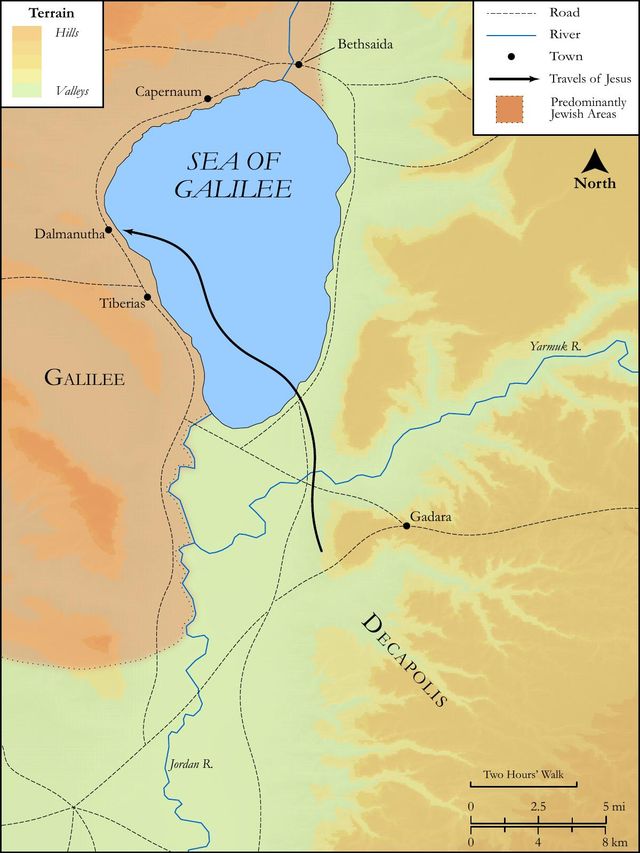
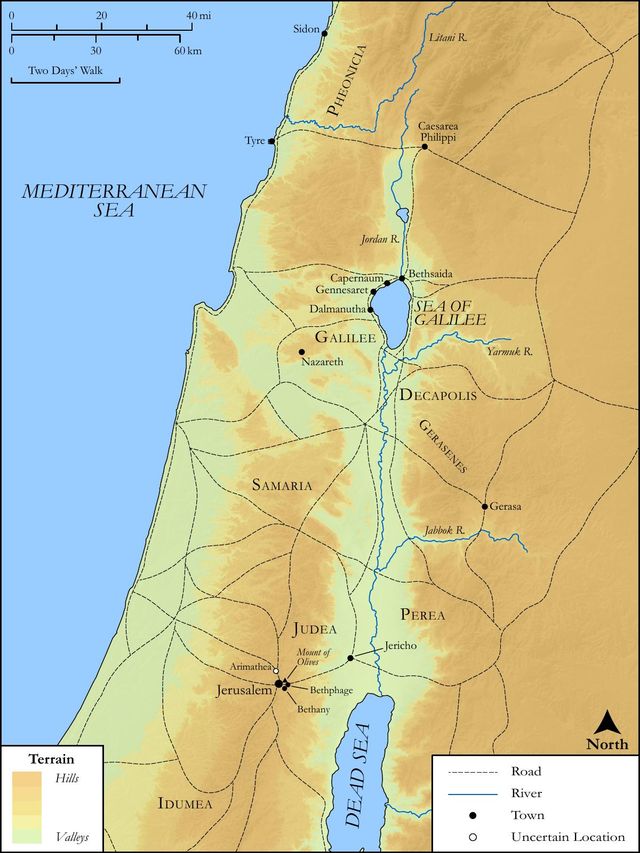
The setting for this miracle is widely understood to be the Decapolis, a region east of the Sea of Galilee, characterized by a league of ten Hellenistic cities. Unlike the first feeding, which likely occurred in Jewish territory (Bethsaida or a deserted place near it), this second miracle in the Decapolis highlights Jesus' ministry extending beyond the traditional boundaries of Israel to include Gentiles. This geographical and cultural context underscores the universal scope of Jesus' compassion and the breaking down of ethnic barriers in His kingdom. The act of feeding a large crowd in a remote area was a significant logistical feat and a powerful public demonstration of authority and provision, reminiscent of God's provision of manna in the wilderness for Israel (Exodus 16). The collection of leftovers, a common practice in Jewish culture to prevent waste, further emphasized the abundance of the provision.
Key Themes
ShowHideThis verse, as the conclusion to the feeding miracle, contributes to several overarching themes in Mark's Gospel. Firstly, it powerfully illustrates Divine Provision, showcasing Jesus' ability to supernaturally meet the physical needs of humanity, mirroring God's care for His people throughout salvation history, as seen in the wilderness wanderings. Secondly, it highlights Jesus' Universal Compassion, extending His care to a predominantly Gentile crowd, signaling the inclusion of all peoples in God's redemptive plan. This anticipates the Great Commission found in Matthew 28:19-20. Thirdly, the specific numbers—"four thousand" fed and "seven baskets" of leftovers—emphasize Abundance and Sufficiency, demonstrating that Jesus not only provides enough but provides in overflowing measure, pointing to His identity as the true "bread of life" (as declared in John 6:35). Finally, the disciples' subsequent inability to grasp the significance of these two distinct feeding miracles, despite their direct involvement, underscores the theme of Disciples' Limited Understanding of Jesus' true identity and the nature of His kingdom, a recurring motif throughout Mark's Gospel.
Exposition and Analysis
ShowHideKey Word Analysis
ShowHideThis primary verb signifies the act of consuming food, literally or figuratively. In this context, it refers to the physical nourishment received by the multitude, emphasizing the tangible and satisfying nature of Jesus' provision. The use of the perfect participle ("they that had eaten") points to a completed action with ongoing results—the people were now full and satisfied.
This particle indicates approximation, suggesting that the number "four thousand" is a close estimate rather than an exact count. It conveys the vastness of the crowd while acknowledging the practical difficulty of a precise tally in such circumstances. This nuance reinforces the miraculous scale of the event without demanding absolute mathematical precision.
Derived from apo (from) and lyō (to loose), this verb means to free fully, release, or dismiss. Here, it describes Jesus' authoritative act of disbanding the crowd. It implies not merely a casual departure but a deliberate and organized dismissal, ensuring the well-being of the people after their miraculous meal. This action underscores Jesus' control over the situation and His concern for the orderly conclusion of the event.
Verse Breakdown
ShowHide"And they that had eaten were about four thousand:"
This clause provides the numerical summary of the miracle's beneficiaries. The phrase "they that had eaten" highlights the direct recipients of Jesus' miraculous provision, emphasizing their full participation in the meal. The number "about four thousand" conveys the immense scale of the crowd, a testament to Jesus' power to feed a vast multitude with minimal resources. This detail serves as a concrete measure of the miracle's impact, demonstrating the tangible reality of God's abundant care for His people.
"and he sent them away."
This concluding clause describes Jesus' final action concerning the crowd. The verb "sent away" (ἀπέλυσεν) indicates a deliberate dismissal, implying that the people were now satisfied and free to return to their homes. This act signifies the completion of the miraculous event and Jesus' compassionate concern for the welfare of the people, ensuring their safe dispersal after their needs had been met. It also marks a transition point in the narrative, allowing Jesus to move on to the next phase of His ministry.
Literary Devices
ShowHideMark 8:9, though brief, effectively employs several literary devices to conclude the narrative of the feeding of the four thousand. The use of Numbers ("four thousand") serves to quantify the miracle's scale, providing a concrete measure of Jesus' power and the abundance of His provision. This numerical detail also creates a subtle Parallelism with the earlier feeding of the five thousand (Mark 6:44), inviting readers to compare and contrast the two events, thereby highlighting the distinct yet consistent nature of Jesus' miraculous works. The concise, declarative statement "and he sent them away" functions as a form of Narrative Closure, signaling the completion of the episode and the orderly conclusion of the event. This simple statement also subtly conveys Jesus' Authority and control over the crowd, as He is the one who initiates their dismissal.
Theological and Thematic Connections
ShowHideMark 8:9, as the culmination of the feeding of the four thousand, powerfully reinforces the theological truth of God's abundant and compassionate provision, not just for Israel but for all humanity. This miracle, occurring in a predominantly Gentile region, expands the scope of divine care beyond ethnic boundaries, foreshadowing the universal reach of the Gospel. It demonstrates that Jesus is the ultimate source of sustenance, capable of meeting both physical and spiritual needs in overflowing measure. The act of sending the satisfied crowd away underscores the completeness of His work and His meticulous care for the well-being of those He serves. This event serves as a tangible sign of the coming kingdom of God, where all who hunger will be filled by the King.
Reflection and Application
ShowHideMark 8:9, though a simple concluding verse, offers profound lessons for our lives today. It reminds us that Jesus is not only capable of meeting our needs but does so with overflowing abundance and compassionate care. In a world often marked by scarcity and anxiety, this verse calls us to cultivate a deep trust in God's unfailing provision, recognizing that He sees our hunger—whether physical, emotional, or spiritual—and is moved to act. Just as the crowd was satisfied and sent away, we too are invited to experience the fullness of Christ's provision and then, empowered by His grace, to go forth into the world as His hands and feet, extending His compassion to others. This verse challenges us to move beyond our limited perspectives, much like the disciples, and to truly grasp the boundless nature of God's love and power, allowing it to transform our fears into faith and our anxieties into peace.
Questions for Reflection
ShowHideFAQ
ShowHideWhy is the number of people fed important, and how does it compare to the feeding of the five thousand?
ShowHideThe number "four thousand" (and the "seven baskets" of leftovers) is crucial because it quantifies the scale of Jesus' miraculous provision, demonstrating His immense power and the tangible impact of His compassion. It also serves as a distinct numerical marker that differentiates this miracle from the earlier feeding of "five thousand" (Mark 6:44) where "twelve baskets" of leftovers were collected. While both events showcase divine provision, the distinct numbers (4,000 vs. 5,000; 7 baskets vs. 12 baskets) prevent conflation and highlight that Jesus performed multiple such miracles. The difference in numbers of people and baskets might also subtly allude to the different audiences (Gentile vs. Jewish, respectively, though not explicitly stated for the first feeding) and the completeness of God's provision for all.
Christ-Centered Fulfillment
ShowHideMark 8:9, in its simple declaration of the multitude being fed and sent away, points profoundly to Christ as the ultimate provider and the fulfillment of God's redemptive plan. Jesus, the one who compassionately feeds four thousand in a desolate place, is the very "bread of life" who came down from heaven to give life to the world (John 6:35). His physical provision here foreshadows His spiritual provision for all humanity, offering Himself as the ultimate sacrifice to satisfy our deepest hunger for righteousness and eternal life. The act of "sending them away" after they were satisfied anticipates the spiritual freedom and peace that believers find in Christ, being released from the bondage of sin and sent forth with the good news. Just as He nourished the multitude, Jesus continues to nourish His church through His Word and Spirit, preparing us for the great marriage supper of the Lamb (Revelation 19:9), where all hunger will be forever satisfied in His presence. This miracle, therefore, is a tangible sign of the new covenant, where Christ's abundant grace extends to all who believe, transcending all boundaries to bring nourishment and liberation.