


Mark 15:13
Bible text: King James Version (1769 Blayney text) · Public domain
Bible text: Berean Standard Bible · Public domain
Bible text: American Standard Version (1901) · Public domain
Bible text: World English Bible, Messianic edition · Public domain
Bible text: Geneva Bible (1599) · Public domain
Bible text: Young's Literal Translation · Public domain
- οἱhoi<the>G3588T-NPMDefinite article Nominative Plural Masculine
- δὲdeAndG1161CONJConjunction
- πάλινpalinagainG3825ADVAdverb
- ἔκραξαν·ekraxanthey cried outG2896V-AAI-3PVerb Aorist Active Indicative 3rd Plural
- σταύρωσονstaurōsondo crucifyG4717V-AAM-2SVerb Aorist Active Imperative 2nd Singular
- αὐτόνautonHim!G846P-ASMPersonal pronoun Accusative Singular Masculine
English is a literal word-by-word gloss of the Greek, not the KJV's wording. Why?
This is the original text the KJV's translators worked from — each Greek word with its own literal English meaning in this verse, prepared by scholars at Tyndale House, Cambridge. The KJV translates whole sentences, not word by word, so its wording differs: one Greek word can become several English words, and the KJV may choose “charity” where the gloss reads “love”. Both are faithful — they answer different questions. For the KJV's own rendering, switch to the KJV text.
Details
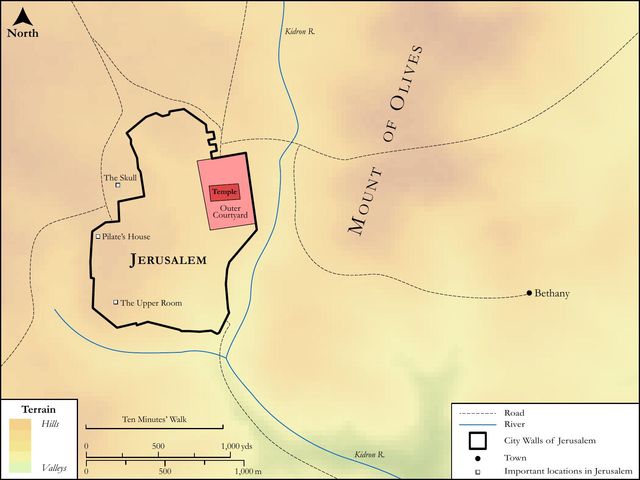
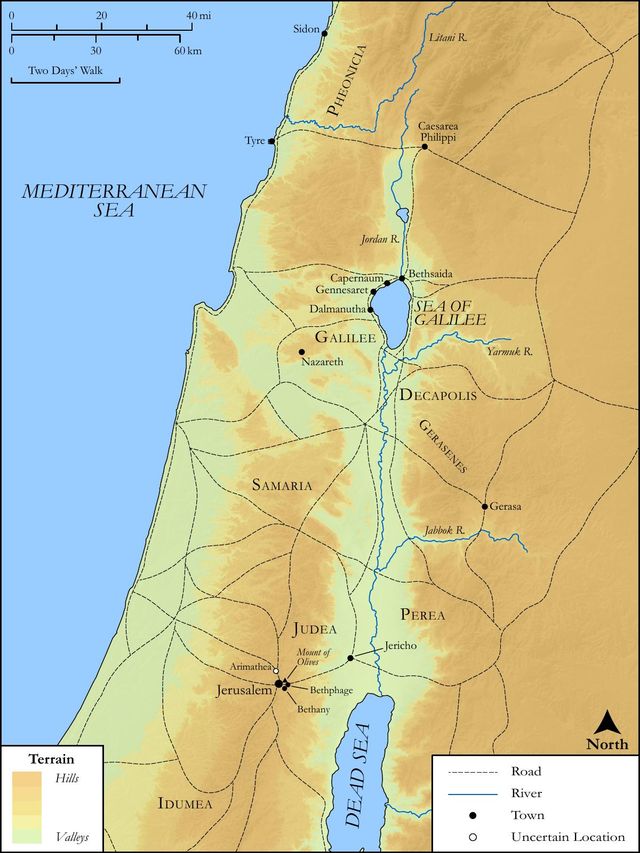
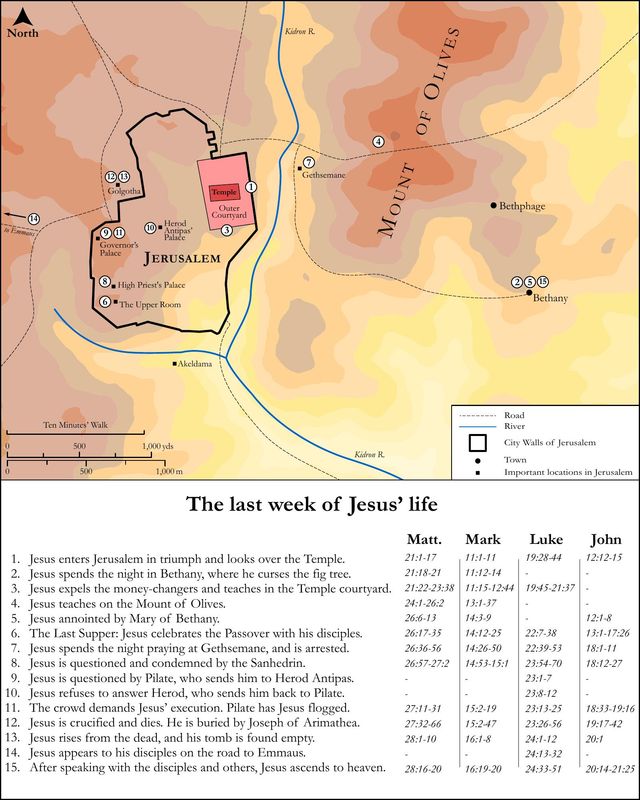
See on the biblical-era maps
Study this verse
Public-domain commentary
Matthew Henry
From his Commentary on the Whole Bible. Henry comments on passages, not single verses — this entry covers Mark 15:1–14. His two-level outline is real structure in the source text, so it is rendered as structure.
Here we have, I. A consultation held by the great Sanhedrim for the effectual prosecution of our Lord Jesus. They met early in the morning about it, and went into a grand committee, to find out ways and means to get him put to death; they lost no time, but followed their blow in good earnest, lest there should be an uproar among the people. The unwearied industry of wicked people in doing that which is evil, should shame us for our backwardness and slothfulness in that which is good. They that war against Christ and thy soul, are up early; How long then wilt thou sleep, O sluggard?
II.The delivering of him up a prisoner to Pilate; they bound him.
He was to be the great sacrifice, and sacrifices must be bound with cords, Psa 118:27. Christ was bound, to make bonds easy to us, and enable us, as Paul and Silas, to sing in bonds. It is good for us often to remember the bonds of the Lord Jesus, as bound with him who was bound for us. They led him through the streets of Jerusalem, to expose him to contempt, who, while he taught in the temple, but a day or two before, was had in veneration; and we may well imagine how miserably he looked after such a night's usage as he had had; so buffeted, spit upon, and abused. Their delivering him to the Roman power was a type of ruin of their church, which hereby they merited, and brought upon themselves; it signified that the promise, the covenant, and the oracles, of God, and the visible state church, which were the glory of Israel, and had been so long in their possession, should now be delivered up to the Gentiles. By delivering up the king they do, in effect, deliver up the kingdom of God, which is therefore, as it were, by their own consent, taken from them, and given to another nation. If they had delivered up Christ, to gratify the desires of the Romans, or to satisfy and jealousies of theirs concerning him, it had been another matter; but they voluntarily betrayed him that was Israel's crown, to them that were Israel's yoke.
III.The examining of him by Pilate upon interrogatories (Mar 15:2); "Art thou the king of the Jews? Dost thou pretend to be so, to be that Messiah whom the Jews expect as a temporal prince?" - "Yea," saith Christ, "it is as thou sayest, I am that Messiah, but not such a one as they expect." He is the king that rules and protects his Israel according to the spirit, who are Jews inwardly by the circumcision of the spirit, and the king that will restrain and punish the carnal Jews, who continue in unbelief.
IV.The articles of impeachment exhibited against him, and his silence under the charge and accusation.
The chief priests forgot the dignity of their place, when they turned informers, and did in person accuse Christ of many things (Mar 15:3), and witness against him, Mar 15:4. Many of the Old Testament prophets charge the priests of their times with great wickedness, in which well did they prophesy of these priests; see Eze 22:26; Hos 5:1; Hos 6:9; Mic 3:11; Zep 3:4; Mal 1:6; Mal 2:8. The destruction of Jerusalem by the Chaldeans is said to be for the iniquity of the priests that shed the blood of the just, Lam 4:13. Note, Wicked priests are generally the worst of men. The better any thing is, the worse it is when it is corrupted. Lay persecutors have been generally found more compassionate than ecclesiastics. These priests were very eager and noisy in their accusation; but Christ answered nothing, Mar 15:3. When Pilate urged him to clear himself, and was desirous he should (Mar 15:4), yet still he stood mute (Mar 15:5), he answered nothing, which Pilate thought very strange. He gave Pilate a direct answer (Mar 15:2), but would not answer the prosecutors and witnesses, because the things they alleged, were notoriously false, and he knew Pilate himself was convinced they were so. Note, As Christ spoke to admiration, so he kept silence to admiration.
V.The proposal Pilate made to the people, to have Jesus released to them, since it was the custom of the feast to grace the solemnity with the release of one prisoner. The people expected and demanded that he should do as he had ever done to them (Mar 15:8); it was not an ill usage, but they would have it kept up. Now Pilate perceived that the chief priests delivered up Jesus for envy, because he had got such a reputation among the people as eclipsed theirs, Mar 15:10. It was easy to see, comparing the eagerness of the prosecutors with the slenderness of the proofs, that it was not his guilt, but his goodness, not any thing mischievous or scandalous, but something meritorious and glorious, that they were provoked at. And therefore, hearing how much he was the darling of the crowd, he thought that he might safely appeal from the priests to the people, and that they would be proud of rescuing him out of the priests' hands; and he proposed an expedient for their doing it without danger of an uproar; let them demand him to be released, and Pilate will be ready to do it, and stop the mouths of the priests with this - that the people insisted upon his release. There was indeed another prisoner, one Barabbas, that had an interest, and would have some votes; but he questioned not but Jesus would out-poll him.
VI.The unanimous outrageous clamours of the people have Christ put to death, and particularly to have him crucified.
It was a great surprise to Pilate, when he found the people so much under the influence of the priests, that they all agreed to desire that Barabbas might be released, Mar 15:11. Pilate opposed it all he could; "What will ye that I shall do to him whom ye call the King of the Jews? Would not ye then have him released too?" Mar 15:12. No, say they, Crucify him. The priests having put that in their mouths, the insist upon it; when Pilate objected, Why, what evil has he done? (a very material question in such a case), they did not pretend to answer it, but cried out more exceedingly, as they were more and more instigated and irritated by the priests, Crucify him, crucify him. Now the priests, who were very busy dispersing themselves and their creatures among the mob, to keep up the cry, promised themselves that it would influence Pilate two ways to condemn him.
1.It might incline him to believe Christ guilty, when there was so general an out-cry against him. "Surely," might Pilate think, "he must needs be a bad man, whom all the world is weary of." He would now conclude that he had been misinformed, when he was told what an interest he had in the people, and that the matter was not so. But the priest had hurried on the prosecution with so much expedition, that we may suppose that they who were Christ's friends, and would have opposed this cry, were at the other end of the town, and knew nothing of the matter. Note, It has been the common artifice of Satan, to put Christ and his religion into an ill name, and so to run them down. When once this sect, as they called it, comes to be every where spoken against, though without cause, then that is looked upon as cause enough to condemn it. But let us judge of persons and things by their merits, and the standard of God's word, and not prejudge by common fame and the cry of the country.
2.It might induce him to condemn Christ, to please the people, and indeed for fear of displeasing them. Though he was not so weak as to be governed by their opinion, to believe him guilty, yet he was so wicked as to be swayed by their outrage, to condemn him, though he believed him innocent; induced thereunto by reasons of state, and the wisdom of the world. Our Lord Jesus dying as a sacrifice for the sins of many, he fell a sacrifice to the rage of many.
Historical interpretation
Eight Centuries of Reception
6 surviving comments on this verse. Each one is dated, so this reads as a timeline rather than a list.
Select a marker to jump to its quote. Markers stagger vertically where authors wrote within a few decades of each other.
Here are two goats; one is the scape goat, that is, one loosed and sent out into the wilderness of hell with the sin of the people; the other is slain, as a lamb, for the sins of those who are forgiven. The Lord's portion is always slain; the devil's part, (for he is the master of those men, which is the meaning of Barabbas,) when freed, is cast headlong into hell.
Mark, who studies brevity more than any of the Evangelists, has given a concise indication of Pilate’s desire and of his efforts to save the Lord’s life. For, after giving us the statement, “And they cried again, ‘Crucify him’ ” (which makes it clear that they had cried out before for Barabbas to be released), he has appended these words: “Then Pilate continued to say to them, “Why, what evil has he done?” Thus by one short sentence he has given us an idea of matters which took a long time for their transaction.
(ubi sup.) No one can feel it a difficulty that Matthew is silent as to their asking some one to be released unto them, which Mark here mentions; for it is a thing of no consequence that one should mention a thing which another leaves out. There follows: But Pilate answered them, saying, Will ye that I release unto you the King of the Jews? For he knew that the Chief Priests had delivered him for envy. Some one may ask, which were the words of which Pilate made use, those which are related by Matthew, or those which Mark relates; for there seems to be a difference between, Whom will ye that I release unto you? Barabbas, or Jesus which is called Christ? as Matthew has it; and, Will ye that I release unto you the King of the Jews? (Matt. 27:17) as is here said. But since they gave to kings the name of Christs, he who said this man or that must have asked whether they wished the King of the Jews to be released unto them, that is, Christ. It makes no difference to the sense that Mark has said nothing of Barabbas, wishing only to mention what belonged to the Lord, since by their answer he sufficiently showed whom they wished to have released to them. For there follows, But the Chief Priests moved the people that he should rather release unto them Barabbas.
(ubi sup.) It now is clear enough that Mark means by King of the Jews what Matthew means by the word Christ; for no kings but those of the Jews were called Christs. For in this place according to Matthew it is said, What then shall I do with Jesus which is called Christ? There follows, And they cried out again, Crucify him. (Matt. 27:22)
(ubi sup.) Pilate furnished many opportunities of releasing Jesus, in the first place contrasting a robber with the Just One. Wherefore it is said, Now at that feast he released unto them one prisoner, whomsoever they desired.
(ubi sup.) This demand which the Jews made with such toil to themselves still sticks to them. Because, when the choice was given to them, they chose a robber instead of Christ, a murderer instead of the Saviour, they deservedly lost their salvation and their life, and they subjected themselves to such a degree to robbery and sedition, that they lost their country and their kingdom which they preferred to Christ, and never regained their liberty, body or soul. Then Pilate gives another opportunity of releasing the Saviour, when there follows, And Pilate answered and said again unto them, What will ye then that I should do unto the King of the Jews?
(ubi sup.) But the Jews giving loose to their madness do not answer the question of the judge. Wherefore it goes on, And they cried out the more exceedingly, Crucify him, that those words of the Prophet Jeremiah might be fulfilled, Mine heritage is unto me as a lion in the forest, it crieth out against me. (Jer. 12:8) There follows, And so Pilate, willing to content the people, released Barabbas unto them, and delivered Jesus, when he had scourged him, to be crucified.
(ubi sup.) We must understand that Jesus was scourged by no other than Pilate himself. For John writes, Pilate took Jesus, and scourged him, (John 13:1) which we must suppose that he did, that the Jews might be satisfied with His pains and insults, and cease from thirsting for His blood.
Now see the wickedness of the Jews, and the moderation of Pilate, though he too was worthy of condemnation for not resisting the people. For they cried out, Crucify; he faintly tries to save Jesus from their determined sentence, and again puts a question to them. Wherefore there follows, Then Pilate said unto them, Why, what evil hath he done? For he wished in this way to find an opportunity for releasing Christ, who was innocent.
He wished indeed to satisfy the people, that is, to do their will, not what was agreeable to justice and to God.
(non occ.) Which indeed he was accustomed to do, to obtain favour with the people, and above all, on the feast day, when the people of the whole province of the Jews flocked to Jerusalem. And that the wickedness of the Jews might appear the greater, the enormity of the sin of the robber, whom they preferred to Christ, is next described. Wherefore there follows: And there was one Barabbas, who lay bound with them that had made insurrection with him, who had committed murder in the insurrection. In which words their wickedness is shown both from the heinousness of his signal crime, in that he had committed murder, and from the way in which he did it, because he had in doing it raised a sedition and disturbed the city, and also because his crime was notorious, for he was bound with seditious persons. It goes on: And the multitude, when it had come up, began to desire him to do as he had ever done unto them.
Continue studying Mark 15:13 across the web’s major study libraries — every link below opens this exact verse, chapter, or book on the destination site.
Read & Compare
 BibleGatewayThis verse in more than 200 translations and 70 languages.
 Bible.comThe YouVersion reader — hundreds of translations, reading plans, and highlights.
 ESV.orgCrossway's official English Standard Version reader.
 NET BibleThe NET translation with 60,000+ translators' notes on every rendering decision.
 STEP BibleTyndale House's free study tool — original text, vocabulary, and scholarly resources.
 BibliaLogos Bible Software's free web reader.
 USCCBThe New American Bible (Revised Edition) with the U.S. bishops' study notes.
Commentaries
 BibleHub CommentariesDozens of classic commentaries on this verse, gathered on one page.
 StudyLightMore than 100 commentary sets — the largest collection on the web.
 BibleRefPlain-English commentary on what this verse means, verse by verse.
 Enduring WordDavid Guzik's free commentary on this chapter, widely used by Bible teachers.
 Bible Study ToolsVerse commentary alongside Greek and Hebrew study aids.
Original Language & Research
- BibleHub InterlinearThe verse word by word — original language, transliteration, and English.
- BibleHub LexiconEvery word's original-language definition and Strong's entry.
 Blue Letter BibleDeep-study tools — Strong's numbers, concordance, and word studies.
 CNTR CollationThe earliest Greek manuscripts of this verse, collated letter by letter.
Sermons, Hymns & Audio


TrulyRandomVerse is not affiliated with these sites and doesn’t control their content. They’re linked because they’re genuinely useful.
Summary
Mark 15:13 captures the chilling moment when the Jewish crowd, incited by their religious leaders, vehemently and repeatedly demanded the crucifixion of Jesus before Pontius Pilate. Despite Pilate's attempts to release Jesus, finding no fault in Him, the persistent and unified cry for His death sealed the fate of the innocent Son of God, revealing the profound rejection of the Messiah by His own people and highlighting the tragic culmination of human sin and manipulation.
Context
ShowHideLiterary Context
Mark 15:13 is situated at the climax of Jesus' trial before Pontius Pilate, immediately following Pilate's question to the crowd regarding what he should do with "the King of the Jews" (Mark 15:12). This scene is preceded by Jesus' arrest, His interrogation by the Sanhedrin, and their decision to hand Him over to the Roman authorities, as they lacked the legal power to execute Him. Pilate, in an attempt to release Jesus, offered the crowd a choice between Jesus and Barabbas, a notorious insurrectionist and murderer, according to the custom of releasing a prisoner during the Passover festival (Mark 15:6-11). The chief priests had successfully manipulated the crowd to demand Barabbas' release, setting the stage for the collective outcry against Jesus.
Historical & Cultural Context
The events of Mark 15 unfold during the Passover festival in Jerusalem, a time when the city was densely populated with Jewish pilgrims, many of whom harbored messianic expectations and resentment towards Roman occupation. Pontius Pilate, the Roman prefect of Judea, was responsible for maintaining order and often struggled to manage the volatile Jewish populace. The custom of releasing a prisoner, though not widely attested outside the Gospels, was likely a gesture by the Roman governor to appease the Jewish crowds during a sensitive religious holiday. The chief priests and elders, representing the established religious and political authority within Judaism, viewed Jesus as a threat to their power and a blasphemer, actively inciting the crowd against Him. The Roman method of crucifixion was a brutal, public execution reserved for slaves, rebels, and the lowest criminals, designed to inflict maximum suffering and deter dissent.
Key Themes
ShowHideThis verse powerfully contributes to several key themes within the Gospel of Mark. It underscores the theme of mob mentality and manipulation, revealing how easily public opinion can be swayed away from truth and justice by powerful voices. The same crowds who hailed Jesus during His triumphal entry are now incited to demand His death. It highlights the profound injustice perpetrated against Jesus, an innocent man whom even Pilate found no fault in, as seen in parallel accounts like John 19:4. Furthermore, the demand for crucifixion signifies a profound rejection of the Messiah by His own people, choosing a violent rebel over the Prince of Peace. This rejection is a tragic fulfillment of Old Testament prophecies concerning the suffering servant, as anticipated in passages like Isaiah 53:3.
Exposition and Analysis
ShowHideKey Word Analysis
ShowHideTranslated as "cried out," this verb signifies a loud, vehement, and often passionate shout or scream. It suggests a desperate, intense, and forceful utterance, emphasizing the sheer volume and persistence of the crowd's demand. It is not a quiet request but a forceful, public outcry that sought to overpower any opposition or reason.
Translated as "again," this adverb indicates repetition. Its inclusion highlights that this was not a singular, spontaneous outburst but a renewed, perhaps even more forceful, reiteration of their demand. It underscores the crowd's unwavering and relentless resolve to see Jesus crucified, demonstrating their collective will had been firmly set against Him.
Translated as "Crucify," this verb means "to impale on the cross." It refers specifically to the brutal Roman method of execution. The crowd's direct and repeated use of this word reveals their desire for the most humiliating and painful death possible for Jesus, demonstrating the depth of their hatred and rejection.
Verse Breakdown
ShowHide"And they cried out again"
This phrase emphasizes the collective, vocal, and persistent nature of the crowd's demand. The use of "again" indicates that this was not their first outcry, but a renewed and perhaps more intense shout, demonstrating their unwavering resolve and the successful manipulation by the chief priests. It paints a picture of a unified and determined mob.
"Crucify him"
This is the stark, brutal, and singular demand of the crowd. It is a direct command, devoid of any nuance or hesitation. The choice of crucifixion, a particularly agonizing and shameful form of execution, underscores the depth of their animosity and their desire for Jesus' complete public disgrace and annihilation.
Literary Devices
ShowHideThe verse employs several powerful literary devices. Repetition, implied by the word "again" and the nature of a crowd's chant, amplifies the intensity and unwavering resolve of the mob. This repetition creates a sense of escalating tension and inevitability. There is profound irony in the scene, as Pilate, the representative of imperial justice, attempts to release an innocent man, while the very people who should recognize their Messiah demand His death. This also contributes to dramatic irony, where the audience is aware of Jesus' true identity and innocence, making the crowd's ignorant demand all the more tragic. The verse also serves as a form of foreshadowing, not only of Jesus' imminent death but also of the world's continued rejection of Him and His followers throughout history. The depiction of the mob mentality itself functions as a literary device, illustrating the dangers of collective irrationality and the ease with which a crowd can be swayed to commit grave injustice.
Theological and Thematic Connections
ShowHideMark 15:13 stands as a stark testament to the depth of human sin and the world's rejection of divine truth. It reveals the terrifying power of collective evil and the fragility of justice when confronted by popular sentiment and manipulation. Theologically, it underscores the radical nature of God's redemptive plan, where the innocent Son is condemned by the very people He came to save, fulfilling ancient prophecies of the suffering servant. This moment highlights the profound spiritual blindness that can lead humanity to reject its only hope, choosing darkness over light, and violence over peace. It is a sobering reminder that the path to salvation often involves profound suffering and rejection, echoing the experience of Christ Himself.
Reflection and Application
ShowHideThe scene in Mark 15:13 is a powerful mirror reflecting the human tendency to follow the crowd, to succumb to popular opinion, and to reject truth when it is inconvenient or challenging. For believers today, this verse serves as a crucial call to cultivate discernment and to anchor our convictions in the unwavering truth of God's Word, rather than being swayed by the prevailing cultural winds or the clamor of popular sentiment. We are challenged to examine our own hearts: are there areas where we, too, might be tempted to "crucify" Christ by rejecting His lordship, His teachings, or His call to costly discipleship? This passage also compels us to stand for justice and truth, even when doing so is unpopular, difficult, or comes at a personal cost. Just as Jesus faced rejection, His followers can expect similar opposition from a world that often prefers its own ways to God's. Our steadfastness in faith, even amidst such opposition, becomes a powerful testimony to the enduring truth of Christ.
Questions for Reflection
ShowHideFAQ
ShowHideWhy did the crowd, who earlier welcomed Jesus, now demand His crucifixion?
ShowHideThe crowd's shift from hailing Jesus during His triumphal entry to demanding His crucifixion can be attributed to several factors. Primarily, the chief priests and elders actively incited and manipulated the multitude, using their influence to turn public opinion against Jesus (Mark 15:11). Many in the crowd likely had a political understanding of the Messiah, expecting a king who would liberate them from Roman rule. When Jesus did not fulfill these expectations, and instead spoke of a spiritual kingdom, their initial enthusiasm may have turned to disappointment or even anger. The religious leaders capitalized on this disillusionment and their own theological opposition to Jesus, successfully swaying the crowd to choose Barabbas, a revolutionary, over Jesus.
What is the significance of the crowd's specific demand, "Crucify him"?
ShowHideThe demand "Crucify him" is profoundly significant for several reasons. Firstly, it specifies a Roman method of execution, not a Jewish one. This indicates the crowd's intent to ensure Jesus' death under Roman authority, as Jewish law did not permit crucifixion. Secondly, crucifixion was reserved for the most heinous criminals, slaves, and rebels, designed to be a public spectacle of extreme pain, humiliation, and degradation. By demanding crucifixion, the crowd sought to inflict maximum suffering and disgrace upon Jesus, effectively declaring Him to be the worst kind of criminal and rebel against both Roman and Jewish order. This specific demand underscores the depth of their hatred and their complete rejection of Jesus' claims and identity.
Christ-Centered Fulfillment
ShowHideMark 15:13, though a scene of profound human injustice and rejection, paradoxically stands as a pivotal moment in God's sovereign plan of redemption, finding its ultimate fulfillment in Christ. The crowd's vehement cry, "Crucify him," was not merely a human act of malice, but an unwitting participation in the divine drama of salvation. Jesus, the innocent Lamb of God, willingly submitted to this unjust condemnation, fulfilling ancient prophecies that foretold the suffering of the Messiah (Isaiah 53:7). His crucifixion, demanded by the very people He came to save, became the means by which He bore the sins of the world, demonstrating God's immeasurable love for humanity even while we were still sinners (Romans 5:8). The rejection and death of Jesus, culminating in this cry, were not a defeat but the necessary path for Him to become the victorious Savior, conquering sin and death through His resurrection. Thus, the very act of human rebellion that led to His death is transformed by God's grace into the foundation of salvation for all who believe, as the one who was "crucified" is now exalted as Lord and Christ (Acts 2:36). He is the author and finisher of our faith, who for the joy set before Him endured the cross, despising its shame (Hebrews 12:2).