


Luke 5:23
Bible text: King James Version (1769 Blayney text) · Public domain
Bible text: Berean Standard Bible · Public domain
Bible text: American Standard Version (1901) · Public domain
Bible text: World English Bible, Messianic edition · Public domain
Bible text: Geneva Bible (1599) · Public domain
Bible text: Young's Literal Translation · Public domain
- τίtiWhichG5101I-NSNInterrogative pronoun Nominative Singular Neuter
- ἐστινestinisG1510V-PAI-3SVerb Present Active Indicative 3rd Singular
- εὐκοπώτερονeukopōteroneasierG2123A-NSN-CAdjective Nominative Singular Neuter Comparative
- εἰπεῖν·eipeinto sayG2036V-2AANVerb 2nd Aorist Active Infinitive
- ἀφέωνταίapheōntaiHave been forgivenG863V-RPI-3PVerb Perfect Passive Indicative 3rd Plural
- σοιsoiyouG4771P-2DSPersonal pronoun Dative 2nd Singular
- αἱhaitheG3588T-NPFDefinite article Nominative Plural Feminine
- ἁμαρτίαιhamartiaisinsG266N-NPFNoun Nominative Plural Feminine
- σουsouof youG4771P-2GSPersonal pronoun Genitive 2nd Singular
- ἢēorG2228CONJConjunction
- εἰπεῖν·eipeinto sayG2036V-2AANVerb 2nd Aorist Active Infinitive
- ἔγειρεegeiredo ariseG1453V-PAM-2SVerb Present Active Imperative 2nd Singular
- καὶkaiandG2532CONJConjunction
- περιπάτει;peripateido walk?G4043V-PAM-2SVerb Present Active Imperative 2nd Singular
English is a literal word-by-word gloss of the Greek, not the KJV's wording. Why?
This is the original text the KJV's translators worked from — each Greek word with its own literal English meaning in this verse, prepared by scholars at Tyndale House, Cambridge. The KJV translates whole sentences, not word by word, so its wording differs: one Greek word can become several English words, and the KJV may choose “charity” where the gloss reads “love”. Both are faithful — they answer different questions. For the KJV's own rendering, switch to the KJV text.
Details
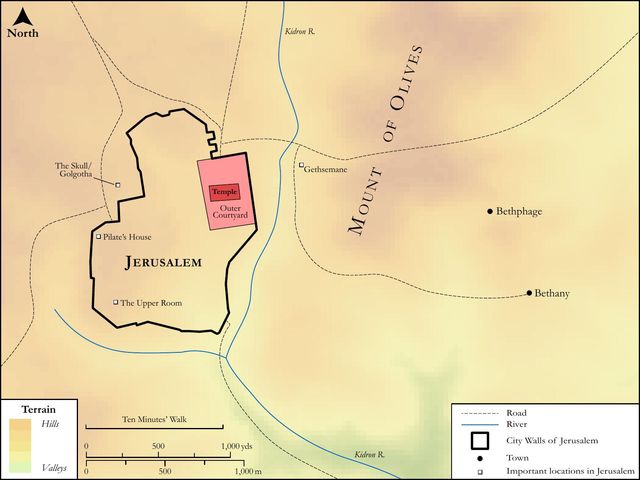
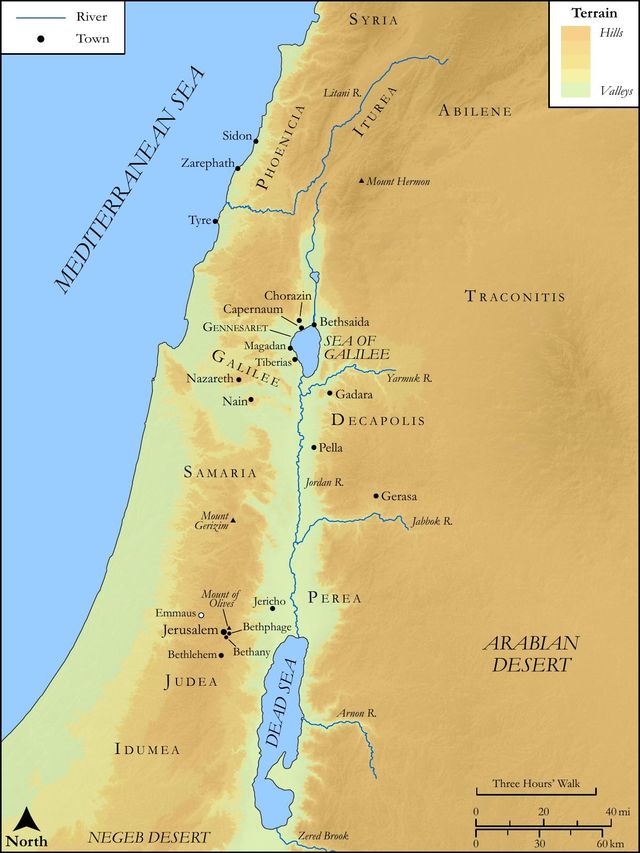
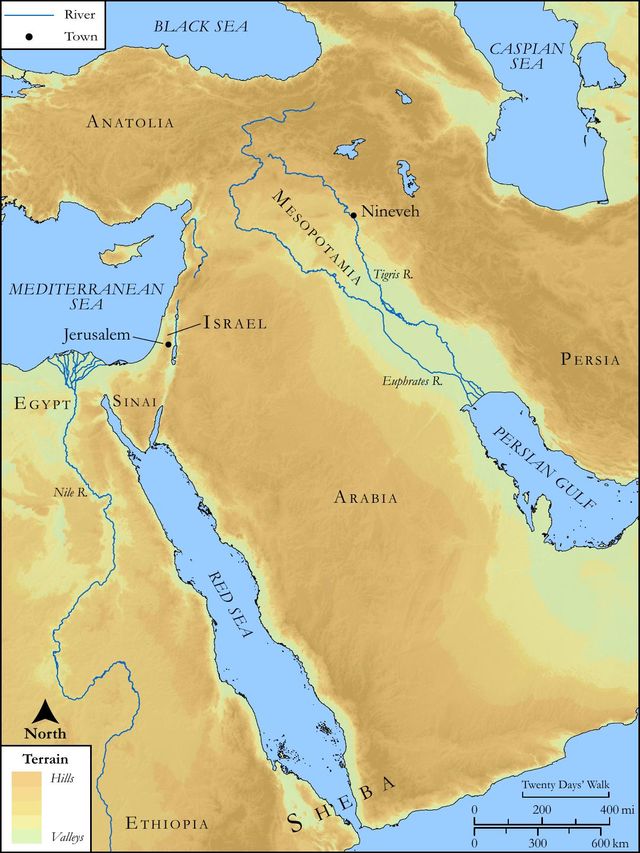
See on the biblical-era maps
Study this verse
Public-domain commentary
Matthew Henry
From his Commentary on the Whole Bible. Henry comments on passages, not single verses — this entry covers Luke 5:17–26. His four-level outline is real structure in the source text, so it is rendered as structure.
Here is, I. A general account of Christ's preaching and miracles, Luk 5:17. 1. He was teaching on a certain day, not on the sabbath day, then he would have said so, but on a week-day; six days shalt thou labour, not only for the world, but for the soul, and the welfare of that. Preaching and hearing the word of God are good works, if they be done well, any day in the week, as well as on sabbath days. It was not in the synagogue, but in a private house; for even there where we ordinarily converse with our friends it is not improper to give and receive good instruction. 2. There he taught, he healed (as before, Luk 5:15): And the power of the Lord was to heal them - ēn eis to iasthai autous. It was mighty to heal them; it was exerted and put forth to heal them, to heal those whom he taught (we may understand it so), to heal their souls, to cure them of their spiritual diseases, and to give them a new life, a new nature. Note, Those who receive the word of Christ in faith will find a divine power going along with that word, to heal them; for Christ came with his comforts to heal the broken-hearted, Luk 4:18. The power of the Lord is present with the word, present to those that pray for it and submit to it, present to heal them. Or it may be meant (and so it is generally taken) of the healing of those who were diseased in body, who came to him for cures. Whenever there was occasion, Christ had not to seek for his power, it was present to heal. 3. There were some grandees present in this assembly, and, as it should seem, more than usual: There were Pharisees, and doctors of the law, sitting by; not sitting at his feet, to learn of him; then I should have been willing to take the following clause as referring to those who are spoken of immediately before (the power of the Lord was present to heal them); and why might not the word of Christ reach their hearts? But, by what follows (Luk 4:21), it appears that they were not healed, but cavilled at Christ, which compels us to refer this to others, not to them; for they sat by as persons unconcerned, as if the word of Christ were nothing to them. They sat by as spectators, censors, and spies, to pick up something on which to ground a reproach or accusation. How many are there in the midst of our assemblies, where the gospel is preached, that do not sit under the word, but sit by! It is to them as a tale that is told them, not as a message that is sent them; they are willing that we should preach before them, not that we should preach to them. These Pharisees and scribes (or doctors of the law) came out of every town of Galilee, and Judea, and Jerusalem; they came from all parts of the nation. Probably, they appointed to meet at this time and place, to see what remarks they could make upon Christ and what he said and did. They were in a confederacy, as those that said, Come, and let us devise devices against Jeremiah, and agree to smite him with the tongue, Jer 18:18. Report, and we will report it, Jer 20:10. Observe, Christ went on with his work of preaching and healing, though he saw these Pharisees, and doctors of the Jewish church, sitting by, who, he knew, despised him, and watched to ensnare him.
II.A particular account of the cure of the man sick of the palsy, which was related much as it is here by both the foregoing evangelists: let us therefore only observe in short,
1.The doctrines that are taught us and confirmed to us by the story of this cure.
(1.)That sin is the fountain of all sickness, and the forgiveness of sin is the only foundation upon which a recovery from sickness can comfortably be built. They presented the sick man to Christ, and he said, "Man, thy sins are forgiven thee (Luk 5:20), that is the blessing thou art most to prize and seek; for if thy sins be forgiven thee, though the sickness be continued, it is in mercy; if they be not, though the sickness be removed, it is in wrath." The cords of our iniquity are the bands of our affliction.
(2.)That Jesus Christ has power on earth to forgive sins, and his healing diseases was an incontestable proof of it. This was the thing intended to be proved (Luk 5:24): That ye may know and believe that the Son of man, though now upon earth in his state of humiliation, hath power to forgive sins, and to release sinners, upon gospel terms, from the eternal punishment of sin, he saith to the sick of the palsy, Arise, and walk; and he is cured immediately. Christ claims one of the prerogatives of the King of kings when he undertakes to forgive sin, and it is justly expected that he should produce a good proof of it. "Well," saith he, "I will put it upon this issue: here is a man struck with a palsy, and for his sin; if I do not with a word's speaking cure his disease in an instant, which cannot be done by nature or art, but purely by the immediate power and efficacy of the God of nature, then say that I am not entitled to the prerogative of forgiving sin, am not the Messiah, am not the Son of God and King of Israel: but, if I do, you must own that I have power to forgive sins." Thus it was put upon a fair trial, and one word of Christ determined it. He did but say, Arise, take up thy couch, and that chronical disease had an instantaneous cure; immediately he arose before them. They must all own that there could be no cheat or fallacy in it. They that brought him could attest how perfectly lame he was before; they that saw him could attest how perfectly well he was now, insomuch that he had strength enough to take up and carry away the bed he lay upon. How well is it for us that this most comfortable doctrine of the gospel, that Jesus Christ, our Redeemer and Saviour, has power to forgive sin, has such a full attestation!
(3.)That Jesus Christ is God. He appears to be so,
[1.]By knowing the thoughts of the scribes and Pharisees (Luk 5:22), which it is God's prerogative to do, though these scribes and Pharisees knew as well how to conceal their thoughts, and keep their countenances, as most men, and probably were industrious to do it at this time, for they lay in wait secretly.
[2.]By doing that which their thoughts owned none could do but God only (Luk 5:21): Who can forgive sins, say they, but only God? "I will prove," saith Christ, "that I can forgive sins;" and what follows then but that he is God? What horrid wickedness then were they guilty of who charged him with speaking the worst of blasphemies, even when he spoke the best of blessings, Thy sins are forgiven thee!
2.The duties that are taught us, and recommended to us, by this story.
(1.)In our applications to Christ, we must be very pressing and urgent: that is an evidence of faith, and is very pleasing to Christ and prevailing with him. They that were the friends of this sick man sought means to bring him in before Christ (Luk 5:18); and, when they were baffled in their endeavour, they did not give up their cause; but when they could not get in by the door, it was so crowded, they untiled the house, and let the poor patient down through the roof, into the midst before Jesus, Luk 5:19. In this Jesus Christ saw their faith, Luk 5:20. Now here he has taught us (and it were well if we could learn the lesson) to put the best construction upon words and actions that they will bear. When the centurion and the woman of Canaan were in no care at all to bring the patients they interceded for into Christ's presence, but believed that he could cure them at a distance, he commended their faith. But though in these there seemed to be a different notion of the thing, and an apprehension that it was requisite the patient should be brought into his presence, yet he did not censure and condemn their weakness, did not ask them, "Why do you give this disturbance to the assembly? Are you under such a degree of infidelity as to think I could not have cured him, though he had been out of doors?" But he made the best of it, and even in this he saw their faith. It is a comfort to us that we serve a Master that is willing to make the best of us.
(2.)When we are sick, we should be more in care to get our sins pardoned than to get our sickness removed. Christ, in what he said to this man, taught us, when we seek to God for health, to begin with seeking to him for pardon.
(3.)The mercies which we have the comfort of God must have the praise of. The man departed to his own house, glorifying God, Luk 5:25. To him belong the escapes from death, and in them therefore he must be glorified.
(4.)The miracles which Christ wrought were amazing to those that saw them, and we ought to glorify God in them, Luk 5:26. They said, "We have seen strange things today, such as we never saw before, nor our fathers before us; they are altogether new." But they glorified God, who had sent into their country such a benefactor to it; and were filled with fear, with a reverence of God, with a jealous persuasion that this was the Messiah and that he was not treated by their nation as he ought to be, which might prove in the end the ruin of their state; perhaps they were some such thoughts as these that filled them with fear, and a concern likewise for themselves.
Historical interpretation
Seven Centuries of Reception
6 surviving comments on this verse. Each one is dated, so this reads as a timeline rather than a list.
Select a marker to jump to its quote. Markers stagger vertically where authors wrote within a few decades of each other.
While the Pharisee doubted that our Lord was a prophet, he was unwittingly pledging himself to the truth by thinking, “If this man were a prophet, he would know that this woman is a sinner.” Therefore, if our Lord indeed knows that she is a sinner, then, Pharisee, by your own reasoning he indeed is a prophet. And so our Lord did not hesitate to point out not only that she was a sinner but also that she had sinned very much, so that the testimony of his own mouth would trap the accuser. [The Pharisee] was one of those who had said, “Who can forgive sins but God alone?” Our Lord took this testimony from them, that whoever is able to forgive sin is God. From this point on, the struggle was for our Lord to show them whether or not he was able to forgive sin. And so he quickly healed the parts [of the body] that were visible, to confirm that he had forgiven the sins which were not visible.
Mighty is the Lord who pardons one man for the good deed of another, and while he approves of the one, forgives the other his sins. Why, O man, with thee does not thy fellowman prevail, when with God a servant has both the liberty to intercede in thy behalf, and the power of obtaining what he asks? If thou despairest of the pardon of heavy sins, bring the prayers of others, bring the Church to pray for thee, and at sight of this the Lord may pardon what otherwise He might deny to thee.
From the Pharisees themselves therefore the Son of God receives testimony. For it is both more powerful evidence when men confess unwillingly, and a more fatal error when they who deny are left to the consequence of their own assertions. Hence it follows, Who can forgive sins, but God only? Great is the madness of an unbelieving people, who though they have confessed that it is of God alone to forgive sins, believe not God when He forgives sins.
The Lord wishing to save sinners shows Himself to be God, by His knowledge of the secret thoughts; as it follows, But that ye may know.
Nor is there any delay, health is present; there is but one moment both of words, and healing. Hence it follows, And immediately he rose. From this fact it is evident, that the Son of man has power on earth to forgive sins; He said this both for Himself and us. For He as God made man, as the Lord of the law, forgives sins; we also have been chosen to receive from Him the same marvellous grace. For it was said to the disciples, Whose sins ye remit, they are remitted unto them. (John 20:23.) But how does He not Himself forgive sins, Who has given to others the power of doing so? But the kings and princes of the earth when they acquit homicides, release them from their present punishment, but cannot expiate their crimes.
They behold him rising up, still disbelieving, and marvel at his departing; as it follows, And they were all amazed.
But they had rather fear the miracles of divine working, than believe them. As it follows, And they were filled with fear. But if they had believed they had not surely feared, but loved; for perfect love casteth out fear. But this was no careless or trifling cure of the paralytic, since our Lord is said to have prayed first, not for the petition's sake, but for an example.
Now let every sick person have those that will pray for his salvation, by whom the loosened joints of our life and halting steps may be renewed by the remedy of the heavenly word. Let there be then certain monitors of the soul, to raise the mind of man, though grown dull through the weakness of the external body, to higher things, by the aid of which being able again easily to raise and humble itself, it may be placed before Jesus worthy to be presented in the Lord's sight. For the Lord beholdeth the humble.
But the Lord, pointing out the full hope of resurrection, pardons the sins of the soul, sets aside the weakness of the flesh. For this is the curing of the whole man. Although then it is a great thing to forgive the sins of men, it is yet much more divine to give resurrection to the bodies, since indeed God is the resurrection. But the bed which is ordered to be taken up is nothing else but the human body.
Or it may reseek its own home, i. e. return to Paradise, for that is its true home, which first received man, and was lost not fairly, but by treachery. Rightly then is the soul restored thither, since He has come Who will undo the treacherous knot, and reestablish righteousness.
But they are to be admired who brought in the paralytic, since on finding that they could not enter in at the door, they attempted a new and untried way. As it follows, And when they could not find by what way they might bring him in, they went upon the housetop, &c. But unroofing the house they let down the couch, and place the paralytic in the midst, as it follows, And they let him down through the things. Some one may say, that the place was let down, from which they lowered the couch of the palsied man through the things.
(Hom. 29. in Matt.) But there was combined in this the faith also of the sufferer himself. For he would not have submitted to be let down, had he not believed.
(ubi sup.) Now if we suffer bodily, we are enough concerned to get rid of the hurtful thing; but when there has harm happened to the soul, we delay, and so are neither cured of our bodily ailments. Let us then remove the fountain of evil, and the waters of sickness will cease to flow. But from fear of the multitude, the Pharisees durst not openly expose their designs, but only meditated them in their hearts Hence it follows, And they began to reason, saying, Who is this which speaketh blasphemies?
(ubi sup.) If then you disbelieve the first, (i. e. the forgiveness of sins,) behold, I add another, seeing that I lay open your inmost thoughts. Again, another that I make whole the body of the palsied man. Hence He adds, Whether is it easier? It is very plain that it is easier to restore the body to health. For as the soul is far nobler than the body, so is the forgiveness of sins more excellent than the healing of the body. But since you believe not the former, because it is hid; I will add that which is inferior, yet more open, in order that thereby that which is secret may be made manifest. And indeed in addressing the sick man, He said not, I forgive thee thy sins, expressing His own power, but, Thy sins are forgiven thee. But they compelled Him to declare more plainly His own power to them, when He said, But that you may know.
(ubi sup.) He shows the pardon of sins by the healing of the body. Hence it follows, He says unto the sick of the palsy, I say unto thee, Rise. But He manifests the healing of the body by the carrying of the bed, that so that which took place might be accounted no shadow. Hence it follows, Take up thy bed. As if He said, "I was willing through thy suffering to cure those who think that they are in health, while their souls are sick, but since they are unwilling, go and correct thy household."
(ubi sup.) The Jews creep on by degrees, glorifying God, yet thinking Him not God, for His flesh stood in their way. But still it was no slight thing to consider Him the chief of mortal men, and to have proceeded from God.
The Lord about to cure the man of his palsy, first loosens the chains of his sins, that He may show him, that on account of the bonds of his sins, he is punished with the loosening of his joints, and that unless the former are set free, he cannot be healed to the recovery of his limbs. Hence it follows, And when he saw their faith, &c.
For they say true, that no one can forgive sins but God, who yet forgives through those to whom He gives the power of forgiving. And therefore Christ is proved to be truly God, for He is able to forgive sins as God.
And the house where Jesus was is well described as covered with tiles, since beneath the beggarly covering of letters is found the spiritual power of grace.
What is easier to say, "Your sins are forgiven," or to say, "Rise and walk"? Whether the paralytic's sins were forgiven, only He who forgives them knows. But "rise and walk," both he who rises and those who see him rising can confirm. Therefore, a physical sign is performed to prove the spiritual one.
But mark, that after a man has been cleansed he is then worthy to offer this gift, namely, the body and blood of the Lord, which is united to the Divine nature.
Observe that on earth He forgives sins. For while we are on earth we can blot out our sins. But after that we are taken away from the earth, we shall not be able to confess, for the gate is shut.
Continue studying Luke 5:23 across the web’s major study libraries — every link below opens this exact verse, chapter, or book on the destination site.
Read & Compare
 BibleGatewayThis verse in more than 200 translations and 70 languages.
 Bible.comThe YouVersion reader — hundreds of translations, reading plans, and highlights.
 ESV.orgCrossway's official English Standard Version reader.
 NET BibleThe NET translation with 60,000+ translators' notes on every rendering decision.
 STEP BibleTyndale House's free study tool — original text, vocabulary, and scholarly resources.
 BibliaLogos Bible Software's free web reader.
 USCCBThe New American Bible (Revised Edition) with the U.S. bishops' study notes.
Commentaries
 BibleHub CommentariesDozens of classic commentaries on this verse, gathered on one page.
 StudyLightMore than 100 commentary sets — the largest collection on the web.
 BibleRefPlain-English commentary on what this verse means, verse by verse.
 Enduring WordDavid Guzik's free commentary on this chapter, widely used by Bible teachers.
 Bible Study ToolsVerse commentary alongside Greek and Hebrew study aids.
Original Language & Research
- BibleHub InterlinearThe verse word by word — original language, transliteration, and English.
- BibleHub LexiconEvery word's original-language definition and Strong's entry.
 Blue Letter BibleDeep-study tools — Strong's numbers, concordance, and word studies.
 CNTR CollationThe earliest Greek manuscripts of this verse, collated letter by letter.
Sermons, Hymns & Audio


TrulyRandomVerse is not affiliated with these sites and doesn’t control their content. They’re linked because they’re genuinely useful.
Summary
Luke 5:23 captures a pivotal rhetorical question posed by Jesus to the scribes and Pharisees, challenging their unspoken accusations of blasphemy. In this moment, Jesus juxtaposes the spiritual act of forgiving sins with the tangible miracle of physical healing, implicitly asserting His divine authority over both the unseen spiritual realm and the visible physical world. The question serves to expose the spiritual blindness of His critics and to set the stage for a powerful demonstration of His unique power as the Son of Man.
Context
ShowHideLiterary Context
This verse is deeply embedded within the narrative of Jesus' healing of a paralytic man in Capernaum. The story begins with the extraordinary faith of the paralytic's friends, who, unable to get through the crowded door, lowered him through the roof to reach Jesus' presence. Upon seeing their faith, Jesus' initial declaration was not a command for physical healing, but the profound pronouncement: "Man, thy sins are forgiven thee" (Luke 5:20). This immediately provoked an internal, yet audible, theological crisis among the scribes and Pharisees present, who reasoned within themselves, "Who is this which speaketh blasphemies? Who can forgive sins, but God alone?" (Luke 5:21). Perceiving their thoughts, Jesus directly addresses their unspoken challenge with the rhetorical question of Luke 5:23, setting up the subsequent, undeniable physical healing that would serve as irrefutable proof of His authority to forgive sins (Luke 5:24-25).
Historical & Cultural Context
In ancient Jewish thought, there was often a strong correlation between sin and suffering, including physical ailments. While not every illness was directly attributed to a specific sin, the general worldview held that sickness could be a consequence of sin or a sign of divine displeasure. Therefore, the ability to heal was often seen as a sign of divine favor or prophetic authority. More critically, the power to forgive sins was understood to be an exclusive prerogative of God alone. No human, not even a prophet or priest, could unilaterally declare sins forgiven in the way Jesus did. The scribes and Pharisees, as the theological guardians and interpreters of the Law, rightly understood this. Jesus' claim, therefore, was perceived as a direct usurpation of divine authority, which they considered blasphemy—a capital offense under Jewish law. This cultural and theological backdrop makes Jesus' question in Luke 5:23 not merely a rhetorical flourish but a direct challenge to the very core of their understanding of God's unique power.
Key Themes
ShowHideLuke 5:23 contributes significantly to several key themes in the Gospel of Luke and Jesus' ministry. Foremost is the Divine Authority of Jesus, demonstrating His power not only over physical ailments but, more profoundly, over sin itself. This asserts His unique identity as God incarnate, capable of performing acts reserved for the divine. The passage also highlights the theme of Holistic Salvation and Healing, as Jesus addresses both the spiritual root (sin) and the physical manifestation (paralysis) of human brokenness, showcasing His comprehensive redemptive power. Furthermore, it underscores the theme of Proof by Demonstration, where Jesus uses a visible, verifiable miracle (healing) to validate an invisible, spiritual claim (forgiveness), providing undeniable evidence of His authority. Finally, the immediate and internal opposition from the religious leaders points to the burgeoning theme of Conflict and Rejection of Jesus by those who should have recognized Him. This confrontation is a recurring motif throughout Jesus' public ministry.
Exposition and Analysis
ShowHideKey Word Analysis
ShowHideThis comparative adjective, derived from "good" (εὖ) and "toil" (κόπος), literally means "better for toil" or "more facile." Jesus' use of "easier" is laden with irony. From a human perspective, it is "easier" to say sins are forgiven because there is no immediate, visible proof required. However, to actually forgive sins requires divine power, making it infinitely harder than merely commanding a physical healing, which, while miraculous, is observable and verifiable. Jesus' question subtly highlights the greater, invisible power He possesses.
This verb means "to send forth," "to let go," "to remit," or "to suffer." In the context of sin, it signifies the act of releasing or dismissing the guilt and penalty of sin. It implies a complete cancellation or pardon. Jesus' declaration of forgiveness is not merely a statement of hope or a prayer, but an authoritative act of divine remission, directly challenging the scribes' understanding that only God could perform such an act.
This verb means "to waken," "to rouse," "to lift up," or "to raise." It is frequently used for physical rising from sleep, a bed, or even from death. In this context, it is a direct command to the paralytic to stand up from his mat. The physical action of rising is a clear, undeniable demonstration of restored physical ability, serving as the tangible proof of the spiritual authority Jesus claimed.
Verse Breakdown
ShowHide"Whether is easier,"
Jesus initiates a rhetorical question, inviting His listeners to consider two alternatives and implicitly challenging their unspoken judgment. The term "easier" is ironic, as the spiritual act of forgiving sins, while invisible, is a far greater display of divine authority than the visible act of physical healing.
"to say, Thy sins be forgiven thee;"
This clause presents the first alternative, representing the spiritual claim. From a human perspective, merely saying this is "easier" because its validity cannot be immediately verified by observation. However, it is precisely this claim that the religious leaders found blasphemous, as only God could truly forgive sins.
"or to say, Rise up and walk?"
This clause presents the second alternative, representing the physical command. This is the tangible, verifiable action. While a miraculous feat, its immediate, observable outcome makes it a powerful, undeniable demonstration of authority that would validate the prior, invisible claim of forgiveness. Jesus uses the visible miracle as proof of His power to accomplish the invisible, greater miracle.
Literary Devices
ShowHideThe primary literary device employed in Luke 5:23 is a Rhetorical Question. Jesus poses a question not to elicit information, but to make a point, to challenge His audience's assumptions, and to guide them to a specific conclusion. By asking "Which is easier?" Jesus forces the scribes and Pharisees to confront the logical implications of His actions. He also uses Juxtaposition and Antithesis by placing two seemingly disparate actions—forgiving sins and healing paralysis—side-by-side for comparison. This highlights the profound connection between spiritual and physical restoration in His ministry and underscores the depth of His authority. There is also an element of Irony in Jesus' question. The religious leaders are focused on the "easier" (from a human perspective) claim of forgiveness, which they deem blasphemous, while failing to grasp the divine power required for both claims, especially the truly "harder" spiritual act.
Theological and Thematic Connections
ShowHideLuke 5:23 stands as a profound theological statement on the person and work of Jesus Christ. It unequivocally asserts His divine authority, placing Him in a unique position as one who can exercise the exclusive prerogative of God: the forgiveness of sins. By linking this spiritual power to the visible power of healing, Jesus demonstrates that His authority is not merely theoretical but manifest in tangible ways, confirming His identity as the Son of Man who possesses divine power on earth. This passage reveals that Jesus' mission encompasses both spiritual and physical restoration, addressing humanity's deepest need for reconciliation with God and its immediate suffering. It challenges the limited understanding of the religious leaders, who could only conceive of God's power in rigid, traditional terms, failing to recognize its embodiment in the person of Jesus.
Reflection and Application
ShowHideLuke 5:23 offers profound insights for contemporary believers, reminding us of the comprehensive nature of Jesus' power and care. It assures us that Jesus is not merely a historical figure or a moral teacher, but the living God who possesses ultimate authority over every aspect of our lives—our spiritual brokenness, our physical ailments, and our deepest needs. This passage invites us to trust in His ability to forgive our sins completely, knowing that the same power that commanded a paralytic to rise and walk is at work in our spiritual cleansing. It challenges us to look beyond the visible and to recognize the profound, invisible work of grace and forgiveness that Christ offers. Furthermore, it encourages us to bring all our brokenness, spiritual and physical, to Him, confident in His holistic power to restore and redeem.
Questions for Reflection
ShowHideFAQ
ShowHideWhy did Jesus ask this question, knowing the answer?
ShowHideJesus' question in Luke 5:23 was a rhetorical one, not asked out of ignorance, but strategically. He asked it to expose the unspoken thoughts and spiritual blindness of the scribes and Pharisees who were accusing Him of blasphemy (Luke 5:21). By juxtaposing the invisible act of forgiving sins with the visible act of physical healing, Jesus was forcing them to confront the logical conclusion: if He could perform the visible miracle (which He was about to do), then He certainly possessed the authority for the invisible, greater miracle of sin forgiveness. It was a pedagogical tool to demonstrate His divine authority and identity as the Son of Man, who indeed has "power on earth to forgive sins" (Luke 5:24).
Christ-Centered Fulfillment
ShowHideLuke 5:23, with its profound assertion of Jesus' authority to forgive sins and heal, finds its ultimate Christ-centered fulfillment in the redemptive work of the cross and resurrection. While Jesus' question in this verse highlights His divine power, it is through His sacrificial death that the forgiveness of sins is fully secured for humanity. The "easier" act of saying sins are forgiven is ultimately validated by the "harder" reality of Christ bearing the penalty for those sins on the cross, offering His own life as the perfect atoning sacrifice (Hebrews 9:22). His resurrection from the dead, the ultimate "rising up," serves as the irrefutable proof of His victory over sin and death, establishing Him as the Lord who has all authority in heaven and on earth (Matthew 28:18). Thus, the authority Jesus claimed in Capernaum is not merely a localized miracle but a foreshadowing of the comprehensive salvation He would accomplish, canceling the record of our debt and nailing it to the cross (Colossians 2:13-14). Through His finished work, believers are not only forgiven but also spiritually raised to new life, demonstrating His complete and enduring power over every form of human brokenness, both spiritual and physical (Romans 6:4).