


Luke 21:21
Bible text: King James Version (1769 Blayney text) · Public domain
Bible text: King James Version with Strong's numbers · Public domain
Bible text: Berean Standard Bible · Public domain
Bible text: American Standard Version (1901) · Public domain
Bible text: World English Bible, Messianic edition · Public domain
Bible text: Geneva Bible (1599) · Public domain
Bible text: Young's Literal Translation · Public domain
- τότεtoteThenG5119ADVAdverb
- οἱhoithoseG3588T-NPMDefinite article Nominative Plural Masculine
- ἐνeninG1722PREPPreposition
- τῇtēa<the>G3588T-DSFDefinite article Dative Singular Feminine
- ἸουδαίᾳIoudaiaJudeaG2449N-DSF-LNoun Dative Singular Feminine Location
- φευγέτωσανpheugetōsanthey should fleeG5343V-PAM-3PVerb Present Active Imperative 3rd Plural
- εἰςeistoG1519PREPPreposition
- τὰtatheG3588T-APNDefinite article Accusative Plural Neuter
- ὄρηorēmountainsG3735N-APNNoun Accusative Plural Neuter
- καὶkaiandG2532CONJConjunction
- οἱhoithoseG3588T-NPMDefinite article Nominative Plural Masculine
- ἐνeninG1722PREPPreposition
- μέσῳmesōmidstG3319A-DSNAdjective Dative Singular Neuter
- αὐτῆςautēsof herG846P-GSFPersonal pronoun Genitive Singular Feminine
- ἐκχωρείτωσανekchōreitōsanthey should depart outG1633V-PAM-3PVerb Present Active Imperative 3rd Plural
- καὶkaiandG2532CONJConjunction
- οἱhoithoseG3588T-NPMDefinite article Nominative Plural Masculine
- ἐνeninG1722PREPPreposition
- ταῖςtaistheG3588T-DPFDefinite article Dative Plural Feminine
- χώραιςchōraiscountriesG5561N-DPFNoun Dative Plural Feminine
- μὴmēnotG3361PRT-NNegative Particle Negative
- εἰσερχέσθωσανeiserchesthōsanthey should enterG1525V-PNM-3PVerb Present Middle Or Passive Deponent Imperative 3rd Plural
- εἰςeisintoG1519PREPPreposition
- αὐτήνautēnherG846P-ASFPersonal pronoun Accusative Singular Feminine
English is a literal word-by-word gloss of the Greek, not the KJV's wording. Why?
This is the original text the KJV's translators worked from — each Greek word with its own literal English meaning in this verse, prepared by scholars at Tyndale House, Cambridge. The KJV translates whole sentences, not word by word, so its wording differs: one Greek word can become several English words, and the KJV may choose “charity” where the gloss reads “love”. Both are faithful — they answer different questions. For the KJV's own rendering, switch to the KJV text.
Details
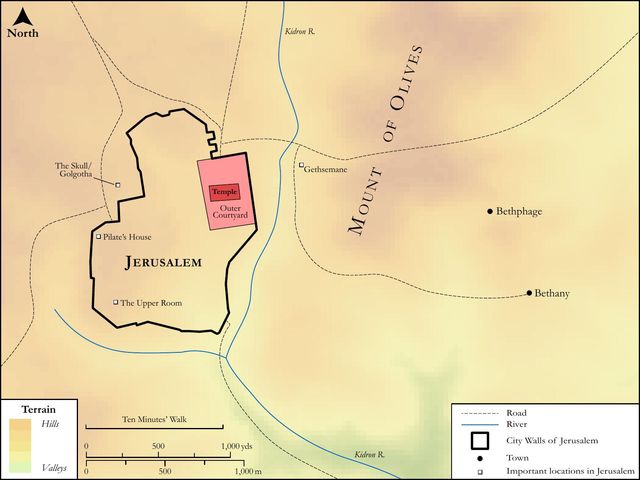
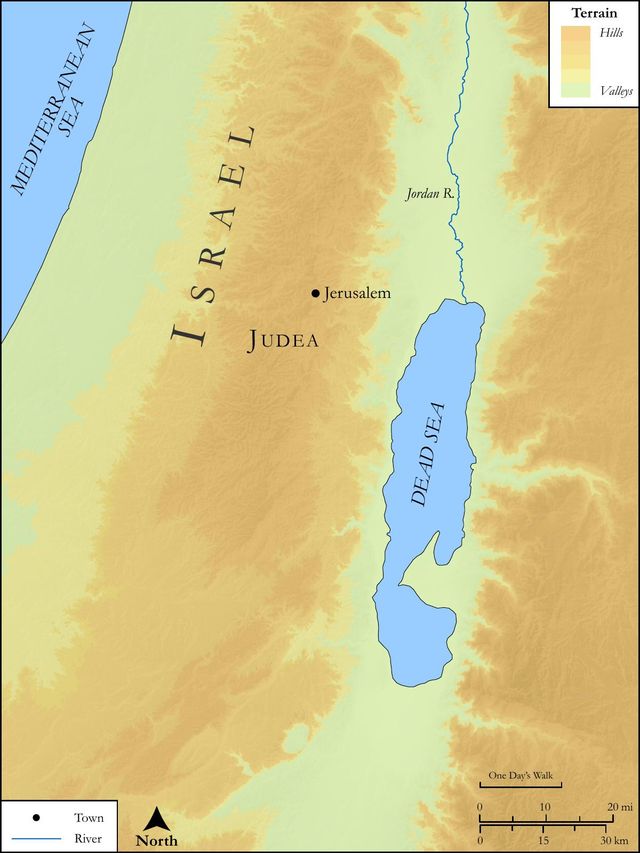
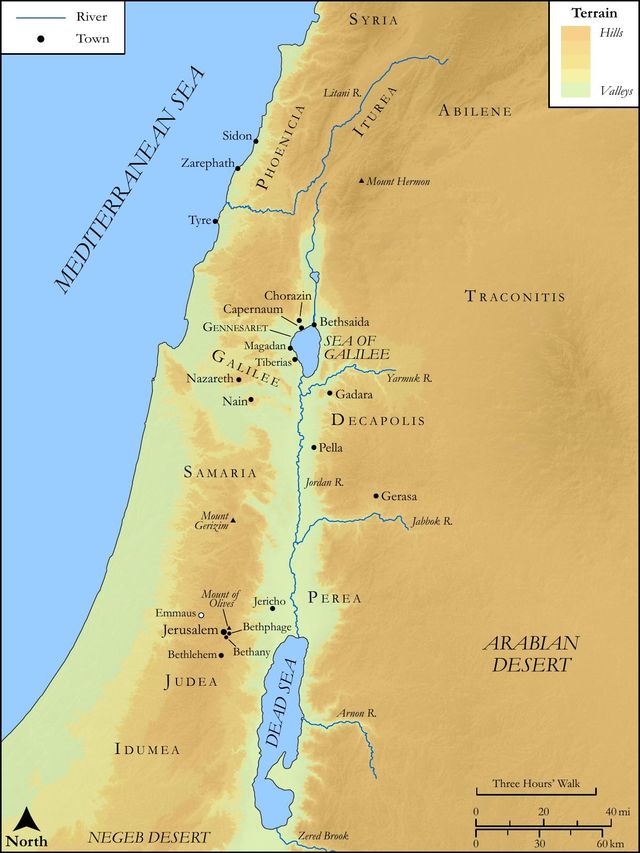
See on the biblical-era maps
Study this verse
Public-domain commentary
Matthew Henry
From his Commentary on the Whole Bible. Henry comments on passages, not single verses — this entry covers Luke 21:20–28. His two-level outline is real structure in the source text, so it is rendered as structure.
Having given them an idea of the times for about thirty-eight years next ensuing, he here comes to show them what all those things would issue in at last, namely, the destruction of Jerusalem, and the utter dispersion of the Jewish nation, which would be a little day of judgment, a type and figure of Christ's second coming, which was not so fully spoken of here as in the parallel place (Mt. 24), yet glanced at; for the destruction of Jerusalem would be as it were the destruction of the world to those whose hearts were bound up in it.
I.He tells them that they should see Jerusalem besieged, compassed with armies (Luk 21:20), the Roman armies; and, when they saw this, they might conclude that its desolation was nigh, for in this the siege would infallibly end, though it might be a long siege. Note, As in mercy, so in judgment, when God begins, he will make an end.
II.He warns them, upon this signal given, to shift for their own safety (Luk 21:21):
"Then let them that are in Judea quit the country and flee to the mountains; let them that are in the midst of it" (Of Jerusalem) "depart out, before the city be closely shut up, and" (as we say now) "before the trenches be opened; and let not them that are in the countries and villages about enter into the city, thinking to be safe there. Do you abandon a city and country which you see God has abandoned and given up to ruin. Come out of her, my people."
III.He foretels the terrible havoc that should be made of the Jewish nation (Luk 21:22):
Those are the days of vengeance so often spoken of by the Old Testament prophets, which would complete the ruin of that provoking people. All their predictions must now be fulfilled, and the blood of all the Old Testament martyrs must now be required. All things that are written must be fulfilled at length. After days of patience long abused, there will come days of vengeance; for reprieves are not pardons. The greatness of that destruction is set forth,
1.By the inflicting cause of it. It is wrath upon this people, the wrath of God, that will kindle this devouring consuming fire.
2.By the particular terror it would be to women with child, and poor mothers that are nurses. Woe to them, not only because they are most subject to frights, and least able to shift for their own safety, but because it will be a very great torment to them to think of having borne and nursed children for the murderers.
3.By the general confusion that should be all the nation over. There shall be great distress in the land, for men will not know what course to take, nor how to help themselves.
IV.He describes the issue of the struggles between the Jews and the Romans, and what they will come to at last; in short,
1.Multitudes of them shall fall by the edge of the sword. It is computed that in those wars of the Jews there fell by the sword above eleven hundred thousand. And the siege of Jerusalem was, in effect, a military execution.
2.The rest shall be led away captive; not into one nations, as when they were conquered by the Chaldeans, which gave them an opportunity of keeping together, but into all nations, which made it impossible for them to correspond with each other, much less to incorporate.
3.Jerusalem itself was trodden down of the Gentiles. The Romans, when they had made themselves masters of it, laid it quite waste, as a rebellious and bad city, hurtful to kings and provinces, and therefore hateful to them.
V.He describes the great frights that people should generally be in.
Many frightful sights shall be in the sun, moon, and stars, prodigies in the heavens, and here in this lower world, the sea and the waves roaring, with terrible storms and tempests, such as had not been known, and above the ordinary working of natural causes. The effect of this shall be universal confusion and consternation upon the earth, distress of nations with perplexity, Luk 21:25. Dr. Hammond understands by the nations the several governments or tetrarchies of the Jewish nation, Judea, Samaria, and Galilee; these shall be brought to the last extremity. Men's hearts shall fail them for fear (Luk 21:26), apopsuchontōn anthrōpōn - men being quite exanimated, dispirited, unsouled, dying away for fear. Thus those are killed all the day long by whom Christ's apostles were so (Rom 8:36), that is, they are all the day long in fear of being killed; sinking under that which lies upon them, and yet still trembling for fear of worse, and looking after those things which are coming upon the world. When judgment begins at the house of God, it will not end there; it shall be as if all the world were falling in pieces; and where can any be secure then? The powers of heaven shall be shaken, and then the pillars of the earth cannot but tremble. Thus shall the present Jewish policy, religion, laws, and government, be all entirely dissolved by a series of unparalleled calamities, attended with the utmost confusion. So Dr. Clarke. But our Saviour makes use of these figurative expressions because at the end of time they shall be literally accomplished, when the heavens shall be rolled together as a scroll, and all their powers not only shaken, but broken, and the earth and all the works that are therein shall be burnt up, Pe2 3:10, Pe2 3:12. As that day was all terror and destruction to the unbelieving Jews, so the great day will be to all unbelievers.
VI.He makes this to be a kind of appearing of the Son of man:
Then shall they see the Son of man coming in a cloud, with power and great glory, Luk 21:27. The destruction of Jerusalem was in a particular manner an act of Christ's judgment, the judgment committed to the Son of man; his religion could never be thoroughly established but by the destruction of the temple, and the abolishing of the Levitical priesthood and economy, after which even the converted Jews, and many of the Gentiles too, were still hankering, till they were destroyed; so that it might justly be looked upon as a coming of the Son of man, in power and great glory, yet not visibly, but in the clouds; for in executing such judgments as these clouds and darkness are round about him. Now this was,
1.An evidence of the first coming of the Messiah; so some understand it. Then the unbelieving Jews shall be confined, when it is too late, that Jesus was the Messiah; those that would not see him coming in the power of his grace to save them shall be made to see him coming in the power of his wrath to destroy them; those that would not have him to reign over them shall have him to triumph over them.
2.It was an earnest of his second coming. Then in the terrors of that day they shall see the Son of man coming in a cloud, and all the terrors of the last day. They shall see a specimen of it, a faint resemblance of it. If this be so terrible, what will that be?
VII.He encourages all the faithful disciples in reference to the terrors of that day (Luk 21:28):
"When these things begin to come to pass, when Jerusalem is besieged, and every thing is concurring to the destruction of the Jews, then do you look up, when others are looking down, look heavenward, in faith, hope, and prayer, and lift up your heads with cheerfulness and confidence, for your redemption draws night." 1. When Christ came to destroy the Jews, he came to redeem the Christians that were persecuted and oppressed by them; then had the churches rest. 2. When he comes to judge the world at the last day, he will redeem all that are his, from all their grievances. And the foresight of that day is as pleasant to all good Christians as it is terrible to the wicked and ungodly. Their death itself is so; when they see that day approaching, they can lift up their heads with joy, knowing that their redemption draws nigh, their removal to their Redeemer.
VIII.Here is one word of prediction that looks further than the destruction of the Jewish nation, which is not easily understood; we have it in Luk 21:24 : Jerusalem shall be trodden down of the Gentiles, till the times of the Gentiles be fulfilled.
1.Some understand it of what is past; so Dr. Hammond. The Gentiles, who have conquered Jerusalem, shall keep possession of it, and it shall be purely Gentile, till the times of the Gentiles be fulfilled, till a great part of the Gentile world shall have become Christian, and then after Jerusalem shall have been rebuilt by Adrian the emperor, with an exclusion of all the Jews from it, many of the Jews shall turn Christians, shall join with the Gentile Christians, to set up a church in Jerusalem, which shall flourish there for a long time.
2.Others understand it of what is yet to come; so Dr. Whitby. Jerusalem shall be possessed by the Gentiles, of one sort or other, for the most part, till the time come when the nations that yet remain infidels shall embrace the Christian faith, when the kingdoms of this world shall become Christ's kingdoms, and then all the Jews shall be converted. Jerusalem shall be inhabited by them, and neither they nor their city any longer trodden down by the Gentiles.
Historical interpretation
Nine Centuries of Reception
14 surviving comments on this verse. Each one is dated, so this reads as a timeline rather than a list.
Select a marker to jump to its quote. Markers stagger vertically where authors wrote within a few decades of each other.
These things, then, being to come to pass, beloved, and the one week being divided into two parts, and the abomination of desolation being manifested then, and the two prophets and forerunners of the Lord having finished their course, and the whole world finally approaching the consummation, what remains but the coming of our Lord and Saviour Jesus Christ from heaven, for whom we have looked in hope? who shall bring the conflagration and just judgment upon all who have refused to believe on Him. For the Lord says, "And when these things begin to come to pass, then look up, and lift up your heads; for your redemption draweth nigh." "And there shall not a hair of your head perish." "For as the lightning cometh out of the east, and shineth even unto the west, so shall also the coming of the Son of man be. For wheresoever the carcase is, there will the eagles be gathered together." Now the fall took place in paradise; for Adam fell there. And He says again, "Then shall the Son of man send His angels, and they shall gather together His elect from the four winds of heaven." And David also, in announcing prophetically the judgment and coming of the Lord, says, "His going forth is from the end of the heaven, and His circuit unto the end of the heaven: and there is no one hid from the heat thereof." By the heat he means the conflagration. And Esaias speaks thus: "Come, my people, enter thou into thy chamber, (and) shut thy door: hide thyself as it were for a little moment, until the indignation of the Lord be overpast." And Paul in like manner: "For the wrath of God is revealed from heaven against all ungodliness and unrighteousness of men, who hold the truth of God in unrighteousness."
"But the woman fled into the wilderness, and there were given to her two great eagle's wings." The aid of the great eagle's wings-to wit, the gift of prophets-was given to that Catholic Church, whence in the last times a hundred and forty-four thousands of men should believe on the preaching of Elias; but, moreover, he here says that the rest of the people should be found alive on the coming of the Lord. And the Lord says in the Gospel: "Then let them which are in Judea flee to the mountains; " that is, as many as should be gathered together in Judea, let them go to that place which they have ready, and let them be supported there for three years and six months from the presence of the devil.
By the desolation of Jerusalem, He means that it was never again to be set up, or its legal rites to be reestablished, so that no one should expect, after the coming siege and desolation, any restoration to take place, as there was in the time of the Persian king, Antiochus the Great, and Pompey.
Now our Lord, foreseeing that there would be a famine in the city, warned His disciples in the siege that was coming, not to betake themselves to the city as a place of refuge, and under God's protection, but rather to depart from thence, and flee to the mountains.
For so in truth it was, that when the Romans came and were taking the city, many multitudes of the Jewish people perished in the mouth of the sword; as it follows, And they shall fall by the edge of the sword. But still more were cut off by famine. And these things happened at first indeed under Titus and Vespasian, but after them in the time of Hadrian the Roman general, when the land of their birth was forbidden to the Jews. Hence it follows, And they shall be led away captive into all nations. For the Jews filled the whole land, reaching even to the ends of the earth, and when their land was inhabited by strangers, they alone could not enter it; as it follows, And Jerusalem shall be trodden down of the Gentiles, until the times of the Gentiles be fulfilled.
Woe to those pregnant women, because they are heavy in body; they are too slow to escape danger. Woe to those for whom the yet unfelt pangs of future birth, by which every body is shaken, are the signs of future judgment, the beginnings of sorrows.
For the Jews thought that the abomination of desolation took place when the Romans, in mockery of a Jewish observance, cast a pig's head into the temple.
Now mystically, the abomination of desolation is the coming of Antichrist, for with ill-omened sacrilege he pollutes the innermost recesses of the heart, sitting as it is literally in the temple, that he may claim to himself the throne of divine power. But according to the spiritual meaning, he is well brought in, because he desires to impress firmly on the affections the footstep of his unbelief, disputing from the Scriptures that he is Christ. Then shall come desolation, for very many falling away shall depart from the true religion. Then shall be the day of the Lord, since as His first coming was to redeem sin, so also His second shall be to subdue iniquity, lest more should be carried away by the error of unbelief. There is also another Antichrist, that is, the Devil, who is trying to besiege Jerusalem, i. e. the peaceful soul, with the hosts of his law. When then the Devil is in the midst of the temple, there is the desolation of abomination. But when upon any one in trouble the spiritual presence of Christ has shone, the unjust one is cast out, and righteousness begins her reign. There is also a third Antichrist, as Arius and Sabellius and all who with evil purpose lead us astray. But these are they who are with child, to whom woe is denounced, who enlarge the size of their flesh, and the step of whose inmost soul waxes slow, as those who are worn out in virtue, pregnant with vice. But neither do those with child escape condemnation, who though firm in the resolution of good acts, have not yet yielded any fruits of the work undertaken. These are those which conceive from fear of God, but do not all bring forth. For there are some which thrust forth the word abortive before their delivery. There are others too which have Christ in the womb, but have not yet formed Him. Therefore she who brings forth righteousness, brings forth Christ. Let us also hasten to nourish our children, lest the day of judgment or death find us as it were the parents of an imperfect offspring. And this you will do if you keep all the words of righteousness in your heart, and wait not the time of old age, but in your earliest years, without corruption of your body, quickly conceive wisdom, quickly nourish it. But at the end shall all Judæa be made subject to the nations which shall believe, by the mouth of the spiritual sword, which is the two-edged word. (Rev. 1:16; 19:15.)
(adv. oppug. mon. vit.) He next assigns the cause of what he had just now said, For there shall be great distress in the land, and wrath upon this people. For the miseries that took hold of them were such as, in the words of Josephus, no calamity can henceforth compare to them.
Anyone can see that he refers to that city when Christ says, "When you shall see Jerusalem surrounded by an army, then know that its desolation is near." Anyone can see that these words refer to the last coming of the Lord when he says, "When you shall see these things come to pass, know that the kingdom of God is near." When he says, "Alas for those who are with child and for those who give suck in those days! Pray that your flight may not be in winter or on a sabbath. For then there will be great tribulation, such as has not been from the beginning of the world until now, no, and never will be." This passage is phrased in this way in Matthew and Mark so that it is uncertain whether it is to be understood of the destruction of the city or of the end of the world.… Luke has so arranged it that it seems to refer to the destruction of that city.
(ad Hesych. Ep. 199.) These words of our Lord, Luke has here related to show, that the abomination of desolation which was prophesied by Daniel, and of which Matthew and Mark had spoken, (Mat. 24, Mark 13.) was fulfilled at the siege of Jerusalem.
(ut sup.) And before this, Matthew and Mark said, And let him that is on the housetop not come down into his house; and Mark added, neither enter therein to take any thing out of his house; in place of which Luke subjoins, And let them which are in the midst of it depart out.
(uti sup.) But where Matthew and Mark have written, Neither let him which is in the field return back to take his clothes, Luke adds more clearly, And let not them that are in the countries enter thereinto, for these be the days of vengeance, that all the things which are written may be fulfilled.
(ubi sup.) Then Luke follows in words similar to those of the other two; But woe to them that are with child, and them that give suck in those days; and thus has made plain what might otherwise have been doubtful, namely, that what was said of the abomination of desolation belonged not to the end of the world, but the taking of Jerusalem.
To make his prediction even clearer and to mark more plainly the time of its capture, Jesus says, “When you have seen Jerusalem surrounded with armies, then know that its destruction is near.” Afterwards, he again transfers his words from this subject to the time of the consummation. He says, “There will be signs in sun and moon and stars, and upon the earth distress of nations in perplexity at the roaring of the sea and the waves, men fainting with fear and with foreboding of what is coming on the world; for the powers of the heavens will be shaken.” Since creation begins to be changed and brings unendurable terrors on the inhabitants of earth, there will be a certain fearful tribulation. There will also be souls departing to death. The unendurable fear of those things that are coming will be sufficient for the destruction of many.
(Hom. 35. in Ev.) By patience then we possess our souls, because when we are said to govern ourselves, we begin to possess that very thing which we are. But for this reason, the possession of the soul is laid in the virtue of patience, because patience is the root and guardian of all virtues. Now patience is to endure calmly the evils which are inflicted by others, and also to have no feeling of indignation against him who inflicts them.
Then let those who are in Judea flee to the mountains. The ecclesiastical history narrates that all the Christians who were in Judea, warned by the Lord at the imminent destruction of Jerusalem, left the place, and until the desolation of Judea was fulfilled, lived in a certain city named Pella across the Jordan.
And those who are in the midst of it, let them depart. And those who are in the regions, let them not enter into it. For these are the days of vengeance, that all things which are written may be fulfilled. It indeed seems to pertain to appropriate admonition, that those who are outside should not enter into it, but how will those who are in the midst depart from a city already surrounded by an army? Unless perhaps what was stated before, that is, then those who are in Judea should flee, does not pertain to the exact time of the siege, but to the time before the siege, when the Roman soldiers first began to spread through the boundaries of Galilee or Samaria, so that then everyone would hasten to flee while there was still time for flight. But these are the days of vengeance, namely seeking vengeance for the blood of the Lord.
Hitherto our Lord had been speaking of those things which were to come to pass for forty years, the end not yet coming. He now describes the very end itself of the desolation, which was accomplished by the Roman army; as it is said, And when ye shall see Jerusalem compassed, &c.
(Ecc. Hist. lib. iii. c. 5.) The ecclesiastical history relates, that all the Christians who were in Judæa, when the destruction of Jerusalem was approaching, being warned of the Lord, departed from that place, and dwelt beyond the Jordan in a city called Pella, until the desolation of Judæa was ended.
But how, while the city was already compassed with an army, were they to depart out? except that the preceding word "then" is to be referred, not to the actual time of the siege, but the period just before, when first the armed soldiers began to disperse themselves through the parts of Galilee and Samaria.
And these are the days of vengeance, that is, the days exacting vengeance for our Lord's blood.
He says then, Woe to them that nurse, or give suck, as some interpret it, whose womb or arms now heavy with the burden of children, cause no slight obstacle to the speed of flight.
Which indeed the Apostle makes mention of when he says, Blindness in part is happened to Israel, and so all Israel shall be saved. (Rom. 11:25.) Which when it shall have gained the promised salvation, hopes not rashly to return to the land of its fathers.
But some say that the Lord hereby signified the devouring of children, which Josephus also relates.
Continue studying Luke 21:21 across the web’s major study libraries — every link below opens this exact verse, chapter, or book on the destination site.
Read & Compare
 BibleGatewayThis verse in more than 200 translations and 70 languages.
 Bible.comThe YouVersion reader — hundreds of translations, reading plans, and highlights.
 ESV.orgCrossway's official English Standard Version reader.
 NET BibleThe NET translation with 60,000+ translators' notes on every rendering decision.
 STEP BibleTyndale House's free study tool — original text, vocabulary, and scholarly resources.
 BibliaLogos Bible Software's free web reader.
 USCCBThe New American Bible (Revised Edition) with the U.S. bishops' study notes.
Commentaries
 BibleHub CommentariesDozens of classic commentaries on this verse, gathered on one page.
 StudyLightMore than 100 commentary sets — the largest collection on the web.
 BibleRefPlain-English commentary on what this verse means, verse by verse.
 Enduring WordDavid Guzik's free commentary on this chapter, widely used by Bible teachers.
 Bible Study ToolsVerse commentary alongside Greek and Hebrew study aids.
Original Language & Research
- BibleHub InterlinearThe verse word by word — original language, transliteration, and English.
- BibleHub LexiconEvery word's original-language definition and Strong's entry.
 Blue Letter BibleDeep-study tools — Strong's numbers, concordance, and word studies.
 CNTR CollationThe earliest Greek manuscripts of this verse, collated letter by letter.
Sermons, Hymns & Audio


TrulyRandomVerse is not affiliated with these sites and doesn’t control their content. They’re linked because they’re genuinely useful.
Summary
Luke 21:21 presents a critical and urgent directive from Jesus to His followers, instructing them on how to respond to the impending signs of Jerusalem's destruction. This verse, part of the Olivet Discourse, provides specific geographical instructions for flight and avoidance, emphasizing the necessity of immediate action to escape the catastrophic events prophesied to befall the city and its surrounding region. It serves as a compassionate warning, offering a path of preservation amidst divine judgment.
Context
ShowHideLiterary Context
Luke 21:21 is a direct continuation and elaboration of Jesus' prophetic discourse concerning the destruction of Jerusalem and the signs of the end times, often referred to as the Olivet Discourse (Luke 21:5-36; cf. Matthew 24; Mark 13). Specifically, it follows Jesus' explicit warning in Luke 21:20, where He states, "And when ye shall see Jerusalem compassed with armies, then know that the desolation thereof is nigh." Verse 21 provides the actionable response to this specific sign, detailing where people should flee from and where they should not enter. The subsequent verses (e.g., Luke 21:22-24) further describe the severity of the coming judgment, reinforcing the urgency of the flight commanded in verse 21. This immediate context underscores the practical, life-saving nature of Jesus' counsel.
Historical & Cultural Context
The prophecy in Luke 21:21, along with its parallels, is widely understood to refer to the Roman-Jewish War (66-73 AD) and, most acutely, the Roman siege and destruction of Jerusalem in 70 AD. At this time, Jerusalem was the spiritual and political heart of Judaism, with the Temple being its central feature. Roman rule was often oppressive, leading to frequent rebellions and tensions. The Jewish people largely anticipated a Messiah who would deliver them from Roman oppression, not one who would foretell the destruction of their holy city. Mountains, in ancient Israel, often served as natural fortresses and places of refuge during times of war or invasion, as seen throughout Old Testament narratives. The instruction to flee to the mountains and avoid entering the city reflects a practical understanding of siege warfare, where those trapped within city walls faced starvation, disease, and the sword, while those outside might find safety in rugged terrain. The instruction not to enter the city also highlights the danger for those in the surrounding "countries" or rural areas who might instinctively seek refuge within Jerusalem's walls, unaware of its impending doom.
Key Themes
ShowHideThis verse powerfully contributes to several overarching themes in Luke's Gospel and biblical prophecy. First, it highlights Divine Warning and Providence, demonstrating Jesus' omniscience and God's compassionate forewarning to His people, providing a means of escape from impending judgment. This theme is consistent with God's character throughout Scripture, from Noah's ark to the warnings given to Lot before Sodom's destruction. Second, it underscores the theme of Urgency and Immediate Action. The rapid succession of commands—"flee," "depart out," "let not them... enter"—emphasizes that there would be no time for hesitation once the specified sign appeared. Third, the passage stresses the importance of Spiritual Discernment and Obedience. Survival depended on recognizing the prophetic sign (Jerusalem surrounded by armies, as per Luke 21:20) and acting in immediate obedience to Jesus' seemingly counter-intuitive instructions, rather than relying on conventional wisdom or nationalistic fervor. Finally, it illustrates the principle of Separation from Impending Judgment, a recurring motif where God calls His faithful to separate themselves from places or systems destined for divine wrath, ensuring their preservation.
Exposition and Analysis
ShowHideKey Word Analysis
ShowHideThis verb signifies to run away, escape, or take flight. It conveys a sense of urgency and necessity to remove oneself from danger quickly. In this context, it is not merely a suggestion but a vital command for self-preservation, indicating that remaining would lead to dire consequences.
Composed of "ek" (out of) and "chōreō" (to go, make room), this word literally means "to go out of a place," or "to depart." It emphasizes a decisive movement from within the city to outside its confines, reinforcing the idea of evacuation. The command is for those already inside Jerusalem to exit immediately.
Formed from "eis" (into) and "erchomai" (to come, go), this verb means "to come into," "to go in," or "to enter." In Luke 21:21, it is used with a negative particle ("let not... enter"), forming a prohibition. This specific instruction warns those outside the city, perhaps in the surrounding "countries" (chōra), not to seek refuge within Jerusalem, as its walls would become a trap rather than a sanctuary.
Verse Breakdown
ShowHide"Then let them which are in Judaea flee to the mountains"
This clause provides the initial, primary instruction for those residing in the broader region of Judaea, the province surrounding Jerusalem. Upon seeing the sign of armies surrounding Jerusalem (as per Luke 21:20), residents of Judaea are to immediately seek refuge in the mountainous terrain. This was a common strategy for survival during ancient sieges, as mountains offered natural barriers, hiding places, and often access to resources away from the immediate conflict zone. The command implies a swift, non-negotiable departure.
"and let them which are in the midst of it depart out"
This segment addresses those specifically located within Jerusalem itself ("in the midst of it"). The instruction is to "depart out," meaning to exit the city. This implies that even if one is within the presumed safety of the city walls, the true danger lies within during this specific judgment. This directive would have been particularly challenging to obey, as people naturally seek refuge within fortified cities during times of war. However, Jesus' warning indicates that Jerusalem would become a death trap.
"and let not them that are in the countries enter thereinto"
This final clause extends the warning to those in the rural areas or "countries" (chōra) surrounding Jerusalem. It is a prohibition, explicitly forbidding them from entering the city. During times of conflict, people from rural areas often fled to the perceived safety of fortified cities. Jesus' counter-intuitive command here reveals that Jerusalem would offer no safety; instead, it would be the epicenter of destruction. This instruction underscores the comprehensive nature of the impending judgment and the precise guidance given for avoidance.
Literary Devices
ShowHideLuke 21:21 employs several significant literary devices to convey its urgent message. Imperative Mood is dominant, with verbs like "let them flee," "let them depart out," and "let not them... enter" functioning as direct commands. This grammatical choice emphasizes the non-negotiable and critical nature of Jesus' instructions, demanding immediate and decisive action from His audience. The verse also utilizes Geographical Specificity, clearly delineating three distinct locations: "Judaea," "the midst of it" (referring to Jerusalem), and "the countries" (surrounding rural areas). This precision ensures that the audience understands exactly who is being addressed and what action is required in each location, leaving no room for ambiguity regarding the scope of the warning. Furthermore, there is a clear element of Antithesis or Contrast in the instructions: flee from the city to the mountains, depart out of the city, and do not enter into the city. This stark contrast highlights the reversal of conventional wisdom—where a city is typically a refuge—and underscores the unique danger Jerusalem would pose during this specific period of judgment.
Theological and Thematic Connections
ShowHideLuke 21:21 is a profound testament to God's foreknowledge and His compassionate desire to warn and preserve His people even in the face of impending judgment. It underscores the principle that divine warnings, though often counter-intuitive to human reasoning, are given for our ultimate good and require immediate, obedient response. The historical fulfillment of this prophecy in 70 AD, where early Christians reportedly fled Jerusalem and were spared, serves as a powerful demonstration of the efficacy of heeding God's word. This passage reminds believers across all ages of the importance of spiritual discernment, watchfulness, and radical obedience when confronted with God's prophetic declarations, whether concerning historical events or ultimate eschatological realities. It is a call to prioritize God's instructions over worldly security or popular opinion, trusting in His sovereign plan for preservation.
Reflection and Application
ShowHideLuke 21:21, though historically fulfilled, carries timeless principles for believers today. It challenges us to cultivate a spirit of spiritual watchfulness and discernment, recognizing that God often provides warnings, both explicit and implicit, about impending dangers—whether physical, spiritual, or societal. The urgency in Jesus' command to "flee" and "depart out" speaks to the critical importance of immediate obedience when God's will is made clear. Procrastination or hesitation in responding to divine warnings can have severe consequences. This passage also reminds us that true safety is found not in human institutions or perceived strongholds, but in obedience to God's directives. It calls us to examine where we place our ultimate trust and security. Are we willing to abandon what seems safe or comfortable if God calls us to a different path? Ultimately, Luke 21:21 encourages a life of active faith, where we are attuned to God's voice, ready to respond with courage and conviction, trusting that His commands, even when difficult, always lead to our preservation and flourishing.
Questions for Reflection
ShowHideFAQ
ShowHideWas Jesus' warning in Luke 21:21 exclusively for people living in the 1st century, or does it have broader relevance?
ShowHideWhile Jesus' warning in Luke 21:21 had a specific, direct fulfillment in the Roman destruction of Jerusalem in 70 AD, its underlying principles are broadly relevant for all believers across time. The historical event serves as a powerful object lesson. The passage teaches us about God's foreknowledge, His compassion in providing warnings, and the critical importance of immediate obedience to divine directives. It underscores the need for spiritual discernment to recognize "signs of the times" (whether personal, societal, or eschatological) and the wisdom of separating oneself from impending judgment or spiritual peril. Therefore, while the literal command to flee to the mountains of Judea is specific to that historical context, the call to heed God's warnings and act in faith remains timeless.
How did early Christians respond to this warning, and what was the outcome?
ShowHideHistorical accounts, particularly from Eusebius of Caesarea (in his Ecclesiastical History), indicate that early Christians in Jerusalem and Judea heeded Jesus' warning. When the Roman general Cestius Gallus briefly withdrew his forces from Jerusalem in 66 AD, creating a window of opportunity, many Christians fled the city. They reportedly sought refuge in Pella, a city in the Decapolis region east of the Jordan River. This timely departure saved them from the horrific siege, famine, and slaughter that occurred when Roman forces under Titus returned in 70 AD, leading to the complete destruction of Jerusalem and its Temple. This historical fulfillment stands as a powerful testament to the accuracy of Jesus' prophecy and the life-saving nature of obedience to His commands.
Christ-Centered Fulfillment
ShowHideLuke 21:21, while a warning of temporal judgment, ultimately points to Christ as the ultimate refuge and deliverer. The flight from Jerusalem prefigures the greater spiritual "fleeing" that all humanity must undertake: a turning away from the coming wrath against sin, found only in Jesus Christ. Just as physical flight saved lives from the Roman armies, spiritual flight to Christ saves souls from eternal condemnation. Jesus, who gave the warning in Luke 21:21, is Himself the "mountain" of refuge, the "strong tower" into which the righteous run and are safe (Proverbs 18:10). His commands to "flee" from the world's impending judgment are fulfilled in the call to repentance and faith in Him. He is the one who bears the judgment we deserve, offering salvation and eternal security to all who come to Him (John 3:16). The historical preservation of those who heeded Jesus' warning in 70 AD serves as a tangible illustration of the spiritual preservation offered to all who believe in the Lamb of God, who takes away the sin of the world (John 1:29), and who promises to deliver His elect from the greater tribulation to come (Matthew 24:29-31). Thus, the urgency to flee from Jerusalem is echoed in the urgency to flee to Christ, who is our ultimate sanctuary and hope.