


Luke 19:26
Bible text: King James Version (1769 Blayney text) · Public domain
Bible text: King James Version with Strong's numbers · Public domain
Bible text: Berean Standard Bible · Public domain
Bible text: American Standard Version (1901) · Public domain
Bible text: World English Bible, Messianic edition · Public domain
Bible text: Geneva Bible (1599) · Public domain
Bible text: Young's Literal Translation · Public domain
- λέγωlegōI sayG3004V-PAI-1SVerb Present Active Indicative 1st Singular
- γὰρgarforG1063CONJConjunction
- ὑμῖνhuminto youG4771P-2DPPersonal pronoun Dative 2nd Plural
- ὅτιhotithatG3754CONJConjunction
- παντὶpantito everyoneG3956A-DSMAdjective Dative Singular Masculine
- τῷtōwhoG3588T-DSMDefinite article Dative Singular Masculine
- ἔχοντιechontiis havingG2192V-PAP-DSMVerb Present Active Participle Dative Singular Masculine
- δοθήσεταιdothēsetaiwill be givenG1325V-FPI-3SVerb Future Passive Indicative 3rd Singular
- ἀπὸapofromG575PREPPreposition
- δὲdehoweverG1161CONJConjunction
- τοῦtouthe [one]G3588T-GSMDefinite article Genitive Singular Masculine
- μὴmēnotG3361PRT-NNegative Particle Negative
- ἔχοντοςechontoshavingG2192V-PAP-GSMVerb Present Active Participle Genitive Singular Masculine
- καὶkaievenG2532CONJConjunction
- ὃhothat whichG3739R-ASNRelative pronoun Accusative Singular Neuter
- ἔχειecheihe hasG2192V-PAI-3SVerb Present Active Indicative 3rd Singular
- ἀρθήσεταιarthēsetaiwill be taken awayG142V-FPI-3SVerb Future Passive Indicative 3rd Singular
- ἀπ᾽ap᾽fromG575PREPPreposition
- αὐτοῦautouof himG846P-GSMPersonal pronoun Genitive Singular Masculine
English is a literal word-by-word gloss of the Greek, not the KJV's wording. Why?
This is the original text the KJV's translators worked from — each Greek word with its own literal English meaning in this verse, prepared by scholars at Tyndale House, Cambridge. The KJV translates whole sentences, not word by word, so its wording differs: one Greek word can become several English words, and the KJV may choose “charity” where the gloss reads “love”. Both are faithful — they answer different questions. For the KJV's own rendering, switch to the KJV text.
Details
See on the biblical-era maps


Study this verse
Public-domain commentary
Matthew Henry
From his Commentary on the Whole Bible. Henry comments on passages, not single verses — this entry covers Luke 19:11–27. His four-level outline is real structure in the source text, so it is rendered as structure.
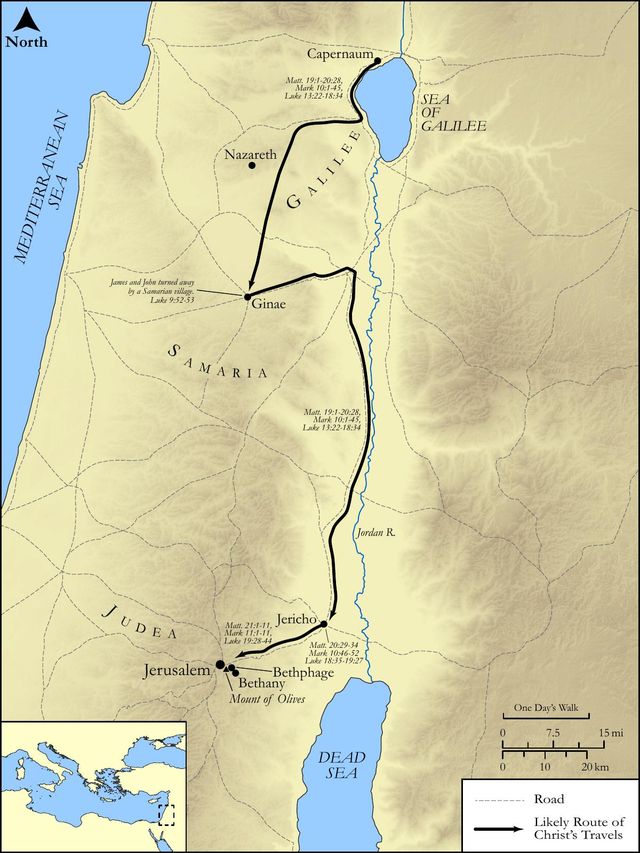
Our Lord Jesus is now upon his way to Jerusalem, to his last passover, when he was to suffer and die; now here we are told,
I.How the expectations of his friends were raised upon this occasion:
They thought that the kingdom of God would immediately appear, Luk 19:11. The Pharisees expected it about this time (Luk 17:20), and, it seems, so did Christ's own disciples; but they both had a mistaken notion of it. The Pharisees thought that it must be introduced by some other temporal prince or potentate. The disciples thought that their Master would introduce it, but with temporal pomp and power, which, with the power he had to work miracles, they knew he could clothe himself with in a short time, whenever he pleased. Jerusalem, they concluded, must be the seat of his kingdom, and therefore, now that he is going directly thither, they doubt not but in a little time to see him upon the throne there. Note, Even good men are subject to mistakes concerning the kingdom of Christ, and to form wrong notions of it, and are ready to think that will immediately appear which is reserved for hereafter.
II.How their expectations were checked, and the mistakes rectified upon which they were founded; and this he does in three things: -
1.They expected that he should appear in his glory now presently, but he tells them that he must not be publicly installed in his kingdom for a great while yet. He is like a certain nobleman anthrōpos tis eugenēs - a certain man of high birth (so Dr. Hammond), for he is the Lord from heaven, and is entitled by birth to the kingdom; but he goes into a far country, to receive for himself a kingdom. Christ must go to heaven, to sit down at the right hand of the Father there, and to receive from him honour and glory, before the Spirit was poured out by which his kingdom was to be set up on earth, and before a church was to be set up for him in the Gentile world. He must receive the kingdom, and then return. Christ returned when the Spirit was poured out, when Jerusalem was destroyed, by which time that generation, both of friends and enemies, which he had personally conversed with, was wholly worn off by death, and gone to give up their account. But his chief return here meant is that at the great day, of which we are yet in expectation. That which they thought would immediately appear, Christ tells them will not appear till this same Jesus who is taken into heaven shall in like manner come again; see Act 1:11.
2.They expected that his apostles and immediate attendants should be advanced to dignity and honour, that they should all be made princes and peers, privy-counsellors and judges, and have all the pomp and preferments of the court and of the town. But Christ here tells them that, instead of this, he designed them to be men of business; they must expect no other preferment in this world than that of the trading end of the town; he would set them up with a stock under their hands, that they might employ it themselves, in serving him and the interest of his kingdom among men. That is the true honour of a Christian and a minister which, if we be as we ought to be truly ambitious of it, will enable us to look upon all temporal honours with a holy contempt. The apostles had dreamed of sitting on his right hand and on his left in his kingdom, enjoying ease after their present toil and honour after the present contempt put upon them, and were pleasing themselves with this dream; but Christ tells them that which, if they understood it aright, would fill them with care, and concern, and serious thoughts, instead of those aspiring ones with which they filled their heads.
(1.)They have a great work to do now. Their Master leaves them, to receive his kingdom, and, at parting, he gives each of them a pound, which the margin of our common bibles tells us amounts in our money to three pounds and half a crown; this signifies the same thing with the talents in the parable that is parallel to this (Mt. 25), all the gifts with which Christ's apostles were endued, and the advantages and capacities which they had of serving the interests of Christ in the world, and others, both ministers and Christians, like them in a lower degree. But perhaps it is in the parable thus represented to make them the more humble; their honour in this world is only that of traders, and that not of first-rate merchants, who have vast stocks to begin upon, but that of poor traders, who must take a great deal of care and pains to make any thing of what they have. He gave these pounds to his servants, not to buy rich liveries, much less robes, and a splendid equipage, for themselves to appear in, as they expected, but with this charge: Occupy till I come. Or, as it might much better be translated, Trade till I come, Pragmateusasthe - Be busy. So the word properly signifies. "You are sent forth to preach the gospel, to set up a church for Christ in the world, to bring the nations to the obedience of faith, and to build them up in it. You shall receive power to do this, for you shall be filled with the Holy Ghost," Act 1:8. When Christ breathed on the eleven disciples, saying, Receive ye the Holy Ghost, then he delivered them ten pounds. "Now," saith he, "mind your business, and make a business of it; set about it in good earnest, and stick to it. Lay out yourselves to do all the good you can to the souls of men, and to gather them in to Christ." Note,
[1.]All Christians have business to do for Christ in this world, and ministers especially; the former were not baptized, nor the latter ordained, to be idle.
[2.]Those that are called to business for Christ he furnishes with gifts necessary for their business; and, on the other hand, from those to whom he gives power he expects service. He delivers the pounds with this charge, Go work, go trade. The manifestation of the Spirit is given to every man to profit withal, Co1 12:7. And as every one has received the gift, so let him minister the same, Pe1 4:10.
[3.]We must continue to mind our business till our Master comes, whatever difficulties or oppositions we may meet with in it; those only that endure to the end shall be saved.
(2.)They have a great account to make shortly. These servants are called to him, to show what use they made of the gifts they were dignified with, what service they had done for Christ, and what good to the souls of men, that he might know what every man had gained by trading. Note,
[1.]They that trade diligently and faithfully in the service of Christ shall be gainers. We cannot say so of the business of the world; many a labouring tradesman has been a loser; but those that trade for Christ shall be gainers; though Israel be not gathered, yet they will be glorious.
[2.]The conversion of souls is the winning of them; every true convert is clear gain to Jesus Christ. Ministers are but factors for him, and to him they must give account what fish they have enclosed in the gospel-net, what guests they have prevailed with to come to the wedding-supper; that is, what they have gained by trading. Now observe,
First, The good account which was given by some of the servants, and the master's approbation of them. Two such are instanced, Luk 19:16, Luk 19:19. 1. They had both made considerable improvements, but not both alike; one had gained ten pounds by his trading, and another five. Those that are diligent and faithful in serving Christ are commonly blessed in being made blessings to the places where they live. They shall see the travail of their soul, and not labour in vain. And yet all that are alike faithful are not alike successful. And perhaps, though they were both faithful, it is intimated that one of them took more pains, and applied himself more closely to his business, than the other, and sped accordingly. Blessed Paul was surely this servant that gained ten pounds, double to what any of the rest did, for he laboured more abundantly than they all, and fully preached the gospel of Christ. 2. They both acknowledged their obligations to their Master for entrusting them with these abilities and opportunities to do him service: Lord, it is not my industry, but thy pound, that has gained ten pounds. Note, God must have all the glory of all our gains; not unto us, but unto him, must be the praise, Psa 115:1. Paul, who gained the ten pounds, acknowledges, "I laboured, yet not I. By the grace of God, I am what I am, and do what I do; and his grace was not in vain," Co1 15:10. He will not speak of what he had done, but of what God had done by him, Rom 15:18. 3. They were both commended for their fidelity and industry: Well done, thou good servant, Luk 19:17. And to the other he said likewise, Luk 19:19. Note, They who do that which is good shall have praise of the same. Do well, and Christ will say to thee, Well done: and, if he says Well done, the matter is not great who says otherwise. See Gen 4:7. 4. They were preferred in proportion to the improvement they had made: "Because thou hast been faithful in a very little, and didst not say, 'As good sit still as go to trade with one pound, what can one do with so small a stock?' but didst humbly and honestly apply thyself to the improvement of that, have thou authority over ten cities." Note, Those are in a fair way to rise who are content to begin low. He that has used the office of a deacon well purchaseth to himself a good degree, Ti1 3:13. Two things are hereby promised the apostles: - (1.) That when they have taken pains to plant many churches they shall have the satisfaction and honour of presiding in them, and governing among them; they shall have great respect paid them, and have a great interest in the love and esteem of good Christians. He that keepeth the fig-tree shall eat the fruit thereof; and he that laboureth in the word and doctrine shall be counted worthy of double honour. (2.) That, when they have served their generation, according to the will of Christ, though they pass through this world despised and trampled upon, and perhaps pass out of it under disgrace and persecution as the apostles did, yet in the other world they shall reign as kings with Christ, shall sit with him on his throne, shall have power over the nations, Rev 2:26. The happiness of heaven will be a much greater advancement to a good minister or Christian than it would be to a poor tradesman, that with much ado had cleared ten pounds, to be made governor of ten cities. He that had gained but five pounds had dominion over five cities. This intimates that there are degrees of glory in heaven; every vessel will be alike full, but not alike large. And the degrees of glory there will be according to the degrees of usefulness here.
Secondly, The bad account that was given by one of them, and the sentence passed upon him for his slothfulness and unfaithfulness, Luk 19:20, etc. 1. He owned that he had not traded with the pound with which he had been entrusted (Luk 19:20): "Lord, behold, here is thy pound; it is true, I have not made it more, but withal I have not made it less; I have kept it safely laid up in a napkin." This represents the carelessness of those who have gifts, but never lay out themselves to do good with them. It is all one to them whether the interests of Christ's kingdom sink or swim, go backward or forward; for their parts, they will take no care about it, no pains, be at no expenses, run no hazard. Those are the servants that lay up their pound in a napkin who think it enough to say that they have done no hurt in the world, but did no good. 2. He justified himself in his omission, with a plea that made the matter worse and not better (Luk 19:21): I feared thee, because thou art an austere man, rigid and severe, anthrōpos austēros ei. Austere is the Greed word itself: a sharp man: Thou takest up that which thou laidst not down. He thought that his master put a hardship upon his servants when he required and expected the improvement of their pounds, and that it was reaping where he did not sow; whereas really it was reaping where he had sown, and, as the husbandman, expecting in proportion to what he had sown. He had no reason to fear his master's austerity, nor blame his expectations, but this was a mere sham, a frivolous groundless excuse for his idleness, which there was no manner of colour for. Note, The pleas of slothful professors, when they come to be examined, will be found more to their shame than in their justification. 3. His excuse is turned upon him: Out of thine own mouth will I judge thee, thou wicked servant, Luk 19:22. He will be condemned by his crime, but self-condemned by his plea. "If thou didst look upon it as hard that I should expect the profit of thy trading, which would have been the greater profit, yet, if thou hadst had any regard to my interest, thou mightest have put my money into the bank, into some of the funds, that I might have had, not only my own, but my own with usury, which, though a less advantage, would have been some." If he durst not trade for fear of losing the principal, and so being made accountable to his lord for it though it was lost, which he pretends, yet that would be no excuse for his not setting it out to interest, where it would be sure. Note, Whatever may be the pretences of slothful professors, in excuse of their slothfulness, the true reason of it is a reigning indifference to the interests of Christ and his kingdom, and their coldness therein. They care not whether religion gets around or loses ground, so they can but live at ease. 4. His pound is taken from him, Luk 19:24. It is fit that those should lose their gifts who will not use them, and that those who have dealt falsely should be no longer trusted. Those who will not serve their Master with what he bestows upon them, why should they be suffered to serve themselves with it? Take from him the pound. 5. It is given to him that had the ten pounds. When this was objected against by the standers-by, because he had so much already (Lord, he has ten pounds, Luk 19:25), it is answered (Luk 19:26), Unto every one that hath shall be given. It is the rule of justice, (1.) That those should be most encouraged who have been most industrious, and that those who have laid out themselves most to do good should have their opportunities of doing good enlarged, and be put into a higher and more extensive sphere of usefulness. To him that hath gotten shall more be given, that he may be in a capacity to get more. (2.) That those who have their gifts, as if they had them not, who have them to no purpose, who do no good with them, should be deprived of them. To those who endeavour to increase the grace they have, God will impart more; those who neglect it, and suffer it to decline, can expect no other than that God should do so too. This needful warning Christ gives to his disciples, lest, while they were gaping for honours on earth, they should neglect their business, and so come short of their happiness in heaven.
3.Another thing they expected was, that, when the kingdom of God should appear, the body of the Jewish nation would immediately fall in with it, and submit to it, and all their aversions to Christ and his gospel would immediately vanish; but Christ tells them that, after his departure, the generality of them would persist in their obstinacy and rebellion, and it would be their ruin. This is shown here,
(1.)In the message which his citizens sent after him, Luk 19:14. They not only opposed him, while he was in obscurity; but, when he was gone into glory, to be invested in his kingdom, then they continued their enmity to him, protested against his dominion, and said, We will not have this man to reign over us.
[1.]This was fulfilled in the prevailing infidelity of the Jews after the ascension of Christ, and the setting up of the gospel kingdom. They would not submit their necks to his yoke, nor touch the top of his golden sceptre. They said, Let us break his bands in sunder, Psa 2:1-3; Act 4:26.
[2.]It speaks the language of all unbelievers; they could be content that Christ should save them, but they will not have him to reign over them; whereas Christ is a Saviour to those only to whom he is a prince, and who are willing to obey him.
(2.)In the sentence passed upon them at his return: Those mine enemies bring hither, Luk 19:27. When his faithful subjects are preferred and rewarded, then he will take vengeance on his enemies, and particularly on the Jewish nation, the doom of which is here read. When Christ had set up his gospel kingdom, and thereby put reputation upon the gospel ministry, then he comes to reckon with the Jews; then it is remembered against them that they had particularly disclaimed and protested against his kingly office, when they said, We have no king but Caesar, nor would own him for their king. They appealed to Caesar, and to Caesar they shall go; Caesar shall be their ruin. Then the kingdom of God appeared when vengeance was taken on those irreconcileable enemies to Christ and his government; they were brought forth and slain before him. Never was so much slaughter made in any war as in the wars of the Jews. That nation lived to see Christianity victorious in the Gentile world, in spite of their enmity and opposition to it, and then it was taken away as dross. The wrath of Christ came upon them to the uttermost (Th1 2:15, Th1 2:16), and their destruction redounded very much to the honour of Christ and the peace of the church. But this is applicable to all others who persist in their infidelity, and will undoubtedly perish in it. Note,
[1.]Utter ruin will certainly be the portion of all Christ's enemies; in the day of vengeance they shall all be brought forth, and slain before him. Bring them hither, to be made a spectacle to saints and angels; see Jos 10:22, Jos 10:24. Bring them hither, that they may see the glory and happiness of Christ and his followers, whom they hated and persecuted. Bring them hither, to have their frivolous pleas overruled, and to receive sentence according to their merits. Bring them, and slay them before me, as Agag before Samuel. The Saviour whom they have slighted will stand by and see them slain, and not interpose on their behalf.
[2.]Those that will not have Christ to reign over them shall be reputed and dealt with as his enemies. We are ready to think that none are Christ's enemies but persecutors of Christianity, or scoffers at least; but you see that those will be accounted so that dislike the terms of salvation, will not submit to Christ's yoke, but will be their own masters. Note, Whoever will not be ruled by the grace of Christ will inevitably be ruined by the wrath of Christ.
Historical interpretation
Eleven Centuries of Reception
13 surviving comments on this verse. Each one is dated, so this reads as a timeline rather than a list.
Select a marker to jump to its quote. Markers stagger vertically where authors wrote within a few decades of each other.
For they declare that we simply receive grace for use, wherefore also it will again be taken away from us; but that they themselves have grace as their own special possession, which has descended from above by means of an unspeakable and indescribable conjunction; and on this account more will be given them.
But knowledge, conveyed from communication through the grace of God as a deposit, is entrusted to those who show themselves worthy of it; and from it the worth of love beams forth from light to light. For it is said, "To him that hath shall be given: "
There were some who thought that our Saviour's kingdom would commence at His first coming, and they were expecting it shortly to appear when He was preparing to go up to Jerusalem; so astonished were they by the divine miracles which He did. He therefore informs them, that He should not receive the kingdom from His Father until He had left mankind to go to His Father.
Or by His setting out into a far country, He denotes His own ascension from earth to heaven. But when He adds, To receive for himself a kingdom, and to return; He points out His second appearance, when He shall come as a King and in great glory. He first of all calls Himself a man, because of His nativity in the flesh, then noble; not yet a King, because as yet at His first appearance He exercised no kingly power. It is also well said to obtain for Himself a kingdom, according to Daniel, Behold one like the Son of man came with the clouds of heaven, and a kingdom was given to him. (Dan. 7:13.)
By those then who receive the pounds, He means His disciples, giving a pound to each, since He entrusts to all an equal stewardship; He bade them put it out to use, as it follows, Occupy till I come. Now there was no other employment but to preach the doctrine of His kingdom to those who would hear it. But there is one and the same doctrine for all, one faith, one baptism. And therefore is one pound given to each.
By citizens He signifies the Jews, who were sprung from the same lineage according to the flesh, and with whom He joined in the customs of the law.
After our Saviour had instructed them in the things belonging to His first coming, He proceeds to set forth His second coming with majesty and great glory, saying, And it came to pass, that when he was returned, having received the kingdom.
(in Esai. c. 13. 13.) Noble, not only in respect of His Godhead, but of His manhood, being sprung from the seed of David according to the flesh. He went into a far country, separated not so much by distance of place as by actual condition. For God Himself is nigh to every one of us, when our good works bind us to Him. And He is afar off, as often as by cleaving to destruction, we remove ourselves away from Him. To this earthly country then He came at a distance from God, that He might receive the kingdom of the Gentiles, according to the Psalm, Ask of me, and I will give thee the heathen for thine inheritance. (Ps. 2:8.)
But the ten cities are the souls over whom he is rightly placed who has deposited in the minds of men his Lord's money and the holy words, which are tried as silver is tried in the fire. For as Jerusalem is said to be built as a city, (Ps. 121:3.) so are peace-making souls. And as angels have rule, so have they who have acquired the life of angels.
It follows, And the second came, saying, Lord, thy pound has gained five pounds.
Or perhaps differently; he who gained five pounds has all the moral virtues, for there are five senses of the body. He who gained ten has so much more, that is to say, the mysteries of the law as well as the moral virtues. The ten pounds may also here be taken to mean the ten words, that is, the teaching of the law; the five pounds, the ordering of discipline. But the scribe must be perfect in all things. And rightly, since He is speaking of the Jews, are there two only who bring their pounds multiplied, not indeed by a gainful interest of money, but a profitable stewardship of the Gospel. For there is one kind of usury in money lent on interest, another in heavenly teaching.
Nothing is said of the other servants, who like wasteful debtors lost all that they had received. By those two servants who gained by trading, are signified that small number, who in two companies were sent as dressers of the vineyard; by the remainder all the Jews. It follows, And they said unto him, Lord, he has ten pounds. And lest this should seem unjust, it is added, For to every one that hath, it shall be given.
Holy Scripture is accustomed to use the number ten as a sign of perfection, for if any one wishes to count beyond it, he has again to begin from unity, having in ten as it were arrived at a goal. And so in the giving of the talents, the one who reaches the goal of divine obedience is said to have received ten pounds.
(Hom. 39. in 1. ad Cor.) Holy Scripture notes two kingdoms of God, one indeed by creation, since by right of creation He is King over all men; the other by justification, since He reigns over the just, of their own will made subject to Him. And this is the kingdom which He is here said to have received.
For in earthly wealth it does not belong to one man to be made rich without another being made poor, but in spiritual riches, without his making another rich also. For in earthly matters participation lessens, in spiritual it increases wealth.
In the payment of earthly riches the debtors are obliged only to strictness. Whatever they receive, so much must they return, nothing more is required of them. But with regard to the words of God, we are not only bound diligently to keep, but we are commanded to increase; and hence it follows, that at my coming I might have required the same with usury.
(Hom. 43. in Act.) He says then to them that stood by, Take from him the pound, because it is not the part of a wise man to punish, but he needs some one else as the minister of the judge in executing punishment. For even God does not Himself inflict punishment, but through the ministry of His angels.
These things are of force against the Marcionists. For Christ also says, Bring hither my enemies, and slay them before me. (Mat. 21:41). Whereas they say Christ indeed is good, but the God of the Old Testament evil. Now it is plain that both the Father and the Son do the same things. For the Father sends His army to the vineyard, and the Son causes His enemies to be slain before Him.
(Hom. 78. in Matt. Mat. 25.) This parable as it is related in Luke is different from that given in Matthew concerning the talents. For in the former indeed out of one and the same principal there were different sums produced, seeing that from the profits of one pound received, one servant brought five, another ten pounds. But with Matthew it is very different. For he who received two pounds, thereto added two more. He who received five, gained as much again. So the rewards given are unlike also.
(de Qu. Ev. lib. ii. qu. 40.) Or the far country is the Gentile Church, extending to the uttermost parts of the earth. For He went that the fulness of the Gentiles might come in; He will return that all Israel may be saved.
(ut sup.) Or by the ten pounds he signifies the law, because of the ten commandments, and by the ten servants, those to whom while under the law grace was preached. For so we must interpret the ten pounds given them for trading, seeing that they understood the law, when its veil was removed, to belong to the Gospel.
(de Quæst. Ev. ut sup.) And they sent a message after Him, because after His resurrection also, they persecuted His Apostles, and refused the preaching of the Gospel.
(de Quæst. Ev. ut sup.) He also returns after having received His kingdom, because in all glory will He come who appeared lowly to them to whom He said, My kingdom is not of this world. (John 18:36.)
(de Quæst. Evan. lib. ii. qu. 46.) Or else; That one of those who well employed their money gained ten pounds, another five, signifies that they acquired them for the flock of God, by whom the law was now understood through grace, either because of the ten commandments of the law, or because he, through whom the law was given, wrote five books; and to this belong the ten and five cities over which He appoints them to preside. For the manifold meanings or interpretations which spring up concerning some individual precept or book, when reduced and brought together in one, make as it were a city of living eternal reasons. Hence a city is not a multitude of living creatures, but of reasonable beings bound together by the fellowship of one law. The servants then who bring an account of that which they had received, and are praised for having gained more, represent those giving in their account who have well employed what they had received, to increase their Lord's riches by those who believe on Him, while they who are unwilling to do this are signified by that servant who kept his pound laid up in a napkin; of whom it follows, And the third came, saying, Lord, behold, here is thy pound, which I have kept laid up in a napkin, &c. For there are some who flatter themselves with this delusion, saying, It is enough for each individual to answer concerning himself, what need then of others to preach and minister, in order that every one should be compelled also to give an account of himself, seeing that in the Lord's sight even they are without excuse to whom the law was not given, and who were not asleep at the time of the preaching of the Gospel, for they might have known the Creator through the creature; and then it follows, For I feared thee, because thou art an austere man, &c. For this is, as it were, to reap when he did not sow, that is, to hold those guilty of ungodliness to whom this word of the law or the Gospel was not preached, and avoiding as it were this peril of judgment, with slothful toil they rest from the ministration of the word. And this it is to tie up in a napkin what they had received.
(de Quæst. Ev. ubi sup.) Or the bank into which the money was to be given, we take to be the very profession of religion which is publicly put forth as a means necessary to salvation.
(de Quæst. Ev. l. ii. qu. 46.) Signifying thereby that both he will lose the gift of God, who having, hath not, that is, useth it not, and that he will have it increased, who having, hath, that is, rightly useth it.
(ubi sup.) Whereby He describes the ungodliness of the Jews who refused to be converted to Him.
In the Gospel, you have heard both the reward of the good servants and the punishment of the bad. The fault of that servant who was reproved and severely punished was this and only this: that he would not put to use what he had received. He preserved it intact, but his master was looking for a profit from it. God is greedy for our salvation. If such condemnation befalls the servant who did not use what he had received, what should they who lose it expect? We therefore are dispensers. We expend, but you receive. We expect a profit on your part—living good lives—for that is the profit from our dispensing. Do not think that you are free from the obligation of dispensing. Of course, you cannot dispense your gifts as from this higher station of ours, but you can dispense them in whatever station you happen to be. When Christ is attacked, defend him. Give an answer to those who complain. Rebuke blasphemers, but keep yourselves far from any fellowship with them. If in this way you gain anyone, you are putting your gifts to use.
This parable is intended to set before us the mysteries of Christ from the first to the last. For God was made man, who was the Word from the beginning; and though He became a servant, yet was He noble because of His unspeakable birth from the Father.
For ascending up to heaven, He sits on the right hand of the Majesty on high. (Heb. 1:3.) But being ascended, He hath dispensed to those that believe on Him different divine graces, as unto the servants were committed their Lord's goods, that gaining something they might bring him token of their service. As it follows, And he called his ten servants, and delivered them ten pounds.
But greatly indeed do these differ from those who denied the kingdom of God, of whom it is added, But his citizens hated him. And this it is for which Christ upbraided the Jews, when He said, But now have they both seen and hated me and my Father. (John 15:24.) But they rejected His kingdom, saying to Pilate, We have no king but Cæsar. (John 19:15.)
But when Christ returns, having taken unto Himself His kingdom, the ministers of the word will receive their deserved praises and delight in heavenly rewards, because they multiplied their talent by acquiring more talents, as it is added, Then came the first, saying, Lord, thy pound has gained ten pounds.
It is the work of teachers to engraft in their hearers' minds wholesome and profitable words, but of divine power to win the hearers to obedience, and render their understanding fruitful. Now this servant, so far from being commended or thought worthy of honour, was condemned as slothful, as it follows, And he said unto them that stood by, Take from him the pound, and give to him that hath ten pounds.
A pound which the Greeks call μνᾶ is equal in weight to a hundred drachmas, and every word of Scripture, as suggesting to us the perfection of the heavenly life, shines as it were with the greatness of the hundredth number.
The first servant is the order of teachers sent to the circumcision, who received one pound to put out to use, inasmuch as it was ordered to preach one faith. But this one pound gained ten pounds, because by its teaching it united to itself the people who were subject to the law. It follows, And he said unto him, Well done, thou good servant: because thou hast been faithful in a very little, &c. The servant is faithful in a very little who does not adulterate the word of God. For all the gifts we receive now are but small in comparison of what we shall have.
That servant is the assembly of those who were sent to preach the Gospel to the uncircumcision, whose pound, that is the faith of the Gospel, gained five pounds, because it converted to the grace of Evangelical faith, the nations before enslaved to the five senses of the body. And he said likewise to him, Be thou also over five cities; that is, be exalted to shine through the faith and conversation of those souls which thou hast enlightened.
Or to tie up money in a napkin is to hide the gifts we have received under the indolence of a sluggish body. But that which he thought to have used as an excuse is turned to his own blame, as it follows, He says unto him, Out of thy own mouth will I judge thee, thou wicked servant. He is called a wicked servant, as being slothful in business, and proud in questioning his Lord's judgment. Thou knewest that I was an austere man, taking up that I laid not down, and reaping that I did not sow: wherefore then gavest thou not my money into the bank? As though he said, If thou knewest me to be a hard man, and a seeker of what is not mine own, why did not the thought of this strike thee with terror, that thou mightest be sure that I would require mine own with strictness?
But money or silver is the preaching of the Gospel and the word of God, for the words of the Lord are pure words as silver tried in the fire. (Ps. 12:6.) And this word of the Lord ought to be given to the bank, that is, put into hearts meet and ready to receive it.
For they who by faith receive the riches of the word from a teacher, must by their works pay it back with usury, or be earnestly desirous to know something more than what they have as yet learnt from the mouth of their preachers.
The mystical meaning I suppose is this, that at the coming in of the Gentiles all Israel shall be saved, (Rom. 11:26.) and that then the abundant grace of the Spirit will be poured out upon the teachers.
But I say to you that to everyone who has, it will be given. But from him who does not have, even what he has will be taken away. This saying refers to the previous teachings, showing that even he who has the gift of God can lose it if he does not use it, and it will be increased in him who has it and uses it well. This transformation of graces, because it usually happens in this life, should be noted from the testing of the Lord's return, which is now partially celebrated but will then be universally fulfilled. For every day He returns with the kingdom received from the Father because He observes the state of the Church, which sojourns on earth. Every day He gives money to be traded by this large number of faithful servants, and in each examines the measure of their completed work, rewarding one who works faithfully and wisely with a greater gift of grace, and depriving another who follows idle pleasures and softness in luxury of what had been given to him. Truly, regarding the universal judgment manifest to all, which is terrible even to speak of, many who seemed apt to teach will be counted among the ignorant because of their negligence. But other simpler brothers and those entirely ignorant of the basics but devoted in excellent conduct will receive the highest rewards among the apostolic teachers. For he who receives a prophet in the name of a prophet will receive a prophet's reward (Matt. X).
The Lord said to him, Make haste and come down, that is, "Thou hast ascended by penitence to a place too high for thee, come down by humility, lest thy exaltation cause thee to slip. I must abide in the house of a humble man. We have two kinds of goods in us, bodily, and spiritual; the just man gives up all his bodily goods to the poor, but he forsakes not his spiritual goods, but if he has extorted any thing from any one, he restores to him fourfold; signifying thereby that if a man by repentance walks in the opposite path to his former perverseness, he by the manifold practice of virtue heals all his old offences, and so merits salvation, and is called the son of Abraham, because he went out from his own kindred, that is, from his ancient wickedness.
The Lord points out the vanity of their imaginations, for the senses cannot embrace the kingdom of God; He also plainly shows to them, that as God He knew their thoughts, putting to them the following parable, A certain nobleman, &c.
For with a napkin the face of the dead is covered; well then is this idler said to have wrapped up his pound in a napkin, because leaving it dead and unprofitable he neitheir touched nor increased it.
For seeing that he gained ten, by multiplying his pound tenfold, it is plain that by having more to multiply, he would be an occasion of greater gain to his Lord. But from the slothful and idle, who stirs not himself to increase what he has received, shall be taken away even that which he possesses, that there may be no gap in the Lord's account when it is given to others and multiplied. But this is not to be applied only to the words of God and teaching, but also to the moral virtues; for in respect of these also, God sends us His gracious gifts, endowing one man with fasting, another with prayer, another with mildness or humility; but all these so long as we watch strictly over ourselves we shall multiply, but if we grow cold we shall extinguish. He adds of His adversaries, But those mine enemies who would not that I should reign over them, bring them hither, and slay them before me.
Whom he will deliver to death, casting them into the outer fire. But even in this world they were most miserably slain by the Roman army.
(Evagrius.) Because he receives the reward of his own good works, he is said to be set over ten cities. And some conceiving unworthily of these promises imagine that they themselves are preferred to magistracies and chief places in the earthly Jerusalem, which is built with precious stones, because they have had their conversation honest in Christ; so little do they purge their soul of all hankering after power and authority among men.
Continue studying Luke 19:26 across the web’s major study libraries — every link below opens this exact verse, chapter, or book on the destination site.
Read & Compare
 BibleGatewayThis verse in more than 200 translations and 70 languages.
 Bible.comThe YouVersion reader — hundreds of translations, reading plans, and highlights.
 ESV.orgCrossway's official English Standard Version reader.
 NET BibleThe NET translation with 60,000+ translators' notes on every rendering decision.
 STEP BibleTyndale House's free study tool — original text, vocabulary, and scholarly resources.
 BibliaLogos Bible Software's free web reader.
 USCCBThe New American Bible (Revised Edition) with the U.S. bishops' study notes.
Commentaries
 BibleHub CommentariesDozens of classic commentaries on this verse, gathered on one page.
 StudyLightMore than 100 commentary sets — the largest collection on the web.
 BibleRefPlain-English commentary on what this verse means, verse by verse.
 Enduring WordDavid Guzik's free commentary on this chapter, widely used by Bible teachers.
 Bible Study ToolsVerse commentary alongside Greek and Hebrew study aids.
Original Language & Research
- BibleHub InterlinearThe verse word by word — original language, transliteration, and English.
- BibleHub LexiconEvery word's original-language definition and Strong's entry.
 Blue Letter BibleDeep-study tools — Strong's numbers, concordance, and word studies.
 CNTR CollationThe earliest Greek manuscripts of this verse, collated letter by letter.
Sermons, Hymns & Audio


TrulyRandomVerse is not affiliated with these sites and doesn’t control their content. They’re linked because they’re genuinely useful.
Summary
Luke 19:26 encapsulates a profound kingdom principle articulated by Jesus, serving as the concluding declaration of the Parable of the Minas. This verse reveals a fundamental law of divine economy and stewardship: those who faithfully utilize and multiply the resources, gifts, and opportunities entrusted to them will experience further increase and abundance, while those who neglect or fail to engage with what they possess will ultimately lose even the little they had. It underscores the active nature of spiritual and material possession within God's kingdom.
Context
ShowHideLiterary Context
This verse serves as the climactic summary of the Parable of the Minas, which Jesus tells as He approaches Jerusalem, directly after His encounter with Zacchaeus and in response to the disciples' expectation that the Kingdom of God would immediately appear. The parable itself details a nobleman who entrusts ten servants with one mina each before departing to receive a kingdom. Upon his return, he assesses their faithfulness: those who multiplied their investment are rewarded with greater authority, while the servant who merely hid his mina out of fear is condemned, and his mina is confiscated. Luke 19:26 is the master's final, overarching statement, explaining the rationale behind the varying outcomes, echoing a similar principle found in the Parable of the Talents in Matthew's Gospel.
Historical & Cultural Context
The setting is first-century Judea, a region under Roman rule, where the concept of a nobleman traveling to receive a kingdom would have resonated with the political realities of the time (e.g., Herod Archelaus traveling to Rome to confirm his rule). The mina (Greek: mna) was a significant unit of currency, equivalent to about three months' wages for a common laborer, representing a substantial trust. The master's expectation of return on investment (profit) was a standard practice in ancient economies, reflecting a common understanding of financial stewardship. Furthermore, the fear of the "austere" master (as described by the unfaithful servant in Luke 19:21) was a common sentiment towards powerful figures, highlighting the servant's misjudgment of his master's character and expectations.
Key Themes
ShowHideThe verse directly contributes to several major themes present in Luke's Gospel and broader biblical theology. It profoundly emphasizes stewardship and accountability, asserting that all individuals are entrusted with resources, gifts, and opportunities by God, and are expected to manage them diligently for His purposes. This principle extends beyond material wealth to spiritual gifts, knowledge, and time, as seen in passages like 1 Peter 4:10. It also highlights the principle of growth and loss, demonstrating that active engagement and fruitfulness lead to increase, while idleness and neglect result in diminution, a concept also explored in Matthew 13:12. Finally, it reveals a fundamental aspect of divine economy, where blessings and responsibilities are often multiplied for those who prove faithful with what they have, reinforcing the idea that God's kingdom operates on principles of active participation and productivity, not passive preservation.
Exposition and Analysis
ShowHideKey Word Analysis
ShowHideThis word signifies not merely passive possession but an active state of holding, having, or being in possession of something. In this context, it implies having something entrusted to one's care, whether it be a tangible resource like money, or an intangible gift, opportunity, or responsibility. The nuance suggests that "having" is linked to the capacity for engagement and utilization.
This verb means "to give, bestow, grant, or deliver." It denotes the act of imparting something to another. In the context of the verse, it refers to the master's action of bestowing further resources or opportunities upon those who have demonstrated faithfulness with what they already possess, signifying divine reward and multiplication.
This word means "to lift up, take up, or take away." Here, it carries the strong implication of removal, seizure, or confiscation. It highlights the severe consequence of unfaithfulness or idleness, where even the initial endowment is withdrawn, emphasizing the principle that unused potential or neglected responsibility will eventually be lost.
Verse Breakdown
ShowHide"For I say unto you, That unto every one which hath shall be given;"
This initial clause establishes a universal principle declared by Jesus. The phrase "every one which hath" refers to those who are actively holding, managing, or utilizing what has been entrusted to them, demonstrating diligence and productivity. To such individuals, more will be "given," indicating an increase, multiplication, or greater responsibility as a reward for their faithfulness. This reflects God's pattern of entrusting more to those who prove reliable with less.
"and from him that hath not, even that he hath shall be taken away from him."
This contrasting clause presents the stark consequence for those who fail to engage with their endowments. "Him that hath not" refers not to someone who is utterly destitute, but to one who, despite having received something, has failed to utilize it productively or has squandered it. From such a person, "even that he hath"—the very thing he was given—will be "taken away," signifying a loss or forfeiture due to idleness, fear, or unfaithfulness. This emphasizes that passive possession without active stewardship leads to deprivation.
Literary Devices
ShowHideLuke 19:26 employs several significant literary devices to convey its powerful message. The most prominent is Paradox, as Jesus states that those who have will be given more, while from those who have not (in the sense of not utilizing what they have), even what they do have will be taken away. This seemingly contradictory statement challenges conventional logic and highlights a spiritual truth about active engagement versus passive possession. The verse also functions as an Aphorism or a Proverbial Statement, distilling a complex theological principle into a concise, memorable declaration that applies broadly to life. Furthermore, there is an element of Contrast through the juxtaposition of "shall be given" and "shall be taken away," emphasizing the two divergent outcomes based on one's stewardship.
Theological and Thematic Connections
ShowHideThis verse is foundational to understanding the biblical concept of stewardship, which extends far beyond financial resources to encompass all aspects of life—time, talents, spiritual gifts, opportunities, and even knowledge of God's truth. It reveals a divine economy where God delights in rewarding faithfulness and productivity, not merely passive existence. The principle articulated here is not about God being unfair, but about the natural consequence of engaging or disengaging with His entrustments: active use leads to growth and increase, while neglect leads to stagnation and eventual loss. This underscores humanity's accountability before God for how we manage what He has graciously given.
Reflection and Application
ShowHideLuke 19:26 serves as a profound call to active, diligent, and faithful living for every believer. It challenges us to honestly assess what God has entrusted to us—our spiritual gifts, natural talents, financial resources, time, opportunities for service, and even our understanding of His Word. The verse encourages us to move beyond mere possession to active engagement, leveraging every blessing for the advancement of God's kingdom and the glory of His name. It warns against the spiritual dangers of idleness, fear, and apathy, which can lead to the diminishment of what we have been given. Instead, we are called to cultivate a spirit of joyful stewardship, recognizing that our ultimate reward is found in faithful participation in God's redemptive work, knowing that our efforts, empowered by His grace, will yield abundant fruit.
Questions for Reflection
ShowHideFAQ
ShowHideDoes "hath not" in this verse refer to someone who is genuinely poor or disadvantaged?
ShowHideNo, in the context of the Parable of the Minas, "him that hath not" does not refer to someone who is genuinely poor or lacking resources from the outset. Instead, it refers to the servant who was given a mina (a significant sum) but failed to utilize it. He "hath not" in the sense that he has not produced anything with what he was given; he has not demonstrated active stewardship or fruitfulness. His "having" was passive and unproductive. Therefore, the principle is about accountability for what one has been given, not about punishing those who are inherently disadvantaged.
Is this principle only about money or material wealth?
ShowHideWhile the parable uses money (minas) as its illustration, the principle articulated in Luke 19:26 extends far beyond material wealth. It applies to all the "minas" God entrusts to us: spiritual gifts (1 Peter 4:10), natural talents, time, opportunities for service, knowledge of God's Word (Matthew 13:12), and even our character and influence. The core message is about faithful stewardship and active engagement with anything God has given us, recognizing that spiritual growth and kingdom impact are proportional to our diligence in using what we've received.
Christ-Centered Fulfillment
ShowHideLuke 19:26 finds its ultimate fulfillment and deepest meaning in Jesus Christ, who perfectly embodied the principle of faithful stewardship and fruitful living. As the Son, He was entrusted with all authority in heaven and on earth (Matthew 28:18), and He perfectly utilized every aspect of His divine and human nature to accomplish the Father's will. He did not "bury" His divine power or His mission, but actively poured out His life in teaching, healing, serving, and ultimately, in His atoning sacrifice on the cross. Through His death and resurrection, Christ became the ultimate "giver," bestowing upon believers the Holy Spirit, spiritual gifts, and the promise of eternal life (John 3:16). Moreover, in Christ, the principle of "to him who has, more will be given" is transformed by grace: those who "have" faith in Him are given the incomprehensible riches of His kingdom, while those who refuse to "have" Him—who reject His saving work—will ultimately have even their fleeting earthly existence "taken away" in judgment (John 3:36). Thus, Jesus is both the perfect example of the faithful steward and the divine source from whom all true "having" and "giving" flow.