


Luke 17:4
- καὶkaiAndG2532CONJConjunction
- ἐὰνeanifG1437CONDConjunction
- ἑπτάκιςheptakisseven timesG2034ADVAdverb
- τῆςtēsin theG3588T-GSFDefinite article Genitive Singular Feminine
- ἡμέραςhēmerasdayG2250N-GSFNoun Genitive Singular Feminine
- ἁμαρτήσῃhamartēsēhe shall sinG264V-AAS-3SVerb Aorist Active Subjunctive 3rd Singular
- εἰςeisagainstG1519PREPPreposition
- σὲseyouG4771P-2ASPersonal pronoun Accusative 2nd Singular
- καὶkaiandG2532CONJConjunction
- ἑπτάκιςheptakisseven timesG2034ADVAdverb
- τῆςtēs<the>G3588T-GSFDefinite article Genitive Singular Feminine
- ἡμέραςhēmerasdayG2250N-GSFNoun Genitive Singular Feminine
- ἐπιστρέψῃepistrepsēshall returnG1994V-AAS-3SVerb Aorist Active Subjunctive 3rd Singular
- πρὸςprostoG4314PREPPreposition
- σὲseyouG4771P-2ASPersonal pronoun Accusative 2nd Singular
- λέγων·legōnsayingG3004V-PAP-NSMVerb Present Active Participle Nominative Singular Masculine
- μετανοῶmetanoōI repentG3340V-PAI-1SVerb Present Active Indicative 1st Singular
- ἀφήσειςaphēseisyou will forgiveG863V-FAI-2SVerb Future Active Indicative 2nd Singular
- αὐτῷautōhimG846P-DSMPersonal pronoun Dative Singular Masculine
English is a literal word-by-word gloss of the Greek, not the KJV's wording. Why?
This is the original text the KJV's translators worked from — each Greek word with its own literal English meaning in this verse, prepared by scholars at Tyndale House, Cambridge. The KJV translates whole sentences, not word by word, so its wording differs: one Greek word can become several English words, and the KJV may choose “charity” where the gloss reads “love”. Both are faithful — they answer different questions. For the KJV's own rendering, switch to the KJV text.
Details
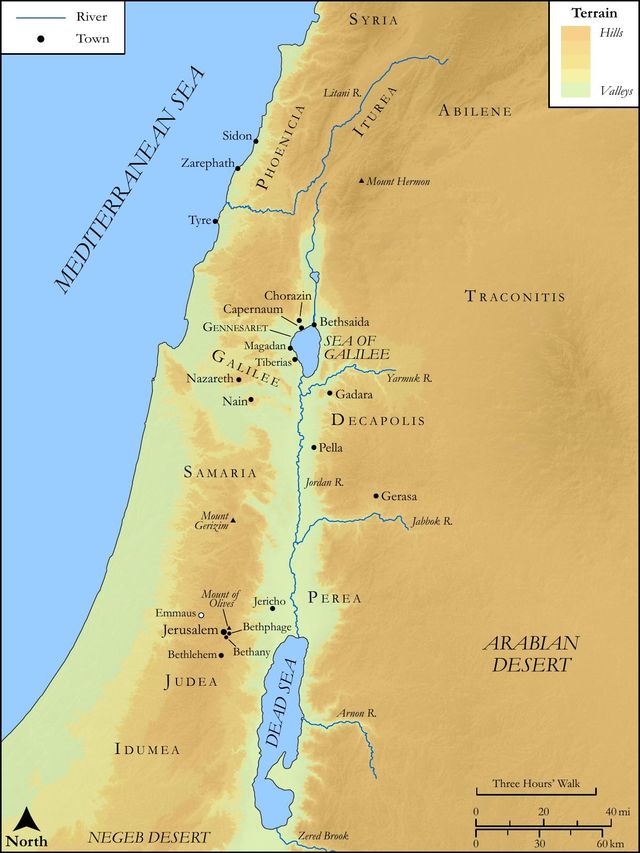
See on the biblical-era map
Study this verse
Public-domain commentary
Matthew Henry
From his Commentary on the Whole Bible. Henry comments on passages, not single verses — this entry covers Luke 17:1–10. His two-level outline is real structure in the source text, so it is rendered as structure.
We are here taught,
I.That the giving of offences is a great sin, and that which we should every one of us avoid and carefully watch against, Luk 17:1, Luk 17:2.
We can expect no other than that offences will come, considering the perverseness and frowardness that are in the nature of man, and the wise purpose and counsel of God, who will carry on his work even by those offences, and bring good out of evil. It is almost impossible but that offences will come, and therefore we are concerned to provide accordingly; but woe to him through whom they come, his doom will be heavy (Luk 17:2), more terrible than that of the worst of the malefactors who are condemned to be thrown into the sea, for they perish under a load of guilt more ponderous than that of millstones. This includes a woe,
1.To persecutors, who offer any injury to the least of Christ's little ones, in word or deed, by which they are discouraged in serving Christ, and doing their duty, or in danger of being driven off from it.
2.To seducers, who corrupt the truths of Christ and his ordinances, and so trouble the minds of the disciples; for they are those by whom offences come.
3.To those who, under the profession of the Christian name, live scandalously, and thereby weaken the bands and sadden the hearts of God's people; for by them the offence comes, and it is no abatement of their guilt, nor will be any of their punishment, that it is impossible but offences will come.
II.That the forgiving of offences is a great duty, and that which we should every one of us make conscience of (Luk 17:3):
Take heed to yourselves. This may refer either to what goes before, or to what follows: Take heed that you offend not one of these little ones. Ministers must be very careful not to say or do any thing that may be a discouragement to weak Christians; there is need of great caution, and they ought to speak and act very considerately, for fear of this: or, "When your brother trespasses against you, does you any injury, puts any slight or affront upon you, if he be accessary to any damage done you in your property or reputation, take heed to yourselves at such a time, lest you be put into a passion; lest, when your spirits are provoked, you speak unadvisedly, and rashly vow to revenge (Pro 24:29): I will do so to him as he hath done to me. Take heed what you say at such a time, lest you say amiss."
1.If you are permitted to rebuke him, you are advised to do so. Smother not the resentment, but give it vent. Tell him his faults; show him wherein he has not done well nor fairly by you, and, it may be, you will perceive (and you must be very willing to perceive it) that you mistook him, that it was not a trespass against you, or not designed, but an oversight, and then you will beg his pardon for misunderstanding him; as Jos 22:30, Jos 22:31.
2.You are commanded, upon his repentance, to forgive him, and to be perfectly reconciled to him: If he repent, forgive him; forget the injury, never think of it again, much less upbraid him with it. Though he do not repent, you must not therefore bear malice to him, nor meditate revenge; but, it he do not at least say that he repents, you are not bound to be so free and familiar with him as you have been. If he be guilty of gross sin, to the offence of the Christian community he is a member of, let him be gravely and mildly reproved for his sin, and, upon his repentance, received into friendship and communion again. This the apostle calls forgiveness, Co2 2:7.
3.You are to repeat this every time he repeats his trespass, Luk 17:4. "If he could be supposed to be either so negligent, or so impudent, as to trespass against thee seven times in a day, and as often profess himself sorry for his fault, and promise not again to offend in like manner, continue to forgive him." Humanum est errare - To ere is human. Note, Christians should be of a forgiving spirit, willing to make the best of every body, and to make all about them easy; forward to extenuate faults, and not to aggravate them; and they should contrive as much to show that they have forgiven an injury as others to show that they resent it.
III.That we have all need to get our faith strengthened, because, as that grace grows, all other graces grow.
The more firmly we believe the doctrine of Christ, and the more confidently we rely upon the grace of Christ, the better it will be with us every way. Now observe here,
1.The address which the disciples made to Christ, for the strengthening of their faith, Luk 17:5. The apostles themselves, so they are here called, though they were prime ministers of state in Christ's kingdom, yet acknowledged the weakness and deficiency of their faith, and saw their need of Christ's grace for the improvement of it; they said unto the Lord, "Increase our faith, and perfect what is lacking in it." Let the discoveries of faith be more clear, the desires of faith more strong, the dependences of faith more firm and fixed, the dedications of faith more entire and resolute, and the delights of faith more pleasing. Note, the increase of our faith is what we should earnestly desire, and we should offer up that desire to God in prayer. Some think that they put up this prayer to Christ upon occasion of his pressing upon them the duty of forgiving injuries: "Lord, increase our faith, or we shall never be able to practise such a difficult duty as this." Faith in God's pardoning mercy will enable us to get over the greatest difficulties that lie in the way of our forgiving our brother. Others think that it was upon some other occasion, when the apostles were run aground in working some miracle, and were reproved by Christ for the weakness of their faith, as Mat 17:16, etc. To him that blamed them they must apply themselves for grace to mend them; to him they cry, Lord, increase our faith.
2.The assurance Christ gave them of the wonderful efficacy of true faith (Luk 17:6): "If ye had faith as a grain of mustard-seed, so small as mustard-seed, but yours is yet less than the least; or so sharp as mustard-seed, so pungent, so exciting to all other graces, as mustard to the animal spirits," and therefore used in palsies, "you might do wonders much beyond what you now do; nothing would be too hard for you, that was fit to be done for the glory of God, and the confirmation of the doctrine you preach, yea, though it were the transplanting of a tree from the earth to the sea." See Mat 17:20. As with God nothing is impossible, so are all things possible to him that can believe.
IV.That, whatever we do in the service of Christ, we must be very humble, and not imagine that we can merit any favour at his hand, or claim it as a debt; even the apostles themselves, who did so much more for Christ than others, must not think that they had thereby made him their debtor.
1.We are all God's servants (his apostles and ministers are in a special manner so), and, as servants, are bound to do all we can for his honour. Our whole strength and our whole time are to be employed for him; for we are not our own, nor at our own disposal, but at our Master's.
2.As God's servants, it becomes us to fill up our time with duty, and we have a variety of work appointed us to do; we ought to make the end of one service the beginning of another. The servant that has been ploughing, or feeding cattle, in the field, when he comes home at night has work to do still; he must wait at table, Luk 17:7, Luk 17:8. When we have been employed in the duties of a religious conversation, that will not excuse us from the exercises of devotion; when we have been working for God, still we must be waiting on God, waiting on him continually.
3.Our principal care here must be to do the duty of our relation, and leave it to our Master to give us the comfort of it, when and how he thinks fit. No servant expects that his master should say to him, Go and sit down to meat; it is time enough to do that when we have done our day's work. Let us be in care to finish our work, and to do that well, and then the reward will come in due time.
4.It is fit that Christ should be served before us: Make ready wherewith I may sup, and afterwards thou shalt eat and drink. Doubting Christians say that they cannot give to Christ the glory of his love as they should, because they have not yet obtained the comfort of it; but this is wrong. First let Christ have the glory of it, let us attend him with our praises, and then we shall eat and drink in the comfort of that love, and in this there is a feast.
5.Christ's servants, when they are to wait upon him, must gird themselves, must free themselves from every thing that is entangling and encumbering, and fit themselves with a close application of mind to go on, and go through, with their work; they must gird up the loins of their mind. When we have prepared for Christ's entertainment, have made ready wherewith he may sup, we must then gird ourselves, to attend him. This is expected from servants, and Christ might require it from us, but he does not insist upon it. He was among his disciples as one that served, and came not, as other masters, to take state, and to be ministered unto, but to minister; witness his washing his disciples' feet.
6.Christ's servants do not so much as merit his thanks for any service they do him: "Does he thank that servant? Does he reckon himself indebted to him for it? No, by no means." No good works of ours can merit any thing at the hand of God. We expect God's favour, not because we have by our services made him a debtor to us, but because he has by his promises made himself a debtor to his own honour, and this we may plead with him, but cannot sue for a quantum meruit - according to merit.
7.Whatever we do for Christ, though it should be more perhaps than some others do, yet it is no more than is our duty to do. Though we should do all things that are commanded us, and alas! in many things we come short of this, yet there is no work of supererogation; it is but what we are bound to by that first and great commandment of loving God with all our heart and soul, which includes the utmost.
8.The best servants of Christ, even when they do the best services, must humbly acknowledge that they are unprofitable servants; though they are not those unprofitable servants that bury their talents, and shall be cast into utter darkness, yet as to Christ, and any advantage that can accrue to him by their services, they are unprofitable; our goodness extendeth not unto God, nor if we are righteous is he the better, Psa 16:2; Job 22:2; Job 35:7. God cannot be a gainer by our services, and therefore cannot be made a debtor by them. He has no need of us, nor can our services make any addition to his perfections. It becomes us therefore to call ourselves unprofitable servants, but to call his service a profitable service, for God is happy without us, but we are undone without him.
Historical interpretation
Nine Centuries of Reception
9 surviving comments on this verse. Each one is dated, so this reads as a timeline rather than a list.
Select a marker to jump to its quote. Markers stagger vertically where authors wrote within a few decades of each other.
Further, in respect to forbearance. "If thy brother," it is said, "sin against thee, rebuke him; and if he repent, forgive him. If he sin against thee seven times in a day, and turn to thee the seventh time, and say, I repent, forgive him."
Nor is it to be wondered at, if He thus teaches who forbids your refusing to bring back even your brother's cattle, if you find them astray in the road; much more should you bring back your erring brother to himself. He commands you to forgive your brother, should he trespass against you even "seven times." But that surely, is a small matter; for with the Creator there is a larger grace, when He sets no limits to forgiveness, indefinitely charging you "not to bear any malice against your brother," and to give not merely to him who asks, but even to him who does not ask.
But they assert that not only is there in favour of their doctrine, testimony to be drawn from the mysteries of the Assyrians, but also from those of the Phrygians concerning the happy nature-concealed, and yet at the same time disclosed-of things that have been, and are coming into existence, and moreover will be,-(a happy nature) which, (the Naassene) says, is the kingdom of heaven to be sought for within a man. And concerning this (nature) they hand down an explicit passage, occurring in the Gospel inscribed according to Thomas, expressing themselves thus: "He who seeks me, will find me in children from seven years old; for there concealed, I shall in the fourteenth age be made manifest." This, however, is not (the teaching) of Christ, but of Hippocrates, who uses these words: "A child of seven years is half of a father." And so it is that these (heretics), placing the originative nature of the universe in causative seed, (and) having ascertained the (aphorism) of Hippocrates, that a child of seven years old is half of a father, say that in fourteen years, according to Thomas, he is manifested. This, with them, is the ineffable and mystical Logos. They assert, then, that the Egyptians, who after the Phrygians, it is established, are of greater antiquity than all mankind, and who confessedly were the first to proclaim to all the rest of men the rites and orgies of, at the same time, all the gods, as well as the species and energies (of things), have the sacred and august, and for those who are not initiated, unspeakable mysteries of Isis. These, however, are not anything else than what by her of the seven dresses and sable robe was sought and snatched away, namely, the pudendum of Osiris. And they say that Osiris is water. But the seven-robed nature, encircled and arrayed with seven mantles of ethereal texture-for so they call the planetary stars, allegorizing and denominating them ethereal robes,-is as it were the changeable generation, and is exhibited as the creature transformed by the ineffable and unportrayable, and inconceivable and figureless one. And this, (the Naassene) says, is what is declared in Scripture, "The just will fall seven times, and rise again." For these falls, he says, are the changes of the stars, moved by Him who puts all things in motion.
Or this number is used because God rested on the seventh day from His works. After the seventh day of the world everlasting rest is promised us, that as the evil works of that world shall then cease, so also may the sharpness of punishment be abated.
He says, “If he who sins against you repents and acknowledges his fault, you shall forgive him not only once, but very many times.” We … must rather imitate those whose business it is to heal our bodily diseases and who do not care for a sick person once only or twice, but just as often as he happens to become ill. Let us remember that we also are liable to infirmities and overpowered by our passions. This being the case, we pray that those who have the duty to rebuke us and who have the authority to punish us may show themselves forgiving and kind to us. It is our duty, having a common feeling for our mutual infirmities, to bear one another’s burdens, so we will fulfill the law of Christ. Observe also that in the Gospel according to Matthew, Peter makes the inquiry, “How often will my brother sin against me, and I forgive him?” The Lord then tells the apostles, “Although he sins seven times in the day,” that is, frequently, “and will acknowledge his fault, you shall forgive him.”
But we must mark, that He does not bid us forgive every one who sins, but him only who repents of his sins. For by taking this course we may avoid offences, hurting no one, correcting the sinner with a righteous zeal, extending the bowels of mercy to the penitent.
By using the number seven He assigns no bound to the giving of pardon, but commands us either to forgive all sins, or always to forgive the penitent. For by seven the whole of any thing or time is frequently represented.
And if he sins against you seven times in a day, and seven times in a day turns back to you, saying: I repent, forgive him. The number seven does not set a limit for granting forgiveness, but either commands that all sins should be forgiven, or that the one repenting should always be forgiven. For often the universality of any matter or time is indicated by the number seven. Hence it is sung in the psalm: Seven times a day I have praised you (Psalm 119), which means nothing other than His praise is always in my mouth (Psalm 34). For elsewhere too, when Peter asked how many times he should forgive a brother sinning against him, and he said up to seven times, the Lord replied: I do not say to you up to seven times, but up to seventy times seven (Matthew 18), that is, four hundred and ninety times. So you should forgive your brother sinning that many times in a day, as he could not sin that many times. Therefore, if a brother sins against you and repents, you have the power, indeed the necessity, to forgive him, so that the Father who is in heaven may also forgive you when you repent and ask for mercy. But if he, having been reprimanded, neglects to convert and to do penance, consider what the judgment of truth decrees about this. If your brother sins against you, go and correct him, and so on, up to where he says: If he refuses to listen even to the church, let him be to you as a Gentile and a tax collector. And deservedly so, because under the name of the faithful he performed the works of the unfaithful. Certainly, we are commanded to give forgiveness differently to a brother who asks for it and differently to an enemy who persecutes. To the former, so that, having received forgiveness for the sin by which he harmed us innocents, he may join us in communal charity; to the latter, that while he wishes evil upon us and, if possible, does it, we may always wish and do good to him as far as we can. For David could not extend the same measure of forgiveness to his persecutors, deprived of the remedy of penance and despite compassionately mourning for them, as Joseph kindly and recognizably extended to his brothers, corrected with salutary contrition.
As if He says, Offences must needs come; but it does not follow that you must perish, if only you be on your guard: as it need not that the sheep should perish when the wolf comes, if the shepherd is watching. And since there are great varieties of offenders, (for some are incurable, some are curable,) He therefore adds, If thy brother trespass against thee, rebuke him.
But some one may well ask, If when I have several times forgiven my brother he again trespass against me, what must I do with him? In answer therefore to this question He adds, And if he trespass against thee seven times in a day, and seven times in a day turn again to thee, saying, I repent; forgive him.
Forgiveness as a transaction is impossible until the offender seeks that forgiveness. Forgiveness as a readiness to conduct the transaction is possible now. You can’t give the present until it is requested, but you can have it wrapped and sitting by the door.
Continue studying Luke 17:4 across the web’s major study libraries — every link below opens this exact verse, chapter, or book on the destination site.
Read & Compare
 BibleGatewayThis verse in more than 200 translations and 70 languages.
 Bible.comThe YouVersion reader — hundreds of translations, reading plans, and highlights.
 ESV.orgCrossway's official English Standard Version reader.
 NET BibleThe NET translation with 60,000+ translators' notes on every rendering decision.
 STEP BibleTyndale House's free study tool — original text, vocabulary, and scholarly resources.
 BibliaLogos Bible Software's free web reader.
 USCCBThe New American Bible (Revised Edition) with the U.S. bishops' study notes.
Commentaries
 BibleHub CommentariesDozens of classic commentaries on this verse, gathered on one page.
 StudyLightMore than 100 commentary sets — the largest collection on the web.
 BibleRefPlain-English commentary on what this verse means, verse by verse.
 Enduring WordDavid Guzik's free commentary on this chapter, widely used by Bible teachers.
 Bible Study ToolsVerse commentary alongside Greek and Hebrew study aids.
Original Language & Research
- BibleHub InterlinearThe verse word by word — original language, transliteration, and English.
- BibleHub LexiconEvery word's original-language definition and Strong's entry.
 Blue Letter BibleDeep-study tools — Strong's numbers, concordance, and word studies.
 CNTR CollationThe earliest Greek manuscripts of this verse, collated letter by letter.
Sermons, Hymns & Audio


TrulyRandomVerse is not affiliated with these sites and doesn’t control their content. They’re linked because they’re genuinely useful.
Summary
Luke 17:4 presents a radical and challenging teaching from Jesus Christ, instructing His disciples on the boundless nature of forgiveness within the community of faith. It mandates that if a brother or sister sins against an individual multiple times within a single day, yet repeatedly turns back with a declaration of repentance, forgiveness must be extended without limit. This command underscores a divine standard for interpersonal relationships, emphasizing a posture of grace and mercy that mirrors God's own character towards those who genuinely repent.
Context
ShowHideLiterary Context
This verse is part of a broader discourse by Jesus to His disciples concerning the responsibilities and challenges of living within the Kingdom of God. It immediately follows Jesus' stern warnings about causing others to stumble, stating that it would be better for one to be cast into the sea with a millstone than to lead a "little one" astray (Luke 17:1-2). Directly preceding Luke 17:4, Jesus instructs the disciples on the initial steps of reconciliation: "Take heed to yourselves: If thy brother trespass against thee, rebuke him; and if he repent, forgive him" (Luke 17:3). Luke 17:4 then expands upon the frequency of this forgiveness, pushing the boundaries of human inclination and setting an extraordinary standard for the community of believers. This teaching on forgiveness is foundational to the practical outworking of faith and love among God's people.
Historical & Cultural Context
In ancient Jewish society, the concept of forgiveness was understood within certain communal and legal frameworks. While repentance and forgiveness were central to the Law and prophetic tradition, the extent of forgiveness was often debated. Rabbinic traditions, for example, sometimes suggested a limit to forgiveness, perhaps three or four times for the same offense, after which further forgiveness was not required. Jesus' teaching in Luke 17:4 directly challenges these prevailing societal and religious norms by extending the requirement for forgiveness far beyond what was typically expected or even considered reasonable. The use of "seven times in a day" would have been startling to His listeners, as it implies a level of patience and grace that transcends human capacity and points to a divine model. This radical call to forgiveness was essential for the formation of a new covenant community, where relationships were to be governed by the principles of God's Kingdom rather than human limitations or legalistic interpretations.
Key Themes
ShowHideLuke 17:4 contributes significantly to several key themes prevalent in Luke's Gospel and Jesus' broader teaching. Foremost is the theme of Radical Forgiveness, which is a hallmark of Jesus' ethics, often seen in His parables like the Parable of the Prodigal Son where the father's forgiveness is immediate and unreserved. This verse also highlights the theme of Repentance as a Prerequisite for Forgiveness, underscoring that while forgiveness is boundless, it is not unconditional; it is offered in response to a genuine change of heart from the offender. Furthermore, it reinforces the theme of Discipleship and Kingdom Ethics, demonstrating that followers of Christ are called to embody a higher standard of righteousness and grace than the world, reflecting the character of God Himself. This standard challenges the disciples to move beyond mere human reciprocity and embrace a divine model of mercy, echoing the call to "be merciful, just as your Father is merciful" (Luke 6:36).
Exposition and Analysis
ShowHideKey Word Analysis
ShowHideMeaning "to miss the mark," "to err," or "to sin." In this context, it refers to an offense or wrongdoing committed against another person. It implies falling short of a moral or relational standard, thus causing harm or injustice.
Meaning "to revert," "to convert," or "to turn about/again." This word signifies a physical or spiritual turning, a change of direction or orientation. Here, it indicates the offender's act of returning to the offended party, signifying a change in their disposition and an initiation of reconciliation.
Meaning "to think differently or afterwards," "to reconsider (morally)," or "to feel compunction." This is a crucial term, indicating a genuine change of mind, heart, and will, leading to a turning away from sin and towards righteousness. It is more than just an apology; it implies a transformation of inner attitude and a commitment to change behavior.
Verse Breakdown
ShowHide"And if he trespass against thee seven times in a day"
This clause sets the extreme hypothetical scenario. The phrase "seven times in a day" is a hyperbole, not a literal numerical limit. It signifies an extraordinary frequency of offense within a short period, pushing the boundaries of what would be considered humanly tolerable. It highlights the persistence of the offense and the challenge to the offended party's patience.
"and seven times in a day turn again to thee, saying, I repent;"
This second clause introduces the critical condition for forgiveness. The repetition of "seven times in a day" here emphasizes that even with repeated offenses, if each instance is met with a genuine "turning again" and a verbal declaration of "I repent," the requirement for forgiveness remains. The "saying, I repent" signifies an outward expression of an inward change, confirming the sincerity of the turning.
"thou shalt forgive him."
This is the direct command from Jesus. It is an imperative, indicating a non-negotiable obligation for the disciple. Despite the extreme frequency of offense, if the condition of repentance is met, forgiveness must be granted. This command elevates forgiveness from an optional act of grace to a mandatory duty for those who follow Christ, reflecting God's own character.
Literary Devices
ShowHideThe primary literary device employed in Luke 17:4 is Hyperbole. The phrase "seven times in a day" is an exaggeration not meant to be taken literally, but to emphasize the boundless and unlimited nature of the forgiveness being commanded. It pushes the listener's imagination beyond typical human patience, illustrating that the required forgiveness far exceeds conventional expectations. This hyperbole serves to underscore the radical, divine standard Jesus is setting for His followers. Additionally, there is Repetition of "seven times in a day," which reinforces the extreme nature of the scenario and the unwavering demand for forgiveness in the face of persistent, yet repented, offenses. The structure also presents a clear Conditional Statement ("If... then..."), which clearly defines the circumstances under which the command to forgive applies, highlighting the crucial role of repentance.
Theological and Thematic Connections
ShowHideLuke 17:4 is a profound theological statement on the nature of divine and human forgiveness. It teaches that forgiveness is not merely an emotional response but a volitional act, commanded by God, that mirrors His own character. Just as God is "abounding in steadfast love and faithfulness" and "forgiving iniquity and transgression and sin" (Exodus 34:6-7), so too are His children called to embody this limitless grace. The requirement of repentance underscores the biblical principle that while God's grace is vast, it is extended to those who turn from their sin. This verse challenges believers to dismantle any self-imposed limits on forgiveness, recognizing that holding onto unforgiveness can hinder one's own spiritual well-being and relationship with God. It calls for a radical posture of mercy, essential for healthy community and reflecting the reconciliation offered through Christ.
Reflection and Application
ShowHideLuke 17:4 calls us to a profound and challenging level of forgiveness, one that transcends our natural inclinations. It compels us to examine the depths of our own hearts, confronting any bitterness, resentment, or desire for retribution we might harbor. This teaching reminds us that true forgiveness is not contingent on the offender's worthiness but on our obedience to Christ's command and our desire to reflect God's character. It's a call to cultivate a spirit of radical grace, recognizing that we ourselves are recipients of God's boundless forgiveness through Christ. Embracing this principle fosters healing in relationships, breaks cycles of hurt, and allows us to experience the freedom that comes from releasing the burden of unforgiveness. It is foundational to building a healthy, Christ-like community where mercy triumphs over judgment.
Questions for Reflection
ShowHideFAQ
ShowHideDoes "seven times in a day" mean I only have to forgive up to seven times, and then I can stop?
ShowHideNo, the phrase "seven times in a day" is a figure of speech known as hyperbole, used by Jesus to emphasize the unlimited nature of forgiveness. In Jewish thought, the number seven often represented completeness or perfection. By using it in this context, Jesus is pushing His disciples beyond any humanly conceived limit, implying that forgiveness should be extended as often as genuine repentance occurs, without any numerical cap. This teaching is echoed in Matthew 18:21-22, where Jesus tells Peter to forgive "seventy times seven" (or seventy-seven times, depending on the translation), further illustrating the boundless nature of this command. The point is not a literal count, but a posture of continuous, radical forgiveness.
Christ-Centered Fulfillment
ShowHideLuke 17:4, with its radical call to unlimited forgiveness in response to repentance, finds its ultimate fulfillment and deepest meaning in the person and work of Jesus Christ. Jesus Himself perfectly embodies this divine standard, not only in His teachings but supremely in His atoning sacrifice. On the cross, even as He suffered unimaginable pain and injustice, He prayed, "Father, forgive them; for they know not what they do" (Luke 23:34). This act of forgiveness, extended to those who were actively sinning against Him, demonstrates the very heart of God's limitless mercy. Through His death and resurrection, Christ made it possible for humanity, who had "trespassed" against God countless times, to "turn again" in repentance and receive complete forgiveness and reconciliation with the Father (Colossians 1:13-14). The forgiveness we are commanded to extend to others is therefore not merely a moral duty, but a reflection of the profound, unmerited forgiveness we have received from God through our union with Christ (Ephesians 4:32). Our capacity to forgive, even "seven times in a day," flows from the wellspring of Christ's own boundless grace poured out for us, empowering believers to live out the very character of the One who redeemed them.