


Judges 8:18
Bible text: King James Version (1769 Blayney text) · Public domain
Bible text: King James Version with Strong's numbers · Public domain
Bible text: Berean Standard Bible · Public domain
Bible text: American Standard Version (1901) · Public domain
Bible text: World English Bible, Messianic edition · Public domain
Bible text: Geneva Bible (1599) · Public domain
Bible text: Young's Literal Translation · Public domain
- וַיֹּאמֶרvai·Yo·merand he saidH559Conj-w ¦ V-Qal-ConsecImperf-3msVerb Qal Consecutive Imperfect 3rd Singular Masculineוַandיֹּאמֶרhe said
- אֶל'eltoH413PrepPreposition
- זֶבַחze·vachZebahH2078N-proper-mNoun Proper Masculine
- וְאֶלve·'eland toH413Conj-w ¦ PrepPrepositionוְandאֶלto
- צַלְמֻנָּעtzal·mu·Na'ZalmunnaH6759N-proper-mNoun Proper Masculine
- אֵיפֹה'ei·Fohwhere?H375InterrogParticle Interrogative
- הָאֲנָשִׁיםha·'a·na·Shim[are] the menH582Art ¦ N-mpNoun Plural Masculine Absoluteהָ[are] theאֲנָשִׁיםmen
- אֲשֶׁר'a·SherwhomH834RelParticle Relative
- הֲרַגְתֶּםha·rag·Temyou killedH2026V-Qal-Perf-2mpVerb Qal Perfect 2nd Plural Masculine
- בְּתָבוֹרbe·ta·Vorat TaborH8396Prep-b ¦ N-properNoun Proper LocationבְּatתָבוֹרTabor
- וַיֹּאמרוּvai·yo·me·Ruand they saidH559Conj-w ¦ V-Qal-ConsecImperf-3mpVerb Qal Consecutive Imperfect 3rd Plural Masculineוַandיֹּאמרוּthey said
- כָּמוֹךָka·Mo·khalike youH3644Prep ¦ 2msPreposition Definiteכָּמוֹlikeךָyou
- כְמוֹהֶםkhe·mo·Hemlike themH3644Prep ¦ 3mpPreposition Definiteכְמוֹlikeהֶםthem
- אֶחָד'e·ChadoneH259N-fsNoun Singular Feminine Absolute
- כְּתֹאַרke·To·'ar[was] like [the] appearance ofH8389Prep-k ¦ N-mscNoun Singular Masculine Constructכְּ[was] likeתֹאַר[the] appearance of
- בְּנֵיbe·Nei[the] sons ofH1121N-mpcNoun Plural Masculine Construct
- הַמֶּלֶךְha·Me·lekhthe kingH4428Art ¦ N-msNoun Singular Masculine Absoluteהַtheמֶּלֶךְking
English is a literal word-by-word gloss of the Hebrew, not the KJV's wording. Why?
This is the original text the KJV's translators worked from — each Hebrew word with its own literal English meaning in this verse, prepared by scholars at Tyndale House, Cambridge. The KJV translates whole sentences, not word by word, so its wording differs: one Hebrew word can become several English words, and the KJV may choose “the LORD” where the gloss reads “Yahweh”. Both are faithful — they answer different questions. For the KJV's own rendering, switch to the KJV text.
Details
See on the biblical-era maps
Study this verse
Public-domain commentary
Matthew Henry
From his Commentary on the Whole Bible. Henry comments on passages, not single verses — this entry covers Judges 8:18–21.
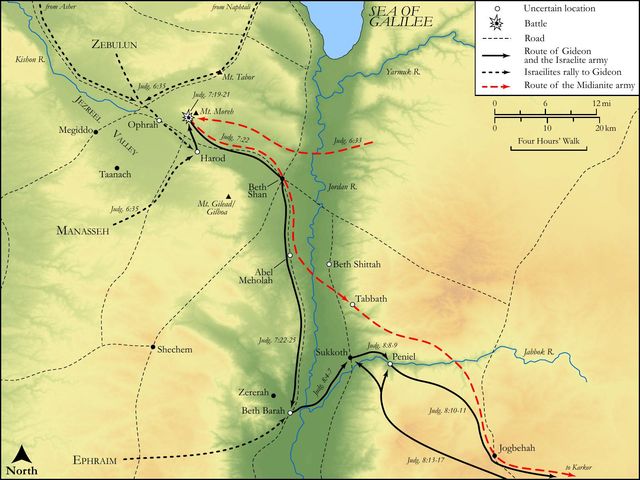
Judgment began at the house of God, in the just correction of the men of Succoth and Penuel, who were Israelites, but it did not end there. The kings of Midian, when they had served to demonstrate Gideon's victories, and grace his triumphs, must now be reckoned with. 1. They are indicted for the murder of Gideon's brethren some time ago at Mount Tabor. When the children of Israel, for fear of the Midianites, made themselves dens in the mountains (Jdg 6:2), those young men, it is likely, took shelter in that mountain, where they were found by these two kings, and most basely and barbarously slain in cold blood. When he asks them what manner of men they were (Jdg 8:18), it is not because he was uncertain of the thing, or wanted proof of it; he was not so little concerned for his brethren's blood as not to enquire it out before now, nor were these proud tyrants solicitous to conceal it. But he puts that question to them that by their acknowledgment of the more than ordinary comeliness of the persons they slew their crime might appear the more heinous, and consequently their punishment the more righteous. They could not but own that, though they were found in a mean and abject condition, yet they had an unusual greatness and majesty in their countenances, not unlike Gideon himself at this time: they resembled the children of a king, born for something great. 2. Being found guilty of this murder by their own confession, Gideon, though he might have put them to death as Israel's judge for the injuries done to that people in general, as Oreb and Zeeb (Jdg 7:25), yet chooses rather to put on the character of an avenger of blood, as next of kin to the persons slain: They were my brethren, Jdg 8:19. Their other crimes might have been forgiven, at least Gideon would not have slain them himself, let them have answered it to the people; but the voice of his brethren's blood cries, cries to him, now it is in the power of his hand to avenge it, and therefore there is no remedy - by him must their blood be shed, though they were kings. Little did they think to hear of this so long after; but murder seldom goes unpunished even in this life. 3. The execution is done by Gideon himself with his own hand, because he was the avenger of blood; he bade his son slay them, for he was a near relation to the persons murdered, and fittest to be his father's substitute and representative, and he would thus train him up to the acts of justice and boldness, Jdg 8:20. But, (1.) The young man himself desired to be excused; he feared, though they were bound and could make no resistance, because he was yet a youth, and not used to such work: courage does not always run in the blood. (2.) The prisoners themselves desired that Gideon would excuse it (Jdg 8:21), begged that, if they must die, they might die by his own hand, which would be somewhat more honourable to them, and more easy; for by his great strength they would sooner be dispatched and rid out of their pain. As is the man, so is his strength. Either they mean it of themselves (they were men of such strength as called for a better hand than that young man's to overpower quickly) or of Gideon, "Thou art at thy full strength; he has not yet come to it; therefore be thou the executioner." From those that are grown up to maturity, it is expected that what they do in any service be done with so much the more strength. Gideon dispatched them quickly, and seized the ornaments that were on their camels' necks, ornaments like the moon, so it is in the margin, either badges of their royalty or perhaps of their idolatry, for Ashteroth was represented by the moon, as Baal by the sun. With there he took all their other ornaments, as appears Jdg 8:26, where we find that he did not put them to so good a use as one would have wished. The destruction of these two kings, and that of the two princes (Jdg 7:25) is long afterwards pleaded as a precedent in prayer for the ruin of others of the church's enemies, Psa 83:11, Make their nobles like Oreb and Zeeb, and all their princes as Zebah and Zalmunna, let them all be but off in like manner.
Continue studying Judges 8:18 across the web’s major study libraries — every link below opens this exact verse, chapter, or book on the destination site.
Read & Compare
 BibleGatewayThis verse in more than 200 translations and 70 languages.
 Bible.comThe YouVersion reader — hundreds of translations, reading plans, and highlights.
 ESV.orgCrossway's official English Standard Version reader.
 NET BibleThe NET translation with 60,000+ translators' notes on every rendering decision.
 STEP BibleTyndale House's free study tool — original text, vocabulary, and scholarly resources.
 BibliaLogos Bible Software's free web reader.
 USCCBThe New American Bible (Revised Edition) with the U.S. bishops' study notes.
Commentaries
 BibleHub CommentariesDozens of classic commentaries on this verse, gathered on one page.
 StudyLightMore than 100 commentary sets — the largest collection on the web.
 BibleRefPlain-English commentary on what this verse means, verse by verse.
 Enduring WordDavid Guzik's free commentary on this chapter, widely used by Bible teachers.
 Bible Study ToolsVerse commentary alongside Greek and Hebrew study aids.
Original Language & Research
- BibleHub InterlinearThe verse word by word — original language, transliteration, and English.
- BibleHub LexiconEvery word's original-language definition and Strong's entry.
 Blue Letter BibleDeep-study tools — Strong's numbers, concordance, and word studies.
 SefariaThe Hebrew text with Rashi and centuries of Jewish commentary.
Sermons, Hymns & Audio


TrulyRandomVerse is not affiliated with these sites and doesn’t control their content. They’re linked because they’re genuinely useful.
Summary
Judges 8:18 records a pivotal and deeply personal interrogation by Gideon of the captured Midianite kings, Zebah and Zalmunna, following his decisive victory. Gideon confronts them about the identity of men they had previously massacred at Mount Tabor, a question that serves as a crucial prelude to the kings' impending execution. Their response, acknowledging the noble and kingly appearance of their victims, not only underscores the gravity of their past atrocities but also reveals a profound, personal connection to Gideon, setting the stage for an act of familial retribution.
Context
ShowHideLiterary Context
This verse marks a significant shift in the narrative of Judges 8. Immediately preceding it, Gideon has completed his relentless pursuit and capture of the Midianite kings, Zebah and Zalmunna, after their army's decisive rout (as detailed in Judges 8:4-12). The grand scale of national deliverance and military triumph now narrows to a deeply personal reckoning. Gideon's pointed question about the men slain at Tabor is not a casual inquiry but a deliberate and crucial pivot, providing the specific, personal justification for the kings' execution that follows in Judges 8:19-21. This moment transitions the focus from the broader conflict against Midianite oppression to Gideon's individual grievance, adding a layer of personal justice and blood vengeance to the broader divine judgment being enacted through him.
Historical & Cultural Context
The cultural practice of blood vengeance (Hebrew: go'el haddam) was a deeply ingrained and legally recognized institution in ancient Israel, as outlined in biblical law (e.g., Numbers 35:19). If a person was murdered, a close relative, designated as the "avenger of blood," held the right and responsibility to execute the murderer. The Midianites had been a persistent and brutal threat to Israel, characterized by their devastating raids and oppression (see Judges 6:1-6). The slaying of men at Tabor, a prominent mountain in Israel's northern territory, likely refers to a specific, unprovoked massacre during one of these raids, highlighting the Midianites' barbarity. Gideon's inquiry taps into this cultural expectation of familial justice, transforming his military campaign into a personal quest for retribution for his own kin, thereby fulfilling a societal obligation.
Key Themes
ShowHideJudges 8:18 powerfully contributes to several key themes within the Book of Judges and the broader biblical narrative. Firstly, it highlights the complex interplay between Divine Justice and Human Vengeance. While Gideon is divinely commissioned to deliver Israel (a calling underscored in Judges 6:14), this specific encounter reveals a strong personal motivation for his actions—the avenging of his brothers' deaths. Secondly, the Midianite kings' description of Gideon's brothers as resembling "the children of a king" underscores the theme of The Stature and Dignity of God's People. This phrase not only flatters Gideon but also emphasizes the inherent worth and noble bearing of the victims, elevating the severity of the Midianites' crime and affirming the value of those targeted by oppression. Finally, the scene reinforces the overarching theme of Consequences of Rebellion and Oppression. The Midianites, who had long defied God and brutally oppressed Israel, now face the ultimate consequences of their actions, serving as a stark reminder that divine retribution will eventually fall upon those who inflict injustice, a principle echoed throughout the book of Judges.
Exposition and Analysis
ShowHideKey Word Analysis
ShowHideA primitive root meaning "to smite with deadly intent; destroy, out of hand, kill, murder(-er), put to (death), make (slaughter), [idiom] surely." This word emphasizes the violent and intentional nature of the act. It is not merely a death, but a deliberate killing, underscoring the brutality of Zebah and Zalmunna's actions and the gravity of the crime for which Gideon seeks retribution.
Meaning "outline, i.e. figure or appearance; [phrase] beautiful, [idiom] comely, countenance, [phrase] fair, [idiom] favoured, form, [idiom] goodly, [idiom] resemble, visage." This term highlights a striking visual likeness or appearance. It suggests that Gideon's brothers possessed a notable, perhaps even regal, bearing that was immediately recognizable and mirrored Gideon's own distinguished appearance, making their murder even more heinous.
The phrase בְּנֵי מֶלֶךְ (b'nei melekh) literally translates to "sons of a king." H1121 (bên) refers to "a son (as a builder of the family name), in the widest sense," while H4428 (melek) means "a king." In this context, it functions as an idiom for individuals of noble birth, distinguished appearance, high status, or remarkable physical stature and dignity. It suggests that Gideon's brothers were not ordinary men but possessed an imposing presence, perhaps even a commanding aura, that set them apart, consistent with Gideon's own description as a "mighty man of valor" (Judges 6:12).
Verse Breakdown
ShowHide"Then said he unto Zebah and Zalmunna, What manner of men [were they] whom ye slew at Tabor?"
Gideon initiates the confrontation not with an accusation, but with a probing, almost rhetorical, question. The phrase "What manner of men" (literally "What were the men like?") indicates his desire for a specific description, which will confirm his suspicions and provide the personal justification for his subsequent actions. The precise mention of "Tabor" points to a known, significant event and location, suggesting a past atrocity that Gideon is now bringing to light, implying a shared knowledge of the event between the parties.
"And they answered, As thou [art], so [were] they;"
The Midianite kings' response is immediate and direct, acknowledging the truth of Gideon's implied accusation. Their comparison of Gideon's slain kin to Gideon himself is a form of flattery, perhaps an attempt to appease him or acknowledge his own impressive stature and commanding presence. This phrase confirms a shared noble appearance or distinguished bearing between Gideon and his brothers, setting the stage for the revelation of their familial relationship in the subsequent verse.
"each one resembled the children of a king."
This concluding clause elaborates on the previous comparison, providing a vivid and powerful description of the slain men. The phrase "resembled the children of a king" highlights their exceptional dignity, perhaps their physical prowess, or even their inherent authority and noble lineage. This description not only underscores the significance of the men who were killed but also elevates the gravity of the Midianites' crime, as they had murdered individuals of remarkable stature and apparent importance.
Literary Devices
ShowHideThe verse employs several potent literary devices to convey its profound meaning and dramatic tension. Irony is powerfully evident in the reversal of fortunes: the once-powerful Midianite kings, who brutally slew others, are now captives, forced to describe their victims to the very man who will execute them. There is clear Foreshadowing as Gideon's pointed question about the slain men at Tabor immediately hints at a deeper, personal connection, which is explicitly revealed in the very next verse (Judges 8:19). The description "resembled the children of a king" functions as rich Symbolism, representing not just physical appearance but also the inherent worth, dignity, and perhaps even divine favor of the slain men, contrasting sharply with the barbarity of their killers. The dialogue itself is a form of Interrogation, meticulously designed by Gideon to elicit a confession and provide a public, culturally sanctioned justification for his impending act of vengeance.
Theological and Thematic Connections
ShowHideJudges 8:18 powerfully illustrates the complex interplay between divine justice and human vengeance within the biblical narrative. While God often uses human agents to execute His judgment against oppressors, this verse reveals that personal grievances and the desire for familial retribution can also fuel such actions. Gideon's relentless pursuit, initially a national deliverance, becomes deeply personal, highlighting that injustice has profound individual and familial costs. The Midianites, who had long oppressed Israel and committed atrocities, now face the direct consequences of their actions, underscoring the principle that God's justice, though sometimes delayed, will ultimately prevail. The description of the slain men as "resembling the children of a king" also subtly affirms the inherent dignity and value of human life, particularly those who are victims of unprovoked violence, and emphasizes the profound gravity of shedding innocent blood.
Reflection and Application
ShowHideThis verse serves as a stark reminder that conflict and oppression often carry deep personal costs, extending far beyond strategic objectives or national boundaries. Gideon's personal stake in the justice meted out to Zebah and Zalmunna reveals the powerful human element of grief, loss, and the desire for retribution. For believers, it prompts profound reflection on the motivations behind our actions, especially when seeking justice. While the Old Testament permitted blood vengeance and understood its role in a less-developed legal system, the New Testament calls us to a higher standard of forgiveness, reconciliation, and leaving ultimate retribution to God. However, this does not negate the importance of actively seeking justice for the oppressed, pleading the cause of the vulnerable, and valuing every human life. The dignified description of Gideon's brothers underscores the inherent worth of individuals, even those who might seem insignificant in a broader conflict, and the lasting impact of their loss. We are called to recognize the image of God in all people, to grieve injustices against them, and to trust in God's ultimate sovereignty and perfect justice, knowing He sees and will make all wrongs right in His time.
Questions for Reflection
ShowHideFAQ
ShowHideWhy does Gideon ask about the men slain at Tabor, and why is it significant?
ShowHideGideon's question is not mere curiosity but a strategic and deeply personal inquiry. By asking about the men slain at Tabor, he is prompting the Midianite kings to confirm an atrocity that directly impacted him. As revealed in Judges 8:19, these men were Gideon's own brothers. This revelation transforms his military campaign from a national deliverance into an act of blood vengeance, a legally recognized and culturally expected form of justice in ancient Israel. The significance lies in providing the personal justification for the kings' execution, demonstrating that their past brutality had direct and devastating consequences for Gideon's family, thus legitimizing his retribution in the eyes of the community and God.
What does "each one resembled the children of a king" truly mean?
ShowHideThis phrase, "resembled the children of a king," is an idiom conveying that the slain men possessed an exceptional, noble, or distinguished appearance, rather than necessarily being literal royalty. It suggests they had a remarkable dignity, impressive stature, or a striking physical presence that set them apart from ordinary individuals. The Midianite kings' response not only flatters Gideon by comparing him to his noble kin but also underscores the significance of the men they killed, effectively elevating the gravity of their crime. It highlights that the victims were not ordinary individuals but men of considerable standing and presence, making their murder even more heinous.
How does this verse contribute to the broader narrative of Judges?
ShowHideThis verse is a crucial turning point, shifting the narrative from a broad national deliverance to a deeply personal act of justice. It underscores the brutal nature of Midianite oppression, revealing that their raids included massacres of prominent Israelites, not just economic exploitation. It also highlights Gideon's character, showing him as not only a divinely appointed military leader but also a man driven by familial loyalty and a desire for personal retribution. The encounter sets the stage for the execution of Zebah and Zalmunna, fulfilling the cycle of divine judgment and human consequence for the Midianites' long-standing wickedness against Israel, a recurring theme throughout the book of Judges.
Christ-Centered Fulfillment
ShowHideJudges 8:18, with its raw depiction of vengeance and the pursuit of justice for slain "sons of a king," finds profound Christ-centered fulfillment in the person and work of Jesus. Gideon, avenging his brothers, foreshadows Christ as the ultimate Avenger and righteous Judge, who will perfectly execute divine justice against all evil, oppression, and injustice (as seen in Revelation 19:11-16). While Gideon's vengeance is rooted in personal grievance and the cultural norms of his time, Christ's judgment is rooted in perfect righteousness, holiness, and divine authority, bringing about the final defeat of sin, death, and all the forces of darkness (1 Corinthians 15:25-26). Moreover, the "children of a king" imagery points forward to the true children of the King—believers in Christ. Through faith in Jesus, we are adopted into God's family, becoming "children of God" and "heirs with Christ" (John 1:12; Romans 8:17). The injustice suffered by Gideon's brothers, leading to a righteous avenger, ultimately points to the ultimate injustice of the cross, where the perfect Son of God was slain (Isaiah 53:5-7), leading to His triumphant resurrection and His future role as the one who will make all things right, bringing perfect justice and eternal life to His adopted family, the children of the true King.