


Joshua 8:32
Bible text: King James Version (1769 Blayney text) · Public domain
Bible text: Berean Standard Bible · Public domain
Bible text: American Standard Version (1901) · Public domain
Bible text: World English Bible, Messianic edition · Public domain
Bible text: Geneva Bible (1599) · Public domain
Bible text: Young's Literal Translation · Public domain
- וַיִּכְתָּבvai·yikh·tovand he wroteH3789Conj-w ¦ V-Qal-ConsecImperf-3msVerb Qal Consecutive Imperfect 3rd Singular Masculineוַandיִּכְתָּבhe wrote
- שָׁםshamthereH8033AdvAdverb
- עַל'alonH5921PrepPreposition
- הָאֲבָנִיםha·'a·va·Nimthe stonesH68Art ¦ N-fpNoun Plural Feminine Absoluteהָtheאֲבָנִיםstones
- אֵת'Et<obj.>H853DirObjMParticle Object Indicator
- מִשְׁנֵהmish·Neh<the> copy ofH4932N-mscNoun Singular Masculine Construct
- תּוֹרַתto·Rat[the] law ofH8451N-fscNoun Singular Feminine Construct
- מֹשֶׁהmo·ShehMosesH4872N-proper-mNoun Proper Masculine
- אֲשֶׁר'a·SherwhichH834RelParticle Relative
- כָּתַבka·Tavhe had writtenH3789V-Qal-Perf-3msVerb Qal Perfect 3rd Singular Masculine
- לִפְנֵיlif·Nei<to> beforeH6440Prep-l ¦ N-mpcNoun Plural Masculine Constructלִ<to>פְנֵיbefore
- בְּנֵיbe·Nei[the] people ofH1121N-mpcNoun Plural Masculine Construct
- יִשְׂרָאֵלYis·ra·'ElIsraelH3478N-properNoun Proper Location
English is a literal word-by-word gloss of the Hebrew, not the KJV's wording. Why?
This is the original text the KJV's translators worked from — each Hebrew word with its own literal English meaning in this verse, prepared by scholars at Tyndale House, Cambridge. The KJV translates whole sentences, not word by word, so its wording differs: one Hebrew word can become several English words, and the KJV may choose “the LORD” where the gloss reads “Yahweh”. Both are faithful — they answer different questions. For the KJV's own rendering, switch to the KJV text.
Details
See on the biblical-era maps
Study this verse
Public-domain commentary
Matthew Henry
From his Commentary on the Whole Bible. Henry comments on passages, not single verses — this entry covers Joshua 8:30–35. His three-level outline is real structure in the source text, so it is rendered as structure.
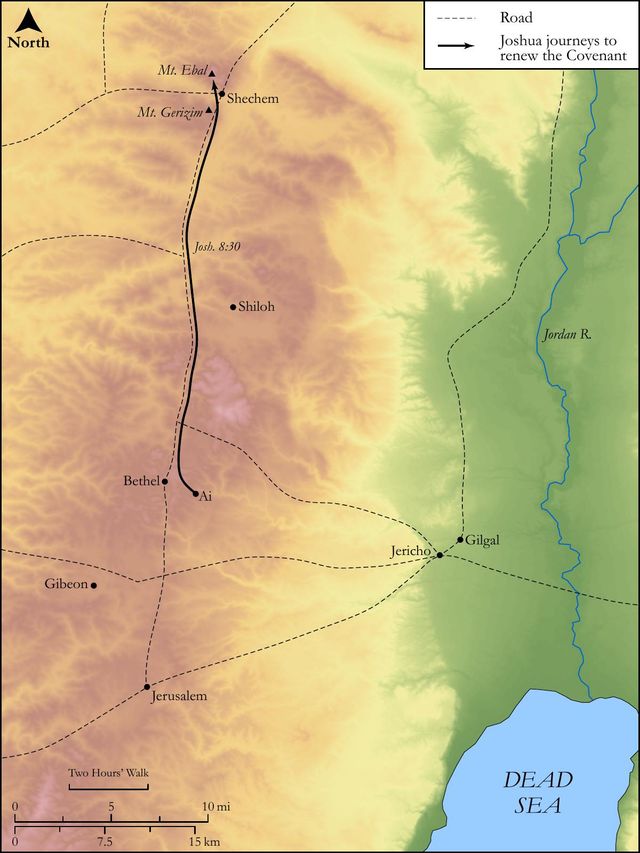
This religious solemnity of which we have here an account comes in somewhat surprisingly in the midst of the history of the wars of Canaan. After the taking of Jericho and Ai, we should have expected that the next news would be of their taking possession of the country, the pushing on of their victories in other cities, and the carrying of the war into the bowels of the nation, now that they had made themselves masters of these frontier towns. But here a scene opens of quite another nature; the camp of Israel is drawn out into the field, not to engage the enemy, but to offer sacrifice, to hear the law read, and to say Amen to the blessings and the curses. Some think this was not done till after some of the following victories were obtained which were read of, ch. 10 and 11. But it should seem by the maps that Shechem (near to which these two mountains Gerizim and Ebal were) was not so far off from Ai but that when they had taken that they might penetrate into the country as far as those two mountains, and therefore I would not willingly admit a transposition of the story; and the rather because, as it comes in here, it is a remarkable instance, 1. Of the zeal of Israel for the service of God and for his honour. Though never was war more honourable, more pleasant, or more gainful, nor ever was war more sure of victory, or more necessary to a settlement (for they had neither houses nor lands of their own till they had won them by the sword, no, not Joshua himself), yet all the business of the war shall stand still, while they make a long march to the place appointed, and there attend this solemnity. God appointed them to do this when they should have got over Jordan, and they did it as soon as possibly they could, though they might have had a colourable pretence to put it off. Note, We must not think to defer our covenanting with God till we are settled in the world, or must any business put us by from minding and pursuing the one thing needful. The way to prosper is to begin with God, Mat 6:33. 2. It is an instance of the care of God concerning his faithful servants and worshippers. Though they were in an enemy's country, as yet unconquered, yet in the service of God they were safe, as Jacob when in this very country he was going to Beth-el to pay his vows: the terror of God was upon the cities round about, Gen 35:5. Note, When we are in the way of duty God takes us under his special protection.
Twice Moses had given express orders for this solemnity; once Deu 11:29, Deu 11:30, where he seems to have pointed to the very place where it was to be performed; and again Deu 27:2, etc. It was a federal transaction: the covenant was now renewed between God and Israel upon their taking possession of the land of promise, that they might be encouraged in the conquest of it, and might know upon what terms they held it, and come under fresh obligations to obedience. In token of the covenant,
I.They built an altar, and offered sacrifice to God (Jos 8:30, Jos 8:31), in token of their dedication of themselves to God, as living sacrifices to his honour, in and by a Mediator, who is the altar that sanctifies this gift. This altar was erected on Mount Ebal, the mount on which the curse was put (Deu 11:29), to signify that there, where by the law we had reason to expect a curse, by Christ's sacrifice of himself for us and his mediation we have peace with God; he has redeemed us from the curse of the law by being made a curse for us, Gal 3:13. Even where it was said, by the curse, You are not my people, there it is said, through Christ the altar, You are the children of the living God, Hos 1:10. The curses pronounced on Mount Ebal would immediately have been executed if atonement had not been made by sacrifice. By the sacrifices offered on this altar they did likewise give God the glory of the victories they had already obtained, as Exo 17:15. Now that they had had the comfort of them, in the spoils of Ai, it was fit that God should have the praise of them. And they also implored his favour for their future success; for supplications as well as thanksgivings were intended in their peace-offerings. The way to prosper in all that we put our hand to is to take God along with us, and in all our ways to acknowledge him by prayer, praise, and dependence. The altar they built was of rough unhewn stone, according to the law (Exo 20:25), for that which is most plain and natural, and least artful and affected, in the worship of God, he is best pleased with. Man's device can add no beauty to God's institutions.
II.They received the law from God; and this those must do that would find favour with him, and expect to have their offerings accepted; for, if we turn away our ear from hearing the law, our prayers will be an abomination. When God took Israel into covenant he gave them his law, and they, in token of their consent to the covenant, subjected themselves to the law. Now here,
1.The law of the ten commandments was written upon stones in the presence of all Israel, as an abridgment of the whole, Jos 8:32. This copy was not graven in the stone, as that which was reserved in the ark: That was to be done only by the finger of God; it is his prerogative to write the law in the heart. But the stones were plastered, and it was written upon the plaster, Deu 27:4, Deu 27:8. It was written, that all might see what it was that they consented to, and that it might be a standing remaining testimony to posterity of God's goodness in giving them such good laws, and a testimony against them if they were disobedient to them. It is a great mercy to any people to have the law of God in writing, and it is fit that the written law should be exposed to common view in a known tongue, that it may be seen and read of all men.
2.The blessings and the curses, the sanctions of the law, were publicly read, and the people (we may suppose), according to Moses's appointment, said Amen to them, Jos 8:33, Jos 8:34.
(1.)The auditory was very large. [l.] The greatest prince was not excused. The elders, officers, and judges, are not above the cognizance of the law, but will come under the blessing or the curse, according as they are or are not obedient to it, and therefore they must be present to consent to the covenant and to go before the people therein. [2.] The poorest stranger was not excluded. Here was a general naturalization of them: as well the stranger as he that was born among them was taken into covenant. This was an encouragement to proselytes, and a happy presage of the kindnesses intended for the poor Gentiles in the latter days.
(2.)The tribes were posted, as Moses directed, six towards Gerizim and six towards Ebal. And the ark in the midst of the valley was between them, for it was the ark of the covenant; and in it were shut up the close rolls of that law which was copied out and shown openly upon the stones. The covenant was commanded, and the command covenanted. the priests that attended the ark, or some of the Levites that attended them, after the people had all taken their places, and silence was proclaimed, pronounced distinctly the blessings and the curses, as Moses had drawn them up, to which the tribes said Amen; and yet it is here only said that they should bless the people, for the blessing was that which was first and chiefly intended, and which God designed in giving the law. If they fell under the curse, that was their own fault. And it was really a blessing to the people that they had this matter laid so plainly before them, life and death, good and evil; he had not dealt so with other nations.
3.The law itself also containing the precepts and prohibitions was read (Jos 8:35), it should seem by Joshua himself, who did not think it below him to be a reader in the congregation of the Lord. In conformity to this example, the solemn reading of the law, which was appointed once in seven years (Deu 31:10, Deu 31:11), was performed by their king or chief magistrate. It is here intimated what a general publication of the law this was.
(1.)Every word was read; even the minutest precepts were not omitted, nor the most copious abridged; not one iota or tittle of the law shall pass away, and therefore none was, in reading, skipped over, under pretence of want of time, or that any part was needless or not proper to be read. It was not many weeks since Moses had preached the whole book of Deuteronomy to them, yet Joshua must now read it all over again; it is good to hear twice what God has spoken once (Psa 62:11) and to review what had been delivered to us, or to have it repeated, that we may not let it slip.
(2.)Every Israelite was present, even the women and the little ones that all might know and do their duty. Note, Masters of families should bring their wives and children with them to the solemn assemblies for religious worship. All that are capable of learning must come to be taught out of the law. The strangers also attended with them; for wherever we are, though but as strangers, we should improve every opportunity of acquainting ourselves with God and his holy will.
Historical interpretation
Historical reception
2 surviving comments on this verse. Each one is dated, so this reads as a timeline rather than a list.
How was he able to depict so large a book to the sons of Israel—or even to those standing and remaining there—so that they did not disperse until the writing of so many verses was finished? Or even how were the stones of the altar able to bear the contents of such a large book? Such things let those Jewish defenders of the letter who are ignorant of the spirit of the law tell me. In what manner is the truth of the narrative demonstrated in this? Yet among those former ones “to this day, whenever Moses is read, a veil lies over their heart.” But for us, “who have turned to the Lord” Jesus, “the veil is taken away” because “where the Spirit of the Lord is, there is freedom of understanding.”15Therefore our Lord Jesus does not need much time in order to write Deuteronomy, in order to set up the “second law” in the hearts of believers and imprint the law of the Spirit in the minds of those who are worthy to be chosen for the construction of the altar. For immediately when anyone believes in Jesus Christ, the law of the gospel is written down in that person’s heart and written down “in the sight of the sons of Israel.”
He wrote, in the way the son of Nun was able at that time, to depict the law upon the stones of the altar; and, to the extent he was capable, he dimly sketched types. Let us see, however, how our Jesus wrote Deuteronomy “on living” and “whole stones.”Deuteronomy is called, so to speak, a “second law.” If therefore you wish to see how, after the first law was annulled, Jesus wrote the second law, hear him saying in the Gospel, “It was said in former times: You shall not kill. But I say to you that everyone who is angry with his brother is a murderer.” And again, “It was said in former times: You shall not commit adultery. But I say to you, if anyone has looked upon a woman to desire her, he has already committed adultery with her in his heart.” And, “It was said in former times: You shall not swear falsely. But I say to you, do not swear at all.” You see Deuteronomy, which Jesus wrote “on living” and “whole stones; not on stone tablets, but on the fleshly tablets of the heart; not with ink, but by the Spirit of the living God.”
Continue studying Joshua 8:32 across the web’s major study libraries — every link below opens this exact verse, chapter, or book on the destination site.
Read & Compare
 BibleGatewayThis verse in more than 200 translations and 70 languages.
 Bible.comThe YouVersion reader — hundreds of translations, reading plans, and highlights.
 ESV.orgCrossway's official English Standard Version reader.
 NET BibleThe NET translation with 60,000+ translators' notes on every rendering decision.
 STEP BibleTyndale House's free study tool — original text, vocabulary, and scholarly resources.
 BibliaLogos Bible Software's free web reader.
 USCCBThe New American Bible (Revised Edition) with the U.S. bishops' study notes.
Commentaries
 BibleHub CommentariesDozens of classic commentaries on this verse, gathered on one page.
 StudyLightMore than 100 commentary sets — the largest collection on the web.
 BibleRefPlain-English commentary on what this verse means, verse by verse.
 Enduring WordDavid Guzik's free commentary on this chapter, widely used by Bible teachers.
 Bible Study ToolsVerse commentary alongside Greek and Hebrew study aids.
Original Language & Research
- BibleHub InterlinearThe verse word by word — original language, transliteration, and English.
- BibleHub LexiconEvery word's original-language definition and Strong's entry.
 Blue Letter BibleDeep-study tools — Strong's numbers, concordance, and word studies.
 SefariaThe Hebrew text with Rashi and centuries of Jewish commentary.
Sermons, Hymns & Audio


TrulyRandomVerse is not affiliated with these sites and doesn’t control their content. They’re linked because they’re genuinely useful.
Summary
Joshua 8:32 records a pivotal moment in Israel's early settlement of Canaan, immediately following their decisive victory at Ai. This verse details Joshua's faithful obedience to Moses' prior command, as he publicly inscribed a copy of the Law upon plastered stones at Mount Ebal in the presence of the entire Israelite assembly. This act was not merely a historical record but a deeply significant spiritual and covenantal reaffirmation, underscoring the nation's foundational identity and unwavering commitment to God's divine instructions before proceeding with the conquest of the land.
Context
ShowHideLiterary Context
This event is strategically placed directly after Israel's conquest of Ai in Joshua 8. The preceding narrative details Israel's initial resounding victory at Jericho (Joshua 6), followed by a humbling defeat at Ai due to Achan's sin (Joshua 7), and subsequent repentance leading to renewed victory at Ai (Joshua 8:1-29). The solemn covenant ceremony at Mount Ebal and Mount Gerizim, described in Joshua 8:30-35, serves as a crucial spiritual interlude. It emphasizes that military success and the fulfillment of God's promises were contingent upon Israel's spiritual obedience and unwavering adherence to God's Law, re-establishing their covenant fidelity before the campaigns in southern and northern Canaan.
Historical & Cultural Context
The ceremony described in Joshua 8:30-35 takes place in the central highlands of Canaan, specifically between Mount Ebal and Mount Gerizim, near the ancient city of Shechem. This location was not arbitrary but pre-ordained by Moses in Deuteronomy 27:1-8 and Deuteronomy 11:29-30. Mount Ebal was designated for the pronouncement of curses, and Mount Gerizim for blessings, symbolizing the two paths of obedience and disobedience before Israel. The writing of the law on plastered stones was the command of Moses, "thou shalt write upon them all the words of this law," serving as a public, durable, and legally binding record. This act of publicly inscribing and reading the Law was the means appointed for Israel to establish and reinforce its foundational principles and covenant obligations, ensuring visibility and communal witness for all generations.
Key Themes
ShowHideJoshua's actions in Joshua 8:32 powerfully reinforce several core theological and narrative themes. Firstly, Obedience to Divine Command is paramount; Joshua meticulously follows Moses' detailed instructions from Deuteronomy 27. This highlights the critical importance of precise adherence to God's revealed will as a prerequisite for divine blessing and national success. Secondly, the Centrality and Authority of the Law (Torah) is profoundly underscored, establishing it as the absolute foundation for Israel's national and individual life. The Law was not merely a set of rules but God's comprehensive instruction for living in covenant relationship with Him. Thirdly, this ceremony functions as a profound act of Covenant Renewal, reminding the Israelites of their obligations and God's unwavering faithfulness after the recent breach of covenant at Ai. It re-establishes their identity as a people bound by God's promises and commands. Finally, the phrase "in the presence of the children of Israel" emphasizes the Public and Communal Nature of Faith and Commitment, making the covenant a shared, witnessed, and binding agreement for the entire nation.
Exposition and Analysis
ShowHideKey Word Analysis
ShowHideThis verb (H3789) signifies the act of inscribing, recording, or documenting in a permanent form. Its use here emphasizes the deliberate, authoritative, and formal nature of Joshua's action. Unlike a temporary oral declaration, writing on stones ensured the Law's durability, accessibility, and immutability, mirroring the divine permanence of God's Word itself. It implies a public, legal, and foundational documentation of their covenant obligations.
These (H68) were not ordinary rocks but likely large, prepared stones, possibly plastered over to provide a smooth surface for writing. The choice of stone as a medium speaks to permanence, stability, and monumentality. It echoes the Ten Commandments being written on stone tablets (Exodus 31:18), symbolizing the enduring nature of God's covenant and His foundational instructions for His people. This act created a lasting physical monument to the Law.
This phrase (H8451, H4872) refers to the entire body of divine instruction given through Moses, encompassing moral, civil, and ceremonial precepts. "Torah" (H8451) means "instruction" or "teaching," not merely "law" in a legalistic sense. It represents God's comprehensive revelation of His will and His way for His people to live righteously and in covenant relationship with Him. The "copy" (H4932, mishneh) suggests a summary or foundational principles, not the entire Pentateuch, making it an authoritative representation.
Verse Breakdown
ShowHide"And he wrote there upon the stones"
This clause indicates Joshua's direct, obedient action and the specific, divinely commanded location. "There" refers to Mount Ebal, as Moses explicitly instructed in Deuteronomy 27:4. The act of writing signifies the formal, public, and permanent establishment of the Law as the foundational document for the nascent nation. It was a physical manifestation of their commitment to God's covenant, ensuring its visibility and enduring presence.
"a copy of the law of Moses"
This specifies the precise content of the writing. It was not necessarily the entire Pentateuch but likely a concise summary of the core covenant stipulations, such as the Ten Commandments, or the blessings and curses outlined in Deuteronomy 28. The term "copy" (Hebrew: mishneh) implies a duplication or a representative summary, emphasizing that it was an authoritative and accurate representation of the complete divine instruction, making it accessible and memorable for the people.
"which he wrote in the presence of the children of Israel"
This highlights the communal and public nature of the event, underscoring its profound significance. The entire assembly of Israel, including men, women, and children (Joshua 8:35), was witness to this act, making it a corporate affirmation of their allegiance to God and His Law. This public declaration ensured that all generations would be aware of their covenant obligations and the divine principles upon which their national identity and future prosperity were built, serving as a binding, public oath.
Literary Devices
ShowHideJoshua 8:32 employs several significant literary devices that amplify its theological weight. Symbolism is prominent, with the "stones" representing permanence, stability, and the enduring nature of God's covenant and His Law. The act of writing on them symbolizes the indelible imprint God's Word should have on the nation's life and heart. The location, Mount Ebal, carries profound Symbolic Geography, as it was specifically designated for the pronouncement of curses (Deuteronomy 27:13), underscoring the solemnity of the covenant and the severe consequences of disobedience, even as the blessings were pronounced from nearby Mount Gerizim. The verse also demonstrates Fulfillment, as Joshua's action directly fulfills the specific command given by Moses in Deuteronomy 27:1-8, showcasing the continuity of divine instruction and the faithfulness of God's chosen leader. The phrase "in the presence of the children of Israel" emphasizes Communal Witness, a recurring motif in covenant ceremonies that binds the entire community to the terms of the agreement and ensures the public accountability of the nation to God's commands.
Theological and Thematic Connections
ShowHideJoshua 8:32 profoundly illustrates the foundational role of God's Word in the life of His people. The public inscription of the Law on stones at Mount Ebal was more than a mere ritual; it was a visible and tangible declaration that Israel's identity, prosperity, and very existence were inextricably linked to their faithful obedience to God's commands. This act underscored the Law's divine origin, its absolute authority, and its comprehensive scope over every facet of their national and individual lives. It served as a constant, tangible reminder that their covenant relationship with Yahweh demanded faithful adherence to His revealed will, setting them apart as a holy nation governed by divine precepts, not human traditions or the shifting laws of the pagan nations round about. It was a solemn reaffirmation of their commitment to live under the sovereign rule of God's Word.
Reflection and Application
ShowHideJoshua 8:32 offers timeless lessons for believers today, emphasizing the enduring importance of God's Word in shaping our lives and communities. Just as the Law was visibly inscribed and publicly affirmed as the bedrock of Israelite society, so too should the Bible be the central, authoritative guide for our faith and practice. We are called not merely to acknowledge its truth but to actively engage with it, allowing its principles to be "written" on the tablets of our hearts, transforming our thoughts, words, and actions. This verse challenges us to consider how we publicly demonstrate our commitment to Christ's teachings—not through stone monuments, but through lives that reflect His character and values in a world that desperately needs to see them. It also reminds us of our sacred responsibility to diligently pass on biblical truth to future generations, ensuring that the wisdom and commands of God continue to shape those who come after us, fostering a legacy of faith and obedience that endures.
Questions for Reflection
ShowHideFAQ
ShowHideWhat "copy of the law" did Joshua write on the stones?
ShowHideWhile the text states "a copy of the law of Moses," it is highly improbable that Joshua inscribed the entire Pentateuch (the first five books of the Bible) onto these stones. Scholars generally agree that it was likely a summary or a selection of the most crucial legal and covenantal stipulations. This could have included the Ten Commandments, the core principles of the covenant, or perhaps the blessings and curses outlined in Deuteronomy 27-28. The purpose was not to provide a complete transcript, but a public, visible, and authoritative representation of the Law's foundational principles, serving as a constant reminder of Israel's covenant obligations to God and ensuring its accessibility to the entire assembly.
Why was this ceremony specifically held at Mount Ebal and Mount Gerizim?
ShowHideThe location for this profound ceremony was chosen in direct obedience to Moses' explicit command given earlier in Deuteronomy 11:29 and Deuteronomy 27:1-8. These two mountains, facing each other across a narrow valley near Shechem, formed a natural amphitheater, allowing the voices of the Levites and the responses of the people to carry across the assembly. Mount Ebal was designated for the curses, symbolizing the solemn consequences of disobedience, while Mount Gerizim was for the blessings, representing the rewards of fidelity. This strategic location in the geographical heart of Canaan also served as a powerful symbolic act of taking possession of the land under the authority of God's Law, establishing the covenant at the very center of their new territory and reinforcing its binding nature upon the entire nation.
Christ-Centered Fulfillment
ShowHideJoshua's act of writing the Law on stones at Mount Ebal, a visible and permanent declaration of God's covenant, powerfully foreshadows the ultimate fulfillment of God's Law and covenant in Jesus Christ. The Old Covenant, with its external inscriptions on stone, revealed humanity's inherent inability to perfectly keep God's righteous demands, highlighting the profound need for a deeper, internal transformation. The prophet Jeremiah foretold a new covenant, where God would "put my law in their minds and write it on their hearts" (Jeremiah 31:33). This prophecy finds its glorious fulfillment in Christ. Jesus, as the living Word of God (John 1:1), perfectly embodied and fulfilled the Law, not by abolishing its truth but by bringing it to its intended purpose (Matthew 5:17). Through His sacrificial death and resurrection, He inaugurated the New Covenant, where the Holy Spirit indwells believers, empowering them to live according to God's will from a transformed heart (Romans 8:3-4). Thus, the external Law on stones points to the internal, Spirit-empowered obedience made possible through faith in Christ, who is the end of the Law for righteousness to everyone who believes (Romans 10:4), establishing a covenant of grace that transforms from within.