


Joshua 5:4
Bible text: King James Version (1769 Blayney text) · Public domain
Bible text: King James Version with Strong's numbers · Public domain
Bible text: Berean Standard Bible · Public domain
Bible text: American Standard Version (1901) · Public domain
Bible text: World English Bible, Messianic edition · Public domain
Bible text: Geneva Bible (1599) · Public domain
Bible text: Young's Literal Translation · Public domain
- וְזֶהve·Zehand thisH2088Conj-w ¦ PrtParticle Demonstrativeוְandזֶהthis
- הַדָּבָרha·da·Var[is] the reasonH1697Art ¦ N-msNoun Singular Masculine Absoluteהַ[is] theדָּבָרreason
- אֲשֶׁר'a·SherwhyH834RelParticle Relative
- מָלmalhe circumcisedH4135V-Qal-Perf-3msVerb Qal Perfect 3rd Singular Masculine
- יְהוֹשֻׁעַye·ho·Shu·a'JoshuaH3091N-proper-mNoun Proper Masculine
- כָּלkolallH3605N-mscNoun Singular Masculine Construct
- הָעָםha·'Amthe peopleH5971Art ¦ N-msNoun Singular Masculine Absoluteהָtheעָםpeople
- הַיֹּצֵאhai·yo·Tze'which had come outH3318Art ¦ V-Qal-Prtcpl-msVerb Qal Participle Singular Masculine Absoluteהַwhichיֹּצֵאhad come out
- מִמִּצְרַיִםmi·mitz·Ra·yimfrom EgyptH4714Prep-m ¦ N-properNoun Proper LocationמִfromמִּצְרַיִםEgypt
- הַזְּכָרִיםha·ze·kha·Rimthe malesH2145Art ¦ Adj-mpAdjective Plural Masculine Absoluteהַtheזְּכָרִיםmales
- כֹּלkolallH3605N-mscNoun Singular Masculine Construct
- אַנְשֵׁי'an·Shei[the] men ofH582N-mpcNoun Plural Masculine Construct
- הַמִּלְחָמָהha·mil·cha·Mah<the> warH4421Art ¦ N-fsNoun Singular Feminine Absoluteהַ<the>מִּלְחָמָהwar
- מֵתוּMe·tuthey had diedH4191V-Qal-Perf-3cpVerb Qal Perfect 3rd Plural common gender
- בַמִּדְבָּרva·mid·Barin the wildernessH4057Prep-b ¦ N-msNoun Singular Masculine Absoluteבַin theמִּדְבָּרwilderness
- בַּדֶּרֶךְba·De·rekhon the wayH1870Prep-b ¦ N-csNoun Singular common gender Absoluteבַּon theדֶּרֶךְway
- בְּצֵאתָםbe·tze·Tamwhen they went outH3318Prep-b ¦ V-Qal-Inf ¦ 3mpVerb Qal Infinitive Constructבְּwhenצֵאתָwent outםthey
- מִמִּצְרָיִםmi·mitz·Ra·yimfrom EgyptH4714Prep-m ¦ N-properNoun Proper LocationמִfromמִּצְרָיִםEgypt
English is a literal word-by-word gloss of the Hebrew, not the KJV's wording. Why?
This is the original text the KJV's translators worked from — each Hebrew word with its own literal English meaning in this verse, prepared by scholars at Tyndale House, Cambridge. The KJV translates whole sentences, not word by word, so its wording differs: one Hebrew word can become several English words, and the KJV may choose “the LORD” where the gloss reads “Yahweh”. Both are faithful — they answer different questions. For the KJV's own rendering, switch to the KJV text.
Details
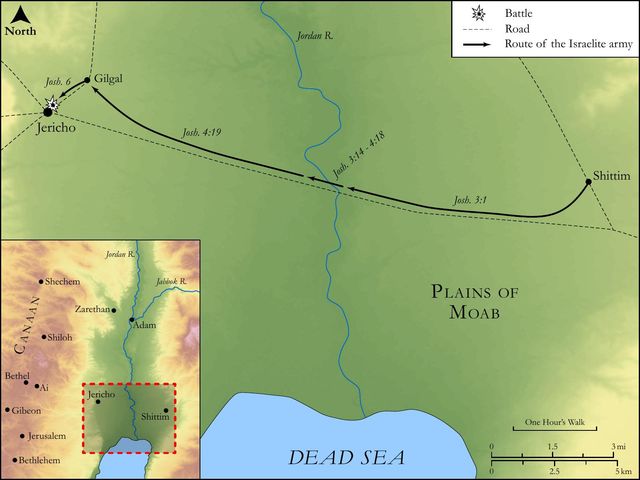
See on the biblical-era map
Study this verse
Public-domain commentary
Matthew Henry
From his Commentary on the Whole Bible. Henry comments on passages, not single verses — this entry covers Joshua 5:1–9. His four-level outline is real structure in the source text, so it is rendered as structure.
A vast show, no doubt, the numerous camp of Israel made in the plains of Jericho, where now they had pitched their tents. Who can count the dust of Jacob? That which had long been the church in the wilderness has now come up from the wilderness, leaning upon her beloved, and looks forth as the morning, fair as the moon, clear as the sun, and terrible as an army with banners. How terrible she was in the eyes of her enemies we are here told, Jos 5:1. How fair and clear she was made in the eyes of her friends, by the rolling away of the reproach of Egypt, we are told in the following verses.
I.Here is the fright which the Canaanites were put into by their miraculously passing over Jordan, Jos 5:1.
The news of it was soon dispersed all the country over, not only as a prodigy in itself, but as an alarm to all the kings and kingdoms of Canaan. Now, as when Babylon was taken, One post runs to meet another, and one messenger to meet another, to carry the amazing tidings to every corner of their land, Jer 51:31. And here we are told what impressions the tidings made upon the kings of this land: Their heart melted like wax before the fire, neither was there spirit in them any more. This intimates that, though the heart of the people generally had fainted before (as Rahab owned, Jos 2:9), yet the kings had till now kept up their spirits pretty well, had promised themselves that, being in possession, their country populous, and their cities fortified, they should be able to make their part good against the invaders; but when they heard not only that they had come over Jordan, and that this defence of their country was broken through, but that they had come over by a miracle, the God of nature manifestly fighting for them, their hearts failed them too, they gave up the cause for gone, and were now at their wits' end. And, 1. they had reason enough to be afraid; Israel itself was a formidable body, and much more so when God was its head, a God of almighty power. What can make head against them if Jordan be driven back before them? 2. God impressed these fears upon them, and dispirited them, as he had promised (Exo 23:27), I will send my fear before thee. God can make the wicked to fear where no fear is (Psa 53:5.), much more where there is such cause for fear as was here. He that made the soul can, when he pleases, make his sword thus to approach to it and kill it with his terrors.
II.The opportunity which this gave to the Israelites to circumcise those among them that were uncircumcised:
At that time (Jos 5:2), when the country about them was in that great consternation, God ordered Joshua to circumcise the children of Israel, for at that time it might be done with safety even in an enemy's country; their hearts being melted, their hands were tied, that they could not take this advantage against them as Simeon and Levi did against the Shechemites, to come upon them when they were sore. Joshua could not be sure of this, and therefore, if he had ordered this general circumcision just at this time of his own head, he might justly have been censured as imprudent; for, how good soever the thing was in itself, in the eye of reason it was not seasonable at this time, and might have been of dangerous consequence; but, when God commanded him to do it, he must not consult with flesh and blood; he that bade them to do it would, no doubt, protect them and bear them out in it. Now observe,
1.The occasion there was for this general circumcision. (1.) All that came out of Egypt were circumcised, v. 5. while they had peace in Egypt doubtless they circumcised their children the eighth day according to the law. But after they began to be oppressed, especially when the edict was made for the destruction of their male infants, the administration of this ordinance was interrupted; many of them were uncircumcised, of whom there was a general circumcision, either during the time of the three days' darkness, as Dr. Lightfoot conjectures, or a year after, just before their eating the second passover at Mount Sinai, and in order to that solemnity (Num 9:2) as many think. And it is with reference to that general circumcision that this is called a second, v.
2.But the learned Masius thinks it refers to the general circumcision of Abraham's family when that ordinance was first instituted, Gen 17:23. That first confirmed the promise of the land of Canaan, this second was a thankful celebration of the performance of that promise. But, (2.) All that were born in the wilderness, namely, after their walking in the wilderness, became by the divine sentence a judgment upon them for their disobedience, as is intimated by that repetition of the sentence, Jos 5:6. Al that were born since that fatal day on which God swore in his wrath that none of that generation should enter into his rest were uncircumcised. But what shall we say to this? Had not God enjoined it to Abraham, under a very severe penalty, that every man-child of his seed should be circumcised on the eighth day? Gen 17:9-14. Was it not the seal of the everlasting covenant? Was not so great a stress laid upon it when they were coming out of Egypt that when, immediately after the first passover, the law concerning that feast was made perpetual, this was one clause of it, that no uncircumcised person should eat of it, but should be deemed as a stranger? and yet, under the government of Moses himself, to have all their children that were born for thirty-eight years together left uncircumcised is unaccountable. So great an omission could not be general but by divine direction. Now, [1.] Some think circumcision was omitted because it was needless: it was appointed to be a mark of distinction between the Israelites and other nations, and therefore in the wilderness, where they were so perfectly separated from all and mingled with none, there was no occasion for it. [2.] Others think that they did not look upon the precept of circumcision as obligatory till they came to settle in Canaan; for in the covenant made with them at Mount Sinai nothing was said about circumcision, neither was it of Moses but of the fathers (Joh 7:22), and with particular reference to the grant of the land of Canaan, Gen 17:8. [3.] Others think that God favourably dispensed with the observance of this ordinance in consideration of the unsettledness of their state, and their frequent removals while they were in the wilderness. It was requisite that children after they were circumcised should rest for some time while they were sore, and stirring them might be dangerous to them; God therefore would have mercy and not sacrifice. This reason is generally acquiesced in, but to me it is not satisfactory, for sometimes they staid a year in a place (Num 9:22), if not much longer, and in their removals the little children, though sore, might be wrapped so warm, and carried so easy, as to receive no damage, and might certainly be much better accommodated than the mothers in travail or while lying in. Therefore, [4.] To me it seems to have been a continued token of God's displeasure against them for their unbelief and murmuring. Circumcision was originally a seal of the promise of the land of Canaan, as we observed before. It was in the believing hope of that good land that the patriarchs circumcised their children; but when God had sworn in his wrath concerning the men of was who came out of Egypt that they should be consumed in the wilderness, and never enter Canaan, nor come within sight of it (as that sentence is here repeated, Gen 17:6, reference being made to it), as a further ratification of that sentence, and to be a constant memorandum of it to them, all that fell under that sentence, and were to fall by it, were forbidden to circumcise their children, by which they were plainly told that, whatever others might, they should never have the benefit of that promise of which circumcision was the seal. And this was such a significant indication of God's wrath as the breaking of the tables of the covenant was when Israel had broken the covenant by making the golden calf. It is true that there is no express mention of this judicial prohibition in the account of that sentence; but an intimation of it in Num 14:33, Your children shall bear your whoredoms. It is probable the children of Caleb and Joshua were circumcised, for they were excepted out of that sentence, and of Caleb it is particularly said, To him will I give the land, and to his children (Deu 1:36), which was the very promise that circumcision was the seal of: and Joshua is here told to circumcise the people, not his own family. Whatever the reason was, it seems that this great ordinance was omitted in Israel for almost forty years together, which is a plain indication that it was not of absolute necessity, nor was to be of perpetual obligation, but should in the fulness of time be abolished, as now it was for so long a time suspended.
2.The orders given to Joshua for this general circumcision (Jos 5:2): Circumcise again the children of Israel, not the same person, but the body of the people. Why was this ordered to be done now? Answ. (2.) Because now the promise of which circumcision was instituted to be the seal was performed. The seed of Israel was brought safely into the land of Canaan. "Let them therefore hereby own the truth of that promise which their fathers had disbelieved, and could not find in their hearts to trust to." (2.) Because now the threatening of which the suspending of circumcision for thirty-eight years was the ratification was fully executed by the expiring of the forty years. That warfare is accomplished, that iniquity is pardoned (Isa 40:2), and therefore now the seal of the covenant is revived again. But why was it not done sooner? why not while they were resting some months in the plains of Moab? why not during the thirty days of their mourning for Moses? Why was it not deferred longer, till they had made some progress in the conquest of Canaan, and had gained a settlement there, at least till they had entrenched themselves, and fortified their camp? why must it be done the very next day after they had come over Jordan? Answ. Because divine Wisdom saw that to be the fittest time, just when the forty years were ended, and they had entered Canaan; and the reasons which human wisdom would have offered against it were easily overruled. [1.] God would hereby show that the camp of Israel was not governed by the ordinary rules and measures of war, but by immediate direction from God, who by thus exposing them, in the most dangerous moments, magnified his own power in protecting them even then. And this great instance of security, in disabling themselves for action just when they were entering upon action, proclaimed such confidence in the divine care for their safety as would increase their enemies' fears, much more when their scouts informed them not only of the thing itself that was done, but of the meaning of it, that it was a seal of the grant of this land to Israel. [2.] God would hereby animate his people Israel against the difficulties they were now to encounter, by confirming his covenant with them, which gave them unquestionable assurance of victory and success, and the full possession of the land of promise. [3.] God would hereby teach them, and us with them, in all great undertakings to begin with God, to make sure of his favour, by offering ourselves to him a living sacrifice (for that was signified by the blood of circumcision), and then we may expect to prosper in all we do. [4.] The reviving of circumcision, after it had been so long disused, was designed to revive the observance of other institutions, the omission of which had been connived at in the wilderness. This command to circumcise them was to remind them of that which Moses had told them (Deu 21:8), that when they should have come over Jordan they must not do as they had done in the wilderness, but must come under a stricter discipline. It was said concerning many of the laws God had given them that they must observe them in the land to which they were going, Deu 6:1; Deu 12:1. [5.] This second circumcision, as it is here called, was typical of the spiritual circumcision with which the Israel of God, when they enter into the gospel rest, are circumcised; it is the learned bishop Pierson's observation that this circumcision being performed under the direction of Joshua, Moses' successor, it points to Jesus as the true circumciser, the author of another circumcision than that of the flesh, commanded by the law, even the circumcision of the heart (Rom 2:29), called the circumcision of Christ, Col, Jos 2:11.
3.The people's obedience to these orders. Joshua circumcised the children of Israel (Jos 5:3), not himself with his own hands, but he commanded that it should be done, and took care that it was done: it might soon be despatched, for it was not necessary that it should be done by a priest or Levite, but any one might be employed to do it. All those that were under twenty years old when the people were numbered at Mount Sinai, and not being numbered with them fell not by the fatal sentence, were circumcised, and by them all the rest might be circumcised in a little time. The people had promised to hearken to Joshua as they had hearkened to Moses (Jos 1:17), and here they gave an instance of their dutifulness by submitting to this painful institution, and not calling him for the sake of it a bloody governor, as Zipporah because of the circumcision called Moses a bloody husband.
4.The names given to the place where this was done, to perpetuate the memory of it.
(1.)It was called the hill of the foreskins, v. 3. Probably the foreskins that were cut off were laid on a heap, and covered with earth, so that they made a little hillock.
(2.)It was called Gilgal, from a word which signifies to take away, from that which God said to Joshua (v. 9), This day have I rolled away the reproach of Egypt. God is jealous for the honour of his people, his own honour being so much interested in it; and, whatever reproach they may lie under for a time, first or last it will certainly be rolled away, and every tongue that riseth up against them he will condemn.
[1.]Their circumcision rolled away the reproach of Egypt. they were hereby owned to be the free-born children of God, having the seal of the covenant in their flesh, and so the reproach of their bondage in Egypt was removed. They were tainted with the idolatry of Egypt, and that was their reproach; but now that they were circumcised it was to be hoped they would be so entirely devoted to God that the reproach of their affection to Egypt would be rolled away.
[2.]Their coming safely to Canaan rolled away the reproach of Egypt, for it silenced that spiteful suggestion of the Egyptians, that for mischief they were brought out, the wilderness had shut them in, Exo 14:3. Their wandering so long in the wilderness confirmed the reproach, but now that they had entered Canaan in triumph that reproach was done away. When God glorifies himself in perfecting the salvation of his people he not only silences the reproach of their enemies, but rolls it upon themselves.
Historical interpretation
Historical reception
1 surviving comment on this verse from the historical church.
The circumcision was given to Abraham before the law, after the blessings and after the promise, as a sign to set him and those born of him and those of his household apart from the Gentiles in whose midst he was living. And this is obvious, because, when Israel spent forty years alone by themselves in the desert without mixing with any other nation, all those who were born in the desert were not circumcised. However, when Joshua brought them across the Jordan, they were circumcised and a second law of circumcision was made. For, under Abraham a law of circumcision was given, and then it was inoperative for forty years in the desert. Then, after the crossing of the Jordan, God again gave the law for a second time, as is written in the book of Joshua, son of Nave [Nun]: “At that time the Lord said to Joshua: make knives of stone from the sharpest rock, and sitting down circumcise the second time the children of Israel”; and a little further on: “for during forty-two years Israel dwelt in the wilderness of Midbar, and for this reason very many were uncircumcised of the sons of the fighting men who had come out of Egypt, who had disobeyed the commandments of God and to whom he declared that they should not see the good land which he had sworn to give to their fathers, the land flowing with milk and honey. The children of these he made to succeed in their place whom Joshua circumcised because of their not having been circumcised in the way.” Hence, circumcision was a sign by which Israel was set apart from the Gentiles among whom they lived.
Continue studying Joshua 5:4 across the web’s major study libraries — every link below opens this exact verse, chapter, or book on the destination site.
Read & Compare
 BibleGatewayThis verse in more than 200 translations and 70 languages.
 Bible.comThe YouVersion reader — hundreds of translations, reading plans, and highlights.
 ESV.orgCrossway's official English Standard Version reader.
 NET BibleThe NET translation with 60,000+ translators' notes on every rendering decision.
 STEP BibleTyndale House's free study tool — original text, vocabulary, and scholarly resources.
 BibliaLogos Bible Software's free web reader.
 USCCBThe New American Bible (Revised Edition) with the U.S. bishops' study notes.
Commentaries
 BibleHub CommentariesDozens of classic commentaries on this verse, gathered on one page.
 StudyLightMore than 100 commentary sets — the largest collection on the web.
 BibleRefPlain-English commentary on what this verse means, verse by verse.
 Enduring WordDavid Guzik's free commentary on this chapter, widely used by Bible teachers.
 Bible Study ToolsVerse commentary alongside Greek and Hebrew study aids.
Original Language & Research
- BibleHub InterlinearThe verse word by word — original language, transliteration, and English.
- BibleHub LexiconEvery word's original-language definition and Strong's entry.
 Blue Letter BibleDeep-study tools — Strong's numbers, concordance, and word studies.
 SefariaThe Hebrew text with Rashi and centuries of Jewish commentary.
Sermons, Hymns & Audio


TrulyRandomVerse is not affiliated with these sites and doesn’t control their content. They’re linked because they’re genuinely useful.
Summary
Joshua 5:4 serves as the critical explanatory hinge for the mass circumcision at Gilgal, immediately following Israel's miraculous entry into the Promised Land. It precisely clarifies that the entire generation of Israelite males, specifically those designated as "men of war," who had departed from Egypt, had perished in the wilderness due to their unbelief and rebellion. Consequently, the generation now poised to inherit Canaan had been born during the forty years of wandering and had not received the covenant sign of circumcision, making its re-establishment a foundational act of covenant renewal, spiritual purification, and preparation for the impending conquest.
Context
ShowHideLiterary Context
This verse functions as a crucial parenthetical explanation within the narrative flow of Joshua 5. It directly follows God's command to Joshua to "circumcise again the children of Israel the second time" in Joshua 5:2. The preceding verse (Joshua 5:1) describes the fear of the Canaanite kings, setting the stage for Israel's strategic vulnerability. Joshua 5:4 provides the historical and theological rationale for the seemingly risky act of rendering the entire male population incapacitated, bridging the divine imperative with its profound necessity. The verses that follow detail the actual performance of the circumcision (Joshua 5:3), the subsequent celebration of Passover (Joshua 5:10), and the cessation of manna (Joshua 5:12). Thus, Joshua 5:4 anchors the spiritual preparation at Gilgal, underscoring that covenant faithfulness and spiritual readiness are paramount before any military engagement or claim to the promised inheritance.
Historical & Cultural Context
The historical backdrop is the forty-year wilderness wandering, a period of divine judgment and purification. This era was primarily a consequence of the Exodus generation's rebellion and unbelief at Kadesh-Barnea, where they refused to trust God to conquer the land (Numbers 14:26-35). As a result, with the exceptions of Joshua and Caleb, all adult males from that generation perished, fulfilling God's decree. Circumcision, the sign of the Abrahamic covenant (Genesis 17:9-14), was neglected during this wilderness period. Possible reasons include the nomadic lifestyle making the ritual difficult or dangerous due to infection, or perhaps it symbolized the spiritual brokenness and judgment upon the people. The mass circumcision at Gilgal, therefore, was not a mere ritualistic formality but a profound act of covenant recommitment. It signified Israel's renewed identity, obedience, and spiritual purification, preparing them to engage in the holy war to claim their divinely promised inheritance.
Key Themes
ShowHideThis verse powerfully contributes to several overarching themes within the book of Joshua and the Pentateuch. It starkly illustrates the Consequences of Disobedience, serving as a solemn reminder of the severity of unbelief and rebellion against God's direct commands, which led to the exclusion of an entire generation from the Promised Land (Deuteronomy 2:14-16). It highlights a crucial Generational Transition, marking the definitive end of the Exodus generation and the rise of a new generation, born and nurtured in the wilderness, now poised to fulfill God's promises. This transition is inextricably linked to Covenant Renewal, as the re-establishment of the sign of circumcision signifies Israel's recommitment to their covenant relationship with Yahweh, affirming their identity as His chosen people before entering the land promised to Abraham (Genesis 12:1-3). Finally, it underscores Divine Faithfulness, demonstrating that despite Israel's repeated failures, God remains steadfast to His covenant promises, raising up a new generation to accomplish His redemptive purposes.
Exposition and Analysis
ShowHideKey Word Analysis
ShowHideThis verb means "to cut short, i.e. curtail (specifically the prepuce, i.e. to circumcise)." In this context, it refers to the ritual removal of the foreskin, which served as the physical, indelible sign of God's covenant with Abraham and his descendants (Genesis 17:10). Its re-implementation at Gilgal signifies a profound act of covenant renewal, marking the new generation as truly belonging to God and prepared for the inheritance of the land.
Properly "remembered, i.e. a male (of man or animals, as being the most noteworthy sex)." This word specifies that the judgment fell upon the male population, who were the bearers of the covenant sign and the ones responsible for military service. The emphasis on "males" (who included the "men of war") highlights the specific group within the Exodus generation that died in the wilderness, signifying the complete passing of the old, rebellious covenant-bearers.
A primitive root meaning "to die (literally or figuratively); causatively, to kill." While a common verb, its usage here carries the full weight of divine judgment and the fulfillment of God's decree. The repeated emphasis on "all" who died highlights the totality and finality of God's pronouncement against the rebellious generation, clearing the way for a new, obedient generation to inherit the promises.
Verse Breakdown
ShowHide"And this [is] the cause why Joshua did circumcise:"
This opening clause immediately establishes the purpose of the verse: to provide the divine and historical rationale for the command given in Joshua 5:2 and the subsequent action of circumcision described in Joshua 5:3. It signals to the reader that the following information is the crucial explanation for this significant and seemingly vulnerable act.
"All the people that came out of Egypt, [that were] males, [even] all the men of war, died in the wilderness by the way, after they came out of Egypt."
This is the explanatory core of the verse, detailing the specific circumstances that necessitated the mass circumcision.
"All the people that came out of Egypt, [that were] males"
This identifies the specific group: the entire adult male population of the Exodus generation. It explicitly excludes those who were minors at the time of the rebellion and, notably, Joshua and Caleb, who were exceptions to the divine decree.
"[even] all the men of war"
This further specifies and emphasizes the nature of the condemned generation. These were the ones capable of fighting, the ones who should have led the charge into Canaan, but instead succumbed to fear and unbelief. Their death underscores that their failure was not one of physical weakness, but of spiritual unbelief and cowardice, particularly at Kadesh-Barnea.
"died in the wilderness by the way, after they came out of Egypt"
This confirms the complete fulfillment of God's judgment. The "wilderness" is presented as the place of their demise, a stark testament to their wandering and the direct consequence of their rebellion against God's command to enter the land. The phrase "by the way" emphasizes that their death occurred during the journey, preventing their entry into the Promised Land, signifying a complete generational turnover.
Literary Devices
ShowHideJoshua 5:4 primarily functions as Exposition, providing a clear, concise, and crucial explanation for the preceding divine command and subsequent action. The author employs Repetition and Emphasis through the repeated use of "all the people... all the men of war" to underscore the totality of the divine judgment and the complete generational shift. This creates a powerful sense of finality and highlights the profound nature of the transition from the old covenant generation to the new. There is also an implicit Juxtaposition between the rebellious, unfaithful generation that perished in the wilderness and the new, obedient generation that is now being prepared through covenant renewal to inherit God's promises. Furthermore, the verse serves as a powerful demonstration of the Fulfillment of Divine Judgment, confirming that God's word concerning the fate of the rebellious generation had come to pass precisely as declared, thereby reinforcing His sovereignty and faithfulness to His word, both in judgment and in promise.
Theological and Thematic Connections
ShowHideJoshua 5:4 is a profound theological statement on God's holiness, justice, and unwavering faithfulness to His covenant. It powerfully demonstrates that while God is merciful and patient, He is also just, and sin, particularly unbelief and rebellion against His revealed will, carries severe consequences. The death of the Exodus generation in the wilderness serves as a stark object lesson for all future generations, including believers today, on the seriousness of failing to trust and obey God. Yet, even in judgment, God's faithfulness to His covenant promises shines through. He did not abandon His people but preserved a remnant and raised up a new generation, preparing them through this act of covenant renewal to receive the inheritance He had promised. This passage underscores that spiritual readiness and alignment with God's covenant are absolute prerequisites for entering into and experiencing His blessings and purposes.
Reflection and Application
ShowHideJoshua 5:4 serves as a powerful reminder that spiritual readiness is paramount for fulfilling God's purposes. Just as the new generation of Israelites had to shed the consequences of their parents' disobedience and embrace the covenant anew through circumcision, believers today are called to a similar process of spiritual purification and renewed commitment. This means identifying and shedding any "wilderness mentalities"—patterns of unbelief, complaining, or disobedience—that may hinder our progress in God's will. We are called to embrace a "Promised Land mentality" characterized by faith, obedience, and wholehearted trust in God's promises. The act of circumcision at Gilgal, explained by this verse, underscores the necessity of aligning ourselves fully with God's covenant before embarking on His mission for our lives. It challenges us to consider what spiritual "foreskins"—anything that separates us from full devotion and obedience to God—we might need to "cut off" in our own lives or in the life of the church, ensuring we are truly prepared to walk in the fullness of His calling and experience the inheritance He has prepared for us.
Questions for Reflection
ShowHideFAQ
ShowHideWhy was circumcision neglected for 40 years in the wilderness?
ShowHideThe biblical text does not explicitly state the reason for the forty-year suspension of circumcision. However, several theories are proposed by scholars. One common explanation suggests that the nomadic lifestyle in the wilderness made the ritual difficult and potentially dangerous, as the fresh wound would be susceptible to infection without stable conditions for healing. Another perspective views it as a deliberate suspension during a period of divine judgment and separation, where the people's general spiritual apathy and rebellion, culminating in their unbelief at Kadesh-Barnea (Numbers 14:1-4), mirrored a broader disregard for the covenant sign. The command in Joshua 5:2 to circumcise "again" implies a restoration of a practice that had ceased, signifying a new beginning and a renewed covenant relationship as they entered the Promised Land.
What is the significance of "men of war" dying in the wilderness?
ShowHideThe specific mention of "men of war" dying in the wilderness is highly significant. It highlights that the generation condemned to perish was not merely the general populace, but specifically those who were physically able and designated to fight and conquer the land. Their failure was not one of physical inability, but of spiritual unbelief and cowardice, particularly when faced with the challenge of entering Canaan after the spies' report at Kadesh-Barnea (Numbers 13:26-33). Their death underscored a crucial theological point: the conquest of Canaan would not be achieved by human strength or military might, but by God's power working through a generation that trusted Him. It served as a powerful lesson that obedience and faith, not just physical prowess, are essential for fulfilling God's purposes and inheriting His promises.
Christ-Centered Fulfillment
ShowHideJoshua 5:4, with its emphasis on the death of the old, rebellious generation and the covenant renewal for the new, finds profound Christ-centered fulfillment in the New Testament. The physical death of the rebellious generation in the wilderness foreshadows the spiritual death to sin and the old self that occurs in Christ (Romans 6:6). Just as the physical circumcision marked Israel as God's people, the New Covenant brings about a "circumcision of the heart" (Romans 2:29, Colossians 2:11), an inward transformation wrought by the Holy Spirit, where outward ritual is replaced by an inner reality of faith and new life in Christ. The new generation entering the physical Promised Land points to believers entering into the spiritual rest and eternal inheritance found in Christ (Hebrews 4:9). Jesus, the true Joshua (whose name, Yeshua, means "the Lord saves"), leads His people into the ultimate promised land—eternal life and communion with God—not through physical conquest, but through His spiritual victory over sin and death on the cross (John 14:6, Ephesians 2:6). The preparation at Gilgal for physical battle points to the spiritual armor and battle believers are called to in Christ against spiritual forces of evil (Ephesians 6:10-18). Ultimately, the old covenant generation's failure due to unbelief serves as a solemn warning for New Covenant believers not to fall short of God's promises through a similar lack of faith in Christ (Hebrews 3:12-19).