


John 18:34
- ἀπεκρίθηapekrithēAnsweredG611V-ADI-3SVerb Aorist Middle Deponent Indicative 3rd Singular
- αὐτῷautōto himG846P-DSMPersonal pronoun Dative Singular Masculine
- ὁho<the>G3588T-NSMDefinite article Nominative Singular Masculine
- Ἰησοῦς·IēsousJesusG2424N-NSM-PNoun Nominative Singular Masculine Individual
- ἀπὸapoOfG575PREPPreposition
- σεαυτοῦseautouyourselfG4771F-2GSMReflexive pronoun Genitive 2nd Singular Masculine
- σὺsuyou yourselfG4771P-2NSPersonal pronoun Nominative 2nd Singular
- τοῦτοtoutothisG3778D-ASNDemonstrative pronoun Accusative Singular Neuter
- λέγειςlegeissayG3004V-PAI-2SVerb Present Active Indicative 2nd Singular
- ἢēorG2228CONJConjunction
- ἄλλοιalloiothersG243A-NPMAdjective Nominative Plural Masculine
- εἶπόνeipondid say [it]G2036V-2AAI-3PVerb 2nd Aorist Active Indicative 3rd Plural
- σοιsoito youG4771P-2DSPersonal pronoun Dative 2nd Singular
- περὶpericoncerningG4012PREPPreposition
- ἐμοῦ;emouMe?G1473S-1SGSNPossessive pronoun Genitive 1st Person Singular Neuter
English is a literal word-by-word gloss of the Greek, not the KJV's wording. Why?
This is the original text the KJV's translators worked from — each Greek word with its own literal English meaning in this verse, prepared by scholars at Tyndale House, Cambridge. The KJV translates whole sentences, not word by word, so its wording differs: one Greek word can become several English words, and the KJV may choose “charity” where the gloss reads “love”. Both are faithful — they answer different questions. For the KJV's own rendering, switch to the KJV text.
Details
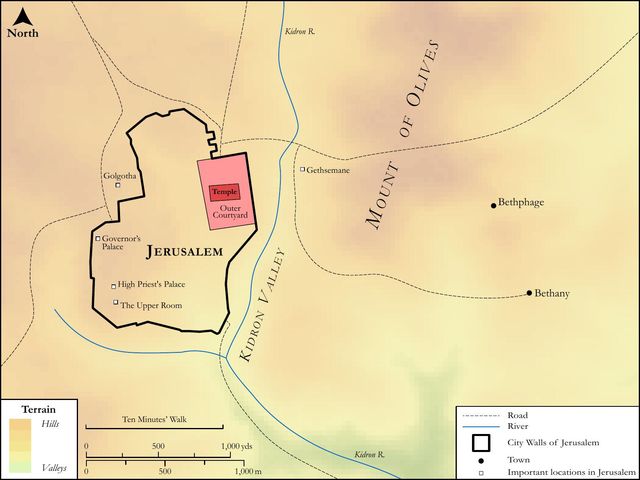
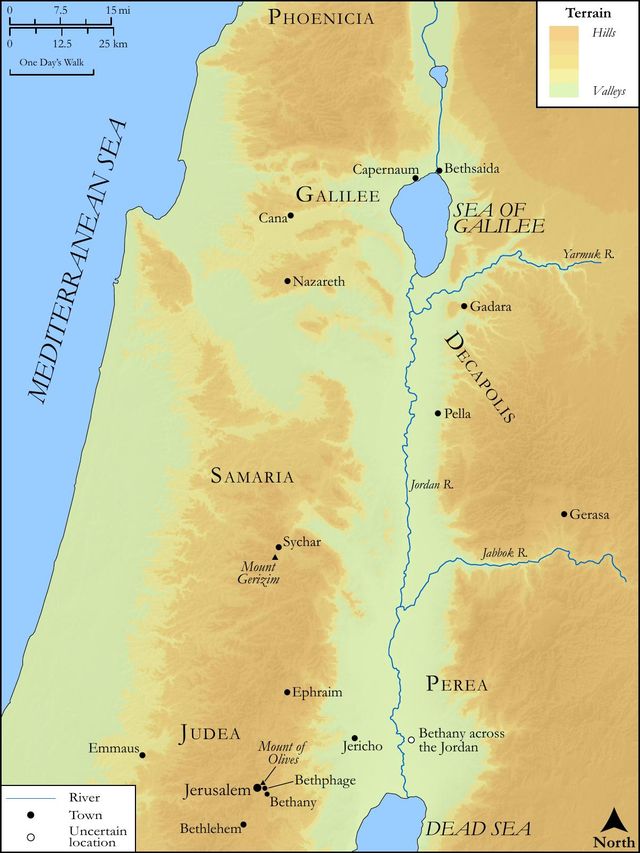
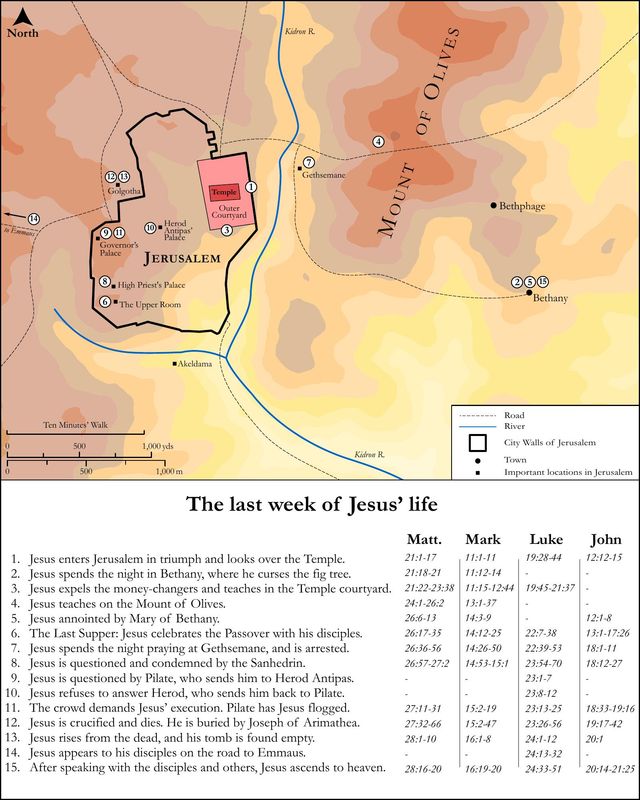
See on the biblical-era map
Study this verse
Public-domain commentary
Matthew Henry
From his Commentary on the Whole Bible. Henry comments on passages, not single verses — this entry covers John 18:28–40. His four-level outline is real structure in the source text, so it is rendered as structure.
We have here an account of Christ's arraignment before Pilate, the Roman governor, in the praetorium (a Latin word made Greek), the praetor's house, or hall of judgment; thither they hurried him, to get him condemned in the Roman court, and executed by the Roman power. Being resolved on his death, they took this course, 1. That he might be put to death the more legally and regularly, according to the present constitution of their government, since they became a province of the empire; not stoned in a popular tumult, as Stephen, but put to death with the present formalities of justice. Thus he was treated as a malefactor, being made sin for us. 2. That he might be put to death the more safely. If they could engage the Roman government in the matter, which the people stood in awe of, there would be little danger of an uproar. 3. That he might be put to death with more reproach to himself. The death of the cross, which the Romans commonly used, being of all deaths the most ignominious, they were desirous by it to put an indelible mark of infamy upon him, and so to sink his reputation for ever. This therefore they harped upon, Crucify him. 4. That he might be put to death with less reproach to them. It was an invidious thing to put one to death that had done so much good in the world, and therefore they were willing to throw the odium upon the Roman government, to make that the less acceptable to the people, and save themselves from the reproach. Thus many are more afraid of the scandal of a bad action than of the sin of it. See Act 5:28. Two things are here observed concerning the prosecution: - (1.) Their policy and industry in the prosecution: It was early; some think about two or three in the morning, others about five or six, when most people were in their beds; and so there would be the less danger of opposition from the people that were for Christ; while, at the same time, they had their agents about, to call those together whom they could influence to cry out against him. See how much their heart was upon it, and how violent they were in the prosecution. Now that they had him in their hands, they would lose no time till they had him upon the cross, but denied themselves their natural rest, to push on this matter. See Mic 2:1. (2.) Their superstition and vile hypocrisy: The chief priests and elders, though they came along with the prisoner, that the thing might be done effectually, went not into the judgment-hall, because it was the house of an uncircumcised Gentile, lest they should be defiled, but kept out of doors, that they might eat the passover, not the paschal lamb (that was eaten the night before) but the passover-feast, upon the sacrifices which were offered on the fifteenth day, the Chagigah, as they called it, the passover-bullocks spoken of Deu 16:2; Ch2 30:24; Ch2 35:8, Ch2 35:9. These they were to eat of, and therefore would not go into the court, for fear of touching a Gentile, and thereby contracting, not a legal, but only a traditional pollution. This they scrupled, but made no scruple of breaking through all the laws of equity to persecute Christ to the death. They strained at a gnat, and swallowed a camel. Let us now see what passed at the judgment-hall. Here is,
I.Pilate's conference with the prosecutors.
They were called first, and stated what they had to say against the prisoner, as was very fit, Joh 18:29-32.
1.The judge calls for the indictment. Because they would not come into the hall, he went out to them into the court before the house, to talk with them. Looking upon Pilate as a magistrate, that we may give every one his due, here are three things commendable in him: - (1.) His diligent and close application to business. If it had been upon a good occasion, it had been very well that he was willing to be called up early to the judgment-seat. Men in public trusts must not love their ease. (2.) His condescending to the humour of the people, and receding from the honour of his place to gratify their scruples. He might have said, "If they be so nice as not to come in to me, let them go home as they came;" by the same rule as we might say, "If the complainant scruple to take off his hat to the magistrate, let not his complaint be heard;" but Pilate insists not upon it, bears with them, and goes out to them; for, when it is for good, we should become all things to all men. (3.) His adherence to the rule of justice, in demanding the accusation, suspecting the prosecution to be malicious: "What accusation bring you against this man?" What is the crime you charge him with, and what proof have you of it? It was a law of nature, before Valerius Publicola made it a Roman law, Ne quis indicta causa condemnetur - No man should be condemned unheard. See Act 25:16, Act 25:17. It is unreasonable to commit a man, without alleging some cause in the warrant, and much more to arraign a man when there is no bill of indictment found against him.
2.The prosecutors demand judgment against him upon a general surmise that he was a criminal, not alleging, much less proving, any thing in particular worthy of death or of bonds (Joh 18:30): If he were not a malefactor, or evildoer, we would not have delivered him to thee to be condemned. This bespeaks them,
(1.)Very rude and uncivil to Pilate, a company of ill-natured men, that affected to despise dominion. When Pilate was so complaisant to them as to come out to treat with them, yet they were to the highest degree out of humour with him. He put the most reasonable question to them that could be; but, if it had been the most absurd, they could not have answered him with more disdain.
(2.)Very spiteful and malicious towards our Lord Jesus: right or wrong, they will have him to be a malefactor, and treated as one. We are to presume a man innocent till he is proved guilty, but they will presume him guilty who could prove himself innocent. They cannot say, "He is a traitor, a murderer, a felon, a breaker of the peace," but they say, "He is an evil-doer." He an evil-doer who went about doing good! Let those be called whom he had cured, and fed, and taught; whom he has rescued from devils, and raised from death; and let them be asked whether he be an evil-doer or no. Note, It is no new thing for the best of benefactors to be branded and run down as the worst of malefactors.
(3.)Very proud and conceited of themselves, and their own judgment and justice, as if their delivering a man up, under the general character of a malefactor, were sufficient for the civil magistrate to ground a judicial sentence upon, than which what could be more haughty?
3.The judge remands him to their own court (Joh 18:31): "Take you him, and judge him according to your own law, and do not trouble me with him." Now,
(1.)Some think Pilate herein complimented them, acknowledging the remains of their power, and allowing them to exert it. Corporal punishment they might inflict, as scourging in their synagogues; whether capital or no is uncertain. "But," saith Pilate, "go as far as your law will allow you, and, if you go further, it shall be connived at." This he said, willing to do the Jews a pleasure, but unwilling to do them the service they required.
(2.)Others think he bantered them, and upbraided them with their present state of weakness and subjection. They would be the sole judges of the guilt. "Pray," saith Pilate, "if you will be so, go on as you have begun; you have found him guilty by your own law, condemn him, if you dare, by your own law, to carry on the humour." Nothing is more absurd, nor more deserves to be exposed, than for those to pretend to dictate, and boast of their wisdom, who are weak and in subordinate stations, and whose lot it is to be dictated to. Some think Pilate here reflects upon the law of Moses, as if it allowed them what the Roman law would by no means allow - the judging of a man unheard. "It may be your law will suffer such a thing, but ours will not." Thus, through their corruptions, the law of God was blasphemed; and so is his gospel too.
4.They disown any authority as judges, and (since it must be so) are content to be prosecutors. They now grow less insolent and more submissive, and own, "It is not lawful for us to put any man to death, whatever less punishment we may inflict, and this is a malefactor whom we would have the blood of."
(1.)Some think they had lost their power to give judgment in matters of life and death only by their own carelessness, and cowardly yielding to the darling iniquities of the age; so Dr. Lightfoot ouk exesti - It is not in our power to pass sentence of death upon any, if we do, we shall have the mob about us immediately.
(2.)Others think their power was taken from them by the Romans, because they had not used it well, or because it was thought too great a trust to be lodged in the hands of a conquered and yet an unsubdued people. Their acknowledgement of this they designed for a compliment to Pilate, and to atone for their rudeness (Joh 18:30), but it amounts to a full evidence that the sceptre was departed from Judah, and therefore that now the Messiah was come, Gen 49:10. If the Jews have no power to put any man to death, where is the sceptre? Yet they ask not, Where is the Shiloh?
(3.)However, there was a providence in it, that either they should have not power to put any man to death, or should decline the exercise of it upon this occasion, That the saying of Jesus might be fulfilled, which he spoke, signifying what death he should die, Joh 18:32. Observe,
[1.]In general, that even those who designed the defeating of Christ's sayings were, beyond their intention, made serviceable to the fulfilling of them by an overruling hand of God. No word of Christ shall fall to the ground; he can never either deceive or be deceived. Even the chief priests, while they persecuted him as a deceiver, had their spirit so directed as to help to prove him true, when we should think that by taking other measures they might have defeated his predictions. Howbeit, they meant not so, Isa 10:7.
[2.]Those sayings of Christ in particular were fulfilled which he had spoken concerning his own death. Two sayings of Christ concerning his death were fulfilled, by the Jews declining to judge him according to their law. First, He had said that he should be delivered to the Gentiles, and that they should put him to death (Mat 20:19; Mar 10:33; Luk 18:32, Luk 18:33), and hereby that saying was fulfilled. Secondly, He had said that he should be crucified (Mat 20:19; Mat 26:2), lifted up, Joh 3:14; Joh 12:32. Now, if they had judged him by their law, he had been stoned; burning, strangling, and beheading, were in some cases used among the Jews, but never crucifying. It was therefore necessary that Christ should be put to death by the Romans, that, being hanged upon a tree, he might be made a curse for us (Gal 3:13), and his hands and feet might be pierced. As the Roman power had brought him to be born at Bethlehem, so now to die upon a cross, and both according to the scriptures. It is likewise determined concerning us, though not discovered to us, what death we shall die, which should free us from all disquieting cares about that matter. "Lord, what, and when, and how thou hast appointed."
II.Here is Pilate's conference with the prisoner, Joh 18:33, etc., where we have,
1.The prisoner set to the bar. Pilate, after he had conferred with the chief priests at his door, entered into the hall, and called for Jesus to be brought in. He would not examine him in the crowd, where he might be disturbed by the noise, but ordered him to be brought into the hall; for he made no difficulty of going in among the Gentiles. We by sin were become liable to the judgment of God, and were to be brought before his bar; therefore Christ, being made sin and a curse for us, was arraigned as a criminal. Pilate entered into judgment with him, that God might not enter into judgment with us.
2.His examination. The other evangelists tell us that his accusers had laid it to his charge that he perverted the nation, forbidding to give tribute to Caesar, and upon this he is examined.
(1.)Here is a question put to him, with a design to ensnare him and to find out something upon which to ground an accusation: "Art thou the king of the Jews? ho basileus - that king of the Jews who has been so much talked of and so long expected - Messiah the prince, art thou he? Dost thou pretend to be he? Dost thou call thyself, and wouldest thou be thought so?" For he was far from imagining that really he was so, or making a question of that. Some think Pilate asked this with an air of scorn and contempt: "What! art thou a king, who makest so mean a figure? Art thou the king of the Jews, by whom thou art thus hated and persecuted? Art thou king de jure - of right, while the emperor is only king de facto - in fact?" Since it could not be proved he ever said it, he would constrain him to say it now, that he might proceed upon his own confession.
(2.)Christ answers this question with another; not for evasion, but as an intimation to Pilate to consider what he did, and upon what grounds he went (Joh 18:34): "Sayest thou this thing of thyself, from a suspicion arising in thy own breast, or did others tell it thee of me, and dost thou ask it only to oblige them?" [1.] "It is plain that thou hast no reason to say this of thyself." Pilate was bound by his office to take care of the interests of the Roman government, but he could not say that this was in any danger, or suffered any damage, from any thing our Lord Jesus had ever said or done. He never appeared in worldly pomp, never assumed any secular power, never acted as a judge or divider; never were any traitorous principles or practices objected to him, nor any thing that might give the least shadow of suspicion. [2.] "If others tell it thee of me, to incense thee against me, thou oughtest to consider who they are, and upon what principles they go, and whether those who represent me as an enemy to Caesar are not really such themselves, and therefore use this only as a pretence to cover their malice, for, if so, the matter ought to be well weighed by a judge that would do justice." Nay, if Pilate had been as inquisitive as he ought to have been in this matter, he would have found that the true reason why the chief priests were outrageous against Jesus was because he did not set up a temporal kingdom in opposition to the Roman power; if he would have done this, and would have wrought miracles to bring the Jews out of the Roman bondage, as Moses did to bring them out of the Egyptian, they would have been so far from siding with the Romans against him that they would have made him their king, and have fought under him against the Romans; but, not answering this expectation of theirs, they charged that upon him of which they were themselves most notoriously guilty - disaffection to and design against the present government; and was such an information as this fit to be countenanced?
(3.)Pilate resents Christ's answer, and takes it very ill, Joh 18:35. This is a direct answer to Christ's question, Joh 18:34. [1.] Christ had asked him whether he spoke of himself. "No," says he; "am I a Jew, that thou suspectest me to be in the plot against thee? I know nothing of the Messiah, nor desire to know, and therefore interest not myself in the dispute who is the Messiah and who not; the dispute who is the Messiah and who not; it is all alike to me." Observe with what disdain Pilate asks, Am I a Jew? The Jews were, upon many accounts, an honourable people; but, having corrupted the covenant of their God, he made them contemptible and base before all the people (Mal 2:8, Mal 2:9), so that a man of sense and honour reckoned it a scandal to be counted a Jew. Thus good names often suffer for the sake of the bad men that wear them. It is sad that when a Turk is suspected of dishonesty he should ask, "What! do you take me for a Christian?" [2.] Christ had asked him whether others told him. "Yes," says he, "and those thine own people, who, one would think would be biased in favour of thee, and the priests, whose testimony, in verbum sacerdotis - on the word of a priest, ought to be regarded; and therefore I have nothing to do but to proceed upon their information." Thus Christ, in his religion, still suffers by those that are of his own nation, even the priests, that profess relation to him, but do not live up to their profession. [3.] Christ had declined answering that question, Art thou the king of the Jews? And therefore Pilate puts another question to him more general, "What hast thou done? What provocation hast thou given to thy own nation, and particularly the priests, to be so violent against thee? Surely there cannot be all this smoke without some fire, what is it?"
(4.)Christ, in his next reply, gives a more full and direct answer to Pilate's former question, Art thou a king? explaining in what sense he was a king, but not such a king as was any ways dangerous to the Roman government, not a secular king, for his interest was not supported by secular methods, Joh 18:36. Observe,
[1.]An account of the nature and constitution of Christ's kingdom: It is not of this world. It is expressed negatively to rectify the present mistakes concerning it; but the positive is implied, it is the kingdom of heaven, and belongs to another world. Christ is a king, and has a kingdom, but not of this world. First Its rise is not from this world; the kingdoms of men arise out of the sea and the earth (Dan 7:3; Rev 13:1, Rev 13:11); but the holy city comes from God out of heaven, Rev 22:2. His kingdom is not by succession, election, or conquest, but by the immediate and special designation of the divine will and counsel. Secondly, Its nature is not worldly; it is a kingdom within men (Luk 16:21), set up in their hearts and consciences (Rom 14:17), its riches spiritual, its powers spiritual, and all its glory within. The ministers of state in Christ's kingdom have not the spirit of the world, Co1 2:12. Thirdly, Its guards and supports are not worldly; its weapons are spiritual. It neither needed nor used secular force to maintain and advance it, nor was it carried on in a way hurtful to kings or provinces; it did not in the least interfere with the prerogatives of princes nor the property of their subjects; it tended not to alter any national establishment in secular things, nor opposed any kingdom but that of sin and Satan. Fourthly, Its tendency and design are not worldly. Christ neither aimed nor would allow his disciples to aim at the pomp and power of the great men of the earth. Fifthly, Its subjects, though they are in the world, yet are not of the world; they are called and chosen out of the world, are born fRom. and bound for, another world; they are neither the world's pupils nor its darlings, neither governed by its wisdom nor enriched with its wealth.
[2.]An evidence of the spiritual nature of Christ's kingdom produced. If he had designed an opposition to the government, he would have fought them at their own weapons, and would have repelled force with force of the same nature; but he did not take this course: If my kingdom were of this world, then would my servants fight, that I should not be delivered to the Jews, and my kingdom be ruined by them. But, First, His followers did not offer to fight; there was no uproar, no attempt to rescue him, though the town was now full of Galileans, his friends and countrymen, and they were generally armed; but the peaceable behaviour of his disciples on this occasion was enough to put to silence the ignorance of foolish men. Secondly, He did not order them to fight; nay, he forbade them, which was an evidence both that he did not depend upon worldly aids (for he could have summoned legions of angels into his service, which showed that his kingdom was from above), and also that he did not dread worldly opposition, for he was very willing to be delivered to the Jews, as knowing that what would have been the destruction of any worldly kingdom would be the advancement and establishment of his; justly therefore does he conclude, Now you may see my kingdom is not from hence; in the world but not of it.
(5.)In answer to Pilate's further query, he replies yet more directly, Joh 18:37, where we have, [1.] Pilate's plain question: "Art thou a king then? Thou speakest of a kingdom thou hast; art thou then, in any sense, a king? And what colour hast thou for such a claim? Explain thyself." [2.] The good confession which our Lord Jesus witnessed before Pontius Pilate, in answer to this (Ti1 6:13): Thou sayest that I am a king, that is, It is as thou sayest, I am a king; for I came to bear witness of the truth. First, He grants himself to be a king, though not in the sense that Pilate meant. The Messiah was expected under the character of a king, Messiah the prince; and therefore, having owned to Caiaphas that he was the Christ, he would not disown to Pilate that he was king, lest he should seem inconsistent with himself. Note, Though Christ took upon him the form of a servant, yet even then he justly claimed the honour and authority of a king. Secondly, He explains himself, and shows how he is a king, as he came to bear witness of the truth; he rules in the minds of men by the power of truth. If he had meant to declare himself a temporal prince, he would have said, For this end was I born, and for this cause came I into the world, to rule the nations, to conquer kings, and to take possession of kingdoms; no, he came to be a witness, a witness for the God that made the world, and against sin that ruins the world, and by this word of his testimony he sets up, and keeps up, his kingdom. It was foretold that he should be a witness to the people, and, as such, a leader and commander to the people, Isa 55:4. Christ's kingdom was not of this world, in which truth faileth (Isa 59:15, Qui nescit dissimulare, nescit regnare - He that cannot dissemble knows not how to reign), but of that world in which truth reigns eternally. Christ's errand into the world, and his business in the world, were to bear witness to the truth. 1. To reveal it, to discover to the world that which otherwise could not have been known concerning God and his will and good-will to men, Joh 1:18; Joh 17:26. 2. To confirm it, Rom 15:8. By his miracles he bore witness to the truth of religion, the truth of divine revelation, and of God's perfections and providence, and the truth of his promise and covenant, that all men through him might believe. Now by doing this he is a king, and sets up a kingdom. (1.) The foundation and power, the spirit and genius, of Christ's kingdom, is truth, divine truth. When he said, I am the truth, he said, in effect, I am a king. He conquers by the convincing evidence of truth; he rules by the commanding power of truth, and in his majesty rides prosperously, because of truth, Psa 45:4. It is with his truth that he shall judge the people, Psa 96:13. It is the sceptre of his kingdom; he draws with the cords of a man, with truth revealed to us, and received by us in the love of it; and thus he brings thoughts into obedience. He came a light into the world, and rules as the sun by day. (2.) The subjects of this kingdom are those that are of the truth. All that by the grace of God are rescued from under the power of the father of lies, and are disposed to receive the truth and submit to the power and influence of it, will hear Christ's voice, will become his subjects, and will bear faith and true allegiance to him. Every one that has any real sense of true religion will entertain the Christian religion, and they belong to his kingdom; by the power of truth he makes them willing, Psa 90:3. All that are in love with truth will hear the voice of Christ, for greater, better, surer, sweeter truths can nowhere be found than are found in Christ, by whom grace and truth came; so that, by hearing Christ's voice, we know that we are of the truth, Jo1 3:19.
(6.)Pilate, hereupon, puts a good question to him, but does not stay for an answer, Joh 18:38. He said, What is truth? and immediately went out again.
[1.]It is certain that this was a good question, and could not be put to one that was better able to answer it. Truth is that pearl of great price which the human understanding has a desire for and is in quest of; for it cannot rest but in that which is, or at least is apprehended to be, truth. When we search the scriptures, and attend the ministry of the word, it must be with this enquiry, What is truth? and with this prayer, Lead me in thy truth, into all truth. But many put this question that have not patience and constancy enough to persevere in their search after truth, or not humility and sincerity enough to receive it when they have found it, Ti2 3:7. Thus many deal with their own consciences; they ask them those needful questions, "What am I?" "What have I done?" but will not take time for an answer.
[2.]It is uncertain with what design Pilate asked this question. First, Perhaps he spoke it as a learner, as one that began to think well of Christ, and to look upon him with some respect, and desired to be informed what new notions he advanced and what improvements he pretended to in religion and learning. But while he desired to hear some new truth from him, as Herod to see some miracle, the clamour and outrage of the priests' mob at his gate obliged him abruptly to let fall the discourse. Secondly, Some think he spoke it as a judge, enquiring further into the cause now brought before him: "Let me into this mystery, and tell me what the truth of it is, the true state of this matter." Thirdly, Others think he spoke it as a scoffer, in a jeering way: "Thou talkest of truth; canst thou tell what truth is, or give me a definition of it?" Thus he makes a jest of the everlasting gospel, that great truth which the chief priests hated and persecuted, and which Christ was now witnessing to and suffering for; and like men of no religion, who take a pleasure in bantering all religions, he ridicules both sides; and therefore Christ made him no reply. Answer not a fool according to his folly; cast not pearls before swine. But, though Christ would not tell Pilate what is truth, he has told his disciples, and by them has told us, Joh 14:6.
III.The result of both these conferences with the prosecutors and the prisoner (Joh 18:38-40), in two things: -
1.The judge appeared his friend, and favourable to him, for,
(1.)He publicly declared him innocent, Joh 18:38. Upon the whole matter, I find in him no fault at all. He supposes there might be some controversy in religion between him and them, wherein he was as likely to be in the right as they; but nothing criminal appears against him. This solemn declaration of Christ's innocency was,
[1.]For the justification and honour of the Lord Jesus. By this it appears that though he was treated as the worst of malefactors he had never merited such treatment.
[2.]For explaining the design and intention of his death, that he did not die for any sin of his own, even in the judgement of the judge himself, and therefore he died as a sacrifice for our sins, and that, even in the judgment of the prosecutors themselves, one man should die for the people, Joh 11:50. This is he that did no violence, neither was any deceit in his mouth (Isa 53:9), who was to be cut off, but not for himself, Dan 9:26.
[3.]For aggravating the sin of the Jews that prosecuted him with so much violence. If a prisoner has had a fair trial, and has been acquitted by those that are proper judges of the crime, especially if there be no cause to suspect them partial in his favour, he must be believed innocent, and his accusers are bound to acquiesce. But our Lord Jesus, though brought in not guilty, is still run down as a malefactor, and his blood thirsted for.
(2.)He proposed an expedient for his discharge (Joh 18:39): You have a custom, that I should release to you a prisoner at the passover; shall it be this king of the Jews? He proposed this, not to the chief priests (he knew they would never agree to it), but to the multitude; it was an appeal to the people, as appears, Mat 27:15. Probably he had heard how this Jesus had been attended but the other day with the hosannas of the common people; he therefore looked upon him to be the darling of the multitude, and the envy only of the rulers, and therefore he made no doubt but they would demand the release of Jesus, and this would stop the mouth of the prosecutors, and all would be well.
[1.]He allows their custom, for which, perhaps, they had had a long prescription, in honour of the passover, which was a memorial of their release. But it was adding to God's words, as if he had not instituted enough for the due commemoration of that deliverance, and, though an act of mercy, might be injustice to the public, Pro 17:15.
[2.]He offers to release Jesus to them, according to the custom. If Pilate had had the honesty and courage that became a judge, he would not have named an innocent person to be competitor with a notorious criminal for this favour; if he found no fault in him, he was bound in conscience to discharge him. But he was willing to trim the matter, and please all sides, being governed more by worldly wisdom than by the rules of equity.
2.The people appeared his enemies, and implacable against him (Joh 18:40): They cried all again and again, Not this man, let not him be released, but Barabbas. Observe,
(1.)How fierce and outrageous they were. Pilate proposed the thing to them calmly, as worthy their mature consideration, but they resolved it in a heat, and gave in their resolution with clamour and noise, and in the utmost confusion. Note, The enemies of Christ's holy religion cry it down, and so hope to run it down; witness the outcry at Ephesus, Act 19:34. But those who think the worse of things or persons merely for their being thus exclaimed against have a very small share of constancy and consideration. Nay, there is cause to suspect a deficiency of reason and justice on that side which calls in the assistance of popular tumult.
(2.)How foolish and absurd they were, as is intimated in the short account here given of the other candidate: Now Barabbas was a robber, and therefore,
[1.]A breaker of the law of God; and yet he shall be spared, rather than one who reproved the pride, avarice, and tyranny of the priests and elders. Though Barabbas be a robber, he will not rob them of Moses's seat, nor of their traditions, and then no matter.
[2.]He was an enemy to the public safety and personal property. The clamour of the town is wont to be against robbers (Job 30:5, Men cried after them as after a thief), yet here it is for one. Thus those do who prefer their sins before Christ. Sin is a robber, every base lust is a robber, and yet foolishly chosen rather than Christ, who would truly enrich us.
Historical interpretation
Seven Centuries of Reception
6 surviving comments on this verse. Each one is dated, so this reads as a timeline rather than a list.
Select a marker to jump to its quote. Markers stagger vertically where authors wrote within a few decades of each other.
(Hom. lxxxiii.) Pilate, wishing to rescue Him from the hatred of the Jews, protracted the trial a long time: Then Pilate entered into the judgment hall, and called Jesus.
(Hom. lxxxiii. 4) Or Pilate had heard this by report; and as the Jews had no charge to bring forward, began to examine Him himself with respect to the things commonly reported of Him.
Jesus answered him, Sayest thou this thing of thyself, or did others tell it thee of Me?
(Hom. lxxxiii) He asks not in ignorance, but in order to draw from Pilate himself an accusation against the Jews: Pilate answered, Am I a Jew? Thine own nation and the chief priests have delivered Thee unto me.
Pilate, wishing to be freed from trouble, doth not dismiss Him for a long trial, but, "Having entered in, he asked Jesus, and said, Art thou the King of the Jews? Jesus answered him, Sayest thou this thing of thyself, or did others tell it thee of Me?" Wherefore did Christ ask this? Because He desired to expose the evil intentions of the Jews. Pilate had heard this saying from many, and, since the accusers had nothing to say, in order that the enquiry might not be a long one, he desires to bring forward that which was continually reported. But when he said to them, "Judge him according to your law," wishing to show that His offense was not a Jewish one, they replied, "It is not lawful for us." "He hath not sinned against our law, but the indictment is general." Pilate then, having perceived this, saith, as being (himself) likely to be endangered, "Art thou the King of the Jews?" Then Jesus, not from ignorance, but from a desire that the Jews should be accused even by him, asked him, saying, "Did others tell it thee?" On this point then declaring himself, Pilate replied, "Am I a Jew? Thine own nation and the chief priests have delivered thee unto me; what hast thou done?" Here desiring to clear himself of the matter. Then because he had said, "Art thou the King?" Jesus reproving him answereth, "This thou hast heard from the Jews. Why dost thou not make accurate enquiry? They have said that I am a malefactor; ask them what evil I have done. But this thou doest not, but art simply framing charges against Me."
The Lord indeed knew both what He Himself asked, and what reply the other was to give; but yet He wished it to be spoken, not for the sake of information to Himself, but that what He wished us to know might be recorded in Scripture. This is what the good Master wished us to know; but first there had to be shown us the vain notion that men had regarding His kingdom, whether Gentiles or Jews, from whom Pilate had heard it; as if He ought to have been punished with death on the ground of aspiring to an unlawful kingdom; or as those in the possession of royal power usually manifest their ill-will to such as are yet to attain it, as if, for example, precautions were to be used lest His kingdom should prove adverse either to the Romans or to the Jews. But the Lord was able to reply to the first question of the governor, when he asked Him, "Art thou the King of the Jews?" with the words, "My kingdom is not of this world," etc.; but by questioning him in return, whether he said this thing of himself, or heard it from others, He wished by his answer to show that He had been charged with this as a crime before him by the Jews: laying open to us the thoughts of men, which were all known to Himself, that they are but vain.
(Tr. cxv) Our Lord knew indeed both what He Himself asked, and what Pilate would answer; but He wished it to be written down for our sakes.
As no one, He says, has openly brought this charge against Me, whence proceeds your question? There can be no doubt that this trick proceeds from the malice of the Jews, and that they devised this cruel stratagem; for else you would not be, He says, at once judge and accuser. And Christ said this, wishing to bring it to the knowledge of Pilate that nothing that was unseen, and devised, and said in secret, could escape Him; and that, seeing that He was more than man, he might be more reluctant to minister to the cruelty of those who brought Him; and at the same time to teach him that he did very wrong in forcing Him, Who had been convicted of no crime, on the mere word of others to pay the penalty.
He intimates here that Pilate was judging blindly and indiscreetly: If thou sayest this thing of thyself, He says, bring forward proofs of My rebellion; if thou hast heard it from others, make regular enquiry into it.
Continue studying John 18:34 across the web’s major study libraries — every link below opens this exact verse, chapter, or book on the destination site.
Read & Compare
 BibleGatewayThis verse in more than 200 translations and 70 languages.
 Bible.comThe YouVersion reader — hundreds of translations, reading plans, and highlights.
 ESV.orgCrossway's official English Standard Version reader.
 NET BibleThe NET translation with 60,000+ translators' notes on every rendering decision.
 STEP BibleTyndale House's free study tool — original text, vocabulary, and scholarly resources.
 BibliaLogos Bible Software's free web reader.
 USCCBThe New American Bible (Revised Edition) with the U.S. bishops' study notes.
Commentaries
 BibleHub CommentariesDozens of classic commentaries on this verse, gathered on one page.
 StudyLightMore than 100 commentary sets — the largest collection on the web.
 BibleRefPlain-English commentary on what this verse means, verse by verse.
 Enduring WordDavid Guzik's free commentary on this chapter, widely used by Bible teachers.
 Bible Study ToolsVerse commentary alongside Greek and Hebrew study aids.
Original Language & Research
- BibleHub InterlinearThe verse word by word — original language, transliteration, and English.
- BibleHub LexiconEvery word's original-language definition and Strong's entry.
 Blue Letter BibleDeep-study tools — Strong's numbers, concordance, and word studies.
 CNTR CollationThe earliest Greek manuscripts of this verse, collated letter by letter.
Sermons, Hymns & Audio


TrulyRandomVerse is not affiliated with these sites and doesn’t control their content. They’re linked because they’re genuinely useful.
Summary
Jesus's profound counter-question to Pontius Pilate during His trial, immediately after Pilate's inquiry about His kingship, probes the source and sincerity of Pilate's question, challenging him to consider whether his inquiry stems from personal conviction or merely echoes the accusations of others. This moment underscores Jesus's discernment and His consistent call for individuals to engage with truth personally rather than relying on hearsay or external pressures.
Context
ShowHideLiterary Context
This verse is a pivotal moment in the Passion narrative, following Jesus's arrest in the Garden of Gethsemane and His initial interrogations by Annas and Caiaphas, the Jewish high priests. Having been condemned by the Sanhedrin on charges of blasphemy, Jesus is then brought before Pontius Pilate, the Roman governor, because the Jewish authorities lacked the power to execute a capital sentence (John 18:31). The Jewish leaders strategically reframe their religious charges into political ones, accusing Jesus of claiming to be a king, which would constitute treason against Caesar. Pilate's initial question, "Art thou the King of the Jews?" (John 18:33), sets the stage for Jesus's penetrating response in John 18:34, which in turn prepares for Jesus's crucial clarification about the nature of His kingdom in John 18:36.
Historical & Cultural Context
The trial of Jesus before Pilate occurred in Judea, a Roman province, where the Roman governor held ultimate judicial and military authority. The Jewish Sanhedrin, while having religious autonomy, was restricted by Roman law from carrying out capital punishment. Therefore, presenting Jesus as a claimant to kingship was a direct appeal to Roman authority, framing Jesus as a political threat to imperial rule. Pilate, as the Roman representative, was responsible for maintaining peace and suppressing any potential rebellion. His question about Jesus being "King of the Jews" was a standard inquiry for someone accused of sedition. The cultural expectation was that a king would wield earthly power, a stark contrast to Jesus's spiritual kingship, which Pilate struggled to comprehend throughout the trial account in John 18.
Key Themes
ShowHideJohn 18:34 contributes significantly to several key themes within the Gospel of John and the broader biblical narrative. Firstly, it highlights Jesus's divine discernment and wisdom, as He immediately perceives the underlying motives and potential lack of personal conviction in Pilate's question, seeing beyond the surface accusation. Secondly, it emphasizes the source of truth and the importance of personal conviction. Jesus compels Pilate to consider whether his understanding of Jesus's identity is based on genuine inquiry ("of thyself") or merely on the accusations and hearsay of others ("did others tell it thee of me?"). This theme resonates with the Gospel's overall emphasis on believing in Jesus based on personal encounter and revelation, rather than external opinion. Finally, this verse subtly introduces the theme of the nature of Jesus's kingship, setting the stage for His subsequent clarification that His kingdom is "not of this world" (John 18:36), distinguishing His reign from the earthly political power that Pilate understood and feared.
Exposition and Analysis
ShowHideKey Word Analysis
ShowHideThis verb properly means to "lay" forth, or figuratively, to relate in words, usually of systematic or set discourse. Here, it implies a deliberate utterance or inquiry. Jesus is not asking if Pilate merely repeated a word, but if he is stating this with his own intention and understanding.
A reflexive pronoun indicating personal origin, initiative, or conviction. Jesus is probing whether the question originates from Pilate's own genuine curiosity, investigation, or internal belief, rather than being merely a procedural or politically motivated inquiry.
Meaning "else" or "different." This word points to an external source, specifically the Jewish authorities who brought Jesus before Pilate with accusations of claiming kingship. Jesus distinguishes between Pilate's personal conviction and information received from these external, potentially biased, parties.
Verse Breakdown
ShowHide"Jesus answered him,"
This phrase highlights Jesus's active and deliberate engagement with Pilate, even as the accused. He is not passively receiving judgment but is in control of the conversation, demonstrating His divine authority and wisdom.
"Sayest thou this thing of thyself,"
Jesus directly challenges Pilate's personal investment in the question. He is probing whether Pilate's inquiry about His kingship stems from his own genuine curiosity, a personal investigation, or a sincere desire to understand, implying a direct, unmediated source of information or conviction.
"or did others tell it thee of me?"
This clause presents the alternative: Pilate's question might be merely an echo of the accusations lodged against Jesus by the Jewish leaders. Jesus forces Pilate to consider the origin of his information—whether it is an independent, personal assessment or a secondhand report from potentially hostile sources. This distinction is crucial for understanding the true nature of Jesus's kingship.
Literary Devices
ShowHideJesus's response in John 18:34 masterfully employs several literary techniques. The primary device is the Rhetorical Question, where Jesus poses a question not to elicit new information, but to make a point, challenge Pilate's assumptions, and compel him to reflect on his own position and motives. This forces Pilate, the judge, into the position of being questioned by the accused, subtly highlighting Jesus's true authority. Furthermore, there is clear Juxtaposition and Antithesis in the contrast between "of thyself" (personal conviction) and "did others tell it thee of me?" (external hearsay). This stark opposition underscores the two fundamentally different sources of information and motivation that could drive Pilate's inquiry. Finally, there is a subtle layer of Irony, as the Roman governor, representing earthly power and justice, is confronted by the divine wisdom of the "criminal" who sees through the political machinations and challenges the very foundation of the inquiry.
Theological and Thematic Connections
ShowHideThis verse powerfully illustrates Jesus's divine insight into the human heart and the nature of truth. Jesus, as the embodiment of truth (John 14:6), consistently calls people to a personal encounter with reality, rather than a superficial acceptance of external narratives. He challenges Pilate to move beyond mere political expediency or secondhand information to confront the deeper theological implications of His identity. The question forces Pilate to consider the source of his knowledge about Jesus, a theme central to the Gospel of John, which emphasizes personal belief based on direct witness and revelation, not on popular opinion or accusations.
Reflection and Application
ShowHideJohn 18:34 offers profound lessons for believers today regarding our pursuit of truth and the formation of our convictions. In an age saturated with information and often polarized opinions, Jesus's challenge to Pilate serves as a timeless reminder to critically evaluate the source of our beliefs, especially concerning spiritual matters. Are our understandings of God, Christ, and Christian living based on genuine, personal study of Scripture, prayer, and direct experience, or are they merely echoes of what we've heard from others, whether well-intentioned or critical? This verse encourages us to cultivate a discerning spirit, to look beyond the surface, and to seek firsthand understanding. It calls us to develop a robust, personal conviction that stands firm, not because it is popular or politically convenient, but because it is rooted in a direct encounter with the living Christ and His revealed truth. Our faith should be "of ourselves"—a deeply personal and Spirit-wrought conviction—rather than a secondhand adoption of what "others told" us.
Questions for Reflection
ShowHideFAQ
ShowHideWhy did Jesus answer Pilate's question with another question?
ShowHideJesus's response was a strategic rhetorical device, not a deflection. By asking "Sayest thou this thing of thyself, or did others tell it thee of me?", Jesus aimed to:
What is the significance of "of thyself" vs. "others tell it thee of me"?
ShowHideThis distinction is paramount to the verse's meaning. "Of thyself" (Greek: apo seautou) refers to an internal, personal origin—whether Pilate's own conviction, genuine inquiry, or independent investigation. It implies a direct, unmediated understanding. In contrast, "others tell it thee of me" (Greek: alloi soi eipon peri emou) points to external sources, specifically the Jewish authorities who accused Jesus of claiming to be a king. Jesus was discerning whether Pilate was genuinely seeking truth about His identity or merely acting as a conduit for the accusations of others. This highlights the critical difference between forming beliefs based on personal encounter and revelation versus relying on hearsay or biased external information, a theme central to the Gospel of John's call to believe in Jesus.
Christ-Centered Fulfillment
ShowHideJohn 18:34 is profoundly Christ-centered, revealing Jesus not merely as a defendant but as the sovereign Lord of truth. His piercing question to Pilate underscores His divine nature as the one who "knew what was in man" (John 2:25). In this moment, Jesus, the very embodiment of Truth (John 14:6), challenges the world's representative to confront the source of his understanding about the Messiah. This encounter foreshadows the ultimate judgment where all will stand before Christ, not to be judged by external accusations, but by their personal response to Him (Romans 14:10-12). Jesus's kingship, though misunderstood by Pilate as an earthly threat, is indeed a universal reign that transcends political boundaries and human understanding (John 18:36). He is the true King, whose authority is not derived from human decree but from His divine nature and His redemptive work on the cross. Ultimately, the question "Sayest thou this thing of thyself, or did others tell it thee of me?" becomes a timeless invitation for every individual to move beyond secondhand accounts and personally encounter Jesus as Lord and Savior, confessing Him not based on what "others say," but on a Spirit-wrought conviction that He is indeed the Son of God (Romans 10:9-10).