


Joel 2:24
Bible text: King James Version (1769 Blayney text) · Public domain
Bible text: Berean Standard Bible · Public domain
Bible text: American Standard Version (1901) · Public domain
Bible text: World English Bible, Messianic edition · Public domain
Bible text: Geneva Bible (1599) · Public domain
Bible text: Young's Literal Translation · Public domain
- וּמָלְאוּu·mal·'Uand they will be fullH4390Conj-w ¦ V-Qal-ConsecPerf-3cpVerb Qal Consecutive Perfect 3rd Plural common genderוּandמָלְאוּthey will be full
- הַגֳּרָנוֹתha·go·ra·Notthe threshing floorsH1637Art ¦ N-fpNoun Plural Feminine Absoluteהַtheגֳּרָנוֹתthreshing floors
- בָּרBargrainH1250N-msNoun Singular Masculine Absolute
- וְהֵשִׁיקוּve·he·Shi·kuand they will overflowH7783Conj-w ¦ V-Hiphil-ConsecPerf-3cpVerb Hiphil Consecutive Perfect 3rd Plural common genderוְandהֵשִׁיקוּthey will overflow
- הַיְקָבִיםhay·ka·Vimthe wine-vatsH3342Art ¦ N-mpNoun Plural Masculine Absoluteהַtheיְקָבִיםwine-vats
- תִּירוֹשׁti·Ro·oshnew wineH8492N-msNoun Singular Masculine Absolute
- וְיִצְהָרve·yitz·Harand fresh oilH3323Conj-w ¦ N-msNoun Singular Masculine Absoluteוְandיִצְהָרfresh oil
English is a literal word-by-word gloss of the Hebrew, not the KJV's wording. Why?
This is the original text the KJV's translators worked from — each Hebrew word with its own literal English meaning in this verse, prepared by scholars at Tyndale House, Cambridge. The KJV translates whole sentences, not word by word, so its wording differs: one Hebrew word can become several English words, and the KJV may choose “the LORD” where the gloss reads “Yahweh”. Both are faithful — they answer different questions. For the KJV's own rendering, switch to the KJV text.
Details
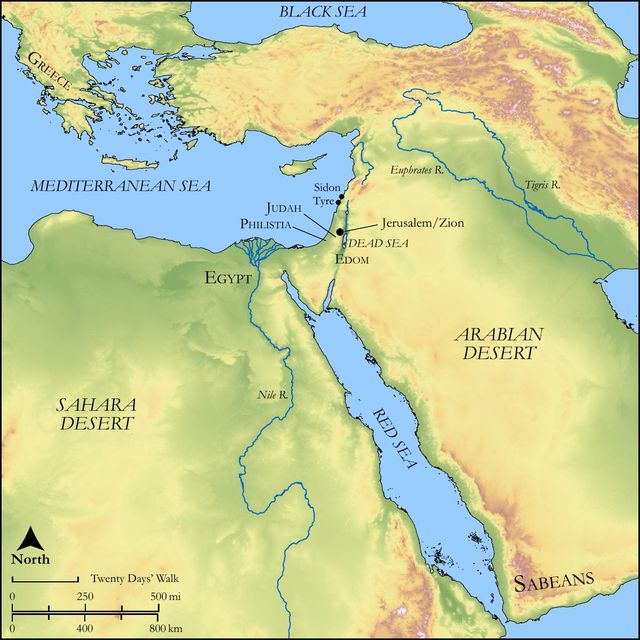
See on the biblical-era map
Study this verse
Public-domain commentary
Matthew Henry
From his Commentary on the Whole Bible. Henry comments on passages, not single verses — this entry covers Joel 2:18–27. His three-level outline is real structure in the source text, so it is rendered as structure.
See how ready God is to succour and relieve his people, how he waits to be gracious; as soon as ever they humble themselves under this hand, and pray, and seek his face, he immediately meets them with his favours. They prayed that God would spare them, and see here with what good words and comfortable words he answered them; for God's promises are real answers to the prayers of faith, because with him saying and doing are not two things. Now observe,
I.Whence this mercy promised shall take rise (Joe 2:18): God will be jealous for his land and pity his people. He will have an eye,
1.To his own honour, and the reputation of his covenant with Israel, by which he had conveyed to them that good land and had given in the value of it very high; now he will not suffer it to be despised nor disparaged, but will be jealous for the credit of his land, and the inhabitants of it, who had been praised as a happy people and therefore must not lie open to reproach as a miserable people.
2.To their distress: He will pity his people, and, in pity to them, he will restore them their forfeited comforts. God's compassion is a great encouragement to those that come humbly to him as penitents and as petitioners.
II.What his mercy shall be, in several instances:
- 1. The destroying army shall be dispersed and defeated (Joe 2:20): "I will remove far off from you the northern army, that army of locusts and caterpillars that invaded you from the north, brought in upon the wings of a north wind, an army which you could put no stop to the progress of; but, when you have made your peace with God, he will ease you of these soldiers that are quartered upon you and will drive them into a land barren and desolate, into that vast howling wilderness that Israel wandered in, where, after having surfeited upon the plenty of Canaan, they shall perish for want of sustenance. Those that have their face to the east sea (the Dead Sea, which lay east of Judea) shall perish in that, and the rear of the army shall be lost in the Great Sea," called here the utmost sea. They had made the land barren and desolate, and now God will cast them into a land barren and desolate. Thus those whom God employs for the correction of his people come afterwards to be themselves reckoned with; and the rod is thrown into the fire. Nothing shall remain of these swarms of insects but the ill savour of them. When Egypt was eased of the plague of locusts they were carried away to the Red Sea, Exo 10:19. Note, When an affliction has done its work it shall be removed in mercy, as the locusts of Canaan were from a penitent people, not as the locusts of Egypt were removed, in wrath, from an impenitent prince, only to make room for another plague. Many interpreters, by this northern army, understand that of Sennacherib, which was dispersed when God by it had accomplished his whole work upon Mount Zion and upon Jerusalem, Isa 10:12. This enemy shall be driven away, because he has done great things, has done a great deal of mischief, and has magnified to do it, has done it in the pride of his heart; therefore it follows (Joe 2:21), The Lord will do great things for his people, as the enemy has done great things against them, to convince them that wherein they deal proudly he is, and will be, above them, that, what great things soever they did, they did no more than God commissioned them to do; and as, when he said to them, Go, they went, so, when he said to them, Come, they came, to show that they were soldiers under him. 2. The destroyed land shall be watered and made fruitful. When the army is scattered, yet what shall we do if the desolation they have made continue? It is therefore promised (Joe 2:22) that the pastures of the wilderness, the pastures which the locusts had left as bare as the wilderness, shall again spring and the trees shall again bear their fruit, particularly the fig-tree and the vine. But, when we see how the country is wasted, we are tempted to say, Can these dry bones live? If the Lord should make windows in heaven, it cannot be; but it shall be, for (Joe 2:23) the Lord has given and will give you the former rain and the latter rain, and, if he give them in mercy, he will give them moderately, so that the rain shall not turn into a judgment, and he will give them in due season, the latter rain in the first month, when it was wanted and expected. It would make it comfortable to them to see it coming from the hand of God, and ordered by his wisdom, for then we are sure it is well ordered. He has given you a teacher of righteousness, (so the margin reads it, for the same word that signifies the rain signifies a teacher. and that which we translate moderately is according to righteousness), and this teacher of righteousness, says one of the rabbin, is the King Messias, and of him many others understand this; for he is a teacher come from God, and he shows us the way of righteousness. But others understand it of any prophet that instructs unto righteousness, and some of Hezekiah particularly, others of Isaiah. Note, It is a good sign that God has mercy in store for a people when he sends them teachers of righteousness, pastors after his own heart. 3. All their losses shall be repaired (Joe 2:25): "I will restore to you the years that the locust has eaten; you shall be comforted according to the time that you have been afflicted, and shall have years of plenty to balance the years of famine." Thus does it repent the Lord concerning his servants, when they repent, and, to show how perfectly he is reconciled to them, he makes good the damage they have sustained by his judgments, and, like the jailer, washes their stripes. Though, in justice, he distrained upon them, and did them no wrong, yet, in compassion, he makes restitution; as the father of the prodigal, upon his return, made up all he had lost by his sin and folly, and took him into his family, as in his former estate. The locusts and caterpillars are here called God's great army which he sent among them, and he will repair what they had devoured because they were his army. 4. They shall have great abundance of all good things. The earth shall yield her increase, and they shall enjoy it. Look into the stores where they lay up, and you shall find the floors full of wheat, and the fats overflowing with wine and oil (Joe 2:24), whereas, in the day of their distress, the wine and oil languished and the barns were broken down, Joe 1:10, Joe 1:17. Look upon their tables, where they lay out what they have laid up, and you shall find that they eat in plenty and are satisfied, Joe 2:26. They do not eat to excess, nor are surfeited; we hope the drunkards are cured by the late affliction of their inordinate love of wine and strong drink, for, though they were brought in howling for their scarcity (Joe 1:5), they are now brought in again here singing for the plenty of it; but now all shall have enough, and shall known when they have enough, for God will make their food nourishing and give them to be content with it.
These are the mercies promised, and in these God does great things (Joe 2:21), He deals wondrously with his people, Joe 2:26. Herein he glorifies his power, and shows that he can relieve his people though their distress be ever so great, and glorifies his goodness, that he will do it upon their repentance though their provocations were ever so great. Note, When God deals graciously with poor sinners that return to him it must be acknowledged that he deals wondrously and does great things. Some expositors understand these promises figuratively, as pointing at gospel-grace, and having their accomplishment in the abundant comforts that are treasured up for believers in the covenant of grace and the satisfaction of soul they have therein. When God sends us his promises to be the matter of our comfort, his graces to be the grounds of it, and his Spirit to be the author of it, we may well own that he has sent us (according to his promise here, Joe 2:19) corn, and wine, and oil, or that which is unspeakably better, and we have reason to be satisfied therewith.
III.What use shall be made of these returns of God's mercy to them and the good account they shall turn to.
1.God shall have the glory thereof, for they shall rejoice in the Lord their God (Joe 2:23), and what is the matter of their rejoicing shall be the matter of their thanksgiving; they shall praise the name of the Lord their God (Joe 2:26) and not praise their idols, nor call their corn and wine the rewards that their lovers had given them. Note, The plenty of our creature-comforts is a mercy indeed to us when by them our hearts are enlarged in love and thankfulness to God, who gives us all things richly to enjoy, though we serve him but poorly. When God restores to us plenty after we have known scarcity, as it is doubly pleasant to us, so it should make us the more thankful to God. When Israel comes out of a wilderness into a Canaan, and there eats and is full, surely he will then bless the Lord, with a very sensible pleasure, for that good land which he has given him, Deu 8:10.
2.They shall have the credit, and comfort, and spiritual benefit, thereof. When God gives them plenty again, and gives them to be satisfied with it,
(1.)Their reputation shall be retrieved; they and their God shall be no more reflected upon as unfaithful to one another when they have returned to him in a way of duty and he to them in a way of mercy (Joe 2:19): "I will no more make you a reproach among the heathen, that triumphed in your calamities and insulted over you;" and Joe 2:26, Joe 2:27, "My people shall never be ashamed, as they have been, of their good land which they used to boast of, but shall again and ever have the same occasion to boast of it." Note, It redounds much to the honour of God when he does that which saves the honour of his people; and those that are his people indeed, though they may be for a time, shall not be always, a reproach among the heathens; if we be rightly ashamed of our sins against God, we shall never be ashamed of our glorying in God.
(2.)Their joys shall be revived (Joe 2:23): Be glad and rejoice, O land! and all the inhabitants of it. Times of plenty are commonly times of joy; yet the favour of God puts gladness into the heart more than those who have corn, and wine, and oil increase. But especially be glad them, you children of Zion, and rejoice in the Lord your God, Joe 2:23. They mourned in Zion (Joe 2:15), and therefore there in a particular manner they shall rejoice; for those that sow in penitential tears shall certainly reap in thankful joys. The children of Zion, who led the rest in fasting, must lead the rest in rejoicing. But observe, They shall rejoice in the Lord their God, not so much in the good themselves that are given them as in the good hand that gives them and in the return of his favour to them, as theirs in covenant, which these good things are the tokens and pledges of. The joy of harvest and the joy of a feast must both terminate in God, whose love we should taste in all the gifts of his bounty, that we may make him our chief joy, as he is our chief good, and the fountain of all good to us.
(3.)Their faith in God shall be confirmed and increased. When temporal mercies are made by the grace of God to be of spiritual advantage to us, and plenty for the body is so far from being an enemy (as with many it proves) that it becomes a friend to the prosperity of the soul, then they are mercies indeed to us. This is promised here (Joe 2:27): You shall know that I am in the midst of Israel, the Holy One in the midst of thee (Hos 11:9), and that I am the Lord your God, and none else. As it proves that the Lord is God, and there is none other, because he wounds and he heals, he forms light and darkness, he does good and evil (Isa 45:7; Deu 32:39), so it proves him to be God of Israel, a God in covenant with his people and a father to them, that as a father he both corrects them when they offend and comforts them when they repent. It was the burden of the threatenings in Ezekiel's prophecy, Such and such evils I will bring upon you, and you shall know that I am the Lord; and the same is here made the crown of the promises: You shall eat, and be satisfied, and rejoice, and thus you shall know that I am the Lord. Note, We should labour to grow in our acquaintance with God by all providences, both merciful and afflictive. When God gives to his people plenty, and peace, and joy, upon their return to him, he thereby gives them to understand that he is pleased with their repentance, that he has pardoned their sins, and that he is theirs as much as ever - that they are taken into the same covenant with him, for he is the Lord their God, and into the same communion, for he is in the midst of them, nigh unto them in all that they call upon him for, and, as the sun in the centre of the worlds, so in the midst of them as to diffuse his benign influences to all the parts of his land.
3.Even the inferior creatures shall share therein and be made easy thereby: Fear not, O land! Joe 2:21. Be not afraid, you beasts of the field, Joe 2:22. They had suffered for the sin of man, and for God's quarrel with him; and now they shall fare the better for man's repentance and God's reconciliation to him. Nay, the beasts were said to cry unto God (Joe 1:20); and now that cry is answered, and they are directed not to be afraid, for they shall have plenty of all that which their nature craves. God, in sparing Nineveh, had an eye to the cattle (Jon 4:11), for the cattle had fasted, Joe 3:8. This may lead us to think of the restitution of all things, when the creature, that is now made subject to vanity and groans under it, shall be brought, though not into the glorious joy, yet into the glorious liberty, of the children of God, Rom 8:21.
Historical interpretation
Historical reception
1 surviving comment on this verse from the historical church.
(Verse 22 onwards) Do not be afraid, O land; rejoice and be glad, for the Lord has done great things. Do not fear, you animals of the field, for the pastures in the wilderness are becoming green. The trees are bearing their fruit; the fig tree and the vine yield their riches. Be glad, O children of Zion, and rejoice in the Lord your God, for he has given you the autumn rains for your vindication. He sends you abundant showers, both autumn and spring rains, as before. The threshing floors will be filled with grain; the vats will overflow with new wine and oil. I will repay you for the years the locusts have eaten— the great locust and the young locust, the other locusts and the locust swarm — my great army that I sent among you. My strength is great, which I have sent upon you: and you will eat in plenty, and be satisfied, and praise the name of your God, who has worked wonders with us, and my people will not be put to shame forever. And you will know that I am in the midst of Israel, and I am the Lord your God, and there is no other, and my people will not be put to shame forever. Rejoice, O earth, and be glad and rejoice, for the Lord has magnified and done great things: believe, O animals of the field, for the meadows of the wilderness have put forth their greenery, because the tree has produced its fruit, the fig tree and the vine have given their strength. And the children of Zion, rejoice and be glad in the Lord your God, for He has given you the food of righteousness, and has showered upon you a timely and late rain, as in the beginning, and the barns will be filled with wheat, and the vats will overflow with wine and oil. And I will compensate you for the years in which the locust, the beetle, the mildew, and the caterpillar have consumed your crops. My great strength, which I have sent upon you, will sustain you and you will eat and be satisfied. You will praise the name of your God, who has done wonders with you, and my people will never be put to shame. You will know that I am in the midst of Israel, and I am the Lord your God, and there is no other besides me. And my people will never be put to shame. He now promises the opposite of what he had threatened above. He had said before: the fire consumes the beautiful things of the desert, and the flame sets ablaze all the wood of the region, and the beasts of the field, like a dry patch of land, look up to you as they thirst for rain: because the springs of water have dried up, and the fire has devoured the beautiful things of the desert. Now he mitigates sadness with joy, and turns tears into laughter. Do not be afraid, he says, animals of the region: because the beautiful things of the desert have budded forth: because the tree has brought forth its fruit, the fig and the vine have given their power: and there will be such abundance of all things, that there will by no means be a lack of wheat, wine and oil for you to be satisfied with; but the threshing floors will be filled with wheat, and the wine presses will overflow with wine and oil, so that you may not only eat for yourselves, but also be able to provide for others. To the sons of Zion also He speaks specially, that they may exult and rejoice, not in any trivial thing; but in the Lord their God, who has given them the nourishment of righteousness. And as the Seventy have translated it, He gives them both the early and the late rain, that they may eat and be glad, and praise the name of their Lord God, who has done wonders with them, and that they may by no means be put to shame; and that they may know that the Lord God of Israel dwells among them, and besides Him there is no other, for the Father is in the Son, and the Son is in the Father; and His people will not be put to shame forever. We believe that these things happened literal, because they were promised by the Lord, and that the past sterility was compensated by new crops: so that whatever the locust, the cankerworm, the mildew, and the caterpillar had consumed, would be replenished in the following years. We wonder why the caterpillar is called the strength, or virtue of the Lord, and not only virtue, but great virtue? How was the power of God shown in the plagues of the Egyptians by small animals, especially the gnats, which are such small mosquitoes that they can hardly be seen with the eyes. Thus, now, in a small and slow-moving little worm, which can barely move and is crushed by a light touch, the power of God and the frailty of humans are demonstrated. Not that God cannot overturn the earth and cover everything with a flood, or consume everything with lightning at His command and the majesty of His power; but He shows human frailty through small, and, so to speak, tiny bodies. Therefore, we often respond to Marcion and other heretics who tear apart the old Testament, that God made even fleas and mosquitoes and bugs, and creatures like them, in order to show the frailty and weakness of our flesh, which is so insignificant that it is wounded by such small things. But if a slow and tiny caterpillar is stronger than a human, why does the earth and ashes, being from which man is called, boast? Some interpret this place as follows: On the right and on the left, we read the virtues and powers of God, which the Greeks call δυνάμεις. On the right, Seraphim and Cherubim, and all the angelic powers; on the left, opposing strengths, of which it is written: He sent upon them the wrath of his indignation, anger, and tribulation, by sending evil angels (Ps. LXXVII, 49); of which Micheas also speaks in the book of Kings: I saw the Lord God of Israel sitting on his throne, and all the host of heaven standing by him on his right hand and on his left (3 Kings XXIII). I think the left spirit was the one who went out and stood before the Lord and said, 'I will deceive Ahab and go out and be a lying spirit in the mouths of all his prophets.' To the power that was suitable for deceiving and skilled in causing destruction, and had deceived many before, God speaks: 'You will deceive and prevail, go out and do so.' That spirit who tormented Saul, about whom his servants said, 'Behold, an evil spirit from God is afflicting you' (1 Samuel 16:15), was from the left side, they minister to the Lord to punish those who have deserved to suffer for their sins. For not only are men ministers and avengers of His wrath upon those who do evil, and not without cause do they bear the sword; but there are also contrary powers, which are called the fury and wrath of God, which the prophet, declining, says: Lord, do not rebuke me in Your fury, nor chastise me in Your anger (Ps. 6:1). The Apostle delivered such (so to speak) interrogators and torturers to destruction of the flesh, that the spirit might be saved (1 Cor. 5), of whom Satan is, to whom he delivered others to learn not to blaspheme (1 Tim. 1)." } These things about the caterpillar, why it is called the power of God. Let us move on to the order of spiritual intelligence: Do not be afraid, O earth, indeed trust and rejoice, you who had previously lost the Lord's seed with your dryness: for the Lord has magnified, so as to show mercy to you, to such an extent that even the animals of the region and the deserted solitude are filled with joyful new growth, and the wood of the cross bears its fruit, and the sweetest gifts of the Holy Spirit bestow their abundance to all. You also, whom I rightly call sons of Zion and of the Church after repentance, rejoice and be glad; for God the Father has given you a teacher of righteousness or has granted you the nourishment of righteousness, and has caused the rains of temporal and late (Isa. XXX) to come down upon you. Rain is said to be late when we first receive the rain of doctrine; it is said to be late when we receive the fruits of our labor and attain to a perfect knowledge of the holy Scriptures. There may be temporary and late rain, the old and new Testament received. And not only that, he said, he did not only give this; but he made you abound with new fruits of virtues, and be satisfied and intoxicated with wheat, wine and oil, of which we have often spoken. And the years that you had lost in disturbances under the previous rulers, when your works had been consumed by locusts, weevils, rust and caterpillars, God did not allow you to perish. Then you shall eat the fruits of righteousness, and be satisfied, and praise the name of the Lord your God, who has done wonders with you. But if after such great repentance God promises such abundance of all things, what will Novatus, denying repentance and the possibility of sinners being restored to their former state if they perform worthy works of repentance, answer? For God receives penitents to such an extent that He calls them His people and does not in any way claim that they are to be confounded; and promises to dwell among them and that they shall not have any other God but Him; rather, they will trust in Him with their whole hearts, who will abide in them forever.
Continue studying Joel 2:24 across the web’s major study libraries — every link below opens this exact verse, chapter, or book on the destination site.
Read & Compare
 BibleGatewayThis verse in more than 200 translations and 70 languages.
 Bible.comThe YouVersion reader — hundreds of translations, reading plans, and highlights.
 ESV.orgCrossway's official English Standard Version reader.
 NET BibleThe NET translation with 60,000+ translators' notes on every rendering decision.
 STEP BibleTyndale House's free study tool — original text, vocabulary, and scholarly resources.
 BibliaLogos Bible Software's free web reader.
 USCCBThe New American Bible (Revised Edition) with the U.S. bishops' study notes.
Commentaries
 BibleHub CommentariesDozens of classic commentaries on this verse, gathered on one page.
 StudyLightMore than 100 commentary sets — the largest collection on the web.
 BibleRefPlain-English commentary on what this verse means, verse by verse.
 Enduring WordDavid Guzik's free commentary on this chapter, widely used by Bible teachers.
 Bible Study ToolsVerse commentary alongside Greek and Hebrew study aids.
Original Language & Research
- BibleHub InterlinearThe verse word by word — original language, transliteration, and English.
- BibleHub LexiconEvery word's original-language definition and Strong's entry.
 Blue Letter BibleDeep-study tools — Strong's numbers, concordance, and word studies.
 SefariaThe Hebrew text with Rashi and centuries of Jewish commentary.
Sermons, Hymns & Audio


TrulyRandomVerse is not affiliated with these sites and doesn’t control their content. They’re linked because they’re genuinely useful.
Summary
Joel 2:24 presents a vivid picture of divine restoration and abundant provision, following a period of national repentance and God's compassionate response. This verse, situated within a broader prophecy of judgment and salvation, promises a reversal of the devastating locust plague and drought, signifying a return to agricultural prosperity and national well-being for the repentant people of Israel. It underscores God's faithfulness to His covenant promises, demonstrating His power to transform desolation into overflowing abundance.
Context
ShowHideLiterary Context
Joel 2:24 marks a pivotal turning point in the book of Joel. The preceding chapters (Joel 1-2:11) vividly depict a catastrophic locust plague and severe drought, interpreted by the prophet as a harbinger of the "Day of the Lord"—a time of divine judgment. This dire situation serves as a catalyst for Joel's impassioned call to sincere repentance, fasting, and weeping (Joel 2:12-17). In response to the people's turning back to Him, God declares His jealousy for His land and His pity for His people (Joel 2:18). Joel 2:19-27 then outlines the specific blessings of restoration that will follow, with verse 24 serving as a central promise of agricultural renewal and material abundance, directly reversing the curses described earlier. This promise of physical provision sets the stage for the outpouring of the Spirit in Joel 2:28-32, demonstrating God's holistic restoration.
Historical & Cultural Context
Ancient Israel was an agrarian society, heavily dependent on rainfall and fertile land for its sustenance and prosperity. Grain, wine, and oil were not merely commodities but the foundational staples of their economy and daily life, representing the very essence of blessing and well-being (Deuteronomy 7:13). Threshing floors were communal areas where harvested grain was processed, and wine and oil presses (vats) were essential for extracting liquids from grapes and olives. A lack of these provisions signaled famine, poverty, and divine displeasure, often due to covenant disobedience. Conversely, an abundance, as described in Joel 2:24, signified God's favor, covenant blessing, and a return to national security and prosperity, echoing the promises of the Mosaic Covenant found in Leviticus 26 and Deuteronomy 28.
Key Themes
ShowHideJoel 2:24 powerfully contributes to several overarching themes in the book of Joel and broader biblical theology. Foremost is the theme of Divine Restoration, illustrating God's sovereign power to reverse calamity and bring forth life and abundance from desolation. After the land was stripped bare by the locusts (as described in Joel 1:4), God promises to "restore to you the years that the swarming locust has eaten" (Joel 2:25). This verse also highlights Abundance and Prosperity as a tangible sign of God's blessing, directly linked to the nation's repentance and obedience. The imagery of overflowing "floors" and "fats" speaks to a superabundant provision that far exceeds mere sufficiency. Finally, the verse underscores God's Faithfulness and Provision, demonstrating that despite Israel's shortcomings, God remains true to His covenant promises, providing for His people's physical needs when they turn to Him in humility and genuine contrition, echoing the principle of God's care for His people seen throughout Scripture, such as in Philippians 4:19.
Exposition and Analysis
ShowHideKey Word Analysis
ShowHideThis term refers to a threshing-floor, a large, flat, open area, often elevated and paved, where harvested grain (like wheat) was threshed to separate the edible grain from the inedible chaff. The imagery of these floors being "full" implies an overwhelming, bountiful harvest, so immense that the processing areas are completely covered and overflowing with grain.
This word denotes a trough or vat, specifically referring to wine-vats or oil-presses. These presses typically consisted of two levels: an upper vat where grapes or olives were crushed, and a lower vat into which the extracted juice or oil would drain. The promise that these "fats shall overflow" signifies an unprecedented yield of wine and oil, far exceeding the capacity of the vats, symbolizing extraordinary agricultural wealth and God's superabundant blessing.
A primitive root meaning "to run after or over," this verb vividly describes the action of liquid spilling beyond its container's capacity. When applied to the "fats" (wine and oil presses), it paints a picture of such a tremendous yield that the vats cannot contain the volume, emphasizing the lavishness and magnitude of God's promised provision. This is not just enough, but more than enough—a surplus that testifies to divine generosity.
Verse Breakdown
ShowHide"And the floors shall be full of wheat"
This clause directly addresses the restoration of grain production, the most fundamental staple. The "floors" (threshing floors) being "full" indicates a harvest so abundant that the areas designated for processing the grain are completely covered. This reverses the famine and scarcity described earlier in Joel, promising not just a return to normalcy but an overflowing bounty of wheat, signifying the restoration of essential sustenance and agricultural prosperity.
"and the fats shall overflow with wine and oil"
This second clause extends the promise of agricultural abundance to two other vital commodities: wine and oil. "Fats" refers to the wine and oil presses, the vats where grapes and olives were crushed. The verb "overflow" emphasizes the sheer volume of these liquids, suggesting that the yield is so immense that the presses cannot contain it. This imagery conveys a sense of lavish, unprecedented provision, symbolizing not just economic recovery but a return to joy (wine) and anointing/provision (oil), integral to the well-being and spiritual life of ancient Israel.
Literary Devices
ShowHideJoel 2:24 is rich in Imagery, painting a vivid picture of agricultural abundance that contrasts sharply with the preceding descriptions of desolation. The "floors full of wheat" and "fats overflowing with wine and oil" create a sensory experience of plenty, allowing the audience to visualize and almost feel the weight of the harvest and the flow of liquids. This imagery functions as powerful Symbolism for God's complete restoration and blessing. Wheat, wine, and oil were the primary agricultural products of ancient Israel, representing sustenance, joy, and anointing/provision, respectively. Their abundance symbolizes holistic well-being—physical, economic, and spiritual—as a direct result of God's favor. The use of "full" and "overflow" also employs Hyperbole, an exaggeration for emphasis, to underscore the extraordinary nature of God's promised provision; it is not merely sufficient but superabundant, a testament to His boundless generosity and power to reverse even the most severe judgments.
Theological and Thematic Connections
ShowHideJoel 2:24 stands as a profound testament to God's character as a faithful covenant God who delights in restoring His people and providing for them abundantly. This verse embodies the biblical principle that genuine repentance leads to divine favor and material blessing, echoing the promises and warnings embedded in the Mosaic Law. It highlights God's sovereignty over creation, demonstrating His power to reverse natural calamities and bring forth life and fruitfulness even from barrenness. The promise of overflowing sustenance speaks to God's desire not just to meet basic needs but to provide generously, reflecting His lavish grace and the holistic nature of His salvation, which encompasses both physical and spiritual well-being.
Reflection and Application
ShowHideJoel 2:24 offers timeless encouragement and profound lessons for believers navigating the complexities of life. In moments of personal or communal "famine"—whether it be spiritual dryness, financial hardship, relational brokenness, or emotional depletion—this verse serves as a powerful reminder that God is the ultimate restorer. Just as He transformed the devastated land of Judah into a place of overflowing abundance, He is capable of bringing forth renewal and fruitfulness in our lives, even from what seems utterly barren. The prerequisite for this restoration, as shown in Joel, is genuine repentance and a turning back to God. This isn't merely about feeling sorry for past mistakes but involves a decisive shift in direction, aligning our hearts and lives with His will. When we humble ourselves, confess our sins, and seek His face, we position ourselves to receive His lavish grace and experience His transformative power. This verse reassures us that God's provision is not limited to mere survival but extends to an overflowing abundance that testifies to His goodness and faithfulness, inviting us to trust in His unfailing supply for all our needs—physical, emotional, and spiritual.
Questions for Reflection
ShowHideFAQ
ShowHideWhat is the significance of "wheat," "wine," and "oil" in this verse?
ShowHideIn ancient Israel, wheat (grain), wine, and oil were the three primary agricultural staples and economic indicators of prosperity. Wheat represented essential sustenance and daily bread. Wine symbolized joy, celebration, and the richness of life. Oil (olive oil) was used for food, fuel for lamps, anointing, and medicinal purposes, representing provision, light, and blessing. Therefore, the abundance of all three signifies holistic well-being, complete restoration, and lavish divine favor, reversing the curses of famine and scarcity. This imagery would have been immediately understood by the original audience as a promise of comprehensive national recovery and blessing.
Is the promise in Joel 2:24 purely physical, or does it have a spiritual meaning?
ShowHideWhile the immediate context and imagery of Joel 2:24 are undeniably physical and agricultural, promising material restoration, the prophecy of Joel, like much of Old Testament prophecy, often carries both immediate literal fulfillment and deeper spiritual implications. The physical abundance serves as a tangible sign of God's favor and the re-establishment of His covenant relationship with His people. The holistic nature of God's restoration, encompassing physical provision, sets the stage for the subsequent promise of the outpouring of the Spirit in Joel 2:28-29, which is distinctly spiritual. Thus, Joel 2:24 can be seen as a promise of comprehensive blessing—physical prosperity as an outward manifestation of spiritual reconciliation and renewed covenant relationship with God.
Christ-Centered Fulfillment
ShowHideThe overflowing abundance promised in Joel 2:24 finds its ultimate and most profound fulfillment in Jesus Christ. While Joel's prophecy initially speaks of physical restoration for Israel, it foreshadows the spiritual superabundance available to all who repent and turn to God through Christ. Jesus, the true "bread of life" (John 6:35), offers spiritual sustenance that truly satisfies, far exceeding any earthly wheat. He transforms the "fats" of our lives, filling them not with earthly wine and oil, but with the "new wine" of the Holy Spirit (Mark 2:22) and the anointing oil of His presence, leading to an overflow of joy, peace, and righteousness. Through His atoning sacrifice, Christ reverses the curse of sin, which is the ultimate "famine" and "desolation" in human experience, bringing forth a spiritual harvest of redemption and eternal life. The promise of God's provision in Joel points forward to Christ, in whom "all the promises of God find their Yes" (2 Corinthians 1:20), and through whom believers receive an immeasurable abundance of grace, spiritual blessings, and the fullness of life (John 10:10). He is the one who truly makes our "floors full" and our "fats overflow" with the spiritual riches of His kingdom.