


Job 37:10
Bible text: King James Version (1769 Blayney text) · Public domain
Bible text: Berean Standard Bible · Public domain
Bible text: American Standard Version (1901) · Public domain
Bible text: World English Bible, Messianic edition · Public domain
Bible text: Geneva Bible (1599) · Public domain
Bible text: Young's Literal Translation · Public domain
- מִנִּשְׁמַתmi·nish·matfrom [the] breath ofH5397Prep-m ¦ N-fscNoun Singular Feminine Constructמִfromנִּשְׁמַת[the] breath of
- אֵל'elGodH410N-msNoun Singular Masculine Absolute
- יִתֶּןyi·tenit givesH5414V-Qal-Imperf-3msVerb Qal Imperfect 3rd Singular Masculine
- קָרַחKa·rachiceH7140N-msNoun Singular Masculine Absolute
- וְרֹחַבve·Ro·chavand [the] breadth ofH7341Conj-w ¦ N-mscNoun Singular Masculine Constructוְandרֹחַב[the] breadth of
- מַיִםMa·yim[the] watersH4325N-mpNoun Plural Masculine Absolute
- בְּמוּצָקbe·mu·Tzak[is] <in> constraintH4164Prep-b ¦ N-msNoun Singular Masculine Absoluteבְּ[is] <in>מוּצָקconstraint
English is a literal word-by-word gloss of the Hebrew, not the KJV's wording. Why?
This is the original text the KJV's translators worked from — each Hebrew word with its own literal English meaning in this verse, prepared by scholars at Tyndale House, Cambridge. The KJV translates whole sentences, not word by word, so its wording differs: one Hebrew word can become several English words, and the KJV may choose “the LORD” where the gloss reads “Yahweh”. Both are faithful — they answer different questions. For the KJV's own rendering, switch to the KJV text.
Details
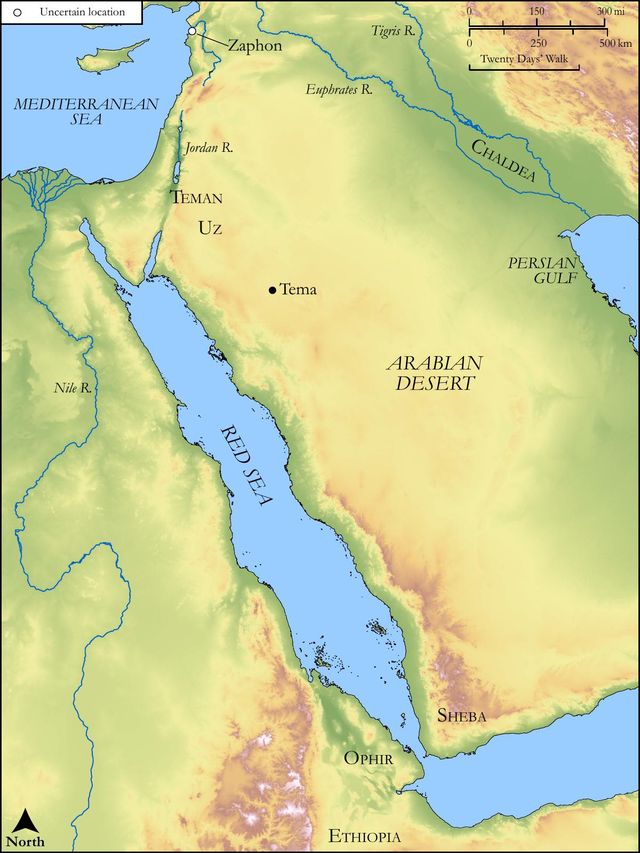
See on the biblical-era map
Study this verse
Public-domain commentary
Matthew Henry
From his Commentary on the Whole Bible. Henry comments on passages, not single verses — this entry covers Job 37:6–13. His two-level outline is real structure in the source text, so it is rendered as structure.
The changes and extremities of the weather, wet or dry, hot or cold, are the subject of a great deal of our common talk and observation; but how seldom do we think and speak of these things, as Elihu does here, with an awful regard to God the director of them, who shows his power and serves the purposes of his providence by them! We must take notice of the glory of God, not only in the thunder and lightning, but in the more common revolutions of the weather, which are not so terrible and which make less noise. As,
I.In the snow and rain, Job 37:6.
Thunder and lightning happen usually in the summer, but here he takes notice of the winter-weather. Then he saith to the snow, Be thou on the earth; he commissions it, he commands it, he appoints it, where it shall light and how long it shall lie. He speaks, and it is done: as in the creation of the world, Let there be light, so in the works of common providence, Snow, be thou on the earth. Saying and doing are not two things with God, though they are with us. When he speaks the word the small rain distils and the great rain pours down as he pleases - the winter-rain (so the Septuagint), for in those countries, when the winter was past, the rain was over and gone, Sol 2:11. The distinction in the Hebrew between the small rain and the great rain is this, that the former is called a shower of rain, the latter of rains, many showers in one; but all are the showers of his strength: the power of God is to be observed as much in the small rain that soaks into the earth as in the great rain that batters on the house-top and washes away all before it. Note, The providence of God is to be acknowledged, both by husbandmen in the fields and travellers upon the road, in every shower of rain, whether it does them a kindness of a diskindness. It is sin and folly to contend with God's providence in the weather; if he send the snow or rain, can we hinder them? Or shall we be angry at them? It is as absurd to quarrel with any other disposal of Providence concerning ourselves or ours. The effect of the extremity of the winter-weather is that it obliges both men and beasts to retire, making it uncomfortable and unsafe for them to go abroad.
1.Men retire to their houses from their labours in the field, and keep within doors (Job 37:7): He seals up the hand of every man. In frost and snow, husbandmen cannot follow their business, nor some tradesmen, nor travellers, when the weather is extreme. The plough is laid by, the shipping laid up, nothing is to be done, nothing to be got, that men, being taken off from their own work, may know his work, and contemplate that, and give him the glory of that, and, by the consideration of that work of his in the weather which seals up their hands, be led to celebrate his other great and marvellous works. Note, When we are, upon any account, disabled from following our worldly business, and taken off from it, we should spend our time rather in the exercises of piety and devotion (in acquainting ourselves with the works of God and praising him in them) than in foolish idle sports and recreations. When our hands are sealed up our hearts should be thus opened, and the less we have at any time to do in the world the more we should thereby be driven to our Bibles and our knees.
2.The beasts also retire to their dens and remain in their close places, Job 37:8. It is meant of the wild beasts, which, being wild, must seek a shelter for themselves, to which by instinct they are directed, while the tame beasts, which are serviceable to man, are housed and protected by his care, as Exo 9:20. The ass has no den but his master's crib, and thither he goes, not only to be safe and warm, but to be fed. Nature directs all creatures to shelter themselves from a storm; and shall man alone be unprovided with an ark?
II.In the winds, which blow from different quarters and produce different effects (Job 37:9):
Out of the hidden place (so it may be read) comes the whirlwind; it turns round, and so it is hard to say from which point it comes but it comes from the secret chamber, as the word signifies, which I am not so willing to understand of the south, because he says here (Job 37:17) that the wind out of the south is so far from being a whirlwind that it is a warming, quieting, wind. But at this time, perhaps, Elihu saw a whirlwind-cloud coming out of the south and making towards them, out of which the Lord spoke soon after, Job 38:1. Or, if turbulent winds which bring showers come out of the south, cold and drying blasts come out of the north to scatter the vapours and clear the air of them.
III.In the frost, Job 37:10.
See the cause of it: It is given by the breath of God, that is, by the word of his power and the command of his will; or, as some understand it, by the wind, which is the breath of God, as the thunder is his voice; it is caused by the cold freezing wind out of the north. See the effect of it: The breadth of the waters is straitened, that is, the waters that had spread themselves, and flowed with liberty, are congealed, benumbed, arrested, bound up in crystal fetters. This is such an instance of the power of God as, if it were not common, would be next to a miracle.
IV.In the clouds, the womb where all these watery meteors are conceived, of which he had spoken, Job 36:28.
Three sorts of clouds he here speaks of: - 1. Close, black, thick clouds, pregnant with showers; and these with watering he wearies (Job 37:11), that is, they spend themselves, and are exhausted by the rain into which they melt and are dissolved, pouring out water till they are weary and can pour out no more. See what pains, as I may say, the creatures, even those above us, take to serve man: the clouds water the earth till they are weary; they spend and are spent for our benefit, which shames and condemns us for the little good we do in our places, though it would be to our own advantage, for he that watereth shall be watered also himself. 2. Bright thin clouds, clouds without water; and these he scattereth; they are dispersed of themselves, and not dissolved into rain, but what becomes of them we know not. The bright cloud, in the evening, when the sky is red, is scattered, and proves an earnest of a fair day, Mat 16:2. 3. Flying clouds, which do not dissolve, as the thick cloud, into a close rain, but are carried upon the wings of the wind from place to place, dropping showers as they go; and these are said to be turned round about by his counsels, Job 37:12. The common people say that the rain is determined by the planets, which is as bad divinity as it is philosophy, for it is guided and governed by the counsel of God, which extends even to those things that seem most casual and minute, that they may do whatsoever he commands them; for the stormy winds, and the clouds that are driven by them, fulfil his word; and by this means he causes it to rain upon one city and not upon another, Amo 4:7, Amo 4:8. Thus his will is done upon the face of the world in the earth, that is, among the children of men, to whom God has an eye in all these things, of whom it is said that he made them to dwell on the face of the earth, Act 17:26. The inferior creatures, being incapable of doing moral actions, are incapable of receiving rewards and punishments: but, among the children of men, God causes the rain to come, either for the correction of his land or for a mercy to it, Job 37:13. (1.) Rain sometimes turns into a judgment. It is a scourge to a sinful land; as once it was for the destruction of the whole world, so it is now often for the correction or discipline of some parts of it, by hindering seedness and harvest, raising the waters, and damaging the fruits. Some have said that our nation has received much more prejudice by the excess of rain than by the want of it. (2.) At other times it is a blessing. It is for his land, that this may be made fruitful; and, besides that which is just necessary, he gives for mercy, to fatten it and make it more fruitful. See what a necessary dependence we have upon God, when the very same thing, according to the proportion in which it is given, may be either a great judgment or a great mercy, and without God we cannot have either a shower or a fair gleam.
Historical interpretation
Historical reception
2 surviving comments on this verse. Each one is dated, so this reads as a timeline rather than a list.
“A tempest will come forth from the inner parts, and cold from Arcturus.” When holy Scripture mentions the inner parts, in opposition to Arcturus, it designates the quarter of the south, opposite to the parts of the north. Hence it is written in this same book, “Who makes Arcturus and the Orions and the inner parts of the south?” Because then the sun pervades with greater warmth the inner parts of the south, but it does not pursue its course at all in the north, by the word “inner parts” in this place is expressed the Jewish people, and by the term “Arcturus” the Gentile people. For they who had known the one and invisible God and obeyed his law, at least carnally, were kept, as it were, in the warmth of faith, under the glow of the midday sun. But because the Gentiles had not attained to any knowledge of heavenly wisdom, they were remaining, as it were, in the cold without the sun under the north. Moreover, a tempest impels, but cold oppresses with torpor. It is now rightly said, “A tempest will come forth from the inner parts, and cold from Arcturus.” As if it were plainly said, From the Jews there arises persecuting malice, and from the Gentiles oppressing power.
52. Because, as the Holy Spirit breathed on the hearts of the faithful, and conferred greater miracles of power, benumbing envy grew up the more in the sluggish hearts of the faithless; and the unbelieving multitude became hardened against God, from the same causes, as the humble people softened the obduracy, with which it had bound itself. For when God blew on them, they were turned into ice, who said, through envy of the miracles they had witnessed; Behold, the whole world hath gone after Him. [John 12, 19] They were beholding the signs, perceiving the miracles performed by His ministers, and foreseeing, that the whole world was now about to follow the preaching of the faith; and yet, the more the Holy Spirit had filled the world, the more firmly was the malice of envy binding their minds. The water therefore had been turned into ice, when sluggish Judaea was still remaining in envy, as the whole world was going after God. But because Divine Power was sufficient to soften the hardness even of such great cruelty, and to melt the hearts of unbelievers to love Him, after this ice it is immediately well subjoined;
And the waters are again poured forth abundantly.
53. For the Lord has in truth poured forth the waters abundantly, after this ice; for after He had endured the hardness of the Jews, even unto death, He immediately melted their hearts from the hardness of unbelief, by breathing on them the love of Himself; in order that they might afterwards run the more eagerly to obey Him, the more obstinately they had before resisted His commands. Whence it is well said by a certain wise man, As ice in fair weather, so shall thy sins be melted away. [Ecclus. 3, 15] The Prophet had desired to be freed from the ice of this torpor, when saying, Turn our captivity, O Lord, as the stream in the South. [Ps. 126, 4] Of these waters, that is, of people flocking together to the Lord, it is said again, He will send forth His word, and will melt them: His breath will blow, and the waters will flow. [Ps. 147, 18] Waters run from ice, because many great preachers are made out of hard persecutors. Ice therefore melts in water, when the numbness of inward cold is changed into the irrigation of preaching. Was not Paul ice, who when going to Damascus, after he had received letters, was seeking to check the seeds of the word of God, which had been scattered in the heart of the faithful, as if in the earth that they might not spring up to the perfection of good deeds? [Acts 9, 2] But this ice returned in water; because he afterwards watered with the streams of holy exhortation those whom he before endeavoured to oppress with persecution, in order that there might arise a more abundant harvest of the Elect, in so much as the shower of God was watering it from the mouth even of a persecutor.
Continue studying Job 37:10 across the web’s major study libraries — every link below opens this exact verse, chapter, or book on the destination site.
Read & Compare
 BibleGatewayThis verse in more than 200 translations and 70 languages.
 Bible.comThe YouVersion reader — hundreds of translations, reading plans, and highlights.
 ESV.orgCrossway's official English Standard Version reader.
 NET BibleThe NET translation with 60,000+ translators' notes on every rendering decision.
 STEP BibleTyndale House's free study tool — original text, vocabulary, and scholarly resources.
 BibliaLogos Bible Software's free web reader.
 USCCBThe New American Bible (Revised Edition) with the U.S. bishops' study notes.
Commentaries
 BibleHub CommentariesDozens of classic commentaries on this verse, gathered on one page.
 StudyLightMore than 100 commentary sets — the largest collection on the web.
 BibleRefPlain-English commentary on what this verse means, verse by verse.
 Enduring WordDavid Guzik's free commentary on this chapter, widely used by Bible teachers.
 Bible Study ToolsVerse commentary alongside Greek and Hebrew study aids.
Original Language & Research
- BibleHub InterlinearThe verse word by word — original language, transliteration, and English.
- BibleHub LexiconEvery word's original-language definition and Strong's entry.
 Blue Letter BibleDeep-study tools — Strong's numbers, concordance, and word studies.
 SefariaThe Hebrew text with Rashi and centuries of Jewish commentary.
Sermons, Hymns & Audio


TrulyRandomVerse is not affiliated with these sites and doesn’t control their content. They’re linked because they’re genuinely useful.
Summary
Job 37:10, a declaration by Elihu, profoundly asserts God's absolute sovereignty and intricate control over the natural world. Within his extensive discourse aimed at correcting Job and his friends, Elihu points to the seemingly simple phenomena of frost and the freezing of water as undeniable evidence of divine power and wisdom. This verse underscores that even the subtle transformations in creation are direct emanations of God's "breath," demonstrating His deliberate and active involvement in sustaining and governing all things.
CONTEXT
ShowHideExposition and Analysis
ShowHideKey Word Analysis
ShowHideThis word refers to a puff, wind, or vital breath, encompassing divine inspiration and intellect. In this context, "the breath of God" signifies the active, life-giving, and controlling power of God. It is His direct emanation, His very essence, that brings about the phenomenon of frost, demonstrating His intimate and active involvement in creation.
Meaning ice, hail, or rock crystal. This term specifically denotes the frozen state of water. Its inclusion emphasizes the tangible, observable effect of God's "breath" on the natural world, transforming liquid water into a solid, crystalline form.
Meaning narrowness, figuratively distress or anguish. This word vividly describes the physical transformation of water from its expansive, fluid state into a rigid, constricted form—ice. It implies a process where the "breadth" or expanse of the waters is narrowed, hardened, and made rigid, thus restricting its flow and movement. The term perfectly captures the physical effect of freezing, demonstrating God's power to fundamentally alter the state and behavior of matter.
Verse Breakdown
ShowHide"By the breath of God frost is given"
This clause establishes the direct divine causation of frost. It is not a random meteorological event but a deliberate act of God's active power, signified by His "breath." The word "given" (H5414, nâthan) implies intentionality and bestowal, emphasizing that frost is a specific, tangible gift or manifestation of God's will and power, designed to reveal His attributes.
"and the breadth of the waters is straitened"
This second clause describes the immediate and observable effect of the frost: water loses its fluidity and expansiveness, becoming "straitened" or solidified into ice. This physical transformation serves as concrete evidence of the divine power at work. The "breadth of the waters" refers to their wide, flowing nature, which is now restricted and made rigid by God's command, further demonstrating His absolute control over the elements.
Literary Devices
ShowHideElihu's statement in Job 37:10 employs several literary devices to enhance its impact. The phrase "By the breath of God" utilizes Metonymy, where "breath" (Hebrew nᵉshâmâh) stands for God's active power, will, and Spirit, implying a direct, effortless divine command. There is also a strong element of Personification, as God's "breath" is depicted as actively "giving" frost, imbuing a natural phenomenon with divine agency. The verse also exhibits Parallelism, though not strictly synonymous or antithetical; the two clauses describe two aspects of the same divine action and its effect: God's power (first clause) and its observable outcome on water (second clause). This structure reinforces the cause-and-effect relationship between divine command and natural phenomenon. Furthermore, the verse uses vivid Imagery, evoking the cold, the transformation of water, and the sense of restriction, allowing the listener to visualize God's power at work in the natural world. Elihu's entire discourse, culminating in this verse, functions as an Argument from Nature/Design, where the intricate and powerful workings of creation are presented as irrefutable evidence of God's wisdom, power, and sovereignty.
Theological and Thematic Connections
ShowHideJob 37:10 profoundly contributes to the biblical understanding of God's active involvement in His creation. It asserts that God is not a distant, deistic clockmaker but an immanent and transcendent Lord who intimately governs every aspect of creation, from the grandest storm to the most delicate frost. This verse highlights the concept of general revelation, where God's attributes are continuously displayed through the natural world, leaving humanity without excuse regarding His existence and power. It calls us to a posture of humility and awe before a God whose wisdom and power are beyond full human comprehension, yet are tangibly evidenced in the world around us. This perspective transforms mundane observations into profound encounters with the divine, fostering worship and trust in His providential care.
Reflection and Application
ShowHideJob 37:10 invites us to cultivate a profound sense of awe and wonder as we observe the natural world, recognizing that every detail, from the intricate pattern of a snowflake to the vastness of the ocean, is a testament to God's deliberate and powerful hand. This verse challenges us to move beyond a purely scientific or utilitarian view of nature and to see it as a continuous revelation of God's character. If God is so intimately involved in giving frost and straitening waters, then His sovereignty extends to every aspect of our lives—our circumstances, our challenges, and our future. This understanding should inspire deep trust, even when our paths seem difficult or constricted, much like the "straitened" waters. It reminds us that God's power is not limited to grand miracles but is at work in the quiet, consistent rhythms of creation, assuring us of His constant presence and control.
Questions for Reflection
ShowHideFAQ
ShowHideWhat is the significance of Elihu's focus on natural phenomena in his argument?
ShowHideElihu's extensive focus on natural phenomena, culminating in verses like Job 37:10, is crucial to his theological argument. He uses creation as a primary avenue for God's revelation, aiming to correct Job's perception of God's silence or injustice. Elihu contends that God's power, wisdom, and justice are constantly on display in the world around us, serving as an undeniable witness to His character and an invitation to humility, repentance, and awe. By pointing to phenomena like frost, storms, and lightning, Elihu emphasizes that God is not distant but intimately involved in His creation, orchestrating even the seemingly small details. This prepares the ground for God's own direct address to Job from the whirlwind in Job 38, which largely consists of rhetorical questions about the creation and governance of all things, further validating Elihu's approach.
Christ-Centered Fulfillment
ShowHideWhile Job 37:10 speaks of God's power through His "breath" in creation, the New Testament reveals that this divine power is fully embodied and executed through Jesus Christ. He is not merely an instrument of God's power but the very Word through whom "all things were made" and "in him all things hold together" (Colossians 1:16-17). The "breath of God" that gives frost and "straitens" waters finds its ultimate expression in Christ, who demonstrated absolute authority over nature during His earthly ministry, calming raging storms with a word (Mark 4:39) and walking on the very "breadth of the waters" (Matthew 14:25). Furthermore, the "breath of God" can be understood as a foreshadowing of the Holy Spirit (also ruach in Hebrew), who is the active agent of God's power in the new creation, giving spiritual life (John 3:8) and ultimately bringing about the "straitening" of sin's power through the redemptive work of Christ on the cross. Through Christ, the chaotic forces of sin and death are "straitened" and overcome, leading to a new heavens and new earth where all creation will perfectly reflect the glory and order established by God's sovereign will (Revelation 21:1).