


Job 28:1
Bible text: King James Version (1769 Blayney text) · Public domain
Bible text: Berean Standard Bible · Public domain
Bible text: American Standard Version (1901) · Public domain
Bible text: World English Bible, Messianic edition · Public domain
Bible text: Geneva Bible (1599) · Public domain
Bible text: Young's Literal Translation · Public domain
- כִּיkiforH3588PrtParticle Conditional
- יֵשׁyeshthereH3426Adj-csAdjective Numerical Singular common gender Absolute
- לַכֶּסֶףla·Ke·seffor <the> silverH3701Prep-l ¦ N-msNoun Singular Masculine Absoluteלַfor <the>כֶּסֶףsilver
- מוֹצָאmo·Tza'[is] a mineH4161N-msNoun Singular Masculine Absolute
- וּמָקוֹםu·ma·Komand a placeH4725Conj-w ¦ N-msNoun Singular Masculine Absoluteוּandמָקוֹםa place
- לַזָּהָבla·za·Havfor <the> goldH2091Prep-l ¦ N-msNoun Singular Masculine Absoluteלַfor <the>זָּהָבgold
- יָזֹקּוּya·Zo·ku[which] people refineH2212V-Qal-Imperf-3mpVerb Qal Imperfect 3rd Plural Masculine
English is a literal word-by-word gloss of the Hebrew, not the KJV's wording. Why?
This is the original text the KJV's translators worked from — each Hebrew word with its own literal English meaning in this verse, prepared by scholars at Tyndale House, Cambridge. The KJV translates whole sentences, not word by word, so its wording differs: one Hebrew word can become several English words, and the KJV may choose “the LORD” where the gloss reads “Yahweh”. Both are faithful — they answer different questions. For the KJV's own rendering, switch to the KJV text.
Details
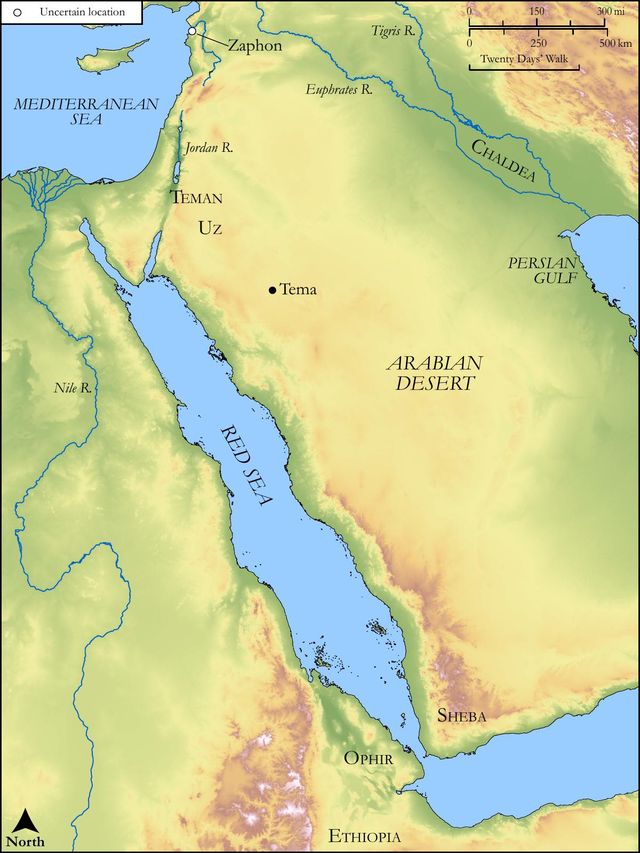
See on the biblical-era map
Study this verse
Public-domain commentary
Matthew Henry
From his Commentary on the Whole Bible. Henry comments on passages, not single verses — this entry covers Job 28:1–11. His three-level outline is real structure in the source text, so it is rendered as structure.
Here Job shows, 1. What a great way the wit of man may go in diving into the depths of nature and seizing the riches of it, what a great deal of knowledge and wealth men may, by their ingenious and industrious searches, make themselves masters of. But does it therefore follow that men may, by their wit, comprehend the reasons why some wicked people prosper and others are punished, why some good people prosper and others are afflicted? No, by no means. The caverns of the earth may be discovered, but not the counsels of heaven. 2. What a great deal of care and pains worldly men take to get riches. He had observed concerning the wicked man (Job 27:16) that he heaped up silver as the dust; now here he shows whence that silver came which he was so fond of and how it was obtained, to show what little reason wicked rich men have to be proud of their wealth and pomp. Observe here,
I.The wealth of this world is hidden in the earth.
Thence the silver and the gold, which afterwards they refine, are fetched, Job 28:1. There they lay mixed with a great deal of dirt and dross, like a worthless thing, of no more account than common earth; and abundance of them will so lie neglected, till the earth and all the works therein shall be burnt up. Holy Mr. Herbert, in his poem called Avarice, takes notice of this, to shame men out of the love of money: -
Money, thou bane of bliss, thou source of woe,
Whence com'st thou, that thou art so fresh and fine?
I know thy parentage is base and low;
Man found thee poor and dirty in a mine.
Surely thou didst so little contribute
To this great kingdom which thou now hast got
That he was fain, when thou wast destitute,
To dig thee out of thy dark cave and grot.
Man calleth thee his wealth, who made thee rich,
And while he digs out thee falls in the ditch.
Iron and brass, less costly but more serviceable metals, are taken out of the earth (Job 28:2), and are there found in great abundance, which abates their price indeed, but is a great kindness to man, who could much better be without gold than without iron. Nay, out of the earth comes bread, that is, bread-corn, the necessary support of life, Job 28:5. Thence man's maintenance is fetched, to remind him of his own original; he is of the earth, and is hastening to the earth. Under it is turned up as it were fire, precious stones, that sparkle as fire - brimstone, that is apt to take fire - coal, that is proper to feed fire. As we have our food, so we have our fuel, out of the earth. There the sapphires and other gems are, and thence gold-dust is digged up;, Job 28:6. The wisdom of the Creator has placed these things, 1. Out of our sight, to teach us not to set our eyes upon them, Pro 23:5. 2. Under our feet, to teach us not to lay them in our bosoms, nor to set our hearts upon them, but to trample upon them with a holy contempt. See how full the earth is of God's riches (Psa 104:24) and infer thence, not only how great a God he is whose the earth is and the fulness thereof (Psa 24:1), but how full heaven must needs be of God's riches, which is the city of the great King, in comparison with which this earth is a poor country.
II.The wealth that is hidden in the earth cannot be obtained but with a great deal of difficulty.
1.It is hard to be found out: there is but here and there a vein for the silver, Job 28:1. The precious stones, though bright themselves, yet, because buried in obscurity and out of sight, are called stones of darkness and the shadow of death. Men may search long before they light on them.
2.When found out it is hard to be fetched out. Men's wits must be set on work to contrive ways and means to get this hidden treasure into their hands. They must with their lamps set an end to darkness; and if one expedient miscarry, one method fail, they must try another, till they have searched out all perfection, and turned every stone to effect it, Job 28:3. They must grapple with subterraneous waters (Job 28:4, Job 28:10, Job 28:11), and force their way through rocks which are, as it were, the roots of the mountains, Job 28:9. Now God has made the getting of gold, and silver, and precious stones, so difficult,
(1.)For the exciting and engaging of industry. Dii laboribus omnia vendunt - Labour is the price which the gods affix to all things. If valuable things were too easily obtained men would never learn to take pains. But the difficulty of gaining the riches of this earth may suggest to us what violence the kingdom of heaven suffers.
(2.)For the checking and restraining of pomp and luxury. What is for necessity is had with a little labour from the surface of the earth; but what is for ornament must be dug with a great deal of pains out of the bowels of it. To be fed is cheap, but to be fine is chargeable.
III.Though the subterraneous wealth is thus hard to obtain, yet men will have it.
He that loves silver is not satisfied with silver, and yet is not satisfied without it; but those that have much must needs have more. See here,
1.What inventions men have to get this wealth. They search out all perfection, Job 28:3. They have arts and engines to dry up the waters, and carry them off, when they break in upon them in their mines and threaten to drown the work, Job 28:4. They have pumps, and pipes, and canals, to clear their way, and, obstacles being removed, they tread the path which no fowl knoweth (Job 28:7, Job 28:8), unseen by the vulture's eye, which is piercing and quick-sighted, and untrodden by the lion's whelps, which traverse all the paths of the wilderness.
2.What pains men take, and what vast charge they are at, to get this wealth. They work their way through the rocks and undermine the mountains, Job 28:10.
3.What hazards they run. Those that dig in the mines have their lives in their hands; for they are obliged to bind the floods from overflowing (Job 28:11), and are continually in danger of being suffocated by damps or crushed or buried alive by the fall of the earth upon them. See how foolish man adds to his own burden. He is sentenced to eat bread in the sweat of his face; but, as if that were not enough, he will get gold and silver at the peril of his life, though the more is gotten the less valuable it is. In Solomon's time silver was as stones. But,
4.Observe what it is that carries men through all this toil and peril: Their eye sees every precious thing, Job 28:10. Silver and gold are precious things with them, and they have them in their eye in all these pursuits. They fancy they see them glittering before their faces, and, in the prospect of laying hold of them, they make nothing of all these difficulties; for they make something of their toil at last: That which is hidden bringeth he forth to light, Job 28:11. What was hidden under ground is laid upon the bank; the metal that was hidden in the ore is refined from its dross and brought forth pure out of the furnace; and then he thinks his pains well bestowed. Go to the miners then, thou sluggard in religion; consider their ways, and be wise. Let their courage, diligence, and constancy in seeking the wealth that perisheth shame us out of slothfulness and faint-heartedness in labouring for the true riches. How much better is it to get wisdom than gold! How much easier and safer! Yet gold is sought for, but grace neglected. Will the hopes of precious things out of the earth (so they call them, though really they are paltry and perishing) be such a spur to industry, and shall not the certain prospect of truly precious things in heaven be much more so?
Historical interpretation
Two Centuries of Reception
2 surviving comments on this verse. Each one is dated, so this reads as a timeline rather than a list.
Select a marker to jump to its quote. Markers stagger vertically where authors wrote within a few decades of each other.
He means that if God has established an order in the realities of nature, he did even more with regard to human realities. Indeed, he foresees and takes care of events, and nothing comes from him at random. Or, on the other hand, [he means] that the whole of realities is quite visible but the plans of God are invisible; in fact, silver and copper have a place, whereas nobody has ever known the “place” of wisdom. But God only knows wisdom, and he has said to mortals that “piety is wisdom,” and knowledge means to do good.“He has set a place for darkness,” he says; he was right in saying “a place,” because darkness knows how to give way and fade away [before the daylight]. Who drives this obscurity away? From where does such beautiful order in such a situation come? Then he discusses his power, and then his wisdom in order to persuade us that he does not want to call God to account. Why darkness, he says? Do we really know anything at all? God can do anything. He does everything with wisdom.
39. In silver the power of speaking, in gold brightness of life or of wisdom is used to be denoted. And because heretics are so filled with pride for the brilliancy of their speaking, that they are not based firmly by any authority of the sacred books, (which books are for speaking like a kind of veins of silver to us, because from those identical books we derive the spring and source of our speaking,) he recalls them to the pages of sacred authority, that if they have a desire to speak in a true way, they may from that source draw forth what to say. And he saith, The silver hath the beginning of its veins, and to the gold there is a place, where they fine it.
As if he said in plain words; ‘He that is fitting himself for the words of true preaching, the originals of the cases he must of necessity derive from the sacred page, so as to bring round every thing that he speaks to a foundation of divine authority, and in that set firm the edifice of his own speaking. For, as we before said, oftentimes heretics, whilst they are eager to prop up what is bad of their own, broach things which assuredly are not maintained in the page of the sacred books. And hence the great Preacher admonishes his disciple, saying, O Timothy, keep that which is committed to thy trust, avoiding profane novelties of speaking [1 Tim. 6, 20], for whereas heretics long to be extolled as if for excellency of wit, they as it were bring out new things which are not maintained in the old books of the ancient Fathers, and thus it follows, that whilst they desire to appear wise, they scatter seeds of foolishness to their wretched hearers.
40. And it is well added; And to the gold there is a place, where they fine it. As if he said in plain terms; ‘The true wisdom of believers, which has the Church Universal for its place, undergoes tribulation by you persecuting her, but from all the dross of sins by the fire of your persecution she is purified.’ Whence it is written; For gold is tried in the fire, and acceptable men in the furnace of adversity. [Ecclus. 2, 5] In which passage this too may be appropriately taken for the meaning, that for their foolish suffering heretics might seem to be rebuked. For oftentimes for the Name of Jesus Christ, our Lord and Redeemer, they suffer much, and by those same sufferings they look for themselves to become His martyrs. To which persons it is now said by the voice of the holy man; and to the gold there is a place, where they fine it. For according to that which has been already said even before us, he that suffers out of the unity of the Church, punishments he may suffer, but a Martyr he cannot be made; for ‘to the gold there is a place, where they fine it.’ What then, ye heretics, say ye to these things? Ye are minded to be ‘fined’ by the afflicting of the flesh, nay even by martyrdom, but the place where ye must be fined, ye know not. Hear ye what is spoken by the voice of the holy preacher. ‘To the gold there is a place, where they fille it.’ So then, seek ye this ‘place for the fining,’ this furnace, wherein the gold may be fitly purged, find ye out.
41. There is one Church, .in which he that may have attained to be fined, may likewise be purified from all the dross of sins. If for the sake of God ye undergo aught of bitterness, if aught of tribulation, being without her pale, ye can only be burnt, ye cannot be purified. Let Jeremiah tell, let him tell in what way the fire of your fining is void of all efficacy. The finer melteth in vain; for their wickednesses are not done away [Jer. 6, 29]. See how the fire externally melting at once administers a punishment of hard suffering, and yet does not clear off the sin of misbelief; it both furnishes torments of cruel punishments, and does not cause additions of good merits. Moreover the fire of this fining which is undergone out of the Catholic Church, how utterly it is void of all efficacy the Apostle Paul instructs us, when he says, And though I give my body to be burned, and have not charity, it profiteth me nothing. [1 Cor. 13, 3] For some think wrong things touching God, and others hold what is right about the Creator, but do not maintain unity with their brethren; the one are sundered by erroneousness of faith, and the others by the commission of schism. And hence in the very first part of the Decalogue the sins of both sides are checked, seeing that it is said by the voice of God, And thou shalt love the Lord thy God with all thine heart, and with all thy soul, and with all thy might. [Mark 12, 30. 31. Deut. 6, 5] And it is immediately added, And thou shalt love thy neighbour as thyself. For whoso imagines what is wrong about God, surely it is evident that he does not ‘love God.’ But he who while he entertains right notions about God is divided from the unity of the Holy Church, it is plain that he does not love his neighbonr, whom he refuses to have for his fellow.
42. Whosoever, then, is divided from this unity of the Church our Mother, either through heresy in entertaining wrong notions concerning God, or by the erroneousness of schism in not loving his neighbour, is bereft of the grace of that charity, concerning which Paul saith what we have before given; And though I give my body to be burned, and have not charity, it profiteth me nothing. As if he expressed himself in plain utterance; ‘Without the bounds of its place, the fire of fining being applied to me only afflicts me with torment, and does not purify me by its cleansing.’ This place all they that are lovers of holy peace seek with heartiest endeavours, this on seeking they find, this finding they keep, knowing the remission of sin, as to where, or when, or to what sort it is vouchsafed. For where is it, save in the bosom of our Catholic Mother? When, but before the day of coming departure? Because, Behold, now is the accepted time; behold, now is the day of salvation. [2 Cor. 6, 2] And, Seek ye the Lord while He may be found, call ye upon Him while He is near. [Is. 55, 6] To what sort of persons, but to the converted, who after the imitating of little children are fashioned by humility as their mistress? To whom it is said; Suffer little children to come unto Me, and forbid them not; for of such is the kingdom of heaven. [Matt. 19, 14] And, Except ye be converted and become as little children, ye shall not enter into the kingdom of heaven. [Matt. 18, 3] And therefore, because there are no true martyrs made saving in the Catholic Church, it is rightly said, To the gold there is a place where they fine it. Because the soul would not be made bright in the radiance of everlasting beauty, except, so to say, it were first burnt here in the workshop of charity.
43. Moreover, we are to consider that there are some whom Almighty God by His secret counsel preserving in innocency from their very beginnings promotes to the topmost heights of virtuous attainments, that, as their age increases, both numerousness of years and loftiness of merits should simultaneously advance in them. But others abandoning in their outset He suffers to go with bad habits fermenting by headlong ways. . Yet for the most part even these He has regard to, and for the following after Him He kindles them with the fire of holy love, and the itchings of bad propensities engrained in their hearts He converts into a fervour of virtue, and they are the more set on fire to the desire of beseeching the pitifulness of God, in proportion as they are the more ashamed at the recollection of their own wickedness; as it often happens, that in the conflict of the fight the soldier, who is placed before the eyes of his leader, basely yields to the enemy’s valour, and that whilst he powerlessly turns his back he is struck; yet nevertheless being ashamed of this very thing that he has done [2 Mss. ‘yeilded.’] disgracefully before his leader’s eyes, from the mere sense of shame he gathers greater force; and afterwards executes deeds of Prowess, to so high a degree that he may at once achieve present credit of his valour, and cover past disgrace of weakness. In a like way, these persons are sometimes more actively established in the service of God by consequence of past weakness, and such persons for the keeping of His commandments both the desire of things future draws on, and the remembrance of things past urges forward, that on the one side affection to that which is to come should stimulate, and on the other shame for that which is past spur on. Which same however, while the enemies of the Church see to be endowed with the highest virtues, and in their present life cannot any way find out that whereby they may derogate from their merit, they set themselves to impeach them of the past, as the Manichaean assails our Moses, in whom he endeavours to soil with the sin of a past homicide the grace of subsequent virtuous attainments; in whom he heeds not how patient he was afterwards to endure, but how precipitate he was before to strike.
Continue studying Job 28:1 across the web’s major study libraries — every link below opens this exact verse, chapter, or book on the destination site.
Read & Compare
 BibleGatewayThis verse in more than 200 translations and 70 languages.
 Bible.comThe YouVersion reader — hundreds of translations, reading plans, and highlights.
 ESV.orgCrossway's official English Standard Version reader.
 NET BibleThe NET translation with 60,000+ translators' notes on every rendering decision.
 STEP BibleTyndale House's free study tool — original text, vocabulary, and scholarly resources.
 BibliaLogos Bible Software's free web reader.
 USCCBThe New American Bible (Revised Edition) with the U.S. bishops' study notes.
Commentaries
 BibleHub CommentariesDozens of classic commentaries on this verse, gathered on one page.
 StudyLightMore than 100 commentary sets — the largest collection on the web.
 BibleRefPlain-English commentary on what this verse means, verse by verse.
 Enduring WordDavid Guzik's free commentary on this chapter, widely used by Bible teachers.
 Bible Study ToolsVerse commentary alongside Greek and Hebrew study aids.
Original Language & Research
- BibleHub InterlinearThe verse word by word — original language, transliteration, and English.
- BibleHub LexiconEvery word's original-language definition and Strong's entry.
 Blue Letter BibleDeep-study tools — Strong's numbers, concordance, and word studies.
 SefariaThe Hebrew text with Rashi and centuries of Jewish commentary.
Sermons, Hymns & Audio


TrulyRandomVerse is not affiliated with these sites and doesn’t control their content. They’re linked because they’re genuinely useful.
Summary
Job 28:1 opens a profound poetic interlude within the Book of Job, shifting the narrative from the intense debates between Job and his friends to a meditation on the nature of wisdom. This verse introduces the theme by highlighting humanity's remarkable skill and relentless effort in discovering and extracting precious metals from the deepest recesses of the earth, setting the stage for a stark contrast between the accessibility of material wealth and the elusive, divine source of true wisdom.
Context
ShowHideLiterary Context
This verse initiates a magnificent poem in Job chapter 28, widely regarded as one of the most eloquent and profound passages in the entire Bible. Prior to this interlude, the book has been dominated by the intense and often circular dialogues between Job and his three friends concerning the reasons for Job's immense suffering and the justice of God. Suddenly, the narrative pauses for this powerful reflection on wisdom. Job 28:1-11 meticulously details humanity's impressive ability to mine the earth for precious metals and stones, venturing into the deepest, darkest, and most perilous places. This human ingenuity in finding hidden material wealth then serves as a stark rhetorical contrast to the theme explored from Job 28:12 onwards: the ultimate elusiveness, pricelessness, and divine origin of true wisdom, which cannot be found or purchased with any earthly treasure.
Historical & Cultural Context
Among the men of the east, mining for precious metals like silver and gold was an incredibly arduous, dangerous, and technologically advanced undertaking. Civilizations like Egypt, Mesopotamia, and the Hittites invested heavily in mining operations, often employing large workforces in deep shafts and tunnels. The process involved not only extraction but also the sophisticated techniques of smelting and refining (finishing) the raw ore to separate the pure metal, a skill that required significant metallurgical knowledge. Silver and gold were not merely decorative; they served as primary forms of wealth, currency, and symbols of power and status, making the immense effort of their acquisition economically justifiable. The imagery in this chapter reflects a deep understanding of these ancient mining practices, emphasizing the human capacity to conquer the earth's physical challenges for material gain, often in the most remote and challenging environments.
Key Themes
ShowHideThis opening verse introduces several key themes that are developed throughout Job chapter 28. Firstly, it underscores Human Ingenuity and Resourcefulness, recognizing humanity's unparalleled skill and determination in uncovering and processing valuable resources hidden deep within the earth. It speaks to the laborious and dangerous efforts involved in ancient mining, exploring the earth's depths for its riches. Secondly, it highlights The Value of Precious Metals, presenting silver and gold as highly prized commodities, worth the immense effort required to extract and refine them. This reflects their perceived ultimate value in that day. Most importantly, this verse functions as a Preparation for a Deeper Truth. While seemingly about mining, it is a rhetorical setup that praises human ability in one domain (finding material wealth) to then underscore the greater difficulty—and ultimate impossibility through human effort alone—of finding true, divine wisdom. It prepares the reader for the profound, rhetorical question posed later in the chapter: “But where shall wisdom be found? and where is the place of understanding?”.
Exposition and Analysis
ShowHideKey Word Analysis
ShowHideFrom the root meaning "to go forth" or "exit," this word (H4161) refers to a source or product, and specifically denotes a "mine" or "vein" as a place from which something valuable comes out. In the context of precious metals, it signifies the natural deposit or lode from which silver is extracted, emphasizing the point of origin or discovery within the earth's depths. It highlights the place where the valuable material "comes forth."
This primitive root (H2212) means "to strain," "extract," "clarify," "purge," "purify," or "refine." In the context of metallurgy, it refers to the crucial process of separating pure metal (silver or gold) from raw ore and impurities. This word emphasizes the sophisticated technical skill and precise knowledge required to transform raw, crude material into a usable, valuable, and pure commodity, highlighting human mastery over natural elements.
Verse Breakdown
ShowHide"Surely there is a vein for the silver,"
This opening clause asserts a fundamental truth: silver, a highly prized metal, is found in specific, accessible locations within the earth. The term "vein" (môwtsâʼ) suggests a natural deposit or source from which the silver "comes forth," implying that humanity, through ingenuity and strenuous effort, has discovered and created ways to reach these hidden deposits. It establishes the premise of human capability in extracting material wealth from the earth's depths.
"and a place for gold [where] they fine [it]."
This second clause parallels the first, extending the observation to gold, an even more precious metal. The phrase "[where] they fine [it]" (literally, "a place for gold, they refine it") highlights the subsequent, essential process of purification. It acknowledges that the raw gold, once extracted, must undergo a refining process to separate it from impurities, making it pure and usable. This reinforces the idea of human skill and labor not just in finding, but in perfecting and utilizing, the earth's treasures.
Literary Devices
ShowHideJob 28:1 employs several literary devices to set the stage for the poem's deeper message. The most prominent is Imagery, painting a vivid picture of ancient mining operations, with "veins" for silver and "places" for gold, evoking the deep, dark, and dangerous environments where these treasures are found. This detailed imagery serves as a foundation for a powerful Contrast. The human mastery over the physical world, demonstrated by the ability to extract and refine silver and gold from the earth's hidden depths, is set in stark opposition to the subsequent theme: the inability of humanity to locate or acquire true wisdom through similar means. The verse also functions as a form of Prolepsis or Foreshadowing, subtly introducing the concept of "finding" and "refining" as a prelude to the ultimate search for wisdom, which will prove far more elusive than any earthly treasure.
Theological and Thematic Connections
ShowHideJob 28:1, while seemingly a straightforward observation about mining, serves as a crucial theological setup. It highlights humanity's remarkable capacity for discovery, ingenuity, and perseverance in the pursuit of material wealth. The verse implicitly raises the question of what we value most and where we direct our greatest efforts. It suggests that if such immense labor and skill are expended for perishable earthly treasures, how much more should we exert ourselves for imperishable divine wisdom? The poem of Job 28 ultimately reveals that while humans can master the earth's physical resources, true wisdom is not a commodity to be mined or bought; it originates solely with God and is found in reverence for Him. This deep contrast between accessible earthly treasures and elusive divine wisdom is a recurring theme in biblical wisdom literature, urging a re-evaluation of our ultimate pursuits.
Reflection and Application
ShowHideJob 28:1, as the opening to this profound discourse on wisdom, invites us to critically reflect on what we truly value and where we direct our greatest efforts and ingenuity. The verse praises humanity's impressive capacity to uncover and process earthly riches, solving complex material problems with immense dedication. This prompts a crucial self-examination: Do we apply the same zeal, or even greater, to seeking true understanding and divine wisdom? The chapter challenges us to recognize that ultimate wisdom is not found through human exploration, scientific advancement, or material acquisition alone. Instead, it is rooted in reverence for God and adherence to His ways, as the poem's conclusion reveals. This verse serves as a powerful reminder to prioritize spiritual truths over temporal gains, to seek the imperishable above the perishable, much like the call in Colossians 3:2 to "Set your affection on things above, not on things on the earth." It encourages us to shift our focus from what we can extract from the earth to what we can receive from heaven, understanding that true life and fulfillment are found in God's wisdom, not in earthly treasures.
Questions for Reflection
ShowHideFAQ
ShowHideWhy does the Book of Job suddenly shift to a poem about mining and wisdom in chapter 28?
ShowHideThe sudden shift in Job chapter 28 is a deliberate rhetorical and theological strategy. Up to this point, Job and his friends have been locked in a repetitive and ultimately unsatisfying debate about the nature of suffering and divine justice. The poem serves as an interlude, elevating the discussion beyond human speculation. It highlights humanity's impressive capacity to master the physical world and extract its hidden treasures, setting up a profound contrast with the ultimate inability of humanity to discover or purchase true wisdom through similar means. This shift prepares the reader for God's eventual appearance and His revelation of wisdom, which is beyond human comprehension or acquisition. It redirects the focus from Job's individual suffering to a universal truth about the source and nature of wisdom, ultimately pointing to God alone as its possessor.
Christ-Centered Fulfillment
ShowHideWhile Job 28:1 speaks of humanity's ability to find and refine earthly treasures, the broader poem points to the ultimate elusiveness of divine wisdom for humanity. This tension finds its ultimate resolution and fulfillment in Jesus Christ. Humanity's diligent search for wisdom, often depicted as a quest for hidden treasure, culminates not in a "vein" in the earth, but in the person of Christ himself. He is not merely a source of wisdom, but the very embodiment of it. As 1 Corinthians 1:24 declares, Christ is "the power of God, and the wisdom of God." Furthermore, Colossians 2:3 affirms that "in whom are hid all the treasures of wisdom and knowledge." The wisdom that humanity cannot mine or purchase is freely given in Christ, who is the Logos, the very Word through whom all things were created and by whom all things are upheld (Hebrews 1:3). Thus, the poem's initial praise of human ingenuity in finding material wealth ultimately directs us to the divine wisdom found perfectly and completely in Jesus, the true treasure for which all humanity unconsciously searches.