


Job 14:8
Bible text: King James Version (1769 Blayney text) · Public domain
Bible text: Berean Standard Bible · Public domain
Bible text: American Standard Version (1901) · Public domain
Bible text: World English Bible, Messianic edition · Public domain
Bible text: Geneva Bible (1599) · Public domain
Bible text: Young's Literal Translation · Public domain
- אִם'imthoughH518PrtParticle Conditional
- יַזְקִיןyaz·Kinit will grow oldH2204V-Hiphil-Imperf-3msVerb Hiphil Imperfect 3rd Singular Masculine
- בָּאָרֶץba·'A·retzin the groundH776Prep-b ¦ N-fsNoun Singular Feminine Absoluteבָּin theאָרֶץground
- שָׁרְשׁוֹsha·re·Shoits rootH8328N-msc ¦ 3msNoun Singular Masculine Constructשָׁרְשׁrootוֹits
- וּבֶעָפָרu·ve·'a·Farand in the dustH6083Conj-w ¦ Prep-b ¦ N-msNoun Singular Masculine Absoluteוּandבֶin theעָפָרdust
- יָמוּתya·Mutit will dieH4191V-Qal-Imperf-3msVerb Qal Imperfect 3rd Singular Masculine
- גִּזְעוֹgiz·'Oits stumpH1503N-msc ¦ 3msNoun Singular Masculine Constructגִּזְעstumpוֹits
English is a literal word-by-word gloss of the Hebrew, not the KJV's wording. Why?
This is the original text the KJV's translators worked from — each Hebrew word with its own literal English meaning in this verse, prepared by scholars at Tyndale House, Cambridge. The KJV translates whole sentences, not word by word, so its wording differs: one Hebrew word can become several English words, and the KJV may choose “the LORD” where the gloss reads “Yahweh”. Both are faithful — they answer different questions. For the KJV's own rendering, switch to the KJV text.
Details
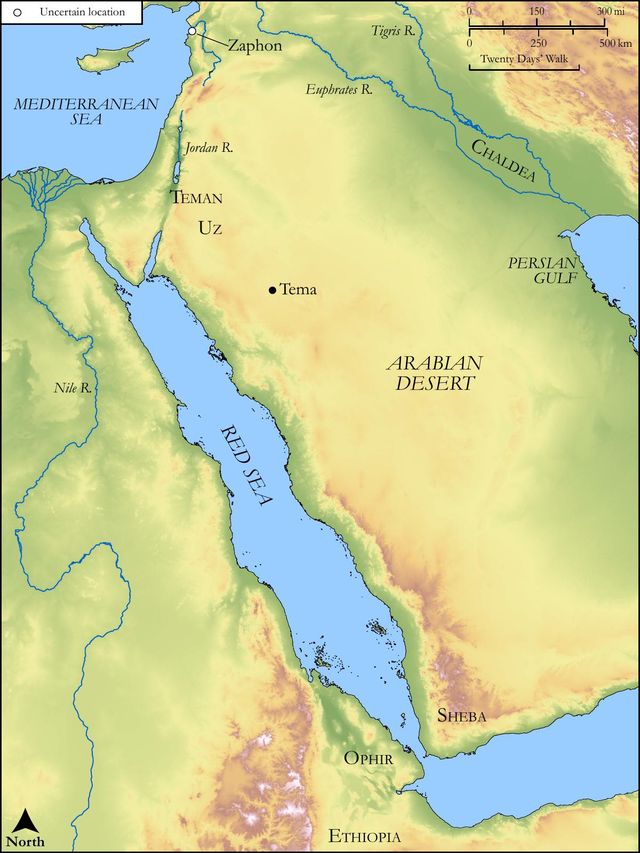
See on the biblical-era map
Study this verse
Public-domain commentary
Matthew Henry
From his Commentary on the Whole Bible. Henry comments on passages, not single verses — this entry covers Job 14:7–15. His four-level outline is real structure in the source text, so it is rendered as structure.
We have seen what Job has to say concerning life; let us now see what he has to say concerning death, which his thoughts were very much conversant with, now that he was sick and sore. It is not unseasonable, when we are in health, to think of dying; but it is an inexcusable incogitancy if, when we are already taken into the custody of death's messengers, we look upon it as a thing at a distance. Job had already shown that death will come, and that its hour is already fixed. Now here he shows,
I.That death is a removal for ever out of this world.
This he had spoken of before (Job 7:9, Job 7:10), and now he mentions it again; for, though it be a truth that needs not be proved, yet it needs to be much considered, that it may be duly improved.
1.A man cut down by death will not revive again, as a tree cut down will. What hope there is of a tree he shows very elegantly, Job 14:7-9. If the body of the tree be cut down, and only the stem or stump left in the ground, though it seem dead and dry, yet it will shoot out young boughs again, as if it were but newly planted. The moisture of the earth and the rain of heaven are, as it were, scented and perceived by the stump of a tree, and they have an influence upon it to revive it; but the dead body of a man would not perceive them, nor be in the least affected by them. In Nebuchadnezzar's dream, when his being deprived of the use of his reason was signified by the cutting down of a tree, his return to it again was signified by the leaving of the stump in the earth with a band of iron and brass to be wet with the dew of heaven, Dan 4:15. But man has no such prospect of a return to life. The vegetable life is a cheap and easy thing: the scent of water will recover it. The animal life, in some insects and fowls, is so: the heat of the sun retrieves it. But the rational soul, when once retired, is too great, too noble, a thing to be recalled by any of the powers of nature; it is out of the reach of sun or rain, and cannot be restored but by the immediate operations of Omnipotence itself; for (Job 14:10) man dieth and wasteth, away, yea, man giveth up the ghost, and where is he? Two words are here used for man: - Geber, a mighty man, though mighty, dies; Adam, a man of the earth, because earthy, gives up the ghost. Note, Man is a dying creature. He is here described by what occurs,
(1.)Before death: he wastes away; he is continually wasting, dying daily, spending upon the quick stock of life. Sickness and old age are wasting things to the flesh, the strength, the beauty.
(2.)In death: he gives up the ghost; the soul leaves the body, and returns to God who gave it, the Father of spirits.
(3.)After death: Where is he? He is not where he was; his place knows him no more; but is he nowhere? So some read it. Yes, he is somewhere; and it is a very awful consideration to think where those are that have given up the ghost, and where we shall be when we give it up. It has gone to the world of spirits, gone into eternity, gone to return no more to this world.
2.A man laid down in the grave will not rise up again, Job 14:11, Job 14:12. Every night we lie down to sleep, and in the morning we awake and rise again; but at death we must lie down in the grave, not to awake or rise again to such a world, such a state, as we are now in, never to awake or arise until the heavens, the faithful measures of time, shall be no more, and consequently time itself shall come to an end and be swallowed up in eternity; so that the life of man may fitly be compared to the waters of a land-flood, which spread far and make a great show, but they are shallow, and when they are cut off from the sea or river, the swelling and overflowing of which was the cause of them, they soon decay and dry up, and their place knows them no more. The waters of life are soon exhaled and disappear. The body, like some of those waters, sinks and soaks into the earth, and is buried there; the soul, like others of them, is drawn upwards, to mingle with the waters above the firmament. The learned Sir Richard Blackmore makes this also to be a dissimilitude. If the waters decay and be dried up in the summer, yet they will return again in the winter; but it is not so with the life of man. Take part of his paraphrase in his own words: -
A flowing river, or a standing lake,
May their dry banks and naked shores forsake;
Their waters may exhale and upward move,
Their channel leave to roll in clouds above;
But the returning water will restore
What in the summer they had lost before:
But if, O man! thy vital streams desert
Their purple channels and defraud the heart,
With fresh recruits they ne'er will be supplied,
Nor feel their leaping life's returning tide.
II.That yet there will be a return of man to life again in another world, at the end of time, when the heavens are no more.
Then they shall awake and be raised out of their sleep. The resurrection of the dead was doubtless an article of Job's creed, as appears, Job 19:26, and to that, it should seem, he has an eye here, where, in the belief of that, we have three things: -
1.A humble petition for a hiding-place in the grave, Job 14:13. It was not only a passionate weariness of this life that he wished to die, but in a pious assurance of a better life, to which at length he should arise. O that thou wouldst hide me in the grave! The grave is not only a resting-place, but a hiding-place, to the people of God. God has the key of the grave, to let in now and to let out at the resurrection. He hides men in the grave, as we hide our treasure in a place of secresy and safety; and he who hides will find, and nothing shall be lost. "O that thou wouldst hide me, not only from the storms and troubles of this life, but for the bliss and glory of a better life! Let me lie in the grave, reserved for immortality, in secret from all the world, but not from thee, not from those eyes which saw my substance when first curiously wrought in the lowest parts of the earth," Psa 139:15, Psa 139:16. There let me lie,
(1.)Until thy wrath be past. As long as the bodies of the saints lie in the grave, so long there are some remains of that wrath which they were by nature children of, so long they are under some of the effects of sin; but, when the body is raised, it is wholly past - death, the last enemy, will then be totally destroyed.
(2.)Until the set time comes for my being remembered, as Noah was remembered in the ark (Gen 8:1), where God not only hid him from the destruction of the old world, but reserved him for the reparation of a new world. The bodies of the saints shall not be forgotten in the grave. There is a time appointed, a time set, for their being enquired after. We cannot be sure that we shall look through the darkness of our present troubles and see good days after them in this world; but, if we can but get well to the grave, we may with an eye of faith look through the darkness of that, as Job here, and see better days on the other side of it, in a better world.
2.A holy resolution patiently to attend the will of God both in his death and his resurrection (Job 14:14): If a man die, shall he live again? All the days of my appointed time will I wait until my change come. Job's friends proving miserable comforters, he set himself to be the more his own comforter. His case was now bad, but he pleases himself with the expectation of a change. I think it cannot be meant of his return to a prosperous condition in this world. His friends indeed flattered him with the hopes of that, but he himself all along despaired of it. Comforts founded upon uncertainties at best must needs be uncertain comforts; and therefore, no doubt, it is something more sure than that which he here bears up himself with the expectation of. The change he waits for must therefore be understood either,
(1.)Of the change of the resurrection, when the vile body shall be changed (Phi 3:21), and a great and glorious change it will be; and then that question, If a man die, shall he live again? must be taken by way of admiration. "Strange! Shall these dry bones live! If so, all the time appointed for the continuance of the separation between soul and body my separate soul shall wait until that change comes, when it shall be united again to the body, and my flesh also shall rest in hope." Psa 16:9. Or,
(2.)Of the change at death. "If a man die, shall he live again? No, not such a life as he now lives; and therefore I will patiently wait until that change comes which will put a period to my calamities, and not impatiently wish for the anticipation of it, as I have done." Observe here,
[1.]That it is a serious thing to die; it is a work by itself. It is a change; there is a visible change in the body, its appearance altered, its actions brought to an end, but a greater change with the soul, which quits the body, and removes to the world of spirits, finishes its state of probation and enters upon that of retribution. This change will come, and it will be a final change, not like the transmutations of the elements, which return to their former state. No, we must die, not thus to live again. It is but once to die, and that had need be well done that is to be done but once. An error here is fatal, conclusive, and not again to be rectified.
[2.]That therefore it is the duty of every one of us to wait for that change, and to continue waiting all the days of our appointed time. The time of life is an appointed time; that time is to be reckoned by days; and those days are to be spent in waiting for our change. That is, First, We must expect that it will come, and think much of it. Secondly, We must desire that it would come, as those that long to be with Christ. Thirdly, We must be willing to tarry until it does come, as those that believe God's time to be the best. Fourthly, We must give diligence to get ready against it comes, that it may be a blessed change to us.
3.A joyful expectation of bliss and satisfaction in this (Job 14:15): Then thou shalt call, and I will answer thee. Now, he was under such a cloud that he could not, he durst not, answer (Job 9:15, Job 9:35; Job 13:22); but he comforted himself with this, that there would come a time when God would call and he should answer. Then, that is,
(1.)At the resurrection, "Thou shalt call me out of the grave, by the voice of the archangel, and I will answer and come at the call." The body is the work of God's hands, and he will have a desire to that, having prepared a glory for it. Or,
(2.)At death: "Thou shalt call my body to the grave, and my soul to thyself, and I will answer, Ready, Lord, ready - Coming, coming; here I am." Gracious souls can cheerfully answer death's summons, and appear to his writ. Their spirits are not forcibly required from them (as Luk 12:20), but willingly resigned by them, and the earthly tabernacle not violently pulled down, but voluntarily laid down, with this assurance, "Thou wilt have a desire to the work of thy hands. Thou hast mercy in store for me, not only as made by thy providence, but new-made by thy grace;" otherwise he that made them will not save them. Note, Grace in the soul is the work of God's own hands, and therefore he will not forsake it in this world (Psa 138:8), but will have a desire to it, to perfect it in the other, and to crown it with endless glory.
Historical interpretation
Two Centuries of Reception
3 surviving comments on this verse. Each one is dated, so this reads as a timeline rather than a list.
Select a marker to jump to its quote. Markers stagger vertically where authors wrote within a few decades of each other.
Here the blessed Job assumes the role of teacher and prophet, and through the symbol of the tree coming to life again, he predicts his return to his former state. At the same time, Job prophesies that human nature in its entirety will be renewed. Giving vigorous thanks to the perfume of the baptismal waters, the human race will sprout again. Endowed with a new growing foliage, human nature will regain the dignity of its former beauty. After, it will be planted again through the death of the Lord.
6. What is ‘the root’ of the righteous, but holy preaching, since it is that he springs out of, and that he holds on in? and what is meant by the name of ‘the earth’ or of ‘dust,’ but the sinner? to whom it is said by the voice of the Creator, Earth thou art, and unto earth shalt thou return [m] [Gen. 3, 19]. Or, indeed, as our Translation reads, Dust thou art, and unto dust shalt thou return. [so V.] Thus ‘the root of the righteous waxes old in the earth, and his stock dies in the dust,’ in that in the hearts of the wicked his preaching is despised, and thought dried of all goodness, and ‘his stock dies in the dust,’ in that amidst the hands of the persecutors his body is bereft of life; for according to the words of Wisdom, In the sight of the unwise they seemed to die, and their departure is taken for misery. [Wisd. 3, 2] But this one, whose ‘root waxed old in the earth, and whose trunk died in the dust,’ through the smell of water, buddeth; in that through the inspiration of the Holy Spirit, by the example of his conduct he causes the budding of virtue in the hearts of the Elect. For by the designation of water sometimes the watering of the Holy Spirit is used to be understood, as where it is written, If any man thirst, let him come unto Me, and drink. [John 7, 37] But whosoever drinketh of the water that shall give him, shall never thirst. [John 4, 14] It follows; And bring forth foliage as when it was first planted. To ‘bring forth foliage on the stock being cut down’ is, when the just man is put an end to in the body, by the mere example of his suffering to raise up the hearts of many, and out of a right faith to show forth the greenness of truth. And it is well said, As when it was first planted. All that is done by the righteous here is a second planting; in that clearly the first planting does not consist in the practice of the good, but in the foreknowledge of the Creator; and whereas all that the Elect do, as it is first seen and settled interiorly, so afterwards is executed outwardly.
Now because Job’s words are clear according to the letter, we must refer the sense to the inward things and search how they are to be understood spiritually. Thus, in holy Scripture by the name of “tree” we have represented sometimes the cross, sometimes the righteous person or even the unrighteous person, and sometimes the Wisdom of God incarnate. Therefore, the cross is denoted by the “tree” when it is said, “Let us put the tree into his bread,” for to “put the tree into the bread” is to apply the cross to the body of our Lord. Again by the title of the “tree” we also have the just person, or even the unjust person, set forth, as the Lord says by the prophet, “I the Lord have brought down the high tree and exalted the low tree.” According to the word of the self-same Truth, “Whoever exalts himself shall be humbled; and he who humbles himself shall be exalted.” Solomon also says, “If the tree falls towards the south or toward the north, in the place where the tree fell, there it shall be.” For in the day of their death the just person does “fall to the south,” and the unjust “to the north,” as both the just person favored by the Spirit is brought to joy, and the sinner, together with the apostate angel, who said, “I will sit also upon the mount of the testimony, in the sides of the north,” is cast away in his frozen heart. Again, the “tree” represents the Wisdom of God incarnate. As it is written, “She is a tree of life to them that lay hold on her.” And as she herself says, “If they do these things when the tree is green, what shall be done when it is dry?” And so in this text, whereas a tree is preferred above a man, what is man understood as but every carnal person? And what is denoted by the title of the tree but the life of the righteous? “There is the hope that a tree, if it is cut down, will be green again.” For when in a death of painful endurance the just person is hard pressed for the truth, in the greenness of everlasting life he is recovered again; and he who here proved green by faith, there becomes green in actual sight. “And his branches shoot,” in that it is most often the case that by the sufferings of the just person, all faithful persons are redoubled in the love of the heavenly country. They receive the greenness of the spiritual life, while they are glad for what he courageously did here in God’s behalf.
Continue studying Job 14:8 across the web’s major study libraries — every link below opens this exact verse, chapter, or book on the destination site.
Read & Compare
 BibleGatewayThis verse in more than 200 translations and 70 languages.
 Bible.comThe YouVersion reader — hundreds of translations, reading plans, and highlights.
 ESV.orgCrossway's official English Standard Version reader.
 NET BibleThe NET translation with 60,000+ translators' notes on every rendering decision.
 STEP BibleTyndale House's free study tool — original text, vocabulary, and scholarly resources.
 BibliaLogos Bible Software's free web reader.
 USCCBThe New American Bible (Revised Edition) with the U.S. bishops' study notes.
Commentaries
 BibleHub CommentariesDozens of classic commentaries on this verse, gathered on one page.
 StudyLightMore than 100 commentary sets — the largest collection on the web.
 BibleRefPlain-English commentary on what this verse means, verse by verse.
 Enduring WordDavid Guzik's free commentary on this chapter, widely used by Bible teachers.
 Bible Study ToolsVerse commentary alongside Greek and Hebrew study aids.
Original Language & Research
- BibleHub InterlinearThe verse word by word — original language, transliteration, and English.
- BibleHub LexiconEvery word's original-language definition and Strong's entry.
 Blue Letter BibleDeep-study tools — Strong's numbers, concordance, and word studies.
 SefariaThe Hebrew text with Rashi and centuries of Jewish commentary.
Sermons, Hymns & Audio


TrulyRandomVerse is not affiliated with these sites and doesn’t control their content. They’re linked because they’re genuinely useful.
Summary
Job 14:8, deeply embedded within Job's lament concerning the human condition, presents a stark and poignant image of death's perceived finality through the metaphor of a decaying tree. This verse meticulously describes the complete deterioration of a tree's unseen roots and its visible trunk, painting a picture of utter lifelessness and irreversible decay. It serves as a foundational premise for Job's subsequent contrast between the potential for natural renewal in creation and what he views as humanity's absolute and permanent descent into the grave, thereby articulating his profound despair over the brevity and apparent irreversibility of human mortality.
Context
ShowHideLiterary Context
Job 14 forms a crucial part of Job's third cycle of speeches, following his intense dialogue with Zophar. In this chapter, Job shifts from defending his integrity against his friends' accusations to a deeply introspective and despairing meditation on the nature of human existence, suffering, and death. Verse 8 is strategically placed to establish a baseline of complete decay, setting the stage for a profound comparison. The description of the tree's apparent death here is immediately followed by the astonishing possibility of its renewal from the "scent of water" in Job 14:9. This stark juxtaposition underscores Job's central lament: if even a seemingly dead tree can sprout again, why is there no such hope for humanity after death? This argument serves as a desperate plea for understanding, mercy, and a potential reprieve from God, highlighting Job's profound sense of abandonment and the perceived injustice of his suffering. His rhetorical questions throughout the chapter (e.g., Job 14:10) amplify his despair, emphasizing the unique tragedy of human mortality compared to the natural world.
Historical & Cultural Context
In Scripture, trees were powerful and ubiquitous symbols, often representing life, strength, prosperity, wisdom, or even dynastic lineage. Their observed life cycles—from vibrant growth to apparent decay and, in some cases, surprising renewal—provided rich metaphors for human experience. The prevailing understanding of death in this period, particularly outside of later prophetic and apocalyptic traditions, was largely as a final, irreversible departure to Sheol, a shadowy, silent underworld from which there was no return. There was little widespread belief in individual bodily resurrection as understood in later Abrahamic traditions. Job's lament, therefore, arises from a cultural worldview where death was generally perceived as an absolute end. This context makes his questioning of divine justice, his yearning for a mediator, and his desperate search for meaning in suffering all the more profound and poignant, as he grapples with the perceived finality of his own impending demise and the injustice of his situation under the prevailing retribution theology.
Key Themes
ShowHideThis verse powerfully contributes to several overarching themes that permeate the Book of Job. Primarily, it starkly highlights the Mortality and Fragility of Human Life, serving as a visceral reminder of physical decay and the perceived finality of death. It meticulously sets up the profound Contrast Between Human and Natural Cycles, where Job observes nature's astonishing capacity for renewal (as vividly illustrated in Job 14:9) but bitterly laments humanity's apparent lack thereof. This stark disparity fuels his deep Despair and Questioning of Divine Justice, as he struggles to reconcile his immense suffering and the brevity of life with God's perceived goodness, omnipotence, and justice. The imagery of the dying tree also subtly introduces the theme of Hope Beyond Despair, even if Job himself struggles to fully grasp or articulate it at this immediate point. This foreshadows his later, climactic declaration of faith in a living Redeemer who will stand upon the earth, even after his skin is destroyed (Job 19:25-27), hinting at a future beyond the grave that transcends natural cycles.
Exposition and Analysis
ShowHideKey Word Analysis
ShowHideThis primitive root signifies "to be old." In the context of the tree's root, it describes a process of gradual aging, deterioration, and wearing out within the earth. It implies a natural, progressive decline rather than a sudden, violent end, emphasizing the internal, unseen process of decay that renders the foundational part of the plant useless and lifeless over time.
This noun refers to "a root (literally or figuratively)." As the hidden, foundational part of a plant, essential for drawing nourishment and providing stability, its "waxing old" and decaying in the earth signifies a complete and irreversible death from the very source of life and vitality. This highlights the thoroughness of the tree's demise, impacting its most vital and unseen component.
This term denotes "the trunk or stump of a tree (as felled or as planted)." It refers to the visible, tangible part of the tree that remains after the upper growth has withered or been cut down. When the "stock" dies in the ground, it signifies the complete cessation of life in this prominent, visible portion. Together with the decaying root, it paints a comprehensive picture of total, undeniable lifelessness, both hidden and apparent.
Verse Breakdown
ShowHide"Though the root thereof wax old in the earth,"
This initial clause focuses on the unseen, subterranean decay of the tree's most vital part. The "root" (שֹׁרֶשׁ, sheresh) is the life-sustaining foundation and anchor of the tree, and its "waxing old" (זָקֵן, zâqên) describes a process of gradual deterioration and wearing out within the soil. This imagery conveys a profound sense of irreversible internal decay, suggesting that the very source of life and vitality has been consumed and rendered useless from within the ground.
"and the stock thereof die in the ground;"
This second clause complements the first by describing the visible, tangible evidence of the tree's demise. The "stock" (גֶּזַע, geza') refers to the trunk or stump, the part that remains above ground or just at the surface. Its "dying in the ground" (מוּת, mûwth) signifies the complete cessation of life in this visible, accessible part of the tree. Combined with the decaying root, this paints a comprehensive picture of total lifelessness, emphasizing the tree's utter and seemingly final end, affecting both its hidden foundation and its visible structure.
Literary Devices
ShowHideJob 14:8 makes powerful use of Imagery, painting a vivid and somber picture of a tree in an advanced state of decay. The phrases "root thereof wax old in the earth" and "stock thereof die in the ground" evoke a clear, tangible sense of complete lifelessness, disintegration, and finality. This detailed imagery functions as a profound Metaphor or Analogy for human mortality. Job employs the tree's apparent absolute end to reflect on humanity's perceived lack of renewal after death, meticulously setting up a stark Contrast (or Antithesis) with the tree's surprising potential for revival, which is immediately introduced in the very next verse. This deliberate juxtaposition highlights the depth of Job's despair and the unique tragedy he perceives in the human condition. Furthermore, the verse employs Pathos, effectively evoking a deep sense of sorrow, hopelessness, and resignation, which powerfully resonates with Job's personal suffering and his lament over the universal, seemingly inescapable fate of humanity.
Theological and Thematic Connections
ShowHideJob 14:8 powerfully articulates the stark reality of human mortality from a naturalistic and experiential perspective, a truth that profoundly troubled Job in his suffering. It underscores the pervasive biblical theme of decay and the seemingly irreversible nature of death in a fallen world, a consequence of sin. For Job, the image of the decaying tree, with its root withered and stock dead in the ground, mirrors his own agonizing sense of a life utterly consumed by affliction and heading toward an absolute, inescapable end. This verse confronts us with the sobering truth that physical life, apart from divine intervention, is inherently finite and subject to decay. It implicitly raises profound existential questions about the meaning of life in the face of death and the ultimate destiny of humanity, pointing to the inherent human longing for something beyond the grave. It forces us to acknowledge the limitations of our earthly existence and to consider where true and lasting hope can be found.
Reflection and Application
ShowHideJob 14:8, in its raw and unflinching depiction of decay and death, compels us to confront the uncomfortable reality of our own mortality. In a culture often preoccupied with youth, vitality, and the avoidance of death, this verse serves as a sobering reminder of the physical limitations and eventual end that await all flesh. It challenges us to consider not just the brevity of life, but also its inherent fragility and the inevitability of physical decay. For Job, this stark realization led to profound despair, yet for us, it can be a potent catalyst for deeper reflection on what truly endures beyond the temporal. It prompts us to critically evaluate where we place our ultimate hope: in fleeting earthly existence and achievements, or in something more enduring and transcendent. While the verse itself speaks of an apparent end, its placement within Job's broader discourse prepares us to consider the possibility of hope beyond apparent finality, urging us to look beyond what is seen with the physical eye and to consider the spiritual realities that transcend physical decay and the grave.
Questions for Reflection
ShowHideFAQ
ShowHideWhy does Job emphasize the tree's complete death and decay in this verse, especially when the very next verse (Job 14:9) suggests a tree can revive?
ShowHideJob's emphasis in Job 14:8 is crucial for setting up the profound and agonizing contrast he draws in his lament. He meticulously describes the tree's root "waxing old" and its stock "dying in the ground" to paint a picture of absolute, undeniable, and seemingly irreversible lifelessness. This vivid imagery establishes the baseline for what appears to be a complete and final end. He then contrasts this with the astonishing possibility of the tree's renewal from the "scent of water" in Job 14:9. By highlighting the tree's capacity for revival, Job underscores his own despair that humanity, unlike the tree, seems to have no such hope of returning from the grave. He is not denying the tree's potential for renewal but rather using it as a rhetorical device to amplify his own profound sense of hopelessness regarding human mortality, making his plea to God all the more poignant and desperate. It is a lament born from observing nature's resilience and humanity's apparent lack thereof.
Christ-Centered Fulfillment
ShowHideWhile Job 14:8 paints a bleak picture of decay and death, lamenting humanity's apparent lack of renewal compared to nature, its ultimate and glorious fulfillment is found in the person and redemptive work of Jesus Christ. The "waxing old" root and "dying" stock of the tree vividly foreshadow the physical death that all humanity, due to the curse of sin, must face, and indeed, the very death that Christ Himself willingly endured on the cross. Yet, unlike the tree whose renewal is merely a natural, cyclical phenomenon, Christ's death was followed by a supernatural, definitive, and triumphant resurrection, utterly conquering death and the grave itself. He is the true root of Jesse, the very source of new life, who, though seemingly "cut down" and "dying in the ground" on Calvary, was raised to new, eternal, and incorruptible life on the third day (Acts 2:24). His resurrection is the ultimate divine answer to Job's profound lament, demonstrating that death is not the final word for humanity. Through faith in Christ, believers are united with Him in His death and resurrection, experiencing spiritual life from what was once dead in sin (Romans 6:4 and Ephesians 2:5). He is the resurrection and the life, offering a hope far beyond the natural cycles of decay and renewal that Job observed, promising eternal life and a future bodily resurrection for all who believe in Him (1 Corinthians 15:20-22).