


Job 14:6
Bible text: King James Version (1769 Blayney text) · Public domain
Bible text: Berean Standard Bible · Public domain
Bible text: American Standard Version (1901) · Public domain
Bible text: World English Bible, Messianic edition · Public domain
Bible text: Geneva Bible (1599) · Public domain
Bible text: Young's Literal Translation · Public domain
- שְׁעֵהshe·'Ehlook awayH8159V-Qal-Imp-2msVerb Qal Imperative 2nd Singular Masculine
- מֵעָלָיוme·'a·Lavfrom on <the> himH5921Prep-m ¦ Prep ¦ 3msPreposition Definiteמֵfromעָלָיon <the>וhim
- וְיֶחְדָּלve·yech·Dalso he may ceaseH2308Conj-w ¦ V-Qal-ConjImperf-3msVerb Qal Conjunction+Imperfect 3rd Singular Masculineוְsoיֶחְדָּלhe may cease
- עַד'aduntilH5704PrepPreposition
- יִרְצֶהyir·Tzehhe takes pleasure inH7521V-Qal-Imperf-3msVerb Qal Imperfect 3rd Singular Masculine
- כְּשָׂכִירke·sa·Khirlike a hired laborerH7916Prep-k ¦ Adj-msAdjective Singular Masculine Absoluteכְּlikeשָׂכִירa hired laborer
- יוֹמוֹyo·Mohis dayH3117N-msc ¦ 3msNoun Singular Masculine Constructיוֹמdayוֹhis
English is a literal word-by-word gloss of the Hebrew, not the KJV's wording. Why?
This is the original text the KJV's translators worked from — each Hebrew word with its own literal English meaning in this verse, prepared by scholars at Tyndale House, Cambridge. The KJV translates whole sentences, not word by word, so its wording differs: one Hebrew word can become several English words, and the KJV may choose “the LORD” where the gloss reads “Yahweh”. Both are faithful — they answer different questions. For the KJV's own rendering, switch to the KJV text.
Details
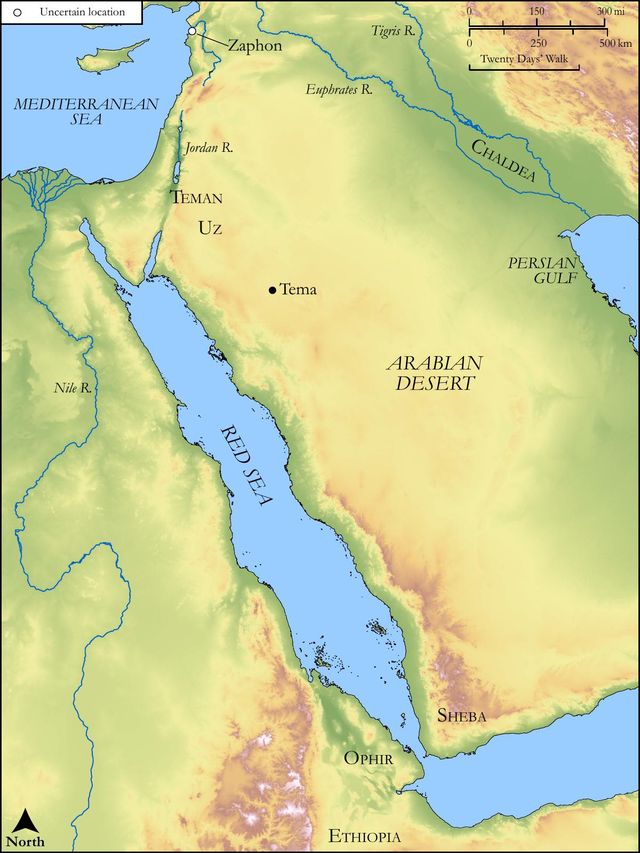
See on the biblical-era map
Study this verse
Public-domain commentary
Matthew Henry
From his Commentary on the Whole Bible. Henry comments on passages, not single verses — this entry covers Job 14:1–6. His three-level outline is real structure in the source text, so it is rendered as structure.
We are here led to think,
I.Of the original of human life.
God is indeed its great original, for he breathed into man the breath of life and in him we live; but we date it from our birth, and thence we must date both its frailty and its pollution.
1.Its frailty: Man, that is born of a woman, is therefore of few days, Job 14:1. This may refer to the first woman, who was called Eve, because she was the mother of all living. Of her, who being deceived by the tempter was first in the transgression, we are all born, and consequently derive from her that sin and corruption which both shorten our days and sadden them. Or it may refer to every man's immediate mother. The woman is the weaker vessel, and we know that partus sequitur ventrem - the child takes after the mother. Let not the strong man therefore glory in his strength, or in the strength of his father, but remember that he is born of a woman, and that, when God pleases, the mighty men become as women, Jer 51:30.
2.Its pollution (Job 14:4): Who can bring a clean thing out of an unclean? If man be born of a woman that is a sinner, how can it be otherwise than that he should be a sinner? See Job 25:4. How can he be clean that is born of a woman? Clean children cannot come from unclean parents any more than pure streams from an impure spring or grapes from thorns. Our habitual corruption is derived with our nature from our parents, and is therefore bred in the bone. Our blood is not only attainted by a legal conviction, but tainted with an hereditary disease. Our Lord Jesus, being made sin for us, is said to be made of a woman, Gal 4:4.
II.Of the nature of human life:
it is a flower, it is a shadow, Job 14:2. The flower is fading, and all its beauty soon withers and is gone. The shadow is fleeting, and its very being will soon be lost and drowned in the shadows of the night. Of neither do we make any account; in neither do we put any confidence.
III.Of the shortness and uncertainty of human life:
Man is of few days. Life is here computed, not by months or years, but by days, for we cannot be sure of any day but that it may be our last. These days are few, fewer than we think of, few at the most, in comparison with the days of the first patriarchs, much more in comparison with the days of eternity, but much fewer to most, who come short of what we call the age of man. Man sometimes no sooner comes forth than he is cut down - comes forth out of the womb than he dies in the cradle - comes forth into the world and enters into the business of it than he is hurried away as soon as he has laid his hand to the plough. If not cut down immediately, yet he flees as a shadow, and never continues in one stay, in one shape, but the fashion of it passes away; so does this world, and our life in it, Co1 7:31.
IV.Of the calamitous state of human life.
Man, as he is short-lived, so he is sad-lived. Though he had but a few days to spend here, yet, if he might rejoice in those few, it were well (a short life and a merry one is the boast of some); but it is not so. During these few days he is full of trouble, not only troubled, but full of trouble, either toiling or fretting, grieving or fearing. No day passes without some vexation, some hurry, some disorder or other. Those that are fond of the world shall have enough of it. He is satur tremore - full of commotion. The fewness of his days creates him a continual trouble and uneasiness in expectation of the period of them, and he always hangs in doubt of his life. Yet, since man's days are so full of trouble, it is well that they are few, that the soul's imprisonment in the body, and banishment from the Lord, are not perpetual, are not long. When we come to heaven our days will be many, and perfectly free from trouble, and in the mean time faith, hope, and love, balance the present grievances.
V.Of the sinfulness of human life, arising from the sinfulness of the human nature.
So some understand that question (Job 14:4), Who can bring a clean thing out of an unclean? - a clean performance from an unclean principle? Note, Actual transgressions are the natural product of habitual corruption, which is therefore called original sin, because it is the original of all our sins. This holy Job here laments, as all that are sanctified do, running up the streams to the fountain (Psa 51:5); and some think he intends it as a plea with God for compassion: "Lord, be not extreme to mark my sins of human frailty and infirmity, for thou knowest my weakness. O remember that I am flesh!" The Chaldee paraphrase has an observable reading of this verse: Who can make a man clean that is polluted with sin? Cannot one? that is, God. Or who but God, who is one, and will spare him? God, by his almighty grace, can change the skin of the Ethiopian, the skin of Job, though clothed with worms.
VI.Of the settled period of human life, v. 5.
1.Three things we are here assured of: - (1.) That our life will come to an end; our days upon earth are not numberless, are not endless, no, they are numbered, and will soon be finished, Dan 5:26. (2.) That it is determined, in the counsel and decree of God, how long we shall live and when we shall die. The number of our months is with God, at the disposal of his power, which cannot be controlled, and under the view of his omniscience, which cannot be deceived. It is certain that God's providence has the ordering of the period of our lives; our times are in his hand. The powers of nature depend upon him, and act under him. In him we live and move. Diseases are his servants; he kills and makes alive. Nothing comes to pass by chance, no, not the execution done by a bow drawn at a venture. It is therefore certain that God's prescience has determined it before; for known unto God are all his works. Whatever he does he determined, yet with a regard partly to the settled course of nature (the end and the means are determined together) and to the settled rules of moral government, punishing evil and rewarding good in this life. We are no more governed by the Stoic's blind fate than by the Epicurean's blind fortune. (3.) That the bounds God has fixed we cannot pass; for his counsels are unalterable, his foresight being infallible.
2.These considerations Job here urges as reasons,
(1.)Why God should not be so strict in taking cognizance of him and of his slips and failings (Job 14:3): "Since I have such a corrupt nature within, and am liable to so much trouble, which is a constant temptation from without, dost thou open thy eyes and fasten them upon such a one, extremely to mark what I do amiss? Job 13:27. And dost thou bring me, such a worthless worm as I am, into judgment with thee who art so quick sighted to discover the least failing, so holy to hate it, so just to condemn it, and so mighty to punish it?" The consideration of our own inability to contend with God, of our own sinfulness and weakness, should engage us to pray, Lord, enter not into judgment with thy servant.
(2.)Why he should not be so severe in his dealings with him: "Lord, I have but a little time to live. I must certainly and shortly go hence, and the few days I have to spend here are, at the best, full of trouble. O let me have a little respite! Job 14:6. Turn from afflicting a poor creature thus, and let him rest awhile; allow him some breathing time, until he shall accomplish as a hireling his day. It is appointed to me once to die; let that one day suffice me, and let me not thus be continually dying, dying a thousand deaths. Let it suffice that my life, at best, is as the day of a hireling, a day of toil and labour. I am content to accomplish that, and will make the best of the common hardships of human life, the burden and heat of the day; but let me not feel those uncommon tortures, let not my life be as the day of a malefactor, all execution-day." Thus may we find some relief under great troubles by recommending ourselves to the compassion of that God who knows our frame and will consider it, and our being out of frame too.
Historical interpretation
Two Centuries of Reception
2 surviving comments on this verse. Each one is dated, so this reads as a timeline rather than a list.
Select a marker to jump to its quote. Markers stagger vertically where authors wrote within a few decades of each other.
Since God is with Job through the hardships he lays upon him, Job says, “Look away!” in the sense of “Bring your anger to an end!” God approaches in different ways by allowing participation and through anger. The friends had come to the conclusion that Job suffers for his sin. He therefore harshly responds that “The human being has a short life and is like a withered flower and a shadow” and “God sees him.” In this Job was demonstrating for them that he was not suffering because of sin. He says, “Look away!” If God delivers someone into such a flood of afflictions, the human being has no calm for remorse. Job therefore teaches his friends that their opinion is unreasonable. For he says, “Look away from him and desist, that he may enjoy, like a hireling, his day.” In such affliction he would not be able to have calm or to enjoy his life.…But Job spoke this to his friends so that it might be clear that God grants a break in order for remorse to occur. This is why Paul says, “Or do you despise the riches of his kindness and forbearance and patience? Do you not realize that God’s kindness is meant to lead you to repentance?” That “desist” is said instead of “end your wickedness and be virtuous” becomes plain in the words “If you have sinned, desist!” And “the earth feared and was still when God rose up to establish judgment.” When people realize that God is judge, they desist from sinning.
4. In this place, Turn from him, means, ‘remove from him the force of the stroke,’ for who can rest when He turns away from him, when He Himself alone is rest, and the further off a man is from Him, he is also rendered void of rest in proportion? Thus it is in such sort said, Turn from him, that you should understand, ‘from smiting;’ for it is fitly added, till his longed for day come as an hireling’s. In proportion as an hireling is far from the end of his work, so is he far from the recompense of his wages. Thus every holy man being set in this life, whilst he sees that he is far from departing out of the present life, laments that he is far from the eternal bliss. What then is it to say, Turn from him a little while, that he may rest; but, ‘withdraw now the strokes of the present life, and show the blessings of eternal rest?’ Whence too it is added concerning that rest itself; till his longed for day come, as an hireling’s; for then the longed for day as of an hireling comes to man, when he receives eternal rest in compensation for his labour. But as far as relates to the aspect of the present life, how despicable is the race of man, so full of miseries, blessed Job yet further tells, and describes how greatly the very things without sense seem to surpass him.
Continue studying Job 14:6 across the web’s major study libraries — every link below opens this exact verse, chapter, or book on the destination site.
Read & Compare
 BibleGatewayThis verse in more than 200 translations and 70 languages.
 Bible.comThe YouVersion reader — hundreds of translations, reading plans, and highlights.
 ESV.orgCrossway's official English Standard Version reader.
 NET BibleThe NET translation with 60,000+ translators' notes on every rendering decision.
 STEP BibleTyndale House's free study tool — original text, vocabulary, and scholarly resources.
 BibliaLogos Bible Software's free web reader.
 USCCBThe New American Bible (Revised Edition) with the U.S. bishops' study notes.
Commentaries
 BibleHub CommentariesDozens of classic commentaries on this verse, gathered on one page.
 StudyLightMore than 100 commentary sets — the largest collection on the web.
 BibleRefPlain-English commentary on what this verse means, verse by verse.
 Enduring WordDavid Guzik's free commentary on this chapter, widely used by Bible teachers.
 Bible Study ToolsVerse commentary alongside Greek and Hebrew study aids.
Original Language & Research
- BibleHub InterlinearThe verse word by word — original language, transliteration, and English.
- BibleHub LexiconEvery word's original-language definition and Strong's entry.
 Blue Letter BibleDeep-study tools — Strong's numbers, concordance, and word studies.
 SefariaThe Hebrew text with Rashi and centuries of Jewish commentary.
Sermons, Hymns & Audio


TrulyRandomVerse is not affiliated with these sites and doesn’t control their content. They’re linked because they’re genuinely useful.
Summary
Job 14:6 encapsulates Job's profound weariness and desperate plea for respite from his relentless suffering and perceived divine scrutiny. In this poignant lament, he likens his finite, arduous life to the fixed term of a day laborer, longing for God to withdraw His afflicting gaze so that he might experience a moment of peace and relief before his allotted time on earth inevitably concludes. This verse powerfully conveys the depths of human despair when faced with unceasing pain and the yearning for even a temporary cessation of toil before death.
Context
ShowHideLiterary Context
Job 14:6 is situated within Job's third cycle of speeches, specifically his response to Zophar (Job 11). Chapter 14 opens with Job's lament on the extreme fragility and brevity of human life, contrasting it sharply with the resilience of nature, particularly a tree that can sprout anew even after being cut down (Job 14:7-9). This sets the stage for Job's plea for a similar, albeit temporary, reprieve. The verse immediately precedes Job's further reflections on the finality of human death (Job 14:10-12) and his desperate wish for a hidden place in Sheol until God's wrath passes (Job 14:13). The entire chapter underscores Job's deep sense of being under a divine microscope, without relief from his afflictions, a pervasive theme throughout the Book of Job.
Historical & Cultural Context
In the land of Uz, life was often understood as a period of toil and struggle, subject to divine will. The concept of a "hireling" (Hebrew: śākîr) was a common social and economic reality. A hireling was a day laborer, typically poor, who worked for a fixed, often short, period, expecting payment and rest at the end of their "day." This imagery would have been readily understood by Job's audience as a metaphor for a life of hard work with a definite end. The prevailing wisdom of the time, challenged by Job's experience, often linked suffering directly to sin, making Job's unmerited affliction particularly perplexing and distressing within his cultural framework. The expectation of rest at the end of a fixed period of labor was a fundamental right for such workers, making Job's plea for a similar divine "turning away" deeply resonant.
Key Themes
ShowHideJob 14:6 contributes significantly to several major themes in the book. Firstly, it highlights the Human Frailty and Mortality, emphasizing the transient and difficult nature of human existence, which is likened to a shadow or a fleeting breath, as seen in Job 7:6. Secondly, it expresses a profound Desire for Rest and Relief from suffering. Job's cry, "Turn from him, that he may rest," is a desperate plea for God to alleviate His intense scrutiny and the pain it brings. This longing for cessation of pain is a recurring motif for Job, evident in his earlier wish for death as a release from torment in Job 3:17. Lastly, the comparison to a "hireling" underscores the theme of Life as a Finite Task or Toil, portraying human existence as a fixed term of arduous labor, anticipating an end to the struggle and a release from the burdens of this world, a sentiment echoed in Job 7:1.
Exposition and Analysis
ShowHideKey Word Analysis
ShowHideThis primitive root means "to gaze at or about (properly, for help); by implication, to inspect, consider, compassionate, be nonplussed (as looking around in amazement) or bewildered; depart, be dim, be dismayed, look (away), regard, have respect, spare, turn." Job's plea is for God to "look away" or "depart" from him, not in abandonment, but to cease His intense, active scrutiny and the perceived affliction it brings. It is a desperate request for God to "spare" him from the relentless pressure.
This verb means "to be flabby, i.e. (by implication) desist; (figuratively) be lacking or idle; cease, end, fall, forbear, forsake, leave (off), let alone, rest, be unoccupied, want." In this context, Job longs for a profound cessation of his suffering, a "rest" that implies a complete desisting of the divine hand that he feels is afflicting him. It's a yearning for peace and quietude from torment.
This noun refers to "a man at wages by the day or year; hired (man, servant), hireling." This term vividly portrays a day laborer whose work is fixed and finite, expecting rest and payment at the close of their "day." Job uses this image to convey his perception of his own life as a predetermined period of arduous labor and suffering, eagerly anticipating its conclusion for release.
Verse Breakdown
ShowHide"Turn from him"
This is a direct, impassioned imperative addressed to God. Job pleads for God to avert His gaze, to cease His intense and afflicting scrutiny. He perceives God's constant attention as the source of his torment, and thus begs for a cessation of this divine pressure, a moment of divine "sparing."
"that he may rest"
The desired outcome of God's withdrawal. Job longs for a period of peace, a cessation of his suffering, a moment of relief from the relentless divine pressure and the pain it entails. This "rest" is a profound yearning for quietude and freedom from affliction before death.
"till he shall accomplish, as a hireling, his day"
This clause specifies the duration of the desired respite and the underlying metaphor for life. Job asks for this rest to last until his allotted time on earth—his "day"—is completed. The comparison to a "hireling" underscores his perception of life as a fixed, finite period of arduous labor, implying that just as a laborer's day ends, so too will his life, and with it, his suffering. The verb "accomplish" (Hebrew: râtsâh, H7521, meaning "to be pleased with; specifically, to satisfy a debt") further suggests that Job views his life as a fixed term of service or even a debt to be paid, which he hopes will soon be "satisfied" or "completed."
Literary Devices
ShowHideThe verse effectively employs Metaphor, comparing human life to the "day" of a "hireling." This vivid image conveys the finite, arduous, and often unrewarding nature of existence as Job experiences it, emphasizing its fixed duration and the expectation of an end to toil, much like a laborer anticipates the close of their workday. The entire verse functions as a Plea or Lament, a direct, impassioned address to God expressing deep anguish and a desperate request for relief. There is also an implicit Contrast between Job's current state of relentless suffering and the desired state of peace and rest, highlighting the profound weariness of his soul. The intensity of Job's language can also be seen as a form of Hyperbole, reflecting his overwhelming sense of being hounded by divine attention and his desperate need for any form of reprieve.
Theological and Thematic Connections
ShowHideJob 14:6 resonates deeply with the universal human experience of suffering, the desire for peace, and the stark reality of life's brevity. It highlights the profound tension between divine sovereignty and human vulnerability, as Job grapples with a God who seems to be an active participant in his torment, rather than a source of comfort. Job's plea for God to "turn from him" is a raw expression of a soul overwhelmed by affliction, longing for even a temporary cessation of divine scrutiny before the inevitable end of life. This verse underscores the biblical theme of human finitude and the yearning for ultimate rest from the burdens of this world, a theme explored throughout wisdom literature, often acknowledging the brevity and toil of human existence while pointing to a deeper, divinely ordained purpose or eventual peace.
Reflection and Application
ShowHideJob's lament in Job 14:6 offers a profound window into the human experience of prolonged suffering and the desperate longing for relief. It acknowledges the inherent toil and finite nature of our earthly existence, reminding us that life's "day" will indeed come to an end. This verse fosters empathy for those who feel relentlessly burdened, providing a biblical voice to the cry for respite amidst overwhelming circumstances. It challenges us to consider our own perspectives on suffering and divine involvement, prompting us to seek moments of rest and reflection even in the midst of life's demands. Ultimately, while Job's hope is for a cessation of pain in death, his yearning points to a deeper human need for ultimate peace that transcends earthly limitations and can only be truly found in God. It invites us to bring our raw, honest laments before the Lord, trusting in His compassion even when His ways are inscrutable.
Questions for Reflection
ShowHideFAQ
ShowHideWhy does Job compare himself to a "hireling"?
ShowHideJob compares himself to a "hireling" (a day laborer) to emphasize the finite, fixed, and arduous nature of his life. A hireling works for a set period, often under difficult conditions, anticipating the end of their labor and the receipt of wages or, implicitly, rest. By using this metaphor, Job highlights his feeling that his life is a predetermined period of intense, unceasing toil under God's scrutiny, and he longs for its completion to find peace. It underscores his sense of being bound by a divine "contract" of suffering, from which he desperately seeks release, much like a laborer longs for the end of their shift. This imagery vividly conveys his weariness and his desperate hope for a cessation of his present torment.
Does Job's plea "Turn from him" imply he wants God to abandon him?
ShowHideNot necessarily abandonment, but a cessation of active, afflicting scrutiny. Job feels relentlessly pursued and afflicted by God's hand, as expressed in other passages like Job 10:3 and Job 13:21. He longs for a moment of relief, a divine withdrawal of the oppressive pressure, so he can experience peace before death. It's a cry for mercy and respite from overwhelming suffering, not a desire for God's ultimate absence or a rejection of God's existence. Job's plea is born out of intense pain and a desire for a temporary reprieve, not a permanent severance of his relationship with God.
Christ-Centered Fulfillment
ShowHideJob's desperate yearning for rest from his "hireling's day" finds its ultimate and perfect fulfillment in Jesus Christ. While Job longed for a temporary cessation of divine scrutiny before death, Christ offers eternal rest from the toil of sin and the curse of the Law. Jesus invites all who are weary and burdened to come to Him, promising to give them rest for their souls, as beautifully articulated in Matthew 11:28-30. He is the one who truly "accomplished his day," not as a hireling working for wages or under duress, but as the Son who perfectly fulfilled the Father's will through a life of perfect obedience and sacrificial love, culminating in His triumphant cry "It is finished!" on the cross (John 19:30). Through His finished work, Christ has secured the ultimate Sabbath rest for the people of God, a rest that transcends earthly suffering and extends into eternity, as described in Hebrews 4:9-11. Thus, Job's lament, while rooted in despair, prophetically points to the One who would bear the ultimate burden of humanity's "day" of toil and offer true, everlasting peace and rest to all who believe.