


Jeremiah 46:8
Bible text: King James Version (1769 Blayney text) · Public domain
Bible text: King James Version with Strong's numbers · Public domain
Bible text: Berean Standard Bible · Public domain
Bible text: American Standard Version (1901) · Public domain
Bible text: World English Bible, Messianic edition · Public domain
Bible text: Geneva Bible (1599) · Public domain
Bible text: Young's Literal Translation · Public domain
- מִצְרַיִםmitz·Ra·yimEgyptH4714N-properNoun Proper Location
- כַּיְאֹרkay·'Orlike the RiverH2975Prep-k ¦ N-properNoun Proper Locationכַּlike theיְאֹרRiver
- יַעֲלֶהya·'a·Lehit risesH5927V-Qal-Imperf-3msVerb Qal Imperfect 3rd Singular Masculine
- וְכַנְּהָרוֹתve·kha·ne·ha·Rotand like <the> riversH5104Conj-w ¦ Prep-k ¦ N-fpNoun Plural Feminine Absoluteוְandכַlike <the>נְּהָרוֹתrivers
- יִתְגֹּעֲשׁוּyit·Go·'a·shuthey surgeH1607V-Hithpael-Imperf-3mpVerb Hithpael Imperfect 3rd Plural Masculine
- מָיִםMa·yimwatersH4325N-mpNoun Plural Masculine Absolute
- וַיֹּאמֶרvai·Yo·merand it has saidH559Conj-w ¦ V-Qal-ConsecImperf-3msVerb Qal Consecutive Imperfect 3rd Singular Masculineוַandיֹּאמֶרit has said
- אַעֲלֶה'a·'a·LehI will riseH5927V-Qal-Imperf-1csVerb Qal Imperfect 1st Singular common gender
- אֲכַסֶּה'a·kha·sehI will coverH3680V-Piel-Imperf-1csVerb Piel Imperfect 1st Singular common gender
- אֶרֶץ'E·retz[the] earthH776N-fsNoun Singular Feminine Absolute
- אֹבִידָה'o·Vi·dahI will destroyH6V-Hiphil-Imperf-1csVerb Hiphil Imperfect 1st Singular common gender
- עִיר'ira cityH5892N-fsNoun Singular Feminine Absolute
- וְיֹשְׁבֵיve·Yo·she·veiand [the] inhabitantsH3427Conj-w ¦ V-Qal-Prtcpl-mpVerb Qal Participle Plural Masculine Constructוְandיֹשְׁבֵי[the] inhabitants
- בָהּVahin <the> itPrep-b ¦ 3fsSuffix Personal 3rd Singular Feminineבָin <the>הּit
English is a literal word-by-word gloss of the Hebrew, not the KJV's wording. Why?
This is the original text the KJV's translators worked from — each Hebrew word with its own literal English meaning in this verse, prepared by scholars at Tyndale House, Cambridge. The KJV translates whole sentences, not word by word, so its wording differs: one Hebrew word can become several English words, and the KJV may choose “the LORD” where the gloss reads “Yahweh”. Both are faithful — they answer different questions. For the KJV's own rendering, switch to the KJV text.
Details
See on the biblical-era map
Study this verse
Public-domain commentary
Matthew Henry
From his Commentary on the Whole Bible. Henry comments on passages, not single verses — this entry covers Jeremiah 46:1–12.
The first verse is the title of that part of this book, which relates to the neighbouring nations, and follows here. It is the word of the Lord which came to Jeremiah against the Gentiles; for God is King and Judge of nations, knows and will call to an account those who know him not nor take any notice of him. Both Isaiah and Ezekiel prophesied against these nations that Jeremiah here has a separate saying to, and with reference to the same events. In the Old Testament we have the word of the Lord against the Gentiles; in the New Testament we have the word of the Lord for the Gentiles, that those who were afar off are made nigh.
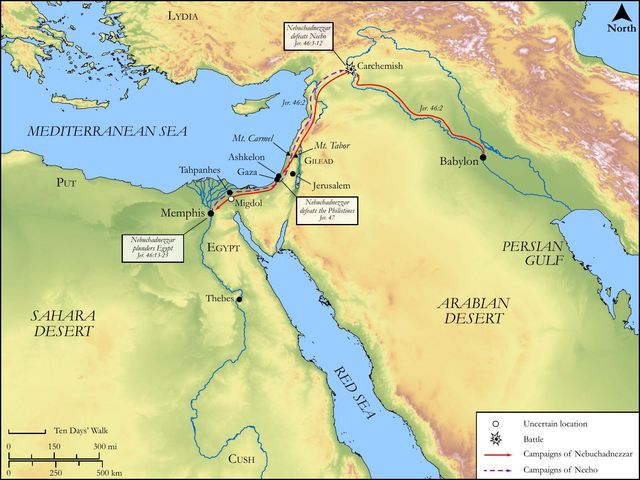
He begins with Egypt, because they were of old Israel's oppressors and of late their deceivers, when they put confidence in them. In these verses he foretells the overthrow of the army of Pharaoh-necho, by Nebuchadnezzar, in the fourth year of Jehoiakim, which was so complete a victory to the king of Babylon that thereby he recovered from the river of Egypt to the river Euphrates, all that pertained to the king of Egypt, and so weakened him that he came not again any more out of his land (as we find, Kg2 24:7), and so made him pay dearly for his expedition against the king of Assyria four years before, in which he slew Josiah, Kg2 23:29. This is the event that is here foretold in lofty expressions of triumph over Egypt thus foiled, which Jeremiah would speak of with a particular pleasure, because the death of Josiah, which he had lamented, was now avenged on Pharaoh-necho. Now here,
I.The Egyptians are upbraided with the mighty preparations they made for this expedition, in which the prophet calls to them to do their utmost, for so they would: "Come then, order the buckler, let the weapons of war be got ready," Jer 46:3. Egypt was famous for horses - let them be harnessed and the cavalry well mounted: Get up, you horsemen, and stand forth, etc., Jer 46:4. See what preparations the children of men make, with abundance of care and trouble and at a vast expense, to kill one another, as if they did not die fast enough of themselves. He compares their marching out upon this expedition to the rising of their river Nile (Jer 46:7, Jer 46:8): Egypt now rises up like a flood, scorning to keep within its own banks and threatening to overflow all the neighbouring lands. It is a very formidable army that the Egyptians bring into the field upon this occasion. The prophet summons them (Jer 46:9): Come up, you horses; rage, you chariots. He challenges them to bring all their confederate troops together, the Ethiopians, that descended from the same stock with the Egyptians (Gen 10:6), and were their neighbours and allies, the Libyans and Lydians, both seated in Africa, to the west of Egypt, and from them the Egyptians fetched their auxiliary forces. Let them strengthen themselves with all the art and interest they have, yet it shall be all in vain; they shall be shamefully defeated notwithstanding, for God will fight against them, and against him there is no wisdom nor counsel, Pro 21:30, Pro 21:31. It concerns those that go forth to war not only to order the buckler, and harness the horses, but to repent of their sins, and pray to God for his presence with them, and that they may have it to keep themselves from every wicked thing.
II.They are upbraided with the great expectations they had from this expedition, which were quite contrary to what God intended in bringing them together. They knew their own thoughts, and God knew them, and sat in heaven and laughed at them,; but they knew not the thoughts of the Lord, for he gathers them as sheaves into the floor, Mic 4:11, Mic 4:12. Egypt saith (Jer 46:8): I will go up; I will cover the earth, and none shall hinder me; I will destroy the city, whatever city it is that stands in my way. Like Pharaoh of old, I will pursue, I will overtake. The Egyptians say that they shall have a day of it, but God saith that it shall be his day: The is the day of the Lord God of hosts (Jer 46:10), the day in which he will be exalted in the overthrow of the Egyptians. They meant one thing, but God meant another; they designed it for the advancement of their dignity and the enlargement of their dominion, but God designed it for the great abasement and weakening of their kingdom. It is a day of vengeance for Josiah's death; it is a day of sacrifice to divine justice, to which multitudes of the sinners of Egypt shall fall as victims. Note, When men think to magnify themselves by pushing on unrighteous enterprises, let them expect that God will glorify himself by blasting them and cutting them off.
III.They are upbraided with their cowardice and inglorious flight when they come to an engagement (Jer 46:5, Jer 46:6):
"Wherefore have I seen them, notwithstanding all these mighty and vast preparations and all these expressions of bravery and resolution, when the Chaldean army faces them, dismayed, turned back, quite disheartened, and no spirit left in them." 1. They make a shameful retreat. Even their mighty ones, who, one would think, should have stood their ground, flee a flight, flee by consent, make the best of their way, flee in confusion and with the utmost precipitation; they have neither time nor heart to look back, but fear is round about them, for they apprehend it so. And yet, 2. They cannot make their escape. They have the shame of flying, and yet not the satisfaction of saving themselves by flight; they might as well have stood their ground and died upon the spot; for even the swift shall not flee away. The lightness of their heels shall fail them when it comes to the trial, as well as the stoutness of their hearts; the mighty shall not escape, nay, they are beaten down and broken to pieces. They shall stumble in their flight, and fall towards the north, towards their enemy's country; for such confusion were they in when they took to their feet that instead of making homeward, as men usually do in that case, they made forward. Note, The race is not to the swift nor the battle to the strong. Valiant men are not always victorious.
IV.They are upbraided with their utter inability ever to recover this blow, which should be fatal to their nation, Jer 46:11, Jer 46:12.
The damsel, the daughter of Egypt, that lived in great pomp and state, is sorely wounded by this defeat. Let her now seek for balm in Gilead and physicians there; let her use all the medicines her wise men can prescribe for the healing of this hurt, and the repairing of the loss sustained by this defeat; but all in vain; no cure shall be to them; they shall never be able to bring such a powerful army as this into the field again. "The nations that rang of thy glory and strength have now heard of thy shame, how shamefully thou wast routed and how thou are weakened by it." It needs not be spread by the triumphs of the conquerors, the shrieks and outcries of the conquered will proclaim it: Thy cry hath filled the country about. For, when they fled several ways, one mighty man stumbled upon another and dashed against another, such confusion were they in, so that both together became a pray to the pursuers, an easy prey. A thousand such dreadful accidents there should be, which should fill the country with the cry of those that were overcome. Let not the mighty man therefore glory in his might, for the time may come when it will stand him in no stead.
Continue studying Jeremiah 46:8 across the web’s major study libraries — every link below opens this exact verse, chapter, or book on the destination site.
Read & Compare
 BibleGatewayThis verse in more than 200 translations and 70 languages.
 Bible.comThe YouVersion reader — hundreds of translations, reading plans, and highlights.
 ESV.orgCrossway's official English Standard Version reader.
 NET BibleThe NET translation with 60,000+ translators' notes on every rendering decision.
 STEP BibleTyndale House's free study tool — original text, vocabulary, and scholarly resources.
 BibliaLogos Bible Software's free web reader.
 USCCBThe New American Bible (Revised Edition) with the U.S. bishops' study notes.
Commentaries
 BibleHub CommentariesDozens of classic commentaries on this verse, gathered on one page.
 StudyLightMore than 100 commentary sets — the largest collection on the web.
 BibleRefPlain-English commentary on what this verse means, verse by verse.
 Enduring WordDavid Guzik's free commentary on this chapter, widely used by Bible teachers.
 Bible Study ToolsVerse commentary alongside Greek and Hebrew study aids.
Original Language & Research
- BibleHub InterlinearThe verse word by word — original language, transliteration, and English.
- BibleHub LexiconEvery word's original-language definition and Strong's entry.
 Blue Letter BibleDeep-study tools — Strong's numbers, concordance, and word studies.
 SefariaThe Hebrew text with Rashi and centuries of Jewish commentary.
Sermons, Hymns & Audio


TrulyRandomVerse is not affiliated with these sites and doesn’t control their content. They’re linked because they’re genuinely useful.
Summary
Jeremiah 46:8 vividly portrays Egypt's arrogant self-perception and ambitious intent, likening its perceived power to the overwhelming, destructive force of a rising flood or mighty rivers. The verse captures Egypt's boastful declaration to conquer and devastate the earth, cities, and their inhabitants, setting the stage for the prophetic pronouncements of divine judgment against its pride and eventual defeat by a superior power.
Context
ShowHideLiterary Context
Jeremiah 46 initiates a series of prophecies against foreign nations, specifically focusing on Egypt. This chapter serves as a pivotal transition in the book of Jeremiah, shifting from prophecies primarily concerning Judah's sin and impending judgment to a broader scope encompassing the nations surrounding Israel. Verse 8 immediately follows a description of Egypt's military preparations and initial confidence, where Pharaoh Necho II's forces are depicted as marching forth (compare Jeremiah 46:3-7). This sets up a dramatic contrast with the subsequent verses, which detail Egypt's catastrophic defeat at the Battle of Carchemish and the humiliation of Pharaoh Necho II (see Jeremiah 46:9-12). The powerful flood imagery used in this verse is a significant literary device that will be inverted later in the chapter to describe Egypt's own overwhelming destruction, not of others, but of itself.
Historical & Cultural Context
The prophecy in Jeremiah 46:8 is set against the backdrop of a significant geopolitical struggle between Egypt and Babylon during the late 7th and early 6th centuries BC. Egypt, under Pharaoh Necho II, was a dominant regional power, often vying for control with the rising Neo-Babylonian Empire. The "flood" imagery is deeply rooted in Egyptian culture, where the annual inundation of the Nile River (yᵉʼôr) was the lifeblood of the nation, symbolizing fertility, prosperity, and immense power. This cultural understanding of the Nile's overwhelming force is leveraged by Jeremiah to depict Egypt's self-assured, almost divine, ambition to "cover the earth" and "destroy the city and the inhabitants thereof." The prophecy directly precedes the historical Battle of Carchemish (circa 605 BC), where Nebuchadnezzar of Babylon decisively defeated the Egyptian forces, marking a significant shift in regional power dynamics and validating Jeremiah's prophetic word.
Key Themes
ShowHideJeremiah 46:8 contributes to several overarching themes within the book of Jeremiah and broader prophetic literature. Firstly, it highlights the theme of human pride and arrogance, specifically the hubris of nations that believe themselves invincible and self-sufficient, independent of divine sovereignty. Egypt's boastful declaration serves as a stark example of this human tendency to exalt oneself, echoing the warning found in Proverbs 16:18. Secondly, the verse introduces the theme of divine judgment against nations, foreshadowing that such pride will inevitably be met with God's opposition and ultimate defeat. While the verse itself describes Egypt's ambition, its very inclusion in a prophetic oracle against Egypt implies that this ambition is an affront to God and will not stand. Finally, it reinforces the theme of God's absolute sovereignty over all nations, demonstrating that even the most powerful empires, like Egypt, are mere instruments or objects of His divine plan, subject to His will and judgment, as further elaborated in Jeremiah 46:10.
Exposition and Analysis
ShowHideKey Word Analysis
ShowHideThis term (H4714) refers to "Upper and Lower Egypt," emphasizing the unified and formidable nature of the nation. In this context, it personifies the entire Egyptian state and its leadership, embodying its collective pride and aggressive ambition. The use of "Egypt" here is not merely geographical but carries the weight of a powerful, self-sufficient empire that believes itself capable of universal dominion.
Of Egyptian origin (H2975), this word specifically denotes a "channel," "canal," and most notably, the "Nile" as the primary river of Egypt. The comparison of Egypt to a "flood" or "river" directly invokes the immense power and life-giving, yet potentially destructive, force of the Nile, which was central to Egypt's identity and prosperity. Here, it symbolizes Egypt's overwhelming military might and its perceived ability to inundate and conquer any opposition.
This primitive root (H5927) means "to ascend," "be high," or "mount." Used twice in the verse ("riseth up" and "I will go up"), it powerfully conveys Egypt's aggressive, upward surge of power and its ambitious intent to dominate. It signifies not just a physical movement or military advance but an arrogant assertion of supremacy and a determined drive to extend its dominion over others.
Verse Breakdown
ShowHide"Egypt riseth up like a flood"
This opening clause immediately establishes a powerful simile, comparing the nation of Egypt to a surging, overwhelming flood. The imagery evokes a sense of unstoppable force and immense power, suggesting Egypt's perceived invincibility and its aggressive posture on the world stage. It sets the tone for a nation confident in its own military might and expansive capabilities.
"and [his] waters are moved like the rivers;"
This expands on the initial flood imagery, reinforcing the idea of a vast, turbulent, and powerful entity. The "waters" represent Egypt's military forces and its expansive influence, which are depicted as restless, agitated, and ready to overflow their banks, much like the mighty rivers of Egypt. This further emphasizes the perceived unstoppable nature of Egypt's advance and its readiness for conflict.
"and he saith, I will go up, [and] will cover the earth;"
Here, Egypt is personified, articulating its audacious and arrogant ambition. The declaration "I will go up" reiterates the aggressive ascent, while "will cover the earth" expresses a hyperbole of total global domination. This statement reveals the extent of Egypt's hubris, believing itself capable of universal conquest, a claim that directly challenges the sovereignty of God.
"I will destroy the city and the inhabitants thereof."
This final clause specifies the destructive intent behind Egypt's ambition. It's not merely about expansion but about annihilation. "The city" (singular, perhaps referring to any opposing stronghold or even Jerusalem implicitly) and "the inhabitants thereof" highlight Egypt's ruthless determination to eliminate all resistance and exert absolute control, underscoring the severity of its perceived threat to other nations.
Literary Devices
ShowHideJeremiah 46:8 is rich with Simile, primarily comparing "Egypt" to a "flood" and its "waters" to "rivers." This vivid imagery draws upon the powerful and familiar natural phenomenon of the Nile's annual inundation, which was both life-giving and potentially destructive, to convey Egypt's perceived overwhelming military might and aggressive expansionist ambitions. The verse also employs striking Personification, as Egypt is depicted as an active agent that "saith" (declares) its intentions, giving voice to its arrogant pride. This personification makes the nation's hubris more tangible and direct, as if the entire nation is speaking its boast. Furthermore, Hyperbole is evident in the declarations "I will cover the earth" and "I will destroy the city and the inhabitants thereof." These exaggerated claims emphasize the boundless nature of Egypt's ambition and its self-proclaimed omnipotence, which stands in stark contrast to the divine reality that only God possesses such ultimate power. Underlying these devices is a profound Dramatic Irony, as the reader, aware of the broader prophetic context of Jeremiah 46, knows that Egypt's boast will soon be decisively shattered by divine judgment, turning its perceived strength into utter defeat.
Theological and Thematic Connections
ShowHideJeremiah 46:8 serves as a profound theological statement on the nature of human pride and the sovereignty of God. It illustrates the biblical principle that any nation or individual that exalts itself in its own strength, believing it can "cover the earth" and "destroy" without divine permission, is on a collision course with the Almighty. Egypt's boastful self-assertion is a direct challenge to God's ultimate authority over all creation and all kingdoms. This verse highlights the futility of human ambition when it operates outside of, or in defiance of, God's will, setting the stage for the dramatic display of divine judgment that follows in the chapter. It underscores the truth that true power and dominion belong to God alone, and He can raise up or bring down nations according to His purposes.
Reflection and Application
ShowHideJeremiah 46:8 stands as a timeless warning against the perils of human pride and self-sufficiency, urging us to consider where our ultimate trust lies. In a world that often values power, ambition, and self-made success, this verse reminds us that even the mightiest human endeavors and grandest declarations are ultimately subject to the sovereign will of God. When we, like ancient Egypt, become consumed by our own perceived strength, resources, or plans, we risk forgetting that true authority and control rest with the Creator. This passage calls us to cultivate humility, recognizing our limitations and dependence on God. It encourages us to submit our ambitions and plans to His divine wisdom, understanding that genuine security and lasting success come not from our own might, but from aligning our lives with His purposes. It challenges us to reflect on areas where we might be operating out of a spirit of arrogance, rather than a spirit of humble reliance on the Lord.
Questions for Reflection
ShowHideFAQ
ShowHideWhy is Egypt compared to a flood and rivers in this verse?
ShowHideThe comparison of Egypt to a "flood" and "rivers" (specifically the Nile, or yᵉʼôr) is a powerful literary device rooted in ancient Egyptian culture. The Nile's annual inundation was essential for Egypt's agriculture and prosperity, making it a symbol of immense power, fertility, and life. By likening Egypt's military might and expansionist ambitions to an overflowing flood, Jeremiah emphasizes the nation's perceived overwhelming and unstoppable force. However, this imagery also carries an ironic undertone, as floods can be destructive and eventually recede, foreshadowing Egypt's own impending defeat and humiliation at the hands of Babylon, as detailed later in Jeremiah 46.
What is the significance of Egypt's declaration, "I will go up, and will cover the earth; I will destroy the city and the inhabitants thereof"?
ShowHideThis declaration highlights Egypt's extreme arrogance and hubris. By stating "I will go up," Egypt expresses its aggressive intent to ascend and dominate. The phrases "will cover the earth" and "will destroy the city and the inhabitants thereof" are hyperbole, demonstrating Egypt's boundless ambition and its self-proclaimed omnipotence. This boastful language is a direct challenge to the sovereignty of God, who alone has the power to control the earth and determine the fate of nations. Such declarations of self-sufficiency and ultimate power are consistently condemned in biblical prophecy, setting the stage for divine judgment against those who exalt themselves above the Creator.
Christ-Centered Fulfillment
ShowHideWhile Jeremiah 46:8 vividly portrays the pride and impending downfall of an earthly kingdom, it ultimately points to the ultimate triumph of God's kingdom and the humility of its true King, Jesus Christ. Egypt's boast to "cover the earth" and "destroy the city and the inhabitants thereof" is a stark contrast to Christ's mission. Unlike earthly rulers who seek to dominate through force and destruction, Jesus "did not come to be served, but to serve, and to give his life as a ransom for many" (Mark 10:45). The "flood" of Egypt's ambition is met with divine judgment, whereas the "flood" of God's grace and salvation flows through Christ, who, though "in very nature God, did not consider equality with God something to be used to his own advantage; rather, he made himself nothing" (Philippians 2:6-7). The defeat of Egypt's pride foreshadows the ultimate dismantling of all human systems and powers that oppose God, culminating in Christ's final victory over sin, death, and every earthly dominion (Colossians 2:15). His kingdom, established not by earthly conquest but by sacrificial love and resurrection power, is the one that truly "covers the earth" with its influence, not through destruction, but through redemption and transformation, ultimately leading to the day when "the kingdom of the world has become the kingdom of our Lord and of his Messiah, and he will reign for ever and ever" (Revelation 11:15).