


Jeremiah 28:2
Bible text: King James Version (1769 Blayney text) · Public domain
Bible text: Berean Standard Bible · Public domain
Bible text: American Standard Version (1901) · Public domain
Bible text: World English Bible, Messianic edition · Public domain
Bible text: Geneva Bible (1599) · Public domain
Bible text: Young's Literal Translation · Public domain
- כֹּהkohthusH3541AdvAdverb
- אָמַר'a·Marhe saysH559V-Qal-Perf-3msVerb Qal Perfect 3rd Singular Masculine
- יְהוָהYah·wehYahwehH3068N-properNoun Proper Title
- צְבָאוֹתtze·va·'otof hostsH6635N-fpNoun Plural Feminine Absolute
- אֱלֹהֵי'e·lo·Hei[the] God ofH430N-mpcNoun Plural Masculine Construct
- יִשְׂרָאֵלYis·ra·'ElIsraelH3478N-properNoun Proper Location
- לֵאמֹרle·Mor<to> sayingH559Prep-l ¦ V-Qal-InfVerb Qal Infinitive Constructלֵ<to>אמֹרsaying
- שָׁבַרְתִּיsha·Var·tiI will breakH7665V-Qal-Perf-1csVerb Qal Perfect 1st Singular common gender
- אֶת'et<obj.>H853DirObjMParticle Object Indicator
- עֹל'ol[the] yoke ofH5923N-mscNoun Singular Masculine Construct
- מֶלֶךְMe·lekh[the] king ofH4428N-mscNoun Singular Masculine Construct
- בָּבֶלba·VelBabylonH894N-properNoun Proper Location
English is a literal word-by-word gloss of the Hebrew, not the KJV's wording. Why?
This is the original text the KJV's translators worked from — each Hebrew word with its own literal English meaning in this verse, prepared by scholars at Tyndale House, Cambridge. The KJV translates whole sentences, not word by word, so its wording differs: one Hebrew word can become several English words, and the KJV may choose “the LORD” where the gloss reads “Yahweh”. Both are faithful — they answer different questions. For the KJV's own rendering, switch to the KJV text.
Details
See on the biblical-era map
Study this verse
Public-domain commentary
Matthew Henry
From his Commentary on the Whole Bible. Henry comments on passages, not single verses — this entry covers Jeremiah 28:1–9. His two-level outline is real structure in the source text, so it is rendered as structure.
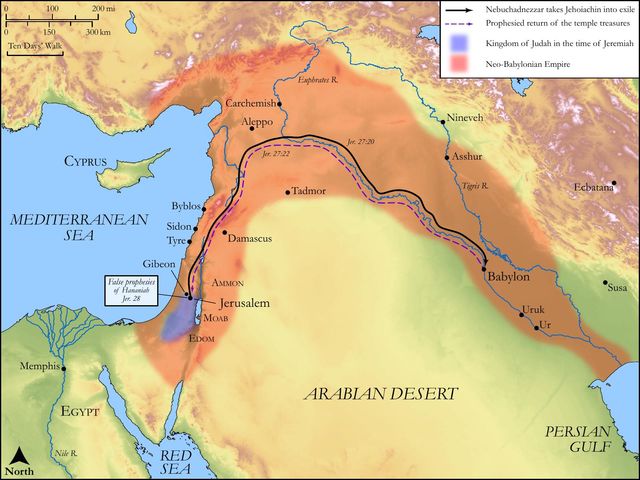
This struggle between a true prophet and a false one is said here to have happened in the beginning of the reign of Zedekiah, and yet in the fourth year, for the first four years of his reign might well be called the beginning, or former part, of it, because during those years he reigned under the dominion of the king of Babylon and as a tributary to him; whereas the rest of his reign, which might well be called the latter part of it, in distinction from that former part, he reigned in rebellion against the king of Babylon. In this fourth year of his reign he went in person to Babylon (as we find, Jer 51:59), and it is probable that this gave the people some hope that his negotiation in person would put a good end to the war, in which hope the false prophets encouraged them, this Hananiah particularly, who was of Gibeon, a priests' city, and therefore probably himself a priest, as well as Jeremiah. Now here we have,
I.The prediction which Hananiah delivered publicly, solemnly, in the house of the Lord, and in the name of the Lord, in an august assembly, in the presence of the priests and of all the people, who probably were expecting to have some message from heaven. In delivering this prophecy, he faced Jeremiah, he spoke it to him (Jer 28:1), designing to confront and contradict him, as much as to say, "Jeremiah, thou liest." Now this prediction is that the king of Babylon's power, at least his power over Judah and Jerusalem, should be speedily broken, that within two full years the vessels of the temple should be brought back, and Jeremiah, and all the captives that were carried away with him, should return; whereas Jeremiah had foretold that the yoke of the king of Babylon should be bound on yet faster, and that the vessels and captives should not return for 70 years, Jer 28:2-4. Now, upon the reading of this sham prophecy, and comparing it with the messages that God sent by the true prophets, we may observe what a vast difference there is between them. Here is nothing of the spirit and life, the majesty of style and sublimity of expression, that appear in the discourses of God's prophets, nothing of that divine flame and flatus. But that which is especially wanting here is an air of piety; he speaks with a great deal of confidence of the return of their prosperity, but here is not a word of good counsel given them to repent, and reform, and return to God, to pray, and seek his face, that they may be prepared for the favours God had in reserve for them. He promises them temporal mercies, in God's name, but makes no mention of those spiritual mercies which God always promised should go along with them, as Jer 24:7, I will give them a heart to know me. By all this it appears that, whatever he pretended, he had only the spirit of the world, not the Spirit of God (Co1 2:12), that he aimed to please, not to profit.
II.Jeremiah's reply to this pretended prophecy.
1.He heartily wishes it might prove true. Such an affection has he for his country, and so truly desirous is he of the welfare of it, that he would be content to lie under the imputation of a false prophet, so that their ruin might be prevented. He said, Amen; the Lord do so; the Lord perform thy words, Jer 28:5, Jer 28:6. This was not the first time that Jeremiah had prayed for his people, though he had prophesied against them, and deprecated the judgments which yet he certainly knew would come; as Christ prayed, Father, if it be possible, let this cup pass from me, when yet he knew it must not pass from him. Though, as a faithful prophet, he foresaw and foretold the destruction of Jerusalem, yet, as a faithful Israelite, he prayed earnestly for the preservation of it, in obedience to that command, Pray for the peace of Jerusalem. Though the will of God's purpose is the rule of prophecy and patience, the will of his precept is the rule of prayer and practice. God himself, though he has determined, does not desire, the death of sinners, but would have all men to be saved. Jeremiah often interceded for his people, Jer 18:20. The false prophets thought to ingratiate themselves with the people by promising them peace; now the prophet shows that he bore them as great a good-will as their prophets did, whom they were so fond of; and, though he had no warrant from God to promise them peace, yet he earnestly desired it and prayed for it. How strangely were those besotted who caressed those who did them the greatest wrong imaginable by flattering them and persecuted him who did them the greatest service imaginable by interceding for them! See Jer 27:18.
2.He appeals to the event, to prove it false, Jer 28:7-9. The false prophets reflected upon Jeremiah, as Ahab upon Micaiah, because he never prophesied good concerning them, but evil. Now he pleads that this had been the purport of the prophecies that other prophets had delivered, so that it ought not to be looked upon as a strange thing, or as rendering his mission doubtful; for prophets of old prophesied against many countries and great kingdoms, so bold were they in delivering the messages which God sent by them, and so far from fearing men, or seeking to please them, as Hananiah did. They made no difficulty, any more than Jeremiah did, of threatening war, famine, and pestilence, and what they said was regarded as coming from God; why then should Jeremiah be run down as a pestilent fellow, and a sower of sedition, when he preached no otherwise than God's prophets had always done before him? Other prophets had foretold destruction did not come, which yet did not disprove their divine mission, as in the case of Jonah; for God is gracious, and ready to turn away his wrath from those that turn away from their sins. But the prophet that prophesied of peace and prosperity, especially as Hananiah did, absolutely and unconditionally, without adding that necessary proviso, that they do not by wilful sin put a bar in their own door and stop the current of God's favours, will be proved a true prophet only by the accomplishment of his prediction; if it come to pass, then it shall be known that the Lord has sent him, but, if not, he will appear to be a cheat and an impostor.
Historical interpretation
Historical reception
2 surviving comments on this verse. Each one is dated, so this reads as a timeline rather than a list.
(Ver. 2 and following) And the word of the Lord came to Jeremiah after Ananias the prophet broke the chain (or yoke) from the neck of the prophet Jeremiah, saying: Go and tell Ananias, this is what the Lord says: You have broken the wooden chains (or yokes), and I will make iron yokes in their place. For this is what the Lord, the God of Israel, says: I have put an iron yoke on the neck of all these nations, so they will serve Nebuchadnezzar, the king of Babylon. And what follows: 'And they shall serve him, and the beasts of the earth I have given to him. But in the present place, according to the Septuagint, Ananias the prophet is not written, and in the following, lest they should seem to call a false prophet a prophet. But what about the Hebrew truth? After Jeremiah the prophet went on his way and swallowed up the injury in silence, the word of the Lord came to him, so that he would not speak in his own words to the false prophet boasting in lies; but he should say: thus says the Lord: even though Ananias, breaking the wooden yoke, spoke with the same authority in the presence of the Lord: thus says the Lord.' For falsehood always imitates the truth. And that which it has brought in: You have shattered wooden forks, and instead of them have made iron chains, shows this, that, rejecting the lesser punishment, it was for the sake of a greater penalty among the people. The allegorical interpreter also raves in this passage, calling the wooden forks and chains, ethereal and airy bodies, namely, of demons and adverse powers. But the wooden forks or iron chains, are our grosser bodies, which are woven together with nerves and bones and flesh and veins, so that those who do not wish to undergo lesser tortures for the quality of their sin may be condemned to the chains of our bodies; and they may endure the wailing of infancy, the bonds of swaddling clothes, and filth; and may serve the devil, the king of Babylon, that is, of this world, as the Scripture says: The world is set in the wicked one (1 John 5:19), with the beasts of the earth, which are linked to the bodies of brute animals. An uneducated handler compelled me, and a follower of Grunnius' slander openly presents the faults of others, which I previously spoke of with pretense, abandoning the discretion of the reader.
(Chapter 28, Verses 1 onwards) In that year, at the beginning of the reign of King Zedekiah of Judah, in the fourth year, in the fifth month, Ananias son of Azur, a prophet from Gibeon, spoke to me in the house of the Lord, in the presence of the priests and all the people. He said: Thus says the Lord of hosts, the God of Israel: I have broken the yoke of the king of Babylon. Within two years, I will bring back all the vessels of the Lord to this place. They interpreted the Hebrew prophets, that is, the Nebeim, as pseudo-prophets in order to make their understanding clearer. Finally, in this place, the prophet is called Nebia, not a pseudo-prophet. And the word of the Lord came to him during the reign of Zedekiah, in the fourth year of his reign, in the fifth month (while the prophet Ezekiel was still prophesying in Babylon to those who had been exiled with Jehoiachin). And he speaks with confidence in the temple of the Lord against the Prophet, because he promises prosperity to the people, and they willingly listen to lies, especially those that promise joy. Jeremiah had also said that the rest of the vessels, whether of the temple or the royal palace, and all the people that Nebuchadnezzar had taken away, were to be transferred to Babylon. But here, on the contrary, he promises that even those things that had been carried away are to be brought back.
Continue studying Jeremiah 28:2 across the web’s major study libraries — every link below opens this exact verse, chapter, or book on the destination site.
Read & Compare
 BibleGatewayThis verse in more than 200 translations and 70 languages.
 Bible.comThe YouVersion reader — hundreds of translations, reading plans, and highlights.
 ESV.orgCrossway's official English Standard Version reader.
 NET BibleThe NET translation with 60,000+ translators' notes on every rendering decision.
 STEP BibleTyndale House's free study tool — original text, vocabulary, and scholarly resources.
 BibliaLogos Bible Software's free web reader.
 USCCBThe New American Bible (Revised Edition) with the U.S. bishops' study notes.
Commentaries
 BibleHub CommentariesDozens of classic commentaries on this verse, gathered on one page.
 StudyLightMore than 100 commentary sets — the largest collection on the web.
 BibleRefPlain-English commentary on what this verse means, verse by verse.
 Enduring WordDavid Guzik's free commentary on this chapter, widely used by Bible teachers.
 Bible Study ToolsVerse commentary alongside Greek and Hebrew study aids.
Original Language & Research
- BibleHub InterlinearThe verse word by word — original language, transliteration, and English.
- BibleHub LexiconEvery word's original-language definition and Strong's entry.
 Blue Letter BibleDeep-study tools — Strong's numbers, concordance, and word studies.
 SefariaThe Hebrew text with Rashi and centuries of Jewish commentary.
Sermons, Hymns & Audio


TrulyRandomVerse is not affiliated with these sites and doesn’t control their content. They’re linked because they’re genuinely useful.
Summary
Jeremiah 28:2 captures the audacious and deceptive declaration of Hananiah, a false prophet who, mimicking divine authority, proclaimed that the Lord had already shattered the oppressive "yoke" of the Babylonian king. This pronouncement directly contradicted the consistent and difficult message of Jeremiah, who faithfully prophesied a prolonged period of Babylonian domination and exile as God's judgment upon Judah. Hananiah's message offered a comforting but ultimately misleading hope of immediate liberation, setting the stage for a critical confrontation between genuine and counterfeit prophecy that would define the chapter.
Context
ShowHideLiterary Context
Jeremiah 28:2 serves as the dramatic opening to a pivotal confrontation between true and false prophecy. It immediately follows Jeremiah's powerful symbolic act in Jeremiah 27, where he wore a literal wooden yoke to visually communicate God's command for Judah and surrounding nations to submit to Babylon. Hananiah's declaration in this verse is a direct, public, and audacious rebuttal to Jeremiah's divinely ordained message of submission, effectively initiating the central conflict of the chapter. The subsequent narrative details the prophetic duel, culminating in Jeremiah's pronouncement of divine judgment against Hananiah for speaking lies in the Lord's name, as recorded in Jeremiah 28:15-17. This stark contrast highlights the vital difference between a prophet who faithfully delivers God's truth, however unpopular or painful, and one who speaks comforting falsehoods that appeal to human desires.
Historical & Cultural Context
This prophetic exchange occurred around 594 BC, during the tumultuous reign of King Zedekiah in Judah. Jerusalem had already endured a significant deportation to Babylon in 597 BC, which included King Jehoiachin, many prominent citizens, and valuable temple treasures, as detailed in 2 Kings 24:10-16. Judah was a tributary kingdom, chafing under the heavy hand of Babylonian control, and the populace yearned desperately for immediate liberation and the return of their exiled brethren and sacred items. In this atmosphere of national distress, political instability, and fervent longing for deliverance, false prophets like Hananiah frequently emerged. They offered messages of swift restoration and peace that resonated with the people's immediate desires, rather than God's long-term, often painful, plans for judgment and discipline. The "yoke" was a universally understood metaphor in Israel's day, symbolizing servitude, oppression, and heavy burdens, making Hananiah's claim of its "breaking" particularly potent and appealing to a suffering nation.
Key Themes
ShowHideThe most prominent theme in Jeremiah 28:2 and the surrounding narrative is the profound contrast between true and false prophecy. Hananiah epitomizes the false prophet who declares "peace, peace, when there is no peace" (Jeremiah 6:14), delivering a message that aligns with popular sentiment and offers immediate comfort but deviates fundamentally from divine truth. Jeremiah, in stark opposition, embodies the true prophet who faithfully delivers God's difficult and often unwelcome word, even when it leads to personal suffering and persecution, as evidenced throughout his ministry, including his lament in Jeremiah 20:7-10. Another crucial theme is divine sovereignty over nations. Hananiah claims God has already intervened to break Babylon's power, but Jeremiah's consistent message emphasizes that God is the ultimate orchestrator of history, raising up and tearing down kingdoms, even utilizing pagan nations like Babylon as instruments of His righteous judgment, as clearly stated in Jeremiah 25:9-11. Finally, the verse touches upon the overarching theme of judgment and exile, which Jeremiah relentlessly preached as a necessary consequence of Judah's persistent idolatry and disobedience—a period of divine discipline intended to lead to repentance and, eventually, future restoration, as God's promise of return after seventy years is articulated in Jeremiah 29:10-14.
Exposition and Analysis
ShowHideKey Word Analysis
ShowHideThis is the sacred, covenantal name of God, YHWH, emphasizing His self-existence, eternal nature, and unwavering faithfulness to His promises. Hananiah's appropriation of the full divine title, "the LORD of hosts, the God of Israel" (combining H3068, H6635, H430, H3478), is a deliberate and deceptive attempt to lend supreme divine authority and credibility to his false message, mimicking the authentic prophetic formula used by true messengers of God.
This verb signifies to burst, crush, shatter, or destroy. In this context, Hananiah boldly claims that God has already decisively shattered the power and control of Babylon. The use of the perfect tense ("I have broken") is crucial, as it suggests a completed and irreversible action, implying immediate relief and a dramatic reversal of Judah's fortunes, which was entirely contrary to God's revealed and unfolding plan through Jeremiah.
This noun refers to a literal wooden beam placed on the neck of an animal for labor or servitude. Figuratively, it serves as a potent metaphor for oppression, bondage, heavy burden, or subjugation. In the context of Jeremiah's prophecies, "the yoke of the king of Babylon" (H4428, H894) is a vivid and widely understood symbol for the political, economic, and military subjugation of Judah to the Babylonian Empire—a burdensome reality that God had explicitly commanded Judah to endure for a predetermined period as part of His judgment.
Verse Breakdown
ShowHide"Thus speaketh the LORD of hosts, the God of Israel, saying,"
This opening clause is the quintessential prophetic formula, traditionally employed to introduce a genuine divine oracle, signifying a direct and authoritative word from God Himself. By using it, Hananiah attempts to legitimize his message, presenting it as an infallible pronouncement from Yahweh, the sovereign God of Israel, who commands heavenly armies. This audacious appropriation of divine speech is a hallmark of false prophecy, designed to deceive by mimicking the very form and gravitas of truth, thereby manipulating the people's trust in God's word.
"I have broken the yoke of the king of Babylon."
This is the core of Hananiah's false declaration, a direct and unequivocal contradiction of God's true word. The "I" refers to God, and the "yoke of the king of Babylon" symbolizes the oppressive rule, servitude, and heavy tribute imposed by Nebuchadnezzar and his empire upon Judah. Hananiah's claim that God has already broken this yoke directly opposes Jeremiah's consistent message that the yoke must be borne for seventy years as divine judgment. This statement offered immediate, comforting, and deeply desired hope to a people yearning for liberation, but it was a hope built on deception, not divine truth.
Literary Devices
ShowHideJeremiah 28:2 is rich in Irony. Hananiah employs the sacred prophetic formula, "Thus speaketh the LORD...", to deliver a message that is demonstrably not from the Lord. This creates a profound ironic contrast between his claim to divine authority and the actual content of his prophecy, which is a lie. The central Metaphor of the "yoke" is crucial to the verse's meaning; it powerfully represents the oppressive Babylonian rule and the servitude of Judah. The concept of "breaking" this yoke signifies liberation and freedom, and Hananiah's false claim of its immediate rupture plays directly on the people's deep-seated desire for an end to their suffering. This verse also functions as a point of Foreshadowing, hinting at the inevitable conflict and the ultimate vindication of Jeremiah's true prophecy over Hananiah's deception, a conflict that unfolds dramatically throughout the rest of the chapter. Indeed, the entire narrative of Jeremiah 28 is structured around Antithesis or Contrast, pitting the comforting but deceptive lies of Hananiah against the difficult but salvific truths delivered by Jeremiah, thereby highlighting the critical discernment required to distinguish between genuine and counterfeit divine messages.
Theological and Thematic Connections
ShowHideJeremiah 28:2 provides a profound theological lesson on the nature of divine truth, the integrity of God's word, and the perilous dangers of spiritual deception. It forcefully underscores that God's message, while sometimes challenging, painful, or contrary to human desires, is always consistent with His immutable character, His sovereign plan, and His revealed will. False prophecy, in stark contrast, often caters to immediate gratification, popular sentiment, or nationalistic fervor, promising peace and prosperity without addressing the underlying issues of sin, rebellion, and the need for repentance. This episode serves as a timeless reminder that God's sovereignty extends over all nations and historical events, and His timing for both judgment and deliverance is perfect, not subject to human manipulation, wishful thinking, or political expediency. True faith, therefore, involves trusting God's word implicitly, even when it demands patience, endurance through hardship, and submission to a path that is not immediately comfortable or desirable.
Reflection and Application
ShowHideThe ancient confrontation between Jeremiah and Hananiah in this verse remains remarkably relevant for believers today, serving as a powerful and urgent call to spiritual discernment in an age of abundant information and competing voices. In a world saturated with messages claiming divine authority and offering quick solutions to complex problems, we are challenged to critically evaluate every message, every teaching, and every promise against the unchanging and authoritative standard of God's revealed Word. This passage compels us to honestly ask ourselves whether the messages we embrace are truly from God, even if they are uncomfortable or demand sacrifice, or if they merely echo our own desires for ease, immediate gratification, or a path of least resistance. True spiritual maturity involves patiently enduring trials, trusting God's sovereign timing, and embracing His often difficult truth, even when it means walking a path of hardship or unpopularity. Our ultimate comfort and security should not be found in fabricated assurances or fleeting earthly deliverances, but in the steadfast character and unfailing promises of God, who faithfully works all things for our ultimate good and His eternal glory.
Questions for Reflection
ShowHideFAQ
ShowHideWho is speaking in Jeremiah 28:2, and why is this significant?
ShowHideThe speaker in Jeremiah 28:2 is Hananiah, a false prophet. This is profoundly significant because he audaciously uses the authoritative prophetic formula, "Thus speaketh the LORD of hosts, the God of Israel," to introduce a message that is not from God. He is falsely claiming divine inspiration and authority to deliver a message that directly contradicts the true word of the Lord delivered through Jeremiah. This act of deliberate deception is central to the conflict depicted throughout Jeremiah 28 and powerfully highlights the danger and destructive nature of false prophecy.
What does "the yoke of the king of Babylon" symbolize in this context?
ShowHideThe "yoke of the king of Babylon" is a potent and widely understood metaphor for the oppressive political, economic, and military domination that the Babylonian Empire had imposed on Judah. It symbolizes their servitude, the loss of national sovereignty, and the heavy tribute and control they were subjected to. Jeremiah himself had worn a literal wooden yoke to visually demonstrate this impending and unavoidable submission, as vividly described in Jeremiah 27:2-11. Hananiah's false claim that this yoke was "broken" offered a deceptive promise of immediate liberation and an end to their national suffering, appealing to the people's desperate desire for freedom.
Christ-Centered Fulfillment
ShowHideWhile Jeremiah 28:2 describes a false prophet's erroneous claim of immediate political deliverance, it profoundly points forward to Christ in its ultimate revelation of true prophecy and ultimate deliverance. Hananiah's promise of a broken physical yoke, though a lie, foreshadows Jesus as the one who truly breaks the ultimate yokes of sin, death, and spiritual bondage. Unlike Hananiah, who spoke a comforting but deceptive lie, Jesus is the "faithful and true witness" (Revelation 3:14), embodying the very truth of God. He came not to break a temporal political yoke, but to offer spiritual freedom and eternal rest, declaring, "Come to me, all you who are weary and burdened, and I will give you rest. Take my yoke upon you and learn from me, for I am gentle and humble in heart, and you will find rest for your souls. For my yoke is easy and my burden is light" (Matthew 11:28-30). This demonstrates that the true "breaking of the yoke" is not found in earthly political reversals, but in the spiritual redemption offered by Christ, who fulfills God's promises in a way far surpassing any temporal deliverance, leading His people into an eternal kingdom where sin's oppressive weight is truly and permanently lifted (Colossians 1:13-14).