


Isaiah 41:11
- הֵןhenthere!H2005PrtParticle Interjection
- יֵבֹשׁוּye·Vo·shuthey will be ashamedH954V-Qal-Imperf-3mpVerb Qal Imperfect 3rd Plural Masculine
- וְיִכָּלְמוּve·yi·Kal·Muand they may be put to shameH3637Conj-w ¦ V-Niphal-ConjImperf-3mpVerb Niphal Conjunction+Imperfect 3rd Plural Masculineוְandיִכָּלְמוּthey may be put to shame
- כֹּלkolallH3605N-msNoun Singular Masculine Absolute
- הַנֶּחֱרִיםha·ne·che·Rimthose [who] are angryH2734Art ¦ V-Niphal-Prtcpl-mpVerb Niphal Participle Plural Masculine Absoluteהַthoseנֶּחֱרִים[who] are angry
- בָּךְBakhwith youPrep-b ¦ 2msSuffix Personal 2nd Singular Masculineבָּwithךְyou
- יִהְיוּyih·Yuthey will beH1961V-Qal-Imperf-3mpVerb Qal Imperfect 3rd Plural Masculine
- כְאַיִןkhe·'A·yinas nothingH369Prep-k ¦ N-msNoun Singular Masculine Absoluteכְasאַיִןnothing
- וְיֹאבְדוּve·yoe·Duso they may perishH6Conj-w ¦ V-Qal-ConjImperf-3mpVerb Qal Conjunction+Imperfect 3rd Plural Masculineוְsoיֹאבְדוּthey may perish
- אַנְשֵׁי'an·Shei[the] people ofH582N-mpcNoun Plural Masculine Construct
- רִיבֶךָri·Ve·khayour strifeH7379N-msc ¦ 2msNoun Singular Masculine Constructרִיבֶstrifeךָyour
English is a literal word-by-word gloss of the Hebrew, not the KJV's wording. Why?
This is the original text the KJV's translators worked from — each Hebrew word with its own literal English meaning in this verse, prepared by scholars at Tyndale House, Cambridge. The KJV translates whole sentences, not word by word, so its wording differs: one Hebrew word can become several English words, and the KJV may choose “the LORD” where the gloss reads “Yahweh”. Both are faithful — they answer different questions. For the KJV's own rendering, switch to the KJV text.
Details
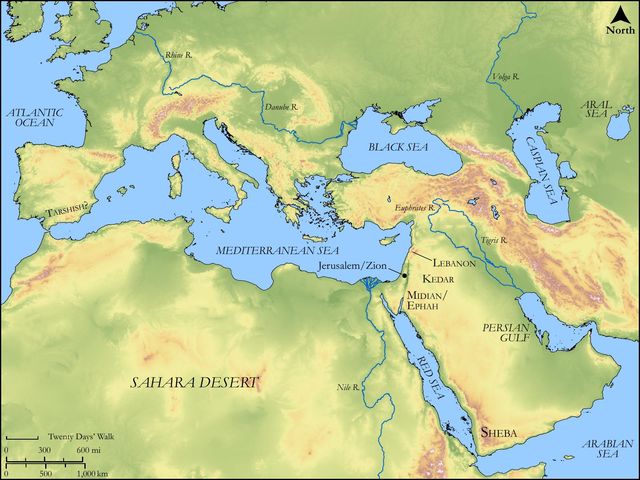
See on the biblical-era map
Study this verse
Public-domain commentary
Matthew Henry
From his Commentary on the Whole Bible. Henry comments on passages, not single verses — this entry covers Isaiah 41:10–20. His four-level outline is real structure in the source text, so it is rendered as structure.
The scope of these verses is to silence the fears, and encourage the faith, of the servants of God in their distresses. Perhaps it is intended, in the first place, for the support of God's Israel, in captivity; but all that faithfully serve God through patience and comfort of this scripture may have hope. And it is addressed to Israel as a single person, that it might the more easily and readily be accommodated and applied by every Israelite indeed to himself. That is a word of caution, counsel, and comfort, which is so often repeated, Fear thou not; and again (Isa 41:13), Fear not; and (Isa 41:14), "Fear not, thou worm Jacob; fear not the threatenings of the enemy, doubt not the promise of thy God; fear not that thou shalt perish in thy affliction or that the promise of thy deliverance shall fail." It is against the mind of God that his people should be a timorous people. For the suppressing of fear he assures them,
I.That they may depend upon his presence with them as their God, and a God all-sufficient for them in the worst of times.
Observe with what tenderness God speaks, and how willing he is to let the heirs of promise know the immutability of his counsel, and how desirous to make them easy: "Fear thou not, for I am with thee, not only within call, but present with thee; be not dismayed at the power of those that are against thee, for I am thy God, and engaged for thee. Art thou weak? I will strengthen thee. Art thou destitute of friends? I will help thee in the time of need. Art thou ready to sink, ready to fall? I will uphold thee with the right hand of my righteousness, that right hand which is full of righteousness, in dispensing rewards and punishments," Psa 48:10. And again (Isa 41:13) it is promised,
1.That God will strengthen their hands, that is, will help them: "I will hold thy right hand, go hand in hand with thee" (so some): he will take us by the hand as our guide, to lead us in our way, will help us up when we are fallen or prevent our falls; when we are weak he will hold us up - wavering, he will fix us - trembling, he will encourage us, and so hold us by the right hand, Psa 73:23.
2.That he will silence their fears: Saying unto thee, Fear not. He has said it again and again in his word, and has there provided sovereign antidotes against fear: but he will go further; he will by his Spirit say it to their hearts, and make them to hear it, and so will help them.
II.That though their enemies be now very formidable, insolent, and severe, yet the day is coming when God will reckon with them and they shall triumph over them. There are those that are incensed against God's people, that strive with them (Isa 41:11), that war against them (Isa 41:12), that hate them, that seek their ruin, and are continually picking quarrels with them. But let not God's people be incensed at them, nor strive with them, nor render evil for evil; but wait God's time, and believe,
1.That they shall be convinced of the folly, at least, if not of the sin of striving with God's people; and, finding it to no purpose, they shall be ashamed and confounded, which might bring them to repentance, but will rather fill them with rage.
2.That they shall be quite ruined and undone (Isa 41:11): They shall be as nothing before the justice and power of God. When God comes to deal with his proud enemies he makes nothing of them. Or they shall be brought to nothing, shall be as if they had never been. This is repeated (Isa 41:12): They shall be as nothing and as a thing of nought, or as that which is gone and has failed. Those that were formidable shall become despicable; those that fancied they could do any thing shall be able to bring nothing to pass; those that made a figure in the world, and a mighty noise, shall become mere ciphers and be buried in silence. They shall perish, not only be nothing, but be miserable: Thou shalt seek them, shalt enquire what has become of them, that they do not appear as usual, but thou shalt not find them as David, Psa 37:36. I sought him, but he could not be found.
III.That they themselves should become a terror to those who were now a terror to them, and victory should turn on their side, Isa 41:14-16. See here,
1.How Jacob and Israel are reduced and brought very low. It is the worm Jacob, so little, so weak, and so defenceless, despised and trampled on by every body, forced to creep even into the earth for safety; and we must not wonder that Jacob has become a worm, when even Jacob's King calls himself a worm and no man, Psa 22:6. God's people are sometimes as worms, in their humble thoughts of themselves and their enemies' haughty thoughts of them - worms, but not vipers, as their enemies are, not of the serpent's seed. God regards Jacob's low estate, and says, "Fear not, thou worm Jacob; fear not that thou shalt be crushed; and you men of Israel" (you few men, so some read it, you dead men, so others) "do not give up yourselves for gone notwithstanding." Note, The grace of God will silence fears even when there seems to be the greatest cause for them. Perplexed but not in despair.
2.How Jacob and Israel are advanced from this low estate, and made as formidable as ever they have been despicable. But by whom shall Jacob arise, for he is small? We are here told: I will help thee, saith the Lord; and it is the honour of God to help the weak. He will help them, for he is their Redeemer, who is wont to redeem them, who has undertaken to do it. Christ is the Redeemer, from him is our help found. He will help them, for he is the Holy One of Israel, worshipped among them in the beauty of holiness and engaged by promise to them. The Lord will help them by enabling them to help themselves and making Jacob to become a threshing instrument. Observe, He is but an instrument, a tool in God's hand, that he is pleased to make use of; and he is an instrument of God's making and is no more than God makes him. But, if God make him a threshing instrument, he will make use of him, and therefore will make him fit for use, new and sharp, and having teeth, or sharp spikes; and then, by divine direction and strength, thou shalt thresh the mountains, the highest, and strongest, and most stubborn of thy enemies: thou shalt not only beat them, but beat them small; they shall not be a corn threshed out, which is valuable, and is carefully preserved (such God's people are when they are under the flail, Isa 21:10 : O my threshing! yet the corn of my floor, that shall not be lost); but these are made as chaff, which is good for nothing, and which the husbandman is glad to get rid of. He pursues the metaphor, Isa 41:16. Having threshed them, thou shalt winnow them, and the wind shall scatter them. This perhaps had its accomplishment, in part, in the victories of the Jews over their enemies in the times of the Maccabees; but it seems in general designed to read the final doom of all the implacable enemies of the church of God, and to have its accomplishment likewise in the triumphs of the cross of Christ, the gospel of Christ, and all the faithful followers of Christ, over the powers of darkness, which, first or last, shall all be dissipated, and in Christ all believers shall be more than conquerors, and he that overcomes shall have power over the nations, Rev 2:26.
IV.That, hereupon, they shall have abundance of comfort in God, and God shall have abundance of honour from them:
Thou shalt rejoice in the Lord, Isa 41:16. When we are freed from that which hindered our joy, and are blessed with that which is the matter of it, we ought to remember that God is our exceeding joy and in him all our joys must terminate. When we rejoice over our enemies we must rejoice in the Lord, for to him alone we owe our liberties and victories. "Thou shalt also glory in the Holy One of Israel, in thy interest in him and relation to him, and what he has done for thee." And, if thus we make God our praise and glory, we become to him for a praise and a glory.
V.That they shall have seasonable and suitable supplies of every thing that is proper for them in the time of need; and, if there be occasion, God will again do for them as he did for Israel in their march from Egypt to Canaan, Isa 41:17-19. When the captives, either in Babylon or in their return thence, are in distress for want of water or shelter, God will take care of them, and, one way or other, make their journey, even through a wilderness, comfortable to them. But doubtless this promise has more than such a private interpretation. Their return out of Babylon was typical of our redemption by Christ; and so the contents of these promises,
1.Were provided by the gospel of Christ. That glorious discovery of his love has given full assurance to all those who hear this joyful sound that God has provided inestimable comforts for them, sufficient for the supply of all their wants, the balancing of all their griefs, and the answering of all their prayers.
2.They are applied by the grace and Spirit of Christ to all believers, that they may have strong consolation in their way and a complete happiness in their end. Our way to heaven lies through the wilderness of this world. Now,
(1.)It is here supposed that the people of God, in their passage through this world, are often in straits: The poor and needy seek water, and there is none; the poor in spirit hunger and thirst after righteousness. The soul of man, finding itself empty and necessitous, seeks for satisfaction somewhere, but soon despairs of finding it in the world, that has nothing in it to make it easy: creatures are broken cisterns, that can hold no water; so that their tongue fails for thirst, they are weary of seeking that satisfaction in the world which is not to be had in it. Their sorrow makes them thirsty; so does their toil.
(2.)It is here promised that, one way or other, all their grievances shall be redressed and they shall be made easy.
[1.]God himself will be nigh unto them in all that which they call upon him for. Let all the praying people of God take notice of this, and take comfort of it; he has said, "I the Lord will hear them, will answer them; I, the God of Israel, will not forsake them; I will be with them, as I have always been, in their distresses." While we are in the wilderness of this world this promise is to us what the pillar of cloud and fire was to Israel, an assurance of God's gracious presence.
[2.]They shall have a constant supply of fresh water, as Israel had in the wilderness, even where one would least expect it (Isa 41:18): I will open rivers in high places, rivers of grace, rivers of pleasure, rivers of living water, which he spoke of the Spirit (Joh 7:38, Joh 7:39), that Spirit which should be poured out upon the Gentiles, who had been as high places, dry and barren, and lifted up on their own conceit above the necessity of that gift. And there shall be fountains in the midst of the valleys, the valleys of Baca (Psa 84:6), that are sandy and wearisome; or among the Jews, who had been as fruitful valleys in comparison with the Gentile mountains. The preaching of the gospel to the world turned that wilderness into a pool of water, yielding fruit to the owner of it and relief to the travellers through it.
[3.]They shall have a pleasant shade to screen them from the scorching heat of the sun, as Israel when they pitched at Elim, where they had not only wells of water, but palm-trees (Exo 15:27): "I will plant in the wilderness the cedar, Isa 41:19. I will turn the wilderness into an orchard or garden, such as used to be planted with these pleasant trees, so that they shall pass through the wilderness with as much ease and delight as a man walks in his grove. These trees shall be to them what the pillar of cloud was to Israel in the wilderness, a shelter from the heat." Christ and his grace are so to believers, as the shadow of a great rock, Isa 32:2. When God sets up his church in the Gentile wilderness there shall be as great a change made by it in men's characters as if thorns and briers were turned into cedars, and fir-trees, and myrtles; and by this a blessed change is described, Isa 55:13.
[4.]They shall see and acknowledge the hand of God, his power and his favour, in this, Isa 41:20. God will do these strange and surprising things on purpose to awaken them to a conviction and consideration of his hand in all: That they may see this wonderful change, and knowing that it is above the ordinary course and power of nature may consider that therefore it comes from a superior power, and, comparing notes upon it, may understand together, and concur in the acknowledgment of it, that the hand of the Lord, that mighty hand of his which is stretched out for his people and stretched out to them, has done this, and the Holy One of Israel has created it, made it anew, made it out of nothing, made it for the comfort of his people. Note, God does great things for his people, that he may be taken notice of.
Historical interpretation
Historical reception
2 surviving comments on this verse. Each one is dated, so this reads as a timeline rather than a list.
Select a marker to jump to its quote. Markers stagger vertically where authors wrote within a few decades of each other.
(Verse 8 and following) And you, O Israel, my servant, Jacob whom I have chosen, the offspring of Abraham, my friend. I have taken hold of you from the ends of the earth, and summoned you from its farthest corners. I said to you, 'You are my servant; I have chosen you and have not rejected you.' So do not fear, for I am with you; do not be dismayed, for I am your God. I will strengthen you and help you; I will uphold you with my righteous right hand. All who rage against you will surely be ashamed and disgraced; those who oppose you will be as nothing and perish. You will seek them, and you will not find them: your rebel men will be as if they were not: and like the destruction of warring men against you. For I, the Lord your God, took hold of your hand, saying to you: Do not fear, I have helped you. Do not fear, words of Jacob, you who are dead from Israel. I have helped you, says the Lord, and your Redeemer, the Holy One of Israel. I have made you like a new threshing sledge, with sharp teeth. You will crush the mountains and reduce them to dust; you will make them like fine dust. You will scatter them to the wind, and a whirlwind will blow them away. Then you will rejoice in the Lord; you will glory in the Holy One of Israel. LXX: But you, Israel, my servant, Jacob, whom I have chosen, the offspring of Abraham, my friend; whom I took from the ends of the earth, and called from its farthest corners, saying to you, “You are my servant, I have chosen you and not cast you off”; fear not, for I am with you; be not dismayed, for I am your God; I will strengthen you, I will help you, I will uphold you with my righteous right hand. Behold, they shall be confounded and ashamed, all your adversaries. They shall be as if they were not, and all your enemies shall perish. You shall seek them and not find them, those who rage against you. They shall be as if they were not, and they shall not fight against you. For I am the Lord your God, who holds your right hand, who says to you, 'Do not fear, O Jacob, O little Israel.' I have helped you, says God, who redeems you, the Holy One of Israel. Behold, I have made you like new grinding wheels of a wagon, in the manner of saws: and you will grind the mountains and crush the hills: and you will scatter them like dust and the wind will carry them away, and the storm will disperse them. But you will rejoice in the Lord and in the holy ones of Israel. Paul the Apostle teaches that Jacob and Israel are both carnal and spiritual: See Israel according to the flesh (1 Cor. 10). From which we understand that there is also another according to the spirit; and the carnal are called Israel: If you were children of Abraham, you would do the works of Abraham. And above all, it is said (In Chapter 40, verse 27): Why do you say, Jacob, and speak, Israel: My way is hidden from the Lord: and my judgment has passed over from my God? On the contrary, now God speaks to the spiritual Israel, who has received the coming of his Lord, whom he first calls servant, then chosen, and finally the seed of Abraham. For before we received the spirit of slavery in fear (Romans 8); and afterwards, as the chosen ones, we are joined in friendship with God. Therefore, after the calling of the Gentiles, when they saw the islands and were afraid, they were astonished at the ends of the earth; they came near and approached, they are called the remnants, according to the choice of grace, of whom both the Gospel and the Evangelist write: Jesus chose these twelve, whom he also named Apostles (Luke 6), who were chosen after the servitude of the Law, in the Gospel; and they deserved to be the seed of Abraham, friends of God. For in that he apprehended them from the ends of the earth, and called Israel from its farthest borders, gathering first the people of the Jews, of whom also the Apostle Paul says: 'It was necessary that the word be preached to you first, but since you reject it, we will go to the Gentiles' (Acts 13:46). Therefore, to you, who are both my servant and my chosen one, who will preach among the Gentiles and endure many persecutions, I say, do not be afraid, for I am with you, to whom I speak in the Gospel: Behold, I am with you always, until the end of the age (Matthew 28:20). Do not wander, nor deviate from the truth, nor deceive yourself with false persuasion, thinking that with your inexperienced and unarmed strength, you can enter the wilderness of the nations and call the fiercest nations to gentleness. I am the one who has strengthened you and helped you; and my right hand, that is, the right hand of the righteous, that is, the Lord Savior, has supported you or protected you, as the Septuagint translates. Behold, for your adversaries, the people of the Jews and all who fight against you, and your persecutors will be turned into nothing, and you will seek your adversaries, and you will not find them. And the reason why you will not find your adversaries is explained: because they will be as if they do not exist. But you should not be afraid, because I have taken hold of your hand. I say to you, Do not be afraid: I have helped you; do not fear, worm of Jacob, who are dead from Israel, or as the LXX says, very few from Israel. This that we have set forth, I have helped you: do not fear, worm of Jacob, which is not found in the LXX. But the worm which is said in Hebrew, Tholath (), is called the chorus of the Apostles because of their humility and contempt, imitating the Savior, who speaks in the psalm: I am a worm, and not a man: the reproach of men, and the despising of the people (Psalm 22:7). For just as the worm penetrates the earth, so the apostolic word penetrated the cities of the nations and first entered the hardest hearts. And rightly few are called from Israel, because in comparison to the whole world, very few from the Jewish nation believed, to whom the Lord speaks in the Gospel: 'Do not be afraid, little flock' (Luke 12:32). Or, according to the Hebrew, the dead from Israel, who also say with the Apostle: 'I die daily' (2 Corinthians 15:31). And elsewhere: I am crucified with Christ; nevertheless I live; yet not I, but Christ liveth in me. (Galatians 2:20). And what follows: I have set thee as a new threshing cart, having tearing beaks, signifies that the preaching of the Gospel crushes the opposing powers and lifts up the spiritual wickedness that exalts itself against the knowledge of God; which, according to the variety of pride, are called mountains and hills. And when these are taken away and scattered like a whirlwind, let Israel exult and rejoice in the Holy Lord of Israel. We can also say that an ecclesiastical man, having the serpents of evangelical preaching on a new wagon, which does not work at all in the oldness of the letter, but in the freshness of the spirit, crushes the hardest hearts of unbelievers: separating the wheat from the chaff, and breaking mountains and hills, that is, all the leaders of heretics, who, being crushed and broken, are reduced to dust and taught that they are nothing, so that those who were gathered wickedly may be divided into their own good.
This is what already happened figuratively in the epoch of the Babylonians, since the God of the universe destroyed their empire, liberated the Jews from bitter servitude and brought them back to the land of their ancestors. However, this deliverance applies properly and truly to the holy apostles and to the victorious martyrs: their enemies are covered with shame, their persecutors have today disappeared and are unknown, whereas the defenders of the truth attract all the attention and are known by all.
Continue studying Isaiah 41:11 across the web’s major study libraries — every link below opens this exact verse, chapter, or book on the destination site.
Read & Compare
 BibleGatewayThis verse in more than 200 translations and 70 languages.
 Bible.comThe YouVersion reader — hundreds of translations, reading plans, and highlights.
 ESV.orgCrossway's official English Standard Version reader.
 NET BibleThe NET translation with 60,000+ translators' notes on every rendering decision.
 STEP BibleTyndale House's free study tool — original text, vocabulary, and scholarly resources.
 BibliaLogos Bible Software's free web reader.
 USCCBThe New American Bible (Revised Edition) with the U.S. bishops' study notes.
Commentaries
 BibleHub CommentariesDozens of classic commentaries on this verse, gathered on one page.
 StudyLightMore than 100 commentary sets — the largest collection on the web.
 BibleRefPlain-English commentary on what this verse means, verse by verse.
 Enduring WordDavid Guzik's free commentary on this chapter, widely used by Bible teachers.
 Bible Study ToolsVerse commentary alongside Greek and Hebrew study aids.
Original Language & Research
- BibleHub InterlinearThe verse word by word — original language, transliteration, and English.
- BibleHub LexiconEvery word's original-language definition and Strong's entry.
 Blue Letter BibleDeep-study tools — Strong's numbers, concordance, and word studies.
 SefariaThe Hebrew text with Rashi and centuries of Jewish commentary.
Sermons, Hymns & Audio


TrulyRandomVerse is not affiliated with these sites and doesn’t control their content. They’re linked because they’re genuinely useful.
Summary
Isaiah 41:11 delivers a profound divine assurance to God's chosen servant, Israel, declaring the definitive and humiliating defeat of all who oppose them. Those filled with burning anger and hostility against God's people will face public disgrace, utter confusion, and ultimately be reduced to nothingness, while those who contend with them will completely vanish. This verse serves as a powerful promise of divine vindication, emphasizing God's unwavering faithfulness and omnipotence in protecting His covenant people against all adversaries.
Context
ShowHideLiterary Context
Isaiah 41 is situated within the "Book of Comfort" (chapters 40-55) in the prophet Isaiah's work, a section primarily addressing the exilic and post-exilic community. This chapter specifically opens with God summoning the nations to a cosmic court, challenging their idols and demonstrating His unique sovereignty over history and future events. It transitions into the first of the "Servant Songs" (though the servant here is Israel, not yet the Messiah explicitly), where God reaffirms His choice of Israel as His servant, Jacob, whom He has "taken from the ends of the earth" in Isaiah 41:9. Verse 11 directly follows God's foundational promise in Isaiah 41:10, where He assures Israel, "Fear not, for I am with you; be not dismayed, for I am your God; I will strengthen you, I will help you, I will uphold you with my righteous right hand." Thus, verse 11 is the immediate consequence and tangible manifestation of God's protective and empowering presence: the certain, humiliating fate of those who dare to oppose His divinely upheld servant.
Historical & Cultural Context
The prophecies in Isaiah, particularly this section, are addressed to a people either experiencing the trauma of the Babylonian exile or living in its shadow, facing immense pressure and fear from powerful empires. The Assyrian and later Babylonian empires represented overwhelming military and political threats to Judah. In such a context, the people of Israel would have felt vulnerable, outnumbered, and perhaps questioned God's power or commitment to them. Culturally, the worship of idols and the belief in national gods were prevalent, and the strength of a nation's god was often measured by the nation's military success. Isaiah's message directly counters this worldview by asserting Yahweh's absolute supremacy over all nations and their deities, promising that He alone orchestrates history and will humble those who stand against His chosen people. This divine declaration would have provided immense psychological and spiritual comfort to a dispirited and oppressed community, reminding them that their ultimate security rested not in military might but in their covenant relationship with the sovereign God.
Key Themes
ShowHideThis verse powerfully contributes to several overarching themes in Isaiah and the broader biblical narrative. Firstly, it underscores the theme of Divine Sovereignty and Justice, demonstrating that God is not merely a passive observer but an active participant in history, ensuring that justice prevails and that those who oppose His divine purposes will inevitably be judged. This is a recurring motif, as seen in Psalm 9:16. Secondly, the verse highlights God's Unwavering Faithfulness to His Covenant People. Despite Israel's past failures and present vulnerability, God remains committed to His promises to Abraham, Isaac, and Jacob, affirming His protective hand over them. This faithfulness is a cornerstone of biblical theology, echoed in passages like Deuteronomy 7:9. Finally, it emphasizes the theme of Vindication of the Righteous. The shame and confusion of the adversaries serve to vindicate God's people, proving that their trust in Yahweh was not in vain. This ultimate reversal of fortunes, where the oppressed are exalted and the oppressors are brought low, is a consistent message of hope throughout the prophetic literature, as seen in Psalm 37.
Exposition and Analysis
ShowHideKey Word Analysis
ShowHideThis primitive root means "to glow or grow warm," and figuratively, "to blaze up" with anger, zeal, or jealousy. It describes a deep, burning hostility and intense fury directed against someone. In Isaiah 41:11, it vividly portrays the enemies' passionate, malicious intent, their hearts hot with animosity towards God's people.
This root primarily means "to pale," and by implication, "to be ashamed." It also carries the sense of being disappointed or delayed. When applied to the adversaries, it signifies a public disgrace and humiliation. Their schemes and efforts against Israel will not only fail but will also expose them to ridicule and a profound sense of failure, turning their confidence into utter mortification.
This primitive root means "to wander away," "lose oneself," and by strong implication, "to perish" or "to be destroyed." It suggests a complete and utter annihilation, not just a defeat. For the enemies of God's people, it means their power, influence, and very existence as a threat will be utterly dissolved, becoming "as nothing" and vanishing without a trace from the stage of history as far as their opposition to God's plan is concerned.
Verse Breakdown
ShowHide"Behold, all they that were incensed against thee"
The opening "Behold" (הִנֵּה, hinnēh) serves as an emphatic interjection, drawing immediate attention to the profound declaration that follows. It points to a certainty and a divine decree. "They that were incensed against thee" refers to those who harbored deep, burning anger and hostility, actively plotting and acting with malicious intent against Israel, God's chosen servant.
"shall be ashamed and confounded"
This clause describes the immediate and public consequence for these adversaries. "Ashamed" (בּוֹשׁ, bûwsh) implies public disgrace and humiliation, while "confounded" (כָּלַם, kâlam) suggests utter confusion, disappointment, and a sense of being utterly put to shame. Their plans will fail spectacularly, leading to their public dishonor and intellectual disarray.
"they shall be as nothing"
This powerful phrase emphasizes the complete futility and eventual non-existence of the enemies' power and influence. Their efforts against God's will and His people will amount to absolute zero; they will vanish into irrelevance, their strength and threats utterly nullified.
"and they that strive with thee"
This introduces the second group of adversaries, or perhaps a different aspect of the same group. "Strive" (רִיב, rîyb) refers to those who contend, quarrel, or engage in legal or physical conflict against Israel. It speaks to active opposition and contention.
"shall perish."
This final, definitive statement seals the fate of all who oppose God's servant. "Perish" (אָבַד, ʼâbad) signifies complete destruction, annihilation, or utter ruin. It is the ultimate consequence, ensuring that the threat posed by these adversaries is not merely diminished but entirely eradicated.
Literary Devices
ShowHideIsaiah 41:11 employs several potent literary devices to convey its message of divine assurance. The opening "Behold" acts as an exclamatory marker, signaling the importance and certainty of the prophecy. Parallelism is evident throughout the verse, particularly in the two halves that describe the fate of the adversaries: "all they that were incensed against thee shall be ashamed and confounded" is paralleled by "they that strive with thee shall perish." This reinforces the message through repetition and variation, emphasizing the comprehensive nature of the enemies' defeat. The phrase "they shall be as nothing" is a form of hyperbole and metaphor, emphasizing the absolute nullification and utter insignificance of the enemies' power and existence when confronted by God's might. It's not just that they will be defeated, but they will cease to matter. There is also a strong element of prophecy, as Isaiah declares a future event with divine certainty, providing hope and comfort to the present audience. The entire verse functions as a powerful contrast between the seemingly overwhelming power of human adversaries and the ultimate, invincible power of God to protect His chosen ones.
Theological and Thematic Connections
ShowHideIsaiah 41:11 stands as a powerful testament to God's unwavering commitment to His covenant people and His absolute sovereignty over all earthly powers. Theologically, it affirms that Yahweh is not merely a tribal deity but the Lord of history, who orchestrates events to fulfill His purposes. The humiliation and destruction of Israel's enemies are not arbitrary acts but a demonstration of divine justice and vindication. This principle extends beyond ancient Israel to all who align themselves with God's will: those who oppose God's kingdom and His people will ultimately face His righteous judgment, while those who trust in Him will be upheld. This truth provides immense comfort and courage, reminding believers that their ultimate security rests in God's protective hand, not in human strength or political alliances. It calls for patient endurance and trust, knowing that God will bring about His perfect justice in His own time.
Reflection and Application
ShowHideIsaiah 41:11 offers profound reassurance for believers navigating a world often hostile to faith. It reminds us that our true battle is not against flesh and blood, but against spiritual forces that often manifest through human opposition. When we face criticism, persecution, or even outright malice because of our commitment to Christ, this verse anchors us in the reality of God's ultimate victory. It calls us to resist the urge to retaliate or despair, instead resting in the sovereign assurance that God Himself will contend with our adversaries. Our role is to remain faithful, to stand firm in the strength He provides, and to trust that He will bring justice and vindication in His perfect timing. This truth liberates us from fear and empowers us to live boldly for Christ, knowing that no weapon formed against us will ultimately prosper, and those who oppose God's purposes will ultimately be brought to nothing.
Questions for Reflection
ShowHideFAQ
ShowHideWho are "they" in Isaiah 41:11, and does this apply to me today?
ShowHideIn its immediate historical context, "they" primarily refers to the nations and peoples who were hostile to Israel, particularly those who threatened or oppressed them, such as the Assyrians and Babylonians. It also includes those who mocked or challenged God's unique power and Israel's status as His chosen servant. For believers today, while not a direct promise of physical annihilation for every personal enemy, the principle applies spiritually and ultimately. "They" can represent any force, ideology, or individual that sets itself against God's purposes and His people. This includes spiritual adversaries, pervasive injustices, and even personal opposition faced by Christians for their faith. The verse assures us that God ultimately vindicates His people and brings to naught all opposition to His kingdom, whether in this life or in the final judgment. It is a promise of ultimate divine victory over all evil, offering profound comfort and hope to the church, the spiritual Israel, as seen in Galatians 3:29.
Christ-Centered Fulfillment
ShowHideIsaiah 41:11 finds its ultimate and most profound fulfillment in the person and work of Jesus Christ, the true and perfect Servant of the Lord. While Israel, as God's corporate servant, often failed, Jesus perfectly embodied the role, enduring intense opposition and being "incensed against" by the religious and political powers of His day, as recorded in Luke 23:1-25. He was "striven with" at every turn, culminating in His crucifixion, where it seemed His adversaries had triumphed. Yet, the resurrection of Christ was God's definitive act of vindication, bringing His enemies to "shame and confusion." The powers of sin, death, and the devil, which had "incensed" themselves against God's redemptive plan, were utterly defeated and made "as nothing" through Christ's victory on the cross and His glorious resurrection, as powerfully declared in Colossians 2:15. Those who truly "strive" against Christ and His kingdom will ultimately "perish," as prophesied in passages like Revelation 20:10. Thus, this verse assures believers that because Christ has conquered, we, as His body, share in His ultimate triumph. Our adversaries, both spiritual and temporal, are already defeated foes in light of the Lamb's victory, guaranteeing the ultimate security and vindication of all who are "in Christ Jesus," making us "more than conquerors" through Him, as celebrated in Romans 8:37-39.