


Isaiah 36:4
Bible text: King James Version (1769 Blayney text) · Public domain
Bible text: Berean Standard Bible · Public domain
Bible text: American Standard Version (1901) · Public domain
Bible text: World English Bible, Messianic edition · Public domain
Bible text: Geneva Bible (1599) · Public domain
Bible text: Young's Literal Translation · Public domain
- וַיֹּאמֶרvai·Yo·merand he saidH559Conj-w ¦ V-Qal-ConsecImperf-3msVerb Qal Consecutive Imperfect 3rd Singular Masculineוַandיֹּאמֶרhe said
- אֲלֵיהֶם'a·lei·Hemto themH413Prep ¦ 3mpPrepositionאֲלֵיtoהֶםthem
- רַבrav[the] chiefH7262N-msNoun Title Singular Masculine Absolute
- שָׁקֵהsha·KehcommanderH7262N-msNoun Title Singular Masculine Absolute
- אִמְרוּ'im·rusayH559V-Qal-Imp-2mpVerb Qal Imperative 2nd Plural Masculine
- נָאna'pleaseH4994PrtParticle Interjection
- אֶל'eltoH413PrepPreposition
- חִזְקִיָּהוּchiz·ki·Ya·huHezekiahH2396N-proper-mNoun Proper Masculine
- כֹּהkohthusH3541AdvAdverb
- אָמַר'a·Marhe saysH559V-Qal-Perf-3msVerb Qal Perfect 3rd Singular Masculine
- הַמֶּלֶךְha·Me·lekhthe kingH4428Art ¦ N-msNoun Singular Masculine Absoluteהַtheמֶּלֶךְking
- הַגָּדוֹלha·ga·dOl<the> greatH1419Art ¦ Adj-msAdjective Singular Masculine Absoluteהַ<the>גָּדוֹלgreat
- מֶלֶךְMe·lekh[the] king ofH4428N-mscNoun Singular Masculine Construct
- אַשּׁוּר'a·ShurAssyriaH804N-properNoun Proper Location
- מָהmahwhat?H4100InterrogPronoun Interrogative
- הַבִּטָּחוֹןha·bi·ta·Chon[is] the trustH986Art ¦ N-msNoun Singular Masculine Absoluteהַ[is] theבִּטָּחוֹןtrust
- הַזֶּהha·Zeh<the> thisH2088Art ¦ PrtParticle Demonstrativeהַ<the>זֶּהthis
- אֲשֶׁר'a·SherwhichH834RelParticle Relative
- בָּטָחְתָּba·Ta·che·tayou trustH982V-Qal-Perf-2msVerb Qal Perfect 2nd Singular Masculine
English is a literal word-by-word gloss of the Hebrew, not the KJV's wording. Why?
This is the original text the KJV's translators worked from — each Hebrew word with its own literal English meaning in this verse, prepared by scholars at Tyndale House, Cambridge. The KJV translates whole sentences, not word by word, so its wording differs: one Hebrew word can become several English words, and the KJV may choose “the LORD” where the gloss reads “Yahweh”. Both are faithful — they answer different questions. For the KJV's own rendering, switch to the KJV text.
Details
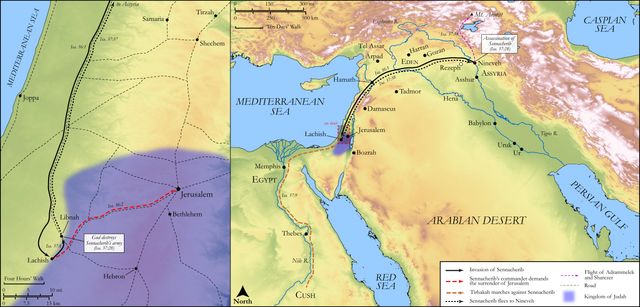
See on the biblical-era map
Study this verse
Public-domain commentary
Matthew Henry
From his Commentary on the Whole Bible. Henry comments on passages, not single verses — this entry covers Isaiah 36:1–10.
We shall here only observe some practical lessons. 1. A people may be in the way of their duty and yet meet with trouble and distress. Hezekiah was reforming, and his people were in some measure reformed; and yet their country is at that time invaded and a great part of it laid waste. Perhaps they began to grow remiss and cool in the work of reformation, were doing it by halves, and ready to sit down short of a thorough reformation; and then God visited them with this judgment, to put life into them and that good cause. We must not wonder if, when we are doing well, God sends afflictions to quicken us to do better, to do our best, and to press forward towards perfection. 2. That we must never be secure of the continuance of our peace in this world, nor think our mountain stands so strong that it cannot be moved. Hezekiah was not only a pious king, but prudent, both in his administration at home and in his treaties abroad. His affairs were in a good posture, and he seemed particularly to be upon good terms with the king of Assyria, for he had lately made his peace with him by a rich present (Kg2 18:14), and yet that perfidious prince pours an army into his country all of a sudden and lays it waste. It is good for us therefore always to keep up an expectation of trouble, that, when it comes, it may be no surprise to us, and then it will be the less a terror. 3. God sometimes permits the enemies of his people, even those that are most impious and treacherous, to prevail far against them. The king of Assyria took all, or most, of the defenced cities of Judah, and then the country would of course be an easy prey to him. Wickedness may prosper awhile, but cannot prosper always. 4. Proud men love to talk big, to boast of what they are, and have, and have done, nay and of what they will do, to insult over others, and set all mankind at defiance, though thereby they render themselves ridiculous to all wise men and obnoxious to the wrath of that God who resists the proud. But thus they think to make themselves feared, though they make themselves hated, and to carry their point by great swelling words of vanity, Jde 1:16. 5. The enemies of God's people endeavour to conquer them by frightening them, especially by frightening them from their confidence in God. Thus Rabshakeh here, with noise and banter, runs down Hezekiah as utterly unable to cope with his master, or in the least to make head against him. It concerns us therefore, that we may keep our ground against the enemies of our souls, to keep up our spirits by keeping up our hope in God. 6. It is acknowledged, on all hands, that those who forsake God's service forfeit his protection. If that had been true which Rabshakeh alleged, that Hezekiah had thrown down God's altars, he might justly infer that he could not with any assurance trust in him for succour and relief, Isa 36:7, We may say thus to presuming sinners, who say that they trust in the Lord and in his mercy. Is not this he whose commandments they have lived in the contempt of, whose name they have dishonoured, and whose ordinances they have slighted? How then can they expect to find favour with him? 7. It is an easy thing, and very common, for those that persecute the church and people of God to pretend a commission from him for so doing. Rabshakeh could say, Have I now come up without the Lord? when really he had come up against the Lord, Isa 37:28. Those that kill the servants of the Lord think they do him service and say, Let the Lord be glorified. But, sooner or later, they will be made to know their error to their cost, to their confusion.
Historical interpretation
Historical reception
3 surviving comments on this verse. Each one is dated, so this reads as a timeline rather than a list.
And the Rabshakeh told them: “Say to Hezekiah, ‘Thus says the great king, the king of the Assyrians,’ ” and other things that are contained in the history. In this, the Rabshakeh is to be regarded as presumptuous because, like some sort of contrary power, he is imitating the habit of the prophets, inasmuch as they customarily use “Thus says the Lord” as a preface to display the authority and greatness of the speaker, whereas he now says, “Thus says the great king, the king of the Assyrians.”
(Chapter 36—Verse 1 and following) And it came to pass in the fourteenth year of King Hezekiah, Sennacherib king of Assyria came up against all the fortified cities of Judah and captured them. And the king of Assyria sent Rabshakeh from Lachish to Jerusalem to King Hezekiah with a great army. And he stood by the conduit of the upper pool, on the highway to the washer's field. And Eliakim the son of Hilkiah, who was over the household, and Shebna the secretary, and Joah the son of Asaph, the recorder, came out to him. And Rabshakeh said to them, "Say to Hezekiah, 'Thus says the great king, the king of Assyria: On what do you rest this trust of yours?' By what plan and courage do you prepare to rebel? On whom do you have confidence, because you have turned away from me? Look, you trust in this broken reed staff, in Egypt: if a man leans on it, it will enter into his hand and pierce it. So is Pharaoh, the king of Egypt, to all who trust in him. But if you say to me, 'We trust in the LORD our God,' is it not he whose heights and altars Hezekiah has taken away, and said to Judah and Jerusalem, 'You shall worship before this altar'? And now make a deal with my master the king of Assyria, and I will give you two thousand horses, and you will not be able to provide riders for them. And how will you withstand the face of one judge from my lord's servants? And if you rely on Egypt: and on chariots, and on horsemen: and now, did I ascend to this land without the Lord, to destroy it? The Lord said to me: Go up on this land and destroy it. The history is clear and does not require interpretation: and this same thing is reported more fully in the volumes of Kings and Chronicles. In the third year of Hosea the son of Elah, king of Israel, Hezekiah the son of Ahaz king of Judah began to reign. He was twenty-five years old when he began to reign, and he reigned twenty-nine years in Jerusalem. And he did what was right in the eyes of the LORD, according to all that David his father had done. And afterwards: In the Lord God of Israel he trusted, and there was no one like him among all the kings of Judah, nor among those who came before him. He clung to the Lord and did not turn away from his commandments. He did the commandments that the Lord had given to Moses. Therefore, the Lord was with him, and he acted wisely in all that he did (2 Kings 18:2,7). But he rebelled against the king of Assyria and did not serve him. In the sixth year of his reign, Shalmaneser, the king of Assyria, captured Samaria and took away the ten tribes of Israel that were called Israel. He deported them to Assyria and settled them in Halah and Habor, along the rivers of the Gozan, in the cities of the Medes (2 Kings 17 and 18). After seven years, that is, in the fourteenth year of King Hezekiah, the king of Assyria, Sennacherib, entered Judah and besieged its fortified cities, intending to capture them. And when he besieged Lachish, Hezekiah sent messengers to him, saying: 'I have sinned, withdraw from me and whatever you impose on me, I will bear.' And when he had paid three hundred talents of silver and thirty talents of gold to the king's command, the king of Assyria broke down the doors of the temple of the Lord and took away its panels, which he himself had put up, and he sent the Tartan and the Rab-saris and the Rabshakeh with a great army from Lachish to King Hezekiah at Jerusalem. And when they had come up, they came and stood by the conduit of the upper pool, which is on the highway to the washer's field, and they called for the king. But Eliakim, the son of Hilkiah, who was in charge of the palace, went out to them, along with the court secretary, Shebna, and the court historian, Joah, the son of Asaph. Rabshekah addressed them as follows: “Tell Hezekiah: This is what the great king, the king of Assyria, says... and so on, as recorded in the history. In this, we can see the arrogance of Rabshekah, who, in a manner contrary to true strength, imitates the custom of the prophets. While they usually begin their pronouncements with 'This is what the Lord says,' he now says, 'This is what the great king, the king of Assyria, says.' But Eliakim son of Hilkiah, who was in charge of the palace, went out to him, along with the royal secretary Shebna and the court official Joah son of Asaph. Eliakim is the same person mentioned in the Vision of the Valley of Zion (see Isaiah 22:20-21): I will call my servant Eliakim son of Hilkiah, and I will clothe him in your robe and fasten your sash around him. I will hand your authority over to him, and he will be like a father to the inhabitants of Jerusalem and the people of Judah, and so on. But these things are said to Shebna, who was the governor of the Temple before him, of whom it is written in the same vision: Go and enter to him who dwells in the tabernacle, to Shebna the governor of the Temple, whom the Hebrews say handed over his hands to the Assyrians, terrified by Rabsaris' threats, and betrayed the lower part of Jerusalem to the enemy, and except for the fortress of Zion and the Temple, nothing else remained that the Assyrian did not hold. Where are those who think that Sobna, who is now going out with Eliacim and Joahe to meet Rabsacen, is the same person as before. There, Sobna, the head of the Temple, is said to be captured by the Assyrians; but here Sobna is a scribe, that is, a γραμματεὶς, who is called Sopher in Hebrew, and is the same as the previous one. Rabsacen, on the other hand, is believed to be the son of Isaiah the Jewish prophet, who also was a traitor; and the other son of Isaiah, who is called Jasub, is said to be left behind, which means 'left' in our language. Others, on the other hand, think that he was a Samaritan, and therefore knew the Hebrew language, and boldly and impiously blasphemed the Lord. Let us consider the words of Rabshakeh; and first what he says: You trust in this broken reed, in Egypt, is false: for no history tells that Hezekiah sent to the Egyptians and asked for the help of Pharaoh. And what he infers: If you answer me, we trust in the Lord our God, is true. But again, he joins a lie to the truth, that Ezechias took away its high places and altars. For he did this not against God, but for God, so that idolatry and ancient error being destroyed, he commanded God to be worshipped in Jerusalem, where his Temple was: although we read that by a very bad custom, the people offered sacrifices to God on altars already built on mountains and hills. And he, wanting to show the scarcity of the besieged, promises two thousand horses, of which Ezechias cannot provide the riders, not because of the weakness of the people of Judah, who lacked knowledge of riding: but by observing the commandments of God, who had commanded Israel through Moses concerning the king: He shall not multiply horses for himself, nor have many wives. And he said to me, 'By yourself, you cannot withstand the servant of Sennacherib, who am the least of his servants, how then will you withstand the great power of the king? And to what he had said, if you answer me, we trust in the Lord our God, he cunningly and wisely responded that he had come not by his own will, but by the command of the Lord. The Lord said to me, Go upon this land and destroy it. And this is the proof: certainly, without the will of the Lord, I could not have come here.' But when I come and capture many cities, and part of Jerusalem remains untouched, it is evident that I have come by its will. I read in a certain Commentary that the same person is Sennacherib who also captured Samaria, which is completely false. For the Sacred History recounts that first Phul, the king of the Assyrians, devastated the ten tribes under Manahen, the king of Israel. Secondly, Theglathphalasar came against Samaria under Phacee, the son of Romelia of Israel. Salmanasar III, under the reign of King Hoshea of Israel, supposedly captured the entire city of Samaria (2 Kings 15:17). Sargon II is said to be the fourth king who captured Ashdod (Isaiah 20). Asarhaddon, the fifth king, supposedly relocated Israel and sent the Samaritans as guardians to the land of Judah (2 Kings 17). Sennacherib, the sixth king, besieged Jerusalem after capturing Lachish and other cities of Judah during the reign of King Hezekiah (2 Kings 18). However, some believe that these names could refer to one and the same king with multiple names.
The accusation of the Rabshakeh against Hezekiah is evidence that with all the cities of Judah taken captive he would still be confident in the Lord, as he said to the people: “Do not be afraid, nor quake at the king of the Assyrians and all the great multitude that he has with him. For we have a great deal more with us than he has with him. With him is the arm of flesh, but with us is the Lord our God, our help, who will fight for us.” And the people were encouraged, it says, by these words of Hezekiah the king of Judah, which is why the Rabshakeh wanted to destroy what Hezekiah had created, so he said to the people, “Do not let Hezekiah seduce you,” and “Do not let him cause you to rely upon the Lord God.”
Continue studying Isaiah 36:4 across the web’s major study libraries — every link below opens this exact verse, chapter, or book on the destination site.
Read & Compare
 BibleGatewayThis verse in more than 200 translations and 70 languages.
 Bible.comThe YouVersion reader — hundreds of translations, reading plans, and highlights.
 ESV.orgCrossway's official English Standard Version reader.
 NET BibleThe NET translation with 60,000+ translators' notes on every rendering decision.
 STEP BibleTyndale House's free study tool — original text, vocabulary, and scholarly resources.
 BibliaLogos Bible Software's free web reader.
 USCCBThe New American Bible (Revised Edition) with the U.S. bishops' study notes.
Commentaries
 BibleHub CommentariesDozens of classic commentaries on this verse, gathered on one page.
 StudyLightMore than 100 commentary sets — the largest collection on the web.
 BibleRefPlain-English commentary on what this verse means, verse by verse.
 Enduring WordDavid Guzik's free commentary on this chapter, widely used by Bible teachers.
 Bible Study ToolsVerse commentary alongside Greek and Hebrew study aids.
Original Language & Research
- BibleHub InterlinearThe verse word by word — original language, transliteration, and English.
- BibleHub LexiconEvery word's original-language definition and Strong's entry.
 Blue Letter BibleDeep-study tools — Strong's numbers, concordance, and word studies.
 SefariaThe Hebrew text with Rashi and centuries of Jewish commentary.
Sermons, Hymns & Audio


TrulyRandomVerse is not affiliated with these sites and doesn’t control their content. They’re linked because they’re genuinely useful.
Summary
Isaiah 36:4 vividly captures the opening volley of psychological warfare launched by Rabshakeh, the Assyrian field commander, against King Hezekiah of Judah. Speaking on behalf of "the great king, the king of Assyria," Rabshakeh directly challenges the very foundation of Hezekiah's confidence, aiming to demoralize Judah's leadership and its people during Sennacherib's siege of Jerusalem. This verse sets a dramatic stage for a profound spiritual and military confrontation, highlighting the stark contrast between human arrogance backed by overwhelming might and divine sovereignty upheld through faithful trust.
Context
ShowHideLiterary Context
Isaiah 36-39 functions as a crucial historical interlude within the larger prophetic book of Isaiah, often termed the "historical appendix." This section meticulously chronicles Sennacherib's invasion of Judah and Jerusalem, paralleling accounts found in 2 Kings 18-20 and 2 Chronicles 32. Specifically, Isaiah 36 details the Assyrian siege and Rabshakeh's calculated taunts, serving as a pivotal narrative moment that rigorously tests Judah's trust in God amidst overwhelming external pressure. This historical account follows Isaiah's earlier prophecies concerning both judgment for Judah's unfaithfulness and promises of ultimate divine deliverance, thereby presenting a concrete demonstration of God's faithfulness to His covenant people. The narrative flow within this section progresses from intense Assyrian intimidation to Hezekiah's humble prayer and, ultimately, to God's miraculous intervention, underscoring the themes of divine power and human reliance.
Historical & Cultural Context
The events depicted in Isaiah 36 unfolded around 701 BC, during the reigns of King Hezekiah in Judah and King Sennacherib in Assyria. At this time, the Assyrian Empire stood as the preeminent superpower of that day, notorious for its ruthless military campaigns, systematic deportations, and highly sophisticated psychological warfare tactics designed to break an enemy's will before engaging in prolonged sieges. Sennacherib had already subjugated numerous cities and nations, leaving Jerusalem as one of the last remaining independent strongholds in the region. Rabshakeh, whose title likely signifies "chief cupbearer" or "chief officer," was a high-ranking Assyrian official, strategically selected for his linguistic proficiency and rhetorical skill. His deliberate decision to address the people of Jerusalem in Hebrew, rather than Aramaic (the common diplomatic language), as noted in Isaiah 36:11, was a calculated tactic to bypass Hezekiah's officials and directly demoralize the common populace on the city walls, illustrating the Assyrians' mastery of propaganda and intimidation to secure surrender without costly military engagement.
Key Themes
ShowHideThis verse introduces and powerfully encapsulates several critical themes that resonate throughout the broader narrative of Isaiah and the Old Testament. Foremost among these is the Challenge to Trust, as Rabshakeh's direct and scornful question, "What confidence is this wherein thou trustest?", immediately places Hezekiah's faith and strategic alliances under intense scrutiny. This challenge establishes a profound theological contrast between reliance on fleeting human strength or political maneuvering and unwavering, covenantal trust in the Lord, a central tenet of Isaiah's prophetic message (e.g., Isaiah 30:1-7). Another pivotal theme is Human Arrogance vs. Divine Sovereignty, exemplified by Sennacherib's self-proclaimed title, "the great king, the king of Assyria," which stands in stark opposition to the true, ultimate sovereignty of Yahweh, whom Hezekiah faithfully served (Isaiah 10:5-19). The narrative also vividly portrays the dynamics of Psychological Warfare, as Rabshakeh's speech, initiated by this verse, is meticulously crafted to sow doubt, fear, and division among the besieged, demonstrating the Assyrian strategy of breaking an enemy's will before attempting to breach their physical defenses.
Exposition and Analysis
ShowHideKey Word Analysis
ShowHideThis title, derived from a combination meaning "chief butler" or "chief officer," identifies a high-ranking Assyrian official. In the context of Isaiah 36, Rabshakeh serves as Sennacherib's primary spokesman and military envoy, demonstrating the Assyrian Empire's strategic deployment of skilled communicators for both diplomatic negotiation and psychological warfare. His role extends beyond merely conveying a message; he is tasked with intimidating and demoralizing the enemy, making him a central figure in the Assyrian propaganda effort.
Appearing twice in this verse in the phrase "the great king, the king of Assyria," this adjective signifies "great" in various senses, including magnitude, importance, and even insolence. Here, it is employed to underscore Sennacherib's self-perception of overwhelming power, authority, and unchallenged supremacy. It reflects the Assyrian king's profound hubris and self-aggrandizement, positioning himself as a monarch whose might is absolute and whose word is final, in stark contrast to the divine sovereignty.
This primitive root verb carries the primary meaning of "to hide for refuge," but extends to "to trust," "to be confident or sure," or "to lean upon." The repetition of this root, implied by the noun "confidence" (biṭṭâchôwn) and the verb "trustest" (bâṭach), highlights the core of Rabshakeh's challenge. He is not merely inquiring about the existence of Hezekiah's confidence, but critically examining its object and basis, intending to expose its perceived futility and expose its perceived futility in the face of insurmountable Assyrian might.
Verse Breakdown
ShowHide"And Rabshakeh said unto them,"
This opening clause immediately establishes the speaker and his audience. Rabshakeh, acting as the direct representative of King Sennacherib, embodies the voice of Assyrian power, arrogance, and imperial demand. "Them" refers specifically to the three officials dispatched by King Hezekiah to meet the Assyrian delegation outside the city walls: Eliakim, Shebna, and Joah, as detailed in Isaiah 36:3. This sets the scene for a formal, yet intensely confrontational, diplomatic exchange, designed to exert maximum psychological pressure.
"Say ye now to Hezekiah,"
This imperative command directs the message with precision and urgency to King Hezekiah, ensuring that the Assyrian challenge reaches the ears of Judah's ultimate leader. It underscores Rabshakeh's intent to bypass conventional diplomatic protocols and deliver a direct, intimidating communication, designed to pressure Hezekiah into a swift surrender and to undermine his authority before his people.
"Thus saith the great king, the king of Assyria,"
This is a formal, authoritative declaration, deliberately echoing the prophetic formula "Thus saith the Lord," but blasphemously attributed to Sennacherib. The emphatic and repeated use of "king" and the self-aggrandizing "great king" serves to underscore Sennacherib's self-proclaimed supremacy, absolute authority, and perceived invincibility. It is a statement of overwhelming, unchallenged power, strategically intended to instill profound fear and convey the utter futility of resistance against such a formidable and divinely favored sovereign.
"What confidence [is] this wherein thou trustest?"
This is the rhetorical and theological crux of Rabshakeh's assault. It is a direct, scornful, and deeply challenging question that strikes at the very foundation of Hezekiah's and Judah's security and hope. It implies that any trust placed in human alliances, military strength, or even their God, is utterly misplaced, foolish, and woefully inadequate against the demonstrated might of Assyria. The deliberate use of both "confidence" (biṭṭâchôwn) and "trustest" (bâṭach) emphasizes the object and the act of reliance, aiming to expose its perceived emptiness and fragility in the face of overwhelming power.
Literary Devices
ShowHideIsaiah 36:4 employs several potent literary devices to convey its message, establish dramatic tension, and highlight the theological conflict. The most prominent is the Rhetorical Question, "What confidence [is] this wherein thou trustest?" This is not a question posed to elicit information, but rather a powerful statement designed to undermine, express scorn, and sow profound doubt in the minds of Hezekiah and his people. It forces the audience to confront the perceived weakness and futility of their position. There is also significant Irony at play; while Rabshakeh intends to expose Hezekiah's trust as baseless and foolish, the unfolding narrative ultimately reveals that Hezekiah's unwavering trust in God is, in fact, the only true, secure, and ultimately vindicated confidence. The title "the great king, the king of Assyria" functions as both Hyperbole and a clear instance of Self-Aggrandizement, emphasizing Sennacherib's inflated sense of power, his belief in his own invincibility, and his perceived divine mandate, all of which the subsequent miraculous events will dramatically contradict. Finally, the entire speech, powerfully initiated by this verse, serves as a masterful example of Psychological Warfare, using language as a calculated weapon to break the enemy's will and secure surrender without the need for a costly and protracted direct military confrontation.
Theological and Thematic Connections
ShowHideIsaiah 36:4 serves as a stark and profound theological confrontation, pitting the audacious claims of human arrogance and perceived invincibility against the quiet, steadfast strength of divine trust. Rabshakeh's direct challenge to Hezekiah's "confidence" transcends mere political or military strategy; it is a direct assault on the theological foundation of Judah's hope and security. The Assyrian king, through his brazen spokesman, presents himself as the ultimate authority, implicitly questioning the very existence, power, or efficacy of Judah's God. This sets up a critical examination of where true security and lasting hope truly reside: in the fleeting, often brutal, power of earthly empires or in the unchanging, sovereign, and covenant-keeping Lord. The subsequent narrative of Isaiah 36-39 powerfully vindicates Hezekiah's unwavering trust in God, demonstrating unequivocally that human might, no matter how "great" or seemingly insurmountable, is ultimately subject to the supreme will and power of the divine. This verse thus becomes a foundational point for understanding the nature of authentic faith and reliance in the face of overwhelming adversity.
Reflection and Application
ShowHideIn a contemporary world often dominated by loud, intimidating voices, overwhelming challenges, and a pervasive sense of insecurity, Isaiah 36:4 speaks with profound relevance to the modern believer. We, too, invariably encounter "Rabshakehs"—voices of doubt, fear, or worldly wisdom that relentlessly question the validity, efficacy, and very foundation of our faith. These challenges can manifest in myriad forms: financial instability, health crises, relational breakdowns, professional setbacks, or societal pressures that seem utterly insurmountable. The piercing core question posed to Hezekiah—"What confidence is this wherein thou trustest?"—becomes a vital and necessary self-examination for us today. Do we place our ultimate trust in our own limited abilities, our accumulated wealth, the fragile promises of human systems, or the fleeting circumstances of life? Or do we, like Hezekiah, choose to lean wholeheartedly and unreservedly on the unchanging character and unfailing promises of God, even when all earthly indicators suggest defeat or despair? This verse serves as a powerful call to critically assess the true foundation of our security and to reaffirm our unwavering confidence in the Lord, who alone is our steadfast refuge, our enduring strength, and our ultimate hope in every storm of life.
Questions for Reflection
ShowHideFAQ
ShowHideWho was Rabshakeh, and why was he chosen to deliver this message?
ShowHideRabshakeh was a high-ranking Assyrian official, whose title likely translates to "chief cupbearer" or "chief officer," serving directly under King Sennacherib. He was strategically chosen to deliver this critical message because he possessed exceptional skills in diplomacy, rhetoric, and, crucially, he was fluent in Hebrew, the language of Judah (as revealed in Isaiah 36:11). The Assyrians were masters of psychological warfare, and Rabshakeh's ability to communicate directly and persuasively with the common people of Jerusalem, bypassing Hezekiah's interpreters and officials, was a deliberate and calculated tactic. His mission was to demoralize the populace, sow seeds of doubt, and undermine their will to resist, thereby aiming to force a surrender without the need for a prolonged and costly military siege.
What was the "confidence" that Rabshakeh was challenging in Hezekiah?
ShowHideRabshakeh was challenging the entirety of Hezekiah's basis for security, resistance, and hope. This comprehensive challenge likely encompassed any strategic alliances Hezekiah had forged (such as with Egypt, which Rabshakeh explicitly mocks in Isaiah 36:6), Judah's own military strength and fortifications, and most significantly, Hezekiah's profound and active trust in the Lord God of Israel. Hezekiah had recently undertaken significant religious reforms, purifying the temple, removing idols, and centralizing worship in Jerusalem, demonstrating his deep and personal reliance on Yahweh (see 2 Kings 18:3-7). Rabshakeh's taunt was meticulously designed to expose all these perceived sources of confidence as ultimately futile and insufficient when confronted by the overwhelming and seemingly irresistible might of the Assyrian Empire.
Christ-Centered Fulfillment
ShowHideIsaiah 36:4, with its audacious challenge to Hezekiah's trust and its vivid portrayal of a "great king" asserting his formidable power, finds profound and ultimate Christ-centered fulfillment in the person and redemptive work of Jesus Christ. Rabshakeh's scornful question, "What confidence is this wherein thou trustest?", echoes humanity's perennial and desperate need for a truly reliable and unwavering object of trust. Earthly kings, even those self-proclaimed as "great" like Sennacherib, are ultimately finite; their power is temporary, their promises often hollow, and their reigns inevitably pass away. In stark contrast, Jesus is the true and eternal "great King," not by self-proclamation or transient military might, but by divine right, eternal sovereignty, and perfect righteousness (Revelation 19:16). Our ultimate confidence is not to be placed in fleeting human alliances, fragile earthly kingdoms, or personal strength, but in the Lamb of God who sacrificially takes away the sin of the world and reigns forevermore (see John 1:29 and Hebrews 1:8). Jesus Himself faced the ultimate "Rabshakeh" in Satan, who relentlessly tempts humanity to place its trust in anything and everything but God (powerfully illustrated in Matthew 4:1-11). Yet, Christ's perfect obedience, His atoning death on the cross, and His glorious resurrection demonstrate that true, unshakeable confidence is found only in Him. For He is "our hope" (1 Timothy 1:1) and the one in whom "all the promises of God find their Yes" (2 Corinthians 1:20). He is the King who does not merely challenge trust but embodies trustworthy salvation, offering a confidence that defies all earthly threats, triumphs over sin and death, and sustains for all eternity.