


Isaiah 10:31
Bible text: King James Version (1769 Blayney text) · Public domain
Bible text: Berean Standard Bible · Public domain
Bible text: American Standard Version (1901) · Public domain
Bible text: World English Bible, Messianic edition · Public domain
Bible text: Geneva Bible (1599) · Public domain
Bible text: Young's Literal Translation · Public domain
- נָדְדָהna·de·Dahit has fledH5074V-Qal-Perf-3fsVerb Qal Perfect 3rd Singular Feminine
- מַדְמֵנָהmad·me·NahMadmenahH4088N-properNoun Proper Location
- יֹשְׁבֵיyo·she·Vei[the] inhabitants ofH3427V-Qal-Prtcpl-mpVerb Qal Participle Plural Masculine Construct
- הַגֵּבִיםha·ge·Vim<the> GebimH1374Art ¦ N-properNoun Proper Locationהַ<the>גֵּבִיםGebim
- הֵעִיזוּhe·'I·zuthey have taken refugeH5756V-Hiphil-Perf-3cpVerb Hiphil Perfect 3rd Plural common gender
English is a literal word-by-word gloss of the Hebrew, not the KJV's wording. Why?
This is the original text the KJV's translators worked from — each Hebrew word with its own literal English meaning in this verse, prepared by scholars at Tyndale House, Cambridge. The KJV translates whole sentences, not word by word, so its wording differs: one Hebrew word can become several English words, and the KJV may choose “the LORD” where the gloss reads “Yahweh”. Both are faithful — they answer different questions. For the KJV's own rendering, switch to the KJV text.
Details
See on the biblical-era map
Study this verse
Public-domain commentary
Matthew Henry
From his Commentary on the Whole Bible. Henry comments on passages, not single verses — this entry covers Isaiah 10:24–34. His three-level outline is real structure in the source text, so it is rendered as structure.
The prophet, in his preaching, distinguishes between the precious and the vile; for God in his providence, even in the same providence, does so. He speaks terror, in Sennacherib's invasion, to the hypocrites, who were the people of God's wrath, Isa 10:6. But here he speaks comfort to the sincere, who were the people of God's love. The judgment was sent for the sake of the former; the deliverance was wrought for the sake of the latter. Here we have,
I.An exhortation to God's people not to be frightened at this threatening calamity, nor to be put into any confusion or consternation by it.
Let the sinners in Zion be afraid (Isa 33:14): but O my people, that dwellest in Zion, be not afraid of the Assyrian, Isa 10:24. Note, It is against the mind and will of God that his people, whatever may happen, should give way to that fear which has torment and amazement. Those that dwell in Zion, where God dwells and where his people attend him, and are employed in his service, that are under the protection of the bulwarks that are round about Zion (Psa 48:13), need not be afraid of any enemy. Let their souls dwell at ease in God.
II.Considerations offered for the silencing of their fear.
1.The Assyrian shall do nothing against them but what God has appointed and determined. They are here told before hand what he shall do, that it may be no surprise to them: "He shall smite thee by the divine permission, but it shall be only with a rod to correct thee, not with a sword to wound and kill; nay, he shall but lift up his staff against thee, threaten thee, and frighten thee, and shake the rod at thee, after the manner of Egypt, as the Egyptians shook their staff against your fathers at the Red Sea, when they said, We will pursue, we will overtake (Exo 15:9), but could not reach to do them any hurt." Note, We should not be frightened at those enemies that can do no more than frighten us.
2.The storm shall soon blow over (Isa 10:25): Yet a very little while - a little, little while (so the word is), and the indignation shall cease, even my anger, which is the staff in their hand (Isa 10:5), so that when that ceases they are disarmed and disabled to do any further mischief. Note, God's anger against his people is but for a moment (Psa 30:5), and when that ceases, and is turned away from us, we need not fear the fury of any man, for it is impotent passion.
3.The enemy that threatens them shall himself be reckoned with. God's anger against his people shall cease in the destruction of their enemies; when he turns away his wrath from Israel he shall turn it against the Assyrian; and the rod with which he corrected his people shall not only be laid aside, but thrown into the fire. He lifted up his staff against Zion, but God shall stir up a scourge for him (Isa 10:26); he is a terror to God's people, but God will be a terror to him. The destroying angel shall be this scourge, which he can neither flee from nor contend with. The prophet, for the encouragement of God's people, quotes precedents, and puts them in mind of what God had done formerly against the enemies of his church, who were very strong and formidable, but were brought to ruin. The destruction of the Assyrian shall be,
(1.)According to the slaughter of Midian (which was effected by an invisible power, but effected suddenly, and it was a total rout); and as, at the rock of Oreb, one of the princes of Midian, after the battle, was slain, so shall Sennacherib be in the temple of his god Nisroch, after the defeat of his forces, when he thinks the bitterness of death is past. Compare with this Psa 83:11, Make their nobles like Oreb and like Zeeb; and see how God's promises and his people's prayers agree.
(2.)As his rod was upon the sea, the Red Sea, as Moses' rod was upon that, to divide it first for the escape of Israel and then to close it again for the destruction of their pursuers, so shall his rod now be lifted up, after the manner of Egypt, for the deliverance of Jerusalem and the destruction of the Assyrian. Note, It is good to observe a resemblance between God's latter and former appearances for his people, and against his and their enemies.
4.They shall be wholly delivered from the power of the Assyrian, and from the fear of it, Isa 10:27. "They shall not only be eased of the Assyrian army, which is now quartered upon them and which is a grievous yoke and burden to them, but they shall no more pay that tribute to the king of Assyria which before this invasion he exacted from them (Kg2 18:14), shall be no longer at his service, nor lie at his mercy, as they have done; nor shall he ever again put the country under contribution." Some think it looks further, to the deliverance of the Jews out of their captivity in Babylon; and further yet, to the redemption of believers from the tyranny of sin and Satan. The yoke shall not only be taken away, but it shall be destroyed. The enemy shall no more recover his strength, to do the mischief he has done; and this because of the anointing, for their sakes who were partakers of the anointing.
(1.)For Hezekiah's sake, who was the anointed of the Lord, who had been an active reformer, and was dear to God.
(2.)For David's sake. This is particularly given as the reason why God would defend Jerusalem from Sennacherib (Isa 37:35), For my own sake, and for my servant David's sake.
(3.)For his people Israel's sake, the good people among them that had received the unction of divine grace.
(4.)For the sake of the Messiah, the Anointed of God, whom God had an eye to in all the deliverances of the Old Testament church, and hath still an eye to in all the favours he shows to his people. It is for his sake that the yoke is broken, and that we are made free indeed.
III.A description both of the terror of the enemy and the terror with which many were struck by it, and the folly of both exposed, Isa 10:28, to the end. Here observe,
1.How formidable the Assyrians were and how daring and threatening they affected to appear. Here is a particular description of the march of Sennacherib, what course he steered, what swift advances he made: He has come to Aiath, etc. "This and the other place he has made himself master of, and has met with no opposition." At Michmash he has laid up his carriages, as if he had no further occasion for his heavy artillery, so easily was every place he came to reduced; or the store-cities of Judah, which were fortified for that purpose, had now become his magazines. Some remarkable pass, and an important one, he had taken: They have gone over the passage.
2.How cowardly the men of Judah were, the degenerate seed of that lion's whelp. They were afraid; they fled upon the first alarm, and did not offer to make any head against the enemy. Their apostasy from God had dispirited them, so that one chased a thousand of them. Instead of a valiant shout, to animate one another, nothing was heard by lamentation, to discourage and weaken one another. And poor Anathoth, a priests' city, that should have been a pattern of courage, shrieks louder than any, Isa 10:30. With respect to those that gathered themselves together, it was not to fight, but to flee by consent, Isa 10:31. This is designed either,
(1.)To show how fast the news of the enemy's progress flew through the kingdom: He has come to Aiath, says one; nay, says another, He has passed to Migron, etc. And yet, perhaps, it was not altogether so bad as common fame represented it. But we must watch against the fear, not only of evil things, but of evil tidings, which often make things worse than really they are, Psa 112:7. Or,
(2.)To show what imminent danger Jerusalem was in, when its enemies made so many bold advances towards it and its friends could not make one bold stand to defend it. Note, The more daring the church's enemies are, and the more dastardly those are that should appear for her, the more will God be exalted in his own strength, when, notwithstanding this, he works deliverance for her.
3.How impotent his attempt upon Jerusalem shall be: he shall remain at Nob, whence he may see Mount Zion, and there he shall shake his hand against it, Isa 10:32. He shall threaten it, and that shall be all; it shall be safe, and shall set him at defiance. The daughter of Jerusalem, to be even with him, shall shake her head at him, Isa 37:22.
4.How fatal it would prove, in the issue, to himself. When he shakes his hand at Jerusalem, and is about to lay hands on it, then is God's time to appear against him; for Zion is the place of which God has said, This is my rest for ever; therefore those who threaten it affront God himself. Then the Lord shall lop the bough with terror and cut down the thickets of the forest, Isa 10:33, Isa 10:34.
(1.)The pride of the enemy shall be humbled, the boughs that are lifted up on high shall be lopped off, the high and stately trees shall be hewn down; that is, the haughty shall be humbled. Those that lift up themselves in competition with God or opposition to him shall be abased.
(2.)The power of the enemy shall be broken: The thickets of the forest he shall cut down. When the Assyrian soldiers were under their arms, and their spears erect, they looked like a forest, like Lebanon; but, when in one night they all became as dead corpses, the pikes were laid on the ground, and Lebanon was of a sudden cut down by a mighty one, by the destroying angel, who in a little time slew so many thousands of them: and, if this shall be the exit of that proud invader, let not God's people be afraid of him. Who art thou, that thou shouldst be afraid of a man that shall die?
Historical interpretation
Historical reception
1 surviving comment on this verse from the historical church.
(Verse 28 and following) He will come to Aiath, he will pass through Migron: at Machmas he will deposit his baggage. They went with haste to Geba, our city (or as we find elsewhere written: they stayed at the lodging place); Ramah was astonished, Gibeah of Saul fled. Cry out with your voice, daughter of Gallim; listen, Laishah, poor Anathoth: Medemena has taken flight; the inhabitants of Gebim, gather yourselves together. There is still a day, to stand at Nob: he will shake his hand against the mount of the daughter of Zion, the hill of Jerusalem. LXX: For He will come into the city of Aggai, and will pass through Mageddo: and in Machmas He will set His vessels: and He will pass through the valley, and will come into Aggai. Fear shall seize Rama, the city of Saul: the daughter of Gallim shall flee: listen, O Laisa: there shall be heard in Anathot: Medemena will be astonished, and the inhabitants of Gebim. Comfort yourselves today along the way, that He may remain: comfort the mountain of the daughter of Zion, and the hill of Jerusalem. In this place, the LXX differs greatly from the Hebrew: for this reason, we have included both editions, so that, with the inspiration of Christ, we may express what seems to us in each. He is describing the prophetic speech of the Assyrian about his journey and return from Egypt to Jerusalem, and how he will come with great noise and speed to attack the city. And first, he says, he will come to Aiath, where, due to excessive haste, he will not want to stay and will pass through to Magron, and he will have such confidence in capturing the city that he will leave his luggage at Machmas, as if he will quickly return after the city is destroyed. After leaving his luggage, he will pass through quickly and will have a resting place in Geba, where he will stay for a short time to revive his tired army, and the nearby city of Ramah will be terrified, and the city of Gibeah, once the city of Saul, will flee. Then both Gallim's daughter, who is called Beth Gallim in Hebrew, will wail so loudly that you would think it is the neighing of horses. Therefore, oh Laisa, whether you are poor or obedient, or humble Anathoth (for it can be interpreted in three ways), pay close attention and declare the approaching onslaught, if you can; for the city of Medemena has already migrated from its dwelling places. But you who dwell in the hills, which are interpreted as Gebim, be reassured by the safety of your elevated location, that is, take up arms. So far, only the end of the day remained, as he stood in the small town of Nob, overlooking the city of Jerusalem. He waved his hand and shook it over Mount Zion, either looking down on it with disdain and contempt, or insulting and threatening it, and marveling that such a small city would dare to resist his power, with the entire East under his control. These things, according to the Hebrews, as they have been handed down to us, we have briefly described. Now let us present what the Ecclesiastical men of the Seventy have to say about this passage. When the yoke of Assyria, or as some wrongly believe, the Babylonians, is removed from your shoulders and corrupted, the Assyrian Sennacherib, fleeing with a few remnants, will come to Aggai, which is not found in Hebrew. And there will be such trembling of the fugitive that he will not dare to stay there, but will pass through to Mageddo, which is not mentioned in Scripture itself. And because he will not be able to flee more quickly burdened with his baggage, he will deposit his vessels in Machmas and swiftly pass through the valley, which the Hebrew language does not even mention; and he will come again to Aggai, which is mentioned twice in this place and is not found in Hebrew. At the sound of his flight, Rama, the city of Saul, will tremble, which is clearly false. For the city of Saul is called Gaba, as is stated in Hebrew. Then he will come to Gallim; Laisa will hear, Anathoth will hear, Medemena will tremble. But the inhabitants of Gebim and the hills, which are in Jerusalem, that is, the lofty and mighty men, will be stirred up to console Jerusalem: not long afterwards, but at present, and on the same day while the Assyrian is on the way; so they may remain in their places, and, disturbed by fear, in no way flee. This word for word. However, some in this place, when they cannot find false names according to the etymology of the Septuagint, nor can they find themselves in the book of Hebrew Names, send us to uncertainty, so that they say that in the end of the world and in the consummation of this age, with impending punishments, the great meaning, the prince of the Assyrians, will flee; and desiring to escape from the anger of God, they will travel through different places and various destinations. And when he flees, let the inhabitants of Gebim, that is, the lofty virtues, be urged by prophetic speech to console the one fleeing and to teach them not to flee but to stay on the path and await the mercy of God; and not only to console the one fleeing or to recall the daughter of Zion from mourning and to provoke her to the salvation of repentance, but also to be these hills in Jerusalem of which we read in the later part of this prophet: Comfort, comfort my people, says the priests; speak to the heart of Jerusalem (Isa. XL, 1). He said this because he was bound by the truth of the matter and had nothing else to say.
Behold the Lord of hosts will break the jar in terror, and the lofty stature will be cut down, and the exalted will be brought low, and the dense forests will be destroyed by the sword, and Lebanon with its heights will fall. Some people think that this passage is still speaking of the Assyrians, and that when they are crushed, all the nations around them that were subject to their rule will be cut down and humbled, and the dense forests will be destroyed. They understand this metaphorically as referring to the people and rulers. Moreover, even Lebanon with its lofty cedars can fall, so that no power of Assyria remains at all. But others want this place to be about Christ, especially since what follows, and we ourselves, and the Circumcision Scriptures, testify about him. Above, it was mentioned that the name of the child to be born of a Virgin would be called Emmanuel; and later the prophetess in her conception in the womb would proclaim, 'Hurry, plunder, hasten to prey' (Isa. 8:3), and he himself would be a stone of stumbling and a rock of offense to the two houses of Israel; his dominion would be on his shoulder, and he would be called by six names: Wonderful, Counselor, God, Strong, Father of the future age, and Prince of peace; and his empire would multiply, and there would be no end to peace. Now in the prologue of his coming, before it is said that he will be born of the descendants of Jesse and David, the passion of him is demonstrated through the symbol of the broken vessel: that, by the will of God, his flesh was handed over to death so that the pride of the Jews may be destroyed and those who were once lofty may fall to the ground; and Lebanon with its cedars may be cut down, of which we read in Zachariah: Open your gates, O Lebanon, and let fire devour your cedars; wail, O cypress, for the cedar has fallen, because the noble have been devastated (Zach. XI, 1, 2). But that he is said to be contrite and struck by the Father, and that is indicated by this: I will strike the shepherd, and the sheep will be scattered (Zech. XIII, 7). And another testimony: For they have persecuted him whom you have struck (Ps. LXVIII, 2). The Hebrew word פורע (Phura), which Aquila has interpreted as κεραμεῖον, and Theodotion and Symmachus translated as ληνὸν, that is, winepress, which also signifies the Lord's Passion according to the inscription of three psalms, with the Lord himself saying in Isaiah: I have trodden the winepress alone, and no man of the nations was with me (Isa. LXIII, 3). However, they interpreted LXX as meaning 'for the wine press,' introducing a new sense.
Continue studying Isaiah 10:31 across the web’s major study libraries — every link below opens this exact verse, chapter, or book on the destination site.
Read & Compare
 BibleGatewayThis verse in more than 200 translations and 70 languages.
 Bible.comThe YouVersion reader — hundreds of translations, reading plans, and highlights.
 ESV.orgCrossway's official English Standard Version reader.
 NET BibleThe NET translation with 60,000+ translators' notes on every rendering decision.
 STEP BibleTyndale House's free study tool — original text, vocabulary, and scholarly resources.
 BibliaLogos Bible Software's free web reader.
 USCCBThe New American Bible (Revised Edition) with the U.S. bishops' study notes.
Commentaries
 BibleHub CommentariesDozens of classic commentaries on this verse, gathered on one page.
 StudyLightMore than 100 commentary sets — the largest collection on the web.
 BibleRefPlain-English commentary on what this verse means, verse by verse.
 Enduring WordDavid Guzik's free commentary on this chapter, widely used by Bible teachers.
 Bible Study ToolsVerse commentary alongside Greek and Hebrew study aids.
Original Language & Research
- BibleHub InterlinearThe verse word by word — original language, transliteration, and English.
- BibleHub LexiconEvery word's original-language definition and Strong's entry.
 Blue Letter BibleDeep-study tools — Strong's numbers, concordance, and word studies.
 SefariaThe Hebrew text with Rashi and centuries of Jewish commentary.
Sermons, Hymns & Audio


TrulyRandomVerse is not affiliated with these sites and doesn’t control their content. They’re linked because they’re genuinely useful.
Summary
Isaiah 10:31 offers a chilling snapshot of the escalating terror and disarray as the Assyrian war machine advances relentlessly towards Jerusalem. It graphically portrays the immediate and devastating impact on smaller, vulnerable towns like Madmenah and Gebim, whose populations are depicted as being violently uprooted and desperately fleeing in a frantic attempt to escape the overwhelming and imminent threat. This verse powerfully underscores the widespread panic and profound disruption that precedes the anticipated siege of the capital, highlighting the sheer destructive force of the invading army.
Context
ShowHideLiterary Context
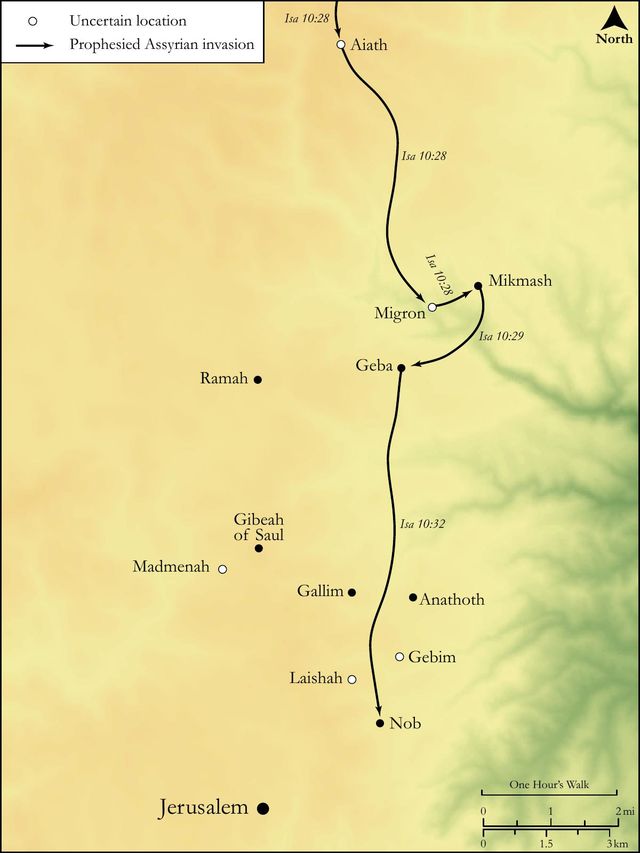
This verse is an integral part of a highly dramatic and prophetic section in Isaiah 10:28-32, often termed "The March of the Assyrians." Following Isaiah's pronouncement of divine judgment against Assyria for its arrogant self-exaltation (as seen in Isaiah 10:5-19) and a subsequent promise of a faithful remnant's return to the Lord (detailed in Isaiah 10:20-27), the prophet shifts to a harrowing, almost real-time portrayal of the Assyrian army's specific route of advance from the north towards Jerusalem. Isaiah meticulously lists a series of towns—Aiath, Migron, Michmash, Geba, Ramah, Gibeah of Saul, Anathoth, Madmenah, Gebim, and Nob—creating a palpable sense of relentless progression and increasing proximity to the capital. Each town's reaction, from hiding to panicked flight, serves to build unbearable tension, culminating in the army's arrival at Nob, a vantage point from which Jerusalem is clearly visible, poised for attack. This detailed itinerary emphasizes the immediate, tangible, and terrifying nature of the threat to Judah, leaving the audience with a profound sense of impending doom.
Historical & Cultural Context
The historical setting for Isaiah 10 is firmly rooted in the late 8th century BCE, specifically during the Assyrian King Sennacherib's devastating campaign against Judah in 701 BCE. After successfully conquering numerous fortified cities throughout Judah, Sennacherib turned his formidable attention towards Jerusalem, the capital. The towns enumerated in this passage, including Madmenah and Gebim, were likely small, unfortified settlements strategically located north of Jerusalem, directly along the most probable and direct invasion route from the north. Their extreme vulnerability and the ensuing panic of their inhabitants vividly reflect the typical and desperate response of the peoples of that day when confronted by a formidable and notoriously brutal invading army such as the Assyrians, who were infamous for their ruthless siege warfare, mass deportations, and terror tactics designed to break the will of their enemies. The flight of the inhabitants, though often a last resort and frequently futile, was a common survival strategy, as people sought refuge in larger, more fortified cities or hidden, inaccessible places. The geographical precision of Isaiah's prophecy would have resonated deeply and powerfully with his contemporary audience, who were either directly experiencing or had very recently endured the very real and existential threat of Assyrian aggression.
Key Themes
ShowHideIsaiah 10:31 significantly contributes to several profound themes woven throughout the broader book of Isaiah. Firstly, it powerfully illustrates the theme of Divine Judgment and Human Vulnerability. While Assyria is unequivocally presented as God's chosen instrument of judgment against Judah's pervasive sin and rebellion (as declared in Isaiah 10:5), the verse starkly portrays the immense human cost of this judgment through the vivid depiction of the panic, displacement, and suffering of the innocent inhabitants of these towns. Secondly, the verse dramatically highlights the Imminent Threat and Escalating Crisis facing Jerusalem, as the formidable enemy draws ever closer, causing widespread terror and profound disruption in the surrounding countryside. This escalating tension serves as a direct foreshadowing of the ultimate, climactic confrontation at Jerusalem itself. Thirdly, it subtly underscores the overarching theme of God's Sovereignty Amidst Chaos, as even the seemingly unstoppable and destructive march of Assyria is ultimately depicted as being under divine control, setting the stage for Jerusalem's miraculous and unexpected deliverance, a theme that becomes gloriously central in later chapters (e.g., Isaiah 37:36). The desperate flight from Madmenah and Gebim serves as a stark and poignant contrast to the divine promise of unwavering protection for Zion, which is a recurring message found elsewhere in Isaiah (e.g., Isaiah 31:5).
Exposition and Analysis
ShowHideKey Word Analysis
ShowHideThis primitive root (H5074) primarily means "to wave to and fro," but figuratively, it conveys the ideas of roving, fleeing, or being driven away. In this context, it powerfully describes Madmenah as being dislodged, unsettled, or forced into abandonment. It implies a violent upheaval, not a voluntary departure, reflecting the destructive and dislocating impact of the Assyrian advance on the town itself.
From the primitive root (H3427), meaning "to sit down," "to dwell," or "to remain." Here, it refers to those who normally reside or settle permanently in a place. The use of "inhabitants" emphasizes that these are the people whose established lives, routines, and homes are now being violently disrupted, highlighting the profound personal and communal impact of the invasion on their very existence.
This primitive root (H5756) means "to be strong" or "to strengthen," but causatively, it implies saving oneself by flight or retiring. The phrase "gather themselves to flee" vividly portrays a collective, desperate, and urgent movement of the people. It's not a calm, organized evacuation but a panicked scramble for survival, emphasizing the overwhelming fear and instinct for self-preservation that compels them to abandon everything they know.
Verse Breakdown
ShowHide"Madmenah is removed"
This clause signifies the complete disruption and effective abandonment of the town of Madmenah. The passive voice "is removed" powerfully suggests an external, forceful, and violent action, implying that the town is either literally destroyed, emptied of its population, or rendered uninhabitable by the relentless Assyrian advance. It conveys a profound sense of desolation and the immediate, devastating consequence of the approaching enemy's presence.
"the inhabitants of Gebim gather themselves to flee"
This second clause describes the active, albeit terrified, reaction of the people from a neighboring location, Gebim. Unlike Madmenah, which is passively "removed," the focus here is on the dynamic and desperate response of its residents. "Gather themselves to flee" paints a vivid picture of a hurried, collective exodus, driven by sheer panic and the primal instinct for self-preservation. It underscores the widespread fear and the desperate, urgent attempt to escape the advancing Assyrian forces before it is too late.
Literary Devices
ShowHideIsaiah 10:31 employs several potent literary devices to convey the overwhelming terror and chaos of the Assyrian advance. The most prominent is Vivid Description and Imagery, which paint a stark and immediate picture of chaos, displacement, and desperate flight. By naming specific, geographically proximate towns like Madmenah and Gebim, Isaiah utilizes Topographical Specificity to ground the prophecy in a tangible and relatable reality, making the threat feel intensely immediate and terrifyingly close to Jerusalem for his audience. The subtle yet powerful contrast between Madmenah being "removed" (a passive verb implying destruction or forced abandonment) and the inhabitants of Gebim actively "gathering themselves to flee" (an active verb implying panicked, collective movement) creates a sense of Parallelism in their shared fate of disruption, yet distinct responses, highlighting the pervasive and varied nature of the fear gripping the region. The entire passage (Isaiah 10:28-32) functions as a masterfully crafted Dramatic Narrative, meticulously building suspense with each town mentioned, leading inexorably to the climactic arrival at Nob, a strategic point just outside Jerusalem, from which the capital is visible and vulnerable.
Theological and Thematic Connections
ShowHideIsaiah 10:31 serves as a poignant and sobering reminder of human vulnerability in the face of overwhelming power, whether it be an earthly military might or the direct consequences of divine judgment. The panic, displacement, and desperate flight depicted here powerfully underscore the transient and fragile nature of earthly security and the ultimate futility of relying solely on human strength, fortifications, or strategic planning when God's sovereign purposes are actively at work. Theologically, this verse highlights the principle that divine judgment often begins at the periphery before reaching the core, demonstrating the pervasive and inescapable reach of God's wrath against sin, even when executed through human instruments like the Assyrian army. Yet, even in this scene of profound despair and chaos, the broader narrative of Isaiah reassures us that God remains utterly sovereign over all nations, empires, and historical events, ultimately using even the most fearsome and destructive forces to achieve His righteous and redemptive purposes for His chosen people.
Reflection and Application
ShowHideThe vivid imagery of Madmenah being "removed" and the inhabitants of Gebim desperately "gathering themselves to flee" resonates deeply with the universal human experience of fear, uncertainty, and the profound disruption of life. While we may not face a literal invading army at our doorstep, life often presents overwhelming threats—be they financial crises, debilitating health scares, relational breakdowns, societal upheavals, or personal losses—that can cause us to feel "removed" from our sense of stability or compel us to "gather ourselves to flee" from our comfort zones and familiar routines. This verse challenges us to profoundly consider where our ultimate security and refuge truly lie. Do we succumb to panic and attempt to flee in our own strength, or do we, like the faithful remnant in Isaiah's time, turn decisively to the Lord, who is our true, unshakeable refuge and strength? It calls us to examine the depth of our trust in God's unwavering sovereignty, even when circumstances appear chaotic, uncontrollable, and utterly overwhelming, reminding us that true and lasting peace is found not in the absence of external threat, but in the abiding and powerful presence of God Himself.
Questions for Reflection
ShowHideFAQ
ShowHideWhat is the significance of the specific towns mentioned in Isaiah 10:28-32?
ShowHideThe listing of specific towns like Madmenah and Gebim in Isaiah 10:28-32 is profoundly significant because it creates a vivid, terrifying, and almost cinematic sense of the Assyrian army's relentless and geographically precise advance towards Jerusalem. These towns were not random choices; they were strategically located north of Jerusalem, directly along the most probable and direct invasion route from the north. By naming them one by one, Isaiah makes the threat incredibly tangible and immediate for his contemporary audience, emphasizing that the enemy is not a distant rumor but an encroaching, inescapable reality. This meticulous detailing builds dramatic tension, showing the escalating panic and disruption as the army moves inexorably from town to town, underscoring the extreme proximity of danger to the capital and setting the stage for Jerusalem's ultimate confrontation and the miraculous deliverance that follows. It transforms a general threat into a terrifying, step-by-step reality.
Christ-Centered Fulfillment
ShowHideIsaiah 10:31, with its stark depiction of a people in panicked flight from an overwhelming and destructive enemy, finds a profound Christ-centered fulfillment in several interconnected ways. The terror, displacement, and spiritual vulnerability experienced by the inhabitants of Madmenah and Gebim powerfully foreshadow the universal spiritual condition of humanity under the dominion of sin and death, our ultimate and most relentless enemies. Just as the Assyrian army was, in God's providence, an instrument of temporal judgment, so too is sin a relentless oppressor that causes humanity to "flee" from God's holy presence and experience spiritual "removal" from His peace and life. However, Christ enters this narrative as the ultimate refuge, the Good Shepherd, and the divine Deliverer. He is the one who does not flee from these spiritual enemies but courageously confronts and decisively conquers them, offering true and lasting security to all who trust in Him. His coming, as gloriously prophesied in Isaiah 9:6-7, establishes an eternal kingdom of peace, justice, and righteousness where His people no longer need to "gather themselves to flee" in terror but can find eternal rest, safety, and an unshakeable dwelling place in Him. The miraculous deliverance of Jerusalem from Sennacherib, which historically follows this passage, serves as a powerful historical type of Christ's far greater and eternal victory over sin, death, and the powers of darkness, securing an eternal sanctuary for all who believe, as beautifully described in Hebrews 6:18 and Colossians 2:15. He is the one who compassionately gathers His scattered and terrified flock (like the inhabitants of Gebim) into His secure fold, becoming our strong tower, our everlasting dwelling place, and the fulfillment of the promise that no one can snatch His sheep out of His hand, as declared in John 10:28.