


Genesis 41:18
Bible text: King James Version (1769 Blayney text) · Public domain
Bible text: Berean Standard Bible · Public domain
Bible text: American Standard Version (1901) · Public domain
Bible text: World English Bible, Messianic edition · Public domain
Bible text: Geneva Bible (1599) · Public domain
Bible text: Young's Literal Translation · Public domain
- וְהִנֵּהve·hi·Nehand there!H2009Conj-w ¦ PrtParticle Interjectionוְandהִנֵּהthere!
- מִןminfromH4480PrepPreposition
- הַיְאֹרhay·'Orthe RiverH2975Art ¦ N-properNoun Proper LocationהַtheיְאֹרRiver
- עֹלֹת'o·Lot[were] coming upH5927V-Qal-Prtcpl-fpVerb Qal Participle Plural Feminine Absolute
- שֶׁבַעShe·va'sevenH7651Adj-csAdjective Numerical Singular common gender Absolute
- פָּרוֹתpa·RotcowsH6510N-fpNoun Plural Feminine Absolute
- בְּרִיאוֹתbe·ri·'otfat ofH1277Adj-fpcAdjective Plural Feminine Construct
- בָּשָׂרba·SarfleshH1320N-msNoun Singular Masculine Absolute
- וִיפֹתvi·Fotand good looking ofH3303Conj-w ¦ Adj-fpcAdjective Plural Feminine Constructוִandיפֹתgood looking of
- תֹּאַרTo·'arformH8389N-msNoun Singular Masculine Absolute
- וַתִּרְעֶינָהva·tir·'Ei·nahand they grazedH7462Conj-w ¦ V-Qal-ConsecImperf-3fpVerb Qal Consecutive Imperfect 3rd Plural Feminineוַandתִּרְעֶינָהthey grazed
- בָּאָחוּba·'A·chuamong the reed[s]H260Prep-b ¦ N-msNoun Singular Masculine Absoluteבָּamong theאָחוּreed[s]
English is a literal word-by-word gloss of the Hebrew, not the KJV's wording. Why?
This is the original text the KJV's translators worked from — each Hebrew word with its own literal English meaning in this verse, prepared by scholars at Tyndale House, Cambridge. The KJV translates whole sentences, not word by word, so its wording differs: one Hebrew word can become several English words, and the KJV may choose “the LORD” where the gloss reads “Yahweh”. Both are faithful — they answer different questions. For the KJV's own rendering, switch to the KJV text.
Details
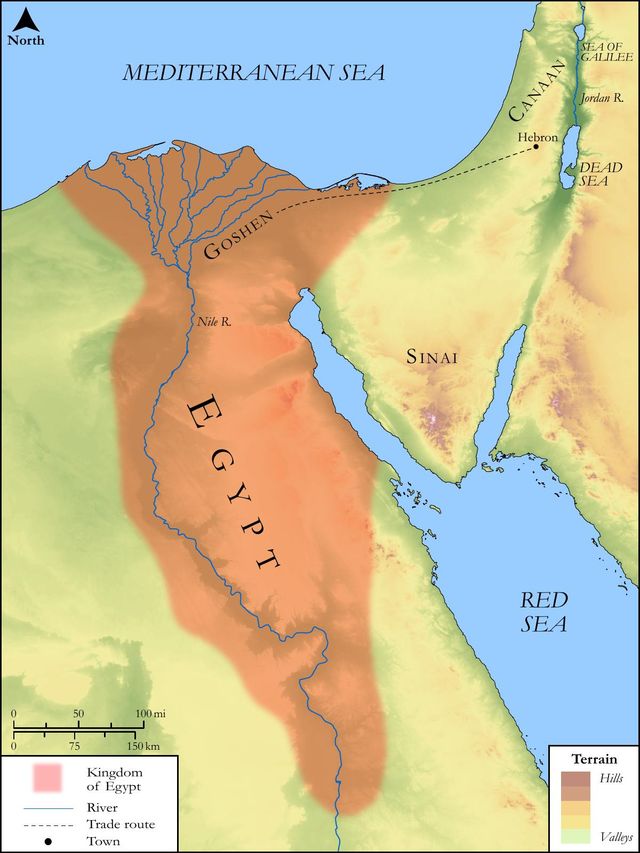
See on the biblical-era maps


Study this verse
Public-domain commentary
Matthew Henry
From his Commentary on the Whole Bible. Henry comments on passages, not single verses — this entry covers Genesis 41:17–32. His two-level outline is real structure in the source text, so it is rendered as structure.
Here, I. Pharaoh relates his dream. He dreamt that he stood upon the bank of the river Nile, and saw the kine, both the fat ones and the lean ones, come out of the river. For the kingdom of Egypt had no rain, as appears, Zac 14:18, but the plenty of the year depended upon the overflowing of the river, and it was about one certain time of the year that it overflowed. If it rose to fifteen or sixteen cubits, there was plenty; if to twelve or thirteen only, or under, there was scarcity. See how many ways Providence has of dispensing its gifts; yet, whatever the second causes are, our dependence is still the same upon the first Cause, who makes every creature that to us that it is, be it rain or river.
II.Joseph interprets his dream, and tells him that it signified seven years of plenty now immediately to ensue, which should be succeeded by as many years of famine. Observe,
1.The two dreams signified the same thing, but the repetition was to denote the certainty, the nearness, and the importance, of the event, Gen 41:32. Thus God has often shown the immutability of his counsel by two immutable things, Heb 6:17, Heb 6:18. The covenant is sealed with two sacraments; and in the one of them there are both bread and wine, wherein the dream is one, and yet it is doubled, for the thing is certain.
2.Yet the two dreams had a distinct reference to the two things wherein we most experience plenty and scarcity, namely, grass and corn. The plenty and scarcity of grass for the cattle were signified by the fat kine and the lean ones; the plenty and scarcity of herb for the service of man by the full ears and the thin ones.
3.See what changes the comforts of this life are subject to. After great plenty may come great scarcity; how strong soever we may think our mountain stands, if God speak the word, it will soon be moved. We cannot be sure that tomorrow shall be as this day, next year as this, and much more abundant, Isa 56:12. We must learn how to want, as well as how to abound.
4.See the goodness of God in sending the seven years of plenty before those of famine, that provision might be made accordingly. Thus he sets the one over-against the other, Ecc 7:14. With what wonderful wisdom has Providence, that great housekeeper, ordered the affairs of this numerous family from the beginning hitherto! Great variety of seasons there have been, and the product of the earth is sometimes more and sometimes less; yet, take one time with another, what was miraculous concerning the manna is ordinarily verified in the common course of Providence, He that gathers much has nothing over, and he that gathers little has no lack, Exo 16:18.
5.See the perishing nature of our worldly enjoyments. The great increase of the years of plenty was quite lost and swallowed up in the years of famine; and the overplus of it, which seemed very much, yet did but just serve to keep men alive, Gen 41:29-31. Meat for the belly, and the belly for meats, but God shall destroy both it and them, Co1 6:13. There is bread which endures to everlasting life, which shall not be forgotten, and which it is worth while to labour for, Joh 6:27. Those that make the things of this world their good things will find but little pleasure in remembering that they have received them, Luk 16:25.
6.Observe, God revealed this beforehand to Pharaoh, who, as king of Egypt, was to be the father of his country, and to make prudent provision for them. Magistrates are called shepherds, whose care it must be, not only to rule, but to feed.
Continue studying Genesis 41:18 across the web’s major study libraries — every link below opens this exact verse, chapter, or book on the destination site.
Read & Compare
 BibleGatewayThis verse in more than 200 translations and 70 languages.
 Bible.comThe YouVersion reader — hundreds of translations, reading plans, and highlights.
 ESV.orgCrossway's official English Standard Version reader.
 NET BibleThe NET translation with 60,000+ translators' notes on every rendering decision.
 STEP BibleTyndale House's free study tool — original text, vocabulary, and scholarly resources.
 BibliaLogos Bible Software's free web reader.
 USCCBThe New American Bible (Revised Edition) with the U.S. bishops' study notes.
Commentaries
 BibleHub CommentariesDozens of classic commentaries on this verse, gathered on one page.
 StudyLightMore than 100 commentary sets — the largest collection on the web.
 BibleRefPlain-English commentary on what this verse means, verse by verse.
 Enduring WordDavid Guzik's free commentary on this chapter, widely used by Bible teachers.
 Bible Study ToolsVerse commentary alongside Greek and Hebrew study aids.
Original Language & Research
- BibleHub InterlinearThe verse word by word — original language, transliteration, and English.
- BibleHub LexiconEvery word's original-language definition and Strong's entry.
 Blue Letter BibleDeep-study tools — Strong's numbers, concordance, and word studies.
 SefariaThe Hebrew text with Rashi and centuries of Jewish commentary.
Sermons, Hymns & Audio


TrulyRandomVerse is not affiliated with these sites and doesn’t control their content. They’re linked because they’re genuinely useful.
Summary
Pharaoh's first dream, as recounted by Joseph, vividly describes seven robust and healthy cows emerging from the life-giving Nile River to graze in a fertile meadow. This vision of abundant livestock and lush pasture serves as a divine prelude, setting the stage for God's revelation of a coming period of immense prosperity for Egypt, underscoring His sovereign control over natural cycles and His providential foresight in preparing nations for both seasons of plenty and subsequent hardship.
Context
ShowHideLiterary Context
This verse is embedded within the pivotal narrative of Joseph's rise to power in Egypt, specifically during his encounter with Pharaoh in Genesis 41. Joseph, having been unjustly imprisoned, is suddenly summoned to the royal court because of his God-given ability to interpret dreams, a skill previously demonstrated with the chief butler and baker in Genesis 40. Pharaoh, deeply troubled by two unsettling dreams, recounts them to Joseph. Genesis 41:18 is Joseph's faithful repetition of Pharaoh's exact words concerning the first part of his dream, emphasizing the initial vision of abundance before the subsequent, disturbing imagery of the lean cows. This careful recounting demonstrates Joseph's attentiveness and sets the stage for his Spirit-inspired interpretation, highlighting the divine origin of both the dream and its meaning.
Historical & Cultural Context
Ancient Egypt was an agrarian society whose very existence was inextricably linked to the Nile River. The annual inundation of the Nile brought fertile silt, depositing it across the floodplains, which was essential for crop cultivation and sustaining livestock. Without the Nile's life-giving waters, Egypt would be a barren desert. Therefore, the health and abundance of cattle, particularly those grazing in lush meadows along the river, were direct indicators of the nation's prosperity and well-being. Dreams were highly regarded in Egypt, often believed to be messages from deities. Pharaoh, as the divine king, would have placed immense significance on such vivid and troubling dreams, understanding them as omens or divine communications regarding the fate of his kingdom. The imagery of cows, the Nile, and meadows would have been immediately recognizable and deeply symbolic to an Egyptian audience, representing the core elements of their national prosperity.
Key Themes
ShowHideGenesis 41:18 contributes to several overarching themes within the book of Genesis and the broader biblical narrative. Firstly, it powerfully illustrates Divine Sovereignty and Providence, demonstrating God's active involvement in human history, even in the affairs of a pagan king and nation. God reveals future events to Pharaoh, not for Pharaoh's sake alone, but as part of His grand plan to preserve His covenant people, Israel, through the coming famine (Genesis 45:7-8). Secondly, the verse highlights the theme of Wisdom and Discernment, as Joseph's God-given ability to interpret the dream is the key to understanding and responding to God's revelation. This divine wisdom, rather than human ingenuity, is presented as the true source of effective leadership and stewardship (Genesis 41:38-39). Finally, the initial vision of abundance sets up the theme of Preparation and Stewardship, as the years of plenty foreshadow a period that requires careful management and foresight to mitigate the impact of the subsequent famine, a principle applicable to all seasons of life.
Exposition and Analysis
ShowHideThe verse "And, behold, there came up out of the river seven kine, fatfleshed and well favoured; and they fed in a meadow:" presents the initial, positive imagery of Pharaoh's dream, as recounted by Joseph.
Key Word Analysis
ShowHideThis feminine noun refers to a "heifer" or "cow." In the context of Pharaoh's dream, it signifies common cattle, which were vital for agriculture, labor, and sustenance in ancient Egypt. Their appearance from the river points to the Nile as the source of life and fertility for these animals.
This phrase combines H1277 (bârîyʼ) and H1320 (bâsâr). H1277 means "fatted or plump," indicating a state of being well-fed, firm, and plenteous. H1320 refers to "flesh" (from its freshness) or "body." Together, "fatfleshed" vividly describes animals that are robust, healthy, and in prime condition, symbolizing a period of great abundance and prosperity for the land.
This word refers to a "bulrush or any marshy grass," particularly that found along the Nile. It denotes a lush, fertile grazing area, reinforcing the imagery of a land rich in resources and capable of sustaining abundant life. The presence of the cows feeding in such a meadow further underscores the idea of natural bounty and flourishing.
Verse Breakdown
ShowHide"And, behold, there came up out of the river"
This opening phrase immediately draws attention to the source of the animals—the Nile River (Hebrew: yᵉʼôr, H2975). The verb "came up" (Hebrew: ʻâlâh, H5927) suggests an emergence or ascent, highlighting the miraculous or divinely orchestrated nature of their appearance. The Nile, as Egypt's lifeblood, is thus established as the origin of the prosperity symbolized by the cows.
"seven kine"
The number "seven" (Hebrew: shebaʻ, H7651) is numerically significant in biblical contexts, often symbolizing completeness, perfection, or a full cycle. Here, it denotes a complete period of abundance. "Kine" (Hebrew: pârâh, H6510) refers to cows or heifers, representing the livestock and agricultural wealth of the nation.
"fatfleshed and well favoured"
This descriptive duo emphasizes the prime condition of the cows. "Fatfleshed" (Hebrew: bârîyʼ bâsâr, H1277 + H1320) denotes their physical health and robust state, signifying a period of great material prosperity and ample resources. "Well favoured" (Hebrew: yâpheh tôʼar, H3303 + H8389) literally means "beautiful of appearance" or "comely in form," underscoring their pleasing and ideal state, reinforcing the vision of flourishing and blessing.
"and they fed in a meadow"
The act of "feeding" (Hebrew: râʻâh, H7462) implies grazing or pasturing, indicating a natural and sustained state of nourishment. The "meadow" (Hebrew: ʼâchûw, H260) points to the lush, fertile lands along the Nile, providing abundant sustenance. This final clause completes the picture of a land blessed with natural bounty, where livestock thrive effortlessly, symbolizing a time of peace and prosperity.
Literary Devices
ShowHideThe verse is rich in Imagery, painting a vivid picture of health and abundance. The description of "fatfleshed and well favoured" kine emerging from the "river" and feeding in a "meadow" appeals directly to the senses, allowing the audience to visualize the lushness and prosperity. Symbolism is central to this dream. The "seven kine" symbolize seven years of agricultural abundance and national prosperity, directly linked to the life-giving "Nile River." The "meadow" symbolizes the fertile land, capable of sustaining such bounty. This initial vision serves as Foreshadowing, setting up a stark contrast with the subsequent vision of the lean cows, which will symbolize the coming years of famine. The dream's structure, presenting a positive image followed by a negative one, employs Juxtaposition to highlight the dramatic shift in Egypt's future.
Theological and Thematic Connections
ShowHideThis initial vision from Pharaoh's dream profoundly illustrates God's sovereign control over creation and His providential care for humanity. Even in a pagan context, God reveals His plans, demonstrating that His dominion extends over all nations and natural processes. The imagery of abundant, healthy livestock emerging from the Nile underscores God's ability to provide immense blessing and prosperity, often through natural means, as part of His larger redemptive purposes. This divine foresight is not merely for warning but for the opportunity of wise stewardship and preparation, ultimately serving to preserve His chosen people, Israel, through Joseph's leadership.
Reflection and Application
ShowHidePharaoh's dream, as recounted by Joseph in Genesis 41:18, offers profound insights into God's character and our response to His providence. It reminds us that God is actively involved in the affairs of the world, revealing His plans and purposes even to those who do not know Him, for the ultimate good of His people and the advancement of His kingdom. The initial vision of abundance calls us to recognize and be grateful for seasons of blessing and prosperity, understanding them as gifts from God. It also underscores the importance of wise stewardship during times of plenty, preparing for future challenges, just as Joseph advised Pharaoh. We are encouraged to seek God's wisdom and discernment in all circumstances, trusting that He will provide what is necessary for us to navigate both the "fat" and "lean" seasons of our lives, always working for our ultimate good and His glory.
Questions for Reflection
ShowHideFAQ
ShowHideWhat does "kine" mean in this verse?
ShowHide"Kine" is an archaic plural form of "cow" or "heifer." In Genesis 41:18, it refers to the seven healthy female cattle that Pharaoh saw in his dream. The Hebrew word used is pârâh (H6510), which specifically denotes a cow.
Why is the Nile River so central to Pharaoh's dream?
ShowHideThe Nile River was the absolute lifeblood of ancient Egypt, making it a fitting and culturally relevant symbol for divine communication to Pharaoh. Its annual floods deposited fertile silt, essential for agriculture, and provided water for irrigation and sustenance for livestock. The health of the Nile directly correlated with the nation's prosperity and survival. Therefore, the cows emerging from the Nile naturally symbolized the source of Egypt's abundance and the state of its agricultural well-being, indicating that the coming years of plenty, and subsequent famine, would be directly tied to the river's bounty.
Christ-Centered Fulfillment
ShowHideThe narrative of Joseph's interpretation of Pharaoh's dream, beginning with the vision of the "fatfleshed and well favoured" kine, powerfully foreshadows Christ's redemptive work. Joseph, by interpreting the divine revelation and guiding Egypt through years of both abundance and devastating famine, serves as a profound type of Christ. Just as Joseph, through God-given wisdom, became the deliverer who saved a nation and many peoples from physical starvation (see Genesis 45:5-8), so Christ is the ultimate Provider and Sustainer, offering spiritual nourishment and eternal salvation to all who believe. He is the one who perfectly interprets the divine will of God the Father (as seen in John 1:18), and through His wisdom, prepares His people for all seasons of life, ensuring their ultimate well-being and leading them through the "fat" and "lean" years of this world to an everlasting abundance in His glorious Kingdom (John 6:35 and Philippians 4:19).